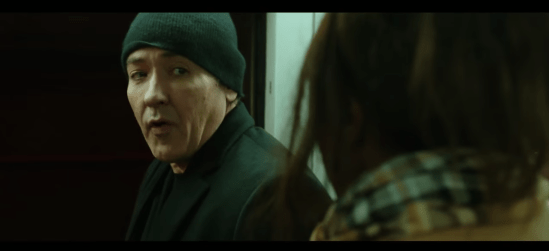
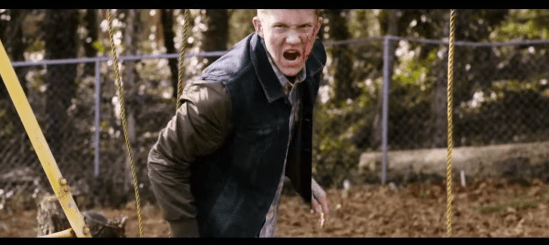
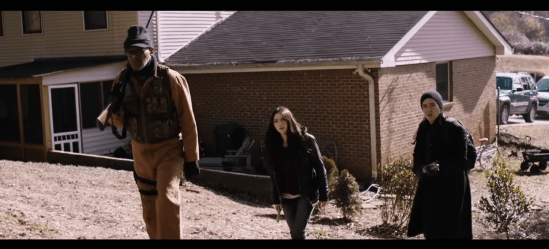
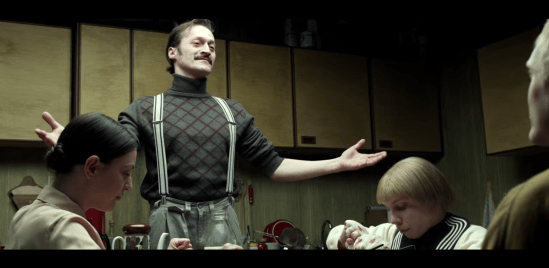
Jessica is plagued by recurring horrific and lucid nightmares of a horse-headed figure that brings death to her dreams. When she has a nightmare about her grandmother being impaled to death by the horsehead monster, she’s immediately phoned by her mother Catelyn informing Jessica that her grandmother has passed away. Jessica travels to the family’s countryside estate for the funeral and is welcomed by her stern mother. Jessica’s nightmares worsen the first night and she becomes trapped in her own dreams as she can feel the haunt of the horse-head figure in the corner’s of her mind. When Jessica soon realizes that her’s grandmother’s death and her mother’s cruelty might be more involved and connected with the horse-head creature, she attempts to stay in a semi-conscious sleep state to puzzle together the mysterious pieces and to control her nightmares once and for all.

The freshman feature film from Romain Basset contains such promise and maturity and Basset shows daring courage to create a horror-fantasy of this caliber thats very aesthetically symbolic and worthy of being awarded qualities of early Dario Argento’s films with intensive surreal and haunting facets. “Horsehead” embodies the character Jessica’s head in creating and blending an atmospheric jigsaw and visceral puzzle of a world while being a mirror in which you can glance back into time, far back beyond your own existence. “Horsehead’s” unique tribute blend contains the bizarre and frightening worlds of Tarsem Singh’s 2000 film “Cell” intertwined with one’s life story similar to the past and present tales of “A Christmas Carol” with Ebenezer Scrooge. However, Jessica’s past is much more dark and grim than Scrooge’s will ever be and her future won’t end in her being generous and kind to a crippled poor boy named Tiny Tim.

Certainly a visually stunning film, “Horsehead” tries turn the mind on it’s end, leaving the suspended muscle dangling near the edge of insanity. Jessica’s reality becomes no more real than her nightmares as the horse-headed monster is has comparable dream-bending qualities to the the same effect as Freddy Krueger of “A Nightmare on Elm Street” but “Horesehead” is a lot more gothic and whole lot less sarcastic than the fedora sporting child murderer. The creature has haunted Jessica’s lineage for at least three generations, presumably starting with her late grandmother and is a symbol of Jessica’s strict-bible-following grandfather who becomes the epicenter of all the family’s issues. Her dreams hold a dark mystery to her family’s continuous cycle of troubles and use horrific symbolism to express, in stages, the truth behind their ancestral secrets.

As much as I love the symbolism in this film, I’m worried about the psycho-sexual portion the film markets, splashed as a tagline right on the Blu-ray cover. Yes, the once little girl from Robert De Niro’s “Ronin” actress Lilly-Fleur Pointeaux does become involved briefly in highly sexual situations in her electric dance music soundtrack nightmares in a down the rabbit hole type of situation, but really serve no purpose to Pointeaux’s character in reality because no much is conveyed except for her profession as a dream psychologist and she has quarrels with her mother, especially on why her mother refuses to informer on the identity of her father. Gala Besson, who plays a younger version of Jessica’s grandmother, also briefly bares skin for a more gruesome and twisted scene that would make Pinhead smile with such pleasure. Perhaps the psycho-sexual scenes stem from the heavily implied incest relationships in the story between father and daughter, sister and sister, and mother and daughter. If incest is the answer to my question on why the film blatantly markets psycho-sexual, than the taboo subject matter makes “Horsehead” that much more risque and that more interestingly ambitious, creating a film that’s hard to swallow and shocking to behold when put into that perspective. Some dream interpreters believe that being chased by a white horse, in which case the horse-headed creature is of off-white color, may represent chaste or having issues with intimacy. This might explain some of Jessica’s unusual sexual scenes in her dream sequences involving relatives.

You might recognize a name from the past in the Italian horror genre: Catriona MacColl, an United Kingdom actress who portrays Jessica’s uptight mother Catelyn. MacColl is best known for her early 1980’s rolls in the Lucio Fulci films “The Beyond,” “City of the Living Dead,” and “House by the Cemetery.” With MacColl and Pointeaux’s as the overpowering female characters, “Horsehead” rounds out with weak male characters such as Jessica’s stepfather Jim, played by Murray Head, and an estate servant George, played by French acting vet Vernon Dobtcheff.

Overall, “Horsehead” delivers solid acting, dons great editing, and has better than average makeup and effects making “Horsehead” a winning release, yet again, for Artsploitation Films. The Blu-ray release is perfectly graced with a stunning 2.35:1 widescreen transfer with a 5.1 Dolby Digital mix, evenly balanced with appropriate LFE during the EDM nightmares. The picture is quite clear with some digital noise interference but only on some minor facial closeup scenes and no damage on the prints. Even though “Horsehead” is a French film and most of the cast is French, the movie is in English and it’s not dubbed English either. Bonus features also include “Inside Horsehead Making of” and four short films that have a total runtime of 81 minutes – a movie in itself.
Tag Archives: blu-ray
Cross-Dressing, Katana Wielding Evil! “Der Samurai” review!
In a small German village, Jakob, a police officer, encounters a blonde cross-dresser wielding a samurai sword who reeks havoc throughout the village. Before Jakob can make an arrest, the decapitating murderer quickly vanishes and reappears during random points of the night. Jakob soon realizes that this cross-dresser killer has more in store for Jakob who, before the strange encounter, struggled to remain above the water living in a town that doesn’t seem to want him there. Does this dangerous individual hold to key to the answers of Jakob’s questions or is he just a mental head case wielding a katana for the fun of it?

“Der Samurai” is certainly an interesting piece of German cinema that’s difficult to follow, but if you dig deep and look closely into the bones of the film, a glimpse into the personal life of our hero Jakob and his conquering of personal struggles is clear to the mind’s eye through the interpretation of writer and director Till Kleinert in his sophomore film. Jakob, portrayed by Michel Diercks, doesn’t quite fit in in his small hometown village; he has no outside life as he spends his every waking moment taking care of his grandmother when not on official police duty, his boss is constantly degrading him, and the town doesn’t respect his job given authority. While he struggles through these life issues, his work obsession becomes with a wolf that has been sited in the village. Since nothing ever happens his his small village, the wolf is the most interesting thing ever to happen as far as crime goes.

The wolf is hardly seen throughout the movie except for a few brief sightings and up until near the end and the reason for that is the katana wielding, cross-dressing maniac Jakob happens upon. The cross-dressing psychopath, played by Pit Bukowski, is a representation of the wolf and the wolf represents the epic struggle in Jakob’s pitiful life. If he can overcome the epic struggle, then he’ll be free of all the insecurities that have burdened to him and dished out by his insincere village folk. However, the quest to best the manic isn’t going to be easy and will be bloody.

With a title like “Der Samurai,” there will be blood, but the production crew had to use cheap tricks to make the realistic violence work and work well. These cheap tricks were very well done and certainly didn’t look phony or cheesy on screen. The effects are also very experimental and up for interpretation. At one point when a character is decapitated, a spectacular display of blood and fireworks skyrocket out of the neck as a sort of spirtual release for the poor headless character. Experimental and up for interpretation, just like the androgynous character that Pit Bukowski portrays. What kind of sexual desires are being explored here between Jakob and the maniac? At first, I thought maybe Jakob was the maniac due to his boss questioning Jakob on the phone that he might be dressed up and wielding a katana and when his grandmother, in a frightened state, claims that the person tending to her was not her grandson when clearly it was Jakob tending to her. This all changes when other police officers and town folk also see the cross-dresser, putting to defunct the speculation that Jakob was this cross-dresser.

Artsploitation Films brings to Blu-ray home video “Der Samurai” and we’re lucking to have a film like this to be available now in America. However, the 1080p widescreen 1.85:1 transfer isn’t up to the Blu-ray quality one would think. There lies a lot of grainy noise interference, perhaps to the low lighting provided for the film as much of duration is shot in the dark. Didn’t look like to me that there was any digital noise reduction used to smooth out the specks. The Dolby Digital 5.1 German dialogue with English subtitles is flawless and all the subtitles sync up well with the characters’ dialogue. Bonus features include a commentary with director Till Kleinert and Producer Linus de Paoli, a theatrical trailer, and a behind the scene featurette that is actually worth looking into as much of the background and backstory is explained. I’d recommend this German horror to all to experience and, to put the cherry on top, you’ll get to see an erect penis! Enjoy!
The Mold Knows Evil. The Mold Knows! “Motivational Growth” review!
Ian Foliver is a pessimistic, depressed, and reclusive young man with a touch of agoraphobia. When his best friend, an old Commodore tube Television named Kent, bites the bullet with a busted boob-tube tube in his unkept apartment, Ian determines that life is no longer worth living because that television named Kent was his only friend, his only ray of daily sunshine and that life-worthy activity had just suddenly died. Feeling that life is no longer worth living, Ian gathers up household chemical products and decides to gas himself to death in his bathtub, but when trying to clog the bathroom air vent, he slips and falls landing on his head. When he wakes up, Ian is face-to-face with a growth of conversing mold. The Mold, as it refers to itself, wants to help Ian – clean up his apartment, shave and bathe, and attract the attention of his attractive next door neighbor who Ian stalks and ogles daily through his front door peephole. In return for this helpful motivation to live, The Mold demands that Ian follows The Mold’s precise instructions which might not be as helpful as Ian first thought.

The Don Thacker directed dark comedy is a surreal voyage into the internal life struggle of Ian Folivar, played beautifully by Adrian DiGiovanni, who directs his own downward situation making the audience part of Ian’s life. Ian is a character that is aware of his flaws but can’t accept his life and his analysis is that “life is shit” and is dangerous so shutting himself in his small apartment fairs way better than living the conventional life. “Motivational Growth” shares commonalities with prior cult favorites; one of those favorites is the Peter Hyams directed and John Ritter starring film “Stay Tuned” to where Ian becomes sucked into eccentric television programs he was viewing before Kent blew a fuse. Also, another cult favorite film, Don Coscarelli’s “John Dies at the End,” which shares that wacky fantastics of dark and ironic situations. All three of these dark comedy romps are in a small, rare genre group that dares to be different and do well at it.

The Mold is an unique, life-like creation of filth that can actually make you feel the fungi-filled griminess lying within between the nooks, crannies, and crevices of your body. A job well done by Thacker and his The Mold puppetry team led by special effects supervisor Steve Tolin of TolinFX. They really did an amazing job creating a practical effect living-being that works in sync with the iconic voice of Jeffrey Combs whose voice fits as The Mold’s persona – confident and inspirational with a hint of cynicism. The interactions between Ian and The Mold becomes symbiotic where Ian needs The Mold to rejuvenate his depressed life back to order and back to the land of the living while The Mold needs Ian to fulfill it’s inauspicious desires for Ian’s “well-being.” When Adrian DiGiovanni interacts with The Mold, he’s interacting with an actual character in the room and not a hokey-hapless effect. You have to hand it to DiGiovanni in forming a believable dialogue and relationship between himself and an inanimate object such as the lowest scum, excuse me – fungus, on Earth.

What I adore about “Motivational Growth’s” plot is the mysterious time period that it’s set in as many references point to the late 1980’s to the early 1990’s with the video game imagery, the television personalities, and the hairdos and clothing lines of characters in Kent’s hosted top shows Ian mindlessly views. Ian, himself, is stuck in time not knowing what a Plasma TV was which would fall right in line with the time frame above since Plasma’s didn’t start rolling around until the mid 90’s. I also like the peculiar characters Ian encounters even though his setting his solely set in his cramped apartment. Box the Ox, played by the intimidating Pete Giovagnoli, pinpoints his character perfectly as a seemingly overbearing, yet somewhat absent and simple minded, landlord who threatens Ian with off-the-wall metaphors, thus making him fun to watch and see how Ian attempts to interact with Box until Box cuts him off all the time even if Ian is provoked with a question by Box the Ox. Ken Brown as Plasmoday is by far my favorite. With a creepy face and creepy mannerisms, Plasmoday had too short of a role and I thought he would make a return to Ian’s abode to lick his TV again, but in the character’s short amount of screen time, Brown is able to up-play the oddity that embodies Plasmoday with such passion that it’s hard not to love the character.
“Motivational Growth” molds itself into greatness amongst cult movies. The nitty-gritty portions are grossly stimulating and will sure to have you jump in the shower for a quick rinse. Whether or not Ian is suffering from brain trauma, purgatory, or just to awake to a nightmare scenario, the story is left open for interpretation, giving the audience a chance to determine the ending for themselves which is always fun in my little black book. The MVD Blu-ray is spectacular technically. Super clear with no disturbances in the transfer. The Hi-resolution downplays the obvious practical effects on The Mold but that only brings more charm to the film. The sound is clear and the extras are plentiful. I’d suggest “Motivational Growth” to anyone – even to a neat freak with cleanliness issues.
Evil on the Quick Draw! “Day of Anger” review!
In the quiet western town of Clifton, Scott is the naive town fool. As a simple bastard of a prostitute, Scott grew up without a place in Clifton and without knowing who fathered him and is belittled. Scott is only good for is taking up sweeping outside homes, taking care of the horses, and collecting the residential human waste for disposal in order to earn a better living for himself. But That all changed when Frank Talby rode into town. The infamous gunslinger takes the adoring Scott under his wing and turns the town fool into Talby’s right hand gun for hire, making Scott a fast drawing force in Clifton. When Talby takes the reigns over the town of Clifton, Scott doesn’t pity those who mistreated him as Talby turns the disrespectful rich into the town fools, but the one man that cared for Scott is the one man Talby hates the most from his past and Scott must choose between his long time mentor or his newly found idol when the two showdown.
This is a first; a spaghetti western review on Its Bloggin’ Evil! But I just love the genre with the rich story lines and colorful dialogues and dynamics between characters. The genre never becomes dull, the desert stricken west never looks unbearable on screen, and, just like that Seth MacFarlane movie, there are certainly are a million ways to die in the west. Director Tonino Valerli’s “Day of Anger” fits the bill for the Italian Western genre. Also entitled “Gunlaw” or “I giorni dell’ira,” Rome born Giuliana Gemma stars as Scott Mary to make this an authentic spaghetti western and genre veteran, and overall on screen bad guy, Lee Van Cleef, who you may recognize form “The Good, The Bad, and The Ugly,” as the downright mean snake Frank Talby.
The story directly sets up Scott as this blundering idiot, but if you watch closely during the progression of the character, Scott is written with easter eggs showcasing him as being quick, agile, and strong. With Talby schooling him on how to be a gritty gunslinger, Scott is well on his way to being what he always idolized and instead of being the town joke, the town fears him. This is also where the script becomes a bit of enigma because you want Scott, the fool, to be respected by the people of Clifton. Yet, the people still don’t respect Scott and only fear him because he’s becoming like the ruthless Talby who the town folk despise. Giuliana Gemma does a fine job at portraying the nitwit part of Scott, but not so much the quick draw, new and improved Scott. Gemma made the character growth too easy and didn’t sell it properly to have Scott earn the right to be tough.
Lee Van Cleef, on the other hand, is damn nasty. The natural look of undermining and deceptiveness with power and brutality just can’t be undone in any project Cleef undertakes. The character Talby is formidable, cutthroat, and smart and Cleef plays those qualities to the exact tune. Scott is severely overshadowed by Talby making Cleef more of the stud as the “Day of Anger” headlining actor than Giuliana. Giuliana had some success in the niche genre under the pseudo name Montgomery Wood, maybe because it sounded more American or more Hollywood, but when death came for the genre, so did it for Gemma’s lucrative Italian career. Overall, both male leads are not hindered by a female love interest. “Day of Anger,” from start to finish, only contains a handful of scenes were women become prevalent.
The Arrow Film’s Blu-ray released from MVDVisual is quite awe-inspiring sharp with a beautifully brilliant picture that is presented in it’s original aspect ratio 2.35:1 format from the transfer of the original negative. The long range shots of the desert are unbelievable with the 1080p transfer. The contrasting colors amongst the town of Clifton organically bring the town to life, constructing a seemingly realistic town rather than a stage or a set. The audio comes in three soundtrack options: English (longer cut of the film), Italian (longer cut of the film), or English (shorter international version). The Riz Ortolani soundtrack really stands out clearly and firmly but not in annoying overbearing style that doesn’t sync with the film or with the characters’ dialogues. There are a few high frequency pops during a couple of transitional scenes, but these won’t distract from the amazing film. This Region A and B Blu-ray is absolutely stunning with loads of extras just waiting to be experienced. MVD and Arrow Film’s Blu-ray version of “Day of Anger,” the first time on Blu-ray anywhere in the world, would be a fine piece for anybody’s western collection.
Shout Factory Brings “Destroyer” Back to Life!
Some exciting news coming out of the ever-glorious Scream Factory, aka Shout Factory, company and that is 1988’s “Destroyer” with Anthony Perkins from “Psycho.” The incredulous film will pari with another 1988 film – Scarecrows. The double feature will hit blu-ray in 2015!
A prison riot breaks out at the moment of a serial murderer’s execution by electrocution, and his fate becomes indeterminate when the prison is shut down. 18 months later, a team of filmmakers converge on the prison to film a women-in-prison exploitation flick, but find that a certain somebody is disrupting their shooting schedule…