
EVIL’s One Brush Stroke Away From Losing It! “Spiral” reviewed! (Ronin Flix / Blu-ray)

The New “Spiral” Now on Blu-ray!

Mason, a socially awkward painter and car insurance telemarketer, struggles to cope with a seemingly bad breakup that might have turned into a misdeed, but a quick call to his only, childhood friend Berkeley helps keep his anxious emotions from spiraling out of control into nightmarish allusions.  As Mason gradually works to purge his previously relationship, a woman who was also his inspiration for his artistic work, he suddenly meets Amber, a new amiable hire in his company, sitting with him on his lunchbreak outside bench.  Amber’s able to slowly break down Mason’s guarded wall of insecurity and two begin an innocent, romantic relationship as Mason continues to push his haunting past aside for Amber to fully step into being his modeling muse, but the further imbed she becomes into his life the more enigmatic secrets are revealed surrounding Mason’s life, even the darkness that slowly spreads and loops into it.

Actor Joel David Moore had established himself as an actor in early 2000s, usually portraying the lanky, awkward, if not ungainly trope in comedies most notably in “Dodgeball” and “Grandma’s Boy,” playing a supporting protagonist as well as lead antagonist.  Director Adam Green quickly became an overnight success amongst genre fans with his release of the Cajun miscreant slasher in “Hatchet” that would spawn a pair of sequels.  Having worked as actor and director respectively on “Hatchet,” Moore and Adam became good friends and decided to take a step further to not only expand upon an acting career and expand upon the objectivity of storytelling but also to co-direct their next project entitled “Spiral.”  The script, that orbits around the romantic-psychological thriller purview, is cowritten between Moore with debut feature writer Jeremy Boreing.  The 2007 film revolves around and enters the disconnected mind of an emotionally compromised individual and how he copes and handles everyday life while in constant fear.  “Spiral” is executively produced by Moore and costar Zachary Levi along with Boreing, David Muller, Kurt Schemper and Cory Neal producing under the Balcony 9 and ArieScope Pictures production flag.

If you haven’t gathered already, “Spiral” is Joel David Moore’s baby.  Moore’s idea natural earmarked him as the executive producer and the project is the first to land him a directorial and a writer credit, so unsurprisingly, the role of the socially recluse and mentally scarred Mason went to the Portland, Oregon born actor, likely a role he wrote with himself in mind.  As Mason, Moore breaks the mold that has trapped him in previous films that were relegated to what producers might have considered not leading man material, leaving much to be desired when stuck in a second of third string supporting role.  Then Adam Green puts Moore in “Hatchet” and in the principal protagonist role.  The opportunity proves Moore had more than just comic, sidekick relief and he really cements Mason’s depth with ticks, tantrums, and a taste for tenterhook romance.  Meeting Mason in the ambiguous opening stirs internal conflict for how we’re supposed to receive this hyperventilating wailer confessing to something vile we’re not privy too just yet.  From there, we meet the philandering, go-with-the-flow, and Mason’s best bud, only friend at that, Berkeley (Zachary Levi, “Shazam!) and the quirky cute and Mason-eyer Amber (“Amber Tamblyn, “The Ring”) that develop upon Mason’s home-work relationship that highlight his interests – painting and jazz – as well as his disinterests – basketball and speaking about his past.  The very opening scene compared to the heart of much of the story has stark contrast and, so much so, that audiences will tend to forget Mason’s late-night phone call ramblings and fear to his friend Berkeley, his wake-up screaming nightmares to wear he looks at his hands for blood, and his overall highly anxious persona when he’s talking shop and girls with Berkeley and breaking out of his shell of solitude with Amber in a lengthy string of normalacy.  Ryan Chase, David Muller, Annie Neal and Lori Yohe fill out the cast.

“Spiral” is all about the trauma, a fiercely common theme inside the heads of the mental thriller subgenre.  With deeply troubled lead character, an at interval switchboard that lights and darkens between the protagonist and ambiguous antihero storyline, watching Mason grow, fall, grow, fall, grow, and then finally collapse in a heap of his own trauma is terrifyingly satisfying, mostly to the thanks of Moore’s added plummeting nuances that spit his character back into abnormality.  Mason’s arc circulates in a circular pattern and the evidently timebomb is ticking away but in the middle of that circulation forms a bond, a friendship, an affair, hope, compassion, and every affirmative adjective you can think of to bring happiness to what shouldn’t be a happy trajectory because in the back of our minds, darkness lies.  That’s the sublayer of this trauma-laden yarn with a repressive factor and the key to unleash years of pent up unlocks a whole new side of Mason, one that isn’t completely illuminated upon until the shocking, device-destroying end.  

Ronin Flix rekindles Joel David Moore and Adam Green’s “Spiral” back to Blu-ray with an AVC encoded, 1080p resolution, BD50. Comparatively to the Anchor Bay 2010 Blu-ray release, which also presents the film in a widescreen 1.78:1 aspect ratio, Ronin Flix edges out the now decade previous release but not by much. The back cover only notes the label went through a film restoration with no other details or specifics to elaborate but from a spectator’s view, the 2024 restoration handles a sharper delineation that provides excellent depth that plays key to the various scenes of Amber and Mason’s painting sessions, Mason’s guilt-ridden obsession with the bathroom door, and Mason’s overhead cubicle viewpoint to name a few examples. Details are much more specific in brighter, ambient-lit scenes than the darker shades of key lighting or night sequences not only because of the innate lack of illumining exposure. Blacks tend to crush slightly, bleeding in the details and washing them out in blank of black. Skin and textures particularize better on Ronin Flix’s upgrade that uses a newer codec for compression, elevating the elaboration for this under-the-radar indie. The English DTS-HD Master Audio 5.1 manages the lossless mix much in the same was as Anchor Bay’s with greatly clear articulation on the forefront, a spacious and spatial ambient track, a patterned sound design dynamic to the progression, and a supporting soundtrack that while isn’t overly worthwhile does aid the varying moods, especially when Mason turns on a dime intertwined with jazz brass. Decent sound diffusion through the back and side channels to harness surrounding elements while the fronts tackle the predominant dialogue until an occasion acousmatic turns our heads and our attention. English subtitles are available for selection. The static menu offers special features that includes exclusive content, such as a newly put together making-of “Spiral” entitled Paint it Red, an audio commentary with Adam Green and Joel David Moore, director of photography Will Barrett, and editor Cory Livingston an a behind-the-scenes documentary featurette with interviews from Green, Moore, Livingston, Barrett and co-star and producer Zachary Levi. Archival content includes an audio commentary with the co-directors, director of photography, Levi, writer Jeremy Boreing, and actress Amber Tamblyn, and rounds out with the theatrical trailer. A cardboard O-slipcover sheathes the Blu-ray Amaray case and both contain the same more-gruesome-than-it-really-is cover art and David Levine package design. Inside the case is just the disc pressed with a third copy of the hand dripping blood, or paint. Ronin Flix release is rated PG-13 for disturbing behavior, violence, some partial nudity and language, has a runtime of 91 minutes, and also unlike the Anchor Bay release, this release has region free playback.

Last Rites: “Spiral” paints Joel David Moore in a whole new light, colored in vague tones that just nip at nerves, and slaps you square in the face just when things start to feel warm, cozy, and safe.

The New “Spiral” Now on Blu-ray!

The EVIL is Inside Me! “Nightmare Man” reviewed! (Ronin Flix / Blu-ray)

“Nightmare Man” Is Here To Haunt Your Dreams in High-Definition!  Blu-ray Available at Amazon.com

To channel mystical help with her and her husband’s fertility issues, Ellen purchases a mask from overseas that supposed to provide fruitful results.   Instead, Ellen is plagued by nightmares of a demon figure, forcing himself onto her with a maniacally grin.  Diagnosed a paranoid schizophrenic and on medication to dilute the vivid dreams, Ellen’s husband chauffeurs her to the mountain isolated Devonshire Institute to commit her for treatment, but when the car runs out of gas and her husband ambles for gas, Ellen finds herself alone in the car at night and with the nightmare man lurking outside,   Escaping barely with her lift now that the physical form of her tormentor is no longer just in her dreams, Ellen takes refuge with a pair of couples celebrating an engagement party.  Rambling erratically about an entity no longer inside her, a debate between the group of friends question Ellen’s sanity until the nightmare man shows up and slaughters anyone in his path, but the party’s just beginning when another killer has been freed from suppression.

Pivot stories are the best!  The investments into a foundation roots a focus, provides a clear understanding of the forthcoming, and can be, for better or worse, an expectation of narrative structure.  What happens when a monkey wrench is thrown into the story and completely bends the storyline at a 90-degree angle onto another totally unexpected path?  Some would be too jarred by the jerk toward another direction, coming out of the film with a severe case of whiplash that joggles and boggles the mind, while others, like myself, would find a refreshing phoenix out of the tired ashes of a stale genre and welcome it with open, grateful arms to keep my rear-end sewn to the couch and eyes glued to the television to see what happens next!  Writer-Director Rolfe Kanefsky (“There’s Nothing Out There,” “Art of the Dead”) alters the early 2000s post-“Scream,” masked-slasher with a twist and never second guesses the decision to bounce from out of one subgenre and into another without skipping a beat.  “Nightmare Man” is a production of Delusional Films and is non-SAG, shot in the area of Big Bear, California, produced film by the father-son team of Rolfe and Victor Kanefsky and Esther Goodstein, and Frederico Lapenda.

What’s very curious as well as fascinating about “Nightmare Man’s” character hierarchy is that there isn’t just one lead principal throughout the film.  In fact, lead principals change hands at least three times and also misleads audiences into thinking someone is going to charge of the situation only to be cut down in a blink of eye and a jolt to the normal hardwires of our cerebral higher functioning.   The titular star of Rolfe Kanefsky’s “Jacqueline Hyde,” Blythe Metz, returns to work with the filmmaker as a woman overwhelmed by dreams of a demonic dybbuk of sorts who chases her and tries to force himself onto her, into her, in a violating way.  Metz convinces much later as someone suffering from delusions and paranoia but her Ellen character, a woman who is supposed to be wealthy from some of the dialogue bits, is a bit more lucid and grounded early into the story with only her frustration to lean back on to warrant being committed, which seems like a harsh and unconvincing setup for the character that also induces early suspicion on her husband’s (Luciano Szafir, “Hopekillers”) eagerness to check his wife into a mental institution.  Before long, we’re introduced to two couples, played by Jack Sallfield (aka Jack Sway), Johanna Putnam (“Feast II and III”), James Ferris (“Jacqueline Hyde”), and every fan’s favorite scream queen, who’s currently playing a reoccurring character in season 3 of “Picard,” Tiffany Shepis (“Abominable,” “The Black Room”), partaking in an intimate celebration and partaking in what mostly early 2000s portrayed characters love to participate in – sex themed conversation, games, and forbidden secrets.   Soon, the two parties collide when Ellen is chased through the woods by her African horn-masked dream stalker (Aaron Sherry) and then the situation turns into mice in a glass cage with a snake circling hungry.  Shepis doesn’t stray terrible too far from her normal cache of credits or Tromaville antics as a provocative, promiscuous, and downright master of her domain with intent.  While Shepis doesn’t necessarily compete with any other onscreen personas, as the long-time horror vet can steal a show with ease, we’re also treated to strong performances from her costars, such as Metz splitting into thirds with her diagnosed paranoid-schizophrenia, and we’re introduced to Johanna Putnam in her debut role as an engaged woman has who a dangling lesbian secret from her past hanging over her head.  The dynamic works not in a dramatic means but rather as a comedy portico tossed into the narrative structure to spruce up character conversing toward something humorous and interesting as arrows plunge into chests and knives are puncturing through lower jaws.  “Nightmare Man” rounds out the cast with Richard Moll.  Yes, Bull from Night Court, as well as “Scary Movie 2” and “Sorority Party Massacre, makes brief cameo appearance as the local sheriff and you need look very closely because the scene is so dark, you can barely tell it’s him. 

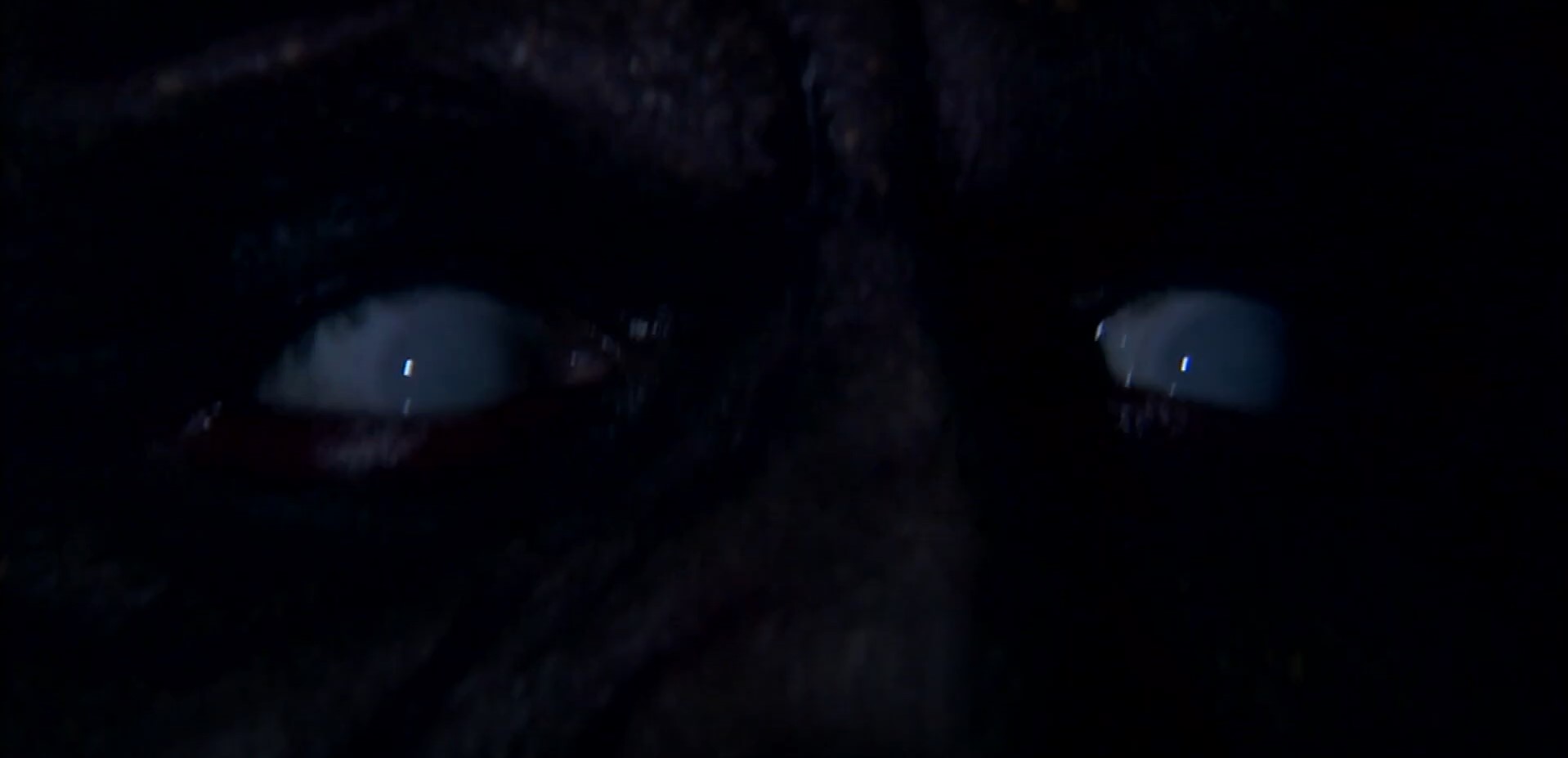
The one theme that keeps popping up in the recess of the mind is perhaps the one theme that eludes being talked enough about when overhauling “Nightmare Man” as a message bearer. Being an early 2000’s horror in the long established and well-dipped into the shadow of the “Scream,” “I Know What You Did Last Summer,” and “Urban Legend” franchises that defined the turn of century before it even happened might have had something to do with “Nightmare Man’s” lack of enticements for distributors to feel love for the man of nightmares and notice it for the novelty and the theme for what it is, an instilled paranoid fear that one’s sexual attacker leaves behind as a post-traumatic stress bomb that is everything all consuming. Kanefsky patterns the hallmarks of rape trauma stealthily into the script, disguised as a shadow, with a teethy mask, and vividly glowing and menacing eyes. Some other scenes are more obvious than others, such as Ellen’s dreams of the sinister smiling figure pinning her to the attic floor and spreading her legs right before she wakes or when she cries out, “I still feel him inside me,” while held up inside the cabin, with Kanefsky painting with a broader brush on “Nightmare Man’s” obscured presence and masked killer with an agenda that attaches itself directly in avoidance of calling a spade a spade. The kills and gore effect gags can stand up against any big budget, Hollywood production and are just unique enough to make the killer interesting in diversity and brutal enough to give “Nightmare Man” an edge sharper than the knife he wields.

If a Tiffany Shepis fan, or a fan of Tiffany Shepis in her underwear holding a crossbow and won’t be rattled by the bent elbow plot pivot, the Rolfe Kanefsky picture is an enjoyable, campy romp that gives homage to the horror films that have set the scene for “Nightmare man” to exist.   Ronin Flix plucks “Nightmare Man” out of standard definition dreamland and into the reality of high-def, 1080p Blu-ray.  Presented in an anamorphic widescreen 1.78:1 aspect ratio, the story is set almost entirely at night with more household lighting for interior shots and not too much exterior lighting to brighten objects or even cast hard-edged shadows.  While this creates more realistic atmospherics of isolating apprehension in the woods horror, Kanefsky and cinematographer Paul Deng (“Trancers 6,” “Song of the Vampire”) bathe many of the night shoots in deep blue tint and the Ronin Flix transfer appears to display in low contrast and is very dark, leaving focal objects nondelineated and obscured.  I haven’t checked out the Lionsgate After Dark DVD print of this film so I can’t compare.  There some dip in the compression decoding as the release hovers in the mid-30Mbps for good periods of time but does dip into the lower 20s and it shows with light phasing macroblocking.  When not bathed in blue, skin tones and grading often look natural and palpable.  The English language DTS-HD 5.1 Master Audio is balanced between all levels tracks, putting the dialogue in the forefront, keeping the range of ambient noises at an appropriate depth, and a soundtrack that maintains tensions rather than over intensifies to a fault.  I will say that the multi-channel lacked a significant stalwart production that didn’t provide the anticipated strength of audio.  Dialogue is clean and clear with no perceptible issues and the overall package track can be said the same.  English SDH are optional.  With the Ronin Flix release, new bonus supplementals extend more background and insight with retrospective discussions and distribution challenges associated with “Nightmare Man,” such has a new interview featurette with director Rolf Kanefsky, producer Esther Goodstein, and star Tiffany Shepis in There’s Something Out There:  The Making of Nightmare Man and a new audio track isolating the film score by Christopher Farrell (“Bus Party to Hell”).  Also included is Creating the Nightmare:  The Making of Nightmare Man – a raw footage behind-the-scenes look at some of special effects, makeup, and off-the-cuff tomfoolery during in between take down time, extended scenes, Tiffany’s Behind-the-Scenes of Tiffany Shepis weaponizing a handheld camera with her flare of sexualized humor and potty-mouth pizazz, an audio commentary track, on the audio setup, with director Rolf Kanefsky, producer Esther Goodstein, and star Tiffany Shepis, Flubbing a Nightmare Gag Reel, still photos, and a promo reel.  The physical features include a David Levine package design of an abract-esque composite of the Nightmare Man mask, Tiffany Shepis in a bra, and a knife all splashed in red lined inside a traditional Blu-ray snapper case with no insert.  The release is locked on Region A playback and the film has a runtime of 87 minutes and is rated R for horror violence, gore, some sexuality/nudity, and language – what Tiffany Shepis release wouldn’t include all of that?  “Nightmare Man” is a dream of a subgenre-bending film; sexy, gory, intense, and unpredictable, all the prefigures of a hell of a good time.

“Nightmare Man” Is Here To Haunt Your Dreams in High-Definition!  Blu-ray Available at Amazon.com