EVILs Make Difficulties in Finding God. “Agnes” reviewed! (Magnet Releasing / Digital Screener)

Blemished man of the cloth, Father Donaghue, and a neophyte are summoned to perform the holy rite of exorcism on a possibly possessed nun, Sister Agnes.  Disadvantaged and forced by his own scandal, Father Donaghue is ordered by the local Bishop to oversee the matter before they ship him overseas to avoid further disgrace upon the Church, but the skeptical priest, who has performed many exorcisms in the past, has never once believed he was casting out a demon but, rather, relieving a guilty, tormented soul seeking divine forgiveness.  When the priests confront Sister Agnes, the situation is violent, wily, and unlike any possession Father Donaghue has ever seen before.  The incident casts doubt over Sister Agnes’s friend and fellow nun, Sister Mary, who leaves the convent to try and live on her own and find God in the real world her own way, but a little bit of Sister Agnes has seemingly rubbed off onto her. 
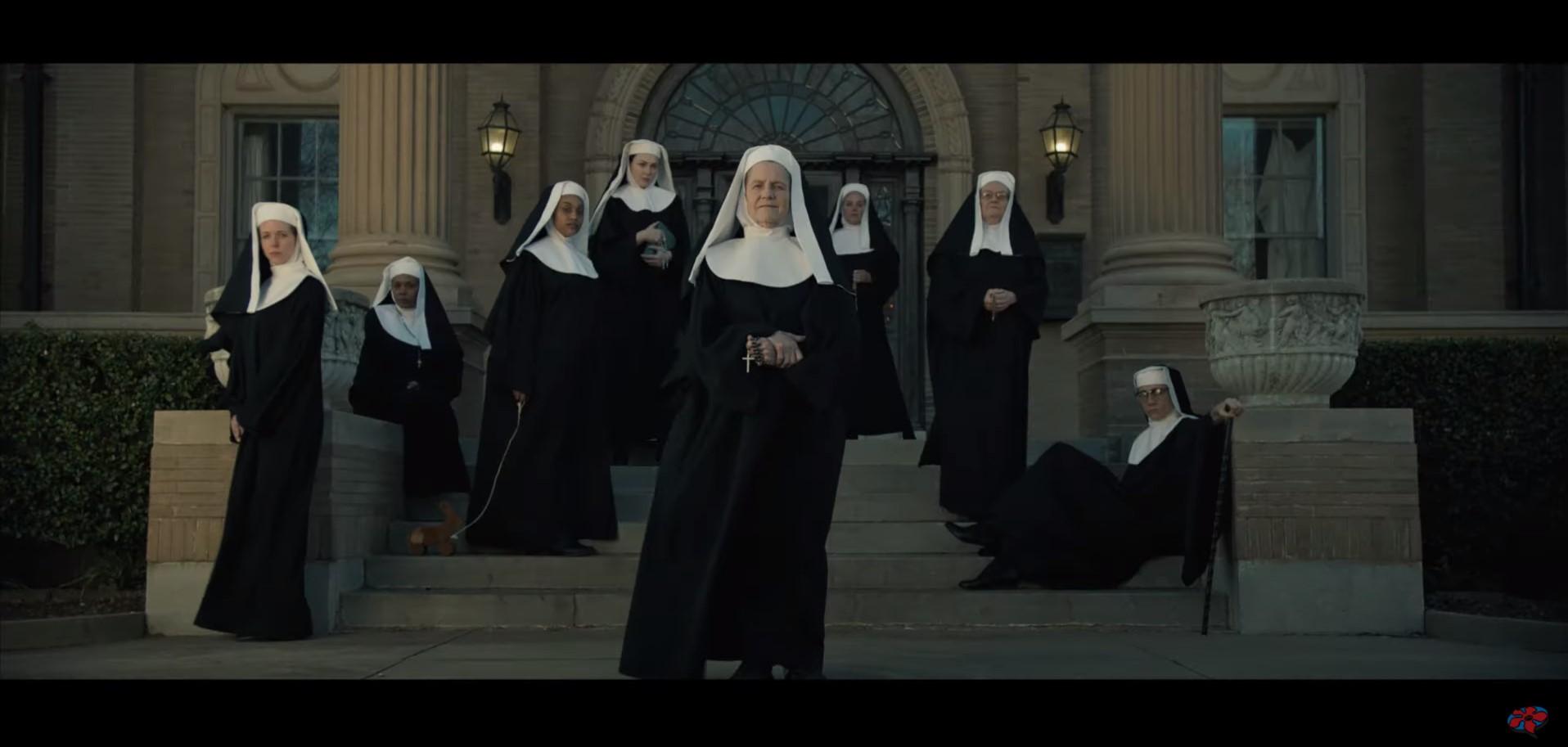
You gotta have faith, sang once by pop-rocker and songwriter George Michael (and Fred Durst, if want to go that route) and though Mickey Reece’s “Agnes” doesn’t necessarily croon a rebuttal, the Oklahoma City born filmmaker surely splits hairs with a formidable blockade that advocates the crisis of faith cinematic model with layered horror.  The “Climate of the Hunter” writer-director’s latest quasi-horror-comedy and full-throttle religious drama questions the validities of finding God on a personal level with a divergently cut screenplay co-written with frequent script partner John Selvidge, whose current post-production penned time-warping horror entitled “Wait!” coming next year.   “Agnes” is filmed in the heartland of America inside Reece’s home state of central Oklahoma and is a reteaming of Mickey Reece and producer Jacob Snovel of Perm Machine with Greg Gilreath and Adam Hendricks’ Divide/Conquer (“Black Christmas” 2019 remake, “Freaky”) as the production companies and is first feature presentation for Molly C. Quinn, Matthew M. Welty, and Elan Gale’s QWGmire Productions.
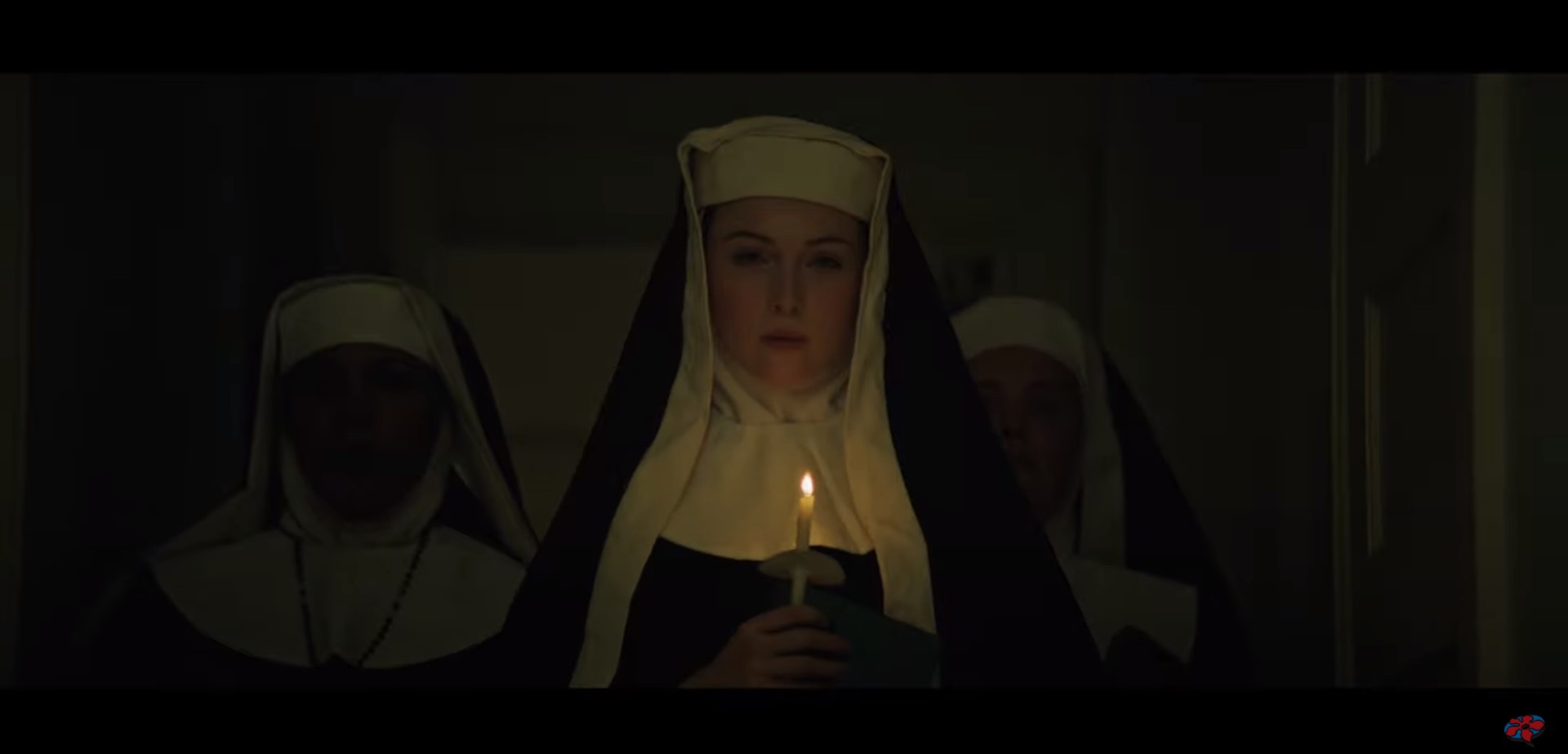
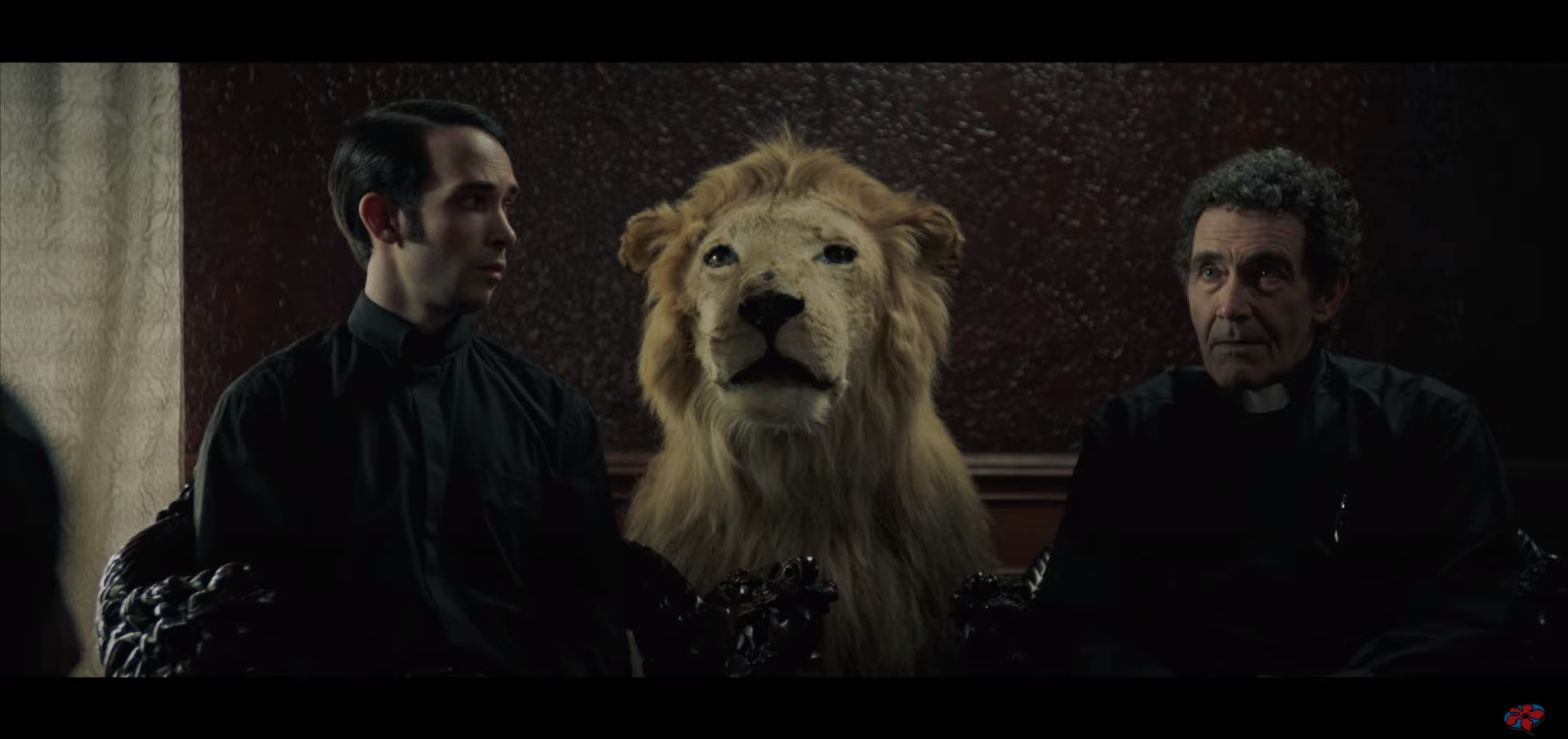
One-third of the head of QWGmire is also the “Agnes” leading lady as Molly C. Quinn, who doesn’t play the titular character, plays Mary, a nun and friend of the possessed plagued Agnes (Hayley McFarland, “The Conjuring”) with a tragic background that ambiguously parallels a similar path to the mother of Jesus, also named Mary for all you non-Christians out there.  Mary is tender, quiet, and self-effacing but determined to pave her own way without the means of charity, especially those of the unsavory-favor nature, and consulting God for answers.  Quinn is perfect to shoulder Mary’s innocent disposition and does carry her naïve meekness throughout up until Mary’s gradual decline toward her faith that turns the sweet and innocent young woman into a pragmatic doubter, spurred by Agnes’ sudden otherworldly turn from devout to impiety that becomes more than what meets the eye.  However, in kicking off Reece’s film, one would have thought the exorcism of Agnes would emphasize more heavily on Father Donaghu (Ben Hall, “Minari”) and soon-to-be priest Benjamin (Jake Hororwitz, “Castle Freak” remake), but despite the involved build up of Father Donahu’s sordid past that conflicts with the Church and his struggles with the exorcism, Reece and Selvidge ultimately do, in what feels like, a pulling of the plug on a storyline that followings in the footsteps of “The Exorcist.”  That is, in my opinion, the downfall of “Agnes’” story in elimination of really interesting character arcs right in their girthy throes, leaving audiences hanging on Father Donaghu, grocer owner/low-end gangster Curly (Chris Sullivan, “This is Us” and “I Trapped the Devil”), ostentatiously swaggering Father Black (Chris Browning, “Let Me In”) and even the titular character Agnes fails to flesh out fully.  Rachel True (“The Craft”), Zandy Hartig, Bruce Davis, Chris Freihofer, Ginger Gilmartin, Mary Buss, and “Guardians of the Galaxy” and “Suicide Squad’s” Sean Gunn as a standup comedian and Mary’s love interest.

“Agnes” loosely follows a couple of Catholic patroness saints in Agnes and Mary derided in a contrary sense.  Agnes, the virgin martyr in Catholic veneration, opposes the Church in the film with flashbacks of her embracing an indulgent life along with her sexual insults that’s uncouth for the patroness saint of pure little girls.  Mary’s a little more recognizable with a previous, ambiguous account of her child’s death (aka Jesus Christ?).  Plus, there’s the religious imagery, amongst others in the film, of Mary with bleeding eyes as an analogous to the weeping statues. Reece blatantly shows most men and women of the cloth to be unorthodox Orthodox Catholics from Father Donaghu’s troubling allegations to the mocking head priests. Mother Superior throws around her superiority amongst the convent nuns and even the Bishop, who doesn’t ever say a word in his brief scene, appears smug and high and mighty with his stature, letting his assistant communicate (and excommunicate) all the ugly business. Only a non-priest, training to be ordained, in Benjamin is the only innocent, infallible Christian who captures the humble essence of God and the only one who can capable in rejuvenating Mary’s faith. “Agnes” is all about doubting faith whether be by demonic possession, the loss of a child, all forms of corruption, and more, but Mary keeps striving, struggling, and searching for that spiritual lifeline amongst seedy and unscrupulous faithless charlatans slowly poisoning her to be the same. However, the “Agnes” story divides too sharply leaving the acute crisis of faith to be nearly lost in translation and is practically a wandering spectrum of identity that’s roughly craft glued together by Reece.
Some may see the film’s poster and excitedly expect Nunsploitation but the reality of “Agnes” digs at the hypocrisy of people and the endless search for faith. What it’s not is the sexual exploitation or sadomasochism of chaste nuns. Give Mickey Reece’s horror-comedy drama “Agnes” a faithful shot come it’s December 10th theatrical release from Magnet Releasing, a subsidiary of Magnolia Pictures. “Agnes” has a runtime of 93 minutes and presented in a 2.55:1 aspect ratio. Typical of any Mickey Reece film, his melodramatic horror-comedy fits into his oeuvre of talking head cinema so leave expectations of brooding and atmospheric milieus at the door for more realistic, down-to-Earth scenes, which is a bit surprising since the cinematographer behind “Hellraiser: Judgement” and “Children of the Corn: Runaway,” Samuel Calvin, has an eye for unhallowed aesthetics. Calvin does produce some perfectly poised shots with the flock of nuns and the ever slightly deviant angle to sharpen a scene. No bonus features were included with the digital screener nor were there any bonus scenes during or after the credits. “Agnes” floats on a haphazard timeline of dark, melodrama comedy for a desperate need of faith against the immense heartache, the crudely selfish, and the absence of morality all of which incessantly imposes upon the good to assimilate.

Time Travel to Stop EVIL via Astral Projection: Part II! “Mandao Returns” reviewed! (Indie Rights / Digital Screener)

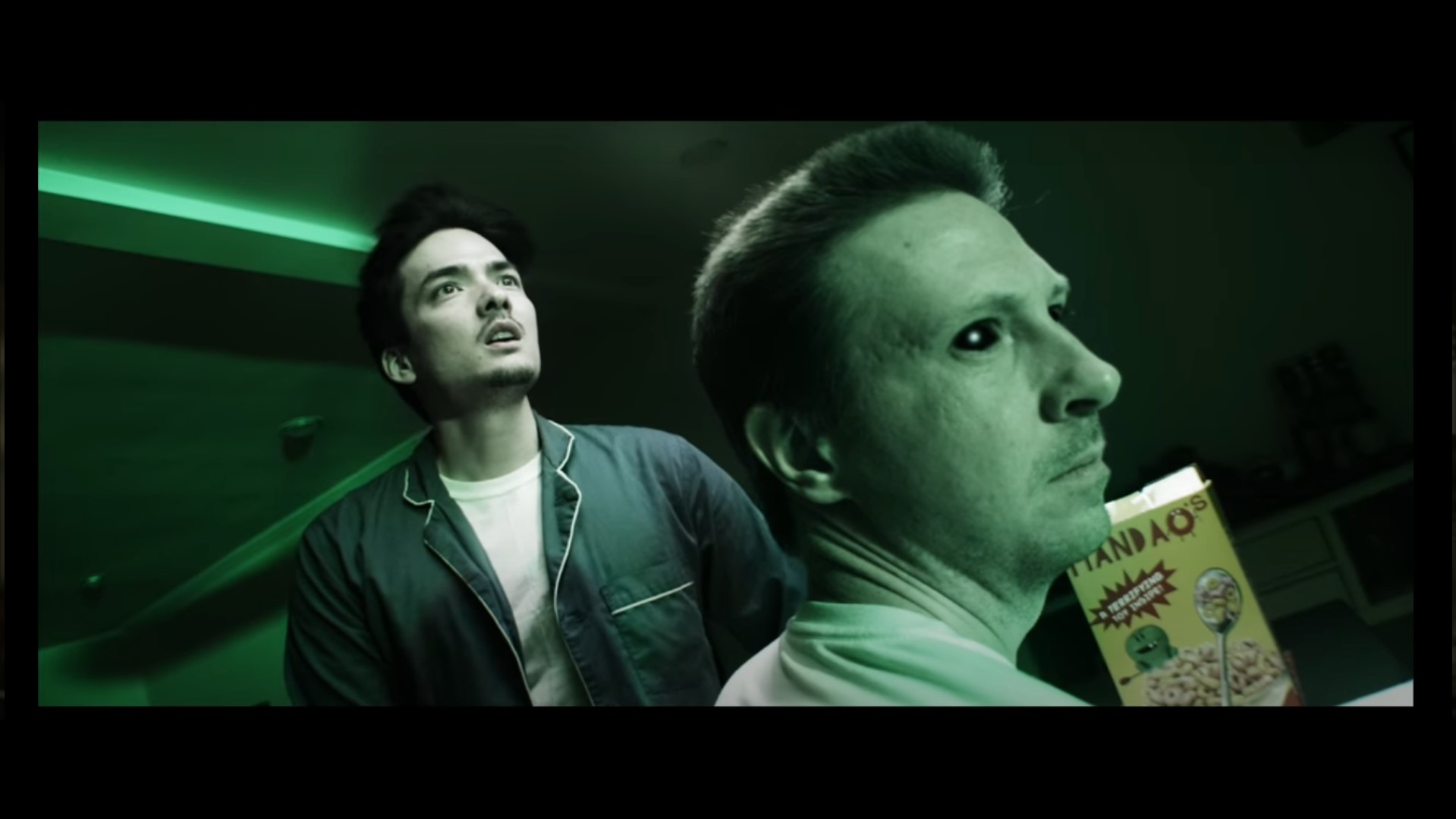
With his powerful ability to astral project, along with the help of a motley entourage of friends and family, Jay Mandao saved multiple lives, some who are close to him, from his blood thirsty ex-girlfriend on Halloween night.  Two months later, days before Christmas, and now living in the scheming medium Cousin Andy’s townhome after his unrelated cousin Jackson set fire to his apartment, Mandao and Jackson float through life, sleeping in Cousin Andy’s living room and barely off the royalties of Mandoa’s father breakfast cereal line.   Dreams of his father, Raymond Mandoa, urging him to stop astral projecting as dark entities will discover him are reluctantly ignored when Cousin Andy connives a get-rich-quick opportunity to contact the recently deceased Aura Garcia, a well-known B-movie actress having died a few nights ago after a drug overdose, but as soon as the spiritual and time planes are disturbed, sinister plans of murder, from the living and the dead, deck the halls with a blood red Christmas.  

Mandao is back!  Or rather returns in a new scouring the astral plane misadventure entitled “Mandao Returns.”  When we last reviewed the Scott Dunn 2019 comedy-horror sleeper hit, “Mandao of the Dead,” an open ending left us salivating with a possible sequel under, what we know now to be a working title, “Mandao of the Damned” that promised exploring the nonphysical and paranormal realm’s mysteries and secrets that threatened Jay Mandao’s whole grain boxed-in existence, at least according to Mandao’s father, Raymond with a foreboding sign of inexplicable things to come.  The Kickstarter.com, crowdfunded modern cult favorite raised more than $26,000, doubling the first film’s budget, from approx. 250+ generous likeminded supporters within two weeks time that brought back four core characters essential to “Mandao of the Dead’s” grim, but lighthearted success to battle half-cocked the supernatural forces of evil.  Instead of a blood drinking cultist, a by-midnight death ceremony concretes stardom and greatness, but not if Jay Mandao has something to say about it.  “Mandao Returns” is a production of Scott Dunn’s Dunnit Films and distributed by Indie Rights.

Returning, obviously as stated in the title, to ensure the safety and well-being of those who incessantly annoy yet deep down care for him on a daily level is the hapless Jay Mandao, the titular hero played by writer, director, and story creator, Scott Dunn, along with Dunn’s wife, Gina Gomez Dunn, who steps back into a co-producer role for the sequel as well as stepping back into the shrewdly wild shoes of Fer, a close but no cigar Mandao love interest continuing to become mixed up in Mandao’s spiritual shenanigans while being a private driver for the Uber-equivalent Bum Rides.  Though blood is thicker than water, Mandao’s cousin-by-marriage Jackson oozes with dense innocence as Sean McBride reprises the daft role to another perfect tune of witless naivety.  Together, Mandao and Jackson arouse a likeable dynamic duo that becomes the keystone to both films’ success because without McBride’s timely childlike disposition, Mandao would just be a snippy and angsty loner and without Dunn’s subtly serious tone, Jackson would overrun the comedy-horror with one-sided gullibility.  With any sequel aiming to top its predecessor, the buddy comedy needed to be bigger and by adding the fourth returning character, Cousin Andy, as an important ingredient to the mix, Sean Liang adds a grounding hoodwinking conspirator that thrusts Mandao and Jackson into action on the astral plane field when the no-good antagonist, Aura Garcia, played by newcomer Jenny Lorenzo, becomes scorned in the spiritual world and takes heinous vengeance that not only involves Mandao, Cousin Andy, Jackson, and Fer, but also Garcia’s talent manager, Ted (Jim O’Doherty), in a sacrificial ritual gone terribly wrong. 

“Mandao Returns” is a smartly written script from creator Scott Dunn whose able to mold fallibly fascinating characters into unlikely heroes juxtaposed against a monumental occurrence much greater than themselves with the vast possibilities in the spacetime continuum.  Of course, the cinema flair to decorate the otherworldly dimensions with accessible ease and gloomy aesthetics faces speculation of existential questions of mindpower and life after death and the challenges the mechanics of the theory of metaphysics, but all that abstract mumbo-jumbo is pushed aside in order to make the “Mandao” films entertaining and for a good reason because when the script has colorful characters and a working narrative, “Mandao Returns” allows audiences to turn off rationality for approx. 71 minutes to enjoy a modestly produced Sci-fi comedy-thriller with a cast accurately in sync with each other’s methods.  The one thing I will say about “Mandao Returns” that I found to be a sore spot, despite still immensely enjoying, is that the story echoes eerily to “Mandao of the Dead.”  With a slight tweak to Mandao’s astral projection powers and trading in a different breed of villain, from point A to point B, from dynamics to outcome, everything seemed nearly identical to “Mandao of the Dead’s” narrative, delivering nothing distinctively new to the table to elevate the character’s fate and circumstances into unique, un-before-seen horizons.  Dunn comes close to challenging and upgrading the prior narrative by hinting something lurking within the spirit world was on the verge of closing in on Jay Mandao if he continues blindly using astral projection by the forewarning words of his father, Raymond Mandao, but slips out of that digressional stream to pit Mandao versus greenhorn cult acolytes looking for glam and glory by way of the gory and that, done in the Dunnit Films’ essence, is okay too.

As a quirky, out-of-body sci-fi thriller experience, “Mandao Returns” succeeds in succeeding as the sequel that brings the thrills and the laughter of far-fetched heroes ready to tear into the fabric of time to stop evil once again. The film comes to you from distributor Indie Rights and is available now streaming only on Amazon Prime so get your pandemic pants on aka comfy, stretchy pants, grab some movie style popcorn, and recline back to watch “Mandao Returns.” Experience the vibrant and wraithy-visioned glow cinematography of A.J. Young, returning from “Mandao of the Dead” as well as Dunn’s first film “Schlep” and another camping trip horror film, “Camp 139.” Young stays true to the films atmospherics with hard lighting a variety of hues and creating a story through the presence of shadows, working movie magic creating an opulent visual experience when really only working with about 25 grand. There were no bonus features nor extended credit scenes with this digital screener. One day, I’d like to see Scott Dunn and his Dunnit Films team work with a good chunk of budget cash and push the limits beyond the simplicities of the “Mandao” films, but until then, “Mandao Returns’ is disseminated with a whimsical awareness and fervent macabre that’s intent to please.

Watch “Mandao Returns” on Prime Video. Click the Poster!

EVIL Exploits Your Fears in “Phobic” reviewed! (Samuel Goldwyn Films / Digital Screener)

The most vulnerable are being chained to chairs and tortured by the terrifying weight of their own extreme phobias until their bodies can no longer take the stress, fatally collapsing where they sit due to heart failure.  Homicide detective Riley Sanders notices frightening similarities to her own abduction months earlier where the kidnapper tortures the stunned detective with an intense light on repeater.   Refusing to believe her abduction and the case she’s investigating are linked, her partner, Paul Carr, continues to insist that her traumatic experience might be key to solving the homicides and finding the killer.  As the detectives dig deeper into a radical psychiatrist’s phobia program whose patients are showing up the killer’s victim list, they find themselves at the center of a disturbing experiment that aims unleash an inner, and only ever theorized, phenomenal ability.

Bryce Clark’s psychological cop thriller, “Phobic,” tales an irregular and irrational serial killer objective derivative of David Fincher’s “Seven” twisted quietly with elements from the superhero universe. Darkly toned exploitation of forcing the worst of the worst fears upon the those already cripple down by their distinct aversion, the 2017 shot “Phobic” marks the return of a Clark written and directed full length feature since the filmmaker’s 2012 debut in both categories with a romantic-comedy starring Mischa Barton.  Both polar opposite films were shot on location in Salt Lake City, Utah, Clark’s residential city, surrounded by picturesque ice capped mountains overlooking the illuminated, pedestrian-saturated metropolitan area home to the story’s wicked psychotronic experiment that literally frightens people to death.  “Phobic’ is a production of Storylab and Pale Moon Entertainment.

Two detectives continue to peel back the arcane layers of the unusual case before them with detective Riley Sanders at the heart of the matter being linked to the recent string of methodical abductions tailored specifically with the victim.  “Looking Glass” actress Jacque Gray dichotomizes Riley not only as a persistent investigator eager to bring this case to an end but also as a struggling closeted neurotic with her own fears that bleed through the celluloid.  Clark makes sure to underscore Riley’s nightly routine before going to bed with her constantly turning on and off lights in her path to represent a lingering but indeterminate phobia response.  Riley is supposed to be this tough, but law abiding cop, who survived a harrowing ordeal, but Gray hardly expresses Riley’s scarred rigid soul, representing more so in the lines of coloring her disposition by the numbers that refuse to waiver outside normalcy.  Devin Liljenquist is even more so vanilla as Riley’s partner, Paul.  As his introductory feature film, Liljenquist’s doesn’t carry the range of a cop who cares, topping out with a straight-faced sleepwalk that challenges the stakes and can be considerably creepy, like subtly sexual grooming predator, when Paul is trying to convince Riley to open her fears with him.  The character audiences deserved, or better suited as Riley’s partner to provide contrast, would have been the third scarcely screened detective on the case that occasionally popped in as the first investigator on scene of a crime in Alex Nibley’s Detective Hank Ferry.  The slightly elder detective, complete with Nibley’s stark white, Anderson Cooper hairstyle, had a quick, dark wit and cavalier presence about him that breached the Riley and Paul uncharismatic stiffness with a relieving change of pace dynamics between colleagues.  You couldn’t wait to see Detective Ferry to make a reappearance, but sadly, his character is sorely underutilized for only a couple of moments.  “Phobic’s” in-and-out supporting cast includes James Jamison, Tiffani DiGregorio, Fred Spencer, and Ernie Lively as Riley Sanders secret-keeping father.

“Phobic” follows a basic detective thriller in tracking down a homicidal maniac with a niche kill tactic that bread crumbs one of the investigating officers into being subverted by a conflict of interest stemmed from her past. However, out of Salt Lake City’s blue skies, Clark suddenly pivots in his script, diverting from a dark, gritty Finchian narrative to an acutely forged new shape of revival and hope, a shape that bares no cape, no mask, or no bald, psychic power yielding man bound to a wheelchair playing headmaster of a school that serves as a façade for an elite team of powerful, do good mutants. If my hint wasn’t overly blunt, let me be utterly clear, “Phobic” has no distinct x-factor but goes from fears to fight with the psychotronic theory where energy and strength derive from stress and fear over the witnessing the impending doom of a loved one. Urban legend surrounding the notion of hysterical strength siphons away the psychosomatic element from the grooves of the cop thriller and Clark copiously throws in crucial red herrings to keep viewers muddling and not Professor X cerebral filling in the gaps unraveling an unlikely and unrealistic prospect of superhuman truth, but “Phobic’s” off-the-cuff pivot is a quick to squander all that’s been built in what’s essentially Bryce Clark’s house of cards to discombobulate an audience with polarizing story principles, rebranding an assayed horror-thriller into rabid conceit.


Easily one of the most idiosyncratic and unanticipated films of 2020, “Phobic” induced fear into audiences panic-stricken hearts this past December 15th onto multiple digital platforms courtesy of Samuel Goldwyn Films, the distributor that brought you “Daniel Isn’t Real” and “Pet.” Brandon Christensen’s tenebrous cinematography is shot on a 6k red epic dragon with ultra definition displaying full range of details in every scene and despite the somber tones created by a slew of gaffer up lighting, we get some really rich natural coloring, even in the baby blue eyes of Ernie Lively, when Christensen isn’t blue or red tinting the lens to underscore the killer’s aftermath crime scene. While the cinematography is good, the editing can be pestilent expression of style to represent Riley’s sporadic and continuous reliving of a reoccurring memory. The stock score is just that set on autoplay for nearly the length of the 81 minute runtime with engineered eruptions in the pitch to denote the jump scares. There were no bonus features included with the digital screener nor were there any bonus scenes during or after the credits. The bland acting hurts “Phobic’s” exploration of the psychological symbiotic energies between that of the mind and body, but the film boils down to have a fascinating perspective on the detective thriller by reshaping the surface with bold expectations of an uncharacteristic, dormant fear free all.

Own or Rent “Phobic” by Clicking the Poster!