Rick, who runs an arcade business and is a pigeon enthusiastic with a dovecote on his building’s rooftop, attends his friend’s Karate competition with another good friend, a schoolteacher and his tenant, Penny. Learning that his Karate friend, Ed Swaan, has developed a romantic relationship with Netherland pop-singer Lilly Marischka and will have a small role in an upcoming movie with the star, shooting in building adjacent to Swaan’s Karate studio, Rick doesn’t think twice about it until Penny catches glimpse of naked photography happening in the very same building. Rick is sent that night to investigate, and witnesses Ed and Lily uncomfortably being persuaded to take part in a private viewing porno and nearly escape with their lives when they rescind their participation and are chased by two low-life goon twins. Ed and Lily’s nudie film now threatens them with scandal and as Rick pokes his nose into the production team’s business, innocent lives pay the price to keep the film in the blackmailing and profit seeking hands of the filmmakers.
A cult comedy-thriller for the ages, “Naked over the Fence,” aka “Naakt over de schutting,” is a murder-mystery monkeying with spirited jest from the Amsterdam-born filmmaker Frans Weisz. The screenplay treatment comes from Weisz familiar writers Rob du Mee and the late Rinus Ferdinandusse, who penned the novel of the same Netherland title from which the story was adapted and who had passed away back in July of this year. Both writers have worked with the director on respective projects, such as “The Burglar” and “A Gangstergirl” before “Naked Over the Fence.” Set in and amongst the close quartered housing of Amsterdam and along the river of the Amstel, Weisz very much incorporates the intertwining the compact of the brick-and-mortar and the expanse of a widened landscape flow of the surroundings into tongue-and-cheek situational micro comedies that sometimes has you forget your watching a rather cynical and entangling murder mystery involving shady pornography, blackmail, and murderous foul play. Parkfilm and Cinécentrum N.V. are the production companies behind the film with Rob du Mee producing and Gerrit Visscher as associate producer.
Initial previewing presumptions about “Naked Over the Fence” might fall along the lines of being a highly erotic comedy because of not only the film’s suggestive title and the half-naked actors halfway over a fence on one of the original poster artworks, but also the fact that Sylvia Kristel as one of the principal stars. Kristel is far and wide known for her continuous provocative performances as the lusciously licentious title character in the erotically charged “Emmanuelle” mega-series that has expanded decades since the 1970s. “Naked Over the Fence” is not that kind of movie. Not even close. There are moments of skin, conservatively from Kristel, and subtle and not so subtle scenes of sensuality coursed throughout but the Weisz film notes as one of the Netherlands’ actress’s first films of her career before “Emmanuelle,” exploring her range as a scared pop singer backed against into a career stemmed quid pro quo before becoming an embedded typecast of the erotic genre. Kristel perfectly complements as a beautiful, delicate, yet reserved in strength starlet alongside arcade owner and staunch friend Rick (Rijk de Gooyer, “Rufus”) and her new beau, a large karate dojo owner Ed (Jon Bluming, Paul Verhoeven’s “Turkish Delight”). As much as an odd couple as they’re describe, Gooyer and Bluming are greatly well-received on screen as a dynamic duo attempting to outwit shady porno makers, blackmailers, and merciless murderers as if the contest to the film reel is a game with that swashbuckling, self-assured attitude as two amateur sleuths. The one character I thought was a little out of place was Penny, played by Jennifer Willems as a schoolteacher renting a room in Rick’s arcade building but is also a good friend of both men. Penny feels solely like an object used to force the hands of Rick and Jon when trouble arises and never actually does any leg work in tracking down the film reel. Willem performs to the best of her extent in a role that doesn’t obtain much action until the unique action chase at the end. Willem, Gooyer, and Bluming have all worked with previously with director Frans Weisz on “The Burglar,” alleviating beforehand any undue first meet jitters and that translate tremendously on screen. “Naked Over the Fence” has an ensemble cast of color characters, each one more interesting than the next, that include Jerome Reehuis, Tom Lensink, Adèle Bloemendaal, Jerry Brouer, and mustache and curly perm identical twins Lodewijk and Hans Sijses as a pair of cronies.
“Naked Over the Fence” might be a pulp novel coursing loosely as a glib tongue in cheek but the complexities the film assume merits cult-worthy cachet. The adaptational flow of a novel story, its wildly entertaining and diverse performances, and its bold direction deserve accolades upon its accolades. The very beginning sets the tenor of the film on the Amsterdam rooftop with tracking shots that are simply amazing, smooth, and precise toward the working up of Rick waiting for his named pigeon friends to return, the Ferenc Kálmán-Gáll cinematography and Ton Ruys editing is remarkably accomplished as the intercut composite between Rick peeping through the fence and the boiling-to-conflict back-and-forth conversing of the pre-setup porn scene that lead up to the film’s title of Ed and Lily hopping climbing over 6 to 7 ft wooden fence is tip-top execution, and the extended tram chase is unlike anything I’ve ever experienced in a bird-dog chain of scenes as the two trams zip down the engrooved track lines on the streets of Amsterdam while making it whimsical and parlous with excitement. there’s real production money financially backing the uncontained and mutable story and it shows right from the get-go to the very end with only a handful of key instances where the digression of the certain level of high-dollar antics can only be done at a lower quality and that drags down Weisz’ flair quite a bit. An enjoyable romp of Dutch cinema, “Naked Over the Fence” ossifies friendship, loyalty, and morality over the forces of tit-for-tat evil.
Proudly continuing their restored release of Sylvia Kristel films, Cult Epics presents “Naked Over the Fence” onto a 2-disc, region free Blu-ray home video set with a newly restored high definition 4K transfer from the original negative. Virtually unscathed by time, the original negative beams with vitality in its showcased 1.37:1 aspect ratio, upgraded into an improved compression rate to hold all its detailed wonders for the full 91-minute runtime. The stable picture and natural, unwavering coloring persists with a consistent color palette. Other than complimentary natural grain of the stock, there’s no obvious instances to fault the image quality that’s above exemplary. The Dutch language tracks come with two audio options: a LPCM 2.0 and a DTS-HD Master Audio 2.0. Both render audibly clear and emphatically enough with the DTS providing a little ambient and dialogue boost with a cleaner track of the dub Dutch language. English subtitles are included and don’t have an apparent errors and synchs well with the pace. Special features include an audio commentary by biographer Harry Hosman, a 15-minute behind-the-scenes featurette of unpolished footage of scene takes and director Frans Weisz at work with his cast, a 2014 Dutch audio interview with Frans Weisz that includes English subtitles, an interview with composer Ruud Bos from 2015 that includes performances with the B-Movie Orchestra, a promotional gallery, Sylvia Kristel trailers, and a 2nd disc, included only in limited edition, 1000 copy sets, of the exclusive compact disc Soundtrack by composer Round Bos. The physical bonus material with the limited-edition release is cardboard slipcover and a reversible cover art that includes the original poster art and a list of the score’s 16 composed track list. I adore the quirkiness and relish in the story’s transgressional diegesis and now with this stellar new and improved Blu-ray release of the Netherlands’ “Naked Over the Fence,” the perfect movie does exist.
David just transferred to Central High School, reuniting with his good friend Mark, but Mark is no longer a part of the outcasted crowd at his new high school as he has joined Bruce and his pals to be the apex elite in the school’s lopsided social hierarchy. Refusing to abide by the relentless and ruthless bullying, attempted rape, and intended bodily harm, David stands up for the oppressed with firm and actionable rebuke. Bruce and his gang don’t take kindly to David’s opposing behavior and purposefully cripple him to teach him a lesson in disobedience punishment under their sovereign thumb, but what doesn’t kill David makes him a retribution killer as he begins his one-by-one takedown of the disparaging upper-class. When there are no more bullies left at Central High, the once oppressed turn into the oppressors and it’s up to David to continue the cleanse of megalomanias.
Now here’s a unique take on the revenge thriller that doesn’t involve the conventional concepts of a slaughter escapade return from being nearly raped to death or to exact revenge for the untimely and heinous murder of a loved one at the hand of sociopathic other. “Massacre at Central High,” written and directed by the late Netherlands filmmaker Rene Daalder, is the sociopolitical, slashereseque picture from 1976 that is just as parentless and bizarre as it is cold in its exaggerated truth of undiplomatic ways. Also known as “Sexy Jeans,” the Italian X-rated interposed cut, “Massacre at Central High,“ is Daalder’s second feature behind his 1969 exploitation and organized crime thriller “The White Slave” that tells the story of one man’s righteous crusade turns into a bungled mess with him being intertwined in a scheme to sell unsuspecting young Dutch women into sexual slavery. Daalder’s sophomore film might not be as controversial, but certainly maintains that provocative and erotica bravado under the otherworldly shadow of an ultra-angsty high school veneer. Filmed in and mostly around Los Angeles’s Griffith Park that included an abandoned private high school in Burbank, “Massacre at Central High” is produced Harold Sobel (“Very Close Quarters”) with Jerome Bauman serving as executive producer.
Before he was the four-eyed face of the franchise where it was cool to be square in “Revenge of the Nerds,” Robert Carradine landed one of his first principal roles in Daalder’s “Massacre at Central High” as free-lovin’ hippie, Spoony. Though Spoony is an activist idealist and gets two chicks, the half-brother of David Carradine wasn’t in the star lead though he certainly had the presence and the state of mind to withstand it. Instead, Derrel Maury enveloped the role David that seeks vigilante justice to a bunch of entitled school bullies lead by Bruce (Ray Underwood, “Jennifer”) with Craig (Steve Bond, “The Prey”) and Paul (Damon Douglas) being a part of his gang. Maury’s deep eyes and good looks make him a shoe in to be one of the top-predators to join Bruce’s paleoconservative circle and, as David, his personal connection with good friend Mark (Andrew Stevens, “The Terror Within”) who eggs, basically begging and pleading, David continuously to join or face the consequences of Bruce’s wrath. The acting and dynamics between this already complicated group of late teens is basic in its formulaic high school turmoil but also very disturbing on many levels that puts the boys-will-by-boys mantra into a whole new comfortless light. We all know characters like Bruce and his lackeys from High School where guys like him think the student body pledges allegiance to their unofficial rule; Ray Underwood, Steve Bond, and Damon Douglas do a phenomenal job of letting you hate them for who they portray with characters who are not beneath attempting the rape of two female peers in broad daylight and in one of the classrooms. To provide another twist to this tale, Bruce and his gang are not the real antagonists in the story but rather just a part of a bigger, broader discernment that’s infectious as it is dangerous in the realm of political power and hierarchy. Kimberly Beck is the angling love interesting that teeters between good friends Mark and David and “Friday the 13 Part IV: The Final Chapter” actress ultimately doesn’t become the focal purpose to David’s revenge (remember, this isn’t a typical revenge narrative) as Beck more than spurs jealously with her feelings for David as well as become eye candy with gratuitous and beachy full frontal nudie scenes. “Massacre at Central High” rounds out the cast with Steve Sikes (“Horrid”), Tom Logan, Jeffrey Winner, Rainbeaux Smith, Dennis Kort, and Lani O’Grady.
The sociopolitical aspect of “Massacre at Central High” is by far the most compelling with the story’s uncompromising subcomponents of teenage high school perils. The fact that are zero parents introduced into the mix makes Daalder’s narrative that much crisper in its poignancy as these children are left to fend for themselves in like some bizarro version of William Golding “Lord of the Flies” that dives into similar themes such as groupthink mentality, social organizations that reshuffles into a lemming trajectory, and even outlier themes comparing Bruce’s gang to Nazism. Behaviors turn on a dime for the worst and bring out the worst when the opportunity to govern the school affairs leads to an asymmetrical power struggle. Even David, our hero of the story, isn’t immune to the adverse effects of change when pushed beyond reasonable reaction after having his leg crushed and he left maimed by Bruce. To David, this turning point reduces down below differentiating the difference between morality and immorality as he views them as equals to right-the-wrongs and to be a way to level out toward equity for all, a quality that’s been an attribute to David’s pre-murderous existence ever since transferring to the school, but the all-around good guy couldn’t rub off the impartial view of the world to others and so he finds himself in a continuous solo crusade of course correcting. “Massacre of Central High” isn’t as austere as “House of the Flies” as its facade is campy and contrived in an artificial manner. The parentless environment disintegrates principles right at the door in “Massacre of Central High’s” biodome of guttersnipes and that sections off this gem from other exploitation ventures in a must-see good way.
Enroll yourself for September 13th releasing of “Massacre at Central High” on Blu-ray home video from Synapse! The spectacular course offers a region free, AVC encoded BD50 Blu-ray that presents the feature in 1080p at a widescreen 1.78:1 aspect ratio and the take on the director’s approved 35mm remastered presentation is tight, detailed, and utterly clean. Color palette is warm but diverse with a great bit of contrast where needed, such as the nighttime skinny dip and love-makin’ beach scenes. Virtually free of wear and imperfections, the impeccable transfer dodges four and half decades of negative ageing with great delineation to show for it. The original English DTS-HD Master Audio mono soundtrack is the only audio option on this release and is more than adequate with the same clarity as the picture. There’s quite a few, ACME-ish style explosions, a tumbling rocks scene, and spates of variable automobile revs, exhausts, and engines to quench an audiophile’s interest with a broad ambient range. With the original soundtrack comes Tommy Leonetti’s clashing lead melodic and easy listening track “Crossroads” that sticks out like a sore love song thumb in the background of murderous revenge. Newly translated optional English subtitles are available. The bonus material includes an audio commentary by “The Projection Booth” podcaster Mike White interviewing cast members Andrew Stevens, Robert Carradine, Derrel Maury, and Rex Steven Sikes. Also included is an archived audio interview with director Renee Daalder with horror historian Michael Gingold, Hell in the Hallways making of featurette with new recollection interviews from the cast and cinematographer, fellow Netherlands native Bertram van Munster, theatrical trailer, TV, and radio spots, and a still gallery. The film is rated R and has a runtime of 88-minutes. “Massacre at Central High” focuses more on detonation than detention as bodies pile high in this explosive dog-eat-dog hatchetjob of unsupervised minors gone wild.
Sylvia Kristel. A name that is synonymous to eroticism. Kristel paved the way in mainstreaming seductive romances of softcore exploits, helping to elevate the provocative genre out of the depths of sleaze and into a more exotic trashy novel for the big screen. In her titular role in the “Emmanuelle” franchise coursed an arousing path of sexual freedom, uninhibition, and became the sumptuous and worldly window in private fantasies. Playing the role for nearly two decades didn’t stop Kristel from other high profile and lucrative projects with an array of filmmakers as well as her roles pre-“Emmanuelle” that molded the Netherlands actress into a sexual icon rather than object of male fantasies. Cult Epics acquires four films – “Playing with Fire,” “Pastorale 1943,” “Mysteries,” and “Julia” – that even though didn’t have Kristel set as a principal lead still showcased her range within the constraints of a minor, but certainly not insignificant, performance.
“Playing With Fire”
In a madcap Paris where sex trafficking is something of a sport, a wealthy French banker learns his daughter has been kidnap and threatened to be tricked out or burned alive if the kidnappers’ ransom isn’t paid. Quickly learning that another woman has been mistaken for his daughter, a wave of relief bestows him to be cautious about future attempts on his daughter’s safety. The banker hires a private detective to protect his loveliest of assets, offering to escort her to a local safehouse with the promise of sanctuary, but the P.I. is operating incognito being really one of the leaders of a surreal and lavish brothel who now has the banker’s beautiful daughter in his possession. Or is it her who possesses him?
Unlike any other exploitation-comedy you’ve likely ever seen, the 1975 released “Playing with Fire,” aka “Le jeu avec le feu,” is a wacky deep-dive of surrealistic sex trafficking from French writer-director Alain Robbe-Grillet whose obsession with prostitution rings and other filmic eroticism pursuits extends back within a decade later with “L’Immortelle,” aka “The Immortal One,” and “Successive Slidings of Pleasure.” A French production of Arcadie Productions, Madeleine Films, and Cinecompany, “Playing with Fire” masters the avant-garde art of making light of a grim topic that results in a pull of emotions. Robbe-Grillet draws out the shocking aspects of sex slavery while also encouraging a smirk or a chuckle at the whimsical characters and shooting techniques weaved throughout a burlesque narrative. Robbe-Grillet also plays with the theme of dualities with a number of the principal characters having two or more versions of themselves: Philippe Noriet plays not only the banker father Georges de Saxe but also a voiceless sleaze erotically interacting with the banker’s daughter in a very Freudian concept between father-daughter relations. His daughter, Carolina (Anicée Alvina), disguises herself as the thin-mustached private detective to thwart future any attempt at an abduction and there’s also the identity mishap with the similar looking woman mistakenly kidnapped by the ringleader. Leading us into Jean-Louis Trintignant as the ringleader Franz constantly in a revolving door switch-a-roo façade into the private detective. The presence of duality doesn’t stop being a present throughout, continuing with the banker’s butler who is also a whorehouse patron without affirmation that they’re the one and same person. Before their illegal banishment in the mid-20th century, Brothels were widely dispersed throughout Paris, but not until the Nazi occupation absorbed the houses of ill-repute that seared a bad taste of deviant humiliation and sordid disgust into the mouths’ of the French populace and Robbe-Grillet taps into that once time of unrest by splicing in a pair of isolating scenes of goose-stepping Nazi soldiers with one of the moments garmenting Anicée Alvina in uniform and marching in the ranks, suggesting a more sinister subplot afoot in the storyline. Kristel plays one of the women snatched by Trintignant’s efficiently devious Franz with virtual a voiceless performance in what’s only a symbol of strength and beauty that sets perversion ablaze as she’s taken through the motions of essentially onboarding her into slavery whoredom. “Playing With Fire” can be at times difficult to keep up with the Alice in Wonderland-like surrealism and the character dualism but persists unwaveringly with a multi-faceted narration of deceit, eroticism, and comedy full of perversions and random outbursts akin to satirical skits that make this film unpredictable yet enjoyable to behold.
Pastorale 1943
During the Nazi occupation of the Netherlands, a quaint Dutch farming village lives day-to-day alongside soldiers and German sympathizers known as National Socialists (NSB) to the Nazis, traitors to their fellow Dutch countrymen. When the Nazis learn of and round up all the dissidents and Jewish heritage people living in hiding on an adjacent, ferryboat island, a small band of unorganized resistant fighters determine the local pharmacist, a NSB member, to be the Nazi collaborator responsible for the treacherous leaking of information because his son impregnates an island village girl, teetering toward the fascist movement when mocked by her peers for her involvement with the pharmacist’s son. Inexperienced in the execution of traitors, the bungling resistance fighters learn just how difficult planning a murder can be when their scheme falls apart in a small village where everybody knows everybody.
On this second of four Sylvia Kristel features is the Spieghel Filmproductiemaatschaappij of “Pastorale 1943” which makes more prominent the Nazi regime, is set with a backdrop of a Nazi occupied Netherland town and has a cameo role of young and dashing Rutger Hauer (“Blind Fury,” “The Hitcher”). Netherland writer-director Wim Verstappen, whose had a few titles released previously from Cult Epics, such as “Obsessions” and “Blue Movie,” develops a script out of the World War II drama novel from author Simon Vestdijk with black comedic undertones and a tinge of corrosive sexuality and released the film in 1978. Pastorale, or Pastoral, refers to the typically calm and idyllic country life which the complete opposite in 1943 Netherlands with all of Europe and East Asia engulfed in war; however, this story takes place in its own corner of the world with a mini, damn near microscopic, war waged between the Nazis occupation along with domestic NSB collaborators and the inhabitants resisting against the encroaching fascism that has plagued revenue crops and instilled an authoritarian culture, such as mandating the teaching of the German language to students in Dutch schools. Kristel’s involvement with Verstappen’s “Pastorale 1943” is about as much as her involvement in “Playing With Fire” with a minor role that’s still a keystone piece to the narrative. She plays Miep Algera, a local schoolteacher disparaged by her neighbors and colleagues for having romantic relations with a Nazi officer, but has she really fallen for the officer or is she secretly conducting counterintelligence for the resistance? “Pastorale 1943’s” two-part story plays heavily embroiling and embroidering characters in the first half to the point of instituting a cornerstone character but when the narrative pivots, to the darker side of implied Nazi exterminations and the fumbling through the execution of a rightfully innocent man, Verstappen homes in on Frederik de Groot as the artist Johan Schults whose Germanic surname causes him much strife amongst his Dutch brethren but to prove himself, Schults takes charge, along with an equally green execution squad of resistance politicians, to murder the NSB collaborator, a local pharmacist Poerstamper (Bernard Droog). The Academy Award submitted “Pastorale 1943” can be light and funny then turn quickly on a dime into wartime darkness and director Wim Verstappen’s vision pops with epic World War II fascism atrocities, confined to one part of the world and without the explicit voyeurism of genocide.
“Mysteries”
After the strange suicidal death of a man named Karlson, Johan Nagel arrives to the coastal town where the death occurred. Immediately, Nagel stands out from the supercilious eccentric residents with his mustard yellow suit and fur coat, dispensing small cigars and money to everyone and every service as if they were infinite, and exhibits his own brand of strange behavior, especially with amorous feelings between two women and an unlikely friendship with a dwarf who has accepted his neighbors’ belittling jabs for humorous pleasure. As his behavior declines, Nagel’s presence unravels the coiled, seemingly impenetrable, barriers around his friends, his enemies, and his romantic pursuits that reshape their properties for the better at the dangers of his own sanity and life.
Finally, we’re at a point in the Sylvia Kristel collection where the titular star is in a lead role with this demolition of concrete idiosyncratic personalities melodrama entitled “Mysteries” from Dutch filmmaker Paul de Lussanet, based off a novel “Mysterier” by Knut Hamsun, with Sigma Film Productions as the production company. Kristel plays the steely Dany Kielland who becomes the infatuation of Nagel in an oppositional performance beautifully deranged and conducted by Rutger Hauer. The hot-and-cold and on the brink of frustration relationship between Kielland and Nagel is as resolved as an unfinished breakfast left to waste and void of complete nutrition as both characters digest morsels of desire only to explode in a frenzy of loathsome disgust in an unsavory, brittle dynamic only Hauer and Kristel could produce on screen. The other love interest involved, yet hardly feels as such until the last half hour, is an aged and more humble Martha Gude portrayed by “Last Night in Soho” British actress Rita Tushingham complete with a poor-looking frosty-colored wig. Kielland and Gude represent the two-side of society – rich and poor respectively – stuck mastering a stanch stance of an indeterminate state that Nagel barrels into and knocks down the status quo, like a bowling ball to ten pins, for the better of the coastal town. None of what Nagel does seemingly makes any sense and that’s very true to Hamsun’s novel in the unconventional, and probably unintentional, methods of Nagel’s erratic influence. “Time Bandit’s” David Rappaport debuts in his first feature film as Grogard, an achondroplasia character bulled by most of the town’s residents due to his disorder. Grogard anecdotally tells the story as “Mysteries” narrator, as if reading straight from Hamsun’s novel, the recollection of Nagel’s dichotomic behavior and, at the same time, Nagel also being a mentor, protector, and a friend that pained Grogard to watch his friend whither to death in fit of emotional exhaustion. “Mysteries” borders arthouse cinema, adaptive faithfulness, and pristine melodramatic performance that sound good in theory but not always translate well to the screen, leaving more of a perplexing impression on the whole purpose of rendering Knut Hamsun’s novel into film in the first place.
“Julia”
Every year, Patrick departs his boarding school for a short holiday with his father and relatives at his grandmother’s idyllic lakeside house. While riding the train en route to his grandmother’s, he encounters an older, yet beautiful, blonde woman inside the passenger carriage car and before he can firm up courage to act upon his sexual brimming hormones, the blonde is swept up by an older gentleman right from under his nose. Come to find out, the blonde woman is actually his father’s girlfriend in a completely open relationship when it boils down to sex. Anxious about his own insecure sexual appetite, Patrick finds himself surrounded by the perversions of his family and friends, leaving the young man hesitant and nearly impotent in bedding the woman he actually cares about, a longtime friend Julia who lives next door to his grandmother.
On the heels of “Emmanuelle,” Sylvia Kristel follows up with another licentious freedom film in Sigi Rothemund’s “Julia.” Also known as “Summer Girl” or “Die Nichte der O,” the German production from the Lisa-Film company is the earliest film on the 1970s collection with a release in 1974 and is the only other screenplay on the collection next to “Playing with Fire” that is not adapted from literature. Instead, “Julia” is a wild romp ride of young sexual exploration and the anxieties that accompany it from an outlandish and witty script by Wolfgang Bauer. “Julia” might not be based off a book, but the story is certainly an unapologetically open book about the insignificance of virginity, polyamorous affairs, lesbianism, voyeurism, and the sexual rite of passage into adulthood with the young and naive principal Patrick, or Pauli as credited, played by the late Ekkehardt Belle who passed away in January of this year. Opposite Belle, Sylvia Kristel obviously dons the titular role of Julia. Inexplicably voluptuously different from the other three films on the collection, Kristel radiates a sexual aurora perhaps infected by proxy of its release soon after “Emmanuelle” as Kristel obvious branches out to more sensible dramatic roles rather than the decor of a German sex comedy such as “Julia” that galvanized by its free-for-all eccentric caricatures including an operatic, overweight, and perverse uncle Uncle Alex (Peter Berling, “When Women Were Called Virgins”), a highly aggressive lesbian in Aunt Myriam (Gisela Hahn, “Devil Hunter”), the house maid Silvana who Myrian seduces with whipped cream and has piano-top sex (Christine Glasner), and his polyamorous father Ralph (Jean-Claude Bouillion, “The Sextorvert”) and girlfriend Yvonne (Teri Tordai, “She Lost Her…You Know What”). Comparatively flimsy next to “Emmanuelle” as a sexual journey and coming of age film but “Julia” is a hot-to-trot sex comedy with funny bits as well as sultry naught bits too.
Beautifully curated for the first time ever release in the United States of all four films is Cult Epics’ “Sylvia Kristel: 1970s Collection” on Blu-ray and DVD. The 4-disc, uncut Blu-ray, which was provided for coverage, is region free, limited to 2500 copies, and perfectly packaging to extol praise upon the robust early career of Sylvia Kristel. Presented in European widescreen 1:66:1 (with the exception of “Playing with Fire” which is displayed in an anamorphic 2:35:1), each film is newly scanned in 2K from the original 35mm elements as well as been restored. Transfers for the most part are exquisitely pristine, each harboring their own mise-en-scene mélange, but some are better than others with “Mysteries” sitting at the bottom rung of showing slightly a few more scratches and one-or-two single frame damages that flame up through the reel briefly. “Julia” also has minor scratches, but that’s really the extent of the issues with the image quality on this restored visual released with a rich color palette and textures redefined for a better palpability. Compression issues are virtually non-existent and there are no tinkering enhancements or cropping used to skirt transfer limitations. I am in awe of the audio output of the 1920kps bitrate, transmitting the highest audio quality possible for each release through either DTS-HD Master Audio 2.0 or a LCPM 2.0. Dialogue clarity comes through cleanly with French in “Playing with Fire,” Dutch and German in “Pastorale 1943,” and German in “Julia.” “Mysteries” sounds a bit muddle sometimes due to the consistently background popping interference, but the Dutch language still pulls through strongly and discernibly. Each film comes with optional English subtitles. Special features are aplenty with audio commentaries by Tim Lucas, Jeremy Richey, and Peter W. Verstraten, new and vintage interviews and promotional footage with cast and crew on ‘Playing with Fire,” “Pastorale 1943,” and “Mysteries,” a poster and still gallery on each release, and original theatrical trailers. Outside the disc contents, the collection’s rugged cardboard boxset housing unit consists of a 4-disc snapper case with vintage-still collage cover art, a 40-page illustrated booklet with color pictures and an essay on all four films written by Jeremy Richey, and a cover art poster by Gilles Vranckx. Total runtime is 429 minutes, enough to get your Syliva Kristel fill and then want more…much more. The “Sylvia Kristel: 1970s Collection” lauds the actress’s versatility of performances and ability to work with any director from any country and fans who love “Emmanuelle,” or of just Kristel, will undoubtedly fall in love with this Cult Epics comprehensive look at the Dutch icon’s outermost filmography.
Eve is a stay at home mother of two who ensures the house is in tiptop shape and that dinner is promptly on the table for her working husband, Ad. When Eve has a break down at the Mother’s Day family dinner table, Ad purchases her a train ticket to enjoy France’s sun and sand with her best friend, Sonja. There she meets an alluring woman, Liliane, living freely and humbly in a commune. An attraction flourishes between them after Eve returns to home to the Netherlands and can’t stop thinking of her time with Liliane. Soon, they become romantically involved with Liliane travelling back and forth from France and that sets the stage for conflict as Ad discovers his wife’s yearning desires for Liliane to horrid and confusing for their young children not to mention also their marriage. Eve is caught in the middle between the woman she desperately wants to be with who still lives in the commune and her children she can’t deal to part from in a tug-a-war of emotions wrought by a failing marriage, society perceptions on lesbianism, and damaging court room battles for children custody.
When thinking about the history of LGBTQ+ films and the filmmakers behind them, director Nouchka van Brakel’s “A Woman Like Eve” should be at the top of any film aficionado’s list despite flying, unjustifiably, under the radar for decades as the Dutch film makes a profound statement with, at the time, unmapped gender fluidity of the 1970’s timeframe that included the women liberation movement that sought to free domesticated women from the limitations of household responsibilities, it cracked the barriers on what constitutes as healthy union between two people, and dove into the intricate internal struggles of a keystone person being pulled between two very different lives of family dynamics. Co-written alongside Judith Herzberg, the 1979 romance drama, natively titled “Een vrouw als Eva,” has a very different kind of evil than the werewolves, vampires, zombies, serial killers, and ghosts typically showcased in our reviews and that is those narrow-mindedly frighteningly submerged in antiquated traditions peered through the perspective of a feminist director in Brakel. Matthijs van Heijningen, who produced Dick Maas’s elevator-horror “The Lift” and also Brakel’s prior work on “The Debut” and later work on “The Cool Lakes of Death,” produces the Dutch tale under his indie banner, Sigma Pictures.”
“A Woman Like Eve” would not have been as provocative with thickly layered nonconformist and spirited topics without the compelling performance of the film’s two leading ladies in Monique van de Ven (Paul Verhoeven’s “Turkish Delight”) as Eve and Maria Schneider (“Last Tango in Paris” costarring Marlon Brando). Van de Ven captures a woman tormented by not only what “proper” society, society being her friends and family, tells her to be, but also distresses going against the grain of her innate guilt and nurture for her two small children during a time of emotional transition that impels her to pursue a relationship with not just any other person but another woman. That other woman being Liliane, an established outlier of what’s considered normal as a lesbian living how she wants in an outskirts commune, and while Schneider’s performance treads lightly through what should be mountains of emotions, especially in a role that has a foundation of someone been out of closet, doesn’t care what anyone thinks, and has tethered a line of security to her soul fulfillment center, Liliane still maintains as the steady constant that never wavers from who she is and what she wants. Toss in the German born and “A Bridge Too Far” actor, Peter Faber, and you can see the gunpowder burn for miles in tense and uncomfortable discourse when Eve confides into Faber’s character, Eve’s husband Ad, about her proclaimed love for another woman and then we witness Ad patronize her with what he calls an epidemic of woman independence and shrugs her true feelings like scraping foods scraps from a dinner plate and into the trash. Faber can get downright ugly with the homophobic bigotry that begins to carousel Eve’s ebb and flow of having any kind relationship with her separated husband until justice system proceedings for children custody. Marijke Merckens, Renée Soutendijk, Anna Knaup, Truus Dekker, and Mike Bendig round out as the support characters caught is the web of Eve’s love affairs and legal issues.
Feminist filmmaker Nouchka van Brakel depicts tremendous themes of a woman’s status in what could have been a universal position for women all over the globe. Seen as only housekeepers, dinner makers, and children bearers or caretakers, women were placed at a standstill after suffragists fought for the right vote at the turn of the 20th century but that fire inside them stayed lit and you can see that with Eve in the opening scenes as she’s longing and looking for something more than to be a house wife. She eventually obtains something more with love for Liliane, the second theme Brakel implements extends upon unfettering women is with lesbianism. Lesbianism is shown to bring down shame upon family, friends, and even just society in general as Eve was offered no solace from those she had a prior relationship with after coming out, a choice seen as a radical and an integration part of that women’s independence movement. Brakel wanted to explore uncharted passion between woman and woman and, in doing so, lifted the curtain on on various foremost concepts that are still…still being talked about today where inequality in the workplace through sexism and salaries still wage a battle of the sexes and homosexuality is still too taboo for even the modern day system. “A Woman Like Eve” has surely inspired and been of homage in more modern pieces, such as “Blue is the Warmest Color,” and should be exhibited more educationally on it’s abundance of relatable themes and not just be another work of unseen cult fiction but be rather a praised film of realism based on nonfiction.
To watch Eve toil in her new life is like climbing Mount Everest; it’s a long, arduous journey with challenging, sometimes spirit crushing, obstacles to overcome in order to reach the top, but once above the cloud, the tooth and nail fight for what’s finally yours and yours alone can be worth it. Unfortunately for Eve, her cumulus glass ceiling is poignant. “A Woman Like Eve” importance is shamefully overlooked and that’s why I’m grateful Cult Epics has brought Brakel’s film, for the first time, on DVD and Blu-ray in North America. Basing this review off the Blu-ray release, clocking in with a 103 minute runtime, the newly restored high definition transfer from the original 35mm print, shown in 1.66:1 aspect ratio, looks respectable from a moderately preserved transfer. An occasion scratch and some real delineation issues with night scenes factor in only little impact when the story is shot mostly in bright daylight and is well light all around with lots of natural grain. No cropping, compression artefacts, or enhancing was detected and the coloring appears very natural without any overcorrecting or mistakes in the primary or secondary hues. The new Dutch/English/French language DTS-HD master audio 2.0 renders dialogue clearly and positioned as the foremost track with a solid sync with the error-free English captioning. There’s a slight lower key hum throughout and some crackling and popping but none of those are a hinderance to the viewing. As far as bonus material, the region free, unrated release contains a 2020 interview between Brakel and film journalist Floortje Smit at the Eye Filmmuseum, a poster and still gallery, and the theatrical trailer on a dual-layered disc. The limited edition package includes new and original cover art on a reversible case sleeve. Probably seen as antiquated celluloid, I see Nouchka van Brakel’s LGBTQ proud and woman empowering film, “A Woman Like Eve,” as historical treasure dug up by Cult Epics, carefully spit-shine restored, and encapsulated forever on physical media for all to enjoy.
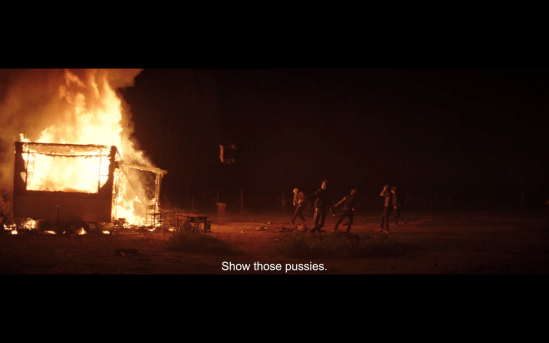
Four teenage boys and four teenage girls decide one summer to live free, without inhibition, and to make as much money as possible. Discovering an abandoned caravan in the middle of nowhere, they set up their home away from home where doing what they want, and who they want, becomes a way of life. Sexual freedom and adolescent independency quickly leads the friends down a path of miscreant wandering and sordid pornography and prostitution. When one of the teens accidently dies, four accounts of what happened are told aloud to the court and with each version, the truth becomes indistinct amongst the slander, exploitative sex work, and their anarchist ways that surround a seemingly corrupt politician.
Debased youth bored with the common fabrics of society stitch their own downfall into extreme moral degeneration in Rene Eller’s 2018 dramatic-thriller from the Netherlands entitled “We.” Also known as “Wij” in the Belgium tongue, Eller tackles the cinematic adaptation of an Elvis Peeters’ novel of the same name from 2009 with not only directing a compelling and frightening image of idle hand youth, but the filmmaker’s also credited as penning the non-linear script told in four chapters that highlight four out of the eight teens’ versions of events and how that fateful summer not only saw their ethics become shattered, but also their close-knit friendships. Eller also co-produces the film, working alongside production companies Pragma Pictures and New Amsterdam Film Company.
“We” consists of a young cast, in age and in experience, bred from the Netherlands and though virtually credit-less, powerful performances from the lot all around that touch not only the venereal stimulators, but also reaches the twisted knot inside the gut of how being human equals being depraved. The four chapters begin with Simone, a young man smitten by the Femke (Salomé van Grunsven) who becomes a catalyst for the trial, played by an Anton Yelchin lookalike, Tijmen Govaerts. Govaerts gleams in Simon’s adolescent jubilee of love, sex, and carefree attitude. His story is followed by Maxime Jacobs’ Ruth, a 16-year-old who can’t seem to step beyond the line into total reckless abandonment, Yet, Ruth’s game for risky her own body to gain approval from her friends and for her shadowed love for Simon. Jacobs gapped teeth act as imperfect perfection upon her slumping figure sheathed in plaid, screaming purity inside her outcast shell, but Jacobs proves she can be more naughty in her character than that of her co-stars. Liesl’s third chapter paints a more grotesque picture of her friends summer. Pauline Casteleyn acts in the role of Liesl, an aspiring artist with that tough inner and outer shell Ruth aspires to but ultimately lacks. Casteleyn can cast a deadpan stare with the best of them that offers more of a chilling vibe off of Liesl, but neither of these roles could outwit, out-dominate Thomas. Aimé Claeys concludes the fourth chapter as the ringleader of the friends, or, more accurate, as the pimp and the kingpin. Thomas’ manipulate hand fosters questions about his past left purposefully open for a subjective opinion on whether his actions were that of his own boredom or being pushed to his limit by external forces. “We” rounds out with Friso van der Werf, Folkert Verdoorn, Laura Drosopoulos, Lieselot Siddiki, Gaia Sofia Cozijn, and Tom Van Bauwel.
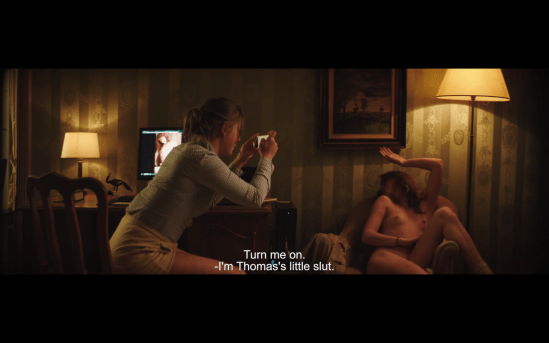
Let me start off by saying that when the teens’ entrepreneur pornography ambitions comes to fruition, these reviewers’ eyes widened at the surprising site of explicit penetrations and fellatios; however, the unexpected hardcore isn’t the act of our already very naked actors who probably stood out for stand-ins as the story leads the friends to think of using masks for anonymity and all explicit scenes of sex involve masked performers or implied scenes are angled just right from the cruel and smart tactics of Rene Eller and cinematographer Maxime Desmet. “We’s” unreserved sexual boot up the censorship’s tight behind is this junkie’s drug of choice that gets the blood pumping in all the right places; yet, “We” garnishes a heavy topical subject serrated with generational and societal gaps of corrosive virtue and speaks in volumes of what entitlement entails for a body of minors spoiled by the very community that either nurtured or tormented them and then, finally, turn on them all, parental or not, with harsh repudiation. As a sincere compliment to director Rene Eller, “We” belongs in the maladjusted family tree that also bears the rotten teenage fruit of Larry Clarks’ “Kids” and Catherine Hardwicke’s “Thirteen” and harks back to the Golden Age of Dutch Cinema with the Dutch Sex Wave from the 1970’s which produced controversial erotica with “Blue Movie” and “My Nights with Susan, Sandra, Olga and Julie” from Scorpio Films. “We” has a friendly look and feel of a 70’s film despite modern devices, making the resemblance to the Golden Age that much striking.
From the Netherlands’ festival circuit comes the highly engrossing, explicit drama “We,” distributed stateside by the Philadelphia based Artsploitation Films onto an unrated director’s edition Blu-ray home video release. Presented on BD-25 in full HD and in a widescreen, 2.65:1 aspect ratio, impressive textures flourish every inch of skin of the actors and in the panning ariel shots, which are, at times, hard to obtain. Despite some early on aliasing during the opening scene and a bit of warm washed coloring that doesn’t pop with a colorful hue range, I’ve still become satisfied with the end result that sells the illusion of Summer (you can see the hot breath during some outdoor scenes), the immense use of natural lightening, and the skin tones announce a fresh feel for the flesh aplenty. The Dutch language DTS-HD Master Audio mix holds nothing to ill speak of with a rendered clear dialogue, ample range and depth, and subtitles that sync fine with clear delineation and no mistakes. Other than a static menu, the only other bonus on this feature is the explicit reversible Blu-ray cover that displays the bare ass(ets) of half the cast from one particular scene. There’s also the PG cover that you’ll see below to not offend any sensitive souls. Coinciding with being a great story, “We” is also an important film of human callousness hidden within the prospect of free love, an age-old infiltration and exploitation concept captured by Rene Eller’s subversive eye and Elvis Peeters sage mind.








 It's Bloggin Evil!