HELLelujah! God Does Not Deliver Us From EVIL! “We Still Say Grace” reviewed! (101 Films / Digital Screener)


A family living in deliberate solitude looks to God to provide them with everything they need to sustain.  Harold’s two teenage daughters have never experienced beyond the 14 acres of land their father and mother own, but the youngest, Maggie, can’t help but think of the wonders outside her father’s god-fearing, draconian sheltering.   When three teenage boys travelling to California suddenly break down on Harold’s remote land, an eager Maggie can’t wait to taste a mere glimpse of their perception of the outside world.  Being a good Christian man, Harold welcomes the hapless travelers into his home and convinces them to follow the rules and stay the night, but the boys’ seemingly happenstance car troubles is manipulated into an unavoidable sign of God’s will, or at least so in Harold’s eyes, and he decides to carry out a predetermined family suicide pact for him and his family to be welcomed into the gates of Heaven.

The one think learned, or maybe had shed more light on, out of this pandemic is the unstable relationship people have with God.  Religious extremist have weaponized the Powerful and Almighty against every day people like you and myself with contentious, hate-filled vocabulary such as damnation, burning, hell, etc., for those who do not seek his glory the way asininely seek it.  “We Still Say Grace” epitomizes that very lifestyle of devout fanaticism that has also been highlighted with buffoonery as the very same people who verbally condemn others usually don’t walk-the-walk but only talk-the-talk or are a charlatan involved in a more sinister plan.  “The Lodge’s” Brad Helmink and John Rauschelbach write and direct the film that has become their second feature horror film produced by the filmmakers under their Brothers Shamus Pictures, Mark Sonoda of Dauntless Studios, Room in the Sky Films, and Lexicon Entertainment. 

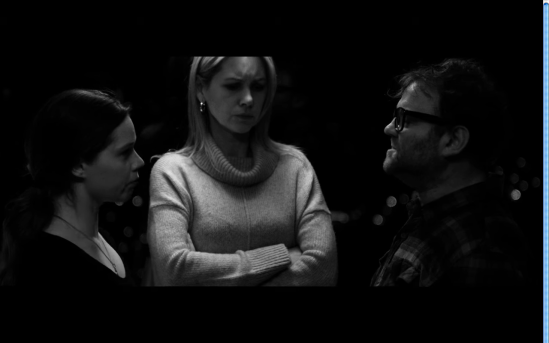
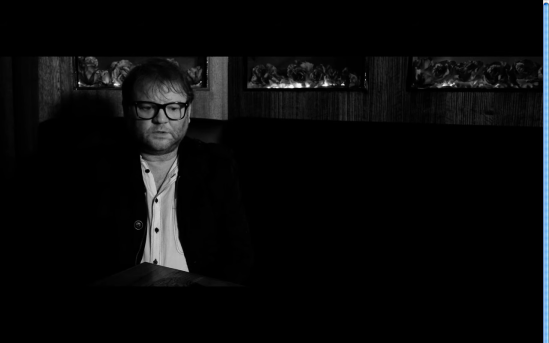
Now, I’m not a religious man or spread the word of the divine in my reviews, but God love Bruce Davison as the “Dahmer” and “X-Men” actor is a silver fox crazy man of God living rurally with his wife and two teenage daughters.  Davison relentlessly rallies Harold’s madness and is having a good old time performing as a man with a hidden agenda.  Harold is an intriguing character with little-to-no information about the character’s background or reasoning for being unreasonable, but that doesn’t seem to faze the legendary actor who had cut his teeth into horror 50 years ago as the original rat-speaking avenger, “Willard,” as Davion trots down a path of deceitful radicalism and manipulative exploitation.  Those he unscrupulously cons with pious smoke and mirrors are his own family in wife Betty (Arianne Zucker, “Days of Our Lives” daytime soap opera), Sarah (Rita Volk), and Maggie (Holly Taylor, FX’s “The Americans”).  As a viewer who is currently, at this very moment, chin deep in catching up on FX’s Cold War espionage thriller series of Soviet spies living as ordinary Americans in Washington, D.C. as they carry out missions in the name of Communism, I found difficult in separating Holly Taylor from her the 2018 series that ended its successful run in 2018 when she was a teenager.  Taylor’s roll in “We Still Say Grace” typecast the actress as another teen though having filmed the movie as a young adult woman, but the lighting is different and I don’t mean in a literal illuminating sense.  Taylor steps out from “The Americans’” 80’s setting and into, what I presume, is the 1990’s based off some wardrobe choices, car models, and the time frames that fit into those constructs and while she still has this inkling of suspicion that her parents are up to something, a parallel that has carried over, there hasn’t been this much ill-fitting reverence of a man hellbent on belting those he breaks bread with on a daily basis.  There is hesitancy and fear in Taylor eyes and that’s breaks up her from a reoccurring teenager role.  When the three teens (Dallas Hart, Frankie Wolf, and Xavier J. Watson) show up at the front door, that’s when things go, more than usual for Maggie, terribly awry. 

Aside from Bruce Davison, the other performances muster little faith in their roles with overplayed tropes, especially the stranded teens who could be plucked out as the Three Stooges of horror they’re so easily identifiable across the genre.  The premise itself isn’t exactly novel of a Bible thumping person teaching and preaching self-sacrifice, aka suicide, as a way to transcend beyond the heathens of this Earth but marketable and attainable as a small independent production with a California desert location, minor but effective special effects, and a handful of actors where much of the money is spent on talent.  “We Still Say Grace” is structurally very loose with character development and plot points, leaking continues dribbles of minor shifts that never patch themselves up on the backend.  For example, Harold’s not the black and white evangelical nut he seems to be but that is where his arc pauses and doesn’t backtrack into reasoning.   Helmink and Rauschelbach do better on the scene setups and interiors that make Harold uncomfortably fearsome and hostile in any context as he sometimes looms in the shadows of his farm chic house or toys with people, even his own family, like rats in a maze as he guides them along to their doom.

Premiering for the first time in the UK courtesy of 101 Films, “We Still Say Grace’s” penitent themed horror-thriller releases digitally this month of May.  As for the imagery presentation, and take this with a grain of salt with any digitally released film, the nearly 94 minute runtime seems to be filmed with a sun derived dust and light haze that I would compare the appearance more akin to trying to look through the bottom of a hard water stained glass.  Under the cinematography of Douglas Quill, the haziness plays into the rustic and dusty atmospherics that give age to the story and Quill frames Harold as a dominant and isolated figure, especially amongst the holy trinity ablaze in human flesh, as if he was the sole antagonist against the world.  The moment for shattered lives remains intent on the very edge of our corneas with the holy hell of “We Still Say Grace’s” patience brittle villain ready to gaslight and sacrifice anyone resisting against the grain of God’s good graces. 

EVIL Slums In The Company of Others. “Hausen” reviewed! (Sky Atlantic / Eps. 1-4 / Digital Screeners)

Jaschek moves into a property supervisor position of a slum housing complex with his 16-year-old son, Juri, after the tragic fiery death of his wife. Trying to rebuild and rebound on what’s left of his and his son’s life and waiting for the insurance money to pay out, Jascheck tends to the decrepit building maintenance and, over time, meeting the cold, strung out, and peculiar tenants while Juri attends school and becomes interested with the building’s discretionary drug pushing youths. When a young couple’s baby goes missing, the mysterious disappearance motivates Juri into an investigation, leading his curiosity to discover that the building itself, and the insidious sludge that oozes nearly from every crevice, feeds on the suffering and pain of the inhabitants.

When a black, wet stain on the wall embodies a biological presence of asexual spores and elicits the instinctual first thought of alarm sounding bells ringing to back away in your mind, this is how Till Kleinert and Anna Stoeva injects fear and biotic crud with their new horror television series, “Hausen.” It’s Bloggin’ Evil got to sample the first four episodes of the German 8-episode series that showcases director Thomas Stuber’s dank complexion of anthropomorphized leeching of the lower class, filmed partially inside an East Germany, 20 plus year abandoned hospital, once known as the GDR Hospital, located in Berlin. Kleinert is the writer and director of 2014’s “Der Samurai,” pulling from his film the lingering disembodied or dreamlike and integrating that surrealism imagery for the new series, and collaborates with first time writer, long time producer Anna Stoeva, one half of the boutique film production company, Tanuki Films. “Hausen” is a production of the Berlin-based company Lago Film, who co-coordinated the production on David Cronenberg’s “A Dangerous Method,” under department head, producer Marco Mehlitz.

“Hausen” primarily focuses around a reestablishing father and son, Jaschek and Juri, after a tragic house fire that claimed the life of Juri’s mother. The series starts off with the two driving up to the housing complex and breaking themselves right away into a runaway rundown building that needs more than just a sprucing up. “Transporter: The Series'” Charly Hübner plays the handy father, Jaschek, with non-expressive can-do attitude that becomes a block of interrelation between him and his son Juri in another unreadable performance from Tristan Göbel of Lago Film’s “Goodbye Berlin. That inexpression is the intentional tone of “Hausen’s” entire cast of tenant characters who float through a barely-living existence, most living grubbily, few living in humble comfort, but all being exploited by the organic narcotic that’s living, breathing, and striving from the inhabitant suffering. Hübner and Göbel impassively shepherd along the story along that introduces new characters into new episodes that digs deeper into the complex’s black, oozy, heart symbiotically connected to a caretaker known as Kater, the very first character Juri and Jaschek meet upon arriving at the building for the first time. The autodidact Alexander Scheer touts an unkempt, dirtied, and made to look like a complete hobo in Kater who, unlike his onscreen cohorts, vitalizes the screen with wild-eye expressions and an unsurmountable jocularity and puckish wit. The series rounds out with stars Lilith Stangenberg (“Bloodsuckers – A Marxist Vampire Comedy”), Stefan Haschke (“Krabat and the Legend of the Satanic Mill”), Daniel Sträßer, and Andrea Guo.

“Hausen’s” intended aloof pulse courses consistently throughout, at least in the first four episodes, that piece together and induce layers of grayscale personalities that have been cross affected by the building’s malevolent life force and the subjugating delinquent class that feel no need to make their surroundings better as their stuck in a vicious cycle rut of drugs and despondency. “Hausen” allegorically uses horror to intensify the already tragic aspects of corrupted ethical life choices people make when drugs are prioritized as more important than others and even their own lives. The first episode features a young couple with an infant and as they attempt to stay clean and withhold what little money saved for a new and better apartment, the building reacts by taking measures in the form of tormenting the husband’s brittle sobriety as he’s caring for the baby alone. He passes out and wakes to find the familiar narcotic he can’t seem to escape on his person. The scene mirrors good intentions of abusers who fall into withdraw with the withdraws being symbolically displayed as the building’s evil doings to keep the pain profit flowing. Overall, “Hausen” drips with underbelly exploitation that doesn’t stop with just the adverse, malignant housing as it spreads into Juri and Jaschek’s tense relationship and into the ounce of good left inside them, fleshed out in scenes that become a crossroad of choices where choice A) is to do the worst thing possible to compromise the smidgen of hope left or choice B) to reserve themselves into taking the harder, but good moral standing, road and work at rekindling a tattered bond that would go against everything the “Hausen” has thrown at them.

A skyscraper of bleak and austere horror, “Hausen” houses a slick secretion of mystery in every crevice. The Sky Germany produced horrifying mystery-thriller is now out in the UK on Sky Germany’s sister-programming, Sky Atlantic. A statically lit doom and gloom scenes never venture away from the tinted battleship gray and blue color scheme that goes hand-and-hand with a cleaned up GDR hospital shots from cinematographer, Peter Matjasko, that’s reminiscent of David Fincher films = think “Alien 3” but with way less yellows. The black sludge is a satisfying unnatural pigment of midnight black that contrasts nicely against said tinted lens coloring, providing a catheter of continuously streaming tenebrosity. We’ll have to wait and see how Juri, Jaschek, and the rest of the tenants fair in the last four episodes that shafted us with a plummeting cliffhanger midway through and, hopefully, ItsBlogginEvil.com can provide more coverage on the unnerving new television series that will put a stain your soul.

Nab’em, Chop’em, and Feed’em to the EVIL Ox! “Butchers” reviewed! (Breaking Glass Pictures / Digital Screener)

After the death of their firm handed, elderly mother, brothers Owen and Oswald Watson remain isolated in the boondocks, off the beaten path to nowhere, to live in their rundown family home, like the generations before them, to do the one thing they desire and born to do – abduct stranded motorists, kill the men, and imprison away the women for their sadistic and misogynistic pleasures.  After breaking down passing through on a rural bypass, four young friends find themselves fighting for their very lives against a pair of siblings with a deep rooted heritage of experienced violence to show for it, but when one of the brothers starts to become even more unhinged than normal, the remaining survivors seek to take advantage of the situation to escape, but their captors know the woods inside and out.

Everyone believes Canadians are overly nice and well-mannered.  Our considerate neighbors of the North withstand the plethora of static noise from the turbulent South, willing to forget and forgive in a moments notice with nothing more than a smile and slap across the back, but has anyone ever bare witness to Adrian Langley’s dog-gonna-hunt, exploitation film, “Butchers,” hailing from Ottawa, Ontario?  The 2020 survival horror thriller displays the unseen dark side of Canadian’s grinning and friendly façade and, boy, does it familiarize and rival some of the similar backwoods doggedness we’ve seen in the last quarter century.  The film is written and directed by Langley and co-written with Daniel Weissenberger (“Come True”) in the intent of being a gritty, hillbilly-gone-wild hoedown with butcher blade sharpness.  Langley’s cinematic shiplap usually provides hard to swallow and violent themed content set to put one on tenterhooks established from his string of unflinching crime dramas (“A Violent State,” “Crook”) when the director is not moonlighting as a made-for-television PG-rated filmmaker for the holidays (“Candy Cane Christmas,” “Homemade Christmas”).  Christmas is long gone and a long way off and no amount of jovial spirit can guarantee a happy ending in “Butchers,” a production of Langley’s Unit XIX Films and Nicolás Onetti, producer and filmmaker behind retro-manufactured giallo horror “Abrakadabra” and “Francesca,” attached under his production banner, Black Mandala.” 

Principal characters are essentially the entire cast, small in size but pack a punch with their performances.  Starting off with the brothers, Owen and Oswald Watson, whose story begins during the snow and icy-filled heart of the winter months with them standing graveside, freshly filled with the remains of their mother, well before the hapless four protagonists breakdown in the summer’s heat.  The Watson boys story arc from second fiddle to top brass in a brief moment of background with the death of their mother as they quickly set to work pouncing on a young couple and exploiting the chained up and captive wife/girlfriend for carnal pleasure while abiding by a certain set of harshly punishable rules.  Television’s “Age of the Living Dead’s” Simon Phillips and Michael Swatton reteam in their respective roles of Owen and Oswald who are very much human characters with carefully planned and executed uncontrollable urges, callous whims, and fallible actions, sullied by a mixture of mental disease and rotten nurturing.  Philips is terrifying as in the intellectual brother, with his sophisticated word hole, very willing to get his hands dirty as the more perverse of the two brothers, but his relationship is on the rocks with his unstable brother, Oswald, as Swatton channels the internal family quibbling mindset of Leatherface from the “Texas Chainsaw Massacre” franchise with the exception of the crossdressing obsession and the iconic, rip-roaring chainsaw.  Oswald instead wields a custom butcher’s knife with jagged shark life teeth as he manically runs through the forest hunting down the four youngsters played by Julie Mainville (“Ghastlies”), James Gerald Hicks (“Killer Mom”), and “The Nights Before Christmas’s Anne-Carolyne Binette and Frederik Storm.  With these lambs for the slaughter characters, this is where Adrian Langley succumbs to tropes that instill a misplaced sense of courage, uncontrollable and shallow horniness, and a turmoil amongst friends to be the divisive factor leading of their fate.  “Butchers” rounds out the cast with Jonathan Largy, Samantha De Benedet, Blake Canning, and Nick Allan as uncle Willard. 

“Butchers” does have blatant derivative bones underneath a body that echoes the frameworks of pioneered films from the aforementioned “Texas Chains Massacre” to more recently “Wrong Turn,” the original film series formed in 2003 about inbred, cannibalistic mountain people.  These powerhouse of unpretentious and bloodthirsty franchises inspired much of what you’ll experience in Langley’s homage of a cyclical subgenre; yet, the filmmaker’s tale of two brothers with a bloodletting scheme of their own doesn’t lend itself as being a hack work nor does the story render like an atrocious carbon copy but, rather, “Butchers” lives in a moment of simple, matter of fact craziness living in the dark corners of the seemingly innocuous world.  Owen paints a near perfect picture of the one in a million chance that people, like his hapless captives, fall into the position they’re in, sophisticatedly monologuing with intent to his bound prey in a pair of scenes that slice a thinly opened gap of possibility and that, right there, is scary.  “Butchers” builds no momentum, but, instead, goes right for the throat straight from the get-go as Langley reinforces the attitude that this can happen to anyone by not getting too familiar with characters in their backstories.  In order to establish a pattern of action and to lay foundations in who we should and shouldn’t root for when things go to hell, virtue-less unfaithfulness becomes a promising wedge that doesn’t necessarily cause descension in the ranks of survival, but paves a trope-laden path of who will ultimately perish.

Backcountry exploitation might have seem to have run it’s course. I mean, really, how many times can crazy deformed cannibals wreak gut-spilling havoc on the naïve outlanders to their idyllic provinces? For me, as many time as it damn well pleases, especially when fundamentally satisfying as Adrian Langley’s “Butchers,” distributed by Breaking Glass Pictures and now available streaming on Prime Video. “Butchers” will be available on DVD at a to be announced date. Langley, wearing multiple of hats in the spirit of indie productions, dons the director of photography bowler hat…well, I don’t really know what hat the DOP would wear, but we’ll represent the position with a bowler for now due to the deluxe sophistication the bowler implies while still sustaining a classic touch and that’s how I see Langley’s clean and competent cinematography style whose able to frame scenes that force audiences to be a part of the action . As soon as a character turns to speak to another character or when a car hood slams, an effective rush of adrenaline courses through the veins when out of nowhere one of the brothers pop onto the widescreen 2.35:1 aspect ratio presented screen. “Butchers” come with no bonus material after a 92 minute runtime, but a single scene lingers during the credits that, again, harps back to a certain dancing killing machine from the original “Texas Chainsaw Massacre.” May not be an original concept, but “Butchers” can still castrate the soul with an exploitatively merciless family tree sowed with perversion and bloodlust.

Rent or Own “Butchers” on Amazon Prime Video! Click the Poster to Watch!

In the S.H.U., The EVIL Comes From Within. “Caged” reviewed! (Shout! Studios / Digital Screener)

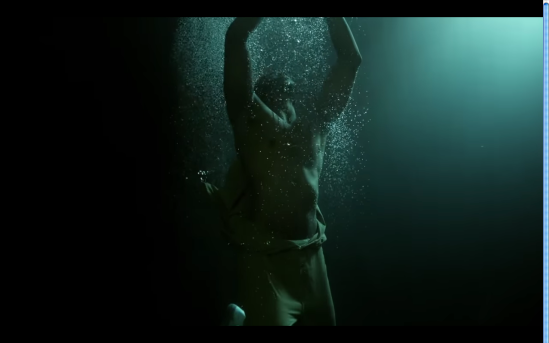
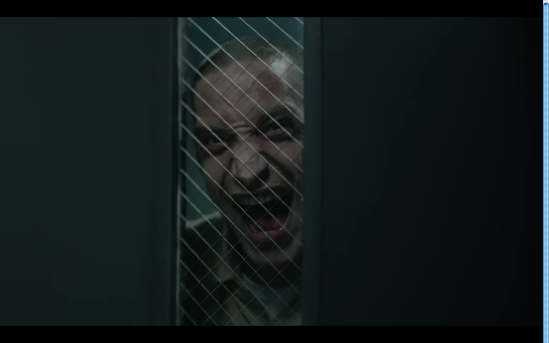
Psychiatrist Dr. Harlow Reid is sentence to life in prison after being convicted of murdering his wife.  With his assets frozen and his legal representation dropping him as a client, Reid is forced into being his own legal counsel.  To make matters worse, a female prison guard’s perverse pleasure is to slowly torture him while in her custody at solitary confinement.  His only means to enter general population is to behave and confess to the crime he contests, but he continues to maintain his innocence by refusing to sign the confession, remaining alone and withstanding abuse until he can write a formal plea to a judge to reconsider the facts in his case.  As the days turn to weeks and weeks turn to months, the usually stable minded Dr. Reid, alone with his thoughts, has his fortress of reality buckle under the heavy burden of isolation compounded with the maltreatment and his personal demons that struggle with the actual events in his wife’s sudden death, questioning himself that her death might have been at his hand.

Inside the clink is a maelstrom set in a pressure cooker. Ready to explode at any moment are cons of, mostly, unsavory personalities simmering with pent up anger, desperation, and ill-will positioned by equally fraught guards harried by timebomb temperaments and undervalued in training and payment. In Aaron Fjellman’s written and directed debut feature film, “Caged,” the strain festers toward being hell behind bars in a ruthless determination of survival. Also once known as the working title, “The S.H.U,” Fjellman constrains his American-made, and inspired, big house thriller with a minimalist approach set with a backdrop of chiefly the solitary housing unit to lock up viewers in, as witnessing accomplices, with a protagonist’s downtrodden path of mental degradation as well as being humanly degraded. Aaron Fjellman produces his film for production company Panic House Films and Shifty Eye Productions with the latter a company created by the film’s star, Edi Gathegi, serving on the board as executive producer.

It’s no big surprise that Edi Gathegi dons the prison house jumper and clanking shackles in this social commentary thriller. The “Blacklist” and “X-Men: First Class” actor knows a good role when he sees with, especially inside the body and mind of one Dr. Harlow Reid. Gathegi regularly has to battle with himself filtered through the madness of the S.H.U. mind-breaking solitary with a little fanning of the flames from sadistic prison guard, Officer Sacks. In an extremely ghastly transformation, Melora Hardin goes from a classic beauty with a big smile and high cheek bones to baring an unflattering lumpy posture with hair pulled back in a tight, short ponytail overtop a demonizing trope of a scar down the left side of her face and an assured cockiness symbolized by the gum smacking that’s sometimes becomes the only thing in the camera frame. As Gathegi masters the ideals of a convict presuming himself innocent, Hardin lurks beyond his cell door as the devilish guard over his shoulder. Officer Sacks defines a face with a story and her story has a hard on for power over prisoners, especially affluent ones or, maybe, those of African American descent in a tinge of racist undertones as Fjellman notes on the racial injustices in the prison system. A smidgen of that notion is supported shown in Officer Sacks behind-the-back passive aggressiveness toward Warden Perez. “Annabelle’s” Tony Amendola truly delivers being a heartfelt ally, yet sturdy firm handed warden with Reid. Perez, an expressed Catholic, seeks Reid’s redemption through the admittance of wrongdoing and that becomes the steadfast barrier Reid has to hurtle that will test his convictions and his sanity. “Caged” rounds out with Mick Jagger’s son, James Jagger, as Reid’s unhinged S.H.U. bedfellow who speaks in hyperbole of inmate hauntings in an opaque analogy of guilt mixed with madness, and “Westworld’s” Angela Sarafyan told through flashbacks and supernatural induced psychosis as Reid’s wife, Amber.

To tell an inmate’s nearly yearlong story succumbing to the brutal and segregating abuses surrounding him in solitary confinement is a tremendous feat working into the mental cracks and exploring the fallacies. Yet, Aaron Fjellman made his fictional interpretation look easy by relating a surreal, but telling story in just 80 minutes, gripping with metaphorical concepts of an overcrowded prison system preying on uncontested obedience, even if the lengths taken to obtain complete compliance is trauma exacting torture of draconian policy, by primarily privately funded institutions with little-to-no funding or resources to manage. “Caged” is very fleeting with montage upon montage of Harlow Reid’s day-to-day, but never becomes a monotonous roundabout vivarium of Reid sitting hopelessly-looking in his cell. Gathegi’s put to work as a man determined to challenge the system that engages Reid to keep sharp and in shape by working out in various exercises, entertain an unhinged neighboring inmate with his ramblings and blurbs of crazy talk truths, and feverishly work on his legal case by any extraordinary measures, including using his own blood as ink. Yes, “Caged” can elicit a genuine sense of horror, a perspective on psychological terror, and be an eye-opening gasp of real life prison dread when good versus evil is mirrored in reverse with the good guys not being the prison guards. Fjellman imprisons us all in “Caged” by culminating the fact that no matter your social circumstances, the S.H.U. breaks everyone.

Orange may be the new black, but Aaron Fjellman’s bleak fretting “Caged” jars with somber authoritarian power. The new thriller released by Shout! Studios premiers unrated on VOD and digital January 26th. “Caged” is film by director of photography, Jessica Young, with an Arri Amira camera and presented in a widescreen format, 16×9 aspect ratio, and, typically, the Amira camera versatility is in the use for low-budget films, perfect for “Caged” in it’s nearly singular setting and two-tone, steely gray and black, atmospherics that naturally have devoid color vibrancy. CJ Johnson, who will soon see his musical scores in a pair of upcoming Friday the 13th fan films, lines “Caged” with a soft, building industrial score that tunes the disquiet in Reid’s racked inner conflict. With this digital screener, there were no bonus materials or any bonus scenes during or after the credits. Through the use of visual and audible horror tropes and with potent performances from Edi Gathegi and Melora Hardin, “Caged” is a ghost story told for the unspoken voices victim to long-term confinement.

Click the poster to pre-order “Caged” at Amazon!

When EVIL Isn’t That Black & White. “Choir Girl” reviewed! (Nexus Production Group / Digital Screener)

Eugene lives a lonely, pitiable existence.  Residing with his ailing father in a slum neighborhood, his photography background captures the crime and the desolation that surrounds him, snapping pictures without ever interceding with his crime-riddled subjects, in an attempt to hold an exhibition or sell his work to a high profile magazine, Slipstream, as his ticket out of the despair that engulfs him.  When Eugene stumbles upon young teenage girls being drugged and held for prostitution, he becomes fixated on Josephine when a low-level editor, seeing her as a professional stepping stone, prods him for more pictures that evoke hope out of her situation, but when he finally intervenes, helping her escape, Eugene falls into a world of a massive prostitution ring with doctors, cops, and major organizations on the payroll and a kingpin named Daddy at the helm.  The deeper the debt placed upon him for showing compassion to Josephine, the more the lines blur on whether he’s become his muse’s lone savior or just his meal ticket out his current life.

How far will your moral principles take you to save a teenage girl when you’re locked into a no-win situation?  That’s the theme explored to a shocking sexual assault conclusion in John Fraser’s 2019 unscrupulous Australian thriller, “Choir Girl.”  Introducing Fraser’s first credited written and directed full length feature film, shot entirely in black and white, the Melbourne arthouse and a goose egg-fairytale version of “Pretty Woman” speaks volumes toward the perceived illegality of immigration, the horrors of sex-trade, and the touch-and-go balance act between doing what’s right and self-serving opportunities with a 15-year old girl’s fate dangling at the end of a line.  “Choir Girl” is produced by Ivan Malekin under his Melbourne based label, Nexus Production Group, along with Lucinda Bruce serving as co-producer.

To carry “Choir Girl” through the muck of it all, a strong performance must arduously burden the gravity of the content and Peter Flaherty astounds with an ingloriously flawed and unlikely hero, Eugene.  “The Butcher Possessions” and “KIllervision” actor masts a greasily haggard with bordering neurodevelopment issues, disheveled in his attire, and walks with a noticeable limp, made intentionally noticeable when as he walks away from characters and situations.  Though Eugene seems meek, the shutterbug aches to improve himself by seemingly exploiting others as a freelance photographer and being persistent in that pursuit until becoming engrossed into a 15-year-old prostitute’s life struggle blossoming before our eyes a rather unsettling grown man and teenage girl relationship that assumes a pedophilia ideology of adoring the child to the extent of protection, but also falls in to grooming and sexual exploitation.  The film introduces audiences to Sarah Timm, playing Eugene’s muse, Josephine, an Eastern European illegal immigrant who literally has nothing left that is her own, this including her body, when forced into sex slavery so when Eugene and other characters call her diminutively by Jo, she immediately corrects them to call her Josephine in order to keep the one thing left that is still hers, her name.  In her first feature role, and a mightily demanding role it is with the amount of discomfiture of playing essentially an abused child, the German native will have audiences overlooking the fact that she’s portraying a teenager in the sordid sultriness of sex-trafficking with crafting Josephine’s war-torn history and pre-adolescent childhood stories as always the girl in the background, the unpretty forgotten girl that blended in and no one noticed, until she’s a part of a much larger, more ferocious, uncompromising system that Daddy (Jack Campbell) dictates with CCTV live feeds of every sleazy, scummy hotel bedroom in his syndicated footprint.  The cruelty that Jack Campbell reins savors every facet of Daddy’s being on screen with an intent to be a immovable roadblock in Eugene’s advanced for progress and for John Fraser’s “Choir Girl,” the character development and personalities find justification from the cast with the exception of one, the low on the totem pole and self-absorbed Slipstream magazine editor, Polly.  Krista Vendy imposes on Polly’s rabid  narcissism with an incredibility that becomes the underbelly amongst a bloc of solid performances.  Andy McPhee (“Wolf Creek”), Lee Mason (“The Caretaker”), Jillian Murray (“Body Melt”), and Kym Valentine fill out supporting roles. 

I love the juxtaposition opening of Eugene in his dark room in the middle of photographic processing his oblivious subjects, including a drug abusing child with a hypodermic heroine needle sticking out of his arm, a blowjob being serviced between a wall and bushes, or the aftermath of man being beaten with his assailants walking away from his leveled body, and then the title fades in from black and the next scene is of a framed magazine cover with the cover title “It’s All Back and White.”  The sequence sets up perfectly the entire premise driving “Choir Girl’s” gray area circumstances that nothing substantial, meaningful, or controversial can be black and white. Plus, the entire film is shot in black and white furthering the contrivance of the theme. The gray area challenging Eugene is a tightrope walk when squeezed for payment for snatching Josephine by the amoral organization claiming property theft, making him submit to the idiom of pulling his strings like a marionette or shooting at his feet to make him dance for insatiable perverse satisfaction. Eugene rarely displays remorse in his demeanor, face, or actions for the things he does and doesn’t do when faced with adversity in a slither of sociopathic idiosyncrasy, but when outright criticized for his inaction, he’s able to right wrongs with deplorable methods like a toddler trying to mop up a grape juice spill with mother’s expensive, white dress. There’s a bit of innocence or naivety in Eugene’s mind as you can almost see the gears slowly spinning when confronted but in the defense of the man who no really gave the time of day, those gyrating mice wheels of delicate thought snuck past every contingency against Eugene surviving Daddy’s deadly game, leading to an unsavory solution that puts the viewer in an awkward spot to either avert the eyes or remained captivated to see it through.


I, for one, remained seated, steadfast to the end, hypnotized by audacity of John Fraser in his feature film directorial, “Choir Girl,” that has arrived onto Apple’s iTunes. The unrated film is presented in it’s original aspect ratio of a widescreen format and will have an English language Dolby Digital 5.1 surround sound availability. Though derided as kitschy at times, the black and white veneer works here inside “Choir Girl’s” vascular system of catch-22s and director of photography, Mark Kenfield, rides a consistent straighten arrow style with steady cam shots, decent framing, and some tracking shots without pushing the envelope in regards to angles or oscillation. There were no bonus content or additional scenes during or after the credits. “Choir Girl” sings no praises of hallelujah. Offers no solace in time of hardship. If you’re looking for a movie that touches you, then you’re in for a rude awakening as “Choir Girl” obliterates the moral standards, leaving faith outside, with a severe penance in abetting the Devil’s work, selling their soul to do what’s right.