The Golden Ninja Warrior Turns Good Ninja Masters to EVIL! “Ninja Terminator” reviewed! (Neon Eagle Video / Blu-ray)

The Golden Ninja Warrior is the corrupt Ninja Empire’s most valued and powerful artifact with mystical powers to whomever posses it’s three pieces, granting them near invincibility against enemy attacks.  The Supreme Ninja leader displays the power of the golden bust, resembling a beastly torse and head wielding a katana, to three of the Empire’s Ninja Masters – Tamashi, Baron, and Harry.  The three Ninja Masters betray their supreme leader, each stealing a piece of the statue for their own intent and purposes.  With one piece back in the hands of the Supreme Ninja leader after Tamashi’s demise, the now crime boss Baron seeks Tamashi’s piece and will do anything, and kill anyone, to get it with the aid of his cruel right hand man Tiger Chan.  Meanwhile, Harry resigned from the Ninja Empire to reform the organization’s criminality but has been unearthed by the Empire’s Supreme leader with an ultimatum to return the pieces of the Golden Ninja Warrior.  With the help of his cocky and confident partner, Jaguar Wong, Harry and Jaguar investigate into Tamashi and his brother’s death, try and protect their surviving sister from those looking for Tamashi’s piece of the Golden Ninja warrior, and defeat any Baron or Empire warriors that stand in their way.
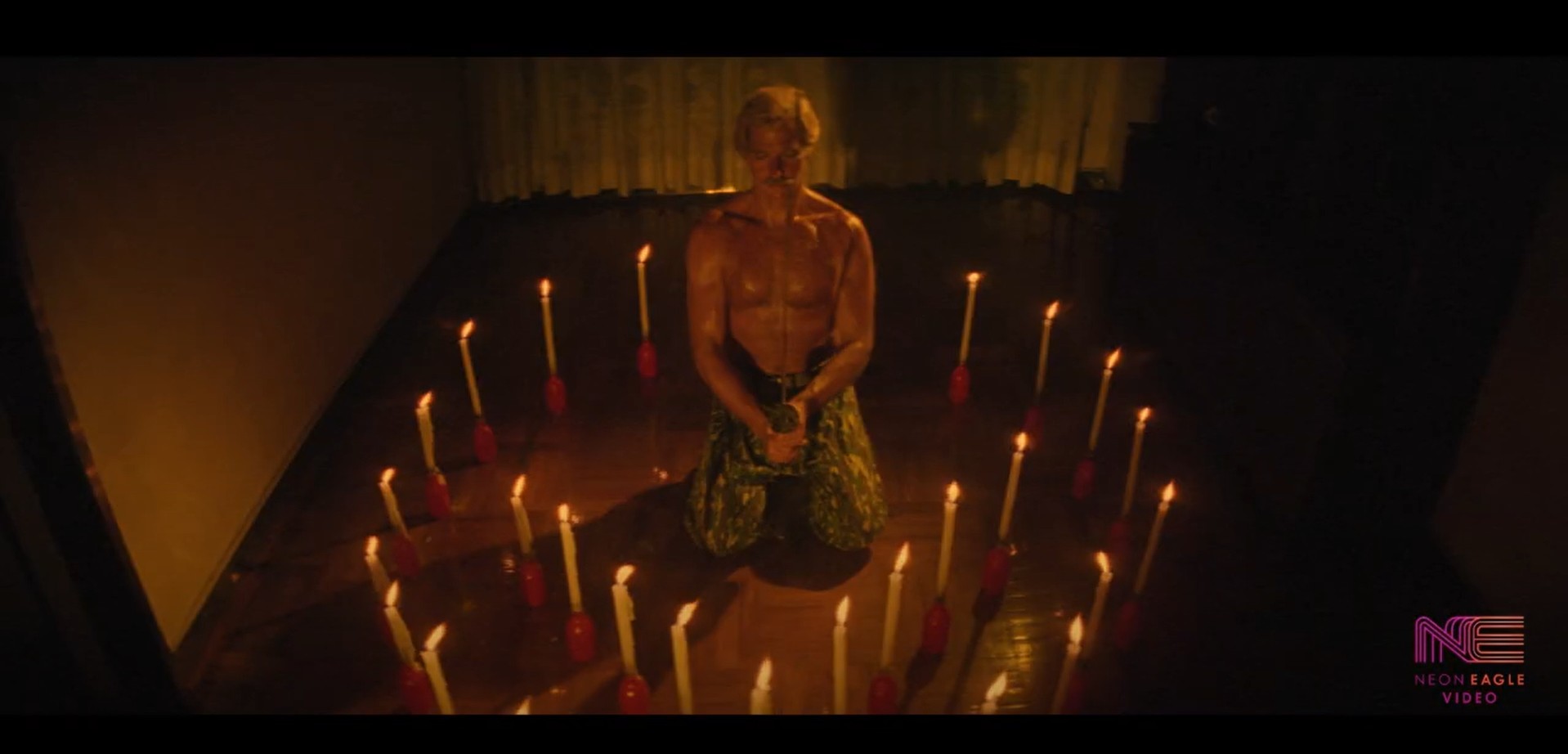
One of the numerous released Godfrey Ho productions in which the director shot new scenes with Caucasian, abroad actors and edited them into an pre-existing film his company owned the international rights.  “Ninja Terminator,” a bestowed title at the height of James Cameron’s highly popular cybernetic, time-travelling thriller “The Terminator,” is the 1986 Hong Kong feature that breathes new life into the South Korean,1984 released, martial arts gangster film “Uninvited Guest” as Ho splices new additional footage to create his own, half-cocked storyline for a cost-effective ninja themed film starring a recognizable white actor.  Ho writes and directs the IFD Films production that’s produced by Ho’s makeshift Ninja feature team of Betty Chan (“Ninja Strike Force”), Joseph Lai (“Full Metal Ninja”), and Steve Kam who regularly took popular U.S. tiltes and integrated them into their own for advantageous marketing.

Where to start with actors and actresses?  Two films shot in two completely different times with renamed characters and additional characters in a jumbled-up mesh of a ninja film.  Lets start with Richard Harrison, an American actor with muscles and good looks who couldn’t quite land the parts he wanted in his home country but found lead man success in other parts of the world, especially in the filmic industries of Italy (“Orgasmo Nero,” “One Hundred Thousand Dollars for Ringo”) earlier in his career and, in this case, Hong Kong (“Inferno Thunderbolt,” Diamond Ninja Force”) later in his career collaborating a handful of times with filmmaker Godfrey Ho.  For “Ninja Terminator,” Harrison isn’t a stealthy cybernetic ninja master but rather an idealistic, benevolent ninja master sporting a unique camo ninja-yoroi to, I guess, blend in around his home and urban environment…?  Still, the camouflaged attire has to be more clandestine than the hot red ninja-yorois of the Ninja Empire.  At least fellow western actor, Jonathan Wattis, as one of the three ninjas who stole a piece of the Golden Ninja Warrior statue and became a crime lord himself, donned a near traditional, black-dyed ninja garb.  Harrison and Wattis do the best they can being spliced into Jack Lam’s film “Uninvited Guest.”  Reconstructed or replayed to be named Jaguar Wong, for his character’s Jaguar fighting style, Jack Lam bests Wattis and levels with Harrison for screen time as a fellow principal lead despite the 2-3 year difference between principal photography but Jaguar fits in aptly enough into an inept chaos of a near nonsensical ninja narrative that jumps to inconclusive subplots with little connective tissue to the core plot.  Maria Francesca, Jeong-lee Hwang, James Chan, Simon Kim, Phillip Ko, Keith Mak, Tae-Joon Lee, Nancy Chan, Gerald Kim, Andrew Lee, and Eric Leung costar.

Cheaply made knockoffs and spirited, gung-ho capitalizing on popular film titles saw fists-of-fury in Hong Kong circa 1970s through the 1980s, much the same way the Italians also didn’t believe the copyright laws when they too took advantage with unofficial sequels, especially in the horror genre.  “Ninja Terminator” is obvious one of those projects and the sly Godfrey Ho manipulated the international market to garner new public interest in what is basically an old film with additional scene, a scheme done pretty much on the regular in various countries, even in the United States.  However, “Ninja Terminator” is not a good movie but rather a hilariously bad one weighed down by irrelevant offshoots to flesh out a scantily structured half-script.  With the additional scenes of Richard Harrison and the others spliced in, plus Jack Lam’s one-man army showdowns against henchmen and sub-bosses, the combat saves “Ninja Terminator” from full frontal embarrassment with competent choreographed fights, plenty of sword, ninja star, and ninja trickery play, and a fair amount of acrobatics, even if some of the scenes are just gratuitous cartwheels and flips in an ostentatious display of skill and of trying to raise the value of a low-budget production.  Granted, there are no cartwheels or flips in Jack Lam’s storyline, nor is there a single ninja, but Lam’s take-on-the-world scenes are confidently hip for the period and that is the jelly to the bold Ninja peanut butter that makes “Ninja Terminator” work on an amusingly bad level. 

Neon Eagle Video, a subsidiary label of Cauldron Films that focuses on the best of the worse of Asian cinema, scour the globe and deliver the best and authorized reproduction of “Ninja Terminator” on Blu-ray in North America, restored from a 4K scan of the original negative and presented in its proper anamorphic widescreen aspect ratio of CinemaScope 2.39:1. I must agree with Neon Video Eagle that this transfer renders the cleanest and clearest reproduction to date, likely ever, in this compilation of source materials to render a corrective, singular 4K scan. The AVC encoded, 1080p high-def resolution, BD50 offers ample storage to limit or squash any compression indelicacies on an already delicate Godfrey Ho production that’s been bootlegged to bastardization for decades. Corrected color timing sizes up the landscape, the mise-en-scene elements, and the characters too with a diffused scheme that holds firm vibrancy across an early 1980’s hip and preppy Japanese fashion. The audio is a forced English dub with an encoded LPCM 2.0 mono. The ADR definitely is seen and sounded as expected with total unsynchronized lips and dialogue, especially when the story is forged from splitting two films into one. What’s also evident amongst the three-prong, rough-and-ready sound design is the unrealistic fighting sounds, overzealous and overexerted to be more like the Hong Kong Kung-Fu movies of the decade before. The last element is the soundtrack that’s got some funk and groove in its ninja-yorois that likely borrowed and repurposed from another Godfrey Ho production to fit this particular need. Optional English subtitles are avaialble.. Special features include brand new material, including an audio commentary by Kenneth Brorsson and Phil Gillon of the Podcast on Fire Network, a second audio commentary by Asian film expert Arne Venema and Mike Leeder, an interview with director Godfrey Ho Ninja Master discussing the popularity of ninja films in the United States and the appropriation of the “Terminator” title as well as touching upon Richard Harrison and his onboarding onto the film, a second Godfrey Ho interview alongside separately dubber Simon Broad Golden Ninja Dubs discussing the quick and loose ADR of Hong Kong cinema, an interview with “These Fits Break Bricks” co-author Chris Poggiali Ninjamania, and the trailer. Neon Eagle Video’s standard release, showcased inside a clear Blu-ray Amaray, presents new artwork by graphic artist Justin Coffee. The reverse side of the cover holds the still capture composition of the original one-sheet. No insert material included, and the disc is pressed with the same Coffee illustration. The region free disc has a runtime of 90 minutes and though not listed as unrated, the film is surely such.

The First Authorized Blu-ray of “Ninja Terminator” Now Available!

Your Hopes and Dreams Come Down to Beating an EVIL Fitness Center in a Workout Marathon! “Heavenly Bodies” reviewed! (Fun City Video / Blu-ray)

Move Your Butt to this Fun City Edition of “Heavenly Bodies” on Blu-ray!

Working 9-to-5 has a secretary, Samantha quits her grinding job to pursuit her passion of owning her own dancercise studio.  Leasing a vacant building with her girlfriends, they form Heavenly Bodies to let the craze of group dancing and aerobics take hold of all those interested.  The success of her rapidly flourishing business persuades her to audition to host a regional workout show while at the same time juggling being a single mother and decrypting feelings for a new man in her life.  After winning the audition, Samantha is targeted by fellow finalist and rival aerobicize instructor from a bigger fitness center having felt deserving to be the television host.  With her relationship heading for the rocks and her fitness studio building being bought outright by the larger investor, Samantha insists on an all or nothing dancercise contest against the rival studio heads, challenging her best versus their best in an hours long workout made for the TV world to see.

Dancercise.  A craze I know all too well watching my mother high-knee kick, arm-twirl, and run-in-place to the programs hosted by Jane Fonda and Denise Austin right in the middle of our living room.  “Flashdance,” “Footloose,” and “Dirty Dancing” are just some examples of the dance centric subgenre that swept through the 1980s.  In the middle of that mix is 1984’s “Heavenly Bodies.”  Written-and-directed by Lawrence Dane, an actor, who had more of a horror lining with roles in “Scanners,” “Happy Birthday to Me,” and “Seed of Chucky, who tried his hand being behind the camera, co-wrote also his first script alongside Ron Base.  The Canadian feature was co-produced by Stephen J. Roth and Robert Lantos, both of whom shared a string of erotic dramas early in his career with “Paradise” starring Phoebe Cates and the sex-comedy “Scandale” but the two parted and became more mainstream on their paths with Roth financing “Scrooged” with Bill Murray and “Last Action Hero” with Arnold Schwarzenegger” while Lantos partnered off-and-on with fellow Canadian and body-horror director David Cronenberg on “eXistenZ,” “Eastern Promises,” and “Crimes of the Future.”  “Heavenly Bodies” is a production of Producers Sales Organization, Moviecorp VIII, and is one of the few less erotic features from Playboy Enterprises.  

Leading the casting headline like her character Samantha leading a group in a dancercise routine is Cynthia Dale.  The “My Bloody Valentine” actress with curly shoulder length brown hair, an infectiously joyful smile, and killer dance body is the heart and soul of what makes “Heavenly Bodies” truly worth watching.  Her long take choreographed dances are breathtakingly fun and gracefully executed, full of energy and sizzle with the camerawork angles that move along every part of her kinetic body.  Samantha embodies the strong, independent single mother who do it on her own terms after setting passion aside once for a man, her son’s father, and is determined to not make the same mistake twice nor back down from being intimidated, but her arc is to change, to fall in love again, and to make sacrifices for not only the sake of her dream but to let someone else into her heart by being flexible and compassionate to their needs.  That person ends up being Richard Rebiere (“Happy Birth to Me”) as the football player who falls for Samantha after his team’s instructed to attend her classes to shape up.  The duo is pitted up against an established, powerhouse fitness center managed by Jack Pearson (Walter George Alton, “10”) and his head aerobics instructor Debbie (Laura Henry) to marathon their way to the last person standing in a 8-versus-8 fitness free-for-all, not to forget some scandalous moments of smooching, swindling, and woman abusing in between.  Pam Henry, Cec Linder, and Patricia Idlette, round out the principal cast with a slew of backup dancers working their butts in shape and officiating contests. 

You think Playboy Enterprises, you think erotic, romantic sleaze with dumbed down dialogue, a half-cooked story, and jazzy, yet soulless soundtrack coupled with candle lit moments and insignificant drama a la carte.  That’s not the case here.  Yes, “Heavenly Bodies” has moments of tenderness between dancer Samantha and football star Steve and fleeting glimpses of nudity, but those bare skin moments are more of a garnish than a main course as the story dishes being a dramedy with a killer soundtrack and a solid acting from main street, legitimate actors, and liberal art performers.  Articles on the film accuse it of being a “Flashdance” imitator and I would be so bold to accuse the authors of those articles to have never seen “Flashdance.”  Dancing along to a hot track does not equivalate two features that share no other plot similarities.  “Heavenly Bodies” stands, or rather dances, on its own two peppy feet in its whimsical nature of an aerobics showdown that determines the fate of a single woman, single mother, and single business owner to topple the threatened-felt commercial giant in a desperation attempt to save face and be relevant. 

Fun City Video steps up to release a new, debut high-definition transfer of “Heavenly Bodies” on an AVC encoded, 1080p, BD50.  The film has been out-of-print for over three decades but now there’s a 4K scan and restoration of the original 35mm internegative presented in the widescreen 1.85:1 aspect ratio.  The new transfer is absolutely gorgeous and rejuvenates the dance-craze 80s right before our very eyes.  Hyper facticity of detail has remarkable texture and color, diffused nicely over all aspects of costume from the leg warming socks to the diversity hued headband assortments, and punctuated distinguishably when sweat soaks shirts and skin.  The grain has natural analog appeal with no hints of DNR or other types of video smooth over or manipulation.  Original elements appear mostly damage free with an occasional dust speckle here and there.  The sole English LPCM stereo 2.0 is suitable mix for this originally at home, premium cable title that pumps and spreads layers through a dual channel output.  Dialogue renders cleanly without a confluence of popping or hissing along the audio.  The integrated soundtrack has stepping and staying power, full-bodied to frenzy synthesizing sound and catchy ballads and motivation lyrics.  Faint crackling or interference in the background but nothing worth really concerning over as there are plenty of other elements audio senses with attune to.  English subtitles are optionally available.  Special features under a fluid menu of one of more ramping up dance scenes includes a new Cynthia Dale interview, a new feature-length audio commentary track with Atlanta based film programmer of cult and late-night cinema and podcaster Millie de Chirico and Jeffrey Mixed, aka Jeffrey Nelson, co-creator of the horror media label Scream Factory, and an image gallery.  The clear Amaray case showcases a retro vibe of multiple boxy colored lines underneath a framed, perspiring Cynthia Dale in low side crouch of her promotional shot for the film’s one sheet.  The reversible side has more artistic illustration of the same post with a tagline and Samatha striking anther aerobic pose in opposite.  The white disc is pressed with a two-tone, darker emphasized silhouette of a dancercise group.  A 15-page one-part faux channel guide, one-part essay by Cinema Studies academic Nathan Holmes is a nice touch of 80s nostalgia and historical context on dance movies of the era.  The region free release is rated R and has a 90-minute runtime.

Last Rites: By no means is “Heavenly Bodies” horror or sleazy sexploitation this reviewer usually injects right into his caustic-cinema arteries, but the Lawrence Dance directed, Cynthia Dale danced cult film embodies eighties elegance this guy grew up in. Those with similar nostalgia enthusiasms or those who find room in their hearts for ridiculous-raving, dancercising dramedies can’t miss out on this intense workout wonderment.

Move Your Butt to this Fun City Edition of “Heavenly Bodies” on Blu-ray!