A Young Man Has to Become Someone Else to Exact Revenge on EVIL! “The Adventurers” (Eureka Entertainment / Special Limited-Edition Blu-ray)

Limited Edition “The Adventurers” Now on Blu-ray from Eureka Entertainment!

A Cambodian boy’s family is brutally murdered by the family friend and covert colleague Ray Lui, in front of him.  Alone and distraught, Wai Lok-yan is taken under the wing of his Uncle Shang, a CIA operative living in Thailand, and grows up to be a military fighter pilot still haunted by the violent death of his family.  When a newspaper headline names the now wealthy-by-gun-smuggling Ray Lui is to attend a public event, Wai Lok-yan is hellbent to kill Ray Lui at any cost, despite his career and his life, but a horribly failed assassination attempt puts his life in danger.  Uncle Shang strikes a deal with the CIA, who also want Ray Liu dead, to allow Wai Lok-yan in the United Staes in exchange to be an undercover operative named Mandy Chan, a gang boss seeking to kidnap Liu’s estranged daughter Crystal to get closer to the murderous arms smuggler.  However, what Wai Lok-yan didn’t expect in his mission was to fall in love.

The 1995 Ringo Lam gun action-thriller “The Adventurers” starring Andy Lau is in no way related to the 2017 Stephen Fung gun action-thriller “The Adventurers” also starring Andy Lau.  I just wanted to get that out there and over with.  Moving on.  Ringo Lam, director of the Jean-Claude Van Damme films “Maximum Risk,” “Replicant,” and “In Hell,” cowrites what is known in Hong Kong as a heroic bloodshed feature with “Supercop 2’s” Sandy Shaw and Kwong-Yam Yip.  Heroic bloodshed is a popular subgenre stemmed and coined from the 1980s that surrounded themes of duty, honor, and violent gunplay while embroiled in a web of drama and plot complexities that make it seem almost impossible for the hero to come out alive.  The internationally filmed production, spearheaded between China Star Entertainment and Win’s Entertainment Ltd., is produced by “Black Mask’s” Tiffany Chan and Charles Heung.

As stated earlier, Andy Lau stars as the protagonist lead playing a dueled dual life as the orphaned Woai Lok-yan seeking vengeance through the pseudonym of Mandy Chan, criminal boss infiltrating as a spy and assassin against his family’s murderer Ray Lui, played by the longstanding actor Paul Chun (“In the Line of Duty III,” “Hong Kong 1941”).  The “Internal Affairs,” Hong Kong action star Lau seizes and harbors his character’s plotted difficult choice:  to do whatever it takes to get within arm’s length trust of the man who killed his family versus falling gradually in love with that same murderer’s innocent daughter.  There’s plenty of back and forth for Lau to engage in both footsteps that teeter a line between duty, responsibility, and the heart but one side does swallow the other and in a negative way as the romance with love interest Crystal (Chien-Lien Wu, “Beyond Hypothermia”) is sorely underplayed against the Ray Lui mission and a competing love interest in Lui’s arm candy flavor of the month Mona, played by Rosamund Kwan (“The Head Hunter”).  Mona’s desperation to leave or kill Ray Lui, and subsequently be with Wai Lok-yan, is to the point of letting the mission and the love between Mandy and Crystal burn to the ground and that greatly built up and infringes upon the lack of genuine connection provided to give Mandy and Crystal a sympathetic understanding, especially when Ringo Lam’s storytelling isn’t scene successive and time is basically nonexistent.  Less detrimental to story, Mona’s subplot also does take a bite out of the whole operative mission itself, as it creates more complexities for Mandy when a gun smuggler’s woman wants out and will reluctantly do anything to achieve that goal, even backstab the Mandy who she wants to be with.  As the zippy story hits all the highlights, one downside aspect is also zipping through interesting supporting roles from David Chiang (“Murder Plot”), Ben Ngai-Cheung Ng (“The Eternal Evil of Asia”), Victor Wong (“Big Trouble in Little China,” “Tremors”), George Cheung (“Robocop 2”), Van Darkholme, Ron Yuan (“Godzilla 2000”), Phillip Ko (“Cannibal Curse”) and Andy Tse (“Naked Ambition”).

A powerfully engaging opening, heighted for full empathetic effect and visceral distress, of little Wai Lok-yan’s family being mercilessly slaughtered right before his eyes immediately has audiences on his side, especially when the boy, whose no more than 6-8 years old, bawls and collapses right into the arms of Uncle Shang shortly after the bloody aftermath.  What ensues is a flash forward to years later with Wai Lok-yan, now a grown man and a Thai fighter pilot, haunted by his past when his family’s killer Ray Lui surfaces in the paper.  At this point is where the story begins to snowball downhill, gaining speed at an inconceivable rate and growing bigger and bigger by the scene.  The action is pleasingly palatable with excellent gunplay and hand-to-hand fight choreographies that’s squib-tastically bloody and hard-hitting.  Where the story struggles typically reside, perhaps on a more subjective level, is the pacing that’s aimed to fly through the Wai Lok-yan/Mandy Chan timeline at a breakneck speed in order to capture the loops and hoops the hero has to jump through to reach Ray Lui but the way he infiltrates the public ceremony to assassinate Ray Lui, being integrated into the San Francisco Asian street gang, and even his sudden marriage to Crystal without the imprinting buildup of romance shocks the critical thinking system, tricking the brain into a stagnant state by time lapsing forward not in days or in weeks but in months or in years of time passed without the ease of a better transition to work into the time and space in-between.  Also, “The Adventurers” severe lack the motorized mayhem in the land, air, and sea, and despite the film’s select advert one sheets of Wai Lok-yan in full fighter pilot gear and his soaring adult introduction, hurts the image the film portrays that’s more grounded in melee combat or in a barrage of bullets with only bookend combat jet and helicopter sequences and a brief car chase in the middle that impress just above the par bar. 

UK label Eureka Entertainment brings to North American shelves, and audiences, a special, limited-edition Blu-ray edition of “The Adventurers,” stored onto an AVC encoded, high-resolution, 1080p, BD50.  Visual aspects on the Eureka’s brand new 2k restoration release is impeccable with a clear delineation, a sharp detail-driven style, and a clean, desaturated color scheme that’s hard, gritty, and muted, catering extensively to the intense violence and fast-paced action themes of the heroic bloodshed subgenre film.  Lam’s Dutch angles are dramatically harnessed in the Hi-Def scan with additional pixels emphasizing every element in the frame that makes the scene that more dramatic and a concentrated actioner in the anamorphic widescreen 1.85:1 aspect ratio.  Even the jetfighters are clearer and distinct with the camera and object movements that render the plane as a fighter plane rather than the vague blur that maybe is a plane or could be bird.  There are three Cantonese audio tracks, including a restored LPCM stereo, a restored DTS-HD MA 5.1, and the original unrestored stereo.  The unrestored stereo is quite indelicate with plenty of flawed rudiments that have a hard time sustaining with “The Adventurer’s” range.  The restored stereo is an efficient, effective, and adequate exaltation of the original audio track but A/V enthusiast will definitely be pleased with the surround sound DTS-HD 5.1 that completely is immersive where it counts, such as the bookend aerials and channel diffused gunplay that brings the action’ to your ears rather than your ears trying to capture the action.  The 5.1 absolutely feels more robust without being artificially broached.  Newly translated English subtitles are optionally available for an inhouse dialogue that’s clear and present at all times throughout the story.  Special features include a new audio commentary by film critic David West, a new interview with Asian Journal’s editor-in-chief Gary Bettinson Two Adventurers, unearthed archive interview with writer and producer Sandy Shaw, and the theatrical trailer.  What’ makes Eureka Entertainment’s release a limited edition is the cardboard O-card slipcase overtop the clear Blu-ray Amaray case with new artwork by Time Tomorrow, which is a composition of stills bathed in yellow and shadowed in black.  The Amaray has the more egregiously misleading original poster art of the protagonist in jetfighter attire and the New York City’s twin towers in the background for the pre 9/11 film; however, Andy Lau is only briefly in the gear during his adult character’s introduction and his character does not end up in New York City, but rather San Francisco.  A collector’s 19-page booklet resides in the insert section with color photos, more misleading promotional stills, an essay by Hong Kong cinema scholar Aaron Han Joon Magnan-Park from the University of Hong Kong, film credits list, Blu-ray credits list, and tips and tricks for viewing the film properly according to your cinema setup settings.  The release is not rated, has a runtime of 110 minutes, and is encoded with a region A and B playback.

Last Rites: Eureka Entertainment brings Andy Lau back into the spotlight with a slick new transfer for “The Adventurers,” action-packed revenge bottled to be less romantic and more fervid in nature.
Limited Edition “The Adventurers” Now on Blu-ray from Eureka Entertainment!

Beckerland Fosters Deranged EVIL Upon POWs! “Opposing Force” reviewed! (Scorpion Releasing / Blu-ray)

“Opposing Foce” now in Control of Blu-ray Home Video!  

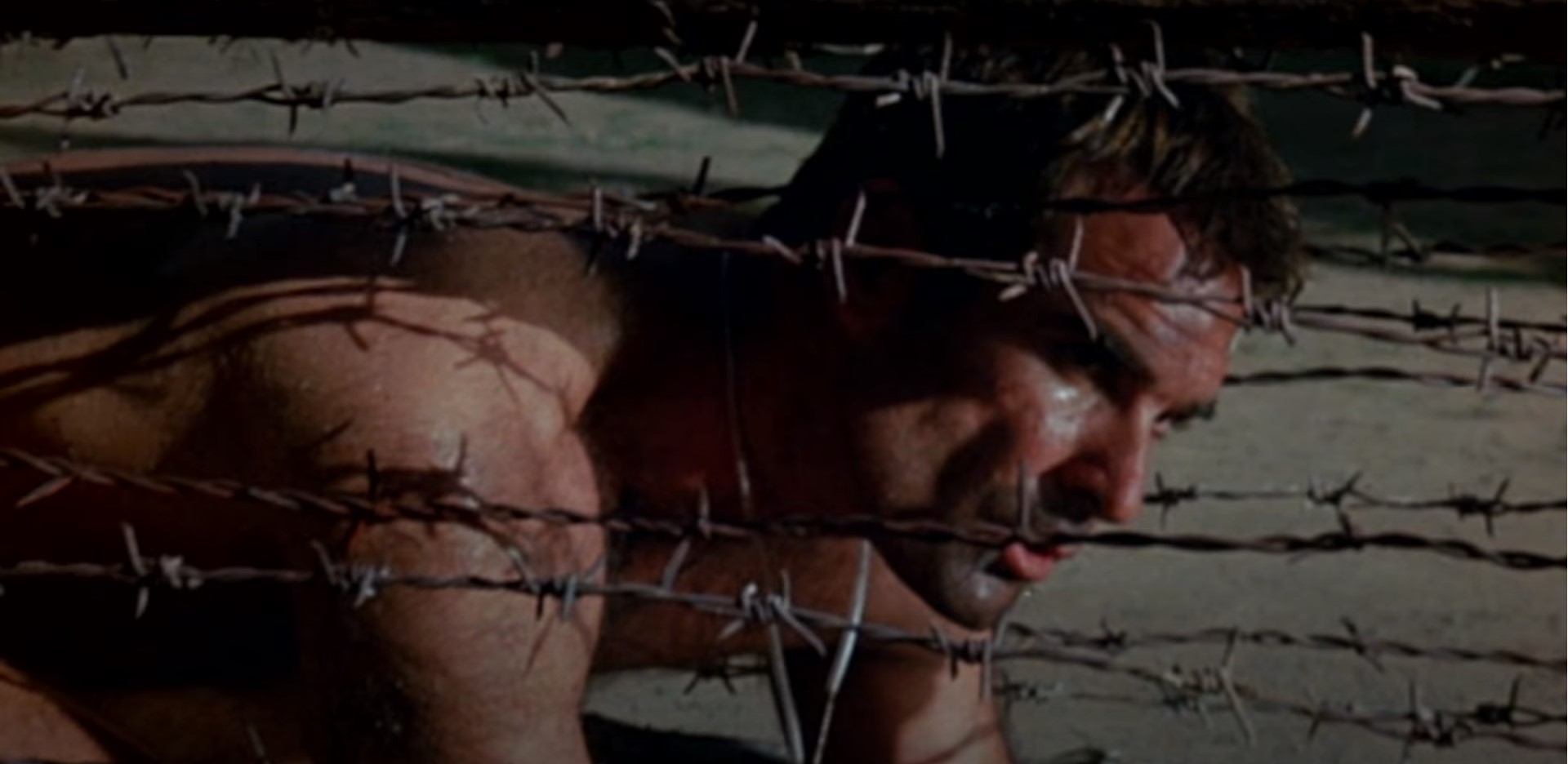
Air Force Lieutenant Casey has initiative, determination, and something to prove being the first woman to be approved for a special and notorious evasion and escape course on a remote U.S. base Philippine island.  The course simulates downed Air Force pilots behind enemy lines where they either have to evade capture or escape as POWs without divulging U.S. secrets.  The simulating is meant to break down the individual physically and mentally through psychological and physical torture that nearly blurs the regulation guidelines of the United States military, but has been proven to be an effective training to withstand the most brutal of POW conditions despite the course’s infamous reputation.  Casey joins the ranks of participants, a young group of eager male officers and one experienced Major Logan looking to requalifying for action, and are dropped into the simulated enemy combat zone controlled by General Becker, a calculating commanding officer who has succumb to his opposing force role.  Becker’s unconventional and illegal tactics exploit Casey’s gender in the name of training her, but his knowingly criminal activity puts the rest of the trainees in danger and it’s up to the Logan and Casey to stop him and his opposing force in an all hell breaks loose war.

POW exploitation has been missing in modern day cinema.  A subgenre that is a dark, degrading note of unscrupulous and vengeful action has been exclusive to the 1980s for far too long, barely being reprised throughout the proceeding decades.  Not to be restricted to the popularization films of Chuck Norris of the “Missing in Action” franchise or of Sylvester Stallone’s Rambo II and III, these camp from Hell films run the money and production gamut, pulling inspiration on conflict wars before the decade, such as Korea, Cambodia, and even as far as World War II.  For mainstream, the jungle entices with harrowing heroism that glorifies determined, strong-arming patriotism while showcasing America’s enemies as Geneva Convention ignoring villains who deserve every ounce of blow’em up, shoot’em up at the hands of escaped captees or an elite team, or a one-man, rescue mission.  Nazis saw more action in the low-budget Eurotrash market with sexploitative women-in-prison camps ran by the sleazy, inhumane, and experimenting Gestapo mostly.  American filmmaker Eric Karson, director of Jean-Claude Van Damme actioners “Black Eagle” and Lionheart,” moves away from the Muscles from Brussels and into Tom Skerritt’s mustache behind bamboo bars in the 1986, American-versus-America military-thriller “Opposing Force.”  Penned by Linda J. Cowgill, under the pen name of Gil Cowan in what’s likely a name change spurred by sexism in the industry, originally titled the script as “Hell Camp” but took the name “Opposing Force” based off the antagonistic enemy labeled as OPFOR right on their chest.  “Opposing Force” is coproduced by “Skinner” and “Final Mission” producer Tamar E. Glaser and “Sometimes They Come Back… for More” producer Daniel Zelik Bert under the theatrical distributors of Orion Pictures. 

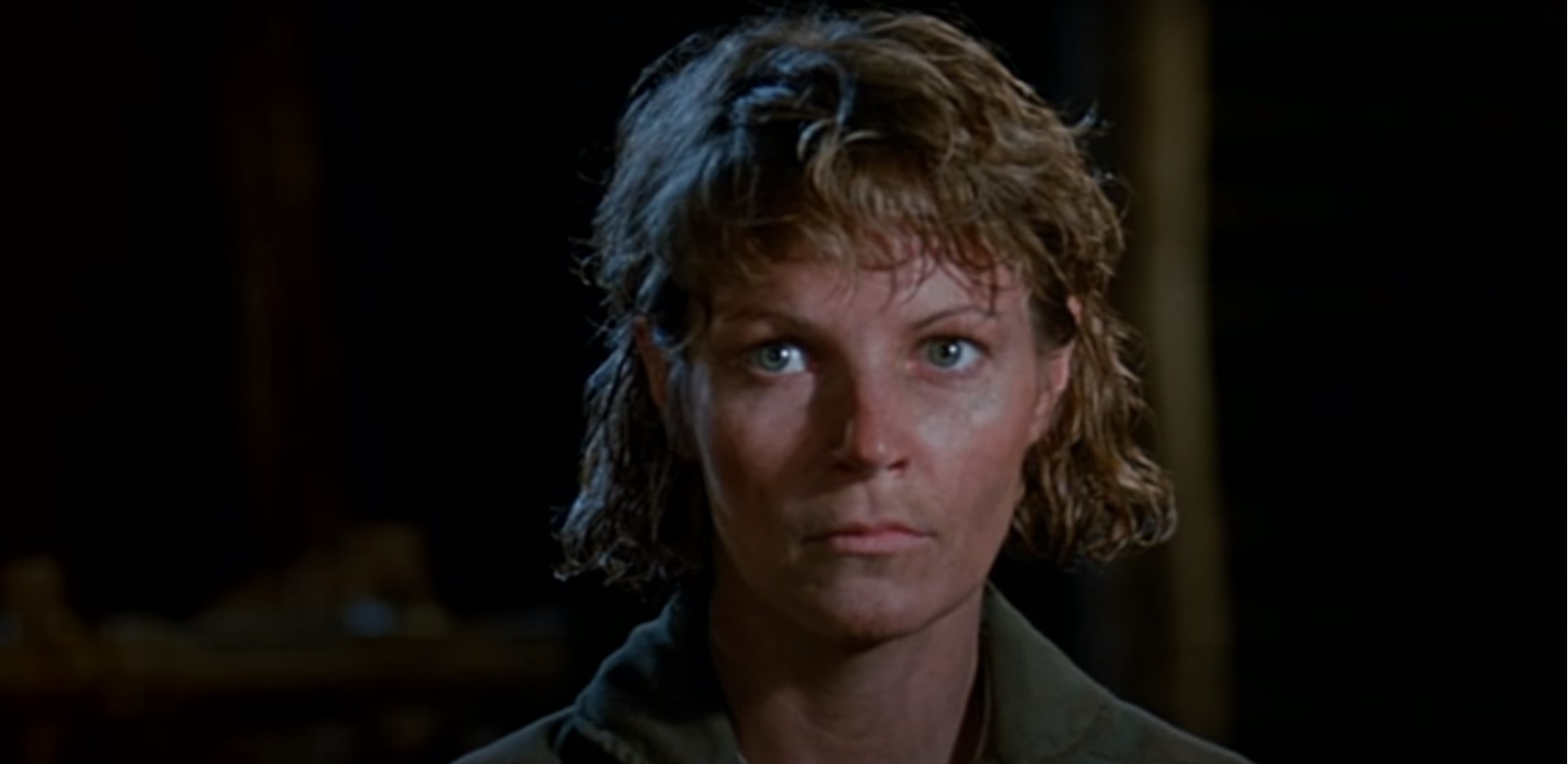
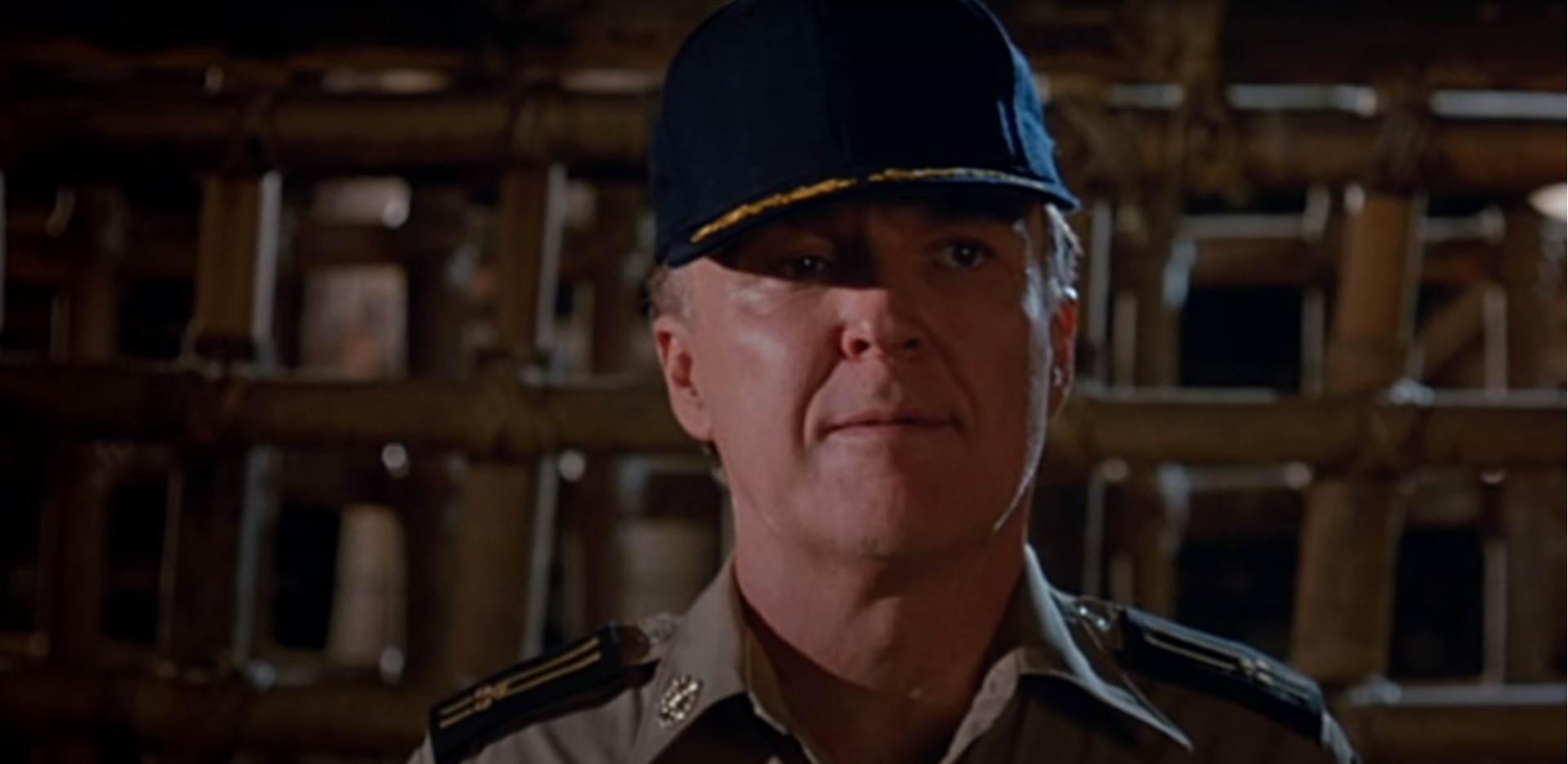
We already know Tom Skerritt’s world-renowned mustache is in the movie and is the star of the show, but Tom Skerritt is in there as well as the man behind the stache as the seasoned boot Major Logan.  The “Alien” and “Contact” actor become the patriarchal figure to a bunch of figurative sons in younger course participants and overprotective of one figurative daughter in Lt. Casey in a wildly uncharacteristic situation brazenly exploited in unconventional mainstream means in the uncomfortable skin of Lisa Eichhorn (“Deus”).  What Lt. Casey goes through is more on familiar ground with the low-budget sleaze of women-in-prison grindhouse and while it’s certainly jarring and unexpected, It’s a welcoming chance for an upper tiered independent film with big names attached.  A couple of the other big names attached are Anthony Zerbe (“The Omega Man”) and Richard Roundtree (“Shaft”) as Commander Becker and his staff sergeant Stafford.  Becker and Logan mirror each other as veterans that have graded into either being corrupted by power or to be righteous in doing what’s right.  Yet, but Zerbe and Skerritt play into what the experienced actors know best, their trademark stoicism.  Tack on Eichhorn’s equally endurable fortitude and a three way standoff erects a monumental solemn stalemate of relatively the same attitudes until the last straw breaks the proverbial camel’s back and war erupts.  Roundtree at least develops Stafford’s internal conflict when the job bites at his conscious, becoming the connection needing convincing of Becker’s crossing over to the darker side of power like a Sithlord in public face disguise.  The narrative physicality aspects piece together a grueling atmosphere that each actor undertakes appropriately by their determined military rank, but as eloquently as Lt. Casey puts it to the aging Major Logan, “You got a limp and I got tits; these aren’t great things ot have in the military,” sets up themselves as misfits-to-heroes that were being crapped on all their careers for their antithetical military image.  “Opposing Force” rounds out the cast with a bunch of moaning male air force participants in the middle of it all with performances from Paul Joynt (“Echos”), Robert Wightman (“Impulse”), George Cheung (“Rambo:  First Blood Part II”), and John Considine (“Circle of Power”).

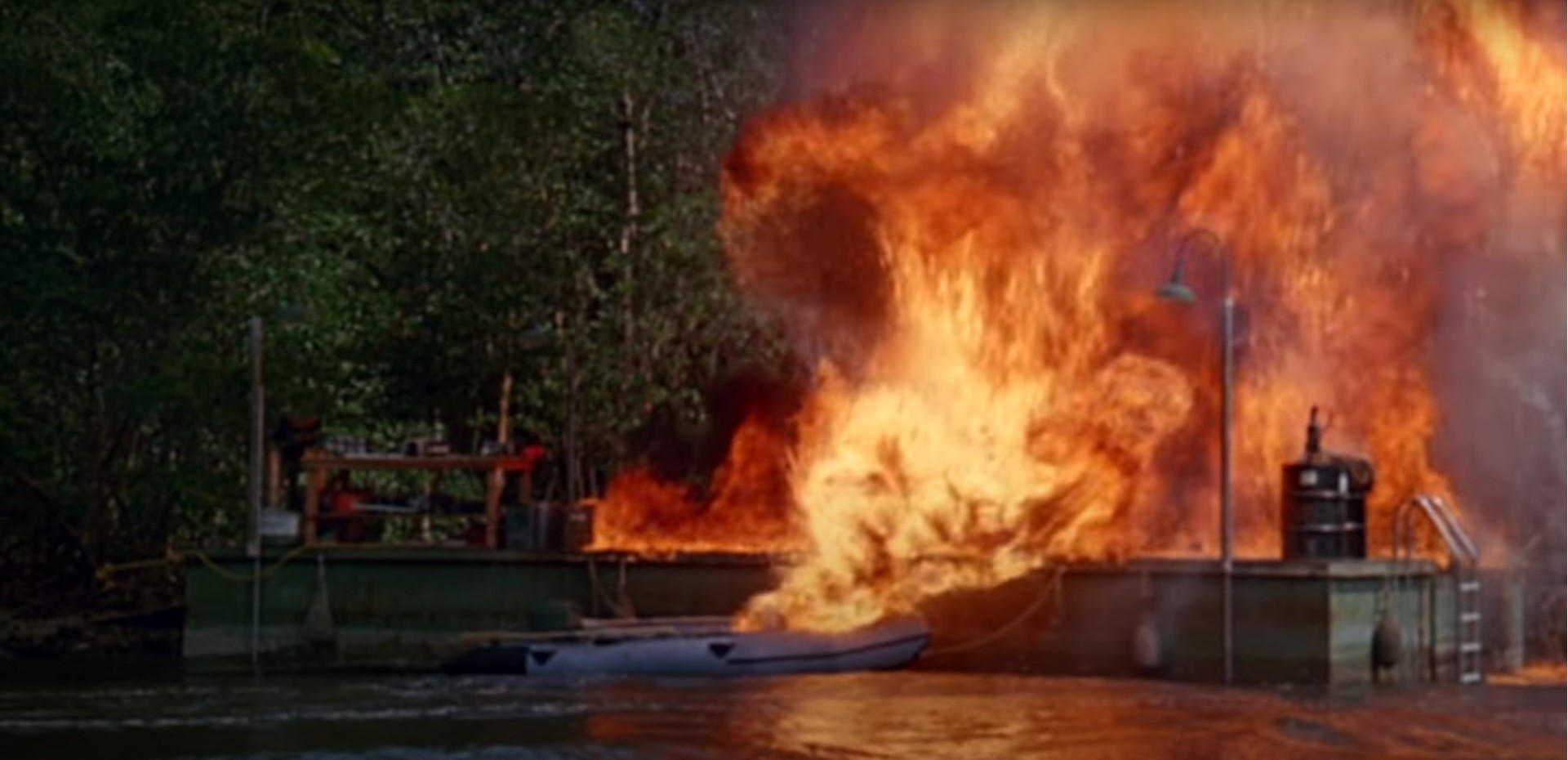
Influenced by the U.S. Military’s real life training program known as S.E.R.E. (Survival, Evasion, Resistance, and Escape.), Cowgill uses the program to formulate “Opposing Force’s” principle groundwork in setting up the jungle POW scenario on a remote island that goes through the motions of no chance of a rescue and aid of any kind.  Participants are throw into a survivalist gauntlet that turns surprisingly rough aggressive when physical and mental tortures are instilled upon those thinking the training would be a walk in the park.  This particular training simulation is unique to the OPFOR team with an aging officer looking to requalify for combat and the first woman to ever be accepted into the course due to a loophole, throwing new challenges to an embedded far too long commander who can easily break a man’s spirit but tiptoes around the possibilities of what to do with a woman until his insidious power and authority blurs right from wrong and takes the torturous tactics and enhanced interrogation techniques too far, beyond the limits of what’s necessary and beyond the limits of human decency all in the name of reinforce training.  The grueling torture and bush action is palpable enough to contrast the naked, sweaty, and battered bodies with the M1A1 bursts and munition explosions galore.  Only one aspect adds an out of place measure in the narrative and that is of the rest of the POW contingent and their seemingly wishy-washy decision on whether to escape, stay put, or join in the fight against Becker and his live-round shooting island battalion; the group disperses into the jungle only to fade from the climatic third act Major Logan, Lt. Casey, and Botts defending their lives against a treacherous throng and their wicked commanding warden.  Their disappearance doesn’t allow for closure for the acts against them during the entire ordeal and becomes a fizzling distraction.  Another distraction is the severely cut ending that freeze frames on Eichhorn’s final act with her voiceover exposition post-battle in what feels sorely rushed to complete.  The Blu-ray bonus features has an extended ending that’s more completist approach in wrapping up the story sutibly.  For a POW film, “Opposing Force” is an archetype of its originating decade that sates the subgenre’s need to pit an overreaching and ruthless camp head against the resiliency and determinate of the America fighting spirit. 

A re-release from the 2019 Scorpion Releasing Blu-ray comes “Opposing Force” reprising a presence on online retail shelves.  The AVC encoded, high-definition, BD25 is presented in 1080p resolution with a widescreen 1.78:1 aspect ratio.  Identical to the earlier Blu-ray 4 years prior, the image quality is freshened up quite a bit from the likely 35 mm print source into a detail-laden HD transfer that offers a lush jungle-scape to be in juxtaposition against the camp from within its center, a large guerilla compound bathed in browns and greens make for good POW-themed pageantry.  Skin tones and individual features flesh out nicely, adding detailed levels of salubrious status over the course of the day-to-day detainment. The English language DTS-HD master audio 2.0 leans toward a softer dialogue mix that, for the majority, is discernible despite favoring “Opposing Force’s” selling points: large explosions, pepper potshots, and militant vehicles running rampant around and above the island terrain. Dialogue’s clear enough to emerge without much hinderance with enough depth to provide a sense of position and the audio layer is remarkably clean with no hissing, popping, or static. English subtitles are an available option. Special features include an audio commentary with director Eric Karson, the trailer, and that extended ending I mentioned, and noted preferred, earlier in the review. The traditional Blu-ray snapper casing includes a rendition of the alternate titled “Hell Camp” poster with a more titillating illustrative lookalike of Lt. Casey in shredded rags and ride-up shorts with hands tied above her head and looking over her shoulder. The warm yellow with a hint of white stirs in an element of jungle heat ramped up by also providing the cage accommodations in the background to let it be known you’re about to watch an exploitation POW film. Locked on a region A playback, “Opposing Force” has a runtime of 98 minutes and is rated R. Eric Karson manages to find a place amongst a serrating subgenre that takes an ostentatious, yet not entirely fictious look, at prisoners of war with his “Opposing Force” actioner that goes to convey that not every unethical and malintent camp leader is a foreigner; evil can also be domestically grown.

“Opposing Foce” now in Control of Blu-ray Home Video!