Clay Riddell just landed in Boston after scoring a huge deal in New York involving concepts for his graphic novel. With all the cellphone charging stations occupied, Clay calls his estranged wife from a pay phone to speak with his son, but when the landline severs communications, that’s when it started. People on their cellphones turn into Phoners, murderous maniacs who tear through anyone in a destructive path mindless insanity. Clay, in the midst of panic, bumps into subway train conductor Tom McCourt and fight their way out of the city, barely escaping with their lives. Fleeing a burning Boston overran by Phoners, Clay is determined to track down his family in New Hampshire with the help of Tom and two teens, Alice and Jordan, but the Phoners are not just absentminded anymore as individuals start to flock together exhibiting the beginning signs of their telepathic network lending to something far more sinister than just temporary mayhem.

“Cell” is the feature film adaptation to Stephen King’s novel of the same title and reunites John Cusack with Samuel L. Jackson once again since their last costarring venture of King’s book-to-silver screen production of “1408.” King shares screenplay credits with Adam Alleca, who co-penned “The Last House on the Left” remake in 2009, and with “Paranormal Activity 2” director Tod Williams at the helm. From the first inkling of a “Cell” movie, back with Eli Roth was attached, the excitement couldn’t be contained as I read the Stephen King novel and was captivated by the unique story of mixed and varied human emotions and the uncontrollable yearnings to be a part of the collective through being electronically connected that ultimately becomes mankind’s undoing.
However, “Cell” was heading in the direction of certain doom from the moment Roth unattached himself from the project, sending “Cell” into the annoyance of limbo until a production company conglomerate formed to pull “Cell” from it’s stagnant state and attached Williams to direct. Yet once again, King’s beloved story goes into the throes of uncertainty with distribution after filming wraps in 2013. 2016 comes and Saban Films, along with Lionsgate , distributes “Cell” theatrically and within the home entertainment market respectively.

After all the monumental problems, I personally wanted to “Cell” to be one of the most entertaining and frightening horror films of the modern age, but as fate would have it, the Williams’ film disappoints. An film adaptation of a King novel needs more minutes to cover the story’s girth and “Cell” lacked pages of warranted minutes to be a full tell all for Clay, Tom, and the Raggedy Man. Portions of the novel were translated to the screen, but for the majority of the film, a rushed version of the story debuts to silver screen audiences that loses the book’s essence and dilutes character development, such as with Raggedy Man who has a sizable role in the book, but the character in Williams’ movie barely scratches the surface with being just a figurehead for the Phoners and not the collective’s soap box looming leader. The film started out great with intense chaos at Boston airport, pictorializing to life the Phoners from the King’s book with pinpoint precision, but from there on, the story’s time span goes vague whereas the book stretches out the length of time. Only a matter of two or three days does it seem the survivors jump from Boston, to the school, to the bar, to the story’s final location of Kashwak, but in reality terms and in the amount of devastation and character portrayal, weeks have passed.

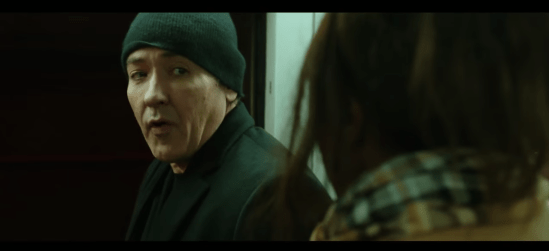
The ending has been rewritten from a surprisingly mixed reaction to the book’s and yet, the unravelling of the finale does more than convolute matters when Clay finds his son. There lies almost a dual ending where one’s interpretation can be the film’s own storybook ending. Stephen King’s “The Mist” had an ending that, when compared to Frank Darabont’s totally new ending for the film, was totally inferior to Darabont’s and I feel like that’s the stage that was trying to bet revisited here with “Cell” and it just missed the mark completely. Not all changes are for the worst. Character Tom McCourt, whose white in book, went to Samuel L. Jackson who absolutely fits the role without question, nailing PTSD stricken McCourt with little emotion but with untapped hurt. If I ever had to choose an middle aged white actor for the role of Clay, John Cusack would be my first and only choice even before casting began for the film. I do feel like having a white Raggedy Man was purposefully steered away from social sensitivities with an antagonistic young black male in a hoodie. The cast rounds out with Isabelle Fuhrman, Owen Teague, and Stacy Keach (“Slave of the Cannibal God”).
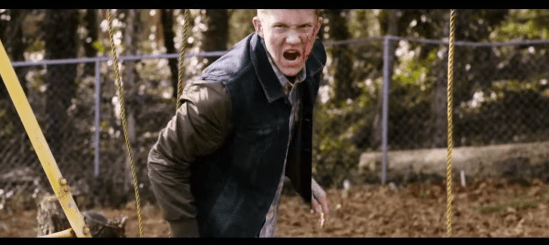
The digital visual effects were so poorly constructed and composited that I’m not surprised “Cell” didn’t have a longer theatrical run. The book had a number of jaw-dropping visuals the imagination could run with and now with seeing the depictions of those visuals on screen, they seemed seriously slapped together in such haste to where the devastating sensationalism turns inane and bland. King’s apocalyptic story warrants Hollywood scale effects, but received a few levels below that bar, failing to deliver major catastrophe on a world ending scale to the likes of “War World Z” or to cleverly style the film through a smaller medium such as George Romero accomplished with this first three “Living Dead” films.
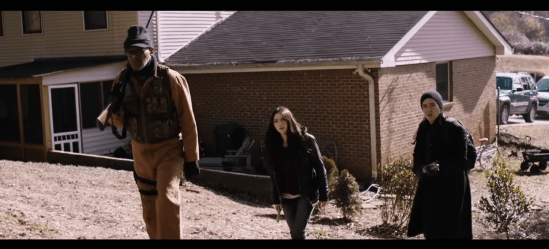
Lionsgate’s Blu-ray release is presented in widescreen 2.40:1 aspect ratio and the 1080p Hi-Def resolution becomes a disadvantage that clearly outlines the quality of the effects. The English 5.1 DTS-HD master audio is par for the course, but slightly in-and-out with dialogue that’s difficult to balance. The 98 minute feature’s bonus features includes an director’s commentary and “To Cell and Back: The Making of the Film” which is redundant if you’ve read the novel. Bottom line is if you’re fan of Stephen King’s novel, you’ll be sorely disappointed with Tod Williams’ “Cell” that’s nothing more than a long awaited entertaining rated-R apocalyptic horror with obsolete effects and with star-studded names attached to this Stephen King story adaptation.
Tag Archives: George Romero
Living Alongside Evil. “A Plague So Pleasant” review!

In the zombie post-apocalypse, the human discovered that by not firing their weapons allowed the flesh eating hordes to calm their desires, resulting in the protection of the zombie species and institutionalizing laws against the killing zombies for fear of another undead swarm attack. One of the many survivors Clay has lived in a zombie cooperation world for over a year after the initial outbreak along with his sister Mia, whose boyfriend Gerry didn’t survive, but still roams the Earth as the walking dead. With no one truly dying, the whole idea of existence becomes meaningless and where people, like Mia, won’t move on when they’re loved ones still feel very much alive. When Clay discovers his sister’s attachment to undead Gerry, he takes it upon himself to kill Mia’s zombie boyfriend, releasing a zombie swarm post-apocalypse apocalypse on the his town.

Unprecedented and gushing with rage, “A Plague so Pleasant” redefines the way audiences would view the zombie since 1968, constructing still a vicious species of man-eating undead while domesticating them to a lumbering land fixture much like the way pigeons amongst the birds. First time directors Benjamin Roberds and Jordan Reyes triumph amongst the modern zombie competition, spilling their heart and soul onto the script and onto the screen. With a story to match, a Romero-inspired social commentary zombie film held true to form by instilling normality to a post-apocalyptic world. Zombie and man living together. What was that Bill Murray line in “Ghostbusters?” “Cats and dogs living together… mass hysteria.” Clay and Mia were living a mundane life while the dead remained alive and protected, socially poking fun at how society maintain a normal livelihood with zombies: the U.S. Government made killing zombies a national felony, companies were mandated to go through a yearly undead awareness program as a formality, and there’s a guarded visitation area full of the undead much like a graveyard without graves.

Stunning cinematography added much needed life to “A Plague so Pleasant” which settles into an already over saturated zombie genre. Starting in black and white, Clay introduces his life in a offscreen monologue, conveying much of the post-apocalyptic and zombie information. The black and white symbolizes how simple and plain life has become with the living with zombies regulations. When Clay breaks the law by offing Gerry for good, thats when the movie turns to color and creating complications in a black and white life. The once unvarying and shuffling zombie nuisance goes into full berserk mode with “28 Days Later” sprinters thirsty to tear into anything with a heart beat. Only when the zombies turn calm is when life goes back to being black and white, considering the option that normality needs to be simplified to live peacefully.

The special effects by first timer Tyler Carver are a great effort clashing together a classic European Giannetto De Rossi style with Carver’s own settle flair by not being overly gruesome. There’s not an over-the-top, chart-topping special effects moment that defines the “A Plague so Pleasant,’ but there the solid effects subtly throughout satisfies. The zombies overall look are the usual stock type, yet they’re exhilarating to watch with an army of intense actors who are no doubt from the Athens, GA Halloween attraction named Zombie Farm where Tyler Carver has a connection. Not everything about the creation of a frightening zombie was accomplished as much of the audio tracks were out of sync and just too gaudy.

Actor David Chandler as Clay does a fine job portraying a bored survivor and a clueless big brother while also performing the second zombie swarm nearly without speaking during the entire engagement. Mia, played by Eva Boehnke, resembles the gorgeous Lebanese-American porn star actress Mia Khalfia with her giant nerdy glasses. Boehnke creates a free spirited, yet delusional, persona in Mia whose holding onto the past and coping the only way she knows how and that’s by not separating from her undead boyfriend Gerry. We round out the cast with Todd played by Maxwell Moody. Todd becomes the catalyst of the coming events by placing the idea of him and Mia being a couple and putting a bullet into Gerry’s rotting brain. Chandler, Boehnke, and Moody on paper are amateur actors in an estimated $1,500 budget, independent movie, but they own their performances and shine through budgetary constraints.

Another awesome release from Wild Eye releasing that would make a worthy and unique edition to a zombie fanatic’s movie collection. Don’t judge to harsh the production value with the slight aliasing, the out of sync zombie audio tracks, and the muffled off screen Clay character monologue. Instead, focus on the cinematography, the actors performances, and the genuine story telling of a socially awkward scenario. Let “A Plague so Pleasant” infect, let it sink it’s teeth deep, and let it help turn your undying attention unto a lively concept.
Evil Has Fallen Far From the Father Tree. “Auteur” review!
A failed filmmaker sets forth to claim is stake in fame by creating a documentary about a legendary horror director who disappeared during his latest highly anticipated masterpiece “Demonic.” The filmmaker is hellbent on finding the director and discovering the truth on why the director had a melt down during filming and stole all the film’s footage. After sitting down with various interviewees and finding the long lost director, this film has become notorious for it’s dark background of death that surrounded some of the cast and crew and their families. The notion seems to becomes evident that “Demonic” should have never been made and that some films should never be released or else more peoples’ lives would be in grave danger.
I surely wanted to believe that Cameron Romero had the same masterful skill set as his father George or also I wouldn’t have mind if Cameron went into a total opposite direction of his zombie king father and create a whole new and eloquent horror genre that puts his name on the map. “Auteur” is my first look into Cameron Romero’s work and my hopes hit the highest of ceilings and anxiousness and eagerness helped drive me to pop this disc into the player as soon as able to without interruption. Unfortunately, I found myself glancing through friends’ comment walls on Facebook and watching various PornTube videos because I was so disappointingly bored with the result of “Autuer.”

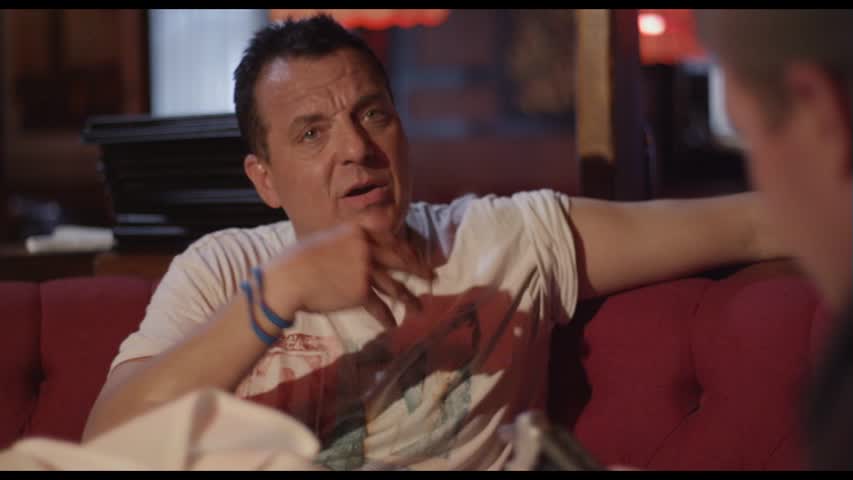
My heart knew something was amiss when Tom Sizemore headlines a movie and sure enough my heart was right and I should have been more perceptive to it’s warnings. Now, I have a soft side for Sizemore; I enjoy the man’s earlier work in Harley Davidson and the Marlboro Man, The Relic, and in Saving Private Ryan – all very great material – but Sizemore has lost his knack as of late. Also, Sizemore doesn’t really have anything to do with headlining “Auteur.” His runtime is no more than maybe 15 minutes tops and I swear he’s reading off cue cards in the restaurant scenes with actor/producer BJ Hendricks playing the documentarian who’s trying to make a documentary about “Demonic” in which Tom Sizemore stars in – got that? Sizemore is just a recognizable name to try and sell home entertainment units.

What really hurts “Auteur” is that it’s too much of a talking head movie. Basically, BJ Hendricks drives around searching for Ian Hutton’s character, the great director Charlie Buckwald, and does a number of interviews with cast and crew members along with other interviews with people who met Charlie outside the studio. Not until in the middle of Act three does the film get somewhat appealing with the levitation scene of Madeline Merritt’s character Kate Rivers. There some scare appeal there that would have been nice if implemented perhaps through the rest of the movie.

What also could be construed about “Auteur” that would compare to most of his father work is that Cameron attempts to convey some social commentary about Hollywood and their stressed out, coming to a breaking point actors and directors losing their cool and jumping off the deep end into a psychotic break abyss and that there are directors and producers out in Hollywood that would jump the wagon to try and make a easy dollar by exploiting their downfall. Cameron, hypothetically, turns the table on the exploiter making this ambulance chaser pay with the story being more sinisterly deadly. In that regard and if that has any truth what Cameron was trying to accomplish, then I applaud him on successfully mocking Tinseltown.

No one should certainly take my word on whether one should watch Cameron Romero’s “Auteur” or not, that’s up to them. I only give my humble critique and my overall impression with the film had cold heartedly, but quietly, crushed my hopes in being something I would enjoy from the next generation of Romeros. But hey, Cameron’s father had to start somewhere and build upon that and that is what I suspect Cameron will do as well. It’s great to see that Cameron did give a little nod to his father in the DVD store scene – twice. You can buy “Auteur” from MVDVisual on DVD Home Entertainment on April 21st.
Nudity Report
No nudity 😦