Are You Ready for EVILLLLL! “Visceral: Between the Ropes of Madness” reviewed! (Unearthed Films / Blu-ray)

Step Into the Ring with “Visceral: Between the Ropes of Madness” On Blu-ray!

A low-ranking boxer is set up with a match of a lifetime.  Quiet but confident, his manager doesn’t exactly have a faith in the underdog, constantly questioning his training with gambled money on the line.  When the boxer is beaten to a pulp in the ring, he’s immediately disowned by the unsympathetic manager and spirals out of his training and into darkness, finding murdering young women to be more pleasurable than the pain of loss and rejection.   His darkness in death incites a demon, perhaps even the Prince of Darkness himself, if the form of a half-naked woman with a distorted face and places him under her ward, forcing him into submission of pain and suffering while also commanding him to collect souls for her through his own tasting menu of torture.  The boxer’s life is told in three different stages of time on how he becomes evil’s most prized champion.

Accurately titular described, “Visceral:  Between the Ropes of Madness” pushes deviant instinct over everything else, a formidable urge to listen and adhere to those intrusive thoughts, especially after one’s lifelong goal, their most prized position, is creamed and squashed for good and forever in a humiliating way.  Writer-director Felipe Eluti uses hopelessness as pure evil’s plaything, turning a dedicated fighter being managed by Hell for the sake of not only revenge but also to fill the emptiness of the Netherworld with tortured souls.  The Chilean born and film schooled Eluti debut feature also enacts him to star as the demented boxer in a gore-soaked, ringside performance that moderately excites and intensifies with rope bondage as one of his character’s key motifs.  The extreme exploitation thriller is under the producing team of Sebastián Amenábar, Cristóbal Rivera, Andres Palma, and Daniel Vivanco.

Felipe Eluti is a one-man steamroller as the unnamed boxer leaving a laid-to-waste corpse trial in his wake.  Going virtually pantomime through the entire quasi-plotted narrative, Eluti conveys an apathy through blood and body language as well as utilizing his unsettling glare underneath different stages of head and facial hair growth from his time as a slimmed down, smooth-shaven boxer to a Curly-do’d, five o’clock shadowed, and expressionless shell of a human being.  From an outsider’s characteristic perspective, the boxer can be considered pathetic by preying down upon and torturing to kill smaller women in what is almost a result of retaliatory motivation after his brutal loss and he literally uses their bodies as his personal punching bags of stoic anger and hate.  The demon also presents itself in the form of a woman named Judas (Carolina Salles), cladded in bondage ropes, speaks in a whispery, omnipotent voice and visits him with a twisted face to represent the evil, or even the ugliness, she embodies, or the boxer sees in all his feminine victims.  Personified as a woman who tortures, beats, and verbally belittles him into a pacifistic submission only amplifies his dark crusade of soul collection.  Other than the boxer’s manager, a porn addicted, condescending loudmouth by José Manuel García, the remaining cast is filled with fleetingly visited torture victims, mostly women who are also voiceless and have little-to-no fight in them until the boxer works up to courage near the end for revenge which he can call his own, and Gabriela Aranchibia, Valentina Varela, Tamara Zuñega, Daniela Pardo, Pia Cardenas, Claudia Mena, Carolina Palacios, and Felipe Ruiz fill in those fated roles. 

While Felipe Eluti’s boxing themed gory shocker and exploitation rope-a-dope is definitely not a Rocky Balboa prime time fight film, “Visceral:  Between the Ropes of Madness” favors severe mental deterioration over an underdog beating the odds with glorifying the ultra-violence.  The strange-faced Judas pertains only to the Boxer’s vision or presence, conjured by feeding off the fighter’s anguish and indoctrinating him through pain, suffering, abuse, torture, and the most horrible like to do the demon’s bidding without resistance or fear.  The boxer’s kidnap and slasher traits shows a motif dominance over women that could possibly stem from most of the Freudian theorized root of a lot of evil doing, mother issues.  Supporting this scenario is the boxer’s visit to his mother.  Face never shown within the thicket of a deep shadow and directed toward a glowing television set, the avoided boxer seeks self-satisfaction approval and support from presumably his one and only blood relation on this planet, but the attentive mother denounces him, rejects him, and belittles his existence as the worst thing to ever happen to her just before his big match.  Eluti’s arthouse direction focuses on the boxer’s lack of love, support, and concern for his wellbeing and uses that the-world-vs-me detestation as a fuel and resupplied by his submission to Juda’s verbal and physical abuse to carry on his hate-filled and apathetic tear of women.  

Unearthed Films, a leader in producing and distributor extreme, ultra-violent and gory movie content brings “Visceral:  Between the Ropes of Madness” into the squared circle with a new Blu-ray release of Chilean production.  The single layered BD25 is AVC encoded and presented in a high-definition, 1080p resolution, with a widescreen 1.77:1 aspect ratio.  Cinematographer Tomas Smith’s approach to the content serves up stark and severe drab with a lifeless parallel to the apathy spree of the Boxer’s dark undertaking.  Heavy on grays and browns, there’s hardly any pop of aesthetic style or color but is counterbalanced by some interesting just obscure or to the side framing that ignite more imagination than having the scene spelled out for you.  There are also other interesting visuals with Judas and inside the Boxer’s mental state that don’t allow much in the way if finer details but allure to and speak of motivation and context.  The divided darkness through provides plenty of opportunities for compressions issues on a lower capacity disc compression but there’s not a whole lot to speak in way of artefacts.  The Spanish PCM 2.0 mix plays the familiar tones of an arthouse gore film by giving more stock to the soundtrack than to the dialogue.  While the dialogue is apparent despite the Boxer saying very little and Judas’s voice done in post, composer René Roco has free reign to be industrially glum above the whimpers, cries, and screams of the Boxer’s tortured women.  Ambient action is perceived post-product separation as the sounds don’t necessary match or synch in frame with the carnage and the environmental ambience is reduced to near nothing with low levels murmurs of city life stock sounds in the exterior scenes.  The English subtitles appear accurate and match well with in-scene prattle.  Extras include a commentary with director Felipe Eluti, a post-showing speech at the Cineteca Nacional’s Massacre in Xoco, Mexico City circa 2013, a behind-the-scenes gallery, and a teaser trailer.  The reverse cover liner art inside the clear Amaray case has barely safe for work primary of the mad Boxer and a bloodied woman bound in rope and a not safe for work cover that focuses on a bare-chested and rope bound Judas, both in contrasted to a deep inky void background.  There are no insert liner supplements and the disc is pressed with the same NSFW cover art image.  The not rated, region A encoded release has a runtime of 76 minutes.

Last Rites: Glorifying hopelessness through violence, “Visceral: Between the Ropes of Madness” is a round-for-round degression from failure through the dreary lens of director Felipe Eluti and his kink for rope bondage that sets forth an unstable champion amongst the maidenly defeated.

Step Into the Ring with “Visceral: Between the Ropes of Madness” On Blu-ray!

Pray EVIL Isn’t This Cruel. “Suffering Bible” reviewed! (Sub Rosa Studios/DVD)


Welcome to the Suffering Bible, a collection of violating and gory interpreted religious allegories digging into stark contrasts of sin and piety and illuminating the darker side of these allegories with a lacerating gruesome perspective. These short stories include the internal strife of a psychopaths strong urge for forbidden lesbian companionship with the contentious, bigoted teachings of finding forever friends inside God’s eyes, a visceral performing depiction of the Incredulity of St. Thomas, an extreme mortification of the flesh, the prideful consequences with a Devil’s pact, and the murderous portrayals of lost souls needing redemption into God’s good graces.

Right in time for the Easter holiday, where Jesus Christ has risen back from the dead for our salvation, comes Davide Pesca’s written and directed “Suffering Bible” of sinfully derived tales of reverent and irreverent perfervid images. The Italian made and produced anthology that’s a contexture of stories is forged together with a wraparound story of the Adam and Eve in the Garden of Eden apologue. “Suffering Bible” begins with a title card excerpt, Tear thy neighbor as thyself, from an unknown storyteller named saamang Ruinees with a skewed version of the second commandment, Love thy neighbor as thyself, subtly denouncing the evils in popular religious culture and then slithering them, not so subtly, into the shorts of those suffering at behest of the bible. Pesca’s shock efforts have come across ItsBlogginEvil.com’s radar once before with another short framed macabre tale, “Hemophobia,” from Artsploitation’s home distributed release of “A Taste of Phobia” anthology and “Hemophobia” is and feels more commercialized with less than salutary toward mutilation and variety body meat, but the filmmaker does fly on a parallel body horror plane and has had his shorts featured alongside with fellow Italian auteur and shock director, Domiziano Cristophario (“House of Flesh Manniquins,” “Red Krokodil”) with a more rudimentary, analogue-video-feel approach. “Suffering Bible” is self-produced by his independent production and distribution company – Demented Gore Productions.

Being an Italian made cast functioning on the performances grounds of a heel budget writing up about “Suffering Bible’s” actors and actresses past credits, influences, methods and so on is proving to be a challenging task. Most of the cast is comprised of alternative, half-naked women, such as Nicola Fugazza and Mary Rubes who are the sole credited on IMDB.com. Rubes, an erotic model, becomes “Suffering Bible’s” inadvertent poster girl that graces the Sub Rosa Studio’s DVD cover and static menu as her seductively deceptive solo performance of body and genital self-mutilation is the most unsettling story revolving around mortification of the flesh. Rubes has previously worked with Pesca on a 2017 short film entitled “Fame de Vampira,” which also co-stars Beata Walewska. Both Rubes and Walewska sizzle in the Italian action scene with “Rage Killers” by director Roger A. Fratter, who co-directed “Fame de Vampira.” As you can see, a casting inner circle is starting to form, but that’s the extent of the network with Simon Rocca, Simon Macleod, Catlin Strange, Pate Douce, Paolo Salvadeo, Emilio Stangalini, Paolo Borsa, Emanuela La Neve, Chiara Digonzelli, and Marilena Marmo.

On the surface, “Suffering Bible” has a unwieldly, pigeonhole affect that places the impervious shutters around one’s peepers and thinking cap for the pleasures of gore and nudity that run continuously rampant, but Davide Pesca has a connect-the-dot vision that aims to unveil the worst of religious culture, using graphic imagery in a reverse psychological and divinity experience that’s wildly novel inside a less commercialized parameters and the more I stew on this film, the more I like it. Without this review not seeming to be a theoretical paper on Davide Pesca and the “Suffering Bible,” examples of the filmmaker using gore as the pain and suffering vessel for those struggling to be closer to God can be modeled from the first short, “My Only God” aka “Friends Forever,” in which a woman stitches herself to her now dead friend to be closer to her, as if their friendship, which was severed insinuated by the dead woman, will continue in the afterlife. Same can be said about the last, if not more potently gristly, short, “The Redemption of Last Souls,” where a druggie, a terminal ill person, and a homeless man who has lost family connectivity have nothing left to lose, have lost faith, and seek redemption through being chair strapped subjects of a snuff film. While “My Only God” and “The Redemption of Lost Souls” caters to the barbaric rite of celestial passage, Davide Pesca’s specialty falls more within the lines of body horror as the filmmaker has saturated himself in the infatuation of the Body Modification culture, reflected in his “St. Thomas” and “In The Name of The Father” that include Doubting Thomas reaching protractedly into a crucified Jesus’s side slit and include the extreme mortification of the sinful flesh – eyes, breasts, and clitoris – by a devout devotee.

“Suffering Bible” is a throwback moxie livid on sin and body destruction and it’s a title coming to you on DVD home vide like a disastrous, break faith, miracle from SRS Home Video and MVDVisual. Though listed as a retro release by SRS, “Suffering Bible” released in 2018, shooting over the course of a few years prior more than likely, with a combination sepia-color approach and the result outputted a strained and digitally cursed image of a widescreen, 1.78:1 presentation that suffers from severe compression artifacts in conjunction with digital interference. The errs are absolved by the very label of a throwback “erotic art house horror” gracing the retro, faux-VHS DVD back cover. The single channel stereo has limited flexibility with some ostentatious, if not laughable, Foley work. Aside from a little dialogue in two of the shorts, “Suffering Bible” takes a vow of silence and speaks volumes in actions alone; this creative choice, along with some probable glitch art, saves much of the technical woes already plaguing Pesca’s stain on profane. The robust grunge-brood style of OKY’s prolong guitar distortions, delicate strum and percussion echoing, and reverse melodies bedazzles in a cathartic relief that no dense, run of the mill metal band is attached to the soundtrack. Special features include a short interview with Davide Pesca, which turned out to be more of a behind-the-scenes look at handful of shorts for the film, a lengthy ultra violent and gory showreel for Pesca’s “Tales from the Deep Hell,” and SRS trailers. More grimly poetic than sleazy gore-porn, the book of the “Suffering Bible” can open eyes to the unsettling infernal of holy virtue with transfixing horrid death rooms.

Shock, gore, profane! “Suffering Bible” DVD has it all!

Finding Love in the Most Evilest Ways! “Brutal” review!


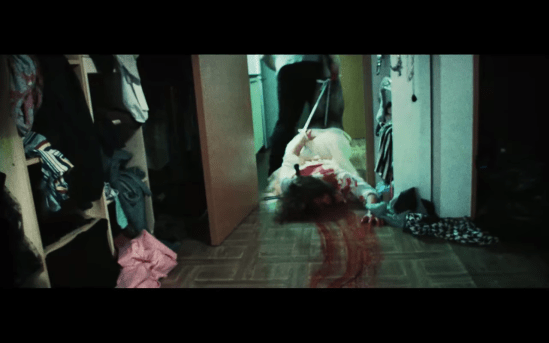
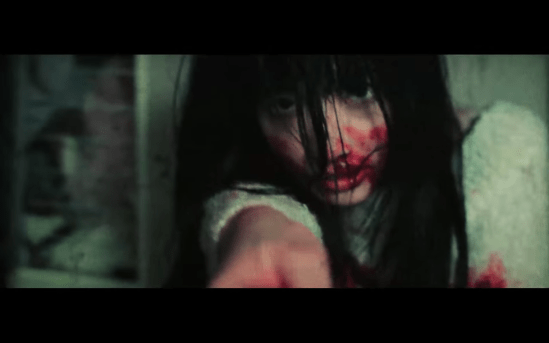
One man kidnaps women, gags and bounds them inside his bleak apartment, and unleashes a fury of hate and disgust whilst searching for one woman who will understand him and his relentless, and vehement, scouring. One woman lures highly aroused men back to their apartment for what they believe will be a night of passionate embrace or of simplistic carnalities of inhibition. While the guys are thinking with the wrong head, the woman slices and dices them to a pulverized pulp of death meat and repetitively fillets their manhood postmortem without guilt. She, too, also searches for something, but is more reserved about it as she allows men to verbalize their needs and desires to her. As the two killers go through the melee day-by-day, they eventually find each other, but before realizing their compatibility, the killer inside themselves square off against each other in a one-on-one bout of maniacal mayhem that must unravel in blood before unsheathing true love.

Who knew that love could hurt so badly? Director Takashi Hirose exhibits a painful peak into two desperate swains callously searching for some understanding, some deep rooted mutual pain that plagues their own embodiment, in “Brutal,” Hirose’s 2016 feature that packs a bloody brawling wallop of the human will toward punitive punishment and desperate determination. The Japanese filmmaker also wrote and co-produced the three part chapters that segments Man, Woman, and Man and Woman into a commingled three act narrative of utter chaos that glorifies finding a soulmate in the most insane circumstances. E-Harmony. OKCupid. OnlyFarmers.com. None of these so-called matchmaker websites have the formidable fortitude to remove all the political niceties and to dig into the human psyche the way that only Takashi Hirose can to lure out and strip one person’s entire vulnerability and, essentially, the parts that makes us ultimately human into a raging, yet emotionally unstable, hapless lover.

Butch, the one and only moniker for the actor, portrays the Man who is a very strong and determined man that brings to his apartment many nice, and sometimes unsavory, attractive ladies; however, he doesn’t whip them up an aphrodisiac dinner or sweep them off their feet with a romantic Rom-Com. He likes to move the relationship along, at a hare’s pace, with getting down and dirty and in certainly not in a sexualized manner. Butch pinpoints the man’s ambitions, machine-like in his will with a hint of softness behind the eyes when plucking through the headcount of numerous women for his match. Ayano is equally compelling as Woman and though Ayano has brawnier range of comedies and dramas under her belt, she notches gore and shock as if it’s simple to get stabbed 50 times and be completely nude with unpleasant prosthetics garnishing the naughty bits of your body. Butch and Ayano are quintessential to “Brutal’s” languishing love story and present themselves with such confidence, which is made key from their previous work with Takashi Hirose – Ayano worked with Hirose in his dramatic horror short, “Bandaged” in 2011 and then Hirose worked with Butch in a 2012 zombie short entitled “Moratorium” that starred Japanese cult and former pinku actress, Asami. The film also stars Katrina Grey (“Vampire Reborn”), Takashi Nishina (“Ringu 2”), Naho Nakashima, and Nanako Ohata.

Hirose doesn’t hold back the punches. In fact, he’s added one or two more for good measures. Helmed by a three person crew and one visual effects artist, the special effects department ramps up the rampage and carnage, making poetry out of ruthless romanticism. The end result is absolutely killer with stab after stab, gore galore, and post-mutilation prosthetics of the naughty bits. Hirose steps aside for fight sequence director Satoshi Hakuzen to exalt his gift for action sequences. Having previously worked on “Resident Evil: Degeneration” and “Dead Sushi,” Hakuzen showcases his mixture of gore and shock horror and hand-to-hand combat in the smallest of quarters while still seamlessly continuing Hirose’s narrative. Yet, “Brutal” doesn’t follow much of the laws of basic human biology as when people are knifed multiple times, whether spreading punctures along the various parts of the body or more precise slices into one focused area like the crotch, they keep breathing breath and they keep moving like their Arnold Schwarzeneggers covered T-800 endoskeletons in “The Terminator” and that unfaithfulness to realism inches “Brutal” more toward a fantastical flavor.

Unearthed Films and MVDVisual present Takashi Hirose’s “Brutal” onto Blu-ray for the first time and it’s brutally honest with a phenomenally fair picture engrained from a singer layer BD and presented in 1080p with a widescreen 1.85:1 aspect ratio. Colors really match the film’s coarse tone of a desaturated hue where the blood runs like caramel colored water. Textures look fine, especially around the natural looking skin toned bodies of each person, and the no noticeable issues with compression. The Japanese language Dolby Digital 2.0 audio track fairs equally well with a prominent dialogue track and a sickening range of lacerating thrust that make wet whiff sounds of cold steel that much painful. Tatsushiro Hirose’s rock score unfortunately wanes in soundtrack behind the intensity of Man and Woman’s blood thirst for love to the point of almost non-existent. Subtitles sync up nicely to the dialogue track. Bonus features a clipped production progression of behind-the-scenes, trailers, and music videos. “Brutal” and Unearthed Films found each other, just as Man and Woman in their twisted circumstances, and present an entertaining 67 minutes that solidifies Takashi Hirose one hell of a romanticist and absolutely, 100% bestow his film a true-to-form designation.

The Unspeakable Evil That Drugs Do to Your Body! “Red Krokodil” review!


“Krokodil is a homemade drug. It combines codeine, lighter fluids, gasoline, paint thinner, alcohol, and other ingredients.” This fast growing Russian street drug gnaws along the inner layers of one man’s insides and clawing its way out. Also, the drug deteriorates his mental stability, invigorating extreme hallucinations from his damaged cerebral equilibrium and manifesting faux body images of himself as well as inviting humanoid demons into his tattered reality. The powerful opioid, if fabricated haphazardly, induces prolonged and deathly ill effects, both physical and mental, and as his body has survived in a post-nuclear world, his mind is as much of a ramshackle as the rest of the world is in ruin. As he spirals down, out of control, through the opioid rabbit hole, he becomes only a shell of himself, transforming into the purest toxicity of the drug that creates alligator scale-like sores over portions of his body.

The need to put the definition of Krokodil” first and foremost, in front of the plot summary above, felt necessary. Director Domiziano Christopharo made it essential to do the same prior to the credits of his 2012 film “Red Krokodil.” To the average joe, the very mention of “krokodil” means nothing other than a seemingly skewed, alternate version of the English word crocodile, but the gore and shock director, best known for his debut work “House of Flesh Mannequins,” wanted the background behind the street drug to sink in, to be injected, to be snorted, and to be smoked before audiences continue with their trip through the breakup of the body. Based off a script written by Francesco Scardone, the Italian director had set the stage with his grippingly ghastly tale telling talents toward the dominion of body horror combined with ample psychological manipulation from substance abuse and while Christopharo is no David Cronenberg, the eclectic filmmaker cycles the story through a poetic flow with mostly an off-screen monologue approach that gives glimpses of a degenerative mindset.

Co-producer of the film, Brock Madson, also stars as the withering drug addict. There are hints Madson plays the character named Arthur, but the film only credits the character as simply him, and theoretically, that’s proportionate to the storyline staged as a post-apocalyptic world where it’s just him, ensnared and isolated. The role’s non-verbal role leaves Madson to go full-throttle in physicality with a semi-to-fully nude performance and he maintains an animated disconcerting fear and aloof glee whenever the moods start to swing. For most of the duration, Madson is solo, but a couple of minor characters, fabricated by his addiction, freakishly gloom over him. Viktor Karam, as the Bunny Man, and Valerio Cassa, as the Monster, positions themselves as enduring internal calamities that plague the Madson’s character.

“Red Krokodil” is laced with themes and symbolism, especially in a religious sense with the resurrection of Jesus Christ that parallels the trials and tribulations of the addict, mainly with going through the withdrawals. In order to save himself to be reborn, he must first sacrifice himself and Madson literally dons the crown of thorns and self-inflicts a stake through his feet. However, this self-crucification is all in his head, but when he awakes he’s able to ignore the heavily influential calls of the krokodil. Christapharo had kept the addicts apartment a dull, colorless prison, growing with filth and decay, but once the addict has saved himself, the room brightens, the outside sky has illuminated, and the near-death abuser has a little life left to be jovial, but to keep the grim themed tone against this man’s struggle to live through strife, Christapharo invokes false hope that ultimately becomes the addict’s concreted freedom from it all. The addict’s inner monologue goes through the steps how recovery, rekindling good memories from the past and wanting to not feel himself as it’s painful to feel your own skin be on fire from the corrosive drug, but rather be a personification of the wind, sun, water, or the grass, an element of the film that touches upon how humans mistreat the Earth much like they mistreat their bodies.

Unearthed Films and MVDVisual present “Red Krokodil” on a director’s cut, high definition, 1080p Blu-ray. Sporting a macabre, yet gorgeously illustrated cover, the release also has the same attributes in the image quality presented in a widescreen 1.85:1 aspect ratio. Like most film distributed by Unearthed Films, the grime and the disgusting reign as supreme and “Red Krokodil” has ample muck with bleeding orifices and an unappetizing uncleanliness about it, but the picture quality is clean and detailed with very little electrical interference. Color palettes, when the addict dreams to escape to nature, is a potent reminder that “Red Krokodil” isn’t just transmitting two-toned, gray and black, scale and displays exquisite landscapes. Even the computer generated Chernobyl like waste land of a city going up in an atomic fashion is well done with only a slightly glossy feel. The Dolby Digital 2.0 track broods with the ideal amount of LFE from composer Alexander Cimini that’s not acutely jarring, but still manages to showcase the detriment. Bonus material includes an alternate musical ending, deleted scenes, photo gallery, the CGI test of the nuclear explosion, teaser trailer, two theatrical trailers, and Unearthed Films tailer reels. “Red Krokodil” is a total out of body experience. Overwhelmingly brutal with muscular and mental breakdown, director Domiziano Christapharo’s indie picture of ill-effects of drug abuse has done what “Requiem for a Dream” has done for the mainstream with the matter-of-fact implication that manufactured street drugs are the purest evil that we could voluntarily do to sabotage ourselves.

Buy “Red Krokodil” from Amazon today!

Visions of Evil From a Disturbed Mind. “Lung” review!


An unidentified man, wearing medical scrubs and gloves, wanders through town, encountering hellishly gruesome scenes of death.  He wanders barefoot through a  ghastly journey that might figuratively expresses his back story of how he came to witness such visions and be relatively undisturbed by the horror they represent.  The filthy, gory, and ill-fated moments might also be hallucinations brought upon by a traumatic occurrence that wrenches him out of reality and into grisly purgatory.  Either way, the nameless man is a lost soul with no ambition, no emotion, and no direction to guide him through an inner conflict of blood-soaked entombment.

Unearthed Films’ 2-disc collector’s edition of “Lung I” and “Lung II” continues with the distribution company’s legacy of delivering the best underground cinema to the forefront of home entertainment.  Phil Stevens, director of positive-reviewed “Flowers,” writes, stars, and directs both feature films about the wandering man in a foggy, distorted haze, but “Lung II” is not a sequel to “Lung I.”  Instead, “Lung I” is the softcore version of events whereas “Lung II” is a hardcore redux – think along the lines of “The Evil Dead” and “Evil Dead II” – that’s much more detached from rationality and by collaborating with “American Guinea Pig: Bloodshock’s” Marcus Koch seizing upon the special effects, you can damn well count on “Lung II,” and certainly “Lung I” as well, being bare-faced dark, violent, and twisted. In more a sequential reality, “Lung” is part of the Phil Stevens’ proposed trilogy entitled the Violence of Dawn with “Flowers” leading the horrific charge. This review will focus more on “Lung II.”

Stevens stars as the unnamed lead, waking up lost under a creek bridge, dressed in medical scrubs, and haunted by unspeakable, bloody post-violence mayhem while continuously battling his evil doppelgänger self. Is this just a strange nightmare or a telltale sign of this man’s troubled past? Then, again, Stevens’ impassive take feels more like wandering through one hell of a dream, an endless journey into one’s post-traumatic warped mind rather than spelunking into one of a murderous soul’s, even if one of the moments of trauma could be his wife – or girlfriend – cheating on him and he catches her in the act with ill-fated consequences. Characters also related to the medical profession, such as a psychologist (David Copping) and quick flashes of a nurse (Angela Jane), are a part of this visceral vision quest. Finally, we come to The Exile character. The Exile might sound familiar if you’ve read my review on “Flowers” as he’s the only character, portrayed once again by Bryan W. Lohr Sr., that connects the two films. The Exile continues to mystify us about his presence, an extremely large and intimating brute with a deathly blank stare and a “don’t fuck with me” attitude.

Unlike “Flowers,” Stevens went the devoid of color route, constructing a black and white feature that, like “Flowers, goes without as much as a sentence of dialogue. Actions, expressions, and every sense of the word “art” tell the story. Non-linear editing and brutally realistic scenes of savagery in the confines of special effects exercise and sparks your brain’s neurons to try spitfire pieces together to cement a coherent narrative. Stevens is almost able to re-tap into and revitalize the silent film genre with “Flowers” and “Lung”, and with the help of a vehement brooding score by Mark Kueffner, I believe this type of experimental horror story telling can fascinate just about anyone without a weak stomach.

Unearthed Films and MVDVisual’s 2-disc DVD collector’s set a beautifully monochrome piece of art with roached infested severed heads, a halfway decomposed homeless man, and a pile of refrigerated sexual organs meshed together like something out of Brian Yuzna’s “Society,” but more gnarly. Im interested to see how Paradis, aka Paradis III, comes to conclude the trilogy and see how Unearthed FIlms releases Phil Stevens’ visionary tales. The Borderline Cinema and Extreme Horror Cinema “Lung” is comprised of two discs that entail “Lung I” Feature Film, “Lung II” Feature Film, Directors Commentary, Editors Commentary, Isolated Sound FX Track, Making of Lung 2 (which is very informative and fun to watch underground cinema come to the fold), Mark Kueffner: Lung Composer Featurette, Martin Trafford: Artwork Featurette, “Cats” Short Film, “Descent” Short Film, and Unearthed Trailers. “Lung” will not tickle everybody’s taste; surely sick and part of a niche network of darkly persuaded and humored people will most likely get it, but there’s still very much to appreciate here from director Phil Stevens and his eye for detail and disturbia. This gore and shock is worth a look and worth a chance.

Buy LUNG at Amazon!