To be a Rich and Famous Rockstar, You Must Sign with EVIL! “Hell’s Bells” reviewed! (SRS Cinema / Blu-ray)

Sign Your Soul To Satan for the “Hells Bells” on Blu-ray!

A pair of middle-aged best friends and rockers named Arthur and Herb have minimum waged jobs, no ambitions, and two level-headed wives on the brink of divorcing them if nothing changes.  All the friends have is their band, Devil Music, and their glam rock music. Out of the blue, a music talent agent signs them in a heartbeat and before they know, Devil Music is rocking out to a packed-full arena full of adoring fans and obsessed groupies, raking in money beyond their capabilities of higher counting.  What they’re oblivious to is the band’s collective souls now belong to the Devil under the contract terms with the servile music agent doing the Devil’s fear-based bidding and whose life and soul hangs in the balance.  When the Devil comes to collect, sending his demonic minions to slay each member of the band, Arthur and Herb must find a way to save themselves from the Devil cancelling their life show forever. 

For over a decade now, filmmakers Jim O’Rear, who’s minor zombie role in George Romero’s “Dawn of the Dead” has launched a career in indie horror in front and behind the camera with “Hayride Slaughter,” “Three Tears of Bloodstained Flesh,” and the “Cruel Summer” trilogy,” and Scott Tepperman, who’s more recent filmography into the indie market also saw highlights of horror, have been in business together ever since co-starring in the 2013 haunted hospital flick, “Hospital.”   From then on, the two had formed their own production company, Los Bastardz Production, specializing in low-budget horror with a select entourage of talent.  The devil and his contract film, underscored with a rock-n-roll fame theme, released in 2020 is duo’s “Hell’s Bells,” a horror-comedy built around if it seems too good to be true, it probably is narrative.  “Hell’s Bells” is also produced by the two filmmakers.

Like most of their produced product, it comes to no surprise that the Los Bastardz themselves, Jim O’Rear and Scott Tepperman step in the principal leads of a Beavis & Butthead or Bill & Ted type of heavy metal music centric duo who are daft beyond repair.  Any innovation aimed for the setup is instantly dissolved by the derivative tepidness as we’ve seen these characters before over the decades now, but O’Rear and Tepperman make for a good dimwitted and guileless pair with a gullibility and an innocence that makes them appear sympathetically simpatico, even when their levelheaded wives (Rebekah Erb, “Death Care,” and pornstar Layla Dawn. “Slumber Party Slaughter Party”) use threatening divorce language to motivate their one-track mind toward another desire in life.  The jokes are a bit long in the tooth and there are a handful of needless fart jokes, but the overall gags do land even if the terrain they contextually touch down on is rocky at best as they play to their individual character strengths of being a grocery bagger enthusiastic about making it big and a loafer who actualy has some intelligence underneath his Jesus hairstyle.  Their band mates, the cocky loudmouth drummer Vic (Paul Van Scott), the butch backup singer Shirley (Lisa Kirk), and the catatonic bassist Gary (Cameron Scott), all have their own quirks, and all are played by actors familiar with El Basterdz having donned roles in previously produced films from the company, such as the “Cruel Summer” series.  As the band Devil Music, they are targeted for soul reaping as a part of a contract byproduct against their music agent Caleb (Tom Komsar), drawn up by the devil himself in Marc Price (“Trick or Treat”) by duplicitous means with deceitful promises.  Without the horns, pitchfork, and red skin, Marc Price makes for a good Devil in human skin with only the economized visual effects fashioned glowing eyes.  Harold McLeod II preludes the story as a victim of contract, Cayt Feinics draws attention with a show of toplessness as Shirley’s lover, Jerry Reeves plays the demon x many going after Devil Music, and a sorely underutilized Jimmy Maguire, as the exasperated grocer manager tired of Arthur and Herb’s lack of common sense, fill out “Hell’s Bells” cast.

To preface with my previous experience with El Basterdz films, “Cruel Summer” didn’t do it for me with a dowdy slasher that’s didn’t leave impression.  Yet, “Cruel Summer” has two sequels plus a 4th soon to be on home video, making this series their most popular commodity.  What can I say?  Cinema is subjective.  That bad taste didn’t deter “Hell’s Bells” from the ever-growing review pile and a second chance to get this long-time horror fan aboard with Jim O’Rear and Scott Tepperman’s blithe outlook toward the horror genre, one that doesn’t take itself too seriously.  With that understanding, going into “Hell’s Bells” was rather easy with no expectations for commentative material and top-notch gags and laughs, but what El Basterdz provides has been long appreciated and continuously favored in genre films:  decent VFX, decent practical effects, and, of course, the provocation of nudity.  There may be times when films can get away with having only one of those key elemental pieces present with great immensity and intense projection that the film can’t be denied it’s due right to seen and heard as a well-made film but have all three and the formula works like a charm amongst genre fans no matter how bad the storyline gets and no matter how bad the acting is portrayed, leveling up a mediocre production to potentially the penthouse of the independent skyscraper.  To be fair, neither the story nor the acting in “Hell’s Bells” is atrocious but the technical aspects during principal photography and post-production throw the film off-balance into slapdash hogwash and that can be rather off-putting right out the gate for most audiences.

“Hell’s Bells” finds itself being a story having been told before, many times over in its airheaded budding duo faced with great task none think possible to complete, but O’Rear and Tepperman manage to befit themselves satisfactorily in archetype with a rock-n-roll nightmare by sticking to their character quirks and incorporating the backbone preferences of shoestring genre filmmaking.  SRS Cinema is a distributing house built on shoestring films and “Hell’s Bells” is another brick in its schlock-sturdy foundation with a Blu-ray release.  Encoded with AVC compression, presented with 1080p high-resolution, on a 25GB BD-R with the purple underbelly, “Hell’s Bells” looks pretty good for commercial grade encoding and minimal capacity.  Details are sharp enough to cause no concern to capture skin variations, the contrasting wardrobe textures, and the shifting compositions between reality and fantasy stemmed from visual effects and fade-in/fade-out montage sequences.   Scenes are mixed bag of grading, some more intense than others that are set with a brighter natural veneer, but all retain their intended quality without any substantial issues from compression.  The English language LPCM 2.0 stereo renders a mix of feeble commercial equipment and green technical knowledge that permits a large noticeable swing in all areas of principal sound recording with most of the pain points affecting dialogue with retreated vocal presence in certain scenes while robust in others, and even an in-moment change of the same scene at times.  Post sound design isn’t marred by the same scenarios that’s a clear as crystal with the added rock soundtrack, crowd cheers, and demonic gutturals.  No English subtitles are offered.  Special features include a commentary track with writer-directors Jim O’Rear and Scott Tepperman, a behind-the-scenes featurette, Arthur and Herb’s Devil Music music video, blooper reel, the feature trailer, and SRS Cinema catalogue trailers.  SRS Cinema’s Blu-ray mirrors their limited 100 count release without the director’s signatures, retailed with a regular Blu-ray Amaray case with illustration composition artwork of mostly the chief principal characters, and as always, the graphic artistry SRS uses is always 100x better the film.  There are no other physical accompaniments.  The not rated release has a runtime of 80 minutes and has region free playback. 

Last Rites: Throw up the sign of the devil horns for “Hell’s Bells’s” comedic contract with a hair metal Satan, but don’t let this narrative fool you by hawking new something old and done before.

Sign Your Soul To Satan for the “Hells Bells” on Blu-ray!

When EVIL Literarature Jumps Right Off the Pages and Starts to Hunt You Down! “Monsters in the Closet” reviewed! (Gravitas Ventures / Digital Screener)


Watch Monsters in the Closet” on Prime Video!

Eccentric horror novelist Raymond Castle mysteriously dies alone in his New York City apartment.  His daughter Jasmin, who never had a loving relationship with her father, returns to her childhood home, self-negative reminiscing about the strenuous verbal arguments between father and daughter with usual themes surrounding her playing with his valuable horror collectibles and her continuous use of the Spanish language despite his desires for an English only language household, but instead of finding the contents of his will or answers to who he really was a person, as a father, Jasmin discovers her father’s latest novel, an anthology collection based off the black magic spells of a 17th century that brings his short stories to life right there in the apartment with her. 

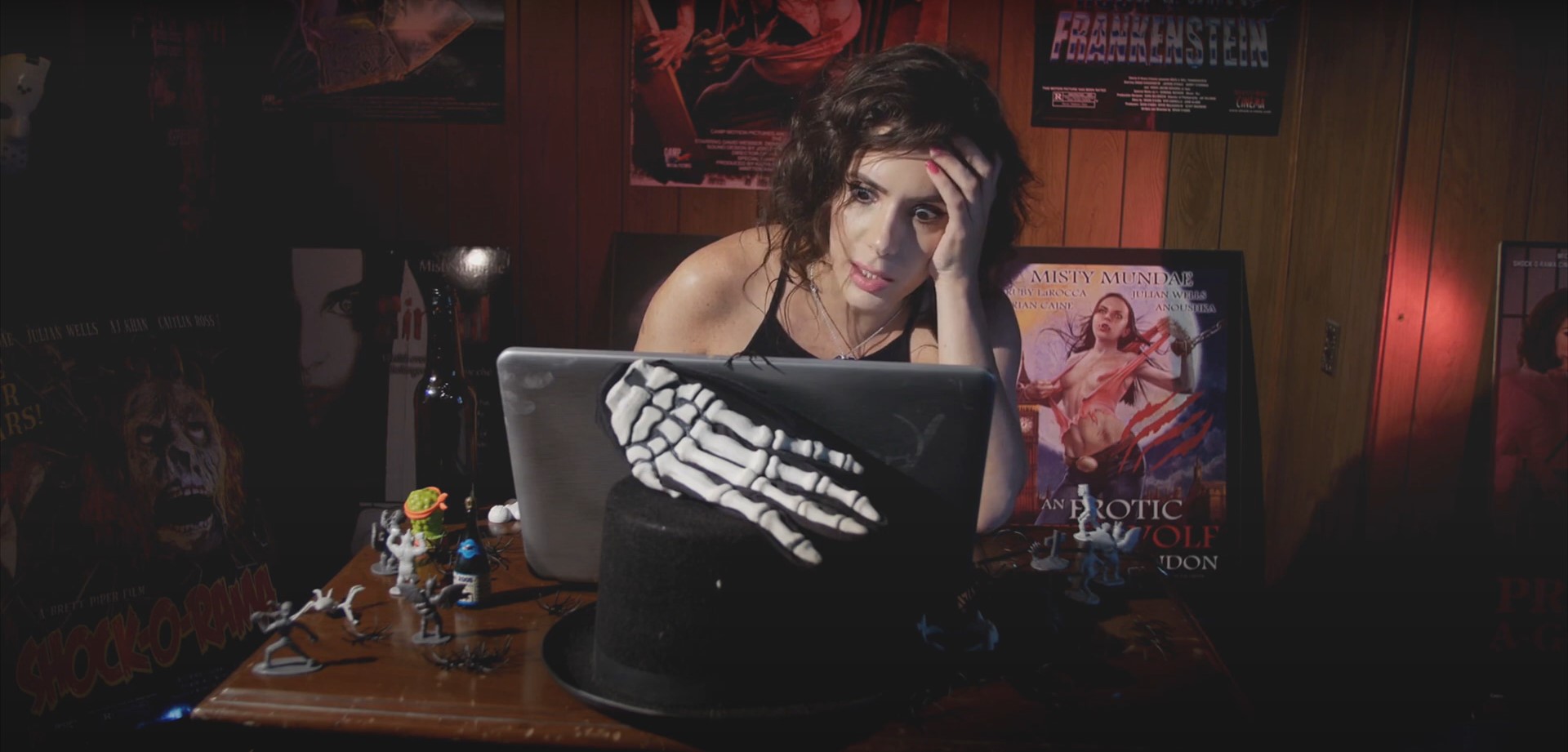
I said it once and I’ll say it again until the day I die:  horror anthologies are not my cup of tea.  Sure, there are excellent oldies, aka classics, out there, like “Creepshow” and “Body Bags,” from the masters of horror and a handful of more modern, done-right, anthologies from filmmakers on their way to such a grandiose title within the “V/H/S” series, but the majority of micro-narratives nowadays are collected from the scrapings of the low-budget trash barrel due in part to the cost-efficiency of short films, shot over a lengthy stretch of time, brought together into a single feature and the types of slim budget stories can sustain a better reception in a shorter format instead of full-length one.  Now, I’m not saying Zack and Spencer Snygg collaborated “Monsters in the Closet” falls into the latter category but as one of the first released films of 2022 to come across our ever-critical desk, the indie horror-comedy anthology needed to punch the living daylights out of use to begin the year and whether the Snyggs’ 4-episode, plus wraparound story, anthology slammed dunk or airballed will be covered below. “Monsters in the Closet” is a kickstarter project and a self-produced venture funded by a pair of sub-Hollywood filmmakers in Spencer Snygg, who has worked behind the scenes in the lighting department on some major films over the recent year, and a veteran indie softcore-horror director Zack whose has involvement with indie production companies like Troma and the New Jersey based E.I. Cinema, as you’ll see with a large, splayed display of E.I and Alternative Cinema posters strategically arranged as background fodder. It’s like a Misty Mundae poster celebration on exhibition.

The outer shell narrative that encompasses and unites each separate story entities begins with a frantic Tom C. Niksson as the diehard believer in his own success horror writer Raymond Castle, covered in blood, manically talking to himself, and in the throes of typing away before a cloaked stalker wielding a knife closes in on him. Niksson, who worked under Zack Snygg’s pseudonym, John Bacchus, in that Easter holiday E.I. Cinema favorite, “Beaster Day: Here Comes Peter Cottonhell,” steps into that looming, ever-present figurehead from the grave, delivering random dad joke dialogue while cozying up the audiences for an audiobook rendition of Castle’s latest bestseller, a black magic spell anthology of horror stories that come to fruition when read aloud. Other than his talking head role, Niksson’s involved in some contentious flashbacks with Jasmin as a child, but we never see Niksson and the adult Jasmin Flores (Jasmin) ever in the same scene together as the flashbacks are Jasmin voiceovers. Nikkson’s theatrical behavior perfectly suits the stagecraft atmospherics in erecting the gameshow-esque of a horror host whereas Flores is often stiff as a dry plank of wood. Limitations drawn from her lack of experience keep the actress’s timing and delivery often subdued in an obtuse and ungraceful character when escaping the ever-changing fiction-to-non-fiction villain of the minute. Jasmin, the character, is already inherently underwhelming in a role that has no purpose or buildup to understand her headspace surrounding the sudden death of her father. What do those flashbacks mean to her or are they just melancholic gibberish? And why isn’t she more interested in his death or even showing a lack of care for it? Throughout “Monsters in the Closet,” a fair amount of pleasantly surprising performances from the anthological works pull the overall project together better than those in the wraparound story. Along with a first person view zombie tale as the first short, Luke Couzens and Carmilla Crawford play newlywed new homeowners going through the frustrations of DIY Hell until they off each other with tools, the silver spoon Jordan Flippo becomes tarnished when a camping accident turns this rich daddy’s girl into an unstoppable killing machine to protect her immaculate image, and side-splitting John Fedele (“The Vampire’s Seduction”) as the humbly polite mad scientist Frankenstein who can’t get over the death of Mrs. Frankenstein (Valerie Bitner) and keeps resurrecting her despite her wishes to stay dead.

What I like and thought interesting about the “Monsters in the Closet” corpora is that they’re written in-house by at least one of the Snygg brothers, sometimes both.  This extends style and control over the entire body of work boundless to the ideas and the panache of other filmmakers and showrunners without having to associate themselves.  The Snyggs’ balanced anthology comes with equal levels of comedy and horror that unearths the humor in humorless scenarios sans the sometimes tired gags that can devalue a project into tedium and, ultimately, into worthlessness and since we’re already being beholden to more than one narrative that jumbles the mind, the mental capacity is too low to withstand different numerous tales in one sitting as well as to try and struggle with the bad unfunny bits.  “Monsters in the Closet” at least has a whimsical darkness about it, a sinister playful attitude, and isn’t afraid to get gory from time to time beginning with the Spency Snygg directed zombie existentialistic “Please Kill Me Again” that takes the viewpoint of a recently turned woman with normal inner thoughts and intentions, but the cravings begin to take over.  The Snygg brothers follow up with darkly satiric “Home Improvement” involving a new couple’s adversary journey to fix up their rundown new home to the point where they can’t take any more of the repairs or of each other and the overflowing sardonic banter starts to spill blood; this bit is fun, more than you know it relatable, and gets real nasty at the end. The weakest short is “The One Percenters” with a nob’s daughter eager to mingle amongst the common folk during a seemingly harmless camping trip that turns deadly after she accidently kills her boyfriend.  Conceptually, the message is sound with the wealthiest subverting the law theme and Jordan Flippo is stunning as a plutocrat’s high expectations daddy’s girl, but the story lacks enough obstacle and tension-filled stuffing for an interesting enough short. “Frankenstein’s Wife” spotlights John Fedele’s equable, light-hearted humor in affectionately reconstructing and resurrecting the wife he accidently kills and with each attempt at bring her back from the dead, her corporeal temple becomes less and less of herself through Frankenstein’s botched cosmetic surgeries. The lovesick cycle is both deranged and full of laughs from Fedele’s riotous desperation take of a classic character.

Gravitas Ventures unchains all the creatures loose in their digital distribution of The Snygg Brothers’ “Monsters in the Closet” anthology now available on-demand and digital platforms this January. None of the audio or visual aspects will be covered since the feature is not a digital release, but when I say The Snygg Brothers self-produced the film, I mean they literally wore nearly every single departmental hat, including director of photography and visual effects that impresses with a wide range of shots from drone, to hand-held, and to tracking done with depth and various levels of focus. There is no one trick pony behind the camera. Some of the digital effects, such as the bullet holes that riddle the basement floor and walls, cheapen the already cheap production and, for the most part, the practical effects reach the passing bar with the obvious lay figure body parts and crude masks/getups. There are no special features or bonus scenes with this release that runs unrated at 88 minutes. Anthology bias be damned, “Monsters in the Closet” is a rarity in a dying breed subgenre with a jocular sense of sinister, social commentary humor braided into a tenebrous fray between man versus man and man versus monster.

Watch “Monsters in the Closet” on Prime Video!