EVIL Bottled Up is EVIL That’s Life Ruining. “Repossession” reviewed! (Gravitas Ventures / Digital Screener)

“Repossession” Available on Amazon Prime Video!

Jim Tan is a middle-aged engineer earning more than decent living for his luxurious lifestyle with a high-rise condo with private swimming pool, his daughter’s university tuition, and an insanely expensive car. When he is suddenly forced to leave his job after decades of service, Jim’s inability to face the truth and retain his pride results in not telling his family upfront. As his bank account dwindles but his family’s lavish spending continues, Jim’s drastic measures of gambling what he has left in the stock market trading goes against his best friend’s advice as he also submits to a meager income as a transportation driver, but as Jim sinks deeper into the red, the secret he keeps from his family eats more and more at psyche and his traumatic past, full of more secrets, leave the door open for a pernicious dark figure to infringe upon his crumbling reality.

Filmed and set in the multicultural, larger-than-life city of Singapore, “Repossession” is a transfixing cautionary tale of the grim side of pride, society’s devaluation of experience, and the return of past demons. Written and directed by the predominantly television producer, writer, and director, Goh Ming Siu, and Scott C. Hillyard, the 2019 thriller about the ugly failings of falling personal stature grace is the first feature length venture from Siu, a Northwestern University’s Communication’s graduate, and Hillyard, a Mass Media Management grad of Nanyang Polytechnic School of Business Management, that showcases not only his drive to create a structurally sound narrative, but also a vision of one man’s minimalistic mental terror backdropped inside a vibrant, heavily urban surrounding where madness can be lost and confused with the day-to-day hustle and bustle. Siu and Hillyard have tapped a handful of short comedy films over his career with “Repossession” being the directors’ first attempt at a fright film, even if it’s only a diluting portion of the considerable drama elements and is a production under their private limited company Monkey & Boar, operating out of Singapore.

“Repossession” revolves around the fall of a prideful patriarch performed by Gerald Chew (“The Tattooist”). Chew, who previously acted in one episode of Siu’s comedy series, “First Class,” has to enact a man torn from the breast of affluent society and forgo the weening process of learning how to manage life’s obstacles without a steady, lucrative income. As the corporate terminated Jim Tan, a middle-aged man forced back into the current job market after 20+ years at the same company, Chew reaches into our darkest corners for anxiety and panic when everything in Tan’s life that has felt secure and sustainable is now on the precipice of tumbling down into a heap of loss. Instead of coming forth with his mare’s nest of occupational troubles, Tan hides it away, keeps it a secret, and tries to maintain status quo from his wife, daughter, and friends, but the daily life of was once sustainable yesterday is not sustainable today and Chew does the immaculate reformulation of proud man who never needed to worry to now a man whose pride is getting in the way of his acceptance and progression. To add an extra little something to the narrative, Tan’s backstory creeps into the fold one flashback at a time to underline the bubbling trauma now aggravated by his newfound sense of desperation that leads him down a concealed path of disturbing distraught. The mostly all-Asian cast rounds out with principle actors in “Just Follow Law’s” Amy Cheng as Jim Tan’s wife Linda, Rachel Wan as his daughter, Jennifer Ebron as the condo-keeper, and Sivakumar Palakrishnan, as his confidant and common-sense life adviser he never thoughtfully considers, along with bit roles from Daniel Jenkins and Grace Chong.

Demonized as an inky black and towering dark figure with long, sharp hands is Jim Tan’s bottled-up trauma ready to pop like a screw loose on an airplane engine that’s flying 10,000 feet above a populated city. A catastrophe of psychological collapsing looms constantly around every corner when the figure first makes its presence known and only Jim experiences its menacing presence. Viewers won’t know if the glomming figure is a figment of Jim’s mounting pressure or a haunting dose of realism from his past. The otherworldly shadow is just that, a tenebrous shadow of Jim’s foreboding hesitancy in coming clean, and, just like most secrets some of which can be monstrous, harmful, and wicked, Jim’s withholding cleans house with his relationships, hurting everyone in his path from friends to family from his past and to his present. Siu and Hillyard offer a slow chug displeasure cruise of one man’s course through dormant madness, triggered after years of comfort and security, in repossessing a lifelong psychological issue thought long suppressed. The wordplay is clever in design with the character’s default on payments as well as defaulting on his own life and, thus, everything he ever owns falls onto the grounds repo-horror. What can be considered asymmetrical in Siu and Hillyard’s film is the concerting connection of the dots, through Jim’s sometimes off-topic flashbacks and startling visions of the dark figure, that lead up to, what I consider to be, one of the best simply shot and powerful climatic endings experienced to render a pitfall of rueful heartache with a gory final moment.

On December 21, “Repossession” came a-knockin’ on the North American market’s digital door with a multi-platform release from Gravitas Ventures in association with Kamikaze Dogfight. The film has a runtime of approx. 96 minutes and bares a not rated certification. Since “Repossession” is a digital release, the audio and video quality critiques will not be covered. However, I was impressed with cinematographer Chow Woon Seong’s wide lens celebration of Singapore by capture various sentimental landmarks in the area and establishing a contrasting space between the actors and the stunning visuals screen monolithic and serene, creating a conflicting blend between ominous and wonder that also translates into the film’s industrial-lite soundtrack by composer Teo Wei Yong with a brooding mechanical perfunctory to match Jim Tan’s hardly lifting a finger effort. There are no special features or bonus scenes included with the digital release. Powerfully relatable, the human condition for survival, despite the trivial circumstances surrounding one’s dignity, can turn deadly in the blink of an empty bank account.

“Repossession” Available on Amazon Prime Video!

Fortuity Can Be EVIL’s Plaything. “Like A Dirty French Novel” reviewed! (Blvd. Du Cinema Productions / Digital Screener)


An organized crime and deceitful milieu sets the stage for a missing bag of stolen cash, an unscrupulous bunch of characters, and a mysterious omnipresence being persuasive behind the curtain of a rotary phone.  When ex-lovers Crystal and Hue are not in heated spats over past infidelities, trapped inside their quaint apartment, Crystal moonlights as an adult cosplaying model secretly having an relationship with a stranger while Hue locks himself away in the bathroom conversing secretively and flirtatiously with an unknown woman he knows nothing about.  They become entwined in a heist gone wrong by a group of halfwit robbers that leaves a trail of death, lies, and an evil charting their fates in the shadows. 

Desultory pulp basking in noir fiction, “Like A Dirty French Novel” flaunts a chicly awkward and brazenly unmethodical black comedy and crime drama front from Cuban-American writer-director Mike Cuenca.  The “By the Wayside” and “I’ll Be Around” auteur stitches together a vivaciously satire and minuscule budgeted drama comedy shot in the zero hours of a time crunching, less than a week, schedule with an editing style, edited by Cuenca himself as one of his many production hats, of five chaptered, non-linear tale of sectionalized cynicism and infringing transgressions.  Cuenca co-write the script with Ashlee Elfmann and “I’ll Be Around” co-writer, Dan Rojay, with Cuenca self-producing under the filmmaker’s East Los Angeles-based, DIY encouraging production company, Blvd. Du Cinema Productions.

With an ensemble cast, “Like A Dirty French Novel” spreads out with five chapters, two interludes, and a prologue that begins with three men walking in a desert and approached by a mysterious woman in a chintzy, but intrinsically detailed, Japanese resembling Oni mask.  Before we can invest into these bewildering circumstance that leave the three men screaming for their very lives, Cuenca whisks up away right into Chapter One, introducing bickering ex-lovers Crystal (Jennifer Daley, “Blood Born”) and Hue (Rob Vally, of gay themed Steven Vasquez pictures such as “Angels with Tethered Wings” and “Dancing on the Dark Side of the Moon.”) snooping into each other’s hidden extracurricular activities that leave Crystal daydreaming about romance and Hue surrendering to smutty phone talk.  Not much is revealed in the first chapter before segueing into the second with Forrester Dooley (Grand Moninger), an unhappily married man who switches places with his twin brother and the recently unincinerated Bugs Dooley (also Moninger), but, as fate would have it, Bugs turns out to be a standup, wonderful guy whereas Forrester need for a break ironically places a bullseye on back and he ends up stranded in the desert with two unsavory fellows, circling back to the film’s vague prologue.  The cause for their stranding is because of Lane, a manic drifter delightfully captured by “We Take The Low Road’s” Amanda Viola.  Lane is approached by cool cat Jake (Aaron Bustos) and what ensues next is a montage of innocent dalliance before he suddenly vanishes and is seemingly dead to the world.  Remaining chapters unravel more about the principle players, spilling their hidden agendas and their scheming roles surrounding a duffle bag of thieved cash pinched from a local ruthless kingpin Filmore Demille, played by Cuenca himself donning yet another hat.  The cast rounds out with Dominic Fawcett, Samantha Nelson, Laura Urgelles, Claire Woolner, Dan Rojay, Joey Halter, Miles Dougal, Steven Escot, Arko Miro, and “Murder Manual’s” Brittany Samson as the interlude’s stammering and obsessed fanatic of the masked and sexy graphic novel cosplay model.

“Like A Dirty French Novel” pulsates with pulpy fiction with hints of Lynchian notes through Cuenca’s back and forth pacing of connecting the dots to his equivocal crime thriller.   Cuenca’s gray area, faltering more than any other, lies in making that relating and understandable so important connection of reverting scenes back to earlier ones in order to have actions make sense.  A once over is not enough to fully grasp “Like A Dirty French Novel’s” abstract features and to be recursive would not be a sign of weakness or simplemindedness on our part.  Still, smoothing out the rough patches like with the peculiar finale, which I’m speculating to be the grounds of Hell, would have made “Like A Dirty French Novel” more of an easy read than a confusing one as well as completing most characters arcs with a satisfying tell all fate. Cuenca’s filmic message of what comes around, goes around comes across more clearly with those who reap what they sow. A faux book entitled Porter du Fruit or Bear Fruit yields to positive results and, in which this case, none of those characters who go to the grounds of Hell are saints by any means. Constrained by a shallow pocket budget, settings are simple outdoor public areas, small apartments utilized with polygonal angles, and, if you’re working in L.A. much like this shoot, then more than likely a scene or two, at the very least, is filmed in the desert, but seasoned cinematographer, Jessica Gallant (“The Control Group,” “Shevenge”) spruces up scenes with neon red lighting, dabbing in black and white, and centralizing characters with focal spotlight, adding little classic techniques that still pop in the camera’s eye. Gallant’s wide berth of techniques, from hot pink tints to emulating grindhouse celluloid grain and scratches, keeps a stylized profile wanting to be watched. However, most cast performances are not so debonair as they come across a bit prosy, staged, and without too much magnetism that usually trends with pulp-noir trademarks and, of course, trashy novels érotiques bon marché.   With the exception of the underused Amanda Viola and Cuenca’s solo-scene monologue, sleeping at the wheel performances drives no other standouts in this cast.

“Like A Dirty French Novel” premiered this past August at the independent showcase, Dances With Films film festival, held in Los Angeles at The Chinese Theaters as part of their Midnight lineup; however, no current confirmations on when the first home release – whether physical release or digital releases – will be available yet. Briskly paced at 78 minutes, Cuenca squeezes into one more hat among his list of production duties as author of the eclectic sometime brooding and sometime high energy score along with Carlos Colon composing the pieces that could resemble the minor league notes of Michel Legrand. Alas, Michael Cuenca’s “Like A Dirty French Novel” aims to be more bourgeoisie than an obvious low cut of a few francs with an ingrained pulpy style and more twist and turns than Grand Prix race car driver, but lacks that tour de force it strives to assimilate as because of stiff performances and a wildly untraceable storyline.

Transcend This Life With an EVIL Elixir! “At Night Come Wolves” reviewed! (Gravitas Ventures / Digital Screener)


Leah has tirelessly tried everything to please her misogynic and negative husband Daniel, even going as far as dressing up in a skimpy and sexy Wonder Woman outfit and serving him his cake in more ways than one.  Yet, nothing seems to be chipper his spirit as he barrages her with meanspirited down talk that disparages her in every possible way.  Fed up with it all and hightailing their home before she does something rash, Leah drives aimlessly to get away from him and winds up, out of gas, at a diner where she meets Mary May, an acolyte to cultist Davey Stone who believes an elixir made from a forgotten, thought extinct, plant will transcend their existence beyond the cruel world of the now.  What the elixir actually does is something far more horrifying.

Verbal abusers, cult leaders, murders.  The crazy doesn’t stop there in Thomas J. Marine’s debut feature film, “At Night Comes Wolves,” landing it’s anti-sexism and anti-misogynistic messages upon the world on digital platforms this month.  Marine comprises his three short 2015 through 2017 films – “Paris, My Love,” “The Call to Future,” and “Object in Reality” – together with central narrative to bring new life into each one of his projects and also create something new from half the work being already filmed years earlier. Marine, or TJ as credited, writes a genre abstract story out of the pieces he tries to puzzle together, wildly cutting and pasting his shorts together as he continuously self-funds that extends into the filler narrative of his 2021 film under his own copyright, leaving “At Night Come Wolves” as a piece of true work from an auteur.

Beyond the first scene of a bound woman to a chair, bleeding from her hungry eyes and mouth, “At Night Comes Wolves” opens with Leah, “On-Site’s” Gabi Alves in her sophomore feature film, coming under hellfire from her loathing husband Daniel (Jacob Allen Weldy). Alves comes off with the submissive, will-do-anything to be a pleasing wife starkly contrasted against Weldy’s take-it-all and give nothing sexist persona; however, their relationship strays into Daniel’s bizarre sexual fetishes and watching his sexually objectified wife become the plaything for another man, a black man to be specific. The scene is brief, but powerful, perhaps the most powerful 10 seconds in the entire film that could have been, or rather should have been, the very principal theme of “At Night Comes Wolves'” subjugating prejudice roots. Instead, Leah throws in the towel and deadheads to nowheresville, serendipitously running into cult acolyte Mary May (Sarah Serio) and cult leader Davey Stone (Vladimir Noel). Stone’s fancies himself as an alchemy enthusiast, mixing his vintage bottled potions of unmarked substances that produce a variety of outcomes, usually ones Stone doesn’t expect and that thinly becomes the plot point genesis of Marine’s shorts. The entire dynamic becomes a glass ceiling as the story kind of just ceases to make logical sense when Leah deliveres Stone and Mary May to Daniel in a reconnect from the past of bad blood crossing paths again and along for the ride is Daniel acolyte Susanne (Colleen Elizabeth Miller “Leaf Blower Massacre 2”) whose down to drink Daniel’s demented womanizing Kool-Aid. Joe Bongiovanni, Myles Forster, Madeleine Heil and Byron Reo are sprinkled into servitude of “At Night Comes Wolves'” contorted three prong story.

Marine might repurposed his shorts into a Frankenstein feature to resuscitate new life into his lifeless projects, but the concept of regurgitating material itself isn’t totally unheard of while also being not widely popular amongst the mainstream crowd and even well-backed, risk-taking B movies due to the innate choppiness consequence.  Whether the restructure comes in the form of a web episodes strung together as in Nicholas Tana’s “Hell’s Kitty” or from lengthy shorts of one continuous story as with Joe Lujan’s “Rust” being a prime example of his short films, “Rust” and “Rust 2,” having been meld together years later, the narrative planes always seem and feel fragmented and staggered to the point where convincing audiences of a seamless story becomes a blurred line of why even try as filming styles, crews, actors, and even equipment change over time and “At Night Comes Wolves” suffers from that very incoherency with an intended non-linear storyline inelegantly sewn together by backtracking segues. Marine has two, if not three, very different ideas floating around his feature with one being very poignant, another identifying ideological radicalism with sexism undertones, and the other being just for the hell of a horrific good time with the undead. Of course, you don’t ever see the finale coming because, let’s face it, there’s never an established clean and clear objective in the narrative that floats in time and space. Hell, I don’t even know if it’s supposed to be partly a comedy or not with the incorporated park ranger scenes with Joe Bongiovanni and Vladimir Noel that are offbeat funny. This is the hand Marine dealt himself and it wasn’t a pretty one, yet somehow his ambition made a semi-intelligible presentation of a cult group toppling another more depreciating cult group before transcending into the seedlings of the apocalypse. And all I can do by the end of the movie is ask myself, what the hell did I just watch?

Don’t let this review scare the preeminent pants off of you from checking out and judging for yourself TJ Marine’s 2015, 2017, or, maybe, 2021 released films within a film as “At Night Comes Wolves” hit digital platforms this month of April, including iTunes, Google Play, Fandago as well as available on cable and satellite VOD services. Clocking in at 77 minutes, the unrated “At Night Comes Wolves” is out now released by worldwide film distributor Gravitas Ventures.  Aside from that singular moment of marital dysphoria that leads into an uncomfortably potent fetish of sexual desires and some witty repartee between a pair of colorful characters, TJ Marine’s reworked story might actually weaken the mystifying intrigue of his shorts as he plucks holes and fills gaps with new footage in a forced teetering of trying to make a comprehensible notch in the movie market.

Rent or Own “At Night Comes Wolves” at Amazon.com!

Two People Living in Different Times Linked By an EVIL Secret. “Dead Air” reviewed! (Freestyle Digital Media / Digital Screener)

As a single parent of two teenage girls, William stows away the painful memories of the death of wife some two years ago.  When rummaging through boxed away belongings, he stumbles upon an old ham radio and a diary that once was his late father’s, who tragically was killed during William’s youth.  Psychiatric sessions aim to resolute a traumatic event from the past William can’t seem to recall and has plagued him over the decades and well into adulthood, but all his problems converge when he befriends another amateur radio user, a woman, that simmers a progression of unraveling his past rooted by an unfathomable secret the woman holds that will collide William’s past and present to alter his future. 

Not to be confused with the 2009 same titled film of bio-terrorism turned zombie horde starring “The Devil’s Reject’s” Bill Moseley or mixed up with 2000’s “Frequency” where Dennis Quaid’s character phenomenally reconnects with his deceased firefighter father over an old ham radio, Kevin Hicks’ “Dead Air” also shears linear time by embracing supernatural elements over the air waves of an archaic means of communication and though flesh eating maniacs don’t ravage the world, another terrible humanoid race in the Nazi’s are brought to the proverbial table.  Nazis, traumatic past, jumbled paranormal radio transmissions, clandestine spies – Kevin Hicks directs a multifaceted suspense mystery thriller penned by wife, Vicki Hicks, marking yet another notch in their collaboration history that includes a strong history of horror-thriller credits from 2010, such as “Paranormal Proof,” “Behind the Door,” and last years “Doppel.”  The husband and wife combo produce the “Dead Air” under their homegrown production company, Chinimble Lore.

However, Kevin and Vicki Hicks do a little more than just be a presence behind the camera, they’re also in front of the camera, co-starring across each other as the principle leads who never come face-to-face as they interact solely by tuning into the radio frequency of the ham radio.  Their respective roles of William and Eva douse “Dead Air” with plenty of cover-your-base exposition in building a long distance friendship that turns sour when truths are revealed by supernatural circumstances.  Before the pinnacle reveal, a stitch in time ripe to be altered, Hicks has to be a widowed husband and father of two teenage girls while parallelly secretly dealing with an unidentified trauma from his past.  The trauma doesn’t peak through in Hicks’ performance as William goes about his day either emotionally comforting his temperament diverse daughters with the loss of their mother or always sitting in front of the ham radio eager to speak with a newfound chat buddy, the adversely taut Eva.  Vicki Hicks shelters in place as the paranoid agoraphobic, though not yet understanding what that term means just yet, as the cagey Eva and Hicks cements Eva’s covert dealings with suspicious eyes and a cryptic gait that tells us she’s chin deep into counter intelligence.  “Dead Air” focuses nearly exclusively on the William and Eva radio hour, but minor characters are sprinkled for support traction with Luca Iacovetti, Chris Xaver, Ryan C. Mitchell, and real life sisters playing sisters on screen and co-producer Mark Skodzinsky’s daughters, Madison Skodzinsky and Mackenzie Skodzinsky. 

As far as indie films go, Chinimble Lore is well versed in the expense saving concept providing “Dead Air” with limited locations of about three or four primary small and conventionally decorated indoor sets, low-key in the little-to-no high-dollar, high-concept action, and having the filmmakers step into the shoes of the principle characters of William and Eva. Don’t expect “Dead Air” to be knocking socks off with mind blowing choreographed sequences or any type of painstaking visual or practical special effects in a story concentrated script constructed to be a fable filled with second chances and righting the wrongs through unexplained phenomena; yet, when blindly vehement to correct the past, the unintended butterfly effect could also take away what’s precious to you. Vicki Hick’s script meets that cautious tale bar, but doesn’t exceed the darn thing as the mystery element, William’s insights into who Eva’s true self and calling and how he’s supposed to stop her despite living decades a part, to which the film could only express verbally instead of plastering a veneer to show, can be quickly solved in “Dead Air’s” blueprints of foreseeable plot points. One thing that teased the imagination and should have been explored further is William’s psychiatrist performing hypnotherapy to unearth his trauma, but then opens the Pandora’s box of well, why the hell didn’t the psychiatrist try this in the first place?!? William notes spending $40 an hour on therapy sessions and we see him sit in at least 3 times with dialogue extending that to a higher number. Either William’s psychiatrist is a hornswoggling swindler or a daft healthcare worker with poor practice management. Either way, team Hicks, between their repertoire of directing, screenwriting, and acting, can’t smooth out the film’s rough patches enough to be an original twisty thriller backdropped with an ethereal external force communicating from beyond the grave to save more than one soul, leaving “Dead Air” radio silent.

Freestyle Digital Media sends signals from the dead with Kevin Hicks’ “Dead Air” available now on Video-On-Demand across North American digital HD, satellite and cable VOD through platforms Including streaming services iTunes, Amazon Video, and Vudu and cable services Comcast, Spectrum, and Cox.  The 91 minute runtime could have been cut to a leaner 70 to 75 minutes to not only dilute the impact of a dialogue-saturated narrative but also trim a forced subplot of William’s cancer-struck wife that doesn’t quite enact the depth to William’s background that it was intended to do.  Presented in a widescreen 1.78:1 aspect ratio, cinematography by Kyle Carr is digitally clean with a blanketed combination of hard and soft lighting in a rather warm glowing color palette of yellow, red, and jade, but the camera work and shots are standard in technique, not offering much in the way of style since most of the shots hover on medium closeups of William and Eva chit-chatting over the radio.  The light rock tracks composed by Kevin Hicks and performed by the versatile music man Lonnie Parks are sprinkled in to engage a sense of passing time correlated with the storyline events, but the soundtrack’s genre tone sounds like a transistor radio out of place of a story built on a ham radio’s static and garbled messages and would have been more poignant with more of Parks’ mellow-brooding engineered score.  The digital screener was not accompanied with any bonus features and there were no bonus scenes during or after the credits.  Part of “Dead Air’s” demise is the fact that “Frequency” established an already familiar foundation over 20 years ago with nearly the same plot studded with star power and a large pocketed budget, but the story’s engaging enough with supernatural radio waves and the clandestine ties to Nazi spies to keep a progressive interest despite our good hunch on the climax and the finale. 

Rent or Own “Dead Air” digitally on Amazon Video by Clicking the Poster!

When The Waters Rush In, It’s the EVIL in Your Head That’ll Kill You. “Relentless” reviewed! (Terror Films / Digital Screener)

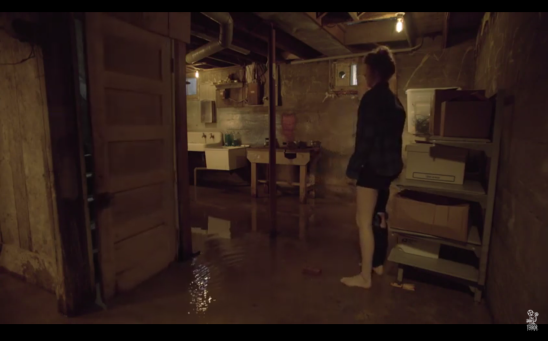
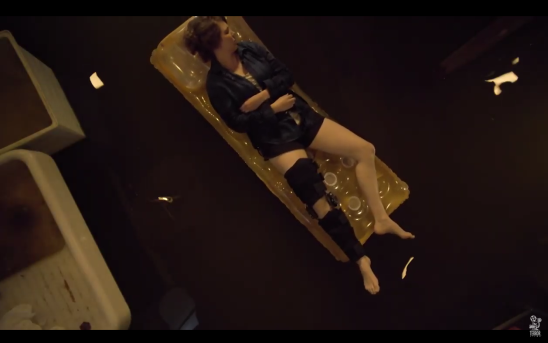
Jennifer Benson’s life is a storybook fairytale that’s embraced by her close sister, exalted by a sweet, kind husband, and excited with the news of an upcoming baby. Yet, all good things come to an end and in Jennifer’s case, in a devastating tragedy when everything and everyone she held close to her heart is unexpectedly wiped away within a single year. Physically injured and suffering from depression, Jennifer withdraws from family and friends inside an empty house, sinking lower into despondency, and letting bills and the house upkeep slip through the seemingly insignificant cracks. Jennifer eventually decides climb up a little out of her rut by cleaning up and letting go of some sentimental materials that leave painful memories by storing them in the unfinished basement, but when the basement door jams and won’t open, Jennifer finds herself trapped in a subterranean state with a large thunderstorm dumping rain that’s seeping from the basement walls, plumbing, and the ground. As the torrential rain continues to fall, the water level continues to rise with no way out.

Get ready to hold your breath in Barry Andersson’s agog of metaphorical poignant survival, “Relentless.” The filling of the fish tank mender is the director’s first and only release of 2020, following his 2019 releases of the historical drama, “The Lumber Baron,” and a 1940’s set sleep deficient thriller, “The Soviet Sleep Experiment.” Andersson continues to tell stories of intricately varied human responses as the filmmaker pens “Relentless” surrounded by themes of reactionary and recovery paths toward death with the film echoing more so with Andersson’s introductory “The Lumbar Baron” on a much smaller scale in terms of cast and setting. The story is set in or near Minnesota, a Midwest state prone to some of the United States worst flash flooding hit areas, and Andersson crafts his creative juices with that in mind to mold a symbolic cognitive descension stemmed by escapism inside creature comforts. Deodand Entertainment and Andersson’s filmic workshop company, Mogo Media, designate as the production companies.

“Relentless” indurates around being a one woman show with Rachel Weber spearheading the subject of crippled and downcast Jennifer Benson. Weber, whose worked briefly with Barry Andersson in “The Soviet Sleep Experiment,” has to operate Jennifer animatedly in a near voiceless, tacit role to simulate one alone with their thoughts and emotions. Only flashbacks limn with dialogue present the state of Jennifer’s woebegone mind as she goes from despair to reluctant acceptance by reopening the wound of concealed painful memories. Weber fulfills every inch of empty space with a tinge sorrow in some way, shape, or form but doesn’t quite convey the impact well enough to fortitude a presence. Weber’s post-flashback expressions deflect the corpus theme with no real tell of how Jennifer actually feels as she stands over a box full of memorabilia of what should be inducing whether a pensive sadness or vitalizing inspiration as she goes through an unbalanced reel of memories that include bedroom book snuggles with her sister at young age or survival life lessons with her father to up at the moment of what was supposed to be a joyous baby shower occasion that turns unexpectedly into tragic point in her life. Though the story acutely restricts the camera on Weber, the unfolding flashbacks ultimately tell the story from the past that includes stint performances from Charles Hubbell (“The Bitch That Cried Wolf”), Anna Hickey, Bea Hannahan, and Presley Grams.

“Relentless” has thought-provoking messages splayed up, down, and all around it’s encased four-walled theme of, literally, drowning in your own self pity and digging yourself out of a hole of depression. The water that gushes into the air tight unfinished basement represents the rising fathoms of depression that initially trickle in harmlessly enough, but the longer the despair drips go unchecked, as noted when Jennifer reaches out to nobody up on the top floors of her house and would rather recap wedding photos in the first act, the more intense the cascades can become when your submerged in from head to toe. Along Jennifer’s rather stagnant perilous journey, sitting on top of work benches as a hapless invalid and rummaging through miscellaneous items, she opens and goes through various storage boxes of her past that she carefully tries to keep dry by continuously moving the boxes out from the low-lying waters. Each box evokes a single memory from her past fashioned in an unchronological order and stews in a melting pot of stirred emotions that work backwards from melancholy to hope to, eventually, in my opinion, an inescapable suicide. My subjective take on Barry Andersson’s open-ended culmination is purely speculative as Jennifer’s struggles for survival may all be for naught, even in the evidence of the character leaving behind a note for storm survivors, or whomever, to collect staggering into what could be Jennifer’s tomb strongly suggests that particular path. That’s what admirable about intense thrillers, such as “Relentless,” that teases an unwritten coda for those to survive and tell the rest of the story, woven with their own personal singularities, but Andersson’s film, heavy in metaphors, lacks spirited vitality in a somber stroll through what’s innately a human fear: death.

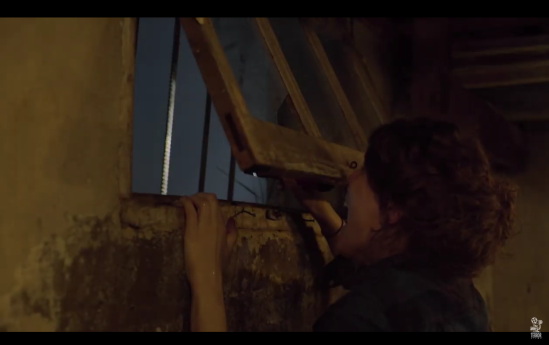
Basements continue to retain their bad rap in the traditional horror sense as well as in Terror Films’ release of Barry Andersson’s survive-or-die succumbing to mopery in “Relentless,” distributed digitally across multiple platforms. Rigorous self preservation might be watered down, but the stagecraft and production design is top shelf quality with a simple set of a well dressed dank and bare basement where streams of water rush into from the barred awning windows and waterlogged plumbing. The basement in itself is a character of misfortune, a cell of rehabilitation, and is just simply effective in a cinematic sense without seeming overly menacingly but rather like every other basement in the world. With the digital screener, there were no bonus material included nor any bonus scenes during or after the credits. Don’t expect a nonstop nail-biter that aims to fill your lungs with asphyxia inhaled water; instead, sympathy or empathy will play significantly in “Relentless'” success with an aggregating flurry of thoughts generator in a post-traumatic vicissitude.

“Relentless” included with Prime Video and available for purchase!