One Out of 7 Most Freaky, if not EVIL, Places on the Planet! “Gonjiam: Haunted Asylum” reviewed! (Second Sight / Limited Edition Blu-ray)

Become Engulfed by the “Gonjiam: Haunted Asylum” on Second Sight’s LE Blu-ray!

Horror Times, a web series dedicated to horror and hits, travels to the Gwangju providence for their next big event, a special episode aimed to rake in 1 million views worldwide as they explore the supposedly haunted, deserted, and derelict Gonjiam psychiatric asylum after midnight on its anniversary date of its closing.  Already buzzing with historical disappearances of those curious and brave enough to investigate the dilapidated corridors and rooms, Horror Times brings in four guests to join his three-man crew to record every second of what CNN labels one of the seven freakiest places on the planet.  Setup with wall-mounted motion activated cameras, harnessed with individual GoPros, and given a multi-layered script to follow on each of Gonjiam’s four floors, all is going as planned broadcasting live the strange atmospherics that slowly see climbing views from the director’s camped base outside the structure, pulling some fabricated strings to not only heighten his viewer pool but also get genuine frightened reactions from his guest team, but when the team and the cameras unexplainable paranormal occurrences, how far will a director go to reach his milestone goal.

Based off the actual CNN listicle of the top 7 freakiest places on the planet, “Gonjiam:  Haunted Asylum” was a real brick-and-mortar edifice committed to the committedly insane and one of the most suspected haunted places in South Korea until it’s demolishment shortly after the 2018 film’s release.  “Epitaph” writer-director Jung Bum-shik joins the ranks of the South Korean supernatural spookies, accompanying notable entries such as “The Tale of Two Sisters,” “Phone,” and “Cinderella.”  Cowritten by Sang-min Park, Gonjiam:  Haunted Asylum” refreshens the ramshackle mental institutionalized horror subgenre with a dash of social media influence and found footage that entangles grudging ghosts with cyber terror.  Historical thriller and drama producer Won-guk Kim spearheads the project under Hive Media productions and distributed globally by Showbox Films. 
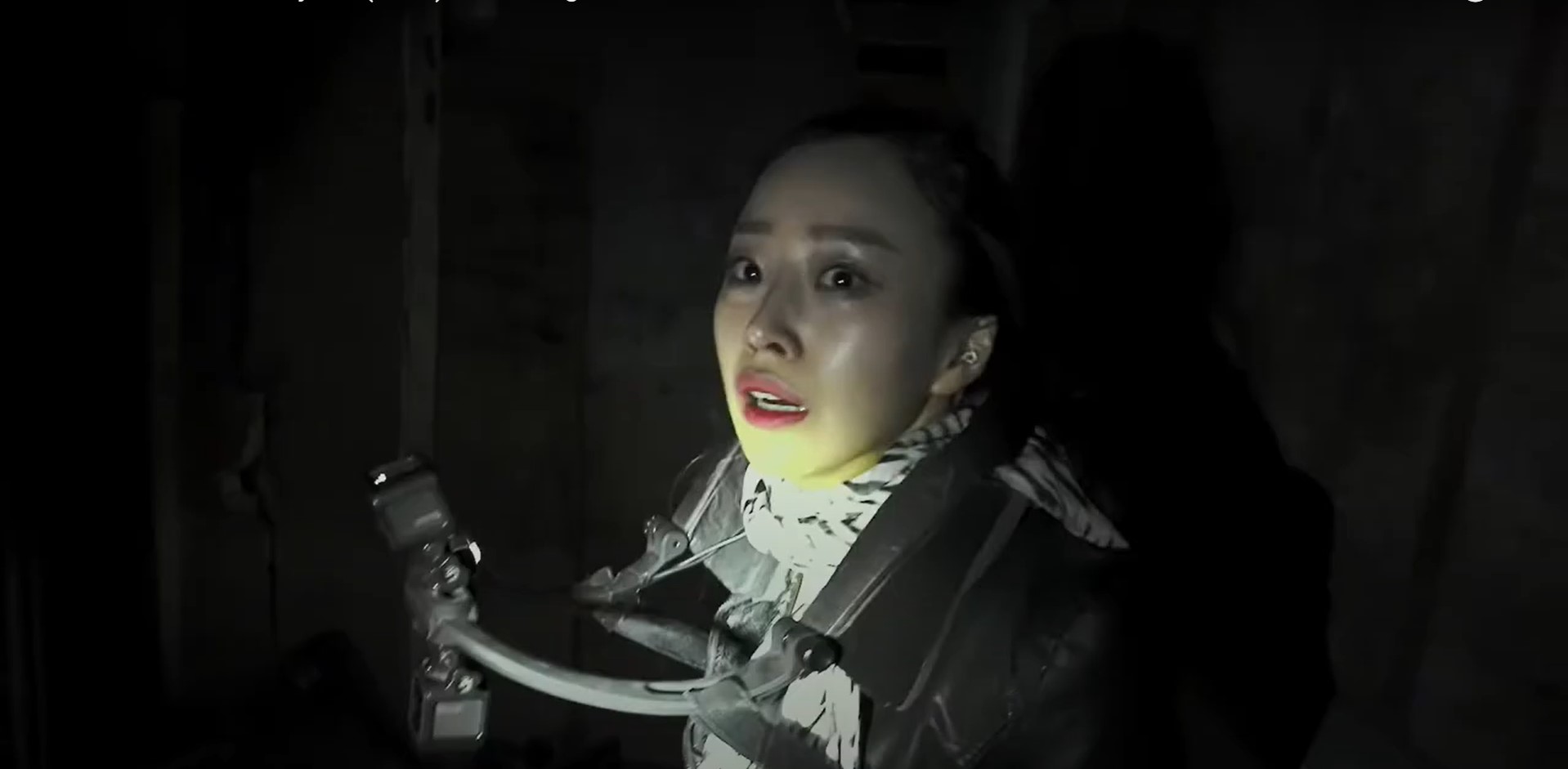
Like a cable-aired, modern-day version of “Ghost Hunters” or “Kindred Spirits,” the vessel Horror Times exploits people’s spirituality beliefs by mingling the exploration of urban legends with gimmicky ploys to keep eyes glued to the show, run up viewership, and earn the root of all evil, money.  The Mystery Incorporated meddling kids might not have a talking Great Dane, but the Gonjiam ghost hunters are a dynamically doomed blend of greed and curiosity, helmed by their captain Ha-joon (Wi Ha-joon, Squid Game) and his on-the-ground, string-pulling marionettes Seung-wook (Lee Seung-wook) and Je-yoon (Yoo Je-Yoon) to conjure up not spirits but pranks under the guise of Gonjiam ghosts.  The unsuspecting portion of the team react as expected, believing the unexplainable as genuine articles of a haunted asylum, until the jokes bleed into the reality of the structure’s incensed force.  Other than Charlotte (Mun Ye-won), a Korean American who travels to Gonjiam to add the location to her lists of CNN’s freakiest places on the planet, there isn’t another mise-en-place character.  Perhaps the others’ backstories are lost in translation but Sung-hoon (Park Sung-hoon, “Hail to Hell”), Ji-hyun (Park Ji-hyun, “The Divine Fury”), and Ah-yeon (Oh Ah-yeon) lose sympathy points for just being there for the sake of being there.  If you haven’t caught on already, the characters and actors name match to add to the faux realism of found footage. 

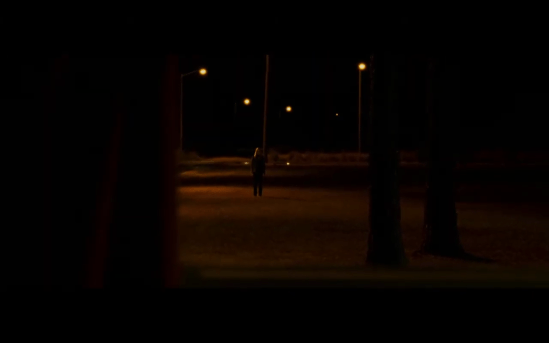
Veritably surrounded by the actual notoriety of the former Gonjiam psychiatric hospital, the story adds to the established frightening folklore of the rundown building and though the filmmakers were not allowed to shoot inside or on the grounds of the restricted abandoned building, Gonjiam blueprints were used to reconstruction the grimy, trash-laden hallways and various rooms inside a high school.  The effect works like charm used to teleport audiences, along with the help of social media GoPros, selfie sticks, and the like, right into the crumbling ruins; you can almost smell the mold and stank of beyond putrid chemicals and filth.  Yoon Byung-Ho’s cinematography plays with the signal disruption touch, often deploying randomized and intentional interference to convey signal disruptions or, perhaps even, the foreshadowing with the wraithy wrath of spirits; yet “Gonjiam” never truly feels like a found footage film due to its radical differences in video media being implemented and there’s often the unexplainable, no camera-in-use angle that dilutes the subgenre medium.  “Gonjiam” falls into this unquantifiable realm of storytelling that’s hard to digest.  The chaos that ensures in the third act is more palpable, geared toward developing a heavily reliant, hard and fast tension and trembling fear without needing bloodshed for the crowd-pleasing shock factor.

Second Sight sees through the dense barrage of found footage films and spots the pearl amongst the muck with “Gonjiam:  Haunted Asylum,” curating a limited edition, big box, Blu-ray release.  The AVC encoded, 1080p high-definition, BD50, presented in a widescreen 1.85:1 aspect ratio, nears 24 FPS and has flawless technical recording in its digital capturing.  Blacks are dense and rich to create that unknown void apprehension, the neglected belongings of a forlorn hospital have palpable consistency that’s grimy and rusty, and skin textures appropriate lose definition but maintain quality to the extent of equipment limits with GoPros, cell phones, and camcorders in low and hazy key lighting, onboard camera lighting, and some night vision for authentic found footage grip.  There’s not much in the way of diverse color for what is a graded tone of tenebrous obscurity throughout.  I’ve already touched upon Byung-Ho’s purposeful transmissive trouble that impresses more of an annoyance than an integrated factor of fear.  The Korean DTS-HD Master Audio 5.1 delivers on the need-to-hear atmospherics that shudders in echoes and the frantic churn of survival.  What there is not a ton of, and gratefully kept to a minimum, was the eerie wails of the dead as their moments are kept mostly visual in a virtually scoreless runtime that focuses on the surrounding milieu rather than building tension artificially through minor key notes.  Dialogue comes through clearly and clean, especially when muzzled by video camera audio band transmissions.  English subtitles are translated well and synch fine enough with the rapid procession.  Special features include an feature-length audio commentary by Mary Beth McAndrews (Dread Central editor-in-chief) and Terry Mesnard (Gayly Dreadful editor-in-chief), UK’s Zoë Rose Smith’s Fear the Unknown visual-essay on the Gonjiam’s origin, history, and what makes the Korean film scary, and archived featurettes with interviews, including with director Jung Bum-shik amongst various crew, that explore the rumored beginnings of Gonjiam’s notoriety that fuels the production into recreating Gonjiam nearly identically, live recordings of the film’s sheer eeriness told through the images captured by the camera harnesses and phone footage, the new faces of fear that circles around the cast and behind-the-scenes table reads, The Sanctum of Horror that aims to explore the connection between the actual freaky locations and their cinematized yarn to create a legacy of folklore for the now demolished Gonjiam hospital, The Truth of the Ghostlore explores Gonjiam’s history and urban myth and how that forms the ghosts in the film, Korean press conference film launch, and the film’s trailers.  As much as we love Second Sight’s authored special features, which from films of the East are rarely produce, there also plenty to be excited about with the physical attributes of the limited edition set, including a rigid and thick sleeve box with a Luke Headland designed Gonjiam building in red and black.  The inside contents include a 6 collector’s art cards in the same red and black color scheme, a 70-page book with new essays from Sarah Appleton (“The J-Horror Virus”), James Marsh (“Wisconsin Death Trip”), film critic Meagan Navarro, and horror content creator Amber T, and finished off with the film itself, encased in a green-colored Amaray with the same front cover artwork as the rigid slip box.  There are no inserts, and the disc is pressed simply with the title, English and Korean, splashed in red on a black background.  The LE set is hardcoded with a region B playback, has a runtime of 94 minutes, and is UK certified 15 for Strong Supernatural Threat and Language.

Last Rites: “Gonjiam: Haunted Asylum” is not just another shaky cam of paranormal activity. The film incorporates a component of reality, embellishing more on top an already suspected haunted building by giving the story teeth, and released with cultural purpose that binds fact and fiction with a terrorizing outcome of some really pissed off spirits.

Become Engulfed by the “Gonjiam: Haunted Asylum” on Second Sight’s LE Blu-ray!

EVIL Loves to Clown Around. “The Jester” reviewed! (Dread / Blu-ray)

“The Jester” on Blu-ray Home Video!

Days before Halloween, a man hangs himself from off a bridge.  His funeral not only services the wake for his grieving daughter Jocelyn but also brought out his estranged and aggrieved daughter Emma, Jocelyn’s half-sister from a failed marriage their father had abandoned when Emma was very young.  Jocelyn reaches across the aisle to connect and to bond with the peripheral Emma, but the scorned older half-sibling only expresses anger and confliction over feeling grief for man who no longer wanted to be a part of her life until the very end after reaching out a few times to make amends.  Emma and Jocelyn soon discover that a malevolent, supernatural trickster, known as the Jester, was somehow involved with their father’s untimely demise and now, on Halloween night, the Jester is following and toying with them in a playfully sadistic manner, preying on the one thing that bonds and also disconnects the sisters from being content. 

Based on his 2016 three chaptered shorts of the same name, writer-director Colin Krawchuk pulls from the best parts of those shorts, sprinkles a little more sadism on top, and creates his debut into full-length feature film with this titular antagonist, “The Jester,” at the center.  Co-written with longtime collaborate on various shorts as well as “The Jester” shorts is Michael Sheffield, who also brings to life the Jester’s amusing animated animosity and flamboyant cryptic personality from script to screen.   “The Jester” represents a theme of tormenting guilt for this afflicted and those surrounding the person and is symbolized by the absurdity of a clown masked fool in a gaudily colored top-hat and cheap suit with a deviant chip on his shoulder.  Film in and around the Frederick, Maryland area, “The Jester” is a product of Cinematic Productions, based in local Maryland region, and the Dread Central acquiring entertainment company, Epic Productions, under the Dread genre label with Carlo Glorioso, Patrick Ewald, and Katie Page producing with Mary Beth McAndrews and Eduardo Sánchez (director of “Satanic Hispanics”) executive producing.

Through the years of cinema, a plethora of personalities have emerged all vying for our entertainment seeking eye and while most, especially in the indie market, recycle the very idiosyncratic eccentricities of notable characters or extract some inspiration for blatant misappropriation into their own performance, every once and awhile comes a role that can be undeniably fresh, engaging, and unpredictable.  That’s how Michael Sheffield’s Jester presents to me as a versatile villain with broad expressions and precise stratagem that even by not saying a single word in the entire runtime still manages to have us on edge with just what’s up the Jester’s playful, prestidigitate sleeve.  Sheffield’s tall and lanky stature greatly suits the Machiavellian complimented by the outlandish vestments and wooden cane.  As an unceremonious symbol of guilt, the Jester becomes the obstacle between half-sisters from both sides of their father’s railroad tracks.  Delaney White’s introductory feature film begins her off as Jocelyn, a well-liked, sympathetic, and balanced young woman who can’t help but want to connect with an older half-sister she never knew.  Lelia Symington (“Brut Force”) couldn’t portray older sister Emma anymore opposite as a daughter holding onto a rightful grudge against a father who abandoned here at a young age.   That same bitterness extends to the more affable and kept cherished extension of her father, to Jocelyn, but an innate emotion eats at Emma, an inexplicable pang for his death that drives her to pique when she shouldn’t care less about her deadbeat dad and that manifests into deadlier, dastardlier demons, or at least one dressed-up, duplicitous, and dapper demon.  Matt Servitto, Lena Janes, Mia Rae Roberts, Sam Lukowski (“You’re F@#K’n Dead!”), and Cory Okouchi (“Ninjas vs. Zombies”) fill out “The Jester’s” roles.

Once the end credits started roll, I immediately research “The Jester” like I do with all the films I review to try and go beyond just the film with information, trivia, connections, see other reviews and public opinion, etc.  Why?  Because I’m a hardcore nerd, but what I found in the public comments about the film, especially on Letterboxd, is that many compared “The Jester” as a rip of Art the Clown from “Terrifier.”  Initially, a small voice inside my mind, processing the images from my visual cortex, thought the very same the mass majority did, or does rather.  Quickly, I nipped that fleeting resemblance in the bud because of a couple of reasons: “Terrifier’s” whole gag is gore-drenched for purely shock value as Art the Clown terrorizes and kills those in his path whereas “The Jester” represents more between the lines of guilt, loss, and connecting with what matters between the disfiguration of a dysfunction relations and the other reason is both films nearly sprout at the same time.  Yes, “All Hallows Eve” was released three years prior to Krawchuk’s short films and while it’s unknown whether the director was inspired by Damien Leone’s first pass, “All Hallows Eve” didn’t quite overflow the social media cup like “Terrifier” did a few years later.  Many in the horror community compare “The Jester” to “Terrifier” despite the latter not having been coined until the same year as “The Jester’s” shorts films were released.  Sure, Art the Clown and the Jester share similarities, such as a form of a clown mask and have malevolent supernatural abilities, but the blanket comments are like saying just because Jason Voorhees wears a mask, uses a knife, and doesn’t say a word that he is a clone of Michael Myers.  Overall, “The Jester’s” understated tone with a no holds barred harlequin has decent dark humor due in part to Michael Sheffield’s charade of an act and precision special effect, editing, and camera angles.  Where “The Jester” struggles is where it hurts the film the most and that is with an ending that just drops off the edge of the cliff without a ton of closer that really wraps Jocelyn and Emma’s story neatly nor offers a satisfyingly open-ended dangler for more violent jest.   Perhaps 7-years too late after the release of the shorts, “The Jester” will see push back as a facsimile but I implore you, the readers, to give the Colin Krawchuk feature more than just a bias-gazing once over. 

Epic Pictures’ genre label Dread releases “The Jester” on an AVC encoded, 1080p high-definition, BD25 that’s presented in a widescreen 1.85:1 aspect ratio.  As much of the film takes place at night, details are heavily reliant on the lighting and the compression encoding.  While “The Jester” is not the epitome of sharp edge delineation and detail with a supercharged color palette, the encoded shingles retain a pullulating scheme of adequate grading and detail keeping artifacts to a reduced level within the slightly softer image. The heavier image compression is fastened to the three shorts in the bonus content with horrendous basins of splotchy patches. Two English Dolby Digital audio tracks come with the release: a 5.1 surround sound and a 2.0 stereo. Each render about the same with the 5.1 slimming down and isolating channels for specific back, front, and center audio assignments. No issues with the clean and clear dialogue through the digital, interference-free registering though most of the conversations are one-sided with the Jester’s mime expressions. English closed caption subtitles are available. The three Colin Krawchuk and Michael Sheffield 2016 shorts, as I said multiple times already, are included in the special features along with the official trailer and other Dread previews. The standard Blu-ray Amary has a hard-lit Jester face to exact ever fold of the mask smack on the front cover with a bare insert pocket and the pressed disc art fanned out with the Jester’s antique playing cards imprinted on top. The region free release has a runtime of 80 minutes and comes not rated. Clever, entertaining, and devilish, “The Jester” acts the whimsical clown of conscience-stricken torment with an indelible joker different from the rest of the villainy pool.

“The Jester” on Blu-ray Home Video!

When EVIL Knocks at the Door, Don’t Answer It. “The Strangers” reviewed! (Second Sight / Blu-ray Screener)


Kristen and James return home late from a wedding reception to James’ isolated family home off the main road. The joyous occasion becomes an afterthought when an unprepared Kristen declines James’s subtle engagement proposal outside the reception venue, straining their once jovial relationship into uncertainty of where it stands now. Before the couple discuss relationship next steps, a strange knock on the door around 4am becomes the initial stirrings of a clouted atmosphere brimming of paranoia, fear, and confusion when three masked strangers menacingly toy with the couple. The fight for survival in the dark early morning hours will determine their fate against strangers compelled to kill them just for the sake of killing.

Call me 12 years behind as I catch up on getting caught up into the brutal home invasion thriller, “The Strangers,” from writer-director Bryan Bertino. “The Strangers” has been panned by critics for being nihilistic and fraudulent with no plot twist In a premise that pits two innocent people against three violent hungry intruders, finding common ground with Wes Craven’s more sadist-driven “Last House on the Left” and the Charles Mansion murders of the late 1960s while also pulling harrowing experiences from Bertino’s own small town suburbia. As Bertino’s debut film, “The Strangers” has become something of a cult film over the years with discussion upon Bertino’s themes, especially the act of pure random violence upon another person, that has become more relevant today than ever. Universal Pictures also saw an intriguing quality illuminating in it’s filmic soul and farming it out the spec to their offshoot, genre label, Rogue Pictures, in association with Vertigo Entertainment, Mandate Pictures, Intrepid Pictures, and Mad Hatter Entertainment.

Bertino’s script attracted it’s leading lady in “Heavy” and “Armageddon’s” Liv Tyler who had to stretch her vocal range to the max in order to scream her head off like her life depended on it. As the disenchanted Kristen, Tyler brings beauty and tenderness to the heartrending woe of the newfangled corroding relationship Kristen and James are experiencing while serving as a stark contrast to the barbarism oppressed upon her. Opposite Tyler, and equally as disenchanted stricken in character, is “Underworld’s” Scott Speedman as Kristen’s beau, James, who difficulty to express himself in an unpredictable moment is greatly felt. Tyler and Speedman exact a crystal clear your head moment of awkward silence, frustration, disappointment, and heart ache that’s suddenly ripped from them, stolen in a away, by masked psychopaths. We’re never privy to their faces, keeping the mystery alluring and suspenseful, but the three actors, Gemma Ward, Kip Weeks, and Laura Margolis, exude a haunting and chilling performance of random acts of violence.

While performance wise is solid, the character logic struggles slightly for a viewer to embrace their actions seriously. I find that when the couple, being the only two terrorized people isolated in a quiet house, split up thinking the act as a sensible way of survival and is completely logical when, in reality, is hell to the no it isn’t! Three versus two together is better odds than three versus two split up, but, thinking outside the box, what if the split is emblematic of their dissolving relationship; no longer will Kristen and James do things together that make them more stronger and more accomplished as a pair. “The Strangers” can be indicative of many themes, whether instilled by Bertino or not who had complete control over the script and direction. Is there a theme of nihilism? Yes. Is there a theme of grim, unprovoked violence? Yes. “The Strangers” purposefully deviates from conventional cinematic means and outcomes, leaving that gutted feeling of dread and psychological torment in an unsullied, overwrought terror film. That uncomfortable pit in the back of your throat is the thick tension your unable to swallow in every moment of breathtaking fear; a feeling that’s very real when the hot flash sweat, producing adrenaline beads down your hair-raised skin, senses danger. The sensation is the welcoming byproduct Bertino’s “The Strangers” fosters toward being a legacy cult film, pivotal by all means as a rightful modern horror.

For his first feature run, Bryan Bertino has captured fear in a bottle with is shocking home invasion thriller, “The Strangers,” that’ll receive the Blu-ray treatment from a Second Sight limited edition release come September 28th. The UK release will be a region B playback format and presented in a widescreen 1.85:1 aspect ratio that’ll include the theatrical cut and the extended cut of the film. Limited to only 3,000 copies, the package will include a soft cover book with new essays by Anton Bitel and Mary Beth McAndrews plus stills and behind-the-scenes images and also include a poster with new artwork. Tomandandy’s floating and distinctive one tones, stretched and strung with the occasional interweaving string and percussion, score is not anything I’ve heard from them being unlike their sonorous scores from “47 Meters Down” or “Resident Evil: Afterlife” that meld a static-electronic rock, sometimes injected with adrenaline, to the action or inaction of the scene. Since a Blu-ray screener disc was provided for review, there will be no critique on the A/V quality. However, the screener did come with special features, including new interviews with director Bryan Bertino, editor Kevin Greutert, actress Liv Tyler, and the masked Pin-Up girl, Laura Margolis; however, be aware and warned that all the interviews segue into the sequel, “The Strangers: Prey at Night,” so there might be some spoiler moments for those who haven’t seen the sequel…like myself. Plus, rehashed special features from previous releases that dive into the same material the interviews provided, but also some exhibits shot locations, technical challenges, and some other brief interviews with cast and crew. A pair of deleted scenes are also available, but, surprisingly, the release won’t have the cut extended climatic finale you hear a lot of about in the new interviews and was in fact filmed, which would give the masked characters more depth into their methodology. Yet, the overall bonus material is vast with wealth of insight from the lengthy new interview material coursing through ever facet from the story’s genesis to the current reception of a film after little more than a decade ago. “The Strangers” is an advocate for the underdog independent narrative told through the eyes of a major studio willing to market and take a chance on pure terror over just putting butts in theater seats.

Nothing Says EVIL Like a Woman Scorned! “Revenge” reviewed! (Second Sight / BR Screener)


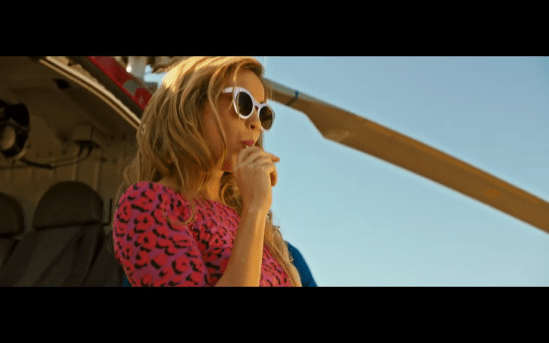
Richard, a wealthy businessman, and Jen, his young, candy arm mistress, helicopter in onto Richard’s desert retreat house. While his wife and children are at home, Richard plans to spend his time away relishing a pleasurable weekend that involves relaxing by the outdoor firepit, swimming in the infinity pool, being sultry with Jen, and do a bit of hunting along the mountains, canyons, and riverbeds. When Richard’s associates, Stan and Dimitri, arrive a day early, a party filled night rapidly ensues, but events turn sour when Jen is brutally attacked the next day and Richard plans to snuff out the scandal before it unravels to ruin him. Unwilling to cooperate with a coverup, Jen is nearly murdered by her three attackers only to arise like the rebirth of the Phoenix, igniting a vengeful fire inside her as she uses everything she has at her disposal to finish what they started.

In a day and age when the slightest bit of a woman’s attention can explode into a vile reaction of testosterone warped misguidance and it’s the woman who is shamed as the accosted criminal being barked at aggressively by the unequivocal fearful and condemning voices of the male species, it’s movies like Coralie Fargeat’s action-packed “Revenge” that symbolizes woman’s resiliencies against men’s efforts in a show of violent force that’s “First Blood” without John Rambo, but rather with a scorned princess for retributive capital justice. “Revenge” is the French filmmaker’s first full-length penned and directed feature film that’s one gritty and bloody grindhouse vindictive sonovabitch, a pure punch to the throat, and a direct message to misogyny everywhere. Filmed in the Morocco desert during Winter, the small cast is swallowed by the vastly arid landscape of transfixing cruelty, a synonymous parallel to the feat the heroine Jen is drawn to task. It’s also a feat that Fargeat managed to salvage to finally release a rape-revenge thriller backed by a conglomerate of production firms and financiers to stand with a film from a first time director whose treatment offers up maltreatment of women, such as the rape, along with the savagery, the concept of revenge, and ridiculous amounts of blood. M.E.S. Productions, Monkey Pack Films, Charades, Logical Pictures, Nextas Factory and Umedia are just to name a few of the production companies to be supporting capital.

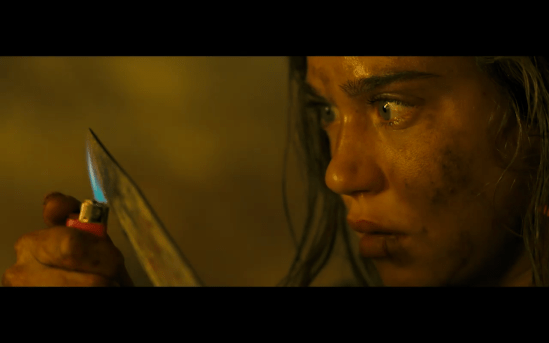
With a role embodying the symbolic brutalization of physical and mental rape, a role of complete loneliness in a fatal skirmish against their attackers, and in a role forsaken in the face of death only to be reborn from the ashes of their former self, Matilda Lutz’s fully charged capacity to tackle such a demanding performance is beyond praiseworthy, scrapping the timid traits from Jen’s ravaged glossy persona and replacing with a rigid exterior ready and willing to combat to the death. The Italian born Lutz has to go through a metamorphosis and refashion Jen to be able to differentiate from her more bubbly first half self as the easy kill or the disposable male plaything. In a twisted turn of events, Jen’s mortal adversaries have every advantage to douse out Jen’s existence: gear, guns, vehicles, clothes, water, fuel, numbers, etc. Yet, despite all the advantages, the desert, much like Jen, is unforgiving as it is bare. Richard (Kevin Janssens), Stan (Vincent Colombe), and Guillaume Bouchede (Dimitri) exude the utmost confidence their grip around Jen’s throat. Janssens’ fortifies as the rigorous cutthroat, a misogynistic philanderer, determined to save his own skin no matter the cost while Colombe’s Stan is a retracting coward with regretful impulses. Colombe’s brings the comedy to a grimly tale and positions Stan to be the teetering villain tarnished by his guilt of nearly killing Jen, but never apologizes to being the catalytic rapist that initiates the whole debacle. Bouchede supplements with his divestment to charm as the overweight, do-nothing witness to save Jen from Stan’s seizing urges. As Dimitri, Bouchede stalls his typical niceties to be the silent violator who can open up the flood gates of aggression when transgression warrants it.

“Revenge” has an ultra-violent and super-synth finish chapping with multiple motifs of a rebirth theme and supplies a hefty bloodletting of incorporeal measures. Knocking it out of the park in her first feature film, Fargeat’s cauterizes the unnerving serious tone with alleviated black comedy of the bloodiest kind. The roundabout endgame chase comes to mind, involving a frazzled Jen and a wounded, but indomitable Richard in a merry-go-round of a shotgun standoff is some of the best editing work of fast and ferocious content I’ve seen in some time while still able to vitalize a transparent sense of what’s occurring. However, not all the slick editing is flawless. Some minor inconsistencies in the editing are noticeable and while these moments of lapse are not detrimental or pivotal to the story, they reflect Fargeat’s challenges of making a hyper-stylized action-thriller in her freshman full-length feature. In a sense, everything Fargeat’s deploys positions “Revenge” into a surreal tonality, glamorized for those thirsty for blood gushing in a canyon-vast desert bristled with rape and payback where a mere four players in this ebb and flow game of killer combat chess can effortlessly locate each other, but one can always find their prey by following their blood trail, another motif that continues to pop up that speaks metaphors of their life blood is the very object gives them away in the end.

Giving the limited edition treatment that it deserves, Second Sight Films’s Blu-ray release of “Revenge” is a mouthwatering narcotic of raging cathexis and while the Blu-ray BD-R can’t be technically critiqued, the LE release offers HD 1080p transfer of the original, 2.39:1 aspect ratio and sports an English language DTS-HD Master Audio 5.1 mix. While Fargeat might be inspired by Lynchian themes, the cinematography work by Robrecht Heyvaert also resembles “Pitch Black” director David Twohy’s films with making something small larger than life and a particular chase scene involving all four characters at the edge of a canyon stroke a familiar chord with Twohy’s “A Perfect Getaway.” There were Second Sight Films’ exclusive bonus features included on the disc, featuring new interviews with director Carolie Fargeat and star Matilda Lutz (entitled “Out for Blood”) an interview with Dimitri actor Guillaume Bouchede (entitled “The Coward”), a interview with Robrecht Heyvaert (entitled “Fairy Tale Violence”), a new interview with composer Robin Coudert and the synth sounds of “Revenge,” and a new audio commentary by Kat Ellinger, author and editor of Diabolique. The release is sheathed inside a rigid slipcase featuring new artwork by Adam Stothard as well as a poster and a new soft cover book with new writings by Mary Beth McAndrews and Elena Lazic Overall, “Revenge” received a monster packaged release ready for the taking on May 11th. “Revenge” destroys toxic masculinity and breathes a vindictive hope from the fiery embers of rebirth and destruction.