EVIL Preys on the Goodness of the Weak. “Lady Terror” reviewed! (Sector 5 Films / DVD)

“Lady Terror” is on the Prowl.  Now on DVD!  

Jake Large, a shrewd personal injury lawyer, finds himself in a loveless engagement that’s full of contempt, especially with his finance who makes up excuses to not be around or intimate with him.  When Jake foils a thief’s grab and dash of Candice’s purse, the lawyer and the exotic dancer quickly fall into a relationship that rekindles Jake’s vivacity of work and life.  Breaking off the engagement to his equally two-timing finance, Jake pours every ounce of emotion into the sexually tempest romance that’s rapidly become more than just courtship when Candice suggests the murder of her frequently threatening and abusive stepfather.  Witnessing first hand some of his behavior, Jake agrees to take out her stepfather in a fiery explosion during one of his rabbit hunting trips.  When the dust settles and all seems to be going well with Candice, a watershed moment reveals Candice’s intentions are not what they seem to be and in the middle of taking the fall for everything is Jake. 

An enticingly fervid thriller, “Lady Terror” is the latest directorial from the 30-year industry producer, writer, and director, Nathan Hill.   Filmed in Melbourne, Victoria, Australia, “Lady Terror” harks back to the early 90’s erotic suspenser of sex, deceit, and murder where seduction and predatory persuasion are welded tools to accomplish unscrupulous acts.  Hill has submersed himself chiefly in low-budget genre films from his first feature, a sewer creature that craves Cartel drug pushers in the SOV shot “The Hidden” released in 1993, to more recent and gamut gorging Australian documentary pictures, such as “Bigfoot Down Under” and “Sex Down Under,” as well as keeping tethered to his horror roots with his short film work contributed to compilated anthologies in “Clownsploitation,” “Previews of Coming Attractions,” and “Schlock-O-Rama.”  Hill produces his “Lady Terror” under his company NHProductions with the Alien enthusiastic documentarian, executive producer Warren Coyle, and marks the reconnection of Hill and director of photography Dia Taylor following their debut, feature film collaboration on Hill’s “I, Portrait” and the various filmic vignettes from before. 

Not only does Hill write, direct, and produce, the filmmaker with a penchant for creating J-named characters is also the lead principal personal injury lawyer Jake Large, owner-proprietor of Large Lawyers.  Though successful in his legal craft, Jake’s has developed depression when his once endearing fiancé Celine has turned against him as she sneaks around his back with a mixed martial artist.   A loathing Celine is played severely cutting by Tritia DeViSha who has previous chemistry alongside Hill during their time on Hill’s “Revenge of the Gweilo” production and while the chemistry between their characters is palatably thick with contempt, there’s not much backstory in gain traction for sympathy, compassion, or any other emotive expression.  Jake has a single flashback of his and Celine’s happiness in simpler times during a moment of what could be regret or longing, but there’s simply not enough breadcrumbs for their history to take shape of any form.  Instead, their turmoil feeds into Jake’s unquestionable willingness to concede to a beautiful exotic dancer and damsel in distress named Candice (Phillyda Murphy).  The attention is good, the sex is good, why not just give a little back by murdering her crooked stepfather (Anton Kormoczi – who also goes by Anton Trejo because he mildly looks like Danny Trejo)?  Well, Jake’s lovestruck blindness obscures the real intent but, luckily for Jake, he has what he describes as a lucky rabbit’s foot in his secretary who aspires to be a private investigator and when she’s not punching keys, she’s clandestinely tailing Candice in a spying and snapping pictures behind trashcans and around corners caricature kind of way.  The platinum blonde and distant relative of horror maestro, Dario Argento, Simay Argento is the peripheral probing dick Ayla Harp that initially doesn’t have this close-knit relationship with her boss until the third act when she happens to take it upon herself, after examining Jake’s behavior and reading his desk notes, to snoop into his private life on his behalf.  It’s not entirely clear how she unearthed who exactly Jake became intimate with but she managed track down Candice’s exact location to snap a few black and whites.  “Lady Terror’s” remaining cast feels very much like Ayla Harp in the disconnection of each other’s narratives, ridden along in choppy succession that leaves too many plot holes to fill.  The cast rounds out with Leslie Lawrence, Anthony Cincotta, Robert Rafik Awad, Challise Free, and Adam Ramzi – the 40-year-old Melbourne actor, not the gay porn star.

Perhaps that character disconnection stems from the distracting filler from in between dialogue scenes.  A slew of these filler scenes are of Jake Large driving around town, pulling up into driveways, and entering his home, Candice’s home, or his office, eating into a runtime that could be better suited for character exploration or assembling the fragments of a deceptive thriller involving the key players.  The current design dulls the run-of-the-mill and insubstantial story with nothing new to offer audiences to facelift the core element, a rope-a-dope of relationship pretense in order to con a fall guy into another’s dirty work.  Though I know the answer in the back of my mind, a considerable amount of struggling happens in the deductive logic and complex problem solving regions of my brain for the missteps of what’s supposed to happen after Jake commits to the hit.  Ultimately, the worst outcome to happen to Jake is not what I suspected; in fact, we should be expecting a more disastrous, run-for-your-life fall from grace, but, instead, there’s no sense of urgency or consequence in the unravelling of Jake’s newfound and glorious prospects with Candice.  In fact, police presence is reduced to informing Candice her stepfather had died and that’s the extent of it, not mentioning the gunshot, a gasoline fueled explosion, or any other kind of suspicious death pursuits.  The awkwardness continues to bleed into the narrative continuity.  “Lady Terror” has a time span of at least a week or two, or longer as it’s not entirely clear, but Jake’s outfit rarely differs from the white pants, blue button-up shirt, tan sport jacket, and fedora.  The same goes with his lacy see-through topped assistant Ayla, suggesting that many of the scenes were shot on the same day or two without a wardrobe change.  When Jake does have a different outfit on, the subsequent scenes revert right back to that then by now stale getup. 

“Lady Terror” arrives onto DVD courtesy of Sector 5 Films, long overdue revisit of the distributor’s line of product since our last review from 2016.  Presented on a DVD-R, with DVD5 capacity, in a widescreen 1:78:1 aspect ratio, “Lady Terror” retains an unhewn image that appears soft, smooth, and with slight aliasing.  Overexposure wipes a fair amount of background sky, such as with approx. ten minutes into the story a plane just flies off into a bright void, but the overcast grading leaves this modern noir consistently dreary to where the only thing that stimulatingly pops is Phillyda Murphy in her skimpy intimates.  Again, there’s not a ton of landscape range, especially being set around Melbourne and not taking advantage of the city skyline or it’s Port Phillip harbor with the drone to gain urban rookery.  Sector 5 DVD’s back cover states the film has a 5.1 surround sound mix, but what my player tells me, “Lady Terror” actually comes supplied with an English Dolby Digital 2.0 mix.  The dual channel output would have been a sufficiently adequate mix albeit unpolished, echoey dialogue but for the entire length of the film, a harsh gargle undercuts the sharpness in the dialogue and the Jamie Murgatroyd (“No Such Things as Monsters”) soundtrack.  This also creates faint whispery-hissing.  There are no optional subtitles included.  Bonus features include doomsday, extraterrestrial, and anthropology hypothetical or alternative fact-doc trailers for “Occult of the Secret Universe,” “Nostradamus:  Future Revelations and Prophecy,” “Ancient Origins:  Extraordinary Evidence,” “Alien Paradox:  Legacy of the UFO,” “Demonic Aliens,” “Breaking Free of the Matrix,” “Ancient Origins:  Mankind’s Mysterious Past,” and “Elusive Bigfoot Abroad.”  The Sector 5 DVD is housed in standard black snapper with trashy romance novel resembling front cover of two who are not Nathan Hill and Phillyda Murphy in throes of passion.  The cropped top portion of the cover art that includes Murphy’s face in composited in 3 hues is also pressed onto the disc art.  The release comes not rated with an 80-minute runtime and a region 1 encoded playback.  Though performances are solid, “Lady Terror” ultimately feels underwhelming and unable to live up to the attractive title with an unadventurous noir thriller hamstrung stake to the heart from the DVD-R’s anemic technical and fidelity issues.

“Lady Terror” is on the Prowl.  Now on DVD!  

When EVIL Isn’t That Black & White. “Choir Girl” reviewed! (Nexus Production Group / Digital Screener)

Eugene lives a lonely, pitiable existence.  Residing with his ailing father in a slum neighborhood, his photography background captures the crime and the desolation that surrounds him, snapping pictures without ever interceding with his crime-riddled subjects, in an attempt to hold an exhibition or sell his work to a high profile magazine, Slipstream, as his ticket out of the despair that engulfs him.  When Eugene stumbles upon young teenage girls being drugged and held for prostitution, he becomes fixated on Josephine when a low-level editor, seeing her as a professional stepping stone, prods him for more pictures that evoke hope out of her situation, but when he finally intervenes, helping her escape, Eugene falls into a world of a massive prostitution ring with doctors, cops, and major organizations on the payroll and a kingpin named Daddy at the helm.  The deeper the debt placed upon him for showing compassion to Josephine, the more the lines blur on whether he’s become his muse’s lone savior or just his meal ticket out his current life.

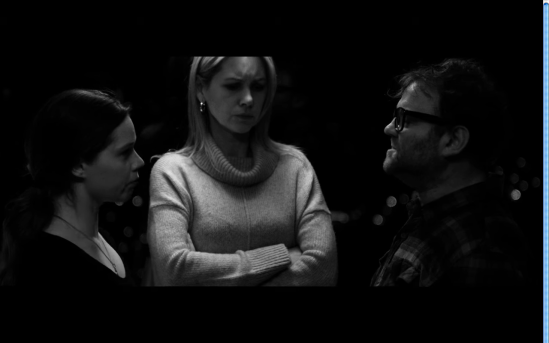
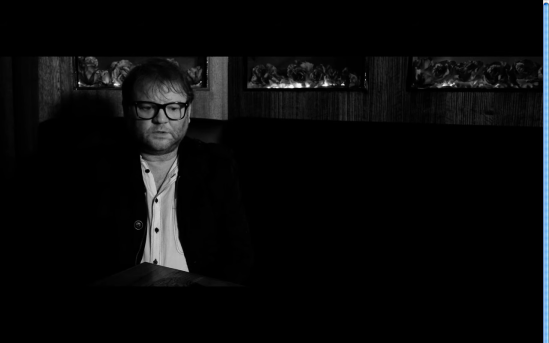
How far will your moral principles take you to save a teenage girl when you’re locked into a no-win situation?  That’s the theme explored to a shocking sexual assault conclusion in John Fraser’s 2019 unscrupulous Australian thriller, “Choir Girl.”  Introducing Fraser’s first credited written and directed full length feature film, shot entirely in black and white, the Melbourne arthouse and a goose egg-fairytale version of “Pretty Woman” speaks volumes toward the perceived illegality of immigration, the horrors of sex-trade, and the touch-and-go balance act between doing what’s right and self-serving opportunities with a 15-year old girl’s fate dangling at the end of a line.  “Choir Girl” is produced by Ivan Malekin under his Melbourne based label, Nexus Production Group, along with Lucinda Bruce serving as co-producer.

To carry “Choir Girl” through the muck of it all, a strong performance must arduously burden the gravity of the content and Peter Flaherty astounds with an ingloriously flawed and unlikely hero, Eugene.  “The Butcher Possessions” and “KIllervision” actor masts a greasily haggard with bordering neurodevelopment issues, disheveled in his attire, and walks with a noticeable limp, made intentionally noticeable when as he walks away from characters and situations.  Though Eugene seems meek, the shutterbug aches to improve himself by seemingly exploiting others as a freelance photographer and being persistent in that pursuit until becoming engrossed into a 15-year-old prostitute’s life struggle blossoming before our eyes a rather unsettling grown man and teenage girl relationship that assumes a pedophilia ideology of adoring the child to the extent of protection, but also falls in to grooming and sexual exploitation.  The film introduces audiences to Sarah Timm, playing Eugene’s muse, Josephine, an Eastern European illegal immigrant who literally has nothing left that is her own, this including her body, when forced into sex slavery so when Eugene and other characters call her diminutively by Jo, she immediately corrects them to call her Josephine in order to keep the one thing left that is still hers, her name.  In her first feature role, and a mightily demanding role it is with the amount of discomfiture of playing essentially an abused child, the German native will have audiences overlooking the fact that she’s portraying a teenager in the sordid sultriness of sex-trafficking with crafting Josephine’s war-torn history and pre-adolescent childhood stories as always the girl in the background, the unpretty forgotten girl that blended in and no one noticed, until she’s a part of a much larger, more ferocious, uncompromising system that Daddy (Jack Campbell) dictates with CCTV live feeds of every sleazy, scummy hotel bedroom in his syndicated footprint.  The cruelty that Jack Campbell reins savors every facet of Daddy’s being on screen with an intent to be a immovable roadblock in Eugene’s advanced for progress and for John Fraser’s “Choir Girl,” the character development and personalities find justification from the cast with the exception of one, the low on the totem pole and self-absorbed Slipstream magazine editor, Polly.  Krista Vendy imposes on Polly’s rabid  narcissism with an incredibility that becomes the underbelly amongst a bloc of solid performances.  Andy McPhee (“Wolf Creek”), Lee Mason (“The Caretaker”), Jillian Murray (“Body Melt”), and Kym Valentine fill out supporting roles. 

I love the juxtaposition opening of Eugene in his dark room in the middle of photographic processing his oblivious subjects, including a drug abusing child with a hypodermic heroine needle sticking out of his arm, a blowjob being serviced between a wall and bushes, or the aftermath of man being beaten with his assailants walking away from his leveled body, and then the title fades in from black and the next scene is of a framed magazine cover with the cover title “It’s All Back and White.”  The sequence sets up perfectly the entire premise driving “Choir Girl’s” gray area circumstances that nothing substantial, meaningful, or controversial can be black and white. Plus, the entire film is shot in black and white furthering the contrivance of the theme. The gray area challenging Eugene is a tightrope walk when squeezed for payment for snatching Josephine by the amoral organization claiming property theft, making him submit to the idiom of pulling his strings like a marionette or shooting at his feet to make him dance for insatiable perverse satisfaction. Eugene rarely displays remorse in his demeanor, face, or actions for the things he does and doesn’t do when faced with adversity in a slither of sociopathic idiosyncrasy, but when outright criticized for his inaction, he’s able to right wrongs with deplorable methods like a toddler trying to mop up a grape juice spill with mother’s expensive, white dress. There’s a bit of innocence or naivety in Eugene’s mind as you can almost see the gears slowly spinning when confronted but in the defense of the man who no really gave the time of day, those gyrating mice wheels of delicate thought snuck past every contingency against Eugene surviving Daddy’s deadly game, leading to an unsavory solution that puts the viewer in an awkward spot to either avert the eyes or remained captivated to see it through.


I, for one, remained seated, steadfast to the end, hypnotized by audacity of John Fraser in his feature film directorial, “Choir Girl,” that has arrived onto Apple’s iTunes. The unrated film is presented in it’s original aspect ratio of a widescreen format and will have an English language Dolby Digital 5.1 surround sound availability. Though derided as kitschy at times, the black and white veneer works here inside “Choir Girl’s” vascular system of catch-22s and director of photography, Mark Kenfield, rides a consistent straighten arrow style with steady cam shots, decent framing, and some tracking shots without pushing the envelope in regards to angles or oscillation. There were no bonus content or additional scenes during or after the credits. “Choir Girl” sings no praises of hallelujah. Offers no solace in time of hardship. If you’re looking for a movie that touches you, then you’re in for a rude awakening as “Choir Girl” obliterates the moral standards, leaving faith outside, with a severe penance in abetting the Devil’s work, selling their soul to do what’s right.

A Lonely Mind Plays Evil Tricks. “Visitors” review!


Yachtman Georgia Perry aims to be a part of the best of the best by joining a handful of women who’ve sailed around the world. The rules are simple: don’t step on land, don’t let anyone step on your boat, and don’t turn on your outboard motor. As Perry heads out into the open ocean, the 25-year-old carries with her a burden of lifetime baggage stemming from her mother’s acute depression and gruesome suicide, her father’s accident and deteriorating health, and the bond between her and her boyfriend Luke coming unraveled. Combine all that weight with complete isolation, loneliness, and no wind to push her sails, Georgia quickly spirals downward into a turbulent state with her only traveling companion being her cat with whom she has conversations on her becalmed sloop. All her fears come to fruition, blurring the line between reality and disturbing fantasy that threatens her voyage and, maybe, even her life.

Bayside Pictures presents “Visitors,” the last helmed feature by the late Richard Franklin of “Psycho II” and “F/X2” fame. “Razorback” writer Everett De Roche penned the 2003 psychological thriller and is able to conjure out some wicked mind buckling material of a woman subjected to cabin fever in the form of a volatile, non-linear story. Franklin adds his two-cent charm with impressive visual sets and effects from the early turn of the century, implementing CGI where appropriate, being practical when deemed, and, by golly, the effects resulted didn’t come out too shabby. The ocean has always been beautiful, yet terrifying mystery that has yet to be fully explored, and Franklin’s able to capture the ominous anomaly that associates with the deep blue sea under an overwhelming guise of mental health and severe isolated confinement.

Before she wandered into “Silent Hill,” but after becoming forsaken in “Pitch Black,” Radha Mitchell showed strength in solitary by playing the headstrong, nautically ambitious sailor, Georgia Perry. Mitchell, who was slightly older than her 25-year-old character, fabricates a troubled young woman willing to risk it all, even her life, even if it meant to leave to escape all her woes and that she holds dear at home. The “Rogue” and “The Crazies” remake actress from Melbourne has a sensationalized and systematic dynamic with her on-screen mother, played by the late Susannah York, in what’s considered to be a disturbing role of manipulative motherhood that forced Georgia to be extremely close and clingy to her endearing father, an underrated role bestowed upon Ray Barrett. A young and upcoming Dominic Purcell (“Blade: Trinity” and “Primeval”) costars as Georgia’s lover and business manager who may or may not have other underlying intentions with Georgia’s sponsors. Appearing never together and putting Mitchell at the epicenter of their lives, the foursome played their roles beautifully by stretching the limits of reality without being overly absurd to the point of being unbecoming of a thriller.

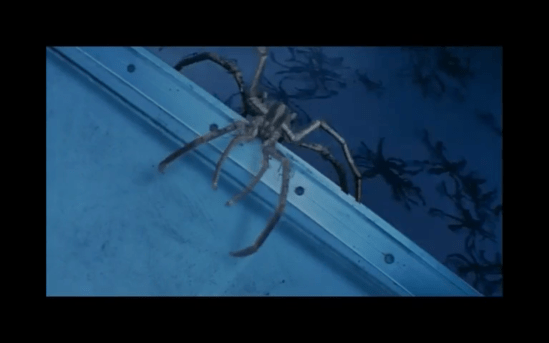
By no means is “Visitors” a woman versus nature premise. Yes, Georgia faces any elements that would plague any sailor who ventured into the ocean alone, but nature was only accessorial. “Visitors,” for the sake of being funny, is more of a film about a young girl embarking on a journey of self discovery. Georgia must get away from negativity that has been eating at her zealous spirit ever since the terrible childhood accident that had crippled her father and destroyed her parents’ marriage. Her embattled mother’s constant belittling, berating, and blaming is the brunt of that that has been burdening. At sea, Georgia battles her onshore demons, which also includes her father’s failing health and her failing relationship with Luke, and coinciding is her ever present looming and underlying fears that lurk out into manifestation, or a visitation if you will, during severe cabin fever. The trip around the world won’t kill her, but her inner demons just might which begs the question if “Visitors” is more of a mental health film and the answer is a firm yes without salty doubt.

Umbrella Entertainment releases “Visitors” onto a region 4 home entertainment DVD. The DVD is beyond an upgrade from it’s region 1 counterpart in the image and audio departments. The anamorphic widescreen, 2.35:1 aspect ratio, renders a cleaner image with slightly more natural color tone as well as offering more film flesh on either side from the 35mm negative. The English Dolby 5.1 audio track offers a range of diversity. The dialogue is clear and fine, the ambient track syncs with ample depth, and the brooding and perilous soundtrack from composer Nerida Tyson-Chew (“Anacondas: The Hunt for the Blood Orchid”) provides a delectable varied score to Georgia’s though process. The extras are thin, not much different from the Stateside release, including a photo gallery, cast and crew bios, and the Palace Film’s theatrical trailer. Considered widely as an Australian ozploitation film, “Visitors” is deep-seeded, mental trench warfare on the high seas set on a course of psychological doom. A fine film for being Richard Franklin’s last hurrah.

Become Internet Famous From Being Buried Alive by Evil! “6 Plots” review!

vlcsnap-00001
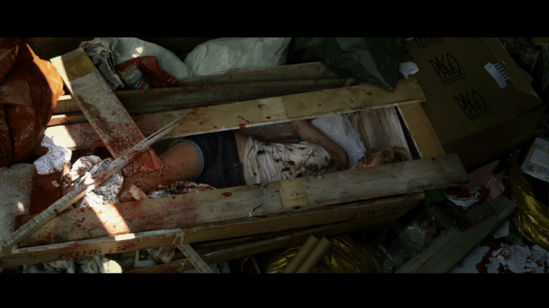
Seven close friends use “Screen It” to live stream online a drug and alcohol bender while partying hard at a vacant swanky home. When Brie awakes in a quiet, dark room of the luxurious house with no sign of her friends, she believes an odd prank is being played at her expense, but when she receives a frantic call from one of her frightened friends trapped inside a wooden box, Brie becomes their only hope of survival. She realizes that her six friends were abducted and buried in wooden boxes around the city, all of which contain it’s own deadly nightmare coinciding with each teen’s personal life. To heighten the tension, their fates are live streamed on the internet for the world to witness. Brie must connect the dots, find the pattern, and save the survivors before they all perish alone.
vlcsnap-00007
Australian survival horror “6 Plots” capitalizes on popular teens being terrorized and murdered by a game mastering and mysterious sadist. The story, devised along with live streaming online the six teens’ fates, stems from director Leigh Sheehan and was commercially penned by the newcomer Tim C. Patterson. Alice Darling stars as Brie, the girl left untouched to save her shallowly engrained friends, along with “Wolf Creek 2” star Ryan Corr, Penelope Mitchell (“The Vampire Diaries”), Eliza Taylor, Emily Wheaton, Joey Coley-Sowry, Damien Harrison, Andrew Clarke, and PJ Lane. “6 Plots” introduces characters to face their fears, putting them up against a destined wall of death if unable to overcome challenges inspired by their own lives. Though the challenges are no where near the legacy of the “Saw” games where players have an opportunity to win their freedom themselves by sacrificing something dear to them and are constructed with their good fortune resting in the hands on one sole person, Sheehan’s race against the clock suspense thriller loses steam, never establishing momentum to strike the edge-of-your-seat nerve.
vlcsnap-00008
Conceptually, placing unconscious disrespectful teens claustrophobic coffin structures and strategically scattering them along a small island coastal town only to direly drown their body and minds in a game of their own primal fears sounds amusingly devious. To pull off a grand recipe of intertwining cruelty, time would be the most difficult obstacle to hurdle and the plan’s organization and successfulness was ultimately determined on whether or not Brie and her friends were having a party at some random swanky house, which was on the verge of possibly being canceled priorly stated by one of the characters. Time spatially speaking, getting all six of her friends completely setup in boxes miles a part from each other would have taken most of the night, pending on how many hands were involved, and the story indulges a, perhaps, 3 to 4 hour workable time frame from each of seven passing out unconsciously due in part of whatever their drugs were laced with to the time they wake up alone in a confinement of darkness with only an element of personal fear accompanying them. In short, and this might spoil the end for a few readers, The Flash was able to accomplish casket coordination without much hassle. Just kidding…
vlcsnap-00005
The biggest issue with “6 Plots” is the story never really comes to a head, never really providing that spark-lit surge of intensity at the point of apex. Instead, the course of action flounders at a lifeless flat line when a moment of clarity for Brie dawns upon her and she figures out the bedeviled jokester’s pentagram pattern, simply by hooking up to the internet and plotting lines onto charts of the island of possible casket locations. Brie made their tormentor’s Russian signal jamming plan the most elementary scheme to deconstruct and solve to date, but that’s due in part to poor character development as well. We know absolutely zilch about Brie, except for the facts that the daredevil rides a motorcycle off road, gives the local authoritative putz a run for his money, and likes to partake in drugs and alcohol. That’s basically all the information we’re given about Brie’s character and, somehow, a character who traditionally would have been nixed right about now was able to unravel a plan much too elaborate for her primitive Netgear hookup intelligence. Not even her tech savvy friend, Marty, could keep up with Brie’s uncanny genius, remarking a couple instances where Brie outthought his intellect about their predicament.
vlcsnap-00002
Sheehan’s directorial style hinges upon a fair amount on the horrendously oppressive alternative music soundtrack and mawkish scenes of melodramatics with an example being after witnessing the horrifying demise of one of the teens on live stream, Sheriff Gary awkwardly drops the phone and hastily crosses the room to give Brie a clutching embrace as they both sob in each others’ arms. I’ve seen less over the top performances in soap operas. Certainly a first where melodrama meets tech horror, I found the technology to be sorely obsolete, especially for a film produced only four years ago. “6 Plots” was for sure a champion for Apple products, focal pointing on MacBooks and a Safari internet browser, but, yet, iPhones are rarely used and, instead, a healthy combination of Brie’s Blackberry and Sheriff Gary’s flip phone ultimately saves the day, proving that the latest and greatest tech gear can’t save you from a casket and can’t aid you in murdering people any faster.
vlcsnap-00006
Lionsgate home entertainment label delivers the 87 minute Eagle I production onto DVD and Digital Video with a widescreen 2.35:1 presentation and an English 5.1 Dolby Digital audio mix. A high point of this “6 Plots” DVD is the video quality, though now fairly standard with current films in their home release formats. Image quality pops with detail and clarity bringing out the worst specifics in the poorly illustrated representation of the antagonist on ancient cell phones. Audio, again, lies in the realm of modern day conventions, albeit the down under accents are sometimes difficult to decipher. From the start, survival horror “6 Plots” quickly snuffs itself out from ever materializing into, what could have been, a gripping thriller by burying the best parts under a 6-foot deep layer of indigestible fluff that’s rudimentary right to the bone.

Go Graveside with “6 Plots” on DVD!