When That Sexy Roommate Turns Out to be an EVIL Hexing Hag! “Don’t Let her In” reviewed! (Full Moon / Blu-ray)

“Don’t Let Her In” on Blu-ray from Full Moon Features and Distributed by MVD Visual

Young artist couple Amber and Ben live downtown in a spacious single floor loft.  To afford rent and earn a little extra cash on the side, they decide to sublet a portion to Serena, a beautiful, and recently single, new age jewelry bowl artist who crafts old age product.  Some would say Serena’s craft is witchcraft as the alluring artist is actually being inhabited by an ancient, malevolent demon.  As she settles into her new abode, Serena slowly works her way between Amber and Ben, seducing and bedding both for her reasons to prolong a legacy on Earth.  When Ben is suddenly whisked away for an unexpected rock tour, Amber finds herself cornered by the demon in human skin and, to her on the pill surprise, pregnant because of Serena’s daily bewitching manipulation and incessant satanic chanting.

As a part of the new Full Moon lineup of 2022, principal Full Moon filmmaker Ted Nicolaou, the mastermind behind “TerrorVision” and the longstanding director of the “Subspecies” franchise, returns with another vision of terror, a beautifully demonic roommate from Hell, in “Don’t Let her In.”  Shot entirely on location at the historic Nate Starkman and Sons Building in Los Angeles, home to an array of productions from inside Paddy’s Bar of “Always Sunny in Philadelphia” to appearing in a handful of iconic horror series, such as “Candyman:  Day of the Dead” and “Wishmaster 2:  Evil Never Dies,” the 1908 erected factory is said itself to be haunted, adding to the miscreant charm of a shapeshifting fiend plaguing the innocence of a young couple.  Charles Band, like all of his productions, serves as chief producer and executive producer with the cannabis friendly Nakai Nelson, this side of the century Full Moon Feature producer with credits such as the “Evil Bong,” “Weedjies,” and a pair of more recent “Puppet Master” films to her name. 

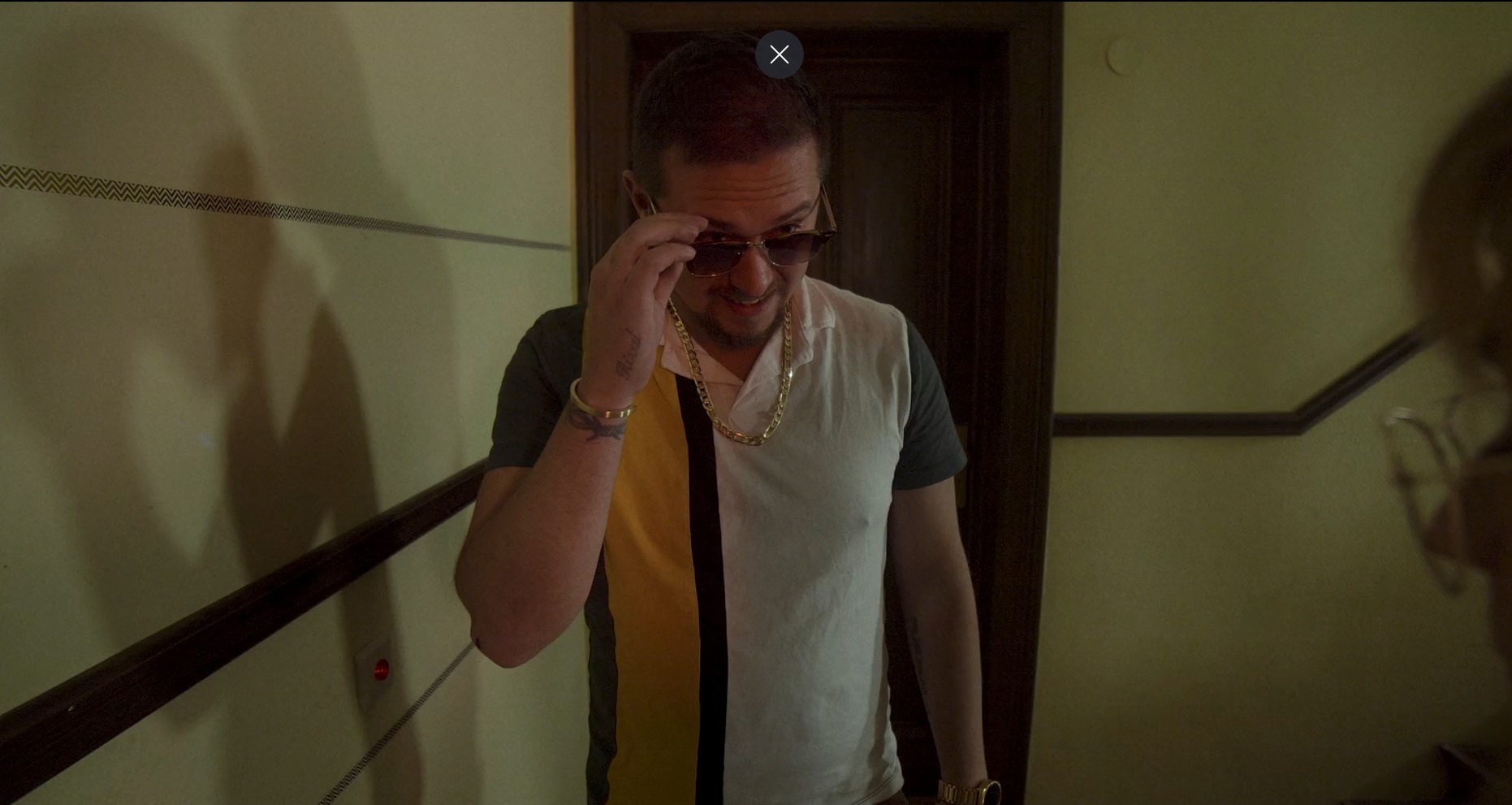
“Don’t Let Her In” has an intimate cast comprised of four actors who have to pull in different, varying levels of character dynamics and frames of mind depending on how Serena’s orchestrating of the strings upon her marionette subjects favor in or from her dastardly ambition.  At the center is first time Full Moon actress Lorin Doctor as the pleasantly chic but unpleasantly succubus-like Serena who wants more than just a place to sojourn from an ex-boyfriend.  Serena is the kind of role where you have to applaud Doctor for not only pulling off grimacing in the shadows and being able to keep up the rhythms and beats of complex chanting but also be comfortable in the facial prosthetic makeup and make like a troll for a creepy crouch walk in a backwards reel speedup effect.  Kelly Curran and Cole Pendery are also newcomers to Full Moon’s world of strange and unusual T&A horror as the loft-residing couple Amber and Ben.  Curran and Pendery make up for an okay, downtown twosome with hints toward a checkered past of philandering that’s irritated by Serena’s provocative presence, but that’s doesn’t quite blossom into more of an issue as Amber is quickly eager to just go with the flow without being too bothered by the prospect that Serena and Amber did the bedsheet whoopee next to Amber as she slept.  The four and last character Elias Lambe is by far the most lacking in development and substance as an important piece of Serena’s puzzle that quickly becomes shoved under the rug.  Austin James Parker plays the part that’s mostly standing outside the building on the street corner looking gothically mirthless rather than ominous and before realizing how Lambe fits into the narrative, the long haired, trench coat-cladded, vampire-esque backstory is quickly snatched away with not a morsel left of his bigger part as suggested.

“Don’t Let Her In” is a refreshing addition to the Full Moon feature line that maintains a lot of hallmarks of the company, such as heavy use of body prosthetics, an expensive veneer on an indie budget, and, of course, nudity.  Though many other audiences draw comparisons to “Rosemary’s Baby,” Nicolaou relates only a smidgen in the story alone without the Roman Polanski pin drop suspense of subjective narration.  Instead, Nicolaou embodies Full Moon’s quirky and special effects greased terror fried to a familiar taste all fans have known from the past 40 years and that’s not terribly a bad thing.  “Don’t Let Her In” feels like an original piece of storytelling, much like “Castle Freak” or  “The Dead Hate the Living,” that detaches itself from Charles Band’s obsession with miniature maniacs, but Full Moon has no shame in telling us we’re still watching one of their films, gratuitously plopping easter eggs of their films all throughout “Don’t Let Her In” (i.e. Poster artist Amber’s current project, a rendering of “Corona Zombies,” and “Castle Freak” playing on the television set as Amber and Serena spend an evening as a pair of winos).  Serena’s demoness rat-faced makeup does appear stiff and inane at times, but the way Nicolaou mostly presents Serena in true form is through a blend of quick-sufficient editing, a manipulation of lens and pace, and the to-and-fro from the human façade that ultimately makes rodent Serena become scary Serena when accompanied by Charles Band’s strike of forte notes when not being melodiously carnivalesque.

Lesson here, kids, is to always background check you potential roommates because they might end up being a demon. Happens all the time. Fortunately, Full Moon Features delivers the entertainingly sapid “Don’t Let Her In” onto Blu-ray home video, presented in region free and a widescreen 1.78:1 aspect ratio. Full high-definition and 1080p resolution, this release has a strong, robust presentation in favor of Nicolaou’s often in your face with evil style despite the single loft location. The fact that this Full Moon feature is toned down from the usual moody, tenebrous gothic style shows a bit of range can be good for the collection. There are two available audio options: a 5.1 surround sound and a dual channel 2.0 stereo. If you want more fluff to your sound design, the 5.1 offers extra street ambiance while characters converse, sawing through the dialogue with car horns, traffic, and other urban outdoor racket as if they’re living right in the middle of Times Square. Yet, all outdoor scenes show little car or foot traffic that makes this fluff foolish. The dialogue is otherwise clean and Charles Band’s soundtrack interposes pizzazz and dread in this brawny audio output. Bonus features include a “Don’t Let Her In” behind-the scenes with snippet interviews from director Ted Nicolaou, actresses Lorin Doctor and Kelly Curran, and producer Nakai Nelson and rounding out with an array of Full Moon trailers. “Don’t Let Her In” has vim and vigor for an indie guise horror that’s erotic as it is fun surrounding a small cast and single location; yet there is also an evoking pathos in its decimation of young, naive artists and couples with career ending consequences.

“Don’t Let Her In” on Blu-ray from Full Moon Features and Distributed by MVD Visual

EVIL Spam E-Mail Wants to Play a Game! “Planet Zee” reviewed! (Darkside Releasing / Blu-ray)

Land onto “Planet Zee” now on Blu-ray! 

Struggling woman filmmaker Zee Bronson is trying to make what she loves a supportive career. Smoking pot, drinking beer, and living with her grandmother Sam mellows out Bronson’s anxiety of potentially landing a writer-director’s gig one day. When her sleazy producer, Serge, closes a deal with an investor interested in her script, Zee eyes widen with excitement, but her premature celebration quickly turns sour when Serge notes the financer wants someone else to direct her screenplay. A vexed Zee turns to a weird email spam virus that has seemingly appropriated her computer to propose a game of life with superpowers or death. Convincing Serge into joining her, the two unwittingly open a diabolical portal that traps them inside the apartment, subjecting them to battling a demon and persuading them to kill one another. As their relationship dissolves slowly throughout the night, lines a drawn between friend and foe in order to escape the grip of a computer-commanding Game of Power.

There is bottom-of-the-barrel independent schlock done with very half-hearted inspiration and then there’s bottom-of-the-barrel independent film done with A for effort around a difficult to sell single-locale story that includes witty dialogue and humble homemade effects. Some of these mighty, homegrown indies stem from one ultra-eccentric Berlin, Germany physics and prehistoric archeology studied-turned-artful filmmaker Zetkin Yikilmis in her second written and directed feature, “Planet Zee.” Her B-movie, or should I say Z-movie, is the epitome of independent filmmaking in knowing the production’s limits and how to make the most of a film with what little material is available to use, such as a deluging cash flow for big budget grandstanding that’ll get your name on marquees, posters, and regional commercials. Instead, “Planet Zee” is very much meta love and confidence concept toward Zetkin Yikilmis herself, as the title implies, being a woman in a typically projected masculine dominated industry. Yikilmis follows up her sophomore film from an array of micro shorts and her 2019 released debut feature, “Some Smoke and a Red Locker,” incorporating elements of the stoner horror-comedy into her 2021 film that’s self-produced by Yikilmis and her cinematographer husband, Dominic, as well as longtime collaborator S.B. Goldberg.

Zetkin Yikilmis, obviously, stars as Zee Bronson, a bohemian screenwriter attempting her hand at filmic success while having her grandmother live with her in a small apartment. Having surveyed Yikilmis’s micro shorts, her droll act as stoner-chic Zee Bronson imitates far from her other self-applied roles with a sluggish repartee and often tinkering with slapstick with fellow costar Alexander Tsypilev as squalid producer Serge. Yikilmis and Tsypilev’s reconnection after “Some Smoke and a Red Locker” gives way to a natural onscreen dynamic that has experience role reversal, gender role reversal, and to test their association connection. With a tight-fitting shirt that flirts with exposing his slightly protruding belly, Serge fits swimmingly into the cesspool of sexist producers with Tyspilev crafting Serge’s slimy mold with little pinches of details toward the producers first-rate me-first attitude. While Bronson and Serge are the two chief residents of “Planet Zee,” there is often a forgotten third wheel who bookends the narrative. Sam, Zee’s elderly only in looks grandmother played by Trish Osmond who had a small role in Zack Snyder’s “Army of Thieves.” The 1944 born English actress bloomed late in her career that begin in 2014, but that doesn’t stop Osmond from being a dominating player of goodwill toward bizarre films and roles, especially playing ones involving an usually vigorous old woman with underlying uncanniness probably important to the story. Minor characters fill in the rest with small brushes with minor scenes from Roland Bialke and Michael Tietz.

Through the veneer of bare budget and puerile comedy, “Planet Zee” puts together a couple of ugly statements well versed like a stain amongst the film industry but only brought up more recently during the #MeToo movement and seen as ingrained into industry as par for the course. Yikilmis mentions in the dialogue that as a woman filmmaker she fears oppressive struggles in forming a passionate career in creating art, her art being satirical comedy-horror motion-pictures, insinuating female-driven aspirations are often squashed by misogynistic viewpoints akin to the British journalist and author Christopher Hutchinson’s claim that women are not funny because they are pretty and do not need to appeal to men through humor. Yikilmin writes pitting herself, as Zee Bronson, against a sleazy and dismissive producer who exploits her with pretense friendship, mirroring the real-life exploitation of certain long-standing, fundamental moguls who instead of being held responsible for distasteful chauvinistic corruption, held women’s careers in the palms of their hands with a conniving, convincing promise of blacklisted ruinous slander or unfounded gossip if unethical compliance to their advances were denied. In lighter terms of the film’s satire, Yikilmis uses the situation as an allegorical parallel of who really has control over the story – the creator or the producer. As the creator, Zee Bronson yearns to maintain creative rights in telling her tale whereas the producer gives into the meddling whims of the highest bidder, reaching for the dollar signs that illuminate over their eyes. Serge’s me-first persona during the game offers no collaboration as he literally pushes down Zee for the faint prospect of survival and causes more harm than beneficial good. Look past the stock electricity effect visuals, polished lens flares, and the cheaply made demon getups and you’ll see inside “Planet Zee’s” fiery core, a passively seething call to overcome the darker side of a biased film industry.

Explore the terrain of Zetkin Yikilmis’s “Planet Zee” now on Blu-ray home video a part of the Darkside Releasing, as feature #24 on their Darkside Collection line, and distributed by MVD Visual. Shot and released in an aspect ratio of 1.78:1 widescreen, “Planet Zee” isn’t breathtaking with nearly the full 97-minute runtime inside Zee’s tight apartment living room, aka Yikilmis apartment where many of her shorts were filmed, and so the 1.78:1 aspect ratio is overkill or wasted on nothing spectacular aside from the trippy wallpaper or the bone-curtain that linger the background. In truth, “Planet Zee” could have been shot in a 4:3 for better framing inside a vertical inclined ratio. The full high definition, 1080p output does look good in the details. The trippy-cladded apartment and warm toned outfits pop with robust color. Though not labeled on the Blu-ray back cover, the release offers a DTS-HD 5.1 surround mix and despite being produced in Germany with Germany actors, the original language track is in English thick with a dialect accent but overall adequate and clean in delivering dialogue. Ambient effects often feel just as distant or separated from the visual trunk as their digitally rotoscoped onto the frame. Special features include a behind-the-scenes that actually isn’t anything relevant to behind-the-scenes material with a couple of rehearsed statements on set from Alexander Tsypilev pretending to be scared of Zetkin Yikilmis’s feigned dictator-like direction. Other bonus content includes a string through of Zetkin Yikilmis’s micro-shorts with Yikilmis serving as a host in between and a woman in horror trailer reel. “Planet Zee” is an unpretentious good time. Small, yes. Limited in budget, yes. Unknown cast, yes. Yet, where the film lacks with high dollar density it makes up for in free reign creativity and breezy humor that becomes a middle finger to inequality and duplicity.

Land onto “Planet Zee” now on Blu-ray! 

EVIL Cowboys Up! “Ghostriders” reviewed! (Verdugo Entertainment / Blu-ray)

A small Texas town in 1887 took lynch mob tactics upon a jailed outlaw Frank Clements after a prominent resident and his family were slain.  In a last-ditch effort to save their gang boss, Clements’ men come in guns blazing but mob leader, the Reverend Thadeous Sutton, pulls the gallows lever to send Frank Clements to his doom.  Fast forward 100 years later to 1987, renowned historian Professor Jim Sutton researches the notorious murdering bandit, even owning a piece of Clements’ property with a cursed sawed-off double barrel shotgun, but the 100th year anniversary delivers good on the Clements’ curse as he and his men return from the dead and gun down all in the rural Texas backland.  Walking into a supernatural showdown with the undead is the professor’s son Hampton and his friends on a road trip to his father’s isolated estate where surviving the night of continuously respawning malevolent six-shooters will seemingly never happen.

Ghost cowboys.  That small and obscure piece of particular subgenre stemmed from the broad western horror pie can be and has been a hard product to peddle, bucking audiences off its hind side faster than a mechanical bull full of amateur rodeo saddlers.  Think about it.  Can one even name a handful of horror westerns involving cowboys, especially gunslingers back from the grave?  There’s Lee Vervoort “Gun Town” that’s more of a saloon town slasher.   “Ghost Brigade” might be the closer to the theme with Civil War soldiers possessed by evil voodoo spirits.  However, the relatively unknown TV movie “Ghost Town” from 2009, surrounding a group of college students pursued by ghostly outlaws in an abandoned western town, hits the nail on the head.  Again, these titles are rare and if you find one that does exists, more than likely the film’s a waste of cinematic space.  In any case, if you’re hellbent on a decent gunslinging ghoul film, Alan Stewart’s “Ghostriders” will saddle up just nicely.  Penned by Clay McBride (“Ghetto Blaster”) and James Desmarais (“Victim of Love”), the debut film of Alan Stewart resurrected a ruthless gang of gunslingers for pure retribution set on location at the Texas Safari Ranch in Clifton, Texas and was self-produced by Stewart, under Alan L. Steward Productions, along with fellow producers in cinematographer Thomas Callaway, who went on to be the DoP of “Slumber Party Massacre II” and “Deep Blue Sea 2,” as well as composer Frank Patterson, and Alan’s wife/production manager Susan Stewart. 

As you’ve probably noticed, the “Ghostriders” crew is small and wears many large brimmed hats by engaging themselves deeply into this 1987 released indie production.  Same can be certainly said about the cast.  Actor turned stunt man Bill Shaw was booked for dual performances between two characters stretching 100 years apart with the zealous Reverend Thadeous Sutton and the reverend’s grandchild, professor Jim Sutton.  The ancillary gunfighters, led by Frank Clements himself, Mike Ammons, are actually members of a roadside replica of a wild west town.  The actors, trained to shoot revolvers, take fake bullet hits, and learn to be rootin-tootin’ cowboys and townsfolk, took to the camera’s key antagonist roles that required them to also do some stunt work.  When considering the other cast, “Ghostriders” struggles to emerge a lead out of the various roles.  In the role of Professor’s Sutton’s son, Hampton, Jim Peters’ often subtle comedic timing, towering stature, and his cool-and-calm intellect as a stunt pilot points to lead man material, yet there are elements and qualities surrounding his young adopted sidekick Cory, played by Ricky Long, who went on to have a very long and extensive career working on the purple dinosaur kid show “Barney,” that qualifies the often inept and lovesick grease monkey to Hampton’s stunt planes as another candidate for lead man.  Even Bill Shaw could be considered principal.  Either way, for an 80’s flick, “Ghostriders” campy characters and dialogue flatten whatever substance McBride and Desmarais tries to wedge into their narrative.  Whether be the tragic bond that glues Hampton and Cory’s strong friendship or Cory’s inability to read his recent court Pam (Cari Powell) and her fascination toward Hampton, those moments of human depth are cannibalized by “Ghostriders’” round’em-up, shoot’em-down gang of ghosts.

Alan Stewart’s “Ghostriders” might be an intelligible film, but it’s certainly not an intellectual one due to budget and inexperience complications.  Pacing is good with the historical backstory opening transitioning into the present’s continued lawlessness of curse-resurrected 19th century killers after building up the prominent players with depth and humanism in order for us to care about their plight, but also in regard to the characters, there’s much left unsaid and undone to nearly every role for a complete and justifiable narrative arc.  Point in case, Clements and his gang’s ability to return 100 years after the hangman’s knot tightened around their throats goes very much unexplained along with their connection to Clements’ shotgun that seemingly holds the key to their supernatural slaying.  A lack of essence towards the titular antagonists’ return from the pine box to wreak havoc on the Sutton bloodline really has no merit to stand on, leaving a void in the crux that doesn’t serve well within the parameters of an imagination reasoning.  We need some sort of resolution for Clements return, whether it’s a deal with the Devil or perhaps stolen Native American necromancy rituals used to cheat an outlaw’s own foretelling of death, to make sense of the senseless driven chaos because, as far as we’re shown, Clements and his gang are no more than just abnormal bad dudes doing normal bad dude things.  “Ghostriders” also won’t knock your boots off with high dollar special effects.  There’s some superimposing of people and items disappearing and some solid stunt work (again – some of these hombres are moonlight as stunt people), but the most impressive practical special effects used are the blood squibs.  If you like firecracker pops making craters and spurting blood off of bodies, “Ghostriders” has you covered with plenty of squibs with a select few in slow-motion.  

“Ghostriders” rides into the black sunset with a rare cowboy horror from Alan Stewart and the film is receiving new life on an unrated Blu-ray from Verdugo Entertainment and MVD Visual.  Verdugo Entertainment’s an independent cult film distributor seeking to release forgotten retro features of the 70s and 80s, centralizing themselves mainly around westerns, horror, or in this case, a blend of both.   The region free Blu-ray converts the 16mm A & B negative into a 4K scan resolution that maintains impeccable image quality with little to fuss about, such as extremely faint and seldom vertical scratches.  There wasn’t any noticed forced enhancement or cropping which provides logical evidence to a pristine original negative. Though the original English language mono soundtrack bears the same unblemished qualities as the video, the difference lies within the soundtrack’s weak decibel levels that leaves the dialogue corridor stuffy and muddled behind a curtain a fairly perceivable static interference through the duration. The release labels the audio as remastered, and I’m certain the audio was spruced up from a worser quality, resulting in a much more palpable and persistent outcome that works at your attention rather than leaving caution to the wind. Verdugo offers up a nice selection of special features with an audio commentary with cinematographer-producer Thomas L. Calloway, writer-producer James Desmarais, and moderator Steve Latshaw, a brand-new original documentary “Bringing Out the Ghosts: The Making of “Ghostriders” with Desmarais and Calloway recollecting memories of being on set and talking about the cast and crew, an archived documentary “Low Budget Films: On the Set of “Ghostriders” is a Baylor University funded vintage doc about the makings of independent film, more so about this particular one, feature stills and behind-the-scenes photo gallery, the original trailer, and a new reissued trailer, which you can see below, all packaged nicely in a Blu-ray case with a cardboard slipcover with a cheeky illustration of three skeleton desperados cladded in cowboy attire and brandishing Winchester rifles. Nowhere near what the film is like but the comicbook-esque cover is eye-catching and whimsical enough to draw you in. Verdugo Entertainment could have easily chewed up this unknown cult film and spat it out with cheap distribution ease into the marketplace spittoon. Yet, the indie distributor dressed the late Alan Stewart film with respect, properly showcasing a neater, cleaner, and far from forgotten meaner spirited square off against the living and the dead.

EVIL Hangs Ten! “Surf Nazis Must Die” reviewed! (Troma Films / Blu-ray)


Check Out the New Price Drop for the New “Surf Nazis Must Die” on Blu-ray!

The waves of Power Beach wash ashore red with the blood of territorial gang war.  Wiping out is not an option for the Nazis, the largest and strongest wave riders consisting of new age Neo-Nazis led by Adolf, his lady Eva, and ingenious welding right hand Mengele.  As they surf for turf, the Nazis strong arm the rival gangs into a no choice option of calling a truce amongst themselves to attack and take down the Krauts and regain control over the towering waves and lucrative scores of Power Beach.  Caught in the middle is Leroy, a young black man who becomes gang war collateral damage on the unsafe beaches.  When Eleanor “Mama” Washington gets wind of those responsible for her son’s death, she’s blitzkriegs the surf Nazi’s of Power Beach with her own brand of grenade throwing justice.

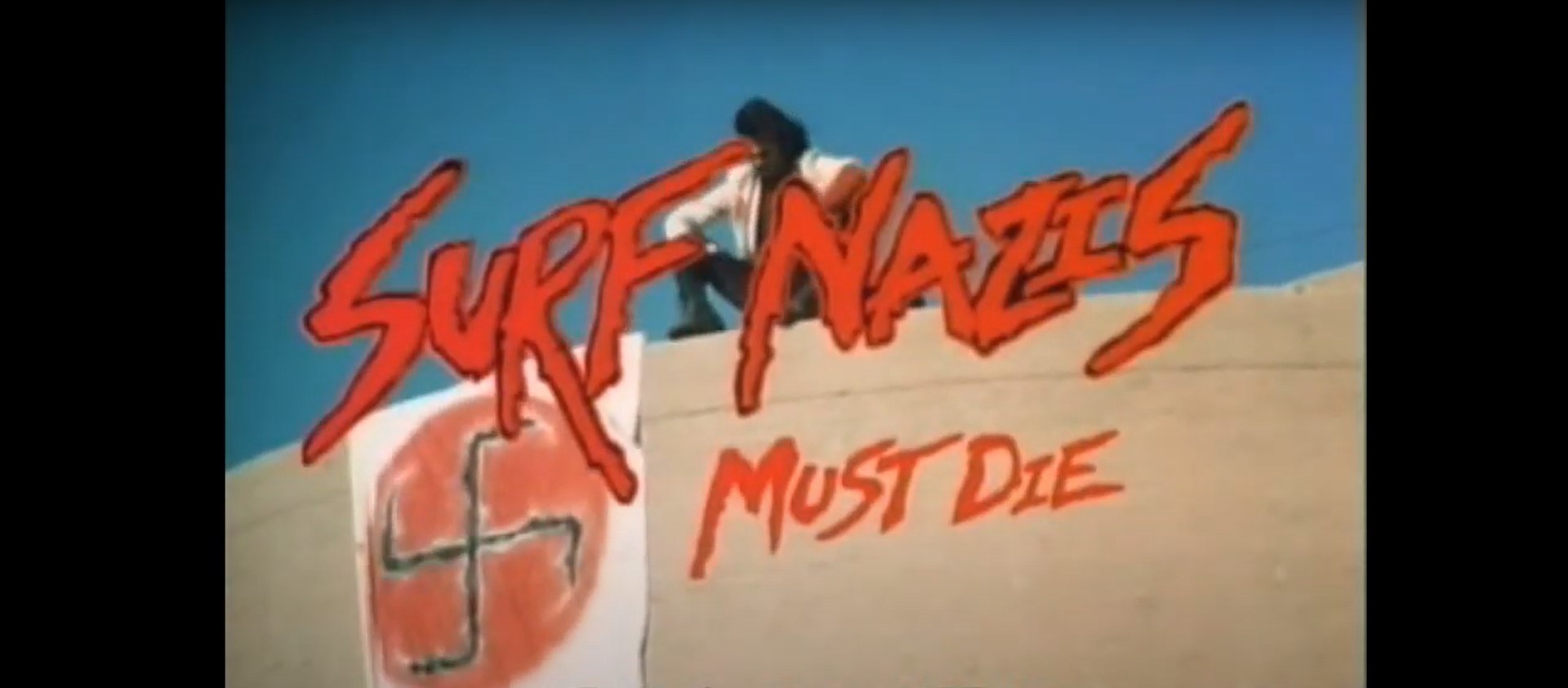
Ever since being highly promoted at random on Alex Powers’ wannabe Troma film “Sadistic Eroticism” starring adult film actress Sophie Dee, perhaps as Powers’ favorite Troma release, seeing “Surf Nazis Must Die” tickled the curiosity of the olfactory snout and became one of those must watch titles canonized with outrageous, off-color content that’s routine for the Lloyd Kaufman and Michael Herz independent shock-and-comedy distributor, Troma Films.  Peter George directed his semi-serious, mostly satirical-toned debut film from a Jon Ayre script based off George’s original story idea of incorporating the territorial surfer scene of California with a laying siege, post-apocalyptic, gang and revenge narrative that’s a delectable smorgasbord buffet of low-budget subgenres.  Perfectly situated in front of deep-water oil rigs and the towering smokestacks of power plants and other various manufactories along California’s graffiti-cladded Huntington Beach, “Surf Nazis Must Die” is a production of Peter George’s The Institute alongside company co-owners in editor Craig A. Colton and producer Robert Tinnell (“Frankenstein and Me”).

Tennessee born actress Gail Neely receives her big break in a lead role of a feature film.  Lamentably, that film was full of bad taste and full of punk surfers with red painted swastikas on their black wetsuits who also paralleled nefariously notorious figures of bigotry and war crimes against anyone not white Anglo-Saxon.  Yes, Neely is a black actress pitted against and taking revenge on a group of racist thugs, a narrative we’ve seen before, but the “Naked Gun 2 ½:  The Smell of Fear” actress took an unjust backseat (an unfortunate and unintended Rosa Parks pun) in sharing the lead with the very Nazis she ruthless takes head on.  Trying to understand why Peter George and Jon Ayre decided to focus more on the strategic overthrows of gangland rather than to journey Mama Washington’s revenge in her death wish arch is beyond comprehension in a lopsided narrative that gives more screen time to Nazis and gangs than it does a grieving, nursing home-residing, mother hellbent on avenging her slain son with vigilantism.  The latter is a much better story that breaks up the stagnant gang mentality unwavering throughout.  Neely does her best to pull audiences back into the revenge fold with a grit and attitude that takes us back to 1970’s blaxploitation films of yore, but ultimately, “Maniac Cop’s” Barry Brenner and “Star Slammers’” Dawn Wildsmith and Michael Sonye inadvertently bleed out Neely’s full potential with their respective Nazi counterparts – Adolf, Eva, and Mengele – and their intercompany squabbles and beach brawls against rival gangs.  “Surf Nazis Must Die’s” cast rounds out with Robert Harden (“Dead Girls”) as Leroy, Joel Hile (“Deadly Friend”) as Hook, Gene Mitchell as Brutus, and Tom Shell (“Hard Rock Nightmare”) as Smeg.

With a title like “Surf Nazis Must Die,” the expectation bar was high to bequeath audiences guaranteed politically incorrect exploitation and sizable good versus bad mayhem crashing like a cacophonic wave on the surf.  “Surf Nazis Must Die” does meet that brazen bar that associates surf territorialism to the likes of Nazism by way of excluding outsiders from their surf turf and be nasty about it as well.  Would I compare it to Nazism?  Probably not, but in the heat of control and power over others less fortunate in riding waves might draw a vague resemblance.  In a bit of satire and irony, 1940s Nazi Germany was ruled by an extremely authoritarian people running a tight ship in every facet from the meticulous armed ranks to innovative engineering to the ostentatious decorated halls and buildings of propaganda and flag hoisting pageantry, but Peter George’s Nazis, granted the new age variety, plague themselves about the beach, living off stolen goods while driving around in a makeshift shark modified van, tanning their mostly exposed bodies, or dressed in graffiti stylized wetsuits and trench coats with glitter-face painted swastikas.  The characters are cuter in caricatures than they are in terrorizing tyrants of the beach.  What’s even more interesting about “Surf Nazis Must Die” is that none of the gangs carry firearms despite one of the popular Troma cover arts displaying an archetypal lampooned Nazi riding a wave and wielding an Uzi.  The “Clockwork Orange” gangs meandering about with unprovoked violence carry traditional switchblades, nontraditional switchblade surfboards, nunchakus, staffs, a hook for an arm, and there’s even one guy with a speargun.  Only Mama Washington is armed to the teeth with conventional weaponry of grenades and a handgun that makes this film even more unfathomable at times.

Thirty-five years later, “Surf Nazis Must Die” continues to make waves a war zone with a new Blu-ray released from Troma Films and distributed by MVD Visual. The newly restored, newly remastered, high-definition region free Blu-ray is presented in a widescreen 16×9 aspect ratio from the original 35mm negative and is not quite the fully uncut version, running two minutes short at 83 minutes from the director’s cut that circulates overseas. The color matte lacks bounteous vision that fails to give range to the graffiti art amongst other aspects. The transfer has little-to-no blights with some transparent vertical scratches in a single frame but nothing else more to note. George and editor Craig A. Colton work their magic on a remarkable cutting room performance with splicing in Hawaiian surfing footage with the Huntington Beach narrative in a near seamless manner. The English language lossy LPCM 2.0 track doesn’t hook into you with a linear fidelity with no range or depth but does provide fair dialogue clarity and no impeding audible damage. “Terror Eyes” and “Future Shock’s” Jon McCallum has a fantastic synth score that pulsates life into the overabundance of stagnant moments and the film is worth a watch just for McCallum’s soundtrack alone. Gnarly special features include a new introduction by a locked down stricken Lloyd Kaufman diving into his pool to take a bath, a circa late 80s/early 90s interview with Peter Geoge conducted by the enthusiastic Lloyd Kaufman, another circa late 80s/early 90s snippet interview with producer Robin Tinell, a pair of deleted scenes with Peter George commentary, scenes from the Tromaville Cafe, Radiation March Promo against pollution, a pair of archived Troma NOW PSA announcements that are as sexually titillating as they are meaningful in their message, a Soul of Troma promo trailer,” “Latched” short, and various other Troma promos: Indie artists vs cartels, Lloyd Kaufman gets “fucked” by the Hollywood system, and Lloyd Kaufman’s Audiobiography. There’s also mention of a “Gizzard Face” promo, but I did not see it as an option in the bonus content. “Surf Nazis Must Die” inches along and loses a lot of key momentum along the way building around the striking title. Eventually, the undercutting of gang machoism crumbles away to leave an open path for Mama Washington’s full-blown assault as a true cinematic Nazi hunter extraordinaire.

Check Out the New Price Drop for the New “Surf Nazis Must Die” on Blu-ray!

Sexual Asphyxiation is Just One of the Offered Services in EVIL’s Lavish S&M Prostitution Biz! “Tokyo Decadence” reviewed! (Unearthed Films / Blu-ray)


Own the new Unearthed Films Blu-ray of “Tokyo Decadeance” today!

Ai doesn’t believe she is not good at anything.  Her youth and beauty provide the early 20-year-old financial means of survival as a high class, Japanese prostitute with a fetish niche for clientele desiring sadism, masochism, or both.  Eccentrically demanding and various in age customers range their likes from total self-humiliation by pain and punishment to rape and necrophilia fantasies.  Unable to stop herself from accepting jobs because of her self-loathing cycle, Ai continues to endure most of the sexual whims no matter how outrageous or aggressive they may be during the sometimes hours long sessions.  What keeps her knocking on strangers’ doors is the pining for a former lover, a now famous celebrity she at one time dated pre-stardom, who has since married and left the memory of a fragile Ai in his life progressing wake.  After taking a gig alongside a fellow mistress in humiliating a real estate mogul like a dog, Ai’s invited back to the mistress’s elegant home where she’s exposed to a long night of unlabeled drugs that sends her into an uncontrollable high, looking for her former lover on the quiet streets of Japanese neighborhoods.

“Tokyo Decadence” makes “50 Shades of Gray” look like an inexperienced couple’s first time fumbling into cutesy foreplay.  Though both films are adapted literary works made into controversial features surrounding sultry nipple clips, whips, chains and other playthings, the 1992 Japanese psychosexual drama is the only one out of the two where the novel’s author, Ryu Murakami, has total creative control of his tale of one woman’s squirming through perversion land as the screenwriter and director.  Titled Topâzu in its originating country’s language, “Tokyo Decadence” opens up a carnalized world rarely seen amongst the daylighting fray and the price paying struggles of someone as meek as Ai in that position’s lustfully gripping vise that begs the question, is S&M obscurity an insatiable erotic hunger or is it a choking dangerous fantasy?  Shot mainly in the titular city of Tokyo, the film is a production of the JVD (Japan Video Distribution) with JVD’s Tadanobu Hirao (“High School Ghostbusters,” “Celluloid Nightmare”) as producer alongside Chosei Funahara, Yousuke Nagata, and Akiuh Suzuki.

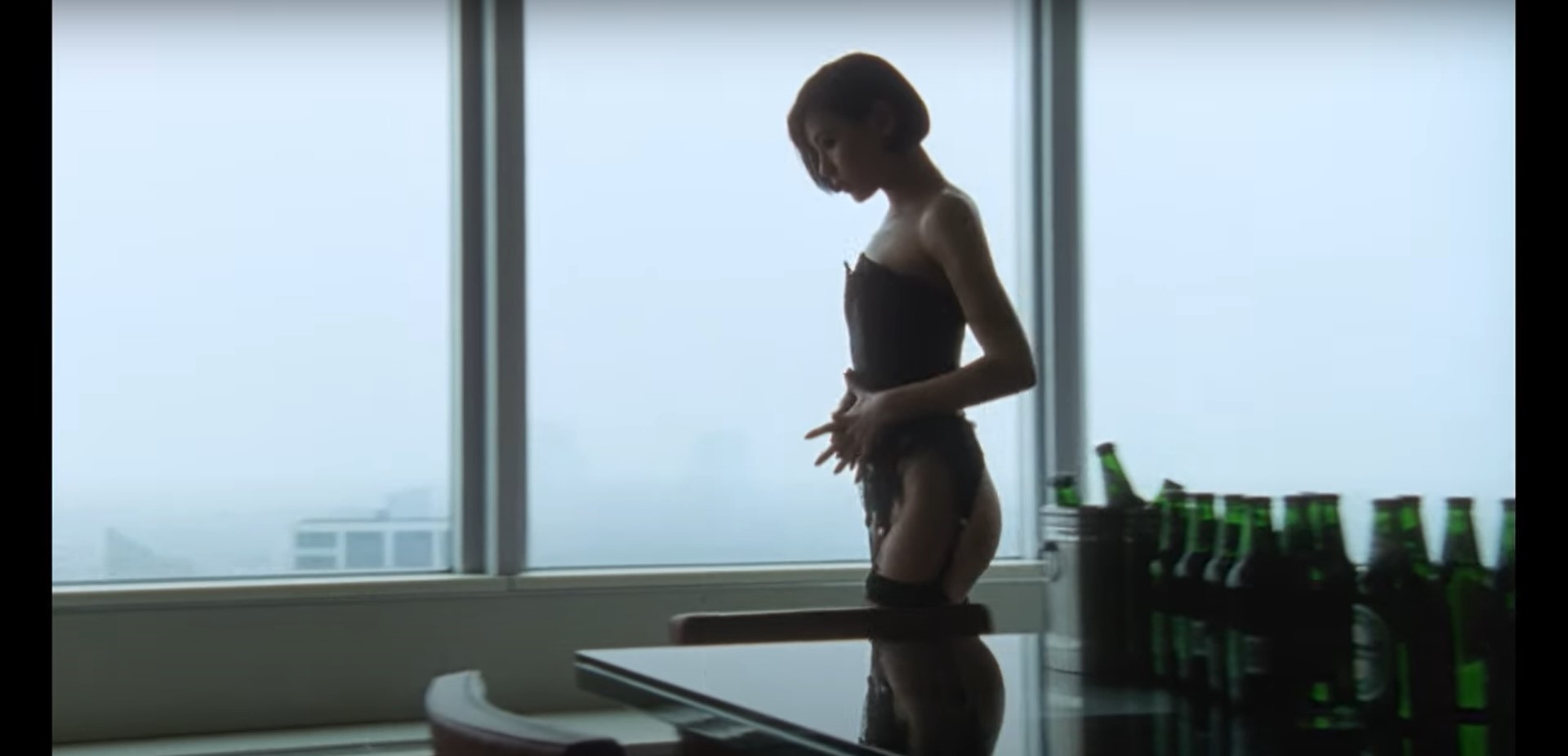
“Tokyo Decadence” is a sure-fire way to start the beginnings of an actress’s career with a rousingly provocative and difficult role that garners attention.  For Miho Nikaido at the very start of her career, the lead role looked like a Tuesday.  The then 26-year-old Nikaido, playing a 22-year-old Ai, stuns as a sympathetically shy S&M prostitute with underlining conflicting issues surrounding her social position, personal interests, and mental status.  The opening scene with her legs lifted and spread strapped into stirrups and her bold colored red lipstick mouth buckled with a black open mouth gag complete with matching blindfold diverts eyes away from the usual nudity focal point.  Instead, we’re more attuned to the happenings of a mild manner, smiling man, who we assume bound her down under professional servicing, as he stands over her, gently stroking her, and telling her to trust him and that he won’t hurt her.  Then, out comes the drug pouch and needle.  The jab sends shock waves of pleasure down Ai’s submissively fastened naked body, ending with Ryu Murakami’s extreme close up on Nikaido’s face after being released from the facial constraints.  Her slightly crooked teeth shiver just past her stark red lips, agape by ecstasy, and the single tear drops from her soft eyes express the gargantuan amount of pleasure coursing through her helpless corporeal temple in a look that says, I am in pure, undiluted heaven.  The opening sets the tone.  Funny enough, Nikaido would go on to have a role in another underground S&M inspired drama “Going Under,” but instead of acting like the subservient dog or humiliating customers by having them suck on her stiletto heels, Nikaido steps aside as the girlfriend to Geno Lechner’s dominatrix role. Sayoko Amano, Tenmei Kano, and Masahiko Shimada co-star.

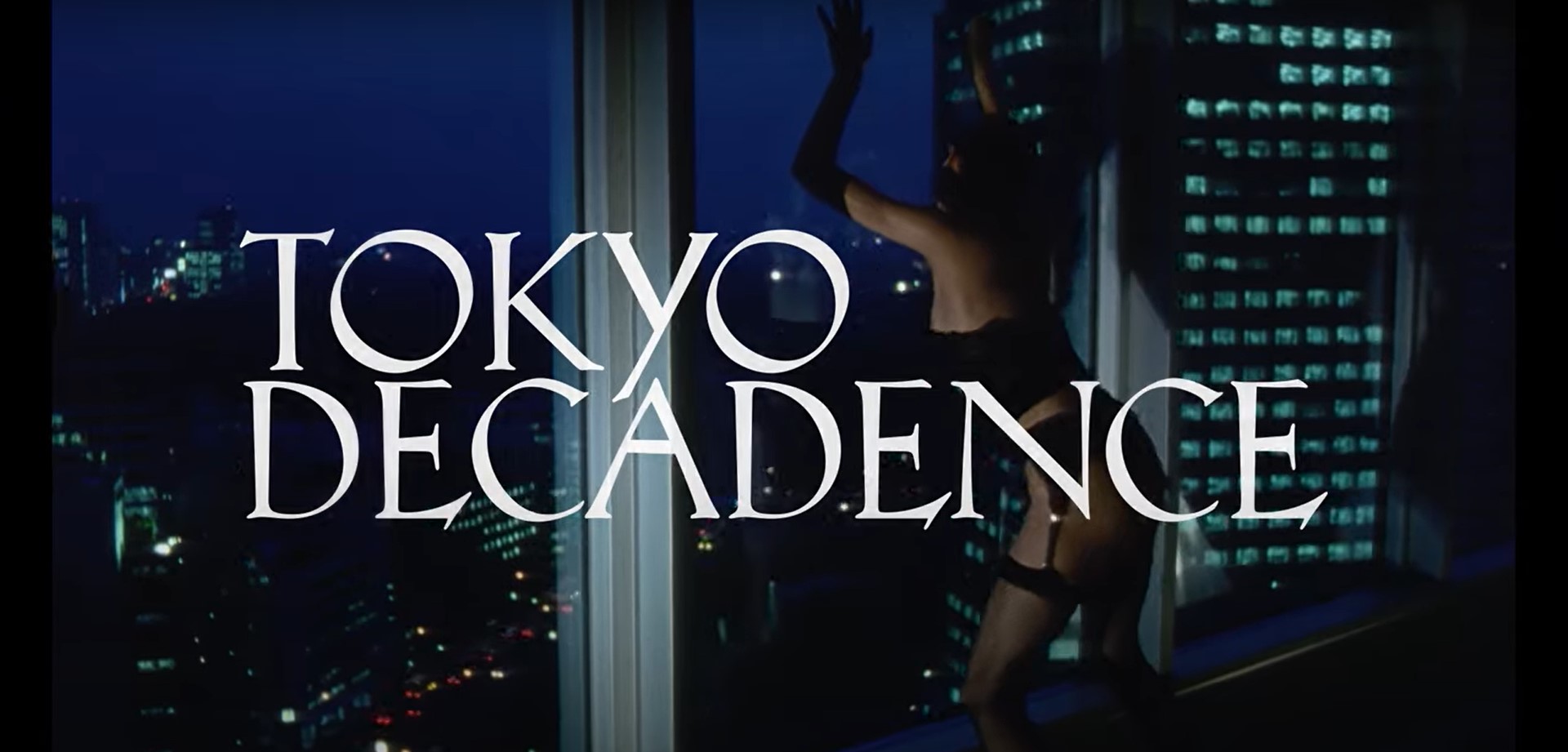
Perhaps one of the most noticeable or mainstream pink films from Japan because of its titillating and iconic cover art of Miho Nikaido arched forward and hands pressed high on the glass above her head, leaning against a tall and large window pane in a skimpy black lace and leather getup and overlooking the city lights and bustling residents,  The very image epitomizes erotica and taboo acts and the narrative itself is nothing short of that slight zing of sordid pleasure we all experience in our minds, bodies, and especially in our more private areas. Pulled straight from Ai’s first job encounter, post-opening credits, with a wealthy business type Mr. Satoh’s and his perversion in dominating and humiliating without much physically contact in the first few couple hours of their session. The long-standing stint pushes Ai’s sexual limits without breaking her spirit that solidifies a baseline for what’s to come and what came crushes Ai’s sexual stimulation beyond the means of pleasure with a petri dish of distinctive peculiarities outside her already fringed tastes. Ai’s self-dismissiveness keeps her plugging away at a profession that’s eating away her, coming close to death in many various forms involving clients’ perversions. When she’s hired by another mistress in a co-op of dominance on a client, an unveiling of empowerment and a lavish lifestyle promises potential happiness away from her fairytale dream of reconnecting with her former lover, but that ultimately becomes a hard pill to swallow after swallowing an unidentifiable pill popper provided by her newfound friend in the trade, a pill that inebriates her into wandering the streets in search for her ex-lover. “Toyko Decadence” is as somber as it is sexy with a paralleling dark trip down delusional happiness and demented fantasy for a young woman clinging onto a past that has completely forgotten her.

Landing in at number seven on the spine is the Unearthed Films release of Ryu Murakami’s “Tokyo Decadence,” receiving a Blu-ray release on the label’s Unearthed Classics line in a widescreen 1.66.1 aspect ratio. The region A release has a runtime of 112 minutes and is plainly evident in exhibiting no rating listed on neither the back of the Blu-ray case nor the cardboard slipcover. After doing some light digging, there is a longer cut of the film with more explicit scenes, especially with Mr. Satoh, that would have adorned the U.S. release with a X-rating. The Unearthed Films release is not that cut; nonetheless, the film before us is still just as decadently beautiful in content and in quality. Stable image and color under the 35mm stock, Tadashi Aoki flipflops between mood lighting and natural light, contrasting the duality of Ai’s worlds with a lightly softness reflecting off the focal subjects. Details extend the same softness as skin textures appear overly smooth most of the time albeit the design of natural color tones. One instance of continuation concern is a prominent scene miscut left in during post at the editing room table. Though the miscut, of a closeup on Miho Nikaido, doesn’t cause a continuity error in the narrative, it does break the integrity of the scene. The Japanese LPCM 2.0 mono sound has a phenomenal, 1920kps bitrate, sound design created around a lite soundtrack that doesn’t leave room for ambient and dialogue tracks to hide behind, as if this release needed to hide behind its brawny audio output. “Tokyo Decadence” is all about the experience and every breath and movement is as felt as it is heard with a discernible dialogue well synched with the English subtitles. An optional English dub track is also available. The Blu’s special features include a release-party featurette/promo trailer that has snippet interviews from the Ryu Murakami during the event, gallery stills, and trailers. An absolute ideal upgrade for one of the best pinksploitation films to ever walk that thin line between sadism and masochism; however, I do believe Unearthed Films insisted upon the safe word by not, whether by choice or other circumstances, retrieving, updating, and releasing the fully uncut and unedited “Toyko Decadence.”

Own the new Unearthed Films Blu-ray of “Tokyo Decadeance” today!