

Recently engaged lovers Daniel and Mina take a trip to visit Daniel’s brother. When they stop to take in one of California’s breathtaking beaches, two vicious bikers, looking for kicks, intrude on the lovebird’s romantic getaway, looking to rape Mina but ending up mercilessly murdering Daniel. Mina’s grief turns the distraught lover into a vengeful bitch, taking the lives of all salacious and beastly men who wish to exploit Mina’s virginal beauty. Meanwhile, Daniel’s brother, a praised police detective, personally takes on the case despite his Captain’s insistence of not getting to close due to his personal connection. The detective tracks down the drug dealer Black Pepper, the head of a notorious biker gang connected to the slaying of his brother, that results in an all out war!

“Dangerous Men” is an action film you hate to love, being so bad it’s good. The film was the non-aborted child of Iranian born, U.S. bound director John Rad, a pseudo name, who had a life-long vision from way back in 1979 to put an eternal awesomeness on the big silver screen and, in one way or another, completed that feat no matter how long the creative process. Only 26 years stood in between John Rad and his masterpiece “Dangerous Men” from being completed and theatrically released to the public, but, low and behold, “Dangerous Men” didn’t succeed into billions or even millions of box office dollars; instead, Rad’s film gained popularity in its notoriety, gaining almost instantly cult status through a niche group of garbage cinema aficionados. By the grace of the provocative arthouse film brew masters at Drafthouse Films and their continuous begging toward Rad’s daughter, “Dangerous Men” redefines the term guilty pleasure.

But what makes “Dangerous Men” so irresistibly appealing? Is it that fact that Iranian born Peter Palian from “Samurai Cop” fame is the most experienced crew member on John Rad’s amateurish, if not solo performing, team? To properly answer that conundrum-filled riddle, looking at what makes “Dangerous Men” so standardly terrible would ultimately lead to the answer. For one, a prominent lead character doesn’t exist in a plot that can’t focus due in part of the two decades the film was shot that resulted in the actors or actresses not being available or unwilling to complete Rad’s work. Various characters, like Mina (Melody Wiggins) or the cop brother (Dutch Van Delsem), come and go in their respective, decade housed plot paths and like one of Drafthouse Films’s bonus features makes light, the film ends on a still frame of characters who have had less than half an hour of screen time. Secondly, the amateur acting in exposition, the cut and dry editing, and the cartoonish foley, by the also writer-director John Rad, hones straight toward gut-punching you to explode into outrageous, painful laughter. “Dangerous Men” is a serious film that’s full of wacky action and some great moments of exploitation, especially scenes involving women knees, but when all the punching and exasperating is of the identical sound bite, like in a “Street Fighter” video game, taking Rad’s film seriously is hard to fathom. Thirdly, the longevity of filming created many production goofs that mistakenly implied the decade. From props, to haircuts, and to clothes, hints of years were obvious to the naked eye. Lastly, a title like “Dangerous Men” should end on an detonative high note; instead, falls just short of a chuckle and a “WTF.”

“Dangerous Men” snuggly finds a spot within the realm of other bad movies not to be missed. “Troll 2,” “Silent Night, Deadly NIght 2” with the infamous garbage day line, “Leonard Part 6,” and “Jaws: The Revenge” would gladly welcome “Dangerous Men” with open arms as a peer in preposterousness. With a little over a measly $2,300 in ticket sales on opening weekend from a film that probably cost John Rad thousands upon thousands of dollars to produce and a whole hell of a lot of time to construct, “Dangerous Men” is most likely an action-packed feature you’ve never, ever heard of before. One positive remark is the soundtrack, which is also composed by John Rad, was, in my humble opinion, swanky and, well, rad – a true testament to the era and the best effort for such bad film. Unfortunately, John Rad never saw his film blossom as he died soon after the release of his masterpiece, sometime mysteriously between 2005 and 2007.

Drafthouse Films, in association with MVDVisual distribution, courteously releases “Dangerous Men” on a sleek not rated two-disc, 1080p 1.85:1 widescreen Blu-ray and DVD set which has a region free presentation that still manages to hold in the cigarette burns and the faded coloring in a sort of time capsule from the 80’s and 90’s. The original print looks to have been kept in good condition for an easy upgradeable and cleanable transfer. The Dolby Digital mono stereo mix is fairly clean aside from some misaligned dialogue tracks with the video and the prevalence of background noise in certain scenes of poor record quality such as the Daniel and Mina restaurant scene. Drafthouse Films doesn’t discriminate amongst the quality of their releases when considering the bonus features. A 16 page booklet featuring documented full-length interviews with director John Rad, audio commentary featuring “Destroy All Movies” authors Zack Carlson and Bryan Connolly, “That’s So Rad,” an epigram stemmed from this film, is an original documentary about the film and its initial 2005 release, an interview with cinematographer Peter Palian, Rare footage of John Rad’s appearance on local access television, and the original theatrical trailer. Quite the laundry list of extras! “Dangerous Men” is so spectacularly unspeakable and trashy it shouldn’t go unseen for absolutely anything, not even for the birth of your first born child!
Tag Archives: MVD
No Escape from Evil’s Spell. “Rows” review!

After serving an eviction notice to a strange old woman, with a grisly rumor in her past, for her realtor mogul father, Rose becomes drugged and bound against her will by the old woman who injects Rose with something. When Rose awakes, she finds her self caught in a repetitive cycle of murder, betrayal, and mystery brought upon by a spell conjured upon Rose by the old enchantress woman. The key to breaking the spell is the enchantress’s family home and it’s up to Rose to whether destroying the home or not will save her father who also falls victim to the old woman’s bewitching power.

“Rows” is the fantasy-horror brainchild of writer-director David Warfield and stars “Feast” actress Hannah Schick along side “House with 100 Eyes’s” Lauren Lakis, Kenneth Hughes, Joe Basile, and Nancy Murray as the enchantress or the witch, which I like to title the character. The overall small casts’ performance achieves the toned-down, nearly expressionless portrayal of characters stuck in the confines of a hex; the “something-doesn’t-feel-right” notion is hyped up without the idea constantly up in your face and is more downplayed to let the viewer interpret Rose’s beyond twisted “Alice in Wonderland” experience. Instead of a world full of giant smoking caterpillars and tea drinking mad hatters, Warfield writes about the relatively unknown horrors of corn fields, an endless maze with rows and rows of high stalks that traps Rose and Greta.

But the corn rows go to the back burner when the nature of the house comes to the forefront. The house’s claim to be the smoking gun to all of Rose’s obstacles is undervalued by the poor written construction of the southern belle style home in the script. The house doesn’t loom, isn’t very menacing, and just can’t seem to ever get on it’s feet to become a character wroth being frightened over. Warfield should have stuck with the corn rows which creates a surface murkiness, goes beyond our heroine’s ability to see or hear, shreds any hope for escape, and looks more ominous during the night; the house was always kept in the daytime. However, the old witch’s power stems from the house and for whatever reason, aside from the extended family history under their thumb, there is this unsatisfied, unknown conclusion for the viewer and the finale is up for personal interpretation.

In making the ending open, Warfield’s “Rows” eases onto the border of experimental. Act one and two weren’t exactly straight forward either, but the understanding was clear and present enough. Once the transition, or the epiphany if you will, into the third act begins, a struggle to grasp Rose’s direction and, in the end, destination becomes more difficult. I can only go on my own interpretation of Rose’s journey and, much like that of the fantasy-ridden “Labyrinth” starring David Bowie, I felt like actress Hannah Schick was the Jennifer Connelly character in the sense that Rose has to grow up, leave the comforts of home, and be responsible and this whole event with the enchantress and the spell is an internal mental battle that ultimately is decided by a choice. In Hannah’s case, her inner, warped conflict is to fight her father’s will or embrace it.

Indie Rights Films and MVDVisual distributes the StorySolver Film Lab production to DVD in a stunning 2.35:1 anamorphic widescreen presentation. Details look fantastic from the farm landscapes to the skin tones with no sign of touch up enhancements such as cropping, sharpening, or smoothing. The English Dolby Digital 5.1 audio track clearly balanced and diversifies all sub-tracks, especially the ambient sounds of the rural atmosphere to set an looming setting. There are no subtitle or settings options, nor do extras exist. Only “play” or “chapters” line the menu title. “Rows” has a sizable underlining gloom about it, setting a rightfully impassive mood through the spell world Rose is thrusted into combating.
Torment and Puke is One Girl’s Evil Journey. “Madness of Many” review!

Victoria propels through an discarded and tragic life of torture and suffering. Her parents sexually abuse her as a child and into her adulthood where she finally is able to desperately flee in search of a new and hopeful life, but Victoria’s destined to fulfill a life with more suffering, even worse than while under the abusive and ever watchful eyes of her family. The anguish built structure of her being leads Victoria to an endless amount of pain that grows inside her, sprouting a vast and treacherous sea of meaningful existence, and blossoming into a eye opening, or eye gouging, experience in which she’ll never forget. This is her journey through the gateway of hell to the inevitable rebirth of pain and puke.
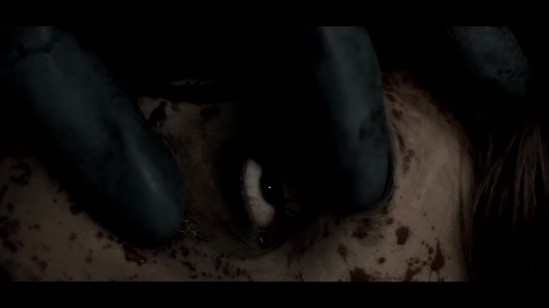
Considered to be the “most controversial” film made in Denmark, director/writer/editor/special effects artist Kasper Juhl’s experimental horror film “Madness of Many” goes through four chapters of Victoria’s detestable existence and transformative suffering. There’s never a time when she’s safe, being dredged through the scum and the dirt for all of her life. The former prostitute and drug addict doesn’t ever rehab or recoup from her time as a sex slave, a human pin cushion, or a human fluid dumpster as her story, mostly told off-screen in a monologue accompanied by grotesque and digestible imagery, is considered to be a rise of a phoenix through the clout of ashes.

However, Victoria is not alone. Numerous other women, some representing Victoria in various stages of her life and others just in an akin to Victoria’s situation, are affixed to the same suffrage and, in the same fashion as many Unearthed Film’s features, self-induced vomiting is a big part of their torment (and about 1/4 of the visual story). “Slaughtered Vomit Dolls” and films like it, such as “Madness of Many,” have never really been my cup of hot bloody spew stew, but “Madness of Many,” by far, has better visual effects when considering the torture and the gore amongst the spew-splattering titles. Much like Victoria, the viewer has to suffer through drawn out portions of the narrator’s exposition in order to set up and enjoy Kasper Juhl’s effectively realistic sinew and gut-churning effects.

I must admit there’s a certain poetic underlining and parallelism to Juhl’s film; a sort of an art-house, coffee shop “fung shui” complexity about suffering that can only be told through the Juhl’s telling of Victoria’s devastating story. The actor portrayal diminishes much of that structure that merely falls into the category, for most of the viewing experience, of interpretative dancing told in the eloquent genre of doom metal and deep underground horror cinema. Yet, Victoria’s plight is never a matter to be cheered for, never a route for hope, and certainly never a situation anyone would envy. “Madness of Many” is not, and I repeat, not a feel good movie. Its not a kid’s movie. Hell, it’s not even a movie for most adults. Certain breeds of human would consider the Kasper Juhl’s film in their niche of subversive cinema.

Produced by Hellbound Productions and distributed fittingly by Unearthed Films and MVDVisual, “Madness of Many” delivers controversy; perhaps not in the States, but for Denmark, I’m sure and will cause much controversy for the weak stomachs who find this title in their possession, going into a viewing without the heads up of what they’re getting themselves into. Juhl’s only English film to date isn’t glamourous popcorn horror with a recognizable cast and it’s replay value is next to none, but if the gore and shock genre is the game you’re willing to play to perverse over, then the “Madness of Many” would be right up that twisted alley.
Evil’s Nun Too Happy. “Flesh for the Inferno” review!

A Church youth group voluntary attends a Saint Christopher’s Catholic Middle School weekend cleanup before the school’s much needed reconstruction and restoration. As soon as they start with the sweeping, dusting, and polishing, three demon nuns, let to suffer behind an enclosed brick wall by a child molesting priest, unleashes their vengeful wrath, a gift from their new lord and savior, the devil, to whom they’ve sold their soul. Quickly, one-by-one the volunteers fall to the flesh hungry demonic nuns, using their sins against them, and extracting their souls for hell bound eternity. The select few to survive the ordeal of nuns will come face-to-face with Satan himself where praying for mercy will get them nowhere and is the same as burning in hell.

Director Richard Griffin once again pushes down the throttle to wrap the shooting of an entire movie in a matter of days on another lightweight budget. “Flesh for the Inferno” had a 9 day shoot with, and no surprise here, Griffin hiring some of his entourage of talented actors and actresses. The stage actors employed are always remarkable to watch; the underrated Michael Thurber, even in a toned down performance, is such a joy to watch with his adaptable skill set to jump into the shoes of any role in any film. The same can be said about the co-leads, Jamie Default and Jamie Lyn Bagley, who easily adjust into various roles from one Griffin film to the next. However, to my surprise, Griffin’s works with new faces, such as Ryan Nunes, Andrew Morais, and Kevin Michael Strauss, whom fit into his homage work of European possession horror. Then, there’s the talented Aaron Andrade who puts any other actor’s portrayal of Devil to shame.

Griffin and long time collaborator and cinematographer Jill Poisson purposefully softens the lens to give the photography a dreamlike or surreal state to mimic the iconic European director styles such as from Mario Bava or more in tunely with Lucio Fulci and though this respectable style was succesffully achieved and did contribute to the Bava or Fulci level of cinematic and atmospheric charm, the haziness was a bit overbearing, almost closing in on the actors within a modified frame of dominating clouds. The effect mostly shadows from what I noticed, right off the bat, the recognizable set from a previous Griffin film, “Future Justice,” sporting a new coat of paint and constructed with new, or new-ish, set pieces to create the Catholic school locale.

Screenwriter Michael Varrati churns out a script in less than a week to give Griffin much time as possible on a location rented much longer than needed. Varrati has written remarkable natural banter between opposition, connected, and flirtatious characters and does well with the dynamics for a quickly progressing story where shit hits the fan, crossing over into act two, in a matter of minutes. Its the dialogue, however, that slightly over saturates “Flesh for the Inferno” and it’s demonic, habit-wearing nuns. Fully engaged conversations between the nuns and the unlucky survivors cross over into theological debates rather than leading into a sacrilegious and unholy curse. Though at times, scenes like the one with Michael Thurber chasing his own tail in a Groundhog Day movie-type scenario was well placed in the story and well shot, even if little-to-no dialogue was present.

“Flesh for the Inferno” was suppose to be Griffin and his crew’s all out gory effects movie the homage attuned director has ever filmed. Yet, I can’t help but feel as if the opportunity was bobbled to recreate a “Demonia’s” bloodshed. The John Dusek effects were simply effective though, catering to all the film’s intention and needs to pull off a nasty nunnery narrative. The Timothy Fife soundtrack isn’t necessarily Fulci inspired as well that perhaps resemble more of a Goblin and Ennio Morricone blend and that’s highly more notable.

Scorpio Film Releasing and MVDVisual distribution together created and distributed another fantastic film that’s graced with retro-sleek cover art, like always, and I’m always impressed by director Richard Griffin’s capability to turn low budget horror into a formidable admiration of the old days of all kind of horror. Griffin and his entourage are on a whole separate level than their counterpart in their Hollywood doppleganger Eli Roth. The MVDVisual DVD looks sleek with a 16:9 widescreen presentation for the 79 minute feature. Bonus material is limited, but informative, that includes a crew commentary, cast commentary, and the film’s trailer.
All Evil Breaks Loose! “Mansion of Blood” review!

Pretentious millionaire Mason Murphy hosts the largest and sexiest lunar eclipse party in the close knit community of River Ridge. Murphy renovates the old Mayhew estate, home to the mysterious disappearance of the wealthy Mr. Mayhew in 1926, as the party’s extravagant setting. One of the young party goers is also a practicing partaker of witchcraft and when she attempts to summon upon the spirit of her dead boyfriend to ask about whether he bought a winning lottery ticket or not just before his death, she accidentally aligns all things evil right as the eclipse takes place, trapping the oblivious guests in a nightmarish twilight zone that includes black bat demons, Civil War ghosts, lawn ornament zombies, bar tending vampires, and a slew of maniacal murderers.

Director Mike Donahue’s “Mansion of Blood” is a horror-comedy of an ambitious narrative that was doomed during the middle of production, resulting in a shameless, mishmash heap of a film. From what I’ve read from various article sources, “Mansion of Blood” came to a screeching production halt due in part of a sexual assault claim from an actress or two. The complaint was against the film’s headlining star, Gary “Lethal Weapon” Busey. Are we really surprised here? Busey, who suffered permanent brain damage in 1988 after a motorcycle accident, has sustained from his wild and crazy, sometimes delusional, antics that raises many eyebrows through almost the last three decades. The film’s crew was so fed up with Busey that he was actually fired and massive re-cuts and re-edits caused the story’s downward slope. Aside from the Busey debacle, executive producer and one of the film’s stars Tom Tangen is rumored to have screwed over the film’s investors, leaving director Mike Donahue high and dry.
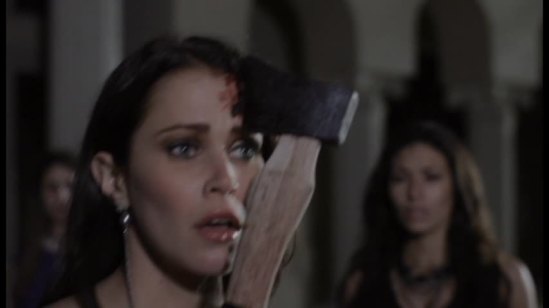
Honestly, I strongly feel “Mansion of Blood” never came an inch off the ground. I get that the film is a horror-comedy in a slapstick sub-genre, but the story is in total shambles. Numerous characters and their individual stories are diluted to the point of being a suffering and aggravated attention deficit disorder. The severely choppy editing, the unbalanced dialogue and ambient audio tracks, and the oafish acting throughout only piles on top of an already high mountain of sadness. And even though I have a soft place in my heart for Busey and his sheer lunacy, in life and on film, his performance as the malicious party host Zachariah was, dare I say it, surprisingly stale. Only a few handful of scenes of Busey’s floating, grinning head faintly superimposed as a ghost or a spirit or as a something are uniquely guilty pleasurable. Not all has failed as the film’s other star, “Star Trek: Voyager’s” and “Innerspace’s” Robert Picardo, attempts and succeeds at a good performance as the party’s caterer who ends up almost being poisoned by his chef wife, played by Lorraine Ziff.
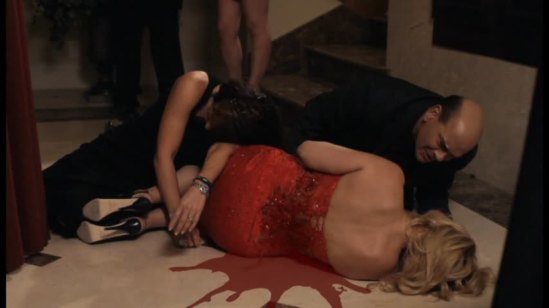
Again, I’m well aware that “Mansion of Blood” is a horror-comedy, but the no budget special effects couldn’t be any more offensive to our intelligence. The “demons” were extras in black face and black leotards with a dark cape and plastered with exuberantly adhesive bat ears. The computer generated lunar eclipse was near 1950’s animated cartoonish. These effects bog down the quality of the film, turning a potential Sci-Fi channel movie spoof to a more of an obsolete, outdated, and cheesy and campy schlock that could be deemed worthy of being presented on Mystery Science Theater 3000. Instead of solidly funded practical and computer generated special effects, Donahue leans firmly on the hard bodies of young (and some slightly older such as Lorraine Ziff) actors and actresses. The naked bodies of upcoming scream queen Mindy Robinson and the industry versatile Dustin Quick are two to name just a few who pair up with the rock hard abs of Kyle Clarke and Frank Mora Jr. One would think Jennifer Tapiero, Sarah Alami, and Tegan Webster would be the group of main characters that would develop and expand throughout the duration since they’re stories begin in a diner, but their characters become junk roles that fizzle into into oblivion and tangents are created for non-setup characters.

“Mansion of Blood’s plethora of characters is too much to handle, especially when the film tries to go in numerous directions that doesn’t give Donahue’s motion picture any direction. The story and script flounders as the legs are cut right from underneath both of them. I empathize that the Gary Busey and the rumored Tom Tangen issues might have derailed this project that categorizes this film into the scrap-to-salvage scenario similar to prior films like “Bad Meat” and “Old 37.” Tom Cat Films and MVD bring “Mansion of Blood” to retail shelves and I encourage those brave enough to venture into the film to remember this particular review because when the credits begin to roll and the popcorn is down to the last few underdeveloped kernels, you will know somewhere in the sands of time and space that I’ll be whispering in the ears of your mind, “I told you so.”
 It's Bloggin Evil!