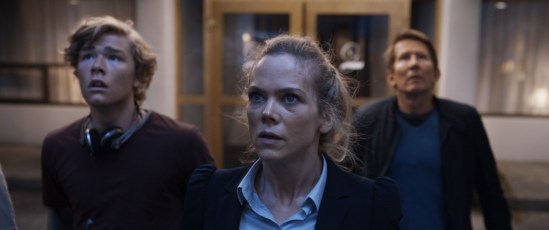
Two half-sisters, Ida, and Tuva, return home to spend time with their mother, preparing for a family dive in the frigid Norwegian waters near an isolated rock cliff. When the mother withdraws because of her health, the sisters embark without her. When a sudden rockslide traps Tuva, also the more experienced diver, between a rock and a hard place Ida must race against the clock to free her from being pinned to the bottom floor before viable air runs out, but with most of their gear under the rockslide rubble on the topside and only a few usable spare air tanks available, Ida, paying no heed to decompression sickness with her hasty reoccurring ascents to the surface, will do whatever it takes save her sister, even if that means being detrimental to her own life.

Scandinavian filmmaking has always been in this personally dissatisfying commercial stasis of public recognition oversight for years even though there are a number of projects, birthed from Sweden or Norway, that have the budget for success, compelling storytelling, and still fly shamefully under the radar and most audiences, speaking more for the U.S. based general admission moviegoers, don’t ever get the chance to experience without the bombardment of marketing or, perhaps more so, they intentionally skip over to titles with, who in large popcorn and soda glazed eyes, are well-known, recognizable thespian faces, or maybe a trailer they’ve seen during their morning daily talk shows and “Keeping Up With the Kardashians,” or for the worst reason of all, the subtitles are a big deterrent since Scandinavian films are in Scandinavian languages, but one of those films that depicts the immense Baltic beauty landscape but can also be edgy with touch of sensationalism is Joachim Hedén’s “Breaking Surface.” The director’s fourth feature length film in 2020 is woman versus nature, time versus the elements, when scuba diving hits direly rock bottom. Hedén wrote the film that’s presented by a Swedish and Norway co-production of companies, including Water Feature Films in association with Film i Väst, Film i Skåne, Umedia, Filmfond Nord, Sveriges Television, and Weggefilms. Julia Gebauer and Jonas Sörensson serve as producers.

At the core of the diving mishap are two sisters, Ida and Tuva. Half-sisters to be exact that are written with tremendous interfamily complexities because of their mother remarries Tuva’s father angle plus incorporating their own personal hang ups in adulthood with the genesis of their problem is stuck in the past. “Breaking Surface” is a woman domineered thriller, challenging the stereotyped patriarch activities of men and, to an extent, whatever role that is inhabited by a man is exhibited in not a good light. It’s reminiscent of the “47 Meters Down” films in more ways than one with scuba diving and an inclination for female principle characters dealing on hand with the cards dealt together to survive the elemental odds. Moa Gammel and Madeleine Martin play the respective leads of older sister Ida in the midst of divorce proceedings that comes complicated with two small children and has mother issues that she projects onto her younger half-sister, Tuva, who lives at the top of the food chain fearlessly and isn’t grounded by anyone, anything, or anywhere. Gammal and Martin instill into their characters a reaffirmations of their talents with Ida being a more recreational diver whereas Tuva lives and breaths underwater professionalism. This dynamic unfolds nicely when Tuva is trapped under a rockslide and her older sister has to be instructed, painfully detail-by-detail, what to do. At times, Ida is a character at a point of collapse because of how overly incompetent she can seem with no-brainer solutions; yet, this is where I believe Hedén to excel at scribing realism because no matter how frustrating can Ida’s actions be, any situation under that much pressure (pun intended) can discombobulate the mind, body, and senses. If my sister was trapped under a rock at the bottom of the sea floor, my id would explode and she would asphyxiate and drown before I could compute the situation. Yet, Ida comes around in her arc, completing more confidently and independently the challenges that face her despite their increase in difficult and severity with only minor eye-rolling cringes loitering in and between the second and third acts.

“Breaking Surface” is a modestly paced film with a slim runtime of 82 minutes that captures the entire trialing day odyssey of conquering nature, time, and death while decompressing fraught mental retentions of estranged sister and motherhood, parroting life circumstances, and a past event parallel that’s nearly paralyzing. As much as underwater thrillers excite as one of my personal favorite subgenres, there are downsides to “Breaking Surface” timing that felt limitless when Ida struggles to regain control from failure-after-failure of hopeless rescue endeavors of the most easiest of solution routes, but when the older sister resurfaces from below for a second time, a quick lap to a neighbors house didn’t quite jive with time and space, especially when the Sweden-residing Ida has to frantically read a map of a near alien Norwegian coastal topography. Miraculous, Ida is able to arrive at her destination, rustle about an absent homeowner’s isolated cabin for internet, phone, or an essential tool, and be back in half hour to scuba back down again toward her sister. I would imagine the series of event would have been on the better part of an hour, but what do I know about Norwegian landscapes? On the topic of knowing stuff, since I’m not a diving expert or aficionado, Hedén, in my eye, was able to sell explaining scuba diving jargon and actions with brief but natural expositions that forms innately with Ida’s recreational side of the activity. While not as tenderly macabre as “Let the Right One In” nor as wonderfully gory as the inane undead Nazi horror, “Dead Snow,” “Breaking Surface” is an oxygenated subaquatic air gasper tussling with submerged phrenic psychological and physical problems of two sisters trying desperately to save their frayed relationship.

As breathtaking as the Scandinavian artic north coastlines are, the icy waters of “Breaking Surface” will definitely take your breath away as an exhilarating underwater survive the clock time chaser. Arriving on VOD platforms on December 15 courtesy of Music Box Films under their Doppelganger Releasing banner, the film will be available on iTunes, Google Play, Amazon, Vudu, and YouTube presented in a widescreen, 2.35:1 aspect ratio, and in a Norwegian and Swedish language 5.1 surround sound with optional English subtitles. Anna Patarakina’s nominal two-tone cinematography induces a steely gray and blue cold environment of Scandinavian’s artic snow covered north. Patarakina captures the immense grandiose of Norway’s Lofoten’s mountains of serenity encircling their imminent, uncertain fate. Eric Börjeson joins the crew as the director of photography underwater and Börjeson, whose credits include “Let the Right One In (that unforgettable pool scene), keeps the shots tight from wandering beyond the cobalt blue, almost black, waters, fulfilling a nerve-splintering sense of disorientation. There were no bonus features included with this release nor were there any bonus scenes during or after the credits, but I did find Juliet Simms’ “100 Little Deaths” to be a great rock-n-roll outro singled to signify the multiple possibilities the two sisters could have met their maker. “Breaking Surface” flurries with a cliffhanging suspense in an extreme counterpart of blending family therapy with acute disaster that brings two incongruous sisters back into restored harmony.