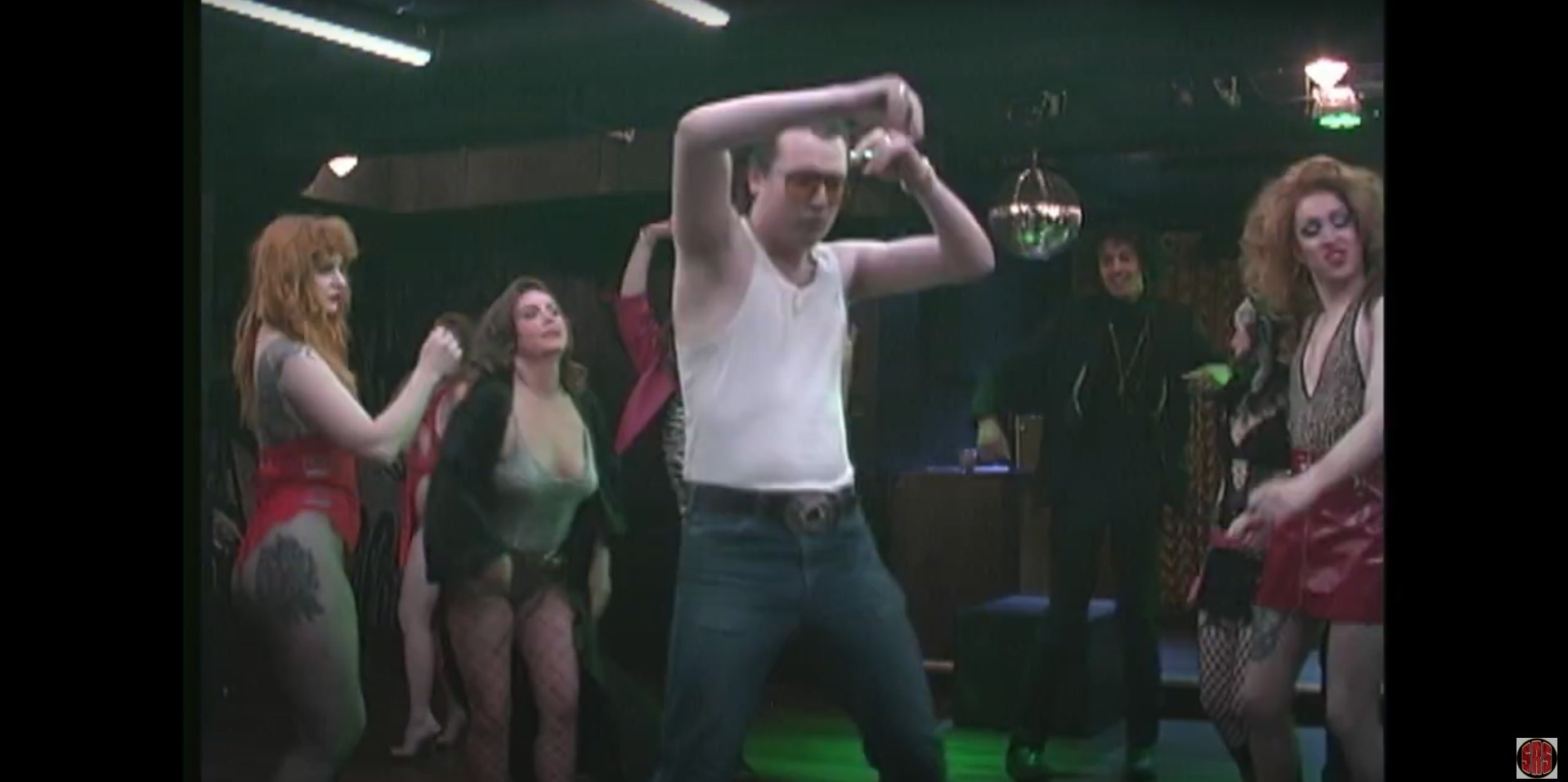
White Space Men are the EVIL Captains of the Zombie-inducing Slave Trade and Intergalactic Fast-Food Industry! “Race War: The Remake” reviewed! (Wild Eye Releasing: Raw & Extreme / DVD)

Get Caught Up in the Middle of a “Race War: The Rmeake” on DVD

Drug dealer Baking Soda is feeling the peddling pangs of dropped traffic for his crystal pure PCP.  With no one buying his smack, he and his friend G.E.D. reside back home to drink with their close fish-headed friend Kreech and sleep off the day’s failure to try again tomorrow.  Their persistence to sell puts them on the radar of a white supremacy group vending a new drug on the street, the cause for Baking Soda’s drop in sales, but their product isn’t just going to get users high, it will turn them into flesh-eating zombie slaves.  When G.E.D. is kidnapped by the group, Baking Soda and Krrech have to run through the list of suspects – Jews, Hispanics, Chinese, and others – for the source of his sale woes and to rescue his friend, guns blazing if necessary or if unnecessary, but there may be more extraterrestrial motives that haven’t yet been unearthed. 

“Race War: The Remake” is a 2012 politically incorrect, ultra-offensive spoof comedy and blaxploitation horror from writer-director Tom Martino.  A Tom Savini school graduate, te special effects artist Martino (“Dead of Knight,” “Return to Nuke ‘Em High Volume 1,” “Doll Factory”) takes helm in the director’s chair for his debut in indie feature productions with one of the wildest, crudest, and tactlessly funny comedy-horrors I’ve seen since Troma’s “The Taint.”  Set in and around Houston, Texas and the greater surrounding area with guerrilla filming in locations such as the Houston Space Center and shooting with permission at the Darke Institute’s Phobia Haunted House, “Race War:  The Remake” doesn’t have an originating film despite the title in what is considered a spoof sequel – think of examples “Dude Bro Massacre III” and it’s standalone release or the non-existent second sequel between  “Thankskilling” and “Thankskilling III.”  Martino produces his own work under his outside of Houston-based company DWN Productions that doubles in making horror theme masks, busts, and props.

Thick-skinned actors comfortable with the narrative’s uncomfortable themes begin with Howard Calvert and Jamelle Kent as Baking Soda and G.E.D.  Calbert and Kent have become regulars in the Tom Martino catalogue of cast members for his more recent films and their humble beginnings in “Race War:  The Remake” proved their longevity to stay with the director, who is white, who wrote extensive race, gender, sexuality, and fart jokes in the context of a comedy-horror with cringy stereotypes and genuine tributes.  Calvert and Kent have great comedic timing to pull off all the zany editing, sound bites, and practical effects distaste Martino has flaming axe tosses at them to achieve his vision.  The two are joined by Danny McCarty, who would become another regular and be the visual effects supervisor for the film, dressed head-to-toe in loose-fitting urban attire to match the theme of Calvert and Kent’s black A-shirt and do-rags but his hands and face are masked to become the Creature from the Black Lagoon, aka Kreech.  Martino’s “Race War:  The Remake” isn’t just about the terrestrial races but intergalactic ones as well and we soon see that later on with the intentions of neo-Nazi white drug suppliers, led by Matt Rogers’ vulgarity in the horseshoe mustached Tex.  There are various other encountered gross stereotypes in the trio’s urban quest, such as a large nosed, greedy Jewish lawyer, Mexican luchador bodyguards, and a Pai Mei-esque Shifu speaking gibberish har har sounds and listing off popular Americanized Chinese dishes in attempt to be derogatorily funny.  With a film titled as “Race Wars:  The Remake,” the cast is mostly white and black actors poking uncouth fun with a big unconcerned and insensitive stick with Corey Fuller, Kerryn Ledet, Sam Rivas, and Coady Allen listed in the cast.

“Race Wars:  The Remake” isn’t funny, it’s stupid funny!  Having grown up in the 1980-2000s, consciously I might add, Martino’s politically incorrect and his brand of juvenile humor resonates with me, reminding me how cinema has become numb to the spoof humor.  Granted, Martino’s humor is over the top cutting, gross, and full of jest bigotry, traits that would trigger many in today’s sensitive awareness, and while cringy after a tasteless joke may result, there’ll likely be some a side of the mouth chuckle to go along with it.  On the opposite side of the spectrum, Martino tributes to references of certain popular culture icons, though slightly bastardizing some for laughs.  From Peter Jackson’s “Bad Taste,” to “Creature from the Black Lagoon,” to even “Mortal Kombat,” “Race Wars: The Remake” integrates the best parts of each these staples of pop culture and that gives his film a leg up on other offensive spoofs of the same crass caliber.  Th one negative story structure item to  highlight is the act one narrative takes a while to work the gears and get going as it attempts to setup the 40oz-drinking chumminess of Baking Soda, G.E.D., and Kreech but lags to a stagnant stall for hot second while still surround with the here-and-there gags, themed with G.E.D. homosexual tendencies and Baking Soda’s drug peddling woes on and off the streets, but once the antics pickup, there’s no stopping Martino and his filmic entourage from raining down an assault of insults. 

If you’re easily offended or put off by off-color race comedy, then Wild Eye Releasing’s “Race War:  The Remake” DVD is not for you!  For me, and those like me, unaffected by the type of uncouth spoof, Tom Martino’s debut is for you!  The Raw & Extreme sublabel’s DVD is MPEG2 encoded, 720p resolution, on a DVD5.  Presented in widescreen 1.78:1 aspect ratio, there is a breadth of visual presentation not confined within’ pillar and letterboxing but is stretched vertically that affects the already par level resolution.  Guerilla filmmaking also involves no production lighting and natural lighting is more than used here in Martino’s run around the Houston area, but one thing good about Martino’s naturally lit cinematography is its neutral set, avoiding under and overexposure.  The lesser used interiors have some tint lighting and key lighting to avoid total flat, dark outcomes but give the image a haze of hue, especially inside Baking Soda’s living room scene in the first act that sees a thin layer of red and green.  The English PCM Stereo has inconsistencies in volume.  Some scenes discern quieter than others because of the guerilla filmmaking constraints as well as just using commercial recording equipment.  However, the dialogue does land well enough for the jokes to hit and overlayed sound effects greatly lift the sound design where needed, such as with the Mortal Kombat video game sequence or with the array-spray of gunshots throughout and soundboard gag effects.  There are no subtitles with this release.  Included in the special features is Tom Martino director’s commentary, a gag/blooper reel, a behind-the-scenes reel of the gory moments, and Wild Eye Releasing trailers that include “Race War:  The Remake.”    The clear, ECO-Light Amaray DVD case houses stellar covert art illustration work by Belgium graphic artist, Stemo, with the inlaid narrative intensity and characters in collage.  The reverse side includes a gory still from one of the scenes.  The disc is pressed with the same front cover image but there are no other physical materials.  The unrated DVD runs for 95 minutes and is region free.

Last Rites:  Wild Eye Releasing re-unleashes another outrageous title on their Raw & Extreme label and the Tom Martino film is every ounce of the sentiment in it’s indie underground hokum of gore, racism, homosexuality, and aliens! 

Get Caught Up in the Middle of a “Race War: The Rmeake” on DVD

Midnight Showing of the Lost EVIL Tape Will Be the Last Thing You’ll Ever See! “Transmission” reveiwed! (Jinga Films, Danse Macabre, MVDVisual / DVD)

“Transmission” Transmitting to Your Television on DVD!

A Santa Mira elderly man sits in a dark room with a glowing television illuminating his silhouette.  As he channels surfs through the night, amongst what’s being broadcast over the airwaves is a bible-thumping televangelist, a children’s puppet show, an 80’s teen romance comedy, a live local news broadcast of a hostage situation and a documentary on the investigation of the disappearance of notorious cult horror film director Frank Tadross Roth pursued by his granddaughter Rachel and her boyfriend.  Going deeper into Ross’s disappearance through archived interviews with the director and crew, on set raw behind-the-scenes footage, and the examination of Ross’s quest for an obscurely treasured videotape by an occult group, the director’s pursuit of, and his eventual unearthing, of the tape become the push for his last and recently discovered film Transmission, thought to have been lost in a building fire after his suspected involvement of the film’s lead actress murder.  Going back and forth between the channel programs builds a sinister, terrible dread that will soon be revealed to terrorize all those glued to the set. 

Late night television has never been so bodingly evil!  Channel surfing transmits an anthological approach between mockumentary and found footage in this uniquely crafted scrolling of boob tube terror entitled “Transmission.”  The 2023 horror is from writer-director Michael Hurst, the English director behind a pair of franchise sequels in “House of the Dead 2” and “Pumpkinhead 4:  Blood Feud.”  His latest venture takes twist to a whole new level different from his repertoire of linear independent horror with backlot dark legend surrounding an occult obsessed horror filmmaker.  Hurst also produced the film, his first in over a decade since 2017 with Andy Hurst’s (“Are You Scared?,” “Wild Things: Foursome”), alongside other self-employed filmmakers with the How to Kill Your Roommates and Get Away with It” producing duo Robbie Dias and Pat Kusnadi.  New Blood Productions serves as the production studio.

“Transmission” traverses in guile under TV guide pretenses of local channels, channeling the horror through the back and forth of unsettling, televised channels that have a familiarity of broadcast shows – sponsor subsidized children shows, perfunctory local news, and black and white sitcoms – but there’s more than what meets the eye.  The film uses recognizable genre names to get the message across with “Sleepaway Camp’s” Felicia Rose in her most vanilla action news reporter role, “Scary Movie’s” Dave Sheridan as an over-the-top protective father caricature in a teen romance comedy, and “The Road Warrior’s” Vernon Wells at the center of the amassing occult suspense as the missing notorious horror director Frank Tadross Roth.  Over the years, Wells’ performance has tapered to a subtle crawl of expression as if the veteran actor is now just running through the motions of the everyday hired gig that’ll headline his name, unlike his former wide-eyed and eccentrically villainous roles in “Commando” and “Innerspace,” but “Transmission” suits his stern act portrayed in video flashback as an occult maniac and peculiar director gripped by the search of an arcane, dark sect’s perniciously videotape.   Spearheading the effort to track down the filmmaker is his granddaughter Rachel, played by Nicole Cinaglia (“Death House”) with an inexplicable character shifting of gears from curiosity and intrigue from the documentary to the frantic and fearful ramblings of a paranoid hostage taker in the new story stemmed by her findings surrounding her grandfather’s disappearance.  There’s potential gap there in the lack of development, or rather the lack of acknowledgement overall, with Rachel’s parents as it’s just a grandfather and granddaughter affair without the recognition of those in between.  There’s also a gap in Rachel’s attained information about the sect, the videotape, and her grandfather’s endgame as she seemingly has more knowledge about the insurmountable otherworld evil on the horizon but how she got there is a few clicks short to fully bridge.  Sadi Katz, Del Howison, Marcella Di Pasquale, Ben Kaplan, Hunter Johnson, Raymond Vinsik Williams, Jennifer Nangle, McKensie Lane, Jessica Cameron, Charles Chudabala, Michael Glenny, Christopher Bryan Gomez, Ruby Reynolds, Ben Stobber, Mark Schaefer, and Robin Hill fill out the channel surfin’ cast of characters.

“Transmission” has a neat story structure built upon components with the premise being a movie inside a documentary while amongst a flipping through the broadcast waves that coincide with another movie as well as television shows, podium preaching, puppet skits, etc., to which is then wrapped up inside and latched onto another movie, a metanarrative with a preamble setup.  The Roth directed Transmission, presented for the first time on Malvolia’s spooky late night show (an Elvira rip) is a space horror off-brand for the filmmaker that mirrors vaguely the reality outside the boob tube but told through the Rachel Roth investigative documentary that builds the timeline pieces while flipping back and forth between the late night movie and the documentary as well as the scroll through every other broadcastings of paralleling programming in what feels like an antiquated prelude to the cable guide button on a tube television with depicted content that resembles much like what programmed over-the-air decades ago down to the very staticky outlines of porn stars expertly doing their fleshy vocational craft in snowy pixelations.  The edited series of a varietal shows creates an erratic unsettlement with an atmosphere churning over the idiosyncrasy content of what’s eventually to spoil or come to chaos by Transmission’s, or rather ”Transmission’s,” twist ending and what a fairly good twist ending it is, even with the slightly ham-fisted acting, by pulling off misdirection as you think you know where the finale is heading but the forces of evil seep through with a backup plan. 

Jinga Films, Danse Macabre, and MVDVisual present “Transmission” onto a MPEG-2 encoded, upscaled 720p (but upconverted on my player but since this title is shot digitally the image appears fairly good to begin with), DVD5 and presented in a widescreen 1.78:1 aspect ratio.  As stated, imagine quality has a fair amount of detail and intended panache interference amongst a broad range of different aesthetic styles and gels through the varied televised broadcasts from static and grain filters to colorless sepia, to filming scenes on television screens, and to other mock-electrical afflictions inside a digitally shot story truck to intermittently snap normality and cause a rising fear of curiosity amongst the TV goers.  Throughout the picture, there were no noticeable true compression issues with the picture.  Some scenes felt slightly stretched by that I chalked that up to filmmaker style when rendering various programming for the narrative.  Though not listed which format is used, the player registers an English Dolby Digital 2.0 Stereo.  With imitating the perspective of someone watching television, audio tracks are distinguished with a flat concave that elevates the pitch but disperse through a single channel.  Emitting through a dual channel stereo, the audio can discern potently through, providing clarity.  When looking at the perspective, we’re either the old man watching the television or when inside the show itself watching from the fourth wall in and subsequently the strength and tone change often quite a bit, creating a rich depth when done correctly.  English subtitles are optionally available through the moving menu.  The DVD is essentially a feature release but there are other Jinga Film trailers that include, “Iconic,” “Tonight She Comes,” “The Protos Experiment,” and this film, “Transmission.”  The DVD comes in a standard single, push-lock, black DVD case with single-side cove art that I personally found gratifying when considering the film as it speaks to the abnormal and drawing glow of a brightly illuminated television in place of a head on top of the shoulders of an opened-armed cultist with a pleasingly red and black contrast.  The DVD is pressed with the same yet cropped image.  “Transmission” has a R rating (no singled-out rationales but there is some language and nudity), has a runtime of 74 minutes, and is region free for all players.

Last Rites: There are no mixed signals from “Transmission’s” gradual rise to impending cosmic doom with an exceptional Lovecraftian twist to nightcap this Michael Hurst channel-hopping and ominous occult production.

“Transmission” Transmitting to Your Television on DVD!

20-Years or More Incarcerated is No Match for Tenacious EVIL! “The Rapacious Jailbreaker” reviewed! (Radiance / Limited Edition Blu-ray)

Break From Your Cage With This New LE Blu-ray of “The Rapacious Jailbreaker”

Masayuki Ueda is nabbed after murdering a drug dealer’s girlfriend during a botched meeting.  Ueda faces a 20-year prison sentence for his crime but after being processed, nothing can change his mind nor his determination to escape.  Willing to sacrifice blood for freedom, Ueda escapes and visits his lover in Kobe for a quick conjugal stop and money only to be caught again when he returns, tacking on additional years to his sentence.  His next escape plan joins forces with two other inmates and, again, his route to freedom is cut short when a brothel visit, while laying low in his sister’s village, turns into a violent brawl with another patron and the authorities round him up in the aftermath, adding more years to his sentence.  While incarcerated, Ueda must kill rival gang bosses who threaten him.  By now, Ueda’s sentence is up to 40-years, and not to be defeated by the prospect of a long term sentence, Ueda has one more desperate attempt for freedom, putting his life on the line.

“The Rapacious Jailbreaker,” aka “Escaped Murderer from Hiroshima Prison” or “脱獄広島殺人囚,”is the crime black comedy from one of the Toei Company’s aggressively eclectic and paced directors Sadao Nakajima (“The Kyoto Connection,” “Female Ninja Magic”).  The prolific yakuza and exploitation filmmaker takes the Tatsuo Nogami (“Father of the Kamikaze”) script, centered on an incessant career criminal hellbent on not spending his days in prison, and runs with it, fashioning the smidgen stitchwork of a nonfictional individual into the post-War World II, American occupation of Japan and adds inner teetering and play-by-play thought narration and the always welcoming gallows humor amongst the exploits of a stubborn felon.  Gorô Kusakabe (“Hell,” “The Red Silk Gambler”) produces the production, which is part of an unofficial Sadao Nakajima trilogy along with “Shimane Prison Riot” and “The Man Who Shot the Don.

Hiroki Matsukata, a prolific yakuza actor from the 1960s to the 1980s with such credits as “Survivor of the Massacre,” “Dangerous Trade in Kobe,” and “Battles Without Honor and Chivalry,” breaks intermittently through the gang wars and boss-laden wall of tattooed violence and varying levels of respect that’s inked the individualized stories’ skin with “The Rapacious Jailbreaker” as the titular lead character under the character’s God-given name of Masayuki Ueda, a tenacious criminal personality type with yakuza-like transgressions of drug peddling and black market trade.  However, Ueda is not a criminal without honor, even if he’s a little rough around the edges, as his loyalties lie with those who are loyal to him: a fellow partner in crime he didn’t rat out, his suffering wife (Yōko Koizumi ), his sister Kazuko (Naoko Ohtani, “Apartment 1303”), and also those who help him escape, such as  Tatsuo Umemiya’s (“Spoils of the Night”) brazen law challenger Yuji.  Yuji and Ueda match well in traits, both eager to test and take risks going against a rather lax authority grain.  Aside from the opening montage of prison routines depicting minor torture from the guards, you don’t get the sense the prison guards have much domination or enough aggressiveness to match the kind of zeal the inmates have to either run a sneaky scheme or take them on toe-to-toe to get what they want, as we see with Yuji’s disgracing efforts against the warden in order to obtain rights that are quickly dismantled by the warden’s reneging, but at the cost of his humiliation.  Matsukata never wavers or deviates from Ueda’s singular drive, layering intensity overtop his thin film of civility with every additional time added to his sentence that eventually goes beyond four decades, but you can see it not only in Ueda’s resolute eyes but in Matsukata’s as well that nothing will stop him from escaping.  The film fills out with Hiroshi Nawa, Gorô Ibuki, Tatsuo Endô, Shigeru Kôyama, Hideo Murota, Harumi Sone, and Akira Shioji in various rolls of yakuza, fellow inmates, and those crossing Ueda’s path in the outside world.

Staying on the theme of Ueda’s loyalty, which is incredibly beyond reproach given his heinous crimes, there’s something to be said for his commitment to be free as a bird but also to the people who do right by him, no matter the circumstances. His wife pledges endless loyalty despite his flaws and felonies, his estranged sister welcomes him with food and shelter, and his opening criminal accomplice provides him a weapon before thanking him for not ratting when Ueda was apprehended by police. There’s an underlining code of respect and duty intertwining the utter most wicked and those blood relations in the field of collateral damage. Ueda’s responsibility for his actions never wanes, never deflects, and never becomes a weight of guilt as the only object, or maybe even obsession perhaps, on his mind is to escape prison and make quick, easy money. His loyalty does come at a fault when his trust reaches into the weeds, especially amongst those he’s already collided head-vs-head against, such as the former head of the black market beef butchers who turns on Ueda for false promises, but it’s in that one and only instance that everything becomes clear, much more to the audience than perhaps Ueda himself, is that in order to remain just out of arms’ length of the law, he must walk his path alone as depicted at the finale moments. The post-World War II American occupation time period has an interest facade to “The Rapacious Jailbreaker’s” context. In fact, the American presence is rarely present at all with Ueda feeling the squeeze mostly in-house within the Japanese penal system with the Americans only rearing their heads in obstacle of his escape attempts in a negative light: Ueda’s standoff against Japanese officers, who won’t shoot him surrounded by a crowd in fear and respect of bystanders, comes to a quick surrender when the Americans, who are perceived to shoot on sight no matter the circumstances arrive on the scene or when his fellow escapee tries attempts to befriend American forces in a military truck only to be runover and killed without remorse or even a slow down. These seemingly insignificant instances spoke volumes against the American occupation as a non-character in Ueda’s tale of total resistance that, one that either represents the American cold passive care of the Japanese under their rule or switch the ironfisted from Japan to America to favor a more lenient system of control.

Radiance Films’ transatlantic “The Rapacious Jailbreaker” lands in the U.S. for the first time on any format, and first on this particular format globally, with a new limited-edition, AVC encoded, 1080p high definition, 50-gigabyte Blu-ray. The dual layer allows for steady color timing and pristine picture quality image that’s leans into its attractively grained 35mm stock and presented in its original widescreen aspect ratio 2.35:1. The original print, transferred into HD from the Toei Company, is nearly faultless with only minor instances of vertical scratching around the theater scene in an otherwise near clean and clear element print. Nakajima’s lower contrast allows for softer coloring and the touch points on Radiance’s treatment showcase a more relaxed but harsh grayish blue with surrounding aspects from the prison’s hoary cement floors and walls to the prison’s steely cell bars and the prisoner’s blue attire. The uncompressed Japanese language PCM mono track offers clearcut dialogue and ambient markers with a clarity on both fronts that render an intelligible layered track without any compromising issue. Kenjirô Hirose (“The Last Dinosaur”) brings a 70’s cop-and-crime swanky score with undertones of traditional Japanese Hyōshigi, the striking of sticks to create that brief and stark crack sound. New translated English subtitles are available, pacing well and are error-free. Encoded special features include a visual essay by film critic Tom Mes and an audio commentary by yakuza film expert and Sadao Nakajima historian, Nathan Stuart. Radiance’s limited-edition set comes in a clear Amaray case with a reversible cover with original and new artwork, the latter commissioned by layout designer Filippo Di Battista (primary). Also included is an obi stirp with the release’s contents, technical specs, and film plot. Limited to 3000 copies, the release comes with a 23-page black and white booklet with stills, an essay Escape as Vocation by Earl Jackson, and a 1974 review by Masaharu. The 97 minute feature comes region A-B locked and unrated from the UK label.

Last Rites: “The Rapacious Jailbreaker” is hardboiled tough as nails while being a series of comedic follies that make this tenaciously titled story of one man’s pursuit of freedom a breakout hit.

Break From Your Cage With This New LE Blu-ray of “The Rapacious Jailbreaker”

Is Your Disturbing Library This EVIL? “Reality Killer” review! (Treasured Films / Blu-ray)

“Reality Killers” Entering the U.S. Torture Porn Market! Buy it Here!

Serial killer known as “The Sculptor” narrates his obsession and love with documenting the stalking, capturing, torturing, raping, and killing of his victims.  As he watches and video tapes his next target, Mary, from afar, a woman he’s chatted with online extensively about recording home snuff movies, The Sculptor opens up his personal library of snuff movies, labeled and numbered dark web bought tape cassettes exhibiting the videoed brutal deaths of strangers by strangers for their pure sordid joy of taking another life.  An adventurous couple lure a promiscuous young girl on the promise of a threesome, a group of three masked teens take pleasure in the torture of a young woman, a couple enticement a child to their backyard pool, father and son roam the streets for call girl action and a little home invasion, and an underground, all-female rock band’s music video takes male fans to new extremes.

A title and a film unabashed and fully accepting the phrase torture porn, as if it’s a pithy elucidative to be proud of, “Reality Killers” is a shot-on-video, found footage anthology and snuff horror from 2005 helmed by “Witch Story” director and “Body Count” writer Alessandro Capone.  The Italian production contains shorts and a wraparound story that connects them together in an ugly tale of sadism, written by four aspiring, young filmmakers in Pablo Dammicco (“A Deadly Compromise”), Francesco Maria Dominedò (“Dedalus”), Volfango de Biasi (“Help!  My In-Laws Are Vampires”), and a writer simply known as Zedd with Alessandro Capone also contributing with his own screenplay while project managing filmic newcomers as they shoot mostly in Los Angeles using American actors.  Alternatively known under the title of “Project K,” the 2005 film of nihilistic sadism is produced by Eagles Pictures’ Ciro Dammicco and Pablo Dammicco and executively produced by Luca Dammicco and Fabrizio Manzollino.

“Reality Killers” is one of those rare breed films that shares a connection with pictures 70+ years it’s senior with having no after credits.  With no before or after cast credits, acknowledging the cast and their ignoble roles is a challenge to say the least.  If fact, it’s impossible.  The wraparound segment with The Sculptor has some clarifying character elucidation online connected to one of the more well-known Italian extreme violence and horror filmmakers in modern times with Domiziano Cristopharo, director of the surrealistic yet broad-stroked with intense visceral “Confessions of a Necrophile Girl” and “House of Flesh Mannequins,” in a role credited as The Monk.  However, there seems to be some melding overlap between The Monk and the large, oiled-up, and masked concentrated sadist on screen in the wraparound story, played by Valter D’Errico, in a disturbing show of vain and perverse expression.  Alongside D’Errico, in a handful of scenes of being stalked around a metropolitan city and in a naked position of vulnerability on D’Errico’s slab of slaughter, is Cristina Puccinelli (“Phantasmagoria”) playing as the aspiring snuffer enthusiast and killer as well as the online conversationalist Mary who turns prey to her own betrayal going against and essentially humiliating a masterclass maniac like the oily and masked maniac.  After that and within the shorts, none of the other actors are repeated or credited for their work that waver between being exaggeratedly overacted and staged to the point of disingenuous means and the thought of the inflicted violence that spur a subtle creepiness.

The trouble with “Reality Killers” is the inherent topsy-turvy post-production that revamped the anthological storyline with a linear outer story with an anthological storyline connected with a threadbare connected wraparound.  Initially story structured with a sheriff unearthing a library of snuff films and going through selected VHS examples of the killer’s cache with a journalist to explicate the rare breed of butcher.  The videos were also lengthier, more narratively in depth of character and plotline, and have digestible connective tissue with the main shell story that’s redesigned for a body round and glistening, conventionally narcissistic, masked chatterbox, “The Sculptor,” who’s just a physical and commanding orb of a presence in a dark and grimy setting, spouting a deluge of devilish details about his devotion to snuff filmmaking and his own contribution to the perversion.  The told tales vary in degree of both explicit violence as well as story structure as some become more glimpses than a perusal of a three act analog anecdotes to which, in all fairness, found footage, especially pulled from VHS, are only short-lived windows into the lives of others, literally short-lived.  The vignettes are mostly hyper concentrated on the gore, leaving little room for a yard to build, lengthen, and become deeper to invest audiences when the decisive moment comes to take a life with sociopathic heartlessness.  However, “Reality Killers” pales in comparison to the likes of others, such as Fred Vogel’s “August Underground” features that really hammer down on violence and gore with sickening special effects and concentrated shock.  Capone’s entry into the niche subgenre feels reversed at times, never really going for gold in the gutting of precious human life, but the film still evokes a visceral response to the extreme content. 

“Reality Killers” arrives into the U.S. market hailing from the UK label Treasured Films, squeezing itself into the ever tightening commerce of boutique distributors.  Treasured Films’ debut special edition Blu-ray is MPEG-2 AVC encoded, 1080p high-definition resolution, BD50 is presented in a 1.33:1 aspect ratio and either scanned through a VHS record or implements a VHS or commercial handheld camera filer to achieve that passé effect that’s slowly making an aesthetic comeback.  There’s not a ton of other stylistic options used in the vignettes to instill a realism effect and result while the wraparound ups the contrast and grades darkly into its grim substance, leaving attenuated tones of yellows, greens, and reds to be coloring that seep through the oily voids.  The featured presentation carries more of the filtered aspects but in the special features’ Original Production Scenes, the alternate telling of “Reality Killers” embarks on a cleaner, conventional approach in the different outer story with the vignettes either slightly less boxed in by a matte or are outright more defined.  The audio track is an English DTS-HD stereo.  Though an Italian production, the vignette actors are primarily American and the wraparound story is voiced over.  Dialogue coincides with an onboard camera mic that picks up every little detail but also captures varying degrees of volume.  Discerning clarity is, must I say, pretty excellent for the differing sub-productions without an overbearing lopsidedness that usually stems with some who don’t have the technical knowhow to engineer audio precision; each episode achieves what’s strived for without interference, or even with the physical release, compression issues.  English subtitles are available.  Special features include a new interview with director-producer Alessandro Capone From Witch Lore to Snuff Gore in Italian only with English subtitles, a new interview with coproducer Gabriele Pacitto A Killing Reality in Italian only with English subtitles, a new English language essay by Giacomo Calzoni Cutting Deep :  Mapping the Origin of Torture Porn which takes a look at films like “Saw” and “Hostel” that generated the coining of descriptor torture porn and how it influenced horror pop culture, a teaser trailer, storyboards, and an image gallery.  The Original Production Scenes I’ve mentioned previously tells a completely different story and, in my opinion, is more interesting with longer story sequences, more nudity and gore, and the first vignette is scored with music from Nine Inch Nails, specifically “Dead Souls” from The Crow soundtrack, which adds another element to the coarse-riddled subject matter.  Treasured Films standard special edition set comes in a rigid slip box with a hazed face of the masked Sculptor.  The clear Amaray case houses new Ilan Sheady illustrative, compilation cover art in all its explicit detail with the same art pressed onto the disc.  Inserted is a 31-page color booklet with film stills, Blu-ray acknowledgments, and a David Flint essay “The Forbidden Films of the 21st Century” that discusses the films banned in Britian, which includes “Reality Killers’ rejected by the BBFC.  The all-region release has a runtime of 75-minuts and is, obviously, not rated.

Last Rites: Torture porn snuff films are, for a lack of a better world, repetitive in their controversial narrative and “Reality Killers” is no exception but it’s the style choices that and effects that entertain us or makes the sweat run down our brow. Alessandro Capone’s entry to torture porn has a visceral bite but isn’t the repulsive best-of-the-worst. Yet, Treasured Films’ entry into U.S. market is remarkably unforgettable.

“Reality Killers” Entering the U.S. Torture Porn Market! Buy it Here!

The Empire of EVIL Reduced to Prostitution, Corruption, and a Wasteland. “Gate of Flesh” reviewed! (88 Films / Blu-ray)

88 Films’ “Gate of Flesh” Now Available in the U.S.!

The American occupation of Japan post-World War II was the result of not only the Iwo Jima atomic bomb but also the relentless destruction of carpet-bombing Tokyo.  Left in near ruins and swarming with the presence of American soldiers, the Japanese people have disseminated into gangs and territories for financial gains and power.  For Kanto Komasa, she and her gang of highly motivated women prostitute themselves for sex-starved American soldiers to accure money for Paradise, the future name of their bomb-ruined, leftover-skeletal building structure revamped into an elegant dance hall where they run the show.  When a rival male gang threatens their business, another all-woman gang challenges them, an inducted outsider betrays them, and a bloodied stranger is found inside their bombed out homebase, all with the Americans military police continuously rounding up prostitutes nightly, Komasa and her gang must walk the paved road through Hell to scratch and claw toward Paradise, even if that means going against their set principles.

Since the end of the World War II Pacific campaign, Japanese novelist Taijirô Tamura’s “Gate of Flesh” has been filmically adapted a handful of times just after the war in 1947.  In 1948, directors Masahir Makino and Ozaki Masafusa first adapted the novel, followed by the Seijun Suzuki version in 1964 and Shōgorō Nishimura’s adaptation in 1977.  In this review, Hideo Gosha’s “Gate of Flesh,” also known as “Carmen 1945,” moves from samurai period actioners, such as “Sword of the Beast,” “Three Outlaw Samurai,” and “Samurai Wolf,” and into a yakuza era of storytelling that came on strong in the 1980s.  “Gate of Flesh” is no different with plenty of yakuza tropes without actually affirming the term in the dialogue.  Gosha’s tale provides more glamour, style, and substance, especially around themes of inner turmoil under outsider control and the divine praise for an enemy-built weapon of destruction, from a screenplay by prolific writer Kazuo Kasahara of “Hiroshima Death Machine” and “Yakuza Graveyard.”  The Toei Company production is produced by Shigeru Okada (“Inferno of Torture”).

“Gate of Flesh” has the interweaving stories of an ensemble with the various faceted chess piece pawns aimed to promote themselves, by cutthroat and sordid means, to a higher degree of social status and wealth improvement like queens and kings within a crummy economical and degraded societal Tokyo commune of prostitution, gambling, and survival.  There are also a few other pieces stealthier knighted behind enemy lines with more noble goals in mind.  While different storylines unfold and merge, Kanto Komasa becomes the generally sensed centerpiece, played by Rino Katase of previously directed Gosha films, “Yakuza Ladies” and “Tokyo Bordello.”  Her preparedness to take on the “Gate of Flesh” role as the female-led gang leader promising Paradise has been success before of her previous performances in Gosha’s films that contain similar traits but Katase delivers a powerhouse, immensely conflicted, act as Komasa’s hopes and dreams to dig herself out of poverty and into high-class are thwarted by deceptive ranks, a haunting past, and, of course, the more present occupation troubles of inner city gang-on-gang wardom, battling advances, negotiates, and the potential for mediation between fellow gang leaders Yoshio Hakamada (Jinpachi Nezu, “Ran”), who wants her building that’ll be lucrative in the future, and Rakucho no Osumi (Yūko Natori, “Stranger”).  Of course, there’s more to bereft Komasa’s mind with the sudden wounded appearance and peculiarity familiarity of stranger Shintaro Ibuki (Tsunehiko Watase, “The Rapacious Jailbreaker”) who has protective parallelism with the 2-ton bomb that also acts as a rival gang repellant and an explosive safety net for Komasa.  Secondary characters provide a layered depth to Hideo Gosha’s charismatic and gender-battling narrative with Miyuki Kanō, Yūko Natori, Senri Yamazaki, Shinsuke Ashida, Naomi Hase, Chie Matsuoka, and Yoshimi Ashikawa.

Surreal like a dystopian science-fiction and wasteland thriller, “Gate of Flesh” has that otherworldly, alternate reality appeal accentuated by Hideo Gosha’s colorfully grim realism that doesn’t convey truth or fact.  In fact, “Gate of Flesh” is very much rooted in reality, truth, and fact in regard to U.S. occupation of Japan after the country’s surrender between 1945 and 1952.  This drops a non-fictionalized period as “Gate of Flesh’s” backlot, corroded by the illicit prostitution that spread to satisfy and bank off allied forces.  Gosha’s film is a game of wits amongst crooks and connivers while the developing sympathy envelopes around the seemingly tough of nails Kanto Kamase with a violin-pining and sympathetic backstory colliding with the injured Colt Shin aka Shintaro Ibuki.  Ibuki himself has history, or perhaps even beef history, with the iron rule of Hakamada, but through thick and thin, Ibuki’s clearly maneuvering the chess board around protecting Kamase for clued in reasons only to be precisely unveiled near the end.  The American presence doesn’t even feel weighty, reduced to hooker johns, voiceless military police, and a one uncouthly boisterous and unpleasant Sergeant to become the poster boy from Japan’s perspective of the occupational paradigm. Other than that, the U.S. forces are background noise, a sidestepped component of a much bigger, domestic ordeal amongst the Japanese people but are still the cause of so much heartache, gangsterism, and civil war.  Sex is also a huge theme as strictly a monetary activity rather than a joyful expression of romance and liberating relief from oppression, which there is none from U.S. forces.  Kazuo Kasahara’s script skirts around the inkling of affection between two people as much of everything else is for ostentatious and desperation means in a time when there was not much else to hold onto in Tokyo after suffering defeat, aside from ruined property, cash for hope, and tattoos to honor the past. 

88 Films proudly presents “Gate of Flesh” from their UK catalogue to their quickly growing US list of titles.  The AVC encoded, 1080p high-definition, BD50 is the first home video release for the rest of the world outside of Japan with a limited-edition release, presented in the original aspect ratio of 1.85:1 widescreen.  Hideo Gosha’s style brilliance flourishes with this impeccably detailed and graded release that pedestals a rich and sustaining color palette.  The stabilization of color extends to the details as textures pop from the screen, especially in Kamase’s gang where each one has a distinct color flair and different pattern design to have them stand out amongst each other in a story that’s greatly character-individualized aware and often tangents into side characters to be worked into the parent plot.  No compression issues to note, day and night transitions have equal clarity and depth, and the Gosha and Yuko Morita’s aesthetic brings the stylistic aspects to the forefront without taking away from the schemes of skin tones and milieu details in the set design of a tumbledown Tokyo.  The Japanese LPCM 2.0 Mono mix diffuses perfectly into the single channel fold and aligns well with the picture, casting synchronous UK English optional subtitles that only had a single misspelling that I had caught.  “Gate of Flesh” has plenty of range and depth captured precisely on this 88 Films release that doesn’t show signs of audio layer wear or any compression issues.  The summiting explosion capitalizes the full potential of the mix with a story grand exit designed to be immersive as possible in its limited capacity through an assistant of visual means.  The special features include an audio commentary by film critics and analysts Amber T and Jasper Sharp, critic Earl Jackson provides an introduction on the many adaptations of Taijiro Tamura’s “Gate of Flesh” with timelines, history, and his own preference accompanied by stills, posters, and video clips, an exclusive interview with tattoo artist Seiji Mouri Flesh & Blood Tattoos who doesn’t view the Gosha’s work as a yakuza-spiced, and rounds out the content with a still gallery and a pair of trailers.  The limited-edition and numbered set, that includes an Obi strip over top a commissioned illustrative composition covert art by Ilan Sheady and housed in a clear Scanova case, contains a 23-page booklet with color photos and posters and essay notes by Robin Gatto and Irene González-López.  The cover art has a reversible side with the original Japanese poster.  Only playable in region A and B, the not rated 88 Films disc comes not rated and with a 119 runtime.

Last Rites: “Gate of Flesh” bears the weight of Taijiro Tamura’s prostitution-laden tale of survival, revenge, and hope with Hideo Gosha’s cinematic eye that captures the beauty and indomitability in the badlands of the occupied proud.

88 Films’ “Gate of Flesh” Now Available in the U.S.!