Spies, Lies, Thighs, and EVIL Guys! “The Dallas Connection” reviewed! (Mill Creek Entertainment / Blu-ray)


Chris Cannon and Mark Austin are back to save the world from a devious organization once again as the two bureau agents are assigned to protect the last world-renowned scientist that developed an International World Arms Removal (I/War) satellite project that could detect terrorists’ weaponry no matter how concealed, but when the other three scientists from around the globe are brutally assassinated, the odds are stacked up against them and the bad guys are always one step ahead of them. Given four computer chips to guard at all times, I/War assigns their best agents to the task of securing hope for the project, called The Dallas Connection, for three days until a specifically timed launch to coordinator with a passing asteroid field that’ll power the satellite for years decades to come, but the well-armed and well-organized crime uses all assets and their power of seduction to gain control over the satellite at all cost.

The L.E.T.H.A.L. ladies series continues with the second buddy-cop picture, “The Dallas Connection,” helmed by Christian Drew Sidaris, son of the erotically charged-action producer and filmmaker, Andy Sidaris that follows up on the first Drew Sidaris prospecting fracas, Enemy Gold. “The Dallas Connection” is the tenth installment of the series, known also as the Triple B series (that’s Boobs, Bombs, and Bullets) that has little-to-nothing linking the entire series cache together aside from being exclusively explosive wrapped with a sensual rouleau of Playmate and Penthouse centerfolds, tightly coiled around the tight and firm half-naked bodies of it’s leading stars. The Sidaris team, under the Malibu Bay Films and Skyhawks Films banners, one again economically ignite a successful B movie that promises 90’s attired, flamboyant action on set at a few familiarly recycled locations in Shreveport, Louisiana and Los Angeles, California, redressed for a not-so different genre or distant premise.

As aforementioned, centerfolds are a staple in any Sidaris, father or son, girls and guns feature and “The Dallas Connection” is no exception, starting off with their main squeeze, good friend, and cult movie icon, Julie Strain, as one of the chief co-antagonist under the nom de guerre, “Black Widow.” Strain is tall, sexy, and a wild villain capable of restraining the violent kick of an AK-47 in thigh high boots and a low-cut open jacket that embodies gun nuts most delectable dreams. The once Penthouse Pet of the Year stays quite reserved compared to her tantamount villainous role in “Enemy Gold” by going topless only in a couple of instances in a death grip roll that involves a lap dance before her prey’s demise, a specified attribute to the beautiful and deadly small spider she spins her call sign from. Black Widow is joined the just as deadly Cobra, fellow Penthouse Pet of the Month February 1993, Julie K. Smith, and Scorpion, the equally as Julie Strain tall, Playboy Playmate of the Month December 1991, Wendy Hamilton. Smith and Hamilton offer up polar features that doesn’t make “The Dallas Connection” a one-type of woman show, but both are voluptuous in their own rite, adding sizzling hot tub sex scenes and long-legged strip shows to accentuate “The Dallas Connection” amongst the B movie fray. “Phantasm II’s” Samantha Phillips becomes the whip cream on top, rounding out Sidaris’ centerfold assembly, as another the third Penthouse Pet of the Month, June 1993. There’s also Bruce Penhall and Mark Barriere, but who cares about these shirtless studs who drag race old Plymouths and jet ski when you four gorgeous women to ogle over? Penhall and Barriere mark their return as Chris Cannon and Mark Austin from Enemy Gold in a buddy-cop adventure loaded with a Dirty Harry Magnum .357 and a M1 Grenade launcher assault rifle. Kaboom! Rounding out the cast is Gerald Okamura (“Big Trouble in Little China”), Roland Marcus, Cassidy Phillips, Ron Browning, Tom Abbott, and Rodrigo Obregon as a satellite scientist.

After finishing “The Dallas Connection,” I wanted to say that I’ve seen this movie before and not because of some misplaced form of déjà vu, but, rather, that I, in fact, HAVE seen this movie before in the precursor film of the L.E.T.H.A.L. ladies series, “Enemy Gold.” The story’s been tweaked slightly to a story with the same framework. Hell, like also mentioned, when you throw in some of the same locations as in “Enemy Gold,” Sidaris’s home with the hot tub and the cabin the woods, and redress the same actors, Julie Strain, Bruce Penhall, Mark Barrier, Rodrigo Obregon, Tom Abbott, and Ron Browning all in the essentially the same roles, “The Dallas Connection” just feels like an extension or a mirror image of that former film, making the story a weary one with nothing really new to spectacle except for three pairs of new, large-and-in charge, breasts in Smith, Hamilton, and Phillips. One difference noticed is that the bureau agents this time around are a lot dafter with skulls thick as a brick and unable to use common logic in the most practical situations. There have been many a time when producer Andy Sidaris commented his films to James Bond, but at least Bond had the smarts to always be on guard; Chris Cannon and Mark Austin do indeed think with their other head that do, in benefit, leave the door open for some saucy hot tub sex that’s perhaps the best simulation from Sidaris reel I’ve seen to date.

Available for the first time on Blu-ray, “The Dallas Connection” will get your rocket launchers off with ton of gunplay and is loaded with beautiful women. The region A, 1080p high definition presentation from a 4K scan restoration has an aspect ratio of 1.78:1 widescreen. The image’s simply gorgeous from the 35mm negative baring a few minor faint scratches that linger only for seconds at a time. There’s quite a bit of noise during the night scenes that almost make the scene look daylit, but skin tones, especially gleaming with water, are remarkably velvety and the textures on clothes and skin looks great for a low budget action. The English language DTS-HD Master Audio dual channel mix medleys appropriately, dialogue is clear and upfront and ambience has proper depth and range. Explosions are powerful coming through the dual channels with a hefty LFE and gunfire can rip just as good as Dutch blasting away at a trophy hunting alien in Predator. Even the sexy lounge soundtrack from Ron Di Iulio is on point despite being a rehash of “Enemy Gold” once again. Hardly any blemishes or distortions coming from the audio track. English SDH subtitles are optional. The bonus features mirror that of “Enemy Gold” as well with Andy Sidaris and Julie Strain doing this awkwardly coy and sugar daddy bit showing off “The Dallas Connection” merchandise and international posters that lead into Andy’s film school where him and his wife, Arlene, go onto commentary on how to shoot scenes and edit them together, using an action and a sexy scene from “Return to Savage Beach” as reference. In the same behind the scenes, there’s an equally bizarre Joe Bob Briggs interview where the legendary MonsterVision and The Last Drive-in Host seems uncomfortable with Andy and star Julie K. Smith about how he persuades to get these beautiful centerfolds to be in his films. Other bonus material includes a commentary on the film itself and theatrical trailer. “The Dallas Connection” is a Texas-size IED with a busty ornate façade, but acts more like a duplication of something we’ve already experienced, making the sophomore feature from Christian Drew Sidaris just a more of the same.

Only $12.99 at Amazon.com! Plus, you purchase a VHS tape! WHAAA!?!

Hard Bodies, Hot Vixens, Civil War Gold, and an Evil Bolivian Druglord in “Enemy Gold” reviewed! (Mill Creek Entertainment / Blu-ray)


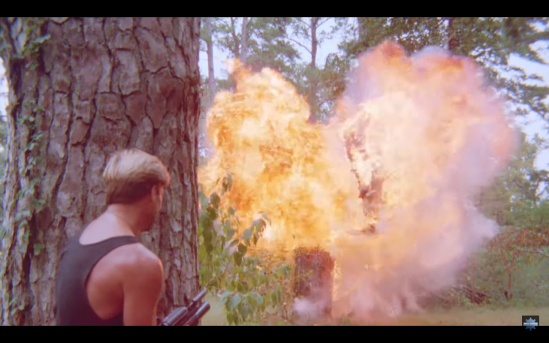
Agents Chris Cannon, Mark Austin, and Becky Midnite go in guns blazing on a drug smuggling operation operated by the goons of a Bolivian drug lord and club owner named Santiago. Furious with their meddling that cost him a hefty dividend, Santiago employs the crooked agency director, Dickson, to do something about his rogue operatives, but with his bureaucratic hands tied, Dickson can only get the agents suspended until further investigation clears them of any wrongdoing. During their leave, the three go on a gold finding expedition based off the tale of a legendary suicide mission conducted by a Confederate Lieutenant during the American Civil War that involved infiltrating behind enemies lines and stealing Union gold to fund the rebellion cause. The gold is believed to be hidden deep within the woods, a secluded area Santiago just happens to learn about while eavesdropping on the agents movements. Deciding take matters into his own hands, Santiago hires an exotic hitwoman, Jewel Panther, to hunt them down for elimination.

Perhaps the Tinto Brass of action films, Andy Sidaris wrote, directed, and produced an extensive filmography of weaponry-packed James Bond-esque films crammed with robust eroticism from the late 1980’s to the heart of the 1990s under his, and his wife’s, own independent banner and though “Enemy Gold” has all the markings of a Sidaris’ productions, including many, many female assets and rock hard abs, his son, Christian Drew Sidaris is handed the sovereignties of the 1993 bodacious hot-body, action-comedy in which he co-writes with Wess Rahn. The cult film showcases the best parts of the most beautiful people who have less-than-stellar thespian chops, hiring outside the conventional casting agencies to lure the attractive attributes of what Playboy and Penthouse have to offer, and sticking them into the tightest and skimpiest clothes that would put Miami’s South beach flamboyantly wild atmosphere to shame. Let me not bring in East Coast flavor to a production that stretches from California to Louisiana under Sidaris’ economically savvy Skyhawks Films company, in association with MBP and Starlight Films.

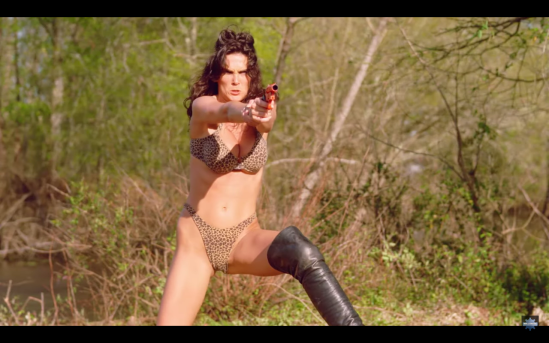
I wasn’t joking when I said Sidaris scouted out Playboy and Penthouse centerfolds that sizzle with sex appeal when strapped with an automatic weapon. The concept is every gun-toting redneck’s wet dream when the producing Sidaris’ employ the well-endowed to be the center of the action. Penthouse Pet and cult horror icon, Julie Strain, certainly fits the description. The voluptuous 6ft 1in actress has the best role in the house as Jewel Panther, the scantily-cladded assassin with a pugnacious attitude that can turn a quarrelsome skirmish into an oddly erotic babes and bombs moment as she whacks a couple of clueless park rangers in nothing more than her thong bikini. Not only does Strain play the best monikered character in the flick, but is a tantalizing, Amazonian lioness of a personality on screen. Suzi Simpson is another centerfold working for truth, justice, and the lethal way as Becky Midnite. The blonde bombshell Playmate does a little dirty work in her cut-off, daisy duke jeans, wriggling in and out of tight situations, and tight clothes, when being eyed up and down by Santiago’s thugs. Midnite’s not as interesting as Jewel Panther and Simpson acting mirror’s than par level posture with rigid aesthetics, even during her sex scenes with Bruce Penhall (“Body Count”). The last Playboy centerfold is Tai Collins, aka Taquil Lisa Collins, and before she was a renowned philanthropist, founding multiple foundations, and spearheading charities for children, Collins was a D.C. suit, an agency head that oversees operative missions, who saw fit to be in a romantic relationship with a subordinate (“Fit to Kill’s” Mark Barriere”) and underneath that suit, you guessed it, was dressed-to-kill lingerie. Then, of course, you have the Bolivian drug lord, Santiago. The role was awarded to one of Andy Sidaris’ casted actors, the late Rodrigo Obregon. The square jaw and poofy-haired Obregon quarterbacked all of Santiago’s antagonism toward the extermination of all the beautiful people aka the agents, but was in reality, or at least in character, was a big softy compared to Jewel Panther who ended up being more despicable in her foxy iniquity. “Enemy Gold” rounds out with Alan Alabew (“Bulletface”), and “Day of the Warrior’s” Ron Browning and Tom Abbott.

Though saturated with plenty of T&A, the Sidaris team keeps scenes classy, sexy, and elegant without stepping a foot into pornographic territory that would ultimate undermine and reclassify “Enemy Gold” as another Axel Braun flesh-flick. Granted, the acting is as cheesy as a cheeseball growing on a cheesy-cheeseball tree and every fit bod sports a cut off T-shirt and vest while pretending their early 1990’s Lenny Dykstra by wearing his baseball shades and fitting a mini-mullet, but for the value, “Enemy Gold” is a goldmine of cut-price epic action providing a variety of numerous explosions and marginal Michael Mann style gun fights. Throw in lengthy scenes of nudity, such as thorough shower scenes and a primal topless with a sword around a firepit, and you have “Bullets, Bombs, and Babes!” so says the tagline. It ain’t lying! Rahn and Drew Sidaris’ script fairs as the weaker link to the entire package that setups a really good criminal retaliation premise that recoils back to one half of the titular element, gold. The film opens up during CIvil War time with a narrative prologue of a Confederate suicide mission in attempting to steal union gold and burying it deep within the forest. The preface only becomes relevant when Christ and Mark decide to use their sudden suspension leave to go on their annual treasure hunt for the buried gold. Santiago’s reprisal of his drug bust forces the Civil War backstory and the gold to be subservient, debasing the story to an unbalanced point that it can’t seem to recover from the absurdity of events.

“Enemy Gold” is worth it’s weight in buxom gratification with a well-endowed Blu-ray plus digital release from Mill Creek Entertainment. The transfer hits Blu-ray for the first via a 4k restoration presented in 1080p, high definition widescreen with an aspect ratio of 1.78:1. The immense details is exquisite when regarding the show of excessive skin in nearly every segment. Exterior scenes look and feel lush within the trees, bushes, and lakeside landscape. Some of the grain is inconsistent, leaving exposed some fluctuations of blockiness to hurtle over. The transfer did suffer some irreparable minor damage, such as some deep scratches that are noticeable in editing and a moment of reel flare that pops up briefly. The English language 2.0 DTS-HD Master Audio offers a respectable mix helmed by the clearly prominent dialogue though, at times, renders a bit soft. Explosions are nicely discernable even in the dual channel. “Repligator’s” Ron Di Iulio’s “Night Court” meets “Red Shoe Diaries” score dips into a monotonous swanky-funk, but is an appeasing instrumental. English SDH are optional/ Bonus features include an introduction by director Andy Sidaris and, if you didn’t get enough boob action, a flirtatious Julie Strain that build up what to expect in a dated DVD launch intro. If you want even more Julie Strain topless, the behind the scenes featurette offers a little more of that DVD launch promo plus a gag of Sidaris guide to filmmaker, plus some interviews with wife Arlene and Drew Sidaris, an interview with Joe Bob Briggs, and some a brief history into the Sidaris legacy. There’s also an audio commentary and trailers. “Enemy Gold” is a prime example of the best erotica action before the turn of the century, fearlessly proud and independent to be perfectly content in the content that’s centerfold perfect. Recommended.

When EVIL Gets Inside Your Head…


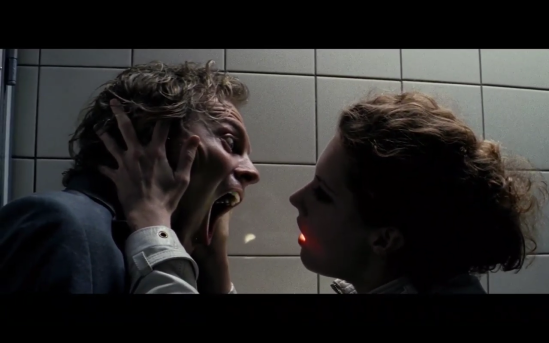
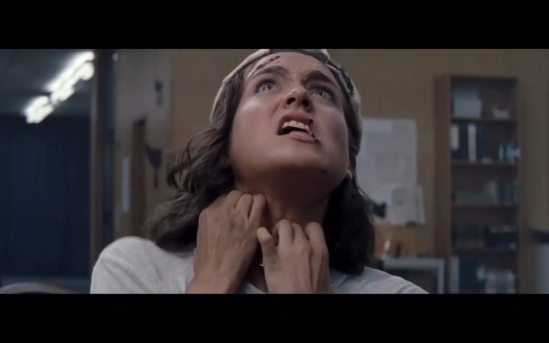
An immigrant cabby named Luz stumbles dazed into a German police station, repeating a profane distortion of a religious prayer to a couple of baffled detectives. Meanwhile, in a nearby bar, a forwardly chatty woman is diving seductively into a spiel about her Catholic schoolgirl friend who just recently jumped out of her moving taxicab to a psychoanalysis specialist on the edge of his seat. Drunk enough to take advantage of, the Doctor falls for the woman’s alluring trap, beguiling him to do her bidding as an unwilling host. As the now possessed doctor arrives to evaluate Nora for the police, he instigates a hypnosis recreation of the details events leading up to Luz’s ravings and disillusions. What happens next goes beyond human comprehension and rational as the doctor desires more from the stupefied Luz than what meets the eye.

Undoubtedly a strong skiff of demonic peculiarity weathering forth against an unforgiving maelstrom of spiffy-glamourous and yacht-sized counterparts is Tilman Singer’s memorizing tale of demigod deception in “Luz.” As the German born filmmaker’s first written-and-directed full length feature film, a film school project shot entirely on 16mm color negative, Singer dazzles with a throwback grindhouse glow set ablaze with a neon flare that adds to the perilous seduction and violation of the mind and primal infatuation. “Luz’s” was filmed in Cologne, Germany, where Singer studied film at the Academy of Media Arts Cologne, during the production year of 2018 and saw success at various Germany festivals, including it’s debut at the Berlin Film Festival and the Fantasia Film Festival. The Academy of Media Arts Cologne also serves as the production company, as it was, after all, a school project, and listed as Kunsthochschule für Medien Köln (KHM).

“Luz” wouldn’t be what as staggering as it is if it wasn’t for the invested cast who brings Singer’s vision to the spectrum. Luana Velis’s seamless grasp of the editing has remarkable wealth when playing a disoriented cab driver coming in off the street and Velis as Luz, in the ebb and flow of reality when Dr. Rosinni (Jan Bluthardt) entrances her with a blend of hypnosis and psychoanalysis techniques, sustains character through various transitions present inside a large police board room, reality, and the subconscious recollection of places and events inside her mind that Singer constructions for visualization, not reality. Singer melds together places, people, and events, throwing audiences for loops and casting misleading signals and just where the hell our characters are gathered. Bluthardt is equally captivating post transformation, coming off like a calculated maniac, resolved in his wild role. Perhaps, my favorite of the cast list goes to Julia Riedler as Nora Vanderkurt, Luz’s icy former bedfellow from Catholic School who slithers into Dr. Rosinni’s ear like a bewitching asp while seeming like a normal bar patron, but Riedler’s spin on Vanderkurt breaks the construct beyond that of the sleazy barfly and into something more conniving, wicked, and alcohol infused while still steamy with sexual emissions. All three performances are keystones to “Luz” success while fellow cast mates Johannes Benecke, Lilli Lorenz, and Nadja Stubiger, offer some spot on support.

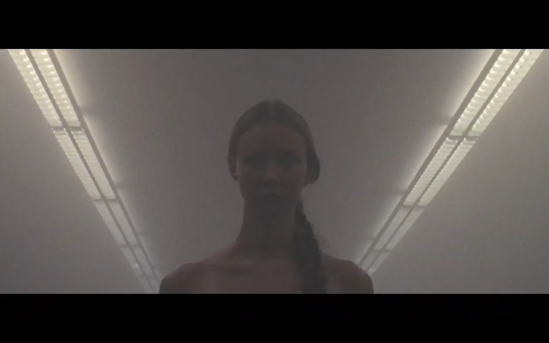
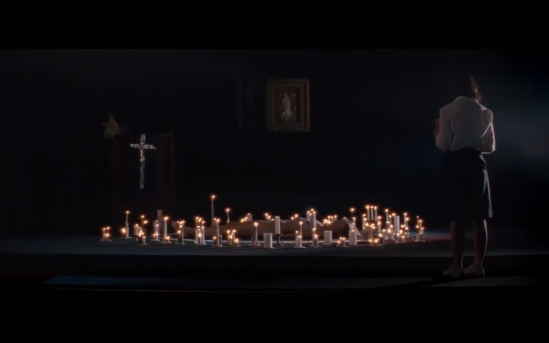
“Luz” summits fear with intrinsic performance art of hazy, but colorful, atmospherics and off-kilter shapes and lines, making the most routine settings feel unsettling. It’s a strong cinematography showcase by Paul Faltz who was able to frame and fright a scene from a sterile and fatigued, wood paneled office environment; essentially put, Faltz turned coal into a diamond while Singer brought a keg of European horror to the party. Unconventional, of course, with a profound arthouse quality about it, “Luz” is very much inspired by the European masters of horror, but pulls quite a bit from the vibrancy of American filmmaking too, pulling inspiration more noticeably from John Carpenter’s overwhelming sense of apocalyptic doom from such a scale down narrative and the terror looms like a chandelier hanging by a single thread just waiting from the startling crash of glass and metal. There are themes related Catholicism, homoeroticism, guilt, and obsession through the venomous innate nature of demon, as if unknowingly leaving an open invitation for evil by way of spiritual clairvoyance and Catholic defiance. Full of abstract visuals and melodious dialogue, “Luz” still burns the scary story lantern with a flickering of imminent existential combustion.

While the theatrical release has been officially canceled, “Luz” will still live on through the digital world, being released by Sharp Teeth Films, who released the POV slasher horror “You Are Not Alone,” on June 1st in the United Kingdom. With this being now a digital release, critiquing the audio and video quality will be limited to the artistic direction. Video-wise, Singer sought the use of a 16mm film stock with the speckle and grain texture of that beloved, yet enveloping imperfection and shooting in an anamorphic widescreen aspect ratio of 2.35:1, using an Arri Alexa and RED cameras that supported an anamorphic lenses. The result is phenomenal to digest with some serious depth when considering how small the sets are, turning mere pockets of space into the likes of grand ball rooms. The German, Spanish, and very little English dialogue tracks are clear and prominently abutted against a well adjusted ambience mix; in all, the audio package has good depth and range. There were no bonus features included with the digital screener. “Luz” is weird, mystifying, and can wriggle into your favor with a chilling essence taking a leisurely stroll along your back, propping up the hairs one strand at a time. Highly recommended.

Pray EVIL Isn’t This Cruel. “Suffering Bible” reviewed! (Sub Rosa Studios/DVD)


Welcome to the Suffering Bible, a collection of violating and gory interpreted religious allegories digging into stark contrasts of sin and piety and illuminating the darker side of these allegories with a lacerating gruesome perspective. These short stories include the internal strife of a psychopaths strong urge for forbidden lesbian companionship with the contentious, bigoted teachings of finding forever friends inside God’s eyes, a visceral performing depiction of the Incredulity of St. Thomas, an extreme mortification of the flesh, the prideful consequences with a Devil’s pact, and the murderous portrayals of lost souls needing redemption into God’s good graces.

Right in time for the Easter holiday, where Jesus Christ has risen back from the dead for our salvation, comes Davide Pesca’s written and directed “Suffering Bible” of sinfully derived tales of reverent and irreverent perfervid images. The Italian made and produced anthology that’s a contexture of stories is forged together with a wraparound story of the Adam and Eve in the Garden of Eden apologue. “Suffering Bible” begins with a title card excerpt, Tear thy neighbor as thyself, from an unknown storyteller named saamang Ruinees with a skewed version of the second commandment, Love thy neighbor as thyself, subtly denouncing the evils in popular religious culture and then slithering them, not so subtly, into the shorts of those suffering at behest of the bible. Pesca’s shock efforts have come across ItsBlogginEvil.com’s radar once before with another short framed macabre tale, “Hemophobia,” from Artsploitation’s home distributed release of “A Taste of Phobia” anthology and “Hemophobia” is and feels more commercialized with less than salutary toward mutilation and variety body meat, but the filmmaker does fly on a parallel body horror plane and has had his shorts featured alongside with fellow Italian auteur and shock director, Domiziano Cristophario (“House of Flesh Manniquins,” “Red Krokodil”) with a more rudimentary, analogue-video-feel approach. “Suffering Bible” is self-produced by his independent production and distribution company – Demented Gore Productions.

Being an Italian made cast functioning on the performances grounds of a heel budget writing up about “Suffering Bible’s” actors and actresses past credits, influences, methods and so on is proving to be a challenging task. Most of the cast is comprised of alternative, half-naked women, such as Nicola Fugazza and Mary Rubes who are the sole credited on IMDB.com. Rubes, an erotic model, becomes “Suffering Bible’s” inadvertent poster girl that graces the Sub Rosa Studio’s DVD cover and static menu as her seductively deceptive solo performance of body and genital self-mutilation is the most unsettling story revolving around mortification of the flesh. Rubes has previously worked with Pesca on a 2017 short film entitled “Fame de Vampira,” which also co-stars Beata Walewska. Both Rubes and Walewska sizzle in the Italian action scene with “Rage Killers” by director Roger A. Fratter, who co-directed “Fame de Vampira.” As you can see, a casting inner circle is starting to form, but that’s the extent of the network with Simon Rocca, Simon Macleod, Catlin Strange, Pate Douce, Paolo Salvadeo, Emilio Stangalini, Paolo Borsa, Emanuela La Neve, Chiara Digonzelli, and Marilena Marmo.

On the surface, “Suffering Bible” has a unwieldly, pigeonhole affect that places the impervious shutters around one’s peepers and thinking cap for the pleasures of gore and nudity that run continuously rampant, but Davide Pesca has a connect-the-dot vision that aims to unveil the worst of religious culture, using graphic imagery in a reverse psychological and divinity experience that’s wildly novel inside a less commercialized parameters and the more I stew on this film, the more I like it. Without this review not seeming to be a theoretical paper on Davide Pesca and the “Suffering Bible,” examples of the filmmaker using gore as the pain and suffering vessel for those struggling to be closer to God can be modeled from the first short, “My Only God” aka “Friends Forever,” in which a woman stitches herself to her now dead friend to be closer to her, as if their friendship, which was severed insinuated by the dead woman, will continue in the afterlife. Same can be said about the last, if not more potently gristly, short, “The Redemption of Last Souls,” where a druggie, a terminal ill person, and a homeless man who has lost family connectivity have nothing left to lose, have lost faith, and seek redemption through being chair strapped subjects of a snuff film. While “My Only God” and “The Redemption of Lost Souls” caters to the barbaric rite of celestial passage, Davide Pesca’s specialty falls more within the lines of body horror as the filmmaker has saturated himself in the infatuation of the Body Modification culture, reflected in his “St. Thomas” and “In The Name of The Father” that include Doubting Thomas reaching protractedly into a crucified Jesus’s side slit and include the extreme mortification of the sinful flesh – eyes, breasts, and clitoris – by a devout devotee.

“Suffering Bible” is a throwback moxie livid on sin and body destruction and it’s a title coming to you on DVD home vide like a disastrous, break faith, miracle from SRS Home Video and MVDVisual. Though listed as a retro release by SRS, “Suffering Bible” released in 2018, shooting over the course of a few years prior more than likely, with a combination sepia-color approach and the result outputted a strained and digitally cursed image of a widescreen, 1.78:1 presentation that suffers from severe compression artifacts in conjunction with digital interference. The errs are absolved by the very label of a throwback “erotic art house horror” gracing the retro, faux-VHS DVD back cover. The single channel stereo has limited flexibility with some ostentatious, if not laughable, Foley work. Aside from a little dialogue in two of the shorts, “Suffering Bible” takes a vow of silence and speaks volumes in actions alone; this creative choice, along with some probable glitch art, saves much of the technical woes already plaguing Pesca’s stain on profane. The robust grunge-brood style of OKY’s prolong guitar distortions, delicate strum and percussion echoing, and reverse melodies bedazzles in a cathartic relief that no dense, run of the mill metal band is attached to the soundtrack. Special features include a short interview with Davide Pesca, which turned out to be more of a behind-the-scenes look at handful of shorts for the film, a lengthy ultra violent and gory showreel for Pesca’s “Tales from the Deep Hell,” and SRS trailers. More grimly poetic than sleazy gore-porn, the book of the “Suffering Bible” can open eyes to the unsettling infernal of holy virtue with transfixing horrid death rooms.

Shock, gore, profane! “Suffering Bible” DVD has it all!

Danzig’s EVIL Stank All Over This One! “Verotika” reviewed! (Blu-ray, DVD, CD / Cleopatra Entertainment)


Three sordid, macabre tales straight from the controversial pages of Glenn Danzig’s Verotik comic line that slips into the surreal lurid dimension of obscure stories of a subconscious half-human, half-spider manifestation with a sexual appetite and a morbid desire to break the necks of women of the night, of a disfigured and mysteriously alluring stripper who seeks out beautiful women nightly to crudely remove their faces with a knife and overlay their once perfect skin on top of her face as she adds them to her collection of facial distinctions, and, lastly, of a bloodthirsty medieval countess known to her subjects for exquisite beauty and grace emanated by the blood baths of her virginal female subjects.

Legendary metal musician and songwriter Glenn Danzig has been a symbolic (Anti-)God that inspired other metal bands and fans over for more than 40 years, birthing perhaps the original, and still more popular, horror-goth punk bands to ever set the black lit stage, the Misfits in the late 1970’s. Outside his illustrious musical career, Danzig owns Verotik, a comic book publisher, that’s a portmanteau derived from “violent” and “erotic,” geared toward adult-themed material and inspired by his fascination with horror. In comes “Verotika,” a three short film anthological horror feature penned by Danzig and is his director debut while in collaboration with powerhouse musical recording label, Cleopatra Records, under their cinema label, Cleopatra Entertainment. Co-producing alongside Danzig is James Cullen Bressack, whose heavily been the created force behind the affectional indie found footage horror “2 Jennifer” and “From Jennifer” films, and Bressack associating collaborator, Jarrett Furst.

Keeping with the “Verotika’s” motif of scantily cladded women and the elements of horror, each story is driven by a female lead portrayed by actress who’ve established themselves with a scream queen presence, have enter the entertainment industry by way of X-rated programming, or are fresh faced with the presumptive hypothesis that the role secured was for their voluptuous assets. Ashley Wisdom is one of those endowed actresses that fit the latter category. The Instagram model and fling of Glenn Danzig becomes a shoe in for the lead of Dajette in the first segment, “The Albino Spider of Dajette.” Wisdom’s cringing faux French accent and rigid manner doesn’t wholly dilute from her bustier attributes that include prosthetic eyeballs for nipples – all part of Dajette’s character – and fairs better than Scotch Hopkins’s (“2 Jennifer”) absurd Albino Spider of grim free verse prospects inside a stiff, stingy mockery of a humoresque spider. Optimistically, the episodes only go up from her with the following tale ”Change of Face” that follows mystery girl, “12/12/12’s” Rachel Alig, hunting down and slashing off the faces of beautiful women for her collection. Alig is a palpable psychopath amongst a sea of overzealous, conventional orchestrated character types that sells a noir, or hints at a giallo, loom that sensualizes as well as sexualizes a salacious one-person schismatic view of beauty. However, the grand finale saves the best for last with Verotik’s more diabolical and foundational brutal transgressors, Drukija: The Countessa of Blood. Without so much of a setup or without expositional bookends that dive into backstory, conflict blossoming, or even resolution, Drukija’s a voyeuristic chronicle that exhibits the day in a life of a abhorrent ruler soaked in virgin blood with Australian actress Alice Tate fulfilling Drukija’s iron spike studded crown. Numerous scenes linger with Tate just bathing in blood or checking her sangre-moisturized skin in a three-way mirror to just extenuate the picking and choosing of daughtered victims, gleaming of deity-hood inside the eye’s of her maniacal maiden hand, and, in her spare time, amasses decapitated heads of the slaughtered young women as keepsakes. Yet, Kayden Kross dignifies that porn stars can get into the silver screen market, well, at least in Danzig’s irregular one. The director and starlet filmmaker hosts an outer edge story as the witchy-gowned and demonically unholy Morella who introduces each segment in between. Sean Kenan (“My Trip Back to the Dark Side”), Natalia Borowsky, Emma Gradin, with special cameo appearances by Caroline Williams (“Texas Chainsaw Massacre II”), Courtney Stodden, and a number of women from the porn circuit like Kross, such as Bobbi Dylan, Katrina Jade, Emma Hix, Aalyiha Hadid, and Veronica Ricci.

I’m all for the forging of industry realms when comic meet the big screen with adaptation and love Verotik’s edgy eroticism and hyper-violence mantra, but “Verotika’s” pulpy irregular narrative meter coursed a perplexing devolved sojourn through our visual cortex, leading us pleading for a bigger, better version of Danzig’s auteur dreamscapes. Verotik’s a fire and brimstone optical narrative from the illustrated pages that speak volumes of profligate and vivid avant-garde characters and unlimited violence that tremendously lose that tailor-made authenticity when translated to the screen. Danzig’s free-form script works with music symbiotically; for together, the strums and riffs glue together disassociating dialogue to a unison of harmonics, even if Danzig’s prefers harsher rock melodies. For the musician’s first dance with directing, Danzig deserves props creating a gory, pulpy, and colorful piece of his subsequent profession. Yet, there’s always room for improvement in his technique, such as Danzig’s fascination with the zoom feature on the camera. The edit cut is almost too rough for swallow with no segue equilibrium between shots that result in some obvious cue acting and I’m usually a fan of Vincent Guaustini’s work, but his Albino Spider suit, in which the other four arms out of the three sets were fastened together, rolled back years of good effects work.

True to form, Cleopatra Entertainment offers a staggering release for Glenn Danzig’s “Verotika” in a triple-format Blu-ray/DVD/CD release distributed by MVDVisual. For this review, the Blu-ray was covered and the transfer is released in a widescreen, 2.35:1 aspect ratio, shot on an Arri Alexa anamorphic lens camera. The enormity of color schemes offers a wide variety of tints, especially in “The Albino Spider of Dajette,” but revert to more a natural tone for “Change of Face” and “Drukija: Countess of Blood” with stable details inside and outside the black. Slightly hazy (or maybe just smokey?) at times, but the 1080 does too good of a job to see all the nonexistent pores on the ripped off faces in “Change of Face.” The English language Dolby Digital 5.1 surround sound audio mix that, again, has a lossy quality from Cleopatra Entertainment, a sub-label of a major music recording company. The surround faintly register ambient audiophiles inside the channels whereas Danzig’s rock solid and eclectic soundtrack offers more, just a notch more, LFE oomph quality to boost into all areas. The CD renders around the same lossy quality. Bonus features include a trailer, a slideshow, and, of course, the compact disc featuring a new track from Danzig and also features tracks by Ministry, Pink Velvet, Studio 69, and Switchblade Symphony. Like a bizarro “Red Shoes Diaries'” episode, “Verotika” bares no shortage of nudity that’s interlocked with well-nigh arbitrary violence spread-eagled in a gnarled cinema anthology of surreality that lied festering inside Glenn Danzig’s head.

3 Disc Danzig! “Verotika” on Amazon!