

Peter coerces his begrudging wife, Marcia, to forgo the luxurious hotels and chauffeured holidays for a long weekend of camping on a remote beach in Australia. An enthusiastic Peter packs the jeep with thousands of dollars worth of outdoor gear, including a surf board, a spear gun, and a hunting rifle. Marcia loathes the outdoors, can’t stomach the very thought, and she lets Peter know her distaste of his plan every other second while on holiday. Yet, this trip for them isn’t just a routine getaway, but, instead, a trip to get away from the swinging friction of close and very intimate friends, to rekindle their relationship, and save what little is left at a frayed string. The already awkward and complaint-riddle holiday turns from bad to worse when nature looms a foreboding shadow over the estranged couple, unleashing one ill-fated omen to the next that checks their nonchalant attitude toward nature with eco-radical discipline.

“Long Weekend” is an eco-horror film by “Innocent Prey” director Colin Eggleston. Alfred Hitchcock, perhaps, birthed the horror subgenre with his 1963 film “The Birds” that led to such films as “Day of the Animals” and “Grizzly.” Nearly 15-years later, Eggleston hones in on his inner Hitchcock by expanding the background on why nature turns cold and unsettlingly supernatural like. Working off a powerfully detailed and haunting script by “Razorback’s” Everett De Roche that circles around two characters like a hungry vultures, Eggleston vitalizes De Roche’s script with a paper to screen bleak, unsettling imagery on a monumentally minimalistic scale. “Long Weekend” could be considered a Hitchcockian film, and most likely is, but can stand firmly by itself as an extension on how mother nature can be a bitch when push comes to shove.

Two characters and the wilderness. That’s all “Long Weekend” boils down to on brass tacks, leaving two actors on the line to act off each other and off of the ominous presence that has fully engulfed them on an isolated stretch of beach and shoreside forestry. “The One Angry Shot’s” John Hargreaves tackles the conceited Peter with a full-bodied combination of heedless gusto and desperation that Hargreaves can seamlessly become lost in Peter’s self-worth. The Sydney born actor is paired with an English actress by way of Briony Behets from the 1980 film “Stage Fright,” a film also co-written by Colin Eggleston. Behets’ Marcia epitomizes the stereotypical enigma that men all think is the inner workings of a woman’s brain; Marcia is hot and cold with fleeting moments of passion for Peter, yet ready to kill him in the next scene. Behets converts the baffling intertwinement of Marica’s energy and channels it well into the dynamic that is their failing marriage.

What’s really special about Eggleston and De Roche’s film is the overloading symbolism. From subtle to simple, “Long Weekend” has the money betted on working on an underlying moment-to-moment, scene-to-scene in each act; a method tirelessly schlepped through with many modern features of today. Using non-threatening animals, such as a small possum and a sea cow or dugong, to be part of a menacing force driving the ominous presence across the narrative just sets the feng shui mindset of an unadulterated evil genius. Instead relying heavily on a physical entity, Eggleston heavily coincides creature imagery with the use of audible creature cues, whether a baby-like wail in the distance or the overpowering cacophony of animal growls and sneers, to invoke panic, fear, and paranoia to divide the already fragile pair into an atomic disaster of their undoing. “Long Weekend” will overshoot some viewers as piecing the puzzle together can be a slow and long process, but one aspect is certain, the off-camera animalistic stare has a powerful affect.

Second Sight delivers the ozploitation classic, “Long Weekend,” onto Blu-ray home video for the first time in the UK this November. Unfortunately, a review DVD-R disc was provided for this critique and audio and visuals components will not be covered. Bonus material was included on the review disc with audio commentary with executive product Richard Brennan and Cinematographer Vincent Monton, an Umbrella Entertainment produced panel discussion with film historians Lee Gambin, Alexandra Heller-Nicholas, Emma Westwood, and Sally Christie, Uncut “Not Quite Hollywood” interviews with Briony Behets, Vincent Monton, and Everett De Rocha, an extensive still gallery with an John Hargreaves audio interview, and original theatrical trailer. “Long weekend” is man versus nature at it’s best with sheer, unrivaled terror in a quaint eco-horror thriller package with a powerful message that nature will seek extreme judgement against Mother Earth criminals.
Tag Archives: nudity
Evil’s Ultimate Climax. “Gorgasm” review!

A low on the totem poll detective receives the chance to get out from behind a paperwork overloaded desk to investigate the gruesome death of a seemingly BDS&M gone array. The case lures the investigator through the muck of the sleazy and sexy underground to where an independent zine lists GORGASM as the ultimate climax. With every lead, GORGASM connects them all and there’s one person, one suspect, on his radar and her name is Tara, the face of GORGASM. Tara’s a psychopathic call girl, aiming to dish out a finitely pleasurable zenith to those who want more than just sex, and the unlikely hero detective embraces the case personally to put a stop to Tara’s gruesome delusional calling before he’s sucked into an inescapable world blended with lustful carnalities and death.

“Gorgasm.” By title alone, “Gorgasm” has already peaked interest and paved for a path of optimism and delight despite the inkling in the back of the mind about the film’s low-budget shlock. In any case, the title comes from the imagination of creator, writer, director of “Dead Silence,” a one Mr. Hugh Gallagher, and is his 1990 sophomore feature that showcase plenty of violence in an ostentatious psychosexual thriller. Gallagher, perhaps, isn’t the first to delve into porn’s mucky and sleazy underworld that’s universally stigma in many cultures, but, and again perhaps, is the first to explore the many facets that porn has to offer and highlights the habituating circumstances porn has to morph into to keep up with customer demand, whether it involves whips, clips, and chains or to be more specific in the realm of fetishes.

Gallagher didn’t manage to make any old, run-of-the-mill low-budget venture, but managed to do so with a professional lead in Rik Billock. The name might sound familiar to horror fanatics. Billock has been a stock regular in George Romero films: “Dawn of the Dead,” “Knightriders,” “Monkey Shines,” and in “The Dark Half.” He also had a small, yet door knocking down roll in Tom Savini’s “Night of the Living Dead.” Billock’s a bright star with an organic singularity amongst a mechanical lineup, popping out like a child’s pop-out book that solidifies his presence. Even his co-lead, introducing an actress only known as Gabriela, a former wrestling-affiliated performer in her first feature film. Gabriela is stunning, beautiful, and well-endowed, perfectly casted to be the personal-placing killer call girl with dark features and though her method is a bit monotoned and monologuing, Gabriela’s looks really do standalone. “Gorgasm” also co-stars Paula Hendricks who puts a real damper into the ebb and flow of being a strict and condescending sergeant to Billock’s character, but the silver lining is that this Hendrick’s sole credited role. Rounding out the cast includes Paula Gallagher, Kevin Patterson, Denis Hellrung, and co-producer Flint Mitchell in a show-stopping slimeball performance as a sleazy magazine owner.

With an extreme and inviting title like “Gorgasm,” there comes a usual, if not blatantly given, perception that blood will flow and guts will be strung and plastered on forefront of the featured scenes, but to an extent, the gore and the blood splatter were surprisingly granular results and doesn’t ultimately champion an autassassinophilia effect. However, don’t be scornfully turned away from Gallagher’s film if “Gorgasm” isn’t locked and loaded with blood drenching entrails and other body fluids and fleshy tissue. Gallagher executes tasty scenes of violence and mortality on a budget with examples being a garage door decapitation and a kill shot to the vagina. There’s also a weed whacker chewing through a pervs face. “Gorgasm,” perhaps, does find space in the gore and shock subgenre pie, even if only a sliver of a piece.

MVDVisual and SRS Cinema release the Draculina Productions film, “Gorgasm,” onto DVD home video and present the film on the original SOV, full-frame format that’s pleasantly held up over the last 28 years. Aliasing is quite common on shot-on-vide, even on Super VHS that director Hugh Gallagher shoots the film, and the coloring has a slight washed look, but considering the VHS monstrosities out in the world today on DVD, “Gorgasm” has no ill-will toward this release. The uncompressed PCM 1.0 mono track has limited depth and range with a consistent static hiss throughout, but generally adequate with clear dialogue upfront. The “bloody” bonus features include a commentary with Hugh Gallagher, behind-the-scenes footage, and trailers. Also, the grisly-gorgeous illustrated cover art by Mike Mez Phillips is exquisitely killer and on point. While director Hugh Gallagher mediocrely went through the nuts and bolts of vehement slasher violence without really thickening already deep pool of gore, the director did manage to fulfill a promising title with meshing sexual deviancy and blood in an entertainingly provocative feature. Rik Billock and Gabriela, whose half naked through more than half the 82 minute runtime, embraces their twisted characters that you’ll love to death!
The Evils of a Transgendered Occultist! “Miss Leslie’s Dolls” review

On a dark and stormy night after a school football game, a teacher and three students take shelter at a cottage adjacent to a cemetery. If the cottage wasn’t creepy enough, the sole occupant owner surpassed the bar. She calls herself Miss Leslie, a middle aged woman with an ill-fated story of her friend and mother’s fiery demise from long past and a quirky penchant for making life-size female dolls that set inside an illuminating shrine. Though they feel uneasy about the creepy surroundings, the visitors stay and get cozy, especially with each other, but Miss Leslie has ulterior, deranged motives. Her dolls are not just lifelike, they once were vibrant lives of women Miss Leslie sorely wanted to inhabit their feminine confines of youth and beauty from over the years, but now they are an undecomposable shells, encase in Miss Leslie’s special doll making brew to timelessly capture their lovely physiques. They are also beautiful, yet painful reminders of her failed attempts to transfer her essence into their adolescent bodies.

Every so often you come across a film with a gigantically absurd hard shell cover with the gooey insides of eye-rolling cheesiness and you just have to ask yourself, how in the world did something like this ever come to fruition!? Yet, somehow, someway, these productions of an oddball variety always have an intense allure about them and end up being just one of the coolest rarities to grace the glazed-over irises. Joseph Prieto’s “Miss Leslie’s Dolls” is the epitome of this very phenomena. “Miss Leslie’s Dolls” is an exploitation, nearly softcore porn, horror with a deranged killers with severe mental issues that range from communication with dead to, what can be now construed as antiquated, complications of gender identity. One of the last directed films from Prieto, who also helmed “Shanty Tramp” and “Savages from Hell,” also penned the screenplay alongside longtime collaborator and producer Ralph Remy Jr. The script reads like an insatiable bedside thriller novel, an object of complete obsession through the entirety and well long after being completed; “Miss Leslie’s Dolls’” has a rich gothic lining, a strong sexual appetite, and a timely LGTB subject that involves debate on mental illness or inherited gender orientation.

Not many actors performed in drag. Sure, there was Jack Lemmon and Tony Curtis in “Some Like It Hot” and there was even Anthony Perkins from “Psycho,” who some might go as far as saying that “Miss Leslie’s Dolls” might draw inspiration from with the whole mother fixation, but only a small faction of fans, especially in the genre, might know Salvador Ugarte. The Cuban born Ugarte has great poise as a woman imprisoned in a man’s body. Miss Leslie just isn’t a deranged killer in drag; the character has deep rooted issues stemming out of not only being a woman embodied incorrectly, but also seeded by an engulfing obsession with capturing beauty to obtain it for herself, an addition from a result of a permanent scarring left behind by Miss Leslie’s homicidal rampage in the character’s history. Ugarte has the mannerisms and the gait down so unerringly that’s the performance is downright creepy, but there was one aspect of womanhood that Ugarte’s masculinity couldn’t mask: his voice. The actor is horrendously dubbed, adding charm to the bizarre concept. Ugarte’s joined by “Little Laura and Big John’s” Terri Juston, Marchelle Bichette (“The Gruesome Twosome”), Kitty Lewis, and Charles Pitts of “Supervixens.”

Contrary to the above, “Miss Leslie’s Dolls” has some drawback. Though the characters might be entertaining and interesting, especially with the Bourbon obsessed and hot for teacher Roy and his terrible gangster accent or the fact that Ms. Alma Frost is a smoking hot, twenty-something year old prude teacher to her pupils who are practically the same age as her, they’re washed over with an aloof mentality, consequently looking past or just blatantly oblivious to Miss Leslie’s obvious male features, her inauspicious ramblings, and the fact she has a shrine of creepy and realistic dolls of women that fill the room with the smell like rot and death. Perhaps too busy running through the cemetery at night in skimpy bedroom garments. Yes, this does happen. On top of that, Miss Leslie harness of occult powers goes relatively unexplored, yet very much utilized as an important portion of the film near the last act. Despite being passively mentioned and rather undercut from more than most of the film, Miss Leslie’s occult mischief is plucked right from left field to further the enigmatic aurora of Prieto’s mystical exploitation.

Network proudly presents “Miss Leslie’s Dolls” on an UK 1080p Hi-Definition, region free Blu-ray home video, remastered from the original film elements once thought to be have been forever lost. The newly scanned transfer came from a surviving print and presented in the film’s original theatrical aspect ratio of 1.85:1. The restoration included detailed grain management, the automated and manual removal of dirt and damage, and the correction of major color instability, warp, and density fluctuations. (In full disclosure, Network sent me a DVD-R screener and that is what the following critique is based off of) Though in some frames there flares up some instability, from my perspective, the first act and half really came out well with the vivid, yet natural, coloring. However, once inside Miss Leslie’s basement, woozy blotchy moments of Leslie fiddling around makes the particular scene a bit off putting. The stereo mono track is fair for the 1973 film that has it’s share of distortions and editing pop faux pas, but the dialogue is fiercely prominent, despite the inherent awfully laid dub track, and equally well balanced with ambient tracks. There were no bonus material on the release. Transvestitism horror is quite a rare experience that always has a lasting impression, cerebrally popping visuals of grim visions commingling with the blood, the viscera, and the other supplementary violence. “Miss Leslie’s Dolls” deserved this Blu-ray release and Network did right by Prieto’s obscure grindhouse feature that will sear into your skull.
Evil Plots and Plans From Within! “Money Movers” review!
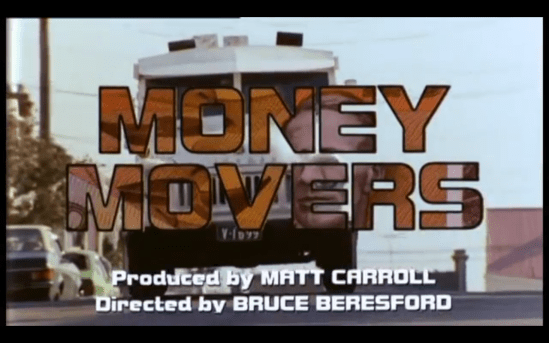
When a deadly robbery strikes one of Darcy Security Services armored cars, the security company’s chief executives aim to crack down on the already rigorous operational security protocols by implementing vastly unpopular and Union-irritating measures. The hit not only induces change to security procedures, but also opens up a can of worms that forces the hand of the three internal company men, who’ve been planning to steal from inside Darcy Security Services over the last five years, to accelerate their timeline. Their carefully laid out plan quickly becomes complicated when the mob gets wind of their elaborate heist, compelling the small three man crew to work for the crime boss without much of a choice as life and limb come to stake. Now the only thing that can stand between them and millions of dollars are two new Darcy recruits, a highly trained former police officer with a penchant for doing what’s honorable and a gun shy bloke targeted to be a prime suspect in previous armored car robberies.
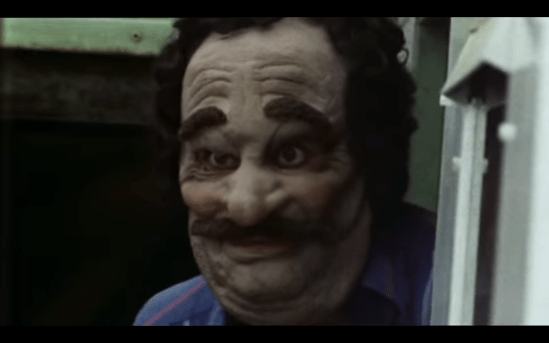
Based loosely on a pair of actual robbery events authored by novelist Devon Minchin, “Money Makers” bares a ruthless resemblance to hardnose acts of crime as filmmaker Bruce Beresford captivates as the maestro behind the orchestration of Minchin’s book that’s gritty and enthralling on the big screen. The “Driving Miss Daisy” and “Double Jeopardy” director also pens a script full of bloody encounters and unflinching greed that delivers “Money Movers” as the first R-rated feature to stem out of South Australian Film Corporation, a production company that, up until then, co-produced dramas, mysteries, and family films, such as Peter Weir’s “Picnic at Hanging Rock” and “The Last Wave,” with McElroy & McElroy and later co-produced the widely successful Outback horror “Wolf Creek” starring John Jarrett nearly 30 years later.

While numerous characters are subject to suspect and their roles’ intentions are guarded to the very end, the plot, for all intents and purposes, circulates around Eric Jackson, a former champion race car driver who now tenures as a 5-year senior security guard at Darcy’s, played by Terence Donovan. Donovan gives the performance his all with a wide range of subversive behavior. From cool, calm, and collective to feral gumption, Donovan race ends in drenching ferocity that’s fueled by his fellow costars who meet him at his level of performance. The most recognizable face, at least for me, is “F/X’s” Bryan Brown who portray’s Eric’s brother, Brian Jackson. They butt heads with former police officer Dick Martin and his no tomfoolery. The late Ed Devereaux had an old school acting method, very impersonal and straight forward like a John Wayne-type, and that worked perfectly in the role of Martin who befriends the projected patzy Leo Bassett played by “Quigley Down Under’s” Tony Bonner. Bonner’s able to capture Bassett’s unconfident, yet smooth persona that’s complete opposite of his partner Dick Martin, whose confident, but brash. What’s curious about the characters lies under the surface of a domineering male lineup – the women. Not one female character is apparent in a co-lead role and each role has a presumable flaw to them. Candy Raymond is an undercover private eye who uses her body and wits for information, Eric Jackson’s wife, played by Jeanie Drynan, has an absent and naive approach, and a handful of minor roles involving non-verbal girlfriends and late night secretary carnalities. The cast rounds out with Charles ‘Bud’ Tingwell, Alan Cassell, Lucky Grills, Hu Pryce, Terry Camilleri and Frank Wilson.

“Money Movers” doesn’t scream perfection, but plays a major influential part in the infancy stages of violent crime thrillers that paved the way for such films like “Heat” or “Point Blank” and supplies another keystone in constructing the genre a solid foundation. “Money Movers” is bookend with graphic shootouts and peppered with conniving dealings and unsavory characters toward a shoot’em up heist climax that Bruce Beresford was able to depict visually and script confidently. In early scene, the storyboards could have been revised, restructured, or reordered to unearth a clear picture of establishing character backstories and setup that still process a puzzling connection between their nefarious intentions, but the ample storyline corrects course quickly without loosing too much time to ponder about the after effects of the early scenes.

Umbrella Entertainment re-releases “Money Movers” on a PAL DVD home video. The region free DVD is presented in a widescreen, 1.85:1 aspect ratio. Definition is key as the colors are, for lack of a better word, washed, but the clear cut outline that produces a sharp finish image grants this release of “Money Movers” a seal of approval that isn’t asterisked with blatant enhancements. The English Dolby Digital 2.0 track is on point with clarity in the dialogue and properly aligned, volumed, and untarnished ambiance. What’s interesting about “Money Movers” is the lack of a score that forces the viewer, subconsciously, to hone in more acute to the characters and their brazen actions. Bonus material includes “Count Your Toes – a making-of featurette with writer-director Bruce Beresford and cast members Bryan Brown, Terence Donovan, Tony Bonner, and Candy Raymond. There’s also the theatrical trailer and Umbrella Entertainment’s propaganda material. One of the first to be up on a prestigious pedastal of heist films, “Money Movers” is a violent, toe-cutting, experience armored with a great cast of acclaimed actors and filmmakers in this Ozploitation classic.
Evil Walks Among Us! “The Devil Incarnate” review!

In a time of Kings and nobility, a traveling beggar roams the open landscape. However, this man is no ordinary vagrant, but is the leisurely wary Devil reincarnated into the flesh, walking amongst mankind with one goal in mind: seeking pleasure by any means necessary. From pillaging to cheating and lust to murder, the haughty Devil has embarked on an oppressive journey as Mr. Leonardo, encountering all walks of life and swindling them of their morality and of their wealth. He’s joined by a young and poor servant boy, Tomas, as a traveling companion, schooling the God fearing lad in man’s corruptible virtues and exploiting their naïve or sinful nature. Though being a powerful immortal in true form, as man, the Devil can succumb to sickness, injury, and even death, but still maintains certain metaphysical abilities to provide an edge over those he bamboozles. In his mischievous encounters on Earth, Leonardo comes to realize that man might just be more immoral as the Devil himself when the Devil, in human form, can’t inflict as much havoc as the unscrupulous attributes of a profane mankind.

“The Devil Reincarnate” is worth it’s weight in ducats for all the Paul Naschy fans. Also known as “El Caminante,” not a literal translation with an interpretation as The Walker, the Paul Naschy starred, co-written, and directed film, under his birth namesake of Jacinto Molina, is a staggering approach toward the exhibition of humanity at it’s complete and utter worst in a cloaked slither of an Naschy anecdote that even the Devil couldn’t top man’s relentless and unremitting cruelty. Naschy’s pessimistic views, much which I’ve always agreed with, illuminate all that was, is, and will be wrong with human race and despite how barbaric and nasty his character, Leonardo, might be portrayed, Naschy manages to be essentially one of the only directors to make the Devil an anti-hero of sorts.

Paul Naschy is Spain’s most recognizable horror icon, recreating many of the iconic monsters and macabre films in his native land. Leonardo is a different sort of character for Naschy, one that doesn’t hide behind a mask or makeup, revealing a full-blown Naschy assortment of just him. As himself in Leonardo, he’s plays a terrible, down-right rotten bastardo who even belittles himself as a simpleton to lie and steal from wealthy aristocracy. Leonardo is smooth, skillful, charming, intriguing, and brutish much like I would imagine Paul Naschy would be in real life. Alongside Naschy, David Rocha portrays Leonardo’s servant companion, Tomas, and Rocha provides a youthful exuberance that translate to onscreen, giving Leonardo companionship, aid, and also assists in being the Devil’s experimental subject to see how long and how much the Devil can instill the dastardly advice and actions into the young man. “The Devil Incarnate’s” concupiscence fully enflames with some of Spain’s more provocative actresses such as Eva León (“Bahía blanca”), Adriana Vega (“The Night of the Executioner”), Blanca Estrada (“Horror of the Zombies”), and “Night of the Werewolf’s” Silvia Aguilar, whose bare rear-end is splayed on many of the film’s iconic posters and the limited edition Mondo Macabro Blu-ray cover with an upside down cross etched into her left butt cheek.

Honestly, “The Devil Incarnate” is exemplary of near perfection. Through the journeyman storyline, the performances maintain the highest caliber inside the realm of horror-comedy with Naschy at the helm, steering the multi-façade Leonardo with charisma, magnetism, and callous barbarity. Supporting cast complete Leonardo’s monstrous persona with pinpoint precision by shifting actors and actresses into diverse walks of life who then churn out comical, chilling, and overall controversial performances that spill into horror subgenre territories, like Nunsploitation for example. The powerful theme is an unfortunate, yet timeless blemish on human culture and society. Cheat, steal, and murder are the core elements conveyed by the filmmaker to suggest that the Devil doesn’t need to take form to stir up mayhem, but that there’s a little bit of the Devil inside us all to complete his bidding in a war against God. Story references the renowned biblical tale of Adam and Eve and the Devil’s temptation that ultimately curses the human race, bestowing upon them with original sin. There’s plenty of sin motifs to go around along with phallic notions through the Devil’s own wandering agenda that’s intertwined with leagues of potential disobedient individuals and shamed religious turncoats to paint a gloomy landscape of man’s most horrid shortcomings.
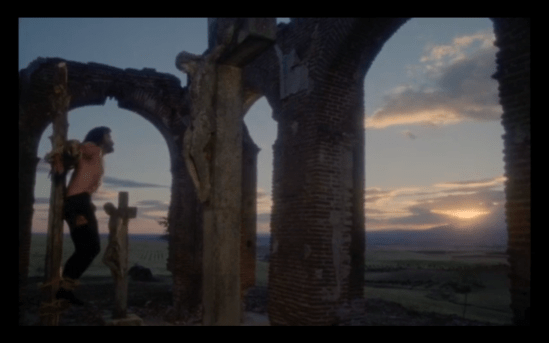
Mondo Macabro and CAV Releasing presents the unrated, non-limited edition of Paul Naschy’s “The Devil Reincarnate” onto a region free, 1080p, BD25 Blu-ray home video with a brand new 4k transfer from the film’s negative and displayed in a widescreen, 1.66:1 aspect ratio. For a negative from 1979, the transfer aims to please with hardly little-to-no damage or other deterioration flaws, no awkward cropping, and no tinkered enhancements detected. Coloring is flattering despite the hint yellowish tint. Some of the darker scenes lose sharp definition do to poor lighting, but there are breathtaking landscapes, especially when Naschy is strung up on the cross, with a vivid, natural aesthetic to the release. The Spanish Dolby Digital LPCM mono, at 24fps, with optional English subtitles packs quite a wallop with robust scuffles, clanking of swords, and a clear rendering of Ángel Arteaga’s zany and harrowing compositions. The extras include an introduction from Paul Naschy, exclusive interviews with costar David Rocha and Naschy’s sons, Sergio and Bruno Molina, a tour of Paul Naschy’s study and home, and exclusive audio commentary by Troy Howarth, author of various horror historical directors and moments in cinema. There’s no contest. “The Devil Incarnate” is, without a single seedling of doubt, the best film of Paul Naschy’s extensive body of work and it’s a film that reinstates an immense amount of melancholy into the soul when regression is setting in that human beings never have been and never will be better than the Devil himself.

Own it today! Click to buy at Amazon!

 It's Bloggin Evil!