Dinner Parties and the Special Guest is EVIL. “Climate of the Hunter” reviewed! (Dark Star Pictures / Blu-ray)

MIckey Reece’s “Climate of the Hunter” Now Available on Amazon.com

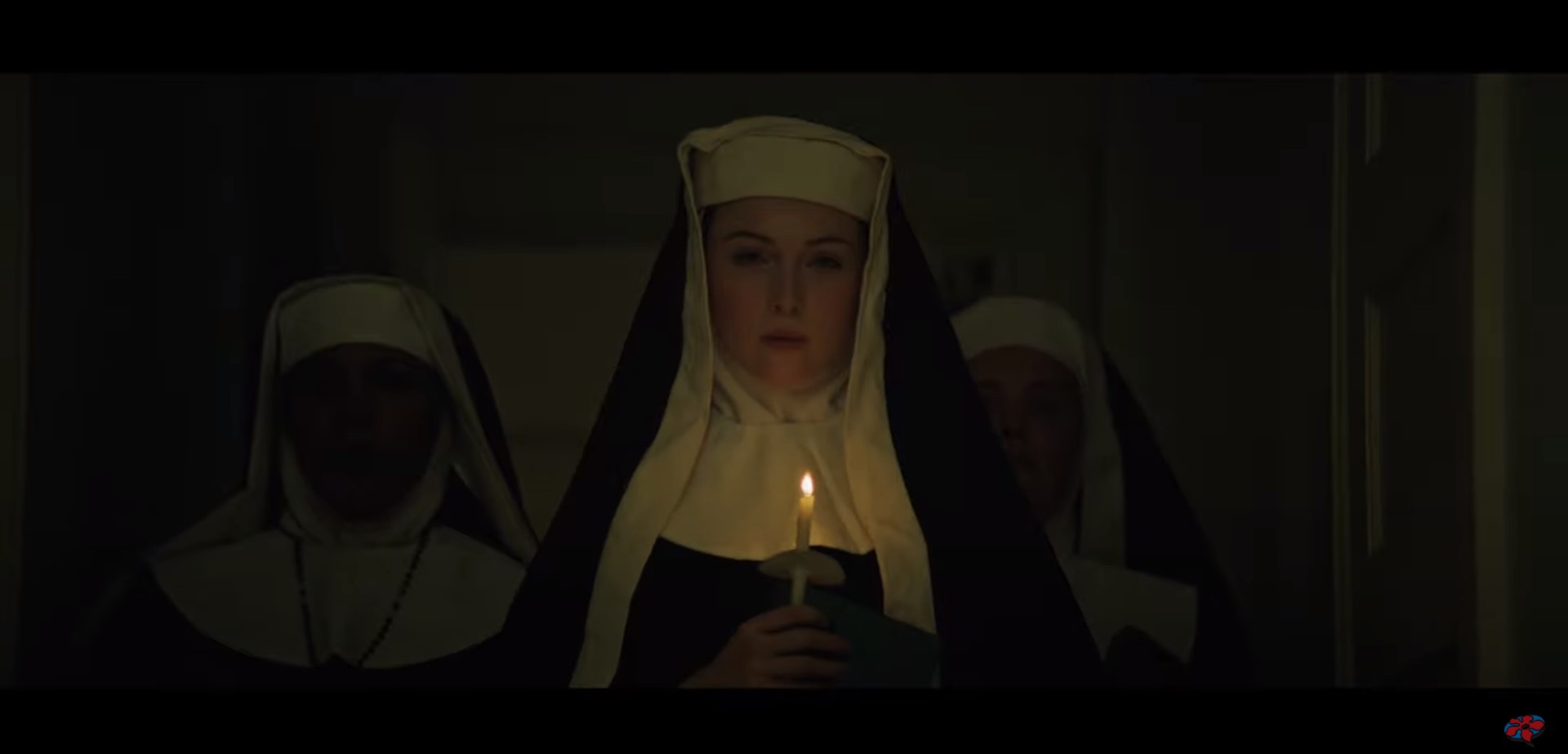
Sisters Alma and Elizabeth meetup at their childhood cabin for a quick getaway.  Their individual neurosis induces the incessant minor league friction between them but never causing any real strain until an old friend, returning from abroad, arrives at his neighboring cabin alone.  With his wife suddenly committed to a mental institute, the well cultured and practically single Wesley finds himself in the company of the desirous Alma and Elizabeth every night for dinner as they vie for his attention and affection.  When Alma crosses paths with Wesley’s strange and curious vibes, they compound upon her baseline suspicion of Wesley possibly being a vampire.  Elizabeth finds herself the victor of Wesley’s adoring warmth, leaving Alma to ramp up her scrutiny into their longtime acquaintance before her sister falls victim to his deadly charm.

Arthouse meets grindhouse in this Mickey Reece written and directed mystery thriller “Climate of the Hunter.”  Co-written alongside frequent collaborating screenwriter John Selvidge, the 2019 take on subtle vampiric ambiguity is punctured, tapped, and drained from the same blood rich veins as Robert Bierman’s “Vampire’s Kiss,” starring Nicholas Cage, and George Romero’s “Martin,” but instead of a protagonist believing in the transference into a bloodsucking creature of the night, “Climate of the Hunter” steps back furthering by approaching with a more elusive and Lynchian-like 3rd party perspective as the story focuses prominently the sisters’ thoughts and actions while Wesley does what Wesley does without self-doubt or obvious distinction.  Shot during the winter months of the diffusely populated woodland area of Welling, Oklahoma, “Climate of the Hunter” is the sole released presentation of Mikey Bill Films and the more seasoned VisionChaos Productions (“The Field Guide to Evil”) under executive producers Uwe R. Feuersenger and Sasha Drews in collaboration with production companies of Adam Hendricks and Greg Gilreath’s Divide/Conquer and Jacob Snovel’s Perm Machine Productions.

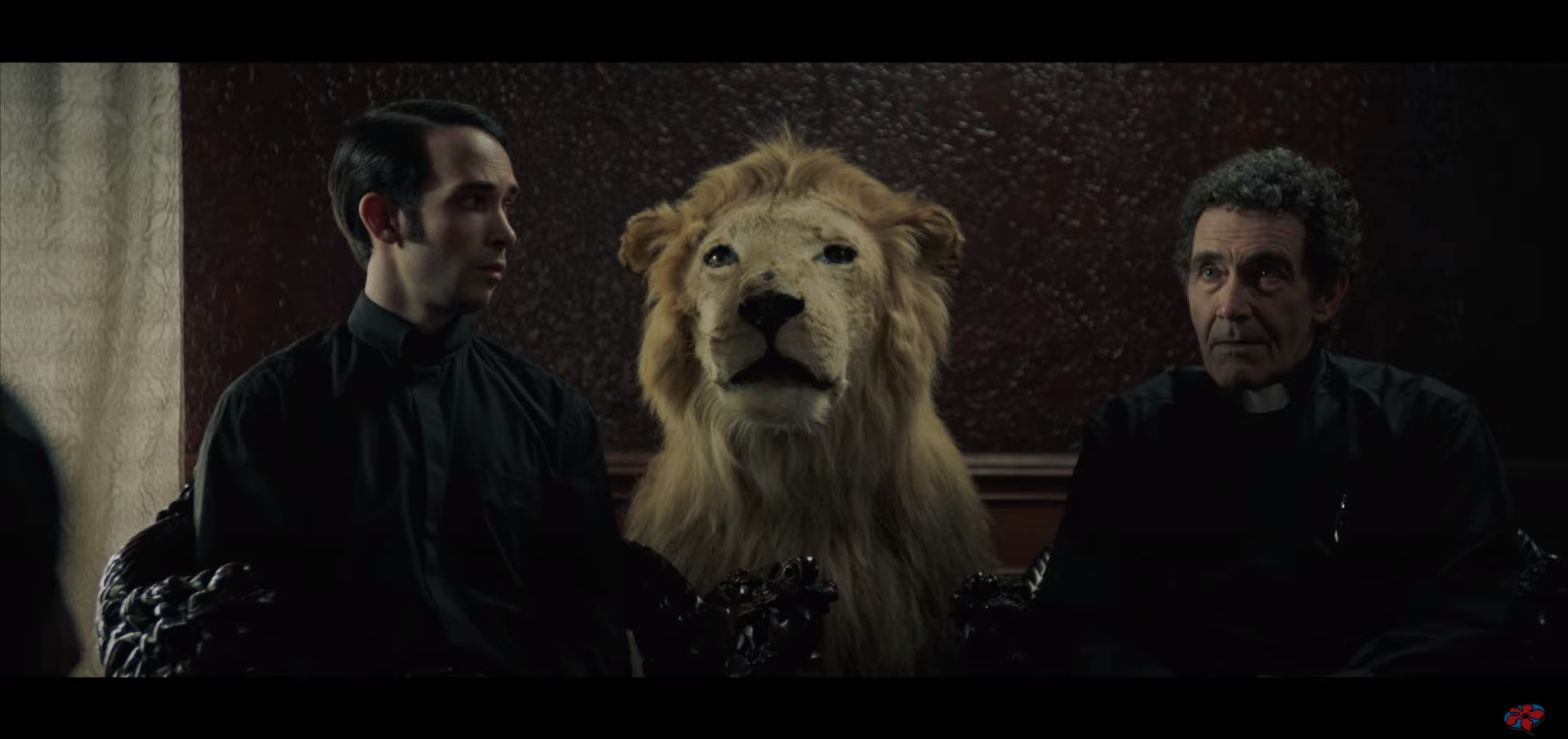
Diving into his best performance as an enigmatic rake with unpronounced intentions is “Minari” actor Ben Hall, who recently costarred as a crises of faith priest in Mickey Reece’s latest release, the comedy-horror drama, “Agnes.”   As the sophisticated wordsmith neighbor, Wesley commands every ounce of oxygen all in thanks to Hall’s elegant pacing of Wesley’s uttered mannerisms and inflections.  Hall is joined by fellow “Agnes” costar Mary Buss as the pining Elizabeth.  Elizabeth practically resents Alma’s seemingly historical persistent hold over Wesley’s affections and Buss bitterness, whether because of Wesley or because of Alma’s uncharacteristic behavior as of late, oozes into the stagnant folds of their relationship.  If you haven’t figured it out by now, “Climate of the Hunter” has an Oklahoma-centric and Mickey Reece’s staple go-to cast, which brings us to the other sister Alma played by Ginger Gilmartin who fits into that aforementioned niche category.  Alma is running from something that goes essentially unsaid that leads her to hide out in the family cabin and Gilmartin, as best as she can, shepherd’s that motivation without the better part of context.  Alma’s also dresses like a crazy cat lady, except she owns a dog, and so reading Alma’s state can be taxing to nail down in an arthouse film where nailing down anything in arthouse cinema is inherently taxing in itself.  The small cast rounds out intermittently with smaller roles that build upon Wesley’s vague nature beginning with a local friend to the sisters named BJ Beavers (producer Jacob Ryan Snovel).  Witnessing Wesley’s strange behavior but oblivious from his own strangeness, BJ becomes a confidant and a collaborator with Alma in revealing Wesley as a vampire.  Sheridan McMichael grows resentful toward his father as Wesley’s spiteful son Percy, Danielle Evon Ploeger seeks incompliancy from her mother Alma as her daughter Rose, and, in the more curious role, is Laurie Cummings (“It Lives Inside,” “Army of Frankensteins”) as Wesley mentally incapacitated wife who somehow manages to lose her wheelchair as it drops from the sky.  You’ll know what I’m talking about when you see it!
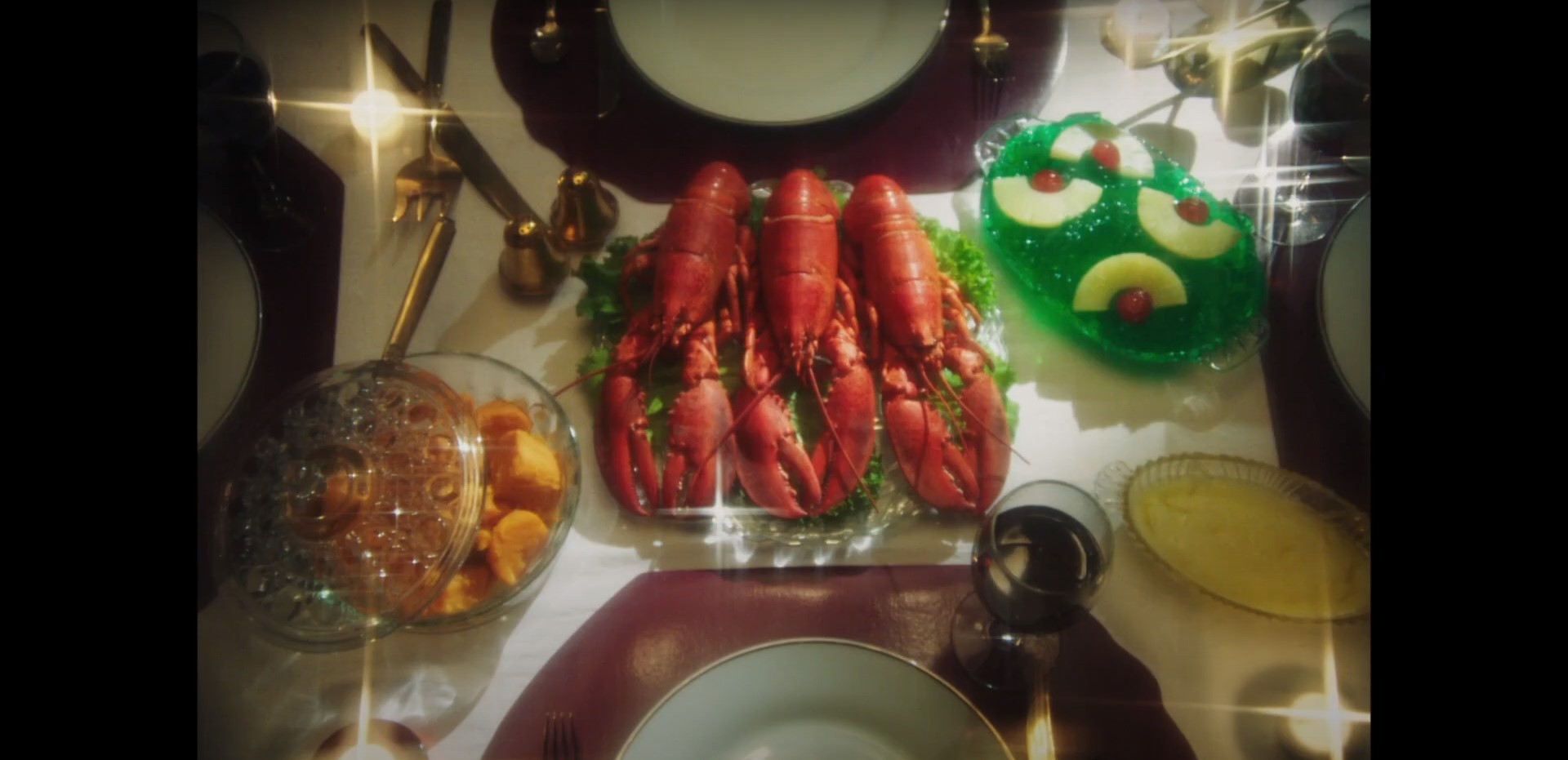
Having watched “Agnes” before diving into “Climate of the Hunter,” I mentally prepared myself for a breathy, long-winded, talking head film.   That readied mindset 100% gave me more clarity into Mickey Reece’s shadow narrative.  “Climate of the Hunter” is an uncharacteristic slow burn for the idiosyncratic grindhouse veneer.  With a 4:3 aspect ratio and a color reduction into a warm hue palette that glows, Reece insists on a design that usually offers loads of cheap thrills in action, sleaze, and gore, but the director’s story is toned down, subtle, and very much ear candy as opposed to a rush of visual adrenaline.  Instead, lucrative character building fizzes with tension as elements of the past and present unravel who’s who and what’s what before the climatic finale that suggests nothing was what it seemed to be.  Though prepped for profound exposition, the dialogue can still be boggling with a composition of Wesley’s personal anecdotes and philosophical quips and quotes.  As stated, Ben Hall is amazingly poised in this film, the unflinching star, rolling easily with Wesley’s gift of gab, persuasive magnetism, and maintaining an oblivious eye to an undercurrent of potential classical madness in Alma.  Between her recreational use of drugs and an ugly divorce, Alma has retreated into herself as well as her isolating cabin and when the spotlight isn’t on her, is her perception of Wesley really fantastical or is there actually something broken within her.  Reece explores a related theme of loneliness around the table with each principle character and how differently being lonely is digested and secreted through the pores of desperation.  Once aspect of Reece’s film that will puzzle viewers, and did puzzle me, is the narrated introduction of the food whenever there is a tabled conversation.  Since there already Portuguese titled chapters segmenting the story, a bit of a harp back to Wesley’s travels abroad, announcing what the character are dinning on seemed virtually unnecessary other than the idea that food brings people together in which it then fits the narrative of loneliness. 
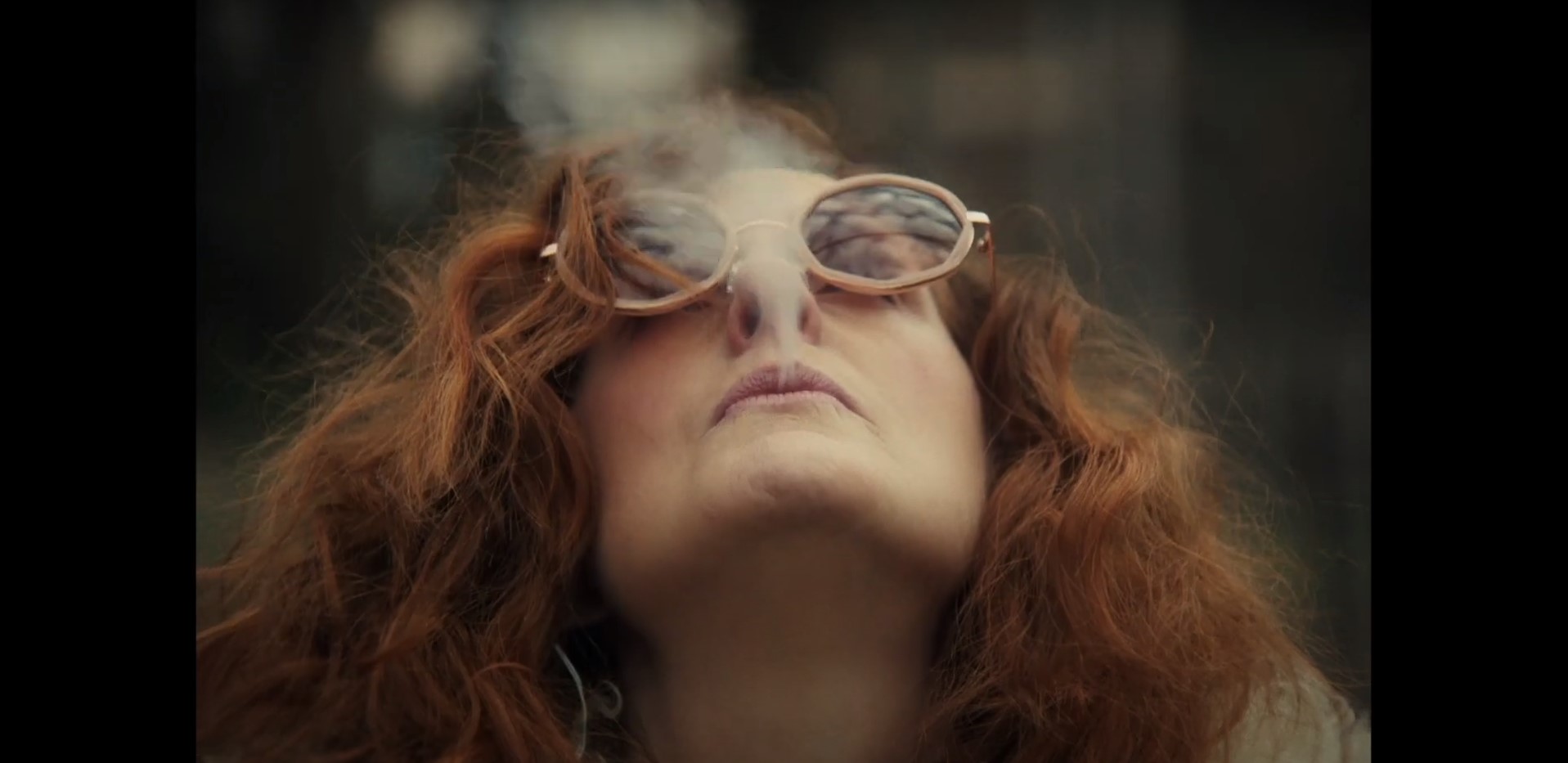
“Climate of the Hunter” is quintessential Mickey Reece melodrama tinged with droplets of horror and subtle dark comedy.  Dark Star Pictures releases the film onto region free, dual layer Blu-ray home video in full 1080p High Definition.  Reece and director of photography Samuel Calvin aim for a vintage but not superannuated look for “Climate of the Hunter,” in which follows suit with the story set circa 1970s, with a 4:3 image on a pillarbox 16X9 display, relying also heavily on a softer lens to produce a dreamlike and luminescent effect but not overdoing it.    The release comes with two audio options – an English language 5.1 DTS-HD Master Audio and, if one wants to fully immerse themselves in the era, a stereo 2.0.  Dialogue is crisp and clean as it is refined as expected. Levels are balanced, range and depth are acceptable, but with this sort of wordy production, switching between the 5.1 and the 2.0 only discern subtle differences. Optional English SDH subtitles are available. The not rated, 82-minute-long film has special features that include another full-length Mickey Reece entitled “Strike, Dear Mistress, and Cure His Heart” as well as a short film “Belle Ile,” deleted scenes, production designer Kaitlyn Shelby’s preparations of the food presented in the film Recipes from the Kitchen of Alma Summers, and production stills and behind-the-scenes gallery. “Climate of the Hunter” deserves at least a once over and, in my opinion, a second viewing to become fully submersed in Mickey Reece’s dialogue rich and nebulous style.

MIckey Reece’s “Climate of the Hunter” Now Available on Amazon.com

EVILs Make Difficulties in Finding God. “Agnes” reviewed! (Magnet Releasing / Digital Screener)

Blemished man of the cloth, Father Donaghue, and a neophyte are summoned to perform the holy rite of exorcism on a possibly possessed nun, Sister Agnes.  Disadvantaged and forced by his own scandal, Father Donaghue is ordered by the local Bishop to oversee the matter before they ship him overseas to avoid further disgrace upon the Church, but the skeptical priest, who has performed many exorcisms in the past, has never once believed he was casting out a demon but, rather, relieving a guilty, tormented soul seeking divine forgiveness.  When the priests confront Sister Agnes, the situation is violent, wily, and unlike any possession Father Donaghue has ever seen before.  The incident casts doubt over Sister Agnes’s friend and fellow nun, Sister Mary, who leaves the convent to try and live on her own and find God in the real world her own way, but a little bit of Sister Agnes has seemingly rubbed off onto her. 

You gotta have faith, sang once by pop-rocker and songwriter George Michael (and Fred Durst, if want to go that route) and though Mickey Reece’s “Agnes” doesn’t necessarily croon a rebuttal, the Oklahoma City born filmmaker surely splits hairs with a formidable blockade that advocates the crisis of faith cinematic model with layered horror.  The “Climate of the Hunter” writer-director’s latest quasi-horror-comedy and full-throttle religious drama questions the validities of finding God on a personal level with a divergently cut screenplay co-written with frequent script partner John Selvidge, whose current post-production penned time-warping horror entitled “Wait!” coming next year.   “Agnes” is filmed in the heartland of America inside Reece’s home state of central Oklahoma and is a reteaming of Mickey Reece and producer Jacob Snovel of Perm Machine with Greg Gilreath and Adam Hendricks’ Divide/Conquer (“Black Christmas” 2019 remake, “Freaky”) as the production companies and is first feature presentation for Molly C. Quinn, Matthew M. Welty, and Elan Gale’s QWGmire Productions.

One-third of the head of QWGmire is also the “Agnes” leading lady as Molly C. Quinn, who doesn’t play the titular character, plays Mary, a nun and friend of the possessed plagued Agnes (Hayley McFarland, “The Conjuring”) with a tragic background that ambiguously parallels a similar path to the mother of Jesus, also named Mary for all you non-Christians out there.  Mary is tender, quiet, and self-effacing but determined to pave her own way without the means of charity, especially those of the unsavory-favor nature, and consulting God for answers.  Quinn is perfect to shoulder Mary’s innocent disposition and does carry her naïve meekness throughout up until Mary’s gradual decline toward her faith that turns the sweet and innocent young woman into a pragmatic doubter, spurred by Agnes’ sudden otherworldly turn from devout to impiety that becomes more than what meets the eye.  However, in kicking off Reece’s film, one would have thought the exorcism of Agnes would emphasize more heavily on Father Donaghu (Ben Hall, “Minari”) and soon-to-be priest Benjamin (Jake Hororwitz, “Castle Freak” remake), but despite the involved build up of Father Donahu’s sordid past that conflicts with the Church and his struggles with the exorcism, Reece and Selvidge ultimately do, in what feels like, a pulling of the plug on a storyline that followings in the footsteps of “The Exorcist.”  That is, in my opinion, the downfall of “Agnes’” story in elimination of really interesting character arcs right in their girthy throes, leaving audiences hanging on Father Donaghu, grocer owner/low-end gangster Curly (Chris Sullivan, “This is Us” and “I Trapped the Devil”), ostentatiously swaggering Father Black (Chris Browning, “Let Me In”) and even the titular character Agnes fails to flesh out fully.  Rachel True (“The Craft”), Zandy Hartig, Bruce Davis, Chris Freihofer, Ginger Gilmartin, Mary Buss, and “Guardians of the Galaxy” and “Suicide Squad’s” Sean Gunn as a standup comedian and Mary’s love interest.

“Agnes” loosely follows a couple of Catholic patroness saints in Agnes and Mary derided in a contrary sense.  Agnes, the virgin martyr in Catholic veneration, opposes the Church in the film with flashbacks of her embracing an indulgent life along with her sexual insults that’s uncouth for the patroness saint of pure little girls.  Mary’s a little more recognizable with a previous, ambiguous account of her child’s death (aka Jesus Christ?).  Plus, there’s the religious imagery, amongst others in the film, of Mary with bleeding eyes as an analogous to the weeping statues. Reece blatantly shows most men and women of the cloth to be unorthodox Orthodox Catholics from Father Donaghu’s troubling allegations to the mocking head priests. Mother Superior throws around her superiority amongst the convent nuns and even the Bishop, who doesn’t ever say a word in his brief scene, appears smug and high and mighty with his stature, letting his assistant communicate (and excommunicate) all the ugly business. Only a non-priest, training to be ordained, in Benjamin is the only innocent, infallible Christian who captures the humble essence of God and the only one who can capable in rejuvenating Mary’s faith. “Agnes” is all about doubting faith whether be by demonic possession, the loss of a child, all forms of corruption, and more, but Mary keeps striving, struggling, and searching for that spiritual lifeline amongst seedy and unscrupulous faithless charlatans slowly poisoning her to be the same. However, the “Agnes” story divides too sharply leaving the acute crisis of faith to be nearly lost in translation and is practically a wandering spectrum of identity that’s roughly craft glued together by Reece.

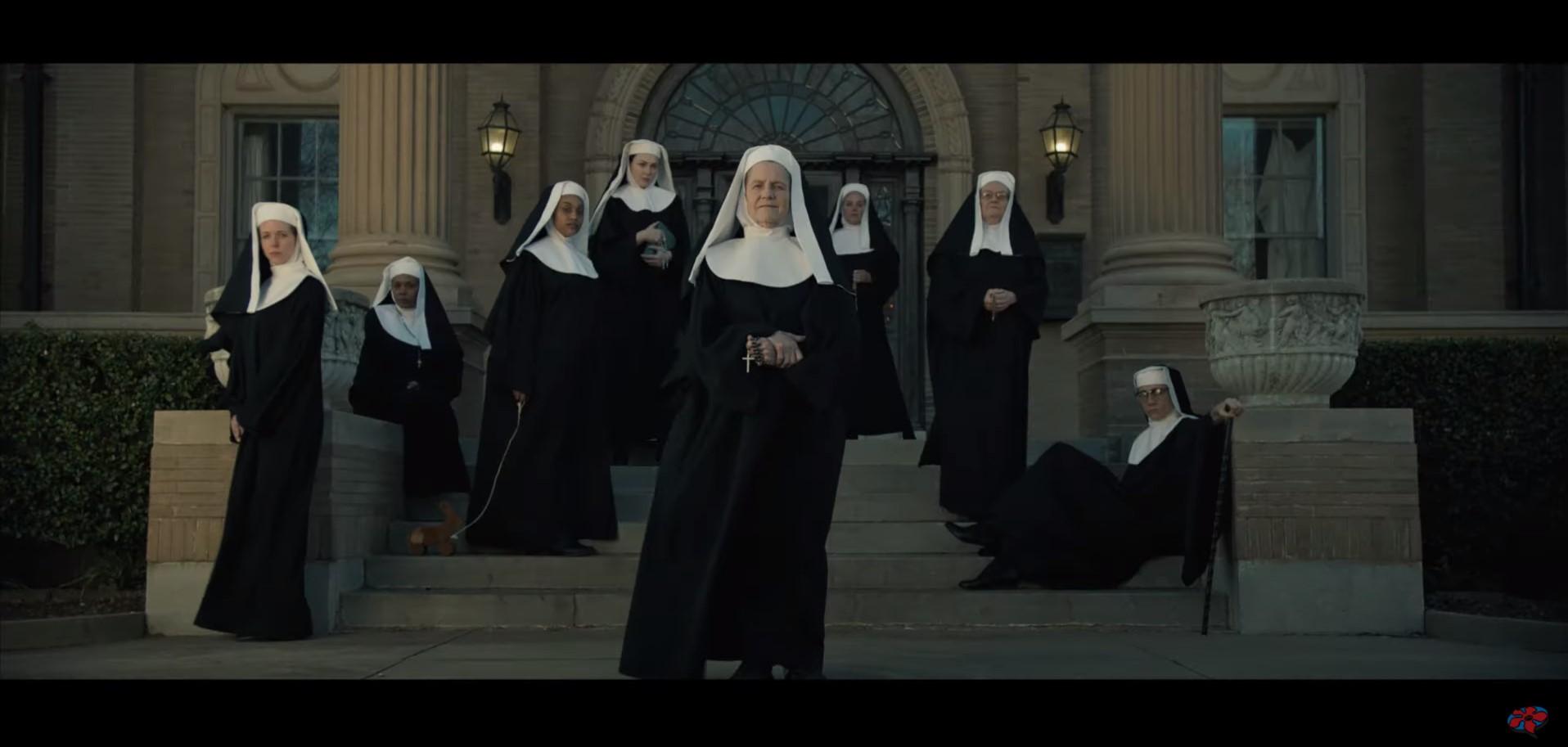
Some may see the film’s poster and excitedly expect Nunsploitation but the reality of “Agnes” digs at the hypocrisy of people and the endless search for faith. What it’s not is the sexual exploitation or sadomasochism of chaste nuns. Give Mickey Reece’s horror-comedy drama “Agnes” a faithful shot come it’s December 10th theatrical release from Magnet Releasing, a subsidiary of Magnolia Pictures. “Agnes” has a runtime of 93 minutes and presented in a 2.55:1 aspect ratio. Typical of any Mickey Reece film, his melodramatic horror-comedy fits into his oeuvre of talking head cinema so leave expectations of brooding and atmospheric milieus at the door for more realistic, down-to-Earth scenes, which is a bit surprising since the cinematographer behind “Hellraiser: Judgement” and “Children of the Corn: Runaway,” Samuel Calvin, has an eye for unhallowed aesthetics. Calvin does produce some perfectly poised shots with the flock of nuns and the ever slightly deviant angle to sharpen a scene. No bonus features were included with the digital screener nor were there any bonus scenes during or after the credits. “Agnes” floats on a haphazard timeline of dark, melodrama comedy for a desperate need of faith against the immense heartache, the crudely selfish, and the absence of morality all of which incessantly imposes upon the good to assimilate.

There’s Evil in Oklahoma! “Meet Me There” review!

vlcsnap-2015-07-14-20h21m44s241

Ada and her boyfriend Calvin love each other tremendously, but Calvin finds difficulty in their intimacy when Ada continues to push him away, as if hurting her, in the middle of intercourse. Her sexual dysfunction puts a strain on their marriage, but Calvin has a plan that he hopes will resolve Ada’s, as well as Calvin’s, intimacy issue. His plan involves travelling to her hometown of Sheol, Oklahoma where much of Ada’s childhood memories seem to have been repressed and might be the root cause of her mental blockage. When they arrive at Sheol, they’re not exactly welcome as the town’s deranged inhabitants have a bible-thumping darkness about them and they don’t agree with Ada’s and Calvin’s lifestyle. When the couple try to escape, the town won’t let them.
vlcsnap-2015-07-14-20h24m37s189
Director Lex Lybrand helms the “Meet Me There” story, written by Brandon Stroud, and Lybrand seems to lose the structure as soon our hero and heroine arrive in the town of Sheol. The film tries to relay underlining messages about sexual dysfunctions, repressed or fragmented memories, suicide, paranoia, and, of course, just plain lethal psychosis. In short, “Meet Me There” attempts to mask the mental repercussions of childhood atrocities with a story about a couple becoming trapped in a town of deadly druids and God-fearing folk. Lybrand didn’t quite pull off the effect I think he was going for and that was creating an overall nightmarish realm without no escape, like a bad dream you’re unable to awake from, and what was missing was smooth segues to keep the glue together for the plot to naturally play out.
vlcsnap-2015-07-14-20h29m25s244
The story’s outer shell might be compromised, but only technically from a director’s chair. The introductory story of two complete strangers meeting at an airport bar, flying in separate passenger seats to Sheol, renting a car together to head to the same destination, and only to blow their brains out in a field at the same instance becomes lost in reason without the backup of exposition. However, the story of how Ada overcomes her sexual dysfunction and her fragmented memories can’t be any clearer and once she realizes and understands her upbringing involving drugged up parents, a creepy Grandfather, and a verbally abusive father, she bangs Calvin in the middle of the field, half naked and without care.
vlcsnap-2015-07-14-20h29m26s2
Lisa Friedrich and Michael Foulk as Ada and Calvin make a mediocre convincing couple. Their tattoos and choice of music, whether created for their characters or in most micro-budget productions the actors just have to bring themselves, labels them as rebellious to which heightens the towns’ scrutiny upon them. Foulk has great timing in his delivery when being comical with Ada, fairing rather naturally for him. Friedrich’s character lumbers a good amount of the film; her spacey attitude leaves nothing to desire and her character becomes dislikeable. I don’t blame Friedrich for a character written too sluggish and poorly for viewing comfort because even when Ada triumphs over her problems, she’s still very out of sorts.
vlcsnap-2015-07-14-20h26m02s10
Ada and Calvin don’t really have a single antagonist pitted against them; basically, the whole town is against them. WWE’s Golddust, aka Dustin Runnels, is one of a many wrestlers who appear in “Meet Me There,” along with other unknown wrestling talents such as Addy Starr, Leva Bates, and Angelus Layne, and is also one of the villains as the town’s preacher. There’s also Ada’s paranoid Aunt who severely disapproves of Ada’s lifestyle choices, the country store bumpkins who wield shotguns, the cloaked orgy-committing druids, and etc. Now, that all might sound enticing, but only the orgy gives a little stimulating thrill to the bone. I would like to know who set fire to Ada and Calvin’s car because the effect is priceless; when Ada and Calvin return to her aunt’s house to flee town, their car is set to inferno and someone on the crew thought that a matchbox car with blazing flames through the windows and being shot up real close would be pass for a great special effect. I admit, the effect kind of works, but still hilariously executed.
vlcsnap-2015-07-14-20h25m07s230
“Meet Me There,” distributed by MVDVisual and produced by SGL Entertainment, is presented in a widescreen presentation with a standard 2.0 mix. The images a bit grainy with dark tones during night scenes. Overall, “Meet Me There” needs a bigger catalyst to get Ada and Calvin into a more dire situation, but the sensation of being in a bad dream is achieved here yet the transitions from act-to-act or even scene-to-scene becomes muddled. Check out Lex Lybrand’s “Meet Me There” and see what the town of Sheol has in store for our hero and heroine.