Family Tree Rooted by Grounded EVIL. “Sator” reviewed! (Umbrella Entertainment / DVD)


Living alone deep among the tall trees and the dark and deafening foliage around him, a tragic past involving the disappearance of his mother haunts the very core of Adam’s broken spirit as he wanders the forest he grew up in and that has also been an afflicting mystifying presence of family lore.  His grandmother, Nani, for a long time has been commenting being the receptor of a dark forest entity named Sator who internally speaks to her and has her write down unintelligible messages; Sator’s words have also whispered in Adam’s ears as well as his vanished mother’s.  Adam ceaselessly searches the clues daily, even setting up a night vision deer cam and ringing out into the woods with a homemade calling flute.  As Adam and his family struggle to rebuild their once strong bond, Sator emerges with an intent to sever what’s left of the tattered strings of family ties, bearing down on the isolated Adam in attempt to insidiously claim more of his kindred for the forest.    

Rich in personal family indispositions that trickle down to unravel everything dear, Jordan Graham’s sophomore supernatural film of a sinister spirt, “Sator,” is much better than my attempt at an alliterated sentence structure.  The 2019 film, hailing out of California, with the forest sequences from Yosemite National Park, is a blend of pristine splendor as it is a nocturnal nightmare in an allegory of mental illness and the distortion of family because of the effects.  For the “Specter” director and screenwriter, particulars of “Sator” intertwine the authenticity of the filmmaker’s ancestry with the ominous unknowns of horror in a DIY production that looks bigger and grander in worth than in actuality.    Graham’s production banner, Mistik Jade Films, and in association with Yellow Veil Pictures, the company behind the colorful demonically intrusive thriller, “Luz,” funds the film with Jordan Graham serving as executive producer alongside Jennifer Graham and Elias Adamopoulous.

“Sator’s” a family and friends affair that opens with Gabriel Nicholson silently, patiently, and near aimlessly wandering through the woods as Adam walking alongside his mutt and carrying a hunting rifle. Jordan Graham’s childhood friend since early teens, Nicholson fills adequately the role’s achy privation and does so without saying so much as a paragraph in the full 85 minute runtime. While “Sator” snuggles up to Adam’s incessant need to check deer cams and conduct daily searches around every rock, tree, and bush, the character isn’t the nucleus essential to Sator’s generational influences that spread like a cancer over Adam’s lineage and he’s where the buck stops. Instead, Jordan Graham’s grandmother, June Peterson aka Nani, bears unwittingly and unimpressed brunt of the actor’s burden to perform due to Peterson’s longtime battle with dementia. Her scenes are authentic and natural in discourse with the recollective ramblings of Graham’s family’s resident topical presence – Sator. Peterson holds all the cards for her grandson’s inspiration from the very name of the entity that speaks to her to the automatic writings set in motion during a stint of Sator’s sometimes hours upon hours of inner ear verbal instructions. Graham doesn’t exploit his grandmother, but rather tells her story in a way dementia allows her not to with recording her experience, with the papers of her automatic writings, and with extending Sator into a metaphor for family strife and mental illness. Rarely are Nicholson and Peterson on screen together, but they come in proxy of one another through the supporting characters played by Michael Daniel as Adam’s troublesome brother, Pete, Rachel Johnson as an unusual relative, Evie, and Wendy Taylor as the bygone mother only remembered in flashbacks and Adam’s documentary memories.

There are movies out in cinema land released for the sole purpose of dishing out entertainment complete with exorbitant special effects and a high profile cast surely to make good on bank statement returns and then there are some with a more somber, but well-crafted, personal story.  “Sator” is the very epitome of that latter category as director Jordan Graham’s profoundly personal story that is tailored to his specifications without the temptation of commercial success.  With dividends on the backburner, “Sator’s” arthouse quality stamps a staid dread of distressing imagery and stillness emblematic from an imprinted personal experience that has been dissected and dispersed to give the entity known as Sator a fluid corporeal form.  What also scores high marks is the ideology of Sator created by, or perhaps more accurately channeled through, June Peterson, forming the breadth of life out of an unseen concept glamourized with unimaginable abilities and attributes that can foraged out of Paganism or Satanic scriptures and have nature be the embodiment of its unholy divinity.  Graham not only unnerves you as passenger looking into eerie family history with “Sator’s” transmissions at the narrative core, but also serenades with serrating stridency in his audio and visual compositions that includes some fantastic gore and torching.  The one thing to point out that “Sator” falls short on is understanding the next jump in the narrative as Graham leaves unclear wide gaps unexplained with only a bit of passive dialogue to gnaw on to get caught up.  In a story that’s already subversive on the plainspoken, “Sator” could use some straight talk to get more inside the dissonance of the entity’s inimical ways.

Let “Sator” whisper into your ear on an Umbrella Entertainment home DVD release. The region 4 DVD comes standard in a NTSC format, like of the Australian distributor’s releases do, and is presented in a widescreen, 2:35:1 aspect ratio. Image quality is paramount for a downbeat psychological horror set inside the absence of noise of a pin drop forest and the release delivers a stunning transfer with elaborating details in the forest setting. Perhaps slightly on the darker on the scale, the engulfing blackness of the cabin, the woods, and Nani’s home add to the surrounding cryptic presence notwithstanding the absence of a body to call the villain. The darker shadows Graham creates sees better contrast in dreamlike sequences with the deep blue sky with a moon over head, the silhouette of the trees, and Adam standing small against the tall trees in his white skivvies, creating stark poetry in the image alone. Graham also incorporates a documentary style, through the mind’s eye of Adam, to replay events like flashbacks that set the stage for the present. The English language Dolby Digital 5.1 surround sound is works inline with the rubato score that creates a pulls and tugs on the emotions. The dialogue isn’t so lucky as actors can only be heard mumbling the lines with the exception of Nani with her natural, genuine talk. Like many of the Umbrella DVD releases, there are no bonus features includes and there are also no bonus scenes during or after the credits. “Sator” thrives as holistic horror with the insurmountable belief that there are far worse things out in the world than mental deterioration that spur random acts of equivocality.

Own Sator on DVD from Umbrealla Entertainment (Region 4)

Furbish the Four Walls EVIL Lives Inside of Your Brain with “The Yellow Wallpaper!” (Hysteria Pictures / Digital Screener)

A prominent physician escorts his wife, Jane, and newborn child to a secluded countryside home after a severe episode of hysteria rattles Jane’s mental state.  For three months in the Summer, Jane is confined to the house grounds with strict instructions to do nothing to exert herself other than to partake in a little gardening.  Even writing, which was profusely Jane’s pursuit, is harshly forbidden.  The bedroom she shares with her husband is nearly unadorned with only their bed in the middle of the room and yellow wallpaper ornamenting all four walls.  As the weeks pass in isolation, Jane can’t escape the feeling the yellow wallpaper is creeping into her mind, imprisoning her, and driving her mad, lending her relaxing retreat from societal nervousness be laid to waste in solitude. 

Charlotte Perkins Gillman’s short story, “The Yellow Wallpaper,” has seen a fair share of filmic adaptations in over a span of a century since being published back in 1892, but all of those variated works have been grounded in the last four decades .  Amongst the numerous shorts and a handful of features, the most notable version of “The Yellow Wallpaper” would be Logan Thomas’ 2012 interpretation, starring Juliet Landau, daughter of the late Martin Landau.  That’s the funny thing about public domain property is it opens up a plethora of pathways to spin and redefine creativity to rework Gillman’s feminist tale from the artists’ voices speaking of the times when women’s mental health, and mental health in general, was perceived naively as anxiety.  Kevin Pontuti steps up to the plate to take a crack at the spiraling to madness story as the filmmaker’s inaugural feature directorial of the American and Ireland co-produced celluloid from an adapted screenplay written by the director and co-written with the story lead actress and producer, Alexandra Loreth.  Under the duo’s entertainment banner, Hysteria Pictures in association with Ireland’s Emerald Giant Productions, the crowdfunded “The Yellow Wallpaper” project receives the latest contemporary treatment that brings Gillman’s words back to the screen.

Co-writer and producer, Alexandra Loreth, takes the lead as Jane coming down off the ledge of a nervous breakdown but still ballooning with instability that’s stretching her fashioned societal-front seams. “The Yellow Wallpaper” is also the California based filmmaker’s first feature film alongside Pontuti, basically penning Jane’s entire mindset of combating the time’s unfamiliar sexisms and mental health. Loreth crawls on her hands and knees, feign glossy, far away eyes, and be cold and distant to be in tune to a woman disassociating with herself and reality and, truth be told, portrays a convincible case that shows feature debut courage with on screen nudity and a stamina for being the focus for the entire 99 minute runtime; however these acts remain stuck in a excessive loop that roots Loreth’s character decline to one a taciturn setting, lacking range and depth to carry Jane into full metal straightjacket crazy. Opposite Loreth is Irish actor Joe Mullins as John, the physician, the only character mentioned in Gillman’s short story. Mullins impels like an automaton through the role with not a lick of zestful misogyny to contrast against. Loreth completely dominates the screen as you barely notice Mullins whisk in and out of scenes to medicate Jane or comfort her with little white lies. John’s dismissive attributes were more dispassionate with Mullins behind the wheel that leaves only half the work’s presence omitted and it’s sorely felt. In the role of Jane’s domicile caregiver, Jeanne O’Connor paves a road of sturdy era authenticity that also is fleeting from “The Yellow Wallpaper” and with her 19th century genteel aesthetics, we’re sucked into the period to keep us grounded in time. Performances round out with Clara Harte as the abstruse infant caregiver and Mark P. O’Connor briefly standing in as Jane’s doctor brother.

Pontuti and Loreth’s “The Yellow Wallpaper” targets the very essence of Gillman’s journal narrated themes of the downplayed and untapped mental health and the secondary expectations of women in 19th century society.  The differences between the 1800’s paper and 2021’s movie narratives are ever so slightly tweaked into the contemporary medium with Loreth narrating right from Gillman’s pages word-for-word in between the auxiliary scripted dialogue and the finale concluding toward a more grim avenue that will surely satisfy the more macabre of hearts.  Yet, not enough material could be extracted from the short story to entice as entertainment as the adaptation lingers in monotone fashion. Jane carries on about the woman trapped behind the yellow wallpaper and is shown going in circles of staring at the wallpaper, crawling on her hands and knees on the estate grounds (as describe in the short story), and just being listless throughout the entirety with her mental issues linked to post-partum and drowning in passive despair.  Perhaps better suited for a short film, as many have been completed already, audiences will become tiresomely and frustratedly lost in all of Jane’s 99-minutes of tedium as there just isn’t enough to sate a feature length film unless you add embellishing bells and whistles in the realm of supernatural or the puppeteering of an unseen force symbolizing Jane’s fractured mindset. Don’t expect “The Yellow Wallpaper” to paint a gripping tale of feministic horror as the story peels off in a superannuated ream of soapbox issues.

“The Yellow Wallpaper” made its world premier this past March at Cinequest in San Jose, California. The film is shot in a modernly unconventional 4:3 pillarbox aspect ratio aka the black bars on each side of the near square image presentation. The intention by cinematographer Sonja Tsypin (“Scare Package”) was to meet the age of Gillman’s original. Yes, I know in 1892, video wasn’t exactly a thing, let alone pillarboxed formats, but aspect ratio does point the a modern adaptation into the right blast from the past direction. What is also curious about Tsypin’s photography, and I’m not positive if this is in fact intentional or not, is the lesser frame rate that induces jumps in the picture in an almost lag effect that doesn’t add much but of annoyance to the viewing pleasure. I was slightly more impressed with Robert J. Coburns score fathomed the depth of disturbance going through Jane’s head and lured out the creepy that played like a broken-melody music box. There were no bonus scenes during or after the credits. Even with a well established and powerful ending shot, a preserving memento of the patriarchy’s ill-conceived mansplaining of a woman’s mind and body, and an intrepid performance by Alexandra Loreth, “The Yellow Wallpaper” stagnates in faithfulness to Gillman’s short and doesn’t offer new and improved ideas of century old, feminist gothic literature.

When EVIL Knocks at the Door, Don’t Answer It. “The Strangers” reviewed! (Second Sight / Blu-ray Screener)


Kristen and James return home late from a wedding reception to James’ isolated family home off the main road. The joyous occasion becomes an afterthought when an unprepared Kristen declines James’s subtle engagement proposal outside the reception venue, straining their once jovial relationship into uncertainty of where it stands now. Before the couple discuss relationship next steps, a strange knock on the door around 4am becomes the initial stirrings of a clouted atmosphere brimming of paranoia, fear, and confusion when three masked strangers menacingly toy with the couple. The fight for survival in the dark early morning hours will determine their fate against strangers compelled to kill them just for the sake of killing.

Call me 12 years behind as I catch up on getting caught up into the brutal home invasion thriller, “The Strangers,” from writer-director Bryan Bertino. “The Strangers” has been panned by critics for being nihilistic and fraudulent with no plot twist In a premise that pits two innocent people against three violent hungry intruders, finding common ground with Wes Craven’s more sadist-driven “Last House on the Left” and the Charles Mansion murders of the late 1960s while also pulling harrowing experiences from Bertino’s own small town suburbia. As Bertino’s debut film, “The Strangers” has become something of a cult film over the years with discussion upon Bertino’s themes, especially the act of pure random violence upon another person, that has become more relevant today than ever. Universal Pictures also saw an intriguing quality illuminating in it’s filmic soul and farming it out the spec to their offshoot, genre label, Rogue Pictures, in association with Vertigo Entertainment, Mandate Pictures, Intrepid Pictures, and Mad Hatter Entertainment.

Bertino’s script attracted it’s leading lady in “Heavy” and “Armageddon’s” Liv Tyler who had to stretch her vocal range to the max in order to scream her head off like her life depended on it. As the disenchanted Kristen, Tyler brings beauty and tenderness to the heartrending woe of the newfangled corroding relationship Kristen and James are experiencing while serving as a stark contrast to the barbarism oppressed upon her. Opposite Tyler, and equally as disenchanted stricken in character, is “Underworld’s” Scott Speedman as Kristen’s beau, James, who difficulty to express himself in an unpredictable moment is greatly felt. Tyler and Speedman exact a crystal clear your head moment of awkward silence, frustration, disappointment, and heart ache that’s suddenly ripped from them, stolen in a away, by masked psychopaths. We’re never privy to their faces, keeping the mystery alluring and suspenseful, but the three actors, Gemma Ward, Kip Weeks, and Laura Margolis, exude a haunting and chilling performance of random acts of violence.

While performance wise is solid, the character logic struggles slightly for a viewer to embrace their actions seriously. I find that when the couple, being the only two terrorized people isolated in a quiet house, split up thinking the act as a sensible way of survival and is completely logical when, in reality, is hell to the no it isn’t! Three versus two together is better odds than three versus two split up, but, thinking outside the box, what if the split is emblematic of their dissolving relationship; no longer will Kristen and James do things together that make them more stronger and more accomplished as a pair. “The Strangers” can be indicative of many themes, whether instilled by Bertino or not who had complete control over the script and direction. Is there a theme of nihilism? Yes. Is there a theme of grim, unprovoked violence? Yes. “The Strangers” purposefully deviates from conventional cinematic means and outcomes, leaving that gutted feeling of dread and psychological torment in an unsullied, overwrought terror film. That uncomfortable pit in the back of your throat is the thick tension your unable to swallow in every moment of breathtaking fear; a feeling that’s very real when the hot flash sweat, producing adrenaline beads down your hair-raised skin, senses danger. The sensation is the welcoming byproduct Bertino’s “The Strangers” fosters toward being a legacy cult film, pivotal by all means as a rightful modern horror.

For his first feature run, Bryan Bertino has captured fear in a bottle with is shocking home invasion thriller, “The Strangers,” that’ll receive the Blu-ray treatment from a Second Sight limited edition release come September 28th. The UK release will be a region B playback format and presented in a widescreen 1.85:1 aspect ratio that’ll include the theatrical cut and the extended cut of the film. Limited to only 3,000 copies, the package will include a soft cover book with new essays by Anton Bitel and Mary Beth McAndrews plus stills and behind-the-scenes images and also include a poster with new artwork. Tomandandy’s floating and distinctive one tones, stretched and strung with the occasional interweaving string and percussion, score is not anything I’ve heard from them being unlike their sonorous scores from “47 Meters Down” or “Resident Evil: Afterlife” that meld a static-electronic rock, sometimes injected with adrenaline, to the action or inaction of the scene. Since a Blu-ray screener disc was provided for review, there will be no critique on the A/V quality. However, the screener did come with special features, including new interviews with director Bryan Bertino, editor Kevin Greutert, actress Liv Tyler, and the masked Pin-Up girl, Laura Margolis; however, be aware and warned that all the interviews segue into the sequel, “The Strangers: Prey at Night,” so there might be some spoiler moments for those who haven’t seen the sequel…like myself. Plus, rehashed special features from previous releases that dive into the same material the interviews provided, but also some exhibits shot locations, technical challenges, and some other brief interviews with cast and crew. A pair of deleted scenes are also available, but, surprisingly, the release won’t have the cut extended climatic finale you hear a lot of about in the new interviews and was in fact filmed, which would give the masked characters more depth into their methodology. Yet, the overall bonus material is vast with wealth of insight from the lengthy new interview material coursing through ever facet from the story’s genesis to the current reception of a film after little more than a decade ago. “The Strangers” is an advocate for the underdog independent narrative told through the eyes of a major studio willing to market and take a chance on pure terror over just putting butts in theater seats.

EVIL Drugs Zap the Sanity Out of Ya! “Dry Blood” reviewed!


Struggling drug addict, Brian Barnes, travels to his and his estranged wife’s cabin in a rural mountain community to force himself into isolated detox. He calls upon his friend Anna to assist with keeping him focused to sobriety. As soon as Brian arrives, temptation to score rears an ugly head and in his battle with withdrawal, Brian is frightened by his experiences with grisly, ominous phantoms in the cabin, a unhinged sheriff perversely following him, and the disassociation of linear time. He unwittingly falls into a mystery he doesn’t want to unravel as the occurrences of death and hallucinations intensify every minute within withdrawal and Anna doesn’t believe his frantic hysteria with ghostly encounters, but scared and unwell, Brian is at the brink of snapping, the edge of reality, and on the cusp of reliving his nightmare over and over again.

A harrowing insight into mental illness and abstaining from illicit drug use exaggerated by the overlapping of paranormal wedges of weird into the fold and Kelton Jones’s “Dry Blood” renders shape as a detoxing detrimental peak into exclusively being afraid and relapsing that also touches upon the idea of being afraid repeating relapse without consciousness. Under the Epic Pictures’ Dread Central Presents distribution banner, the Bloody Knuckles Entertainment production is of a few original horror films from a media leader in the horror community, leading an exposure campaign that might not have otherwise been possible. Not to say “Dry Blood” wouldn’t have metamorphosed from idea to realty by any means, but the DREAD line opens up films to a broader market, a bloodthirsty bandstand section of sometimes divisive and opinionated fans, who have seen, under the DREAD banner, an innovative horror lineup including “The Golem,” “Book of Monsters,” and “Terrifier.” “Dry Blood” fits right into the mix that’s sure to be a favorable side of judgements.

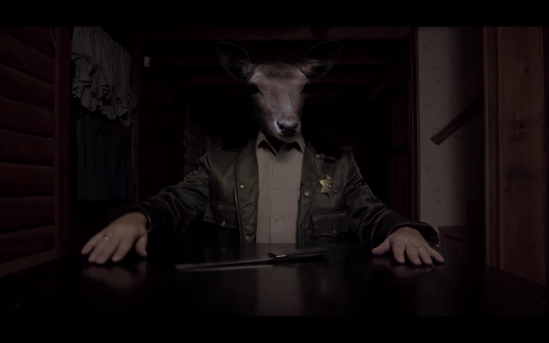
Clint Carney sits front seat as not only screenwriter but also the star of the film with Brian Barnes who tries to reclaim his self-worth and life from long time substance abuse. At the slight entreatment from director Kelton Jones, Carney has a better understanding of downtrodden Barnes character more than anyone and having some experience acting in short films, the writer naturally finds himself ahead of the pack on a short list of talent. However, though Carney has a modestly okay performance, the overall quality in selling Barnes as desperate, duplicitous, and genuine misses the mark, exacting a clunky out of step disposition as the character tries to figure the mystery that enshrouds him. Jones also has a role as the deranged sheriff who stalks Barnes like an overbearing, power monger cop who smells blood in the water. In his feature debut, like Barnes, Jones’ splashes a friendly, yet simultaneously devilish smirk spreading wide under a thick caterpillar mustache that adds another psychological layer in caressing Barnes’ madness. Barnes love interest, Anna, is found in Jayme Valentine and, much in the same regards to Carney, there were issues with her performance as the willing friend to be the support beam to Barnes. Valentine just didn’t have the emotional range and was nearly too automaton to pull Anna off as a person whose romantically unable to resist the addict but can manage to keep a safe distance away in order for both of them to benefit in his sobriety journey. “Dry Blood’s” casts out with some solid supporting performances by Graham Sheldon, Rin Ehlers, Robert Galluzzo (director of “The Psycho Legacy” documentary), and Macy Johnson.

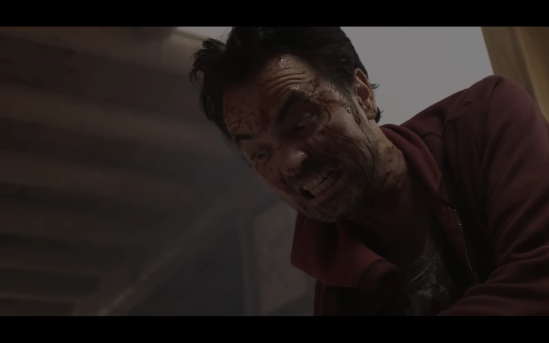
“Dry Blood” is certainly an allegorical move toward the severe effects of withdrawal, even with the title that’s a play on words of a former addict staying dry during their difficult abstaining campaign, and with that symbolism, that ambitious ambiguity, to question whether or not Barnes is actually seeing these horrific images of disfigured bodies becomes open to audience interpretation of their own experience with substance abuse or their empathetic knowledge of it. Combine that individual experience aspect with some out-and-out, gritty moments of bloody violence, especially in the final sequences of Barnes careening reality, and “Dry Blood’s” simmering storyline ignites a volcanic eruption of unhinged blood lava that spews without forbearance. Those responsible for acute effects are Chad Engel and Sioux Sinclair with Clint and Travis Carney rocking out of the visual effects to amplify the scenes already raw and gore-ifying moments.

Epic Pictures and Dread Central Presents a paranoia, paranormal, psychological bloodbath of a production in “Dry Blood” and lands onto a hi-definiton, region free Blu-ray home video in a widescreen, 16:9 aspect ratio, distributed by MVDVisual. The 83 minute presentation has a consistent, natural adequacy that delivers strong enough textures to get a tactile sense of the wood paneling of the rural mountain cabin and also the various materials in clothing and skin surface for easy to flag definition. Hues are potent when necessary, especially when the blood runs in a viscous red-black consistency. Darker, black portions have a tendency to be lossy and flickery at times, but nothing to focus on that’ll interrupt viewing service. The English language 5.1 Dolby Digital surround sound has little to offer without inlaying a full size candy bar of action; instead, “Dry Blood” has bite-size appeal that would render okay without audio channel overkill. With that being said, dialogue doesn’t falter and there maintains an ample range and depth of sounds. Surprisingly, the build up of notating the soundtrack composed by System Syn left a disappointed aftertaste as the expectations of an industrial electronic, upbeat score was met only with a casual fling of the group’s spirit. Still, the soundtrack is a brooding horror melody which isn’t unpleasant…just not what was to be expected. Bonus material includes an audio commentary with Clint Carney and Kelton Jones, the making of “Dry Blood,” and teaser and theatrical trailer. Don’t be fooled by “Dry Blood’s” initial crawl approach as when the tide turns, addiction roles into hallucinogenic despondency and mayhem, and the blood splatters on a dime bag detox, “Dry Blood” will factor into being one of the better sleeper horror films of the year.

Dry Blood on Blu-ray! Purchase It By Clicking Here!

Evil Wants Your Children! “Slender Man” review


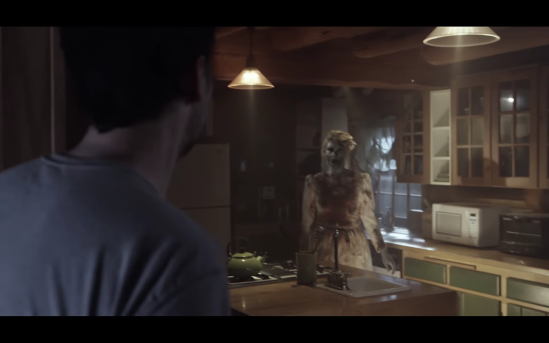
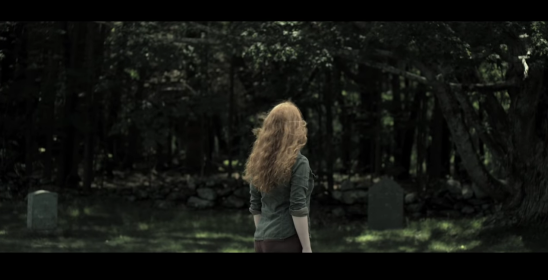
A Massachusetts foursome of girls, Wren, Chloe, Hallie, and Katie, invoke the summoning of an internet lore named Slender Man after watching an instructional online video on how to evoke his presence to reality. After the video completes and the girls dismissively chalk this activity up as hoax-filled rubbish, an embattled and disconnected Katie vanishes a few weeks later during a school sanctioned field trip to a historical graveyard, thrusting the remaining three friends into investigating her abrupt disappearance all the while they each experience an ominous figure haunting them in and out of consciousness. As the continue to look for Katie, Slender Man keeps popping up into the findings. Wren’s convinced, after suffering from terrifying visions, that Slender Man wants the four who’ve contacted him and when her friends dismiss Wren’s frantic ravings, she employs Hallie’s sister, Lizzie, to assist in stopping Slender Man. All of reality is being skewed while Slender Man hunts them down one-by-one and if they’re not taken, those left in Slender Man’s wake will forever be deranged with madness.

Straight from it’s internet meme playbook origins comes the constructed next chapter in “Slender Man’s” mythology from the “I’ll Always Know What You Did Last Summer” director Sylvain White and written by David Birke (“Elle”) that feels very familiar to “The Ring” premise. Based of the mythos created by Victor Surge, aka Eric Knudsen, “Slender Man” fruition onto the Hollywood scene finds a home under Sony’s Screen Gems division, the same division that delivered the Paul W.S. Anderson “Resident Evil” franchise. While not a mega-glossy action horror piece for Sony and Screen Gems, White’s take on one of the internet’s most popular and mysterious spawns revels in it’s own crowd funded supernatural element and White is the grand puppeteer behind the scenes piecing the material together that builds upon, and extends, “Slender Man” canon into film and video visuals. “Slender Man” provides the character flesh, extenuating doubt where special effects can make monolith his presence of inception and flourish from imagination to terrifying reality. If looking outside the box, “Slender Man” could also be translated into symbolism for the online predatory habits men take towards young, sometimes teenage and impressionable girls. There in lies references to this notion with such in Katie, who is a runaway teenage girl with a fixation toward an obscured man from the internet, aka Slender Man, and also Hallie’s vivid nightmares of being pregnant with the very Lovecraftian-esque spawn of Slender Man as tentacles shoot out from her large, protruding stomach. Yes, she’s a high school girl…

“Slender Man” centers around a four female, high school age characters: Chloe, Katie, Wren, and Hallie. The latter being the leader, Hallie, played by Julie Goldani Telles, is an unwavering non-believer of Slender Man, contributing her visions and feelings as some sort of coming of age Freudian bizarro show. The now 23-year old Telles convinces to pull off a well adjusted teenage girl spiraling into Slender Man’s otherworldly oblivion and absolutely turns the corner when younger sister Lizzie, Taylor Richardson, becomes an unwitting participate. Hallie almost comes toe-to-toe with her confident and frantic friend Wren, a character bestowed to Joey King of “Quarantine” and “White House Down.” King’s townboy-ish approach has served well to keep her character apart in order to not clash with other warring personalities. Yet, there’s not a whole lot interesting aspects associated with the other two characters, Chloe and Katie. If audiences were expected to be concerned for Katie, then Annalise Basso needed her character to have more screen time. The “Ouija: Origin of Evil” actress barely had a handful scenes to try to convey a poignant life with an alcoholic father before she’s whisked away to never been seen again. Chloe had a slight more substance as means to exhibit the result of not being taken by Slender Man; “Chilling Adventures of Sabrina’s” Jaz Sinclair didn’t really add any pizzaz to her poorly written flat character.

Though Slender Man’s origins surpasses being a byproduct of an internet meme and becomes woven into a lore of all it’s own through a global, technological network, the very fabric “Slender Man’s” tech horror theme had laid a negligent foundation. Viewers without a hint of Slender Man knowledge will find the connection between the shadowy figure that stalks and kidnaps children and the domain from which it was born, witnessing the technology used in the film being wielded as a tool of evil rather than a conduit of to connect two worlds. What works for Sylvain White is his knack for shaping Slender Man into physicality in an applauding effort that combines chilling atmospherics, well timed visual and audio cues, above decent special effects, and the crunchy, contorted body of Javier Botet as the Slender Man. We’ve covered Botet before in “Insidious: The Last Key” as the antagonistic KeyFace creature. KeyFace and Slender Man, two similar but still vastly different villains, wouldn’t be as influential or be brought to such a horrifying fruition if Botet was not behind the mask and it’s because of Botet’s blessing, but also a curse, Marfan Syndrome physique that he’s able to accomplish a wide range of distorted and malformed characters.

Sony Pictures presents “Slender Man” onto HD 1080p Blu-ray under the Screen Gems label. The Blu-ray is presented in widescreen of the film’s original aspect ratio, 2.39:1. “Slender Man” doesn’t sell itself as high performance, resulting in more details in the range of textures rather than relying on a clean, finished look. Colors are remain behind a cloak of darker shades to pull of gloomy atmospherics, but do brighten when the scene calls for it. The digital film looks great, if not fairly standard, for movies of today. The English DTS-HD Master Audio 5.1 track is quite high performance, like revving an engine on an imported roadster. Slender Man comes with his own cache of audio tinglers to send chills up your spin and invoke cold sweats. Every branch breaking ambiance and desperate and exasperated breath being took by the teen girls aligns cleanly and nicely with the visual representations. Dialogue is lossless and prevalent as well as being integrated seamlessly during more active sequences in a well balanced fit all with range and depth. Thin extras do put a damper on the release with a bland featurette entitled “Summoning ‘Slender Man:’ Meet the Cast.” The featurette doesn’t do much more than give the actors’ and White’s opinion of their characters and Slender Man. The shame of it is that the internet is a vast place of information and knowledge and, yet, the featurette doesn’t knick the surface of who and what is Slender Man. Plus, if remembering correctly, there are scenes omitted from this release; more intense and bloodshed scenes that would have granted a more adult friendly rating. This release doesn’t offer up two versions of the film. Despite embodying a rehashed, bi-annual story of supernatural and psychological tech horror of the PG-13 variety, “Slender Man” endures through with a sliver of appreciation for the easily missed facets that work as a positive in Sylvain White’s 2018 film, such as bleak atmospheric qualities and Javier Botet’s performance, but the diluted final product, released on Blu-ray, benches what could have an at home video entertainment home run for Sony Pictures.