EVIL is the Will of the Gods. “Malpertuis” reviewed! (Radiance Films / Limited Edition Blu-ray)

“Malpertuis” Now Available at Amazon!

Jan, a young sailor returns home from a voyage to find his family home gone.  After getting into a scuffle with pimp at a night club, he’s knocked unconscious by a blackjack and wakes up to his sister Nancy taking care of him and in the bed inside the Malpertuis home of his draconian uncle, Cassavius, a wealthy, stern, and impatient man on the verge of death with terminal illness.  The sailor finds they’re not alone in the large labyrinth estate with peculiar relatives, nearby acquaintances, and longtime servants.  Before his death, Cassavius has his will read with everyone present bedside, announcing the distribution of the immense inheritance amongst the close assembly who’ve either worked and slaved hand and foot for Cassavius or have been on the outside clawing up into his good graces for their greed.  Yet, to receive their portion, they must abide by one stipulation:  they can never leave the Malpertuis.  Jan plunges himself into Cassavius’s unfathomable parting will and design, seeking to unearth Malpertuis’s warren secrets, but all a while, a killer begins to pluck away potential beneficiaries.

The 1943 gothic novel of the title by Belgium author Jean Ray serves as the film adaptation source for Harry Kümel’s 1971 gialli-like and surreal maddening “Malpertuis.”  Released in the U.S. as “The Legend of Doom House,” the Belgium and Dutch co-production creates phantasmic journey down the rabbit hole that unravels a mystery of pantheon proportions.  The “Daughters of Darkness” directing Belgium filmmaker helms the faultlessly fantastical adaptation and script by Jean Ferry, who would also collaborate with Kümel on “Daughters of Darkness” as well as pen original and adaptations of Franco-Italiano melodramas from “The Wayward Wife” to “The Foxiest Girl in Paris.”  Pierre Levie (1969 “The Witness”); and Paul and Ritta Laffargue (“The Mushroom”) produce the gothic and Greek movie under Artemis Film and Les Productions Artistes Associés.

“Malpertius” houses an international cast that ranges from the native English-speaking countries of Britain and America to the European republics of France, Belgium, Germany, and the Netherlands.  The biggest headliner out of the bunch, and perhaps the biggest drunk at the time too, is none other than “Citizen Kane’s” Orson Welles in the boisterous patriarchal role, Cassasvius, on the brink of death.  Welles commands the screen in his short lived but striking hard every note performance that simply overpowers an otherwise Eurocentric cast fashioned with off the wall characters.  The narrative circles around the ingenuous Jan freshly off the boat for a little R&R.  Played by Mathieu Carrière in one of his earliest performances of his copiously filled career that includes horror-based credits like “Born for Hell,” “Nurse Massacre” and “The Murdered Young Girl,” Jan refrains from mostly having a voice but rather actions his will to discover Cassavius’s secrets within Malpertius’s walls as well as extract his fellow beneficiaries aenigmas, such as why the lovely Euryale won’t ever look him in the eye though she’s destined to be his wife per Cassasvius’ will, his sister Nancy’s inexplicable need to leave Malpertuis with her lover, and Alice, one of three intrusive and gossipy sisters, with her cozy up urge to bed Jan while also sating the sexual desires of his greedy cousin and sneaky creep Charles Dideloo (Michael Bouquet, “The Bride Wore Black”).  All three women are played by a single actress.  Hailing from the UK, “The Violent Enemy” actress Susan Hampshire goes into complete incognito mode that disguises her physical attributes and character personalities with mere makeup and temperament tonal shifts too genuine to easily notice Hampshire being all three women.  Hampshire deserves much of the credit and earns a trifecta win by facing down the challenge without compromising character.  Perhaps a little unfair to single out Hampshire as such but the entire “Malpertius” cast deserves recognition for their titan acts, representing humanity-cladded divinity in the most simplistic of human limitation that none of them, apart from one being more recognizable against the others, can be pinpointed definitively who they’re roleplaying.  Charles Janssens, Jean-Pierre Cassel, Walter Rilla, Dora van der Groen, Daniel Piol, Sylvie Vartan, Jenny Van Santvoort, Jet Naessens, Cara Van Wersch, Fanny Winkler, and Bob Storm fill out the cast.

There’s nothing quite like a good film adaptation of a novel.  Author Jean Ray’s four-part narrative isolates characters more exclusively that delineates the individual storylines of the whole gothic affair inside , and outside in parts, of the crumbling Malpertuis estate.  The Harry Kümel and Jean Ferry vision set out to make “Malpertuis” cinematic by collapsing the subset storylines into a single perspective narrative bestowed upon Jan, who is also the main protagonist in Ray’s novel under Jean-Jacques Grandsire, but less involved in comparison to the film version.  This forces audiences to see through Jan’s eyes, a curious, naïve and perhaps good nature fellow, a nationalized sailor of sorts who cares more about his home and sister than the depravity of sailors on shore leave, and what Jan experiences is nothing short of exploitation, sexualization, and torment amongst Cassasvius’s most prized collection of heirs.  Which brings me to uncle Cassavius who is set up, through the remarks of his nephew Jan, as nothing more than a gruff and stern, ill-tempered man living in the gloomy prison-like structure that is Malpertuis, but Cassavius transforms in a postmortal light as no longer a wealthy grouch but as an omnipotent collector that instills a great power upon him albeit his once feeble condition that took his life.  His house is very much like himself, confounding, mysterious, and surreal now pact with peculiar beings that look, sound, and feel human, or at least to Jan, and in appearances to the audiences too.  There’s a theme of limitless power over power itself but with the caveat that everything must come to an end and “Malpertuis” has one Mount Olympus-sized end. 

What’s also definitive is the limited-edition Blu-ray set from Radiance Films.  A beautifully curated boxset encasing a dedication to the undervalued “Malpertuis” with a AVC encoded, 1080p resolution, BD50 set that’s presented in a 1.85:1 widescreen aspect ratio.  In the midst of Malpertuis’s dark corridors and staircases, its classically drab common rooms, and a bleakly deserted grayness to the seaport town that exemplifies the intentionally restored stark and severe grading overseen by director Harry Kümel, the 4K scan, compiled by the shorten Cannes cut and Kümel’s directors cut, depicts quite a bit of localized saturation that pops into play that creates stand out characters in tandem with their eccentric personalities.  There’s a meticulousness in the details that greatly heighten Malpertuis into a prison-like character, one that is personified holding the living, breathing characters into a stasis though they’re freedom to leave is unobstructed, the Lamplighter is a good example of this by appearing to be a near skin and bones, unkempt in appearances, and wailing in disquietude about Cassavius putting out the light, as if Cassavius himself was some sort of jailor and, in a way, he is.  No compression issue within the dim-lit black areas, the ruckus of various action, or any macroblocking during the decoding.  Though there is a language version somewhere in the world, Radiance Films supplies only the original Dutch ADR mono.  The post-production dialogue does have an asynchronous measure between picture and sound, especially between the non-native Dutch speakers, but the track is clear and prominent overtop a mysterious and unobtrusive Georges Delerue (“Platoon”) soundtrack, letting the actors and the action take the helm of the narrative with a low-toned menacing as well as hopeful score pieces that drive their curiosity and individual pecularities.  The diegetic dynamism denotes a defined design to be character driven rather than creating the immense suspense built by an edge of your score and omnipresent nondiegetic sounds.  The faultless and well-paced UK English subtitles are available and can be toggled.  Encoded special features include a 2006 audio commentary from director Harry Kümel and assistant director Françoise Levie, new interviews with Kümel and gothic horror writer Jonathan Rigby, an archival and behind-the scenes documentary on the making of the film with interviews Kümel, lead actor Mathieu Carriere, and director of photography Gerry Fisher, archival interviews with Kümel, Michael Bouquet, and Jean Ray with an archival featurette on Orson Wells and actress Susan Hampshire, Malpertuis Revisted takes audiences on location where the movie was shot with Kümel’s descriptions, the Cannes cut of the film, which is approx. 20 minute short than Kümel’s director’s cut and is viewable in the English and French language for selection, Kümel’s short film “The Warden of the Tomb,” and the trailer. Limited to 3000 copies, “Malpertuis’s” physical presence is palpable with a hard cardboard slipbox with Greek themed compositional artwork with a wraparound Obi strip denoting synopsis, bonus features, and technical aspects. Inside, a clear Blu-ray Amary comes primarily with a front and back still image cover given the artistic liberty treatment. The cover can be flipped from more traditional cover artwork, and all artwork provided is by Time Tomorrow. Heavier than the slipbox and the Amaray is the accompanying 78-page booklet with cast and crew acknowledgements, transfer notes and special thanks credits, and 2025 produced essays by Jonathan Owen, Willow Catelyn Maclay, Lucas Balbo, Maria J. Perez Cuervo, and David Flint. The region free release is region free and houses two runtimes with the main feature being the 125-minute producer cut and the Cannes cut, domiciling in the special features, clocking in at 100-minutes.

Last Rites: No one can top Radiance Films’ “Malpertuis” limited-edition Blu-ray set with its comprehensive insight into one of the more original adaptations surrounding Greek mythology, the harnessing and control of great, immense power, and the how that power is transposed and shaped into the human context where greed, sex, and love are the core contentions.

“Malpertuis” Now Available at Amazon!

EVIL’s Path to being a Psychopath. “The Beast to Die” reviewed! (Radiance Films / Limited Edition Blu-ray)

“The Beast to Die” on Limited Edition Blu-ray from Radiance Films!

Former war journalist, Kunihiko Date, stabs a veteran police investigator to death.  He then uses the detective’s revolver and guns down three, after hours casino employees in cold blood and steals the day’s earnings.  Date’s seemingly random acts of violence and theft from a respected war journalist and photographer are not just random acts but part of a methodical plan for an upcoming heist of a bank in Tokyo’s Nihonbashi district.  Casing the bank’s security, personnel, and layout, Date’s perfect plan has one hitch; Because of the bank’s size and bustling busines, he’ll need a little help.  By chance, he comes across Tetsuo Sanada at an annual school alumni dinner with his closest friends who have a violent run-in with Sanada as their antagonistic waiter.  Seeing the same potential disregard for life and disdain for existence conventions, Date approaches Sanada and mentors him under a nihilistic wing.  Now with a plan and an accomplice, Date’s violent holdup can move forward but to what end is the length of his sociopathic carnage. 

“The Beast to Die,” aka “野獣死すべし, Yajū shisubeshi,” is the intense and violent noir-thriller from Japan, directed by “Dead Angle’s” Tôru Murakawa and a script by Shoichi Maruyama (“The Triple Cross”).  The 1980 released feature would be Murakawa and Maruyama’s second feature length production together behind 1979’s “The Execution Game,” the second film of a trilogy known as “the Japanese Game Trilogy is a visceral yakuza tale of a kidnapped hitman unable to escape the criminal underworld. “The Beast to Die” is a step away from the Japanese gangster film; instead, focuses on the interpretation of war trauma, the cynical views of precious life, and has subtle presences of U.S. big brothering, asexual themes, and coarse, unforgiving violence at the highest level of sophisticated society.  Adapted from the Haruhiko Ôyabu novel of the same name, the written origin mirrors the vehemency of visual art with the film produced by Haruki Kadokawa (“Virus”) and “The Resurrection of the Golden Wolf’s” Mitsuru Kurosawa and Tatsurô Shigaki under the Toei Company and Kadokawa Haruki Jimusho.

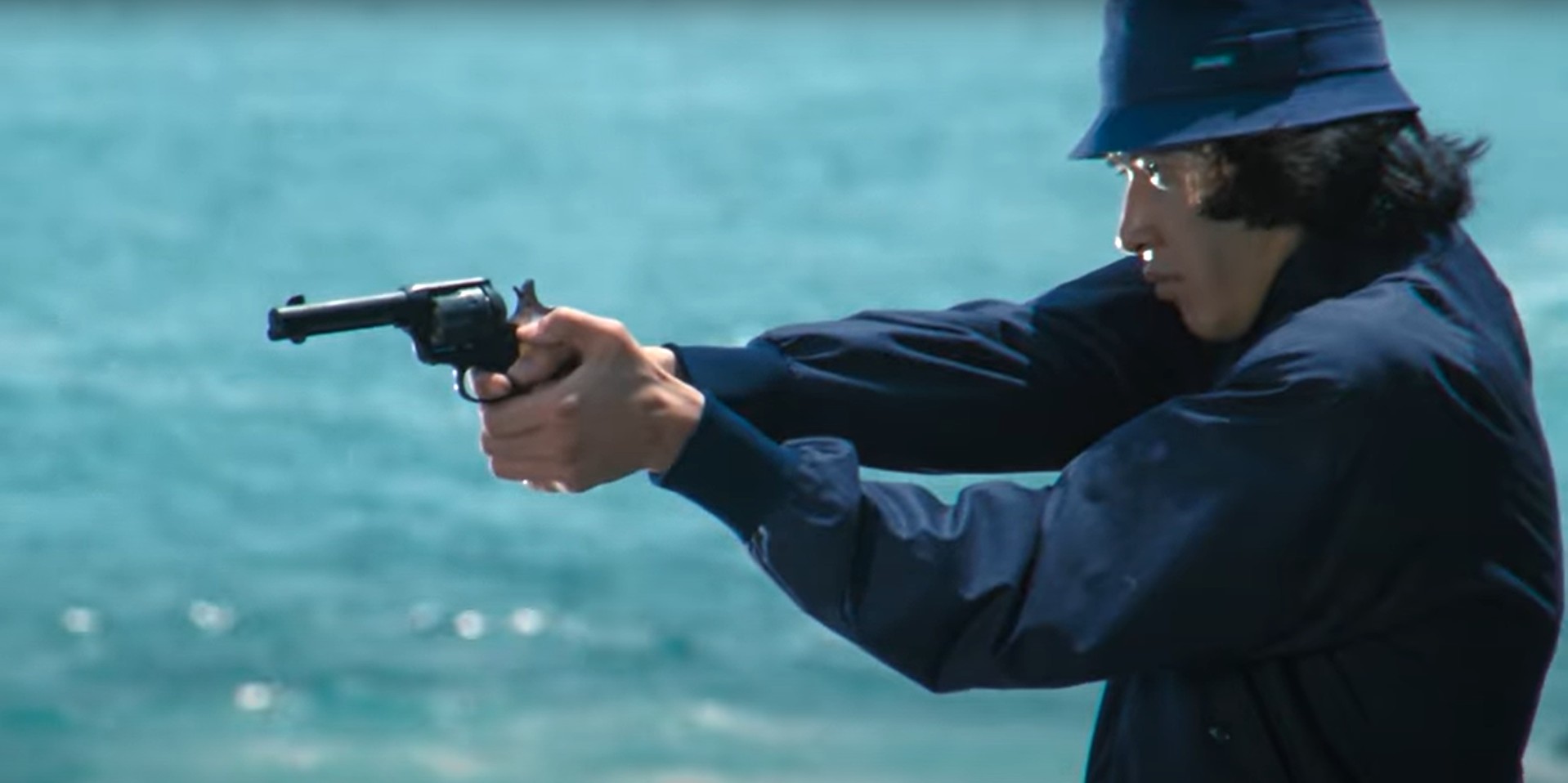
Undoubtedly one of the best sociopathic performances of our lifetime, “Horror of the Wolf” and the Japanese Game trilogy’s Yûsaku Matsuda is a cool, awkward, and, if not, plotting cucumber amongst the masses of jovial and hustling Tokyo denizens.  There’s a serenity about Matsuda’s Kunihiko Date that’s unparalleled, represented by blank stares, a patient demeanor, and precise movements that come in stark contrast in the film opener where Date takes down four people in one night in a show of murderous inexperienced bravado.  Even in the thick of combative survivalism, there’s only objective goal in his sweat infused brow and focused eyes while others gesture and make an invitational show of his attack or of their pleas for mercy.  Date becoming lost in classical music is a formidable way of grounding himself, not only from the high of excitement and thrills of killing, but also a way to retain sanity in the notes, an aspect he quickly unravels from when not exposed to classic music for an extended period.   Oppositely, Tetsu Sanada is full of pent-up anger as if he’s constantly hitting his head on the wall aiming to break free of the surroundings that confine his wild tiger attitude, yet Takashi Kaga (“Isle of the Evil Spirits”) maintains a personal struggle lock on the full emergence of Sanada as Kunihiko’s equal.  This dichotomy between the anger and tranquility of two sociopaths is immensely palpable that leads to a purposeful instability in a number of areas – hesitation and certainly, the sweat-inducing fear and the cooled fearless, and, eventually, the relationship’s ultimate internal destruction.  Thrown into the Kunihiko and Sanada tango is a potential love interest in the puppy-eyed Asami Kobayashi (“Sixteen Years Old:  Nymphets’ Room”) and her shared classical music and tenderness connection with Kunihiko and a happenstance Detective, played with casual approach by Toshie Negishi (“The Rapacious Jailbreaker”), being in Kunihiko’s consciously aloof presence as a pressuring force that suspects something between something off with Kunihiko and the murder of his detective colleague. 

“The Beast to Die” explores various themes around the indirect damage of post-war trauma and living and feeling like an outsider of the what’s consider the normal societal collective, but there’s another avenue to look down when consider Murakawa’s villainous protagonists.  Kunikhiko Date may have been scarred by war, but his mind always had an inkling for bloodthirst, sated through the images of a photographic lens that captured the horrors of global conflict from military losses to the collateral damage.  Upon his return to Japan, Date had lost the exciting sensation of death that has exceled his rationality beyond being Godlike, able to take life without conscious due reproach.   Sanada, in a way, is similar in his radical viewpoints but Date finds him more talk than action, held behind the line he has yet to cross unlike Date’s journalistic meatgrinder and his self-drive to kill the detective and casino workers.  As far as vices go, neither men have an appetite for sex:  Kunikhiko  watches a sex worker masturbate with little interest and his connect with Reiko doesn’t go beyond the gazes into each other’s eyes and Sanada’s fortunate relationship with his girlfriend provides him with well-off opportunity in money, business, and romance but because she dapples in rendezvous with a U.S. sailor, Sanada finds himself engrossed with spite.  Both men become essentially sexually impotent with seeing red, in anger and in blood, replacing that primal need or ravenous appetite.  The last scene between the two men becomes a crucial turning point in their cruel comradery as the forceful sex act with an unconscious woman sends the other unravelling their partnership for good.  “The Beast to Die” is a cynically cold narrative without regard for human life in the traumatizing belief one can surpass the omnipotent Gods by ending the existence of others.

A compelling dark thriller relatable to contemporary trauma feeding mentally warped violence, “The Beast to Die” arrives onto a limited-edition Blu-ray from Radiance Films.  The UK label produces a Kadakawa Coprporation-created digital 4K restoration transfer from the original and pristine 35mm print.  AVC encoded onto a BD50 and presented with 1080p high-definition resolution in a 1.85:1 widescreen aspect ratio, this Stateside edition is the picture of health with a rich palate that’s stark with contrast.  Skin tones and textures, as well as fabrics, emerge into perspicuousness without missing or dropping a beat.  Negative spaces and shadows enshroud appropriate with the keyed lit dim levels.  The grain is pleasant, stable, and natural and there are no real issues with the print itself, withstanding the test of time.  The uncompressed Japanese PCM 2.0 Stere track offers a reasonably ample sound design and fidelity with post-production dialogue, foley, and ambience recordings that creates some mismatch and distancing space between the action and atmosphere audio and the character diegetic dialogue.  There are no rough patches to mention within the audio recordings, producing more than fine discernible quality to the technical threshold.  Japanese to English translator Hayley Scanlon provides newly translated English subtitles that are spotless in the Blu-ray’s world premiere with English subtitles.  Limited to 3000 units, Radiance offers exclusive special features, including new interviews with director Toru Murakawa, screenwriter Shoichi Maruyama, and a film critique and analysis from novelist and screenwriter Jordan Harper.  The newly commissioned artwork by TimeTomorrow revamps with a new look and layout on the classic, original poster art as the primary Amaray front cover with a reversible side housing an alternate rendition.  There are new and archival essays and archival in the limited edition booklet with 27-pages of color stills, a Tom Mes Yusaku Matsude:  Lost Rebel essay from 2004 showcasing the art and films of the lead actor, a new Tatsuo Masuto essay Shadow of the Beast, cast and crew acknowledgements, and transfer notes and Blu-ray release acknowledgements.  Encoded with a region A/B lock, Radiance Films release has a runtime of 119 minutes and is not rated.

Last Rites: Radiance Films’s limited edition run of “The Beast to Die” is immaculate in every aspect – filmically, technically, packaging – and is an important piece of Japanese culture and cinematic criterion.

“The Beast to Die” on Limited Edition Blu-ray from Radiance Films!

20-Years or More Incarcerated is No Match for Tenacious EVIL! “The Rapacious Jailbreaker” reviewed! (Radiance / Limited Edition Blu-ray)

Break From Your Cage With This New LE Blu-ray of “The Rapacious Jailbreaker”

Masayuki Ueda is nabbed after murdering a drug dealer’s girlfriend during a botched meeting.  Ueda faces a 20-year prison sentence for his crime but after being processed, nothing can change his mind nor his determination to escape.  Willing to sacrifice blood for freedom, Ueda escapes and visits his lover in Kobe for a quick conjugal stop and money only to be caught again when he returns, tacking on additional years to his sentence.  His next escape plan joins forces with two other inmates and, again, his route to freedom is cut short when a brothel visit, while laying low in his sister’s village, turns into a violent brawl with another patron and the authorities round him up in the aftermath, adding more years to his sentence.  While incarcerated, Ueda must kill rival gang bosses who threaten him.  By now, Ueda’s sentence is up to 40-years, and not to be defeated by the prospect of a long term sentence, Ueda has one more desperate attempt for freedom, putting his life on the line.

“The Rapacious Jailbreaker,” aka “Escaped Murderer from Hiroshima Prison” or “脱獄広島殺人囚,”is the crime black comedy from one of the Toei Company’s aggressively eclectic and paced directors Sadao Nakajima (“The Kyoto Connection,” “Female Ninja Magic”).  The prolific yakuza and exploitation filmmaker takes the Tatsuo Nogami (“Father of the Kamikaze”) script, centered on an incessant career criminal hellbent on not spending his days in prison, and runs with it, fashioning the smidgen stitchwork of a nonfictional individual into the post-War World II, American occupation of Japan and adds inner teetering and play-by-play thought narration and the always welcoming gallows humor amongst the exploits of a stubborn felon.  Gorô Kusakabe (“Hell,” “The Red Silk Gambler”) produces the production, which is part of an unofficial Sadao Nakajima trilogy along with “Shimane Prison Riot” and “The Man Who Shot the Don.

Hiroki Matsukata, a prolific yakuza actor from the 1960s to the 1980s with such credits as “Survivor of the Massacre,” “Dangerous Trade in Kobe,” and “Battles Without Honor and Chivalry,” breaks intermittently through the gang wars and boss-laden wall of tattooed violence and varying levels of respect that’s inked the individualized stories’ skin with “The Rapacious Jailbreaker” as the titular lead character under the character’s God-given name of Masayuki Ueda, a tenacious criminal personality type with yakuza-like transgressions of drug peddling and black market trade.  However, Ueda is not a criminal without honor, even if he’s a little rough around the edges, as his loyalties lie with those who are loyal to him: a fellow partner in crime he didn’t rat out, his suffering wife (Yōko Koizumi ), his sister Kazuko (Naoko Ohtani, “Apartment 1303”), and also those who help him escape, such as  Tatsuo Umemiya’s (“Spoils of the Night”) brazen law challenger Yuji.  Yuji and Ueda match well in traits, both eager to test and take risks going against a rather lax authority grain.  Aside from the opening montage of prison routines depicting minor torture from the guards, you don’t get the sense the prison guards have much domination or enough aggressiveness to match the kind of zeal the inmates have to either run a sneaky scheme or take them on toe-to-toe to get what they want, as we see with Yuji’s disgracing efforts against the warden in order to obtain rights that are quickly dismantled by the warden’s reneging, but at the cost of his humiliation.  Matsukata never wavers or deviates from Ueda’s singular drive, layering intensity overtop his thin film of civility with every additional time added to his sentence that eventually goes beyond four decades, but you can see it not only in Ueda’s resolute eyes but in Matsukata’s as well that nothing will stop him from escaping.  The film fills out with Hiroshi Nawa, Gorô Ibuki, Tatsuo Endô, Shigeru Kôyama, Hideo Murota, Harumi Sone, and Akira Shioji in various rolls of yakuza, fellow inmates, and those crossing Ueda’s path in the outside world.

Staying on the theme of Ueda’s loyalty, which is incredibly beyond reproach given his heinous crimes, there’s something to be said for his commitment to be free as a bird but also to the people who do right by him, no matter the circumstances. His wife pledges endless loyalty despite his flaws and felonies, his estranged sister welcomes him with food and shelter, and his opening criminal accomplice provides him a weapon before thanking him for not ratting when Ueda was apprehended by police. There’s an underlining code of respect and duty intertwining the utter most wicked and those blood relations in the field of collateral damage. Ueda’s responsibility for his actions never wanes, never deflects, and never becomes a weight of guilt as the only object, or maybe even obsession perhaps, on his mind is to escape prison and make quick, easy money. His loyalty does come at a fault when his trust reaches into the weeds, especially amongst those he’s already collided head-vs-head against, such as the former head of the black market beef butchers who turns on Ueda for false promises, but it’s in that one and only instance that everything becomes clear, much more to the audience than perhaps Ueda himself, is that in order to remain just out of arms’ length of the law, he must walk his path alone as depicted at the finale moments. The post-World War II American occupation time period has an interest facade to “The Rapacious Jailbreaker’s” context. In fact, the American presence is rarely present at all with Ueda feeling the squeeze mostly in-house within the Japanese penal system with the Americans only rearing their heads in obstacle of his escape attempts in a negative light: Ueda’s standoff against Japanese officers, who won’t shoot him surrounded by a crowd in fear and respect of bystanders, comes to a quick surrender when the Americans, who are perceived to shoot on sight no matter the circumstances arrive on the scene or when his fellow escapee tries attempts to befriend American forces in a military truck only to be runover and killed without remorse or even a slow down. These seemingly insignificant instances spoke volumes against the American occupation as a non-character in Ueda’s tale of total resistance that, one that either represents the American cold passive care of the Japanese under their rule or switch the ironfisted from Japan to America to favor a more lenient system of control.

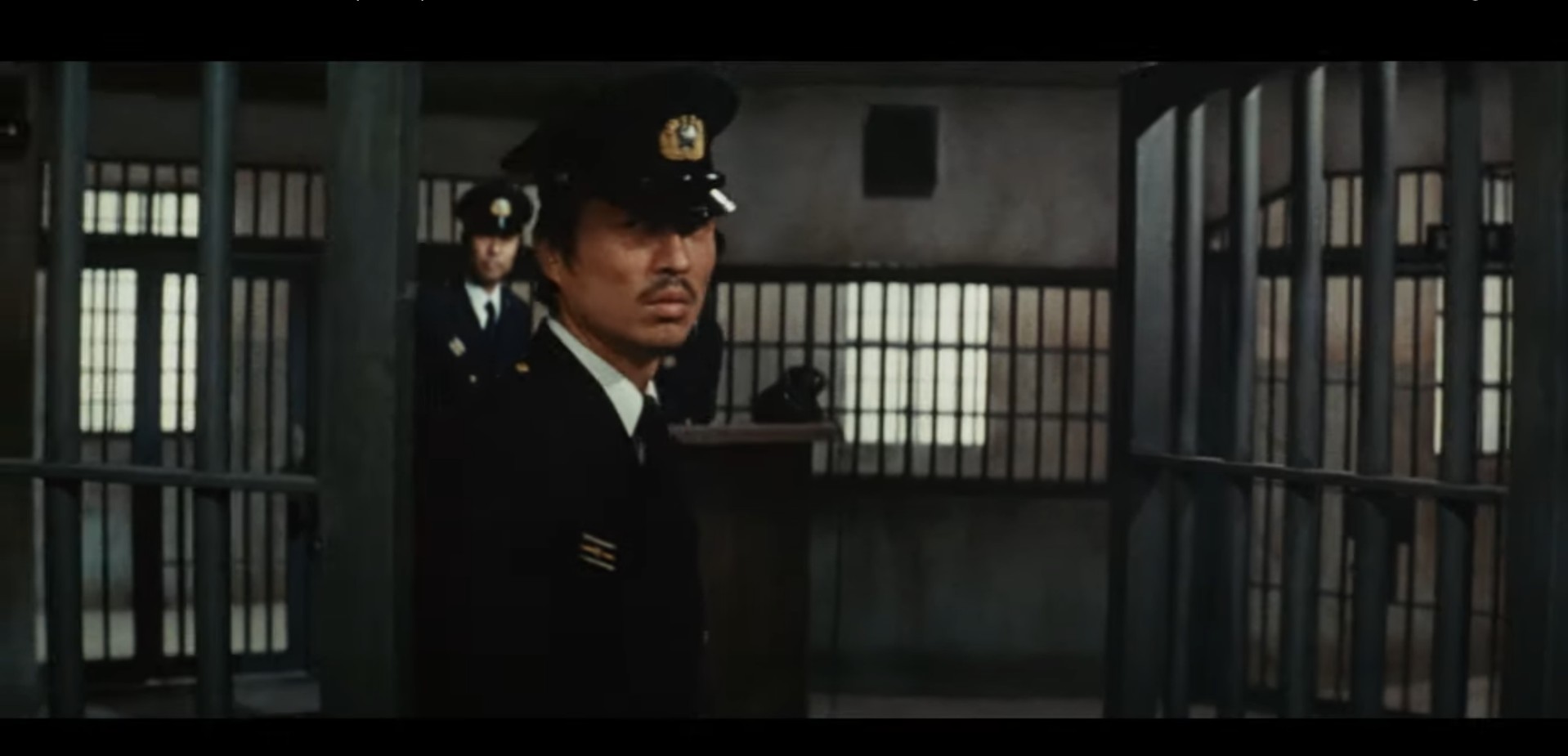
Radiance Films’ transatlantic “The Rapacious Jailbreaker” lands in the U.S. for the first time on any format, and first on this particular format globally, with a new limited-edition, AVC encoded, 1080p high definition, 50-gigabyte Blu-ray. The dual layer allows for steady color timing and pristine picture quality image that’s leans into its attractively grained 35mm stock and presented in its original widescreen aspect ratio 2.35:1. The original print, transferred into HD from the Toei Company, is nearly faultless with only minor instances of vertical scratching around the theater scene in an otherwise near clean and clear element print. Nakajima’s lower contrast allows for softer coloring and the touch points on Radiance’s treatment showcase a more relaxed but harsh grayish blue with surrounding aspects from the prison’s hoary cement floors and walls to the prison’s steely cell bars and the prisoner’s blue attire. The uncompressed Japanese language PCM mono track offers clearcut dialogue and ambient markers with a clarity on both fronts that render an intelligible layered track without any compromising issue. Kenjirô Hirose (“The Last Dinosaur”) brings a 70’s cop-and-crime swanky score with undertones of traditional Japanese Hyōshigi, the striking of sticks to create that brief and stark crack sound. New translated English subtitles are available, pacing well and are error-free. Encoded special features include a visual essay by film critic Tom Mes and an audio commentary by yakuza film expert and Sadao Nakajima historian, Nathan Stuart. Radiance’s limited-edition set comes in a clear Amaray case with a reversible cover with original and new artwork, the latter commissioned by layout designer Filippo Di Battista (primary). Also included is an obi stirp with the release’s contents, technical specs, and film plot. Limited to 3000 copies, the release comes with a 23-page black and white booklet with stills, an essay Escape as Vocation by Earl Jackson, and a 1974 review by Masaharu. The 97 minute feature comes region A-B locked and unrated from the UK label.

Last Rites: “The Rapacious Jailbreaker” is hardboiled tough as nails while being a series of comedic follies that make this tenaciously titled story of one man’s pursuit of freedom a breakout hit.

Break From Your Cage With This New LE Blu-ray of “The Rapacious Jailbreaker”

With Fame Comes Absurd EVIL Exploitation. “A Tale of Sorrow and Sadness” reviewed! (Radiance Films / Limited-Edition Blu-ray)

Limited Edition Blu-ray of “A Tale of Sorrow and Sadness” Now Available!

To compete against a rival fashion magazine who found profound success after hiring a famous gymnast as their spokesmodel, an ambitious fashion company sees potential in amateur golfer Reiko Sakuraba with her beauty, grace, and a decent enough golf game.  The only problem is Reiko has not won a championship.  The fashion company representative and Reiko’s sport’s columnist writer/manager/boyfriend Miyake strike a deal to get intensely train and mentally exhaust Reiko to be the best by the next tournament.  When Reiko outperforms the tournament’s veteran players, she instantly becomes a fashion icon and celebrity that leads to her own show for the magazine, photoshoots, and a large house in the middle of the suburbs.  Miyake’s aloof behavior continues even after Reiko’s success and while he drives her back home, he hits-and-runs a woman form the neighborhood who blackmails and guilts Reiko into letting her into the rich and famous lifestyle.  Reiko’s mental health slowly declines as pressures mounts.

“A Tale of Sorrow and Sadness” is a tale of how the sudden rise of fame and fortune can quickly lead to world of hurt through inexperience, obsession, misguided love, abuse, and the day-to-day tasks that can even burden even the most common person.  The story also represents a dichotomy between fame and the mundane.  The 1977 Japanese surreal drama is helmed by Seijun Suzuki, a filmmaker once blacklisted by the head of Nikkatsu Studios after his film for the company, “Branded to Kill,” was deemed terrible by Nikkatsu execs, and rode the filmic bench for nearly a decade until his theatrical release of the Shochiku Ltd. Released production that allowed him the freedom for artistic expression.  Also concisely known as “A Tale of Sorrow,” the Suzuki picture is written by Atsushi Yamatoya based off manga by Ikki Kajiware and produced by Yoshiki Nomura, Kenzo Asada, and Tokuya Shimada.  

Yoko Shiraki steps into the tragic golf-cleated shoes of golfer-turned-spokesmodel Reiko Sakuraba who finds herself unknowingly being exploited as object of marketable objectification.  What’s interesting about Sakuraba is she’s totally alone amongst other adults in a real cutthroat and cruel way through her trajectory of success.  In the fashion world, the magazine representative behind the concept (Masumi Okada, “The Living Skeleton”) only wants her for her beauty and success, her boyfriend Miyake (Yoshio Harada, “Lady Snowblood 2:  Love Song of Vengeance”), and even an once starstruck housewife, Kayo Senba (Kyôko Enami, “Killer Whale”) who was struck by Miyake’s car and resents Reiko’s, blackmailing her way into the superstar golfer’s life by forcing her hand to relinquish all from her worldly possessions to her mind, body, and soul.  Shiraki gifts Sakuraba the fault of inability to say no with her innocence and naivety ravaged and exploited beyond the point of no return and beyond repair but Sakuraba clings to dear life, perhaps even sanity, because of tone person that too only reacts negatively around her but since their blood reaction is thicker in the watery connections manipulating her, Sakuraba’s hand is forced to do much all of the golfing and modeling hell for her adolescent younger brother Jun (Tetsu Mizuno), a smart yet reclusive boy with off screen aggression getting into fights with school bullies stemmed likely by his sister’s constant absence.  Sakuraba’s not only a slave to external obsessions of success, image, and greed but also a slave to internal obsessions with Mikyake who deprives her of the most basic primal needs for financial gain and for manipulative control.  Kôji Wada, Shûji Sano, Noboru Nakaya, sao Tamagawa, Tokie Hidari, and Jô Shishido co-star.

“A Tale of Sorrow and Sadness” is Seijun Suzuki’s tour de force return to feature films.  A linear narrative speckled with surrealistic doses creates an unsettling and bizarre atmosphere of strongarm manipulation on the unassertive character of Reiko Sakuraba.  Her raw talent is mined and minced without much consent and pushed past mental exhaustion and collapse in what is an all too true theme surrounding the early television era of celebrity branding with esteemed figures being puppets for large scale companies in order to sell their promoted products.  Money, image, and success steer the helm without any due remorse to the elegant centerpiece of the room, driving Suzuki’s social commentary to extreme levels of misappropriation of a human person with feelings and ambitions of their own.  Instead, Reiko’s meekness is measured by Suzuki’s fabricated milieu of mistreatment represented partly in a behavioralism of semi-surrealism – Miyake’s stoic aloofness, Senba’s brazen hijack of Reiko’s fame and wealth, and even Jun’s withdraw and reclusion are all good archetype of strange conducts illegitimizing Reiko as person.  She’s dehumanized so much so she stops whatever little rationality she had to begin with and becomes a vessel of command that allowed those around to walk all over her.  Suzuki’s suburban reach toward fame theme is satirical for “A Tale of Sorrow and Sadness’s” thin blanketing of dark comedy and the filmmaker often accentuates the moments with elongated sequences, randomized bits of eccentricity, and highly stylized contrasts of sex and violence as well as commercially sensationalized imagery versus Stepford wives’ expectations.

A bleak absurdist dream, “A Tale of Sorrow and Sadness” becomes rightly a part of the Radiance obscure, high level lineup with a new, limited-edition high-definition transfer Blu-ray release.  The AVC encoded, 1080p, BD50 receives the high definition transfer from the Shochiku Corporation, who currently distributes a fair amount of Anime and since “A Tale of Sorrow and Sadness” is adapted from a Ikki Kajiware’s Manga, the film fits right in, and is presented in by Radiance in the original aspect ratio of a widescreen 2.35:1.  Radiance’s image quality surpasses expectations as visually bold in a wide variety of contrasting colors, especially in primaries of yellow and reds juxtaposed against achromatic shades of brilliant whites and deep blacks.  The original print is beyond pristine with virtually no dust, dirt, scratches, or any kind of visual impediments in what appears to be a well-preserved 35mm reel.  Skin tones appear naturally organic and textures pop in their specific fabrics inside an overlay of natural stock grain for that bare-faced aesthetic of clear based film strip.  The Japanese uncompressed mono PCM audio, again, surpasses expectations with a diverse mix through a single output that creates excellent note individualism rather than an indistinct amalgam.  The omitted compression codec provides the original audio framework comfortably upholding against the test of time without a flurry of issues in the single layer.  Hissing, popping, crackling and other types of interference are kept either suppressed or to a bare minimal in another pristinely kept transfer.  ADR dialogue clearly affixes to the images with synchronous efforts being no worse compared to other films of the era out of Japan.  The newly improved English subtitles render without error, are compositionally more-or-less within syntax range of translation, and pace nicely throughout.  Special features include a new audio commentary by film historian and author Samm Deighan, a new interview with assistant editor Kunihiko Ukai, and the film’s trailer.  The clear Amaray case contains Sam Smith commissioned artwork on an obi-strip included reversible sleeve – primary cover composition is of a live still of exhausted Reiko Sakuraba lying next to a bunker with a spirally title font and the reverse cover is more NSFW with a partially nude Reiko with boyfriend Miyake portrayed in soft, dreamy glow.  The white and red disc is pressed with eye-pleasing contrast and the inserted 31-page color booklet provides cast and crew credits, essay “Sorrow, Sadness, and the Sweet Smell of Excess” by Radiance regular contributor Jasper Sharp, an archive essay “The Realisation of a Seijun Sizuki Film” by Atsushi Yamatoya, and the Blu-ray acknowledgements. “A Tale of Sorrow and Sadness” Radiance Blu-ray has a runtime of 93 minutes, is unrated, and since Radiance is a UK boutique label, collectors and film aficionados will get the best of both worlds with a region A and B playback.

Last Rites: Seijun Suzuki’s return to theatrical feature films with “A Tale of Sorrow and Sadness” is a remarkable comeback for the ages and the decade interruption didn’t even cause a missed step for his artistic expression of exploitation and consumerism control ruining young, raw talent which is a clear-cut archetype of sorrow and sadness.

Limited Edition Blu-ray of “A Tale of Sorrow and Sadness” Now Available!

Three Million and Staying One Step Head of the Cops is EVIL’s Masterplan! “The Cat” reviewed! (Radiance Films / Limited Edition Blu-ray)

“The Cat” Limited-Edition Blu-ray From Radiance Films Now Available!

Two ex-cons hold up a Düsseldorf bank for 3 million German marks.  Armed with handguns and brazen with their daytime theft, the two men hold hostage a handful of alarmed employees, rounded up before the bank opens for business, including the bank manager.  Going into the heist with a money figure in mind, the vault is discovered with only 200,000 inside, but that was to be expected as the arrival of the police surround the building adjacent to the towering Nikko Hotel where a third man, the mastermind, spies down from one of the upper floors, instructing the two armed men inside of his plan as well as spying on the police activity aimed to thwart the robbery.  Always one step ahead, police, bank employees, and even the bank manager’s wife are all a part of the organized crime for the riches, and maybe even exact a little retaliation in the process too. 

The 1988 released, German crime-thriller “Die Katze,” or “The Cat,” is an intense ruse engrained with deception, affairs, and a saturated with emotional weight.  Helmed by directed Dominik Graf (“The Invincibles”) put the Munich-born, drama-comedy filmmaker to the test with the Christoph Fromm script, adapted from the 1984 novel Uwe Erichsen, entitled Das Leben Einer Katze, aka The Life of a Cat.  “The Cat” would be Graf and Fromm’s second feature together who, four years previously, collaborated on the slice of life for carefree, bike friends suddenly finding themselves in the unemployment lane of “Treffer” and who would then go to after “The Cat” with the gambling comedy “Spieler” two years later.  “The Cat” is a production of Bavaria Film and Zweites Deutsches Fernshehen and is produced by George Feil and Günter Rohrbach (“Das Boot”), shot on location at the Hotel Nikko in Düsseldorf as well as in studios in Munich.

“The Cat” contains a hierarchy amongst the thieves with Britz (Ralf Richter, “Das Boot,” “Sky Sharks”) being at the bottom as a hot-headed hired gun, Jungheim (Heinz Hoenig, “Das Boot,” “Antibodies”) is next step up as the managerial ex-con looking to score big with reprisal, untamed purpose, and, lastly, the only man who can keep Jungheim from spiraling out of control and the spying eye from the tower radioing orders is the mastermind behind the heist plan with a calm as a cucumber demeanor and a cool cat, or katze, finesse and his name is Probek (Götz George, “The Blood of Fu Manchu,” “Scene of the Crime: A Tooth for a Tooth “).  But, as we all know and as the old proverb goes, there is no honor amongst thieves, yet Graf’s filmic adaptation does instill some counterbalance against that adage by keeping a sliver of diligence within their circle but there is an underlining truth well-hidden under-the-table, only informing those down the ladder what they need to know, when they need to know.  As tension ebb and flow from each personality type, throw into the mix an equivocal loyal woman (Gudrun Landgrebe, “Rosinni”), an intelligent officer in charge of hostage operation (Joachim Kemmer, “The Vampire Happening”), and a stubborn and quick to catch-on bank manager (Ulrich Gebauer) and the ensembles ensues an edge of your seat volatility elevated by the steadfast performances with the actors unhinged and let loose to exact their roles.  With lots of moving pieces to the characters’ actions, supporting parts are key to the success, adding flavor to their persona types and unravelling more about who they are and how audiences are supposed to perceive them as either friend or foe.  Sbine Kaack, Heinrich Schafmeister, Claus-Dieter Reents, Iris Disse, Water Gontermann, Bernd Hoffman, Uli Krohm, and Klaus Maas co-star. 

Hardboiled in a game of pursuit and evasion, Dominik Graf finds without difficulty the essence of Uwe Erichsen’s thrilling crime novel staying mostly in one location, evolving the story as the police try every trick in the book to thwart who they believe to be ordinary bank robbers and as the confidence, and perhaps a little brazen cockiness, slowly builds self-assured success. This constant stream of checks and balances between the hard focused, unobservant antitheft division of Germany’s finest and the cooperative crooks consisting of brawns following instructions of the brain keeping ahead of a fate less fortunate never lets down, never idles, and never diverts attention. “The Cat,” in a way, feels very much like 1988’s “Die Hard” from director John McTiernan, a steady source of one-upping the good guys peppered with moments of unvarnished, graphic violence and dark, unforeseen levity, minus a lone wolf John McClane hero behind enemy lines. The very opening scenes of Götz George and Gudrun Landgrebe engaged sexually are raw, sensuous, and sweaty but are under top a jaunty soundtrack that mismatch the heat of the moment in its cheerful, breezy Eric Burden and the Animal’s tune “Good Times,” a track with lyrics that speak of regrets of negating better moments with unsavory choices finds more of a potent meaning at the gun blazing finale where facing death is an inevitable outcome for one’s poor decisions.

UK label Radiance Films releases “The Cat” in the North American market for the first time with English subtitles in a limited-edition Blu-ray with a Dominic Graf approved high-definition transfer, newly graded by Radiance Film, onto an AVC encoded, 1080p, BD50. While the heist concept may be familiar conceptually to “Die Hard,” the look of the film also has that natural grading of “Die Hard” as well with Radiance infused punctuations on skin tones with a natural hardness. The print used was a digitized file, likely already spruced from an extracted print used by Euro Video in 2017, but Radiance retains the organic grittiness as well as the grain in their own sprucing up that sees a muted hues appear more intense. Presented in a widescreen 1.85:1 aspect ratio, I’m curious to know if “Die Katze” was cropped in post to avoid nudity in the love scenes between George and Landgrebe that appear stretched with more pixelation and are oddly framed, as if portions were sliced off and positioning did not change. The German audio mixes include lossless DTS-HD 5.1 Master Audio and a stereo 2.0. The surround mix lets loose and gives way to all to all of “The Cat’s” range in securing side and rear channels with ambient police activity, fireball explosion crackling, and the echoing of cavernous settings juxtaposed against more intimate and cozy locations. Dialogue renders clear, robust, and prominent with a seemingly errorfree, newly translated English subtitle synchronicity albeit the pacing being a little rapid. No signs of compression issues nor any print damage or unpleasant hissing or crackling. Special features include new German-languaged, English subtitled interviews with Dominik Graf, screenwriter Christoph Fromm, and producer George Feil, a scene-select commentary with Graf, and the film’s trailer. Like the rest of Radiance’s catalogue, “The Cat” comes with a clear Amaray with an OBI strip overtop the reversible cover art. The reverse side displays the original home video and poster art. A 19-page color picture booklet features an essay by freelance culture writer and film critic Brandon Streussnig All the Good Times That’s Been Wasted, plus cast and crew credits and transfer information and acknowledgements. The region A/B encoded playback release has a runtime 118 minutes, is not rated, and is limited to only 3000 copies.

Last Rite: A masterful crime thriller, “The Cat” claws away the fuss to unsheathe realism and Radiance Films delivers the Germanic, harrowing heister in all its glory with a Hi-Def release.

“The Cat” Limited-Edition Blu-ray From Radiance Films Now Available!