
Clay Riddell just landed in Boston after scoring a huge deal in New York involving concepts for his graphic novel. With all the cellphone charging stations occupied, Clay calls his estranged wife from a pay phone to speak with his son, but when the landline severs communications, that’s when it started. People on their cellphones turn into Phoners, murderous maniacs who tear through anyone in a destructive path mindless insanity. Clay, in the midst of panic, bumps into subway train conductor Tom McCourt and fight their way out of the city, barely escaping with their lives. Fleeing a burning Boston overran by Phoners, Clay is determined to track down his family in New Hampshire with the help of Tom and two teens, Alice and Jordan, but the Phoners are not just absentminded anymore as individuals start to flock together exhibiting the beginning signs of their telepathic network lending to something far more sinister than just temporary mayhem.

“Cell” is the feature film adaptation to Stephen King’s novel of the same title and reunites John Cusack with Samuel L. Jackson once again since their last costarring venture of King’s book-to-silver screen production of “1408.” King shares screenplay credits with Adam Alleca, who co-penned “The Last House on the Left” remake in 2009, and with “Paranormal Activity 2” director Tod Williams at the helm. From the first inkling of a “Cell” movie, back with Eli Roth was attached, the excitement couldn’t be contained as I read the Stephen King novel and was captivated by the unique story of mixed and varied human emotions and the uncontrollable yearnings to be a part of the collective through being electronically connected that ultimately becomes mankind’s undoing.
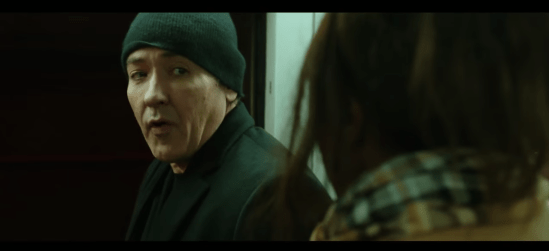
However, “Cell” was heading in the direction of certain doom from the moment Roth unattached himself from the project, sending “Cell” into the annoyance of limbo until a production company conglomerate formed to pull “Cell” from it’s stagnant state and attached Williams to direct. Yet once again, King’s beloved story goes into the throes of uncertainty with distribution after filming wraps in 2013. 2016 comes and Saban Films, along with Lionsgate , distributes “Cell” theatrically and within the home entertainment market respectively.

After all the monumental problems, I personally wanted to “Cell” to be one of the most entertaining and frightening horror films of the modern age, but as fate would have it, the Williams’ film disappoints. An film adaptation of a King novel needs more minutes to cover the story’s girth and “Cell” lacked pages of warranted minutes to be a full tell all for Clay, Tom, and the Raggedy Man. Portions of the novel were translated to the screen, but for the majority of the film, a rushed version of the story debuts to silver screen audiences that loses the book’s essence and dilutes character development, such as with Raggedy Man who has a sizable role in the book, but the character in Williams’ movie barely scratches the surface with being just a figurehead for the Phoners and not the collective’s soap box looming leader. The film started out great with intense chaos at Boston airport, pictorializing to life the Phoners from the King’s book with pinpoint precision, but from there on, the story’s time span goes vague whereas the book stretches out the length of time. Only a matter of two or three days does it seem the survivors jump from Boston, to the school, to the bar, to the story’s final location of Kashwak, but in reality terms and in the amount of devastation and character portrayal, weeks have passed.
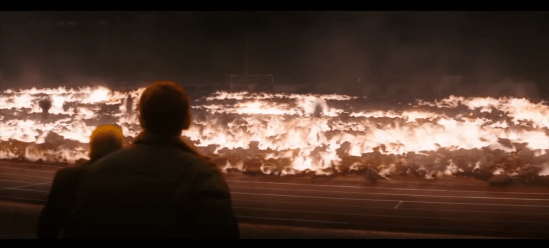
The ending has been rewritten from a surprisingly mixed reaction to the book’s and yet, the unravelling of the finale does more than convolute matters when Clay finds his son. There lies almost a dual ending where one’s interpretation can be the film’s own storybook ending. Stephen King’s “The Mist” had an ending that, when compared to Frank Darabont’s totally new ending for the film, was totally inferior to Darabont’s and I feel like that’s the stage that was trying to bet revisited here with “Cell” and it just missed the mark completely. Not all changes are for the worst. Character Tom McCourt, whose white in book, went to Samuel L. Jackson who absolutely fits the role without question, nailing PTSD stricken McCourt with little emotion but with untapped hurt. If I ever had to choose an middle aged white actor for the role of Clay, John Cusack would be my first and only choice even before casting began for the film. I do feel like having a white Raggedy Man was purposefully steered away from social sensitivities with an antagonistic young black male in a hoodie. The cast rounds out with Isabelle Fuhrman, Owen Teague, and Stacy Keach (“Slave of the Cannibal God”).
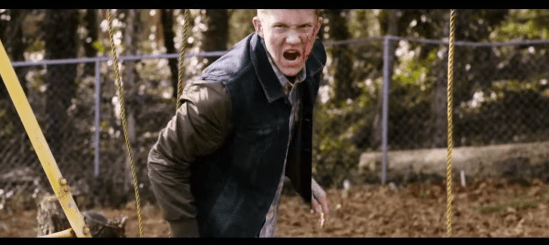
The digital visual effects were so poorly constructed and composited that I’m not surprised “Cell” didn’t have a longer theatrical run. The book had a number of jaw-dropping visuals the imagination could run with and now with seeing the depictions of those visuals on screen, they seemed seriously slapped together in such haste to where the devastating sensationalism turns inane and bland. King’s apocalyptic story warrants Hollywood scale effects, but received a few levels below that bar, failing to deliver major catastrophe on a world ending scale to the likes of “War World Z” or to cleverly style the film through a smaller medium such as George Romero accomplished with this first three “Living Dead” films.
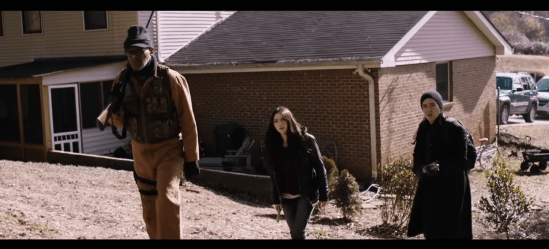
Lionsgate’s Blu-ray release is presented in widescreen 2.40:1 aspect ratio and the 1080p Hi-Def resolution becomes a disadvantage that clearly outlines the quality of the effects. The English 5.1 DTS-HD master audio is par for the course, but slightly in-and-out with dialogue that’s difficult to balance. The 98 minute feature’s bonus features includes an director’s commentary and “To Cell and Back: The Making of the Film” which is redundant if you’ve read the novel. Bottom line is if you’re fan of Stephen King’s novel, you’ll be sorely disappointed with Tod Williams’ “Cell” that’s nothing more than a long awaited entertaining rated-R apocalyptic horror with obsolete effects and with star-studded names attached to this Stephen King story adaptation.
Tag Archives: rated r
The Counselors Face an Evil Murderous Rage. “Summer Camp” review!

Four camp counselors prepare a woodsy, dilapidated living quarters a couple of days before their anxious campers arrival. As the preparations seem to be going as scheduled, a sudden violent rage takes over the head counselor with the eyes turning severely bloodshot and a bloody-black ooze seeping from the tightly grit mouth. The isolated camp structure that should bring joy and excitement to young children becomes an unescapable labyrinth for the counselors when the local transient residents fall also to the murderous madness. Trust between the terrorized counselors thins as none of them have an idea how the infection transmits. Without an operational phone or vehicle, the surviving counselors can only count on themselves to flee and fend from a fury seeking to massacre them all.

When first hearing of Alberto Marini’s inaugural co-written and directed film entitled “Summer Camp,” a vivid portrait of radiant sunshine, lake canoes, bow and arrow games, and lots and lots of children campers naturally come to the forefront of mind – basically, “Salute Your Shorts” pops right into the old “cabeza,” even in front of slasher genre fave “Friday the 13th” that culturally Hollywood-ized camp counselors, transforming them into unlimitedly horny teens, subjecting campers into hapless victims, and demonizing campgrounds as death camps. And while “Summer Camp” resonates good times in the season’s solstice heat, Marini’s version of camp weaves a craft basket of intense fear.

“Summer Camp” opens to a newscasters voice over reporting that three American counselors have vanished in the wilderness of Spain and are unlikely to be alive at this point of search. The setup already denotes no resolution to the counselors’ fate who make their on screen appearance in the following scene engaged in a trust game the Italian filmmaker had constructed to appear as every horror trope imaginable – a woman running through the woods with a blindfold and hands tied behind her back, a lurking ruffian peeping the counselors from the dense tree lot, and etc. The possibility of horror themed scenarios trickle at the top of a hill, snowballing until Marini decides to sudden plop down a massive, unbreakable brick wall in front of soccer ball size snowball before reaching critical speed, size, and strength for massive destruction. Marini’s a magician by convincing viewers to believe the trick in one hand, yet subtly revealing the real trick in the other and by doing this, a flare of confusion immerses the counselors and the audience in order to keep them guessing at every step of the way.

Continuing with Marini’s script co-written with Danielle Schleif, a contrived portion of many possible triggers that causes the violent behavior almost as if Marini and Schleif used satire to highlight the absurdity of previous zombie or infected films and their numerous infected origins. “Summer Camp” leads you to believe that one of the following three, or perhaps a combination of all three, possible culprits are responsible for spawning deranged and violent behavior. Characters are purposefully shown to be unprotected to the transmission of external blood or saliva, seen drinking the mysteriously broken and recently fixed well water pipes, and being exposed to an unusual after spring pollen buildup that seems to be everywhere. Which element prompts an outbreak? Or is it all three?

When the characters are aggressively possessed, a crossbreed between an “Evil Dead” Kandarian demon possession and a hybrid-rabies strain infected from “28 Days Later” sum up a “Summer Camp’s” possessed state of being. The actors themselves wholeheartedly accepted the role, doubling and switching themselves between normalcy and lunacy with ease. While the story prides itself on being quick to action and fast paced like Danny Boyle’s 2002 film, the characters’ depth burdens no viewer and their ultimate fate will raise no brows. The bare bones character backgrounds only affix their red shirt destiny; yet, Marini has already doomed his own characters for on script stupidity and whether intentionally or not, written to be cursed never qualifies a character to be a likable hero or heroine. When Will knocks out a possessed Michelle, he quickly unlatches his belt that holds up his pants to tie her legs with it and while that seems like a smart idea in the beginning, Will stills needs a way to keep his pants up from falling to his ankles in order to run through a dark dense forest from the numerous possessed individuals lurking about, screaming their lungs out. Will also attempts to unlace one of his shoes to bound Michelle’s hands. Why?! You’re going to need a tight fitting shoe to run through the forest and…oh forget it.

Diego Boneta portrays the unluckiest of the luckiest counselors. As Will, he’s accused of murder and along with being bitten, battered, incised, and even drilled; yet, he manages to still lead the surviving charge even if the odds are against him. The physicality of the role contrasts with Boneta’s character whose short and has a vision disadvantage, but Boneta underneath the skin of his character sports an athletic build as shown from one gratuitous shirtless scene. The dynamic between Boneta, Jocelin Donahue as Christy, and Maiara Walsh as Michelle couldn’t have been any better with decoding the group’s trust issues even until the very end, especially between the tomboy with a mysterious past Michelle and the prissy and uptight Christy. Dynamics stands out as the bright point of Marini’s skeleton script that doesn’t involve many complexities as it does debunking horror tropes.

The Lionsgate distributed the rated-R DVD release of the Spanish horror film has a 16:9 widescreen presentation with a Spanish and English 5.1 Dolby Digital audio complete with Spanish and English subtitles. With an average film runtime of 84, “Summer Camp” maintains just enough endless terror to suffice an entertaining haphazard horror-comedy and that’s about all the entertainment delivered from a DVD with thin extras including only trailers and a digital ultraviolet. The lightweight nature of this release should definitely not deter a viewership, but rather “Summer Camp” should be embraced as an intense and scary gauntlet of escape and survival. A well-fought first time feature from director Alberto Marini and a good showing of faith for a talented young group of actors seeking to imprint their names into horror.
Buy “Summer Camp” at Amazon.com!
Dig the Evil out of your Ears! Scream of the Banshee review!
Lauren Holly. Oh, sweet Lauren Holly. My, my how have you tripped and stooped to such films that are way under your more gifted talents (or assets for that matter). From your Turbulence flight of terror to your sweet, Angel Boris lookalike sweet piece of round booty in Dumb and Dumber to your short-lived stint of empowering women roles in NCIS and, now, you’ve dropped to so called “originals” presented by the After Dark collection. Whats next, Lauren Holly? Will we see you next on Soap Operas and Nickelodeon shows? Scream of the Banshee, part of After Dark collection, should be considered as a Nickelodeon TV show!
A university professor and her understudies are sent a mysterious package with no return address. The contents of the box are that of a gauntlet, a suited metal armor that covers the forearm and hand. A note with the gauntlet directs them to Section 3 where a box has been hidden behind a deteriorating wall. The professor uses the gauntlet to open the box releasing a ear-piercing, blood thirsty terror that will haunt them and kill them if they so much as scream!