Spiraling Vloggers Seal Their Fate When Face-to-Face with the “Woods Witch” reviewed! (SRS Cinema / DVD)

“Woods Witch” Available on DVD from SRS Cinema!

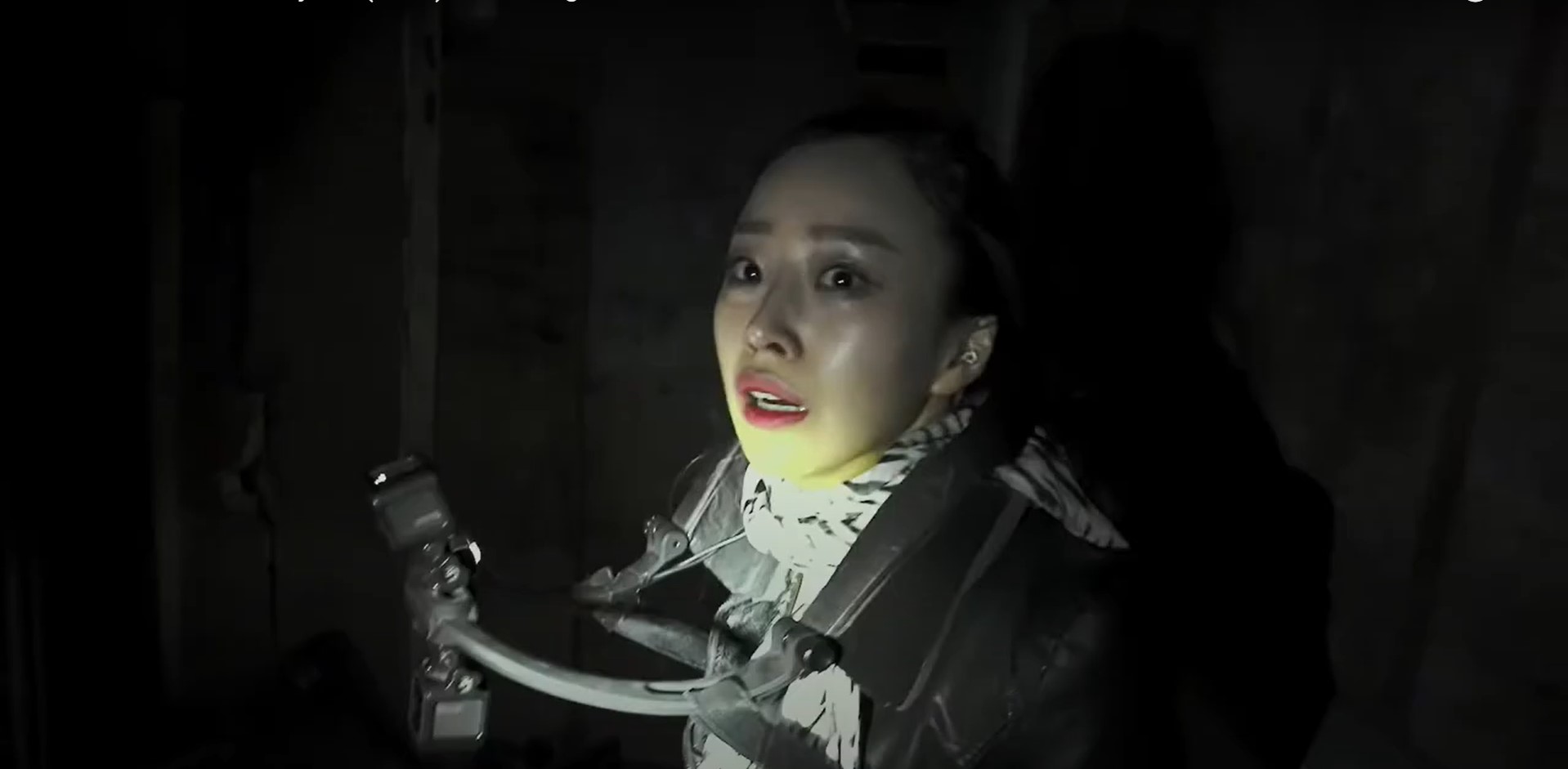
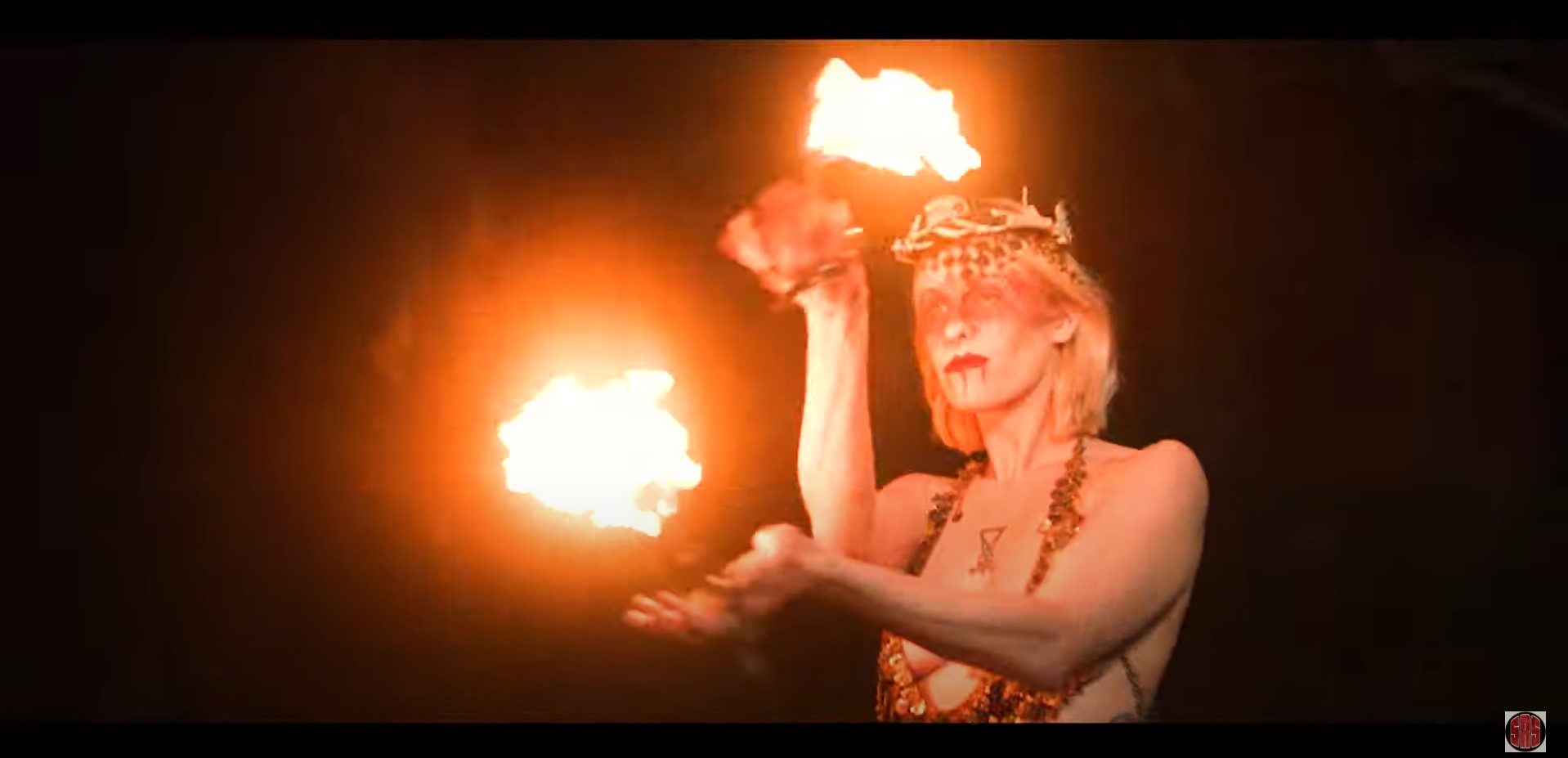
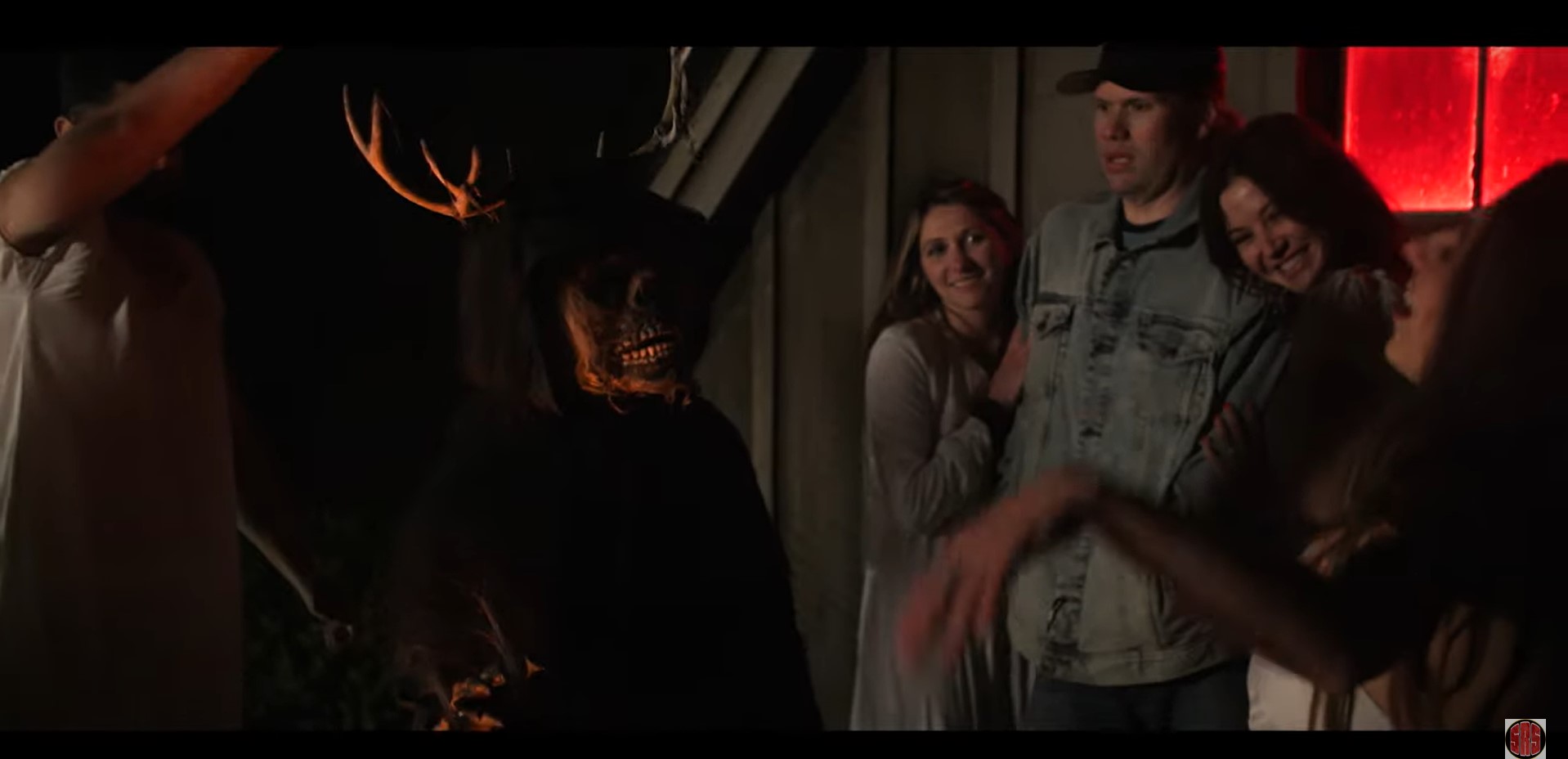
Vloggers Jonah and Jocelyn struggle to sustain a healthy dose of followers for their internet channel.  To spice things up and increase follow traffic, the two embark on a 48-hour challenge to stay in the nearby haunted woods of Allensville where a number of people have gone missing, even a fellow, more popular, vlogger named Garrett Gasper after he was self- recording and suddenly vanished when stumbling upon the blood tree, a tree that oozes a blood-like substance from the trunk.  Tagging along are vlogging, ambivalent friends Dacia and Eugene to help capture the spooky essence of what should be an easy, follower-increasing stunt for the impulsive influencers.  They’re also joined, reluctantly I might add, by a local cowboy, two bar patrons, and a father looking for his daughter who don’t know what they’re instore for as what ensues the unorganized, slapdash survey of the woods is far from being simple and safe when they stumble into the area of a seemingly hippie commune that’s actually a sex cult devoted to the woods witch Melora.

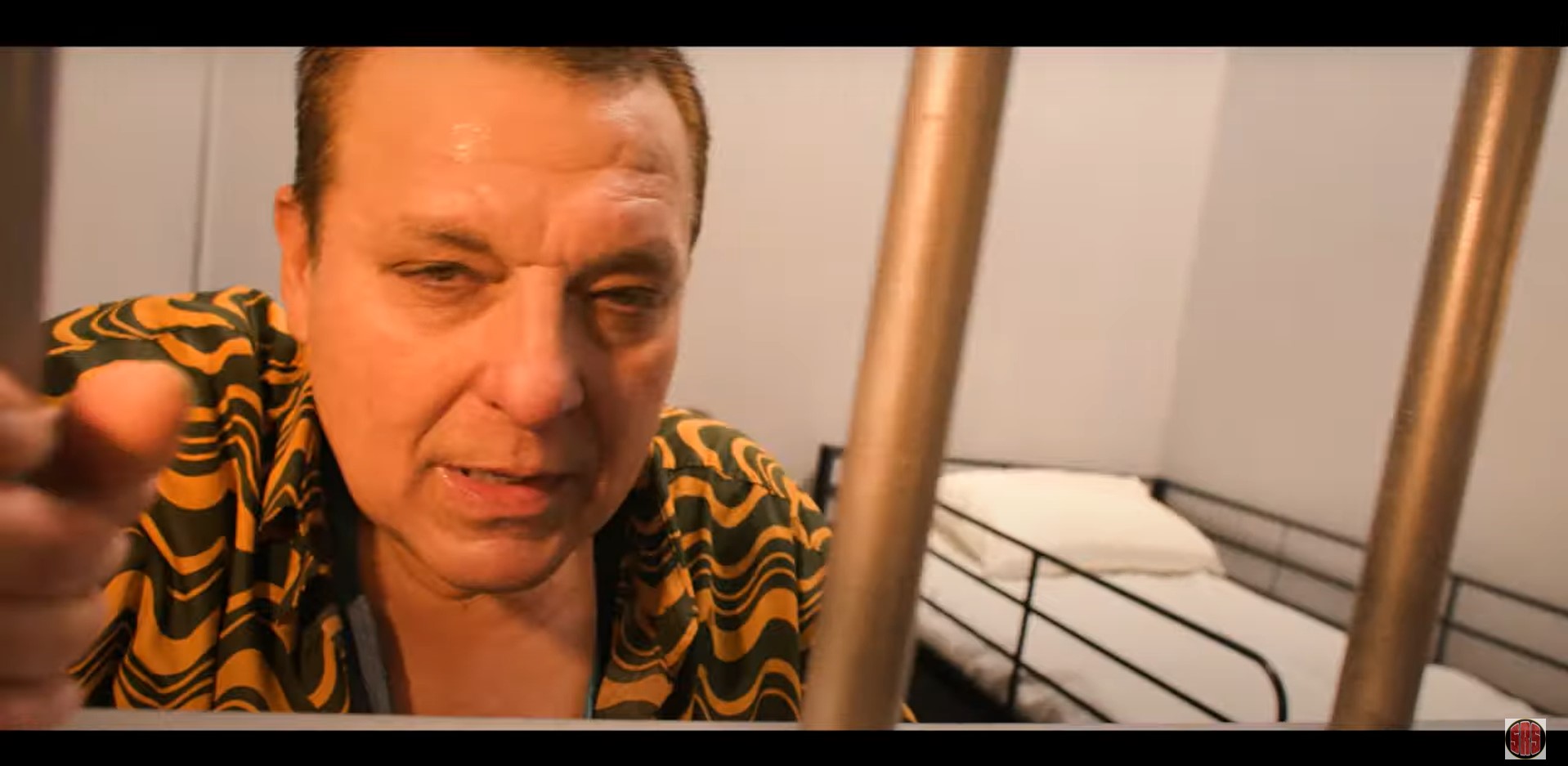
If you’re a diehard horror fan, or even just a physical media movie aficionado, you might have heard of the name Shawn C. Phillips.  The eccentric, high-energy, social media personality buys, watches, and reviews the latest and greatest on home video weekly on this Youtube channel under the handle Coolduder.  Aside from being also a movie actor with a range of roles in mostly low-budget, independent, B-to-Z grade horror films, such as “Girls Gone Dead,” “Blood Orgy at Beaver Lake,” and “WTF!,” Phillips’s social media presence further extends to an inspirational weight loss journey, shedding over 235 lbs.  Having been a longtime actor and producer, one of the Baltimore, Maryland native’s newest ventures is directing having shot mostly self-recorded videos to be inserted into other filmmakers’ movies.  Phillips’s latest is “Woods Witch,” a found footage comedy-horror that’s one-part “Blair Witch Project,” two-parts ADHD (Attention Deficit, Hyperactivity Disorder).  He codirects the film with costar and “Amityville Karen” actress Lauren Francesca in her debut directorial and cowrites with Julie Anne Prescott, writer of many more recent “Amityville” inspired budget horrors like “Amityville Karen,” “Amityville Shark House,” and “Amityville Bigfoot.”  DRAX Films (“Bae Wolf,” “Acorn”) is the production company behind feature that provided most of the funding in conjunction with crowdfunded portion.

Obviously infatuated about being in front of the camera, taking a backseat to his own co-directed film wouldn’t be enough for the nearly 40-year-old personality who costars alongside Lauren Francesca as social media influencing boyfriend and girlfriend Jonah and Jocelyn.  Loud and opinionated, the couple struggle with maintaining viewership but, before that, they also they also struggle with the foulmouthed, death-threatening volley between Jonah and Jocelyn’s robbing-the-cradle by robbing-Jonah’s-cameraman mother, played by Sally Kirkland (“Fatal Games,” “Two Evil Eyes”).  And that sort of leads into a couple of themes “Woods Witch” harps on.  One theme is the constant bickering, shouting, and squabbling between anyone and everyone in a free-for-all of one-upping each other or to not take humility very well in front of others.  None of the characters side with one another, steadying a position of satellite attitudes and courses that lead the story into all different types of unhinged and unfocused directions.  The second theme connects with Sally Kirkland and the other in-and-outs of overripe star power for what crowdfunded money could afford and while there are some likeable and decent names in the cast, such as the late Tom Sizemore (“Relic,” “Saving Private Ryan”) in his last role before his death, James Duvall (“May,” “Donnie Darko”), Robert LaSardo (“Strangeland,” “Death Race”), and Lisa Wilcox (“A Nightmare on Elm Street 4:  The Dream Master”), they used to headline the attraction with only minutes to shine in their respective scenes.  The cast fills in with Kelly Lynn Reiter, David Perry, Carl Soloman, Bill Dawes, Lorelei Linklater, Nicole Butler, Ken Davitian, Bryant Smith, Eva Hamilton, G. Larry Butler, Mary Jones, Tom Harold Batchelder, Jake Pearlman, Brian Metcalf and Sadie Katz. 

“Woods Witch” uses multi-media found footage to tell the story where a bunch of egregiously entitled vloggers trek into infamously mysterious woods for hits, likes, subscribers, and e-revenue.  Not an original bone in its narrative body by any means, Antoine Le’s “Followed” comes to mind, but “Woods Witch” doesn’t hit where it should as a heavily improv comedy-horror that lampoons found footage horror in the woods and, instead, has undeniably become massively cacophonous of in all areas.  Going into the feature familiar with some of the cast and the distributing banner, expectations of a Shawn C. Phillips directed film were all fastened at the lower screwball level with horror elements tacked in here and there, aptly fitting the mold the social media influencer has established for himself with the eccentric personality of a physical media farceur who adores horror, but nothing can prepare audiences for how much confused noise is strewn about with the constant yelling, backbiting, and randomizing introduction of characters that turns what should have been an entertainingly crass and witchy film into just being a completely crass and witchy yawner.  Being completely flat and unfunny wouldn’t be a totally fair statement as “Woods Witch” does have its moments, such as the tree blood being rubbed all over Phillips’s naked torso and him, as Jonah, proclaiming naively Dascia’s kinkiness can be found humorous, but these funny bit moments are far and few in between and there’s just not enough new, fresh, or actor-driven comically-inclined wit and materially to feast on to support the lack of horror despite a few morsels of gore that are left in the dust, overshadowed by an immense pre-trip setup of interviews and infighting that ruins the rest of the reel. 

Enter the world wide web and wacky world of Shawn C. Phillips with his co-directed film with Lauren Francesca in “Woods Witch” on an SRS Cinema DVD. The MPEG2 encoded, 480i upscaled to 720p, DVD9 pulls the differing, clashing video qualities together, mostly earlier on and near the finale, for a coherent beginning, middle, and end narrative telling. If only I could say the same about the story, themes, and character roles. Anyway, not a lot of banding as there’s not a lot of dark scenes in what mostly is fill lighting that brightens up what’s in the scene. Details are okay enough when not implementing shaky cam’s in-and-out focusing found footage and lighting doesn’t completely washout the miniscule bits of texture. The coloring also has a naturally graded look as well as the objects’ organic color palette as budget doesn’t allow for too much fancy cinematography to also evoke a sense of realism. The English language PCM 2.0 stereo mix is consistent as it is coherent with the clarity and the dialogue. Even with pandemonium breaks out, which is often with the screaming and snappy conversations between each other, dialogue remains unscathed without audible squashing feedback or other interferences. English closed captioning is optionally available in the extras. Special features include a behind-the-scenes raw footage from fellow Youtuber Kenneth Ramone who has a small part in the film, a handful of cut scenes, theatrical trailer, funny trailer, an audio commentary by director/star Shawn C. Phillips going deep into the casting, locations, backstories, script and improv moments, etc., and there’s a Lisa Wilcox stinger in the post-credits as the mayor for an additional or extended scene with some improv. The SRS Cinema package comes in a standard DVD Amaray case with eye-catching illustrated artwork, disc pressed with the same artwork, and is an unrated, region free release with a 96-minute runtime.

Last Rites: Humor and horror underperform in the film “Woods Witch” that’s sole purpose is to be a comedy-horror. What the film does do is parody other found footage features and their filmmakers under a misguided sense that in-the-woods horror, from a camera lens point of view, is past its prime when in reality, the long-in-the-tooth subgenre is better than this parody by far.

“Woods Witch” Available on DVD from SRS Cinema!

This One Has the EVIL Touch! “The Hand” reviewed! (Synergetic / DVD)

“The Hand” Pops Onto DVD at Amazon! Click Here to Purchase.

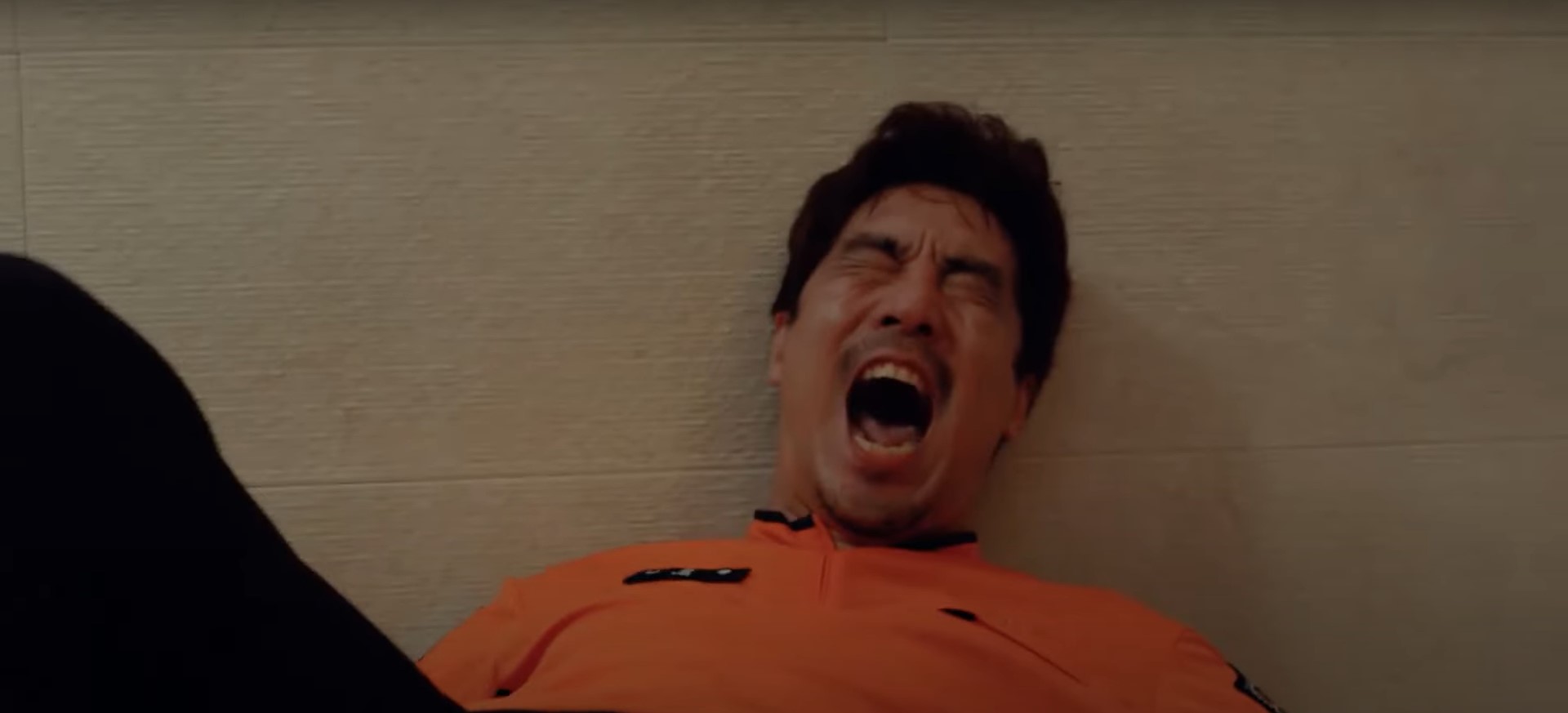
After a night of heavy drinking, Bong-soo wakes up from a strange nightmare.  The nightmare continues when he habitually walks into the bathroom and discovers a grotesque hand sticking up and out of the toilet bowl.  The confused yet calm Bong-soo wakes his wife who passes out at the sight after the hand twitches right in front of them.  Bong-soo calls 911 to report the strange occurrence and when his residence’s security guard and the dispatched EMTs check out the scene and see his wife passed out on the floor and a supposed severed hand sticking out of the toilet, the unbelievable scenario spirals into suspicion and Bong-soo is detained for suspected gruesome acts of foul play, but when the hand violent moves again and the bathroom door suddenly becomes stuck, those left standing, out of the hand’s deadly reach, are left with only toiletries at their disposal to do battle against the a force their unable to flush.

Preying on one of the more irrational fears that something will slither up the toilet while you make the business, “The Hand” extends that fear with a supernatural startlement.  Shot in 2020 but released in 2023, “The Hand,” or “The Hand:  Attack of the Things” is to the degree of a ghostly-demonic thriller sprinkled with dry humor from South Korea by writer-director Choi Yun-ho, claustrophobically shot inside an apartment bathroom which, and let’s be being honest, is roomier than most bathrooms in two-story houses.  Toilet horror is a subgenre that’s not everyone’s cup of eau de toilette but has resiliently found a niche audience and continues to live quietly in the indie shadows, such as with Evan Jacob’s “Death Toilet” films, Matthew Mark Hunter’s “Killer Poop” franchise, and the Asian market, specifically, has an interest in potty horror-humor, “Zombie Ass:  Toilet of the Dead” instantly comes to mind.  However, the absurdity of these titles doesn’t infect Choi Yun-ho’s less feces-filled horror, focusing more on the curled, demonically-skinned hand from out of the toilet.  “The Hand” is a feature presented by Korea Creative Content Agency and Inoi Media and a production of Spooky House, and R202 studio.

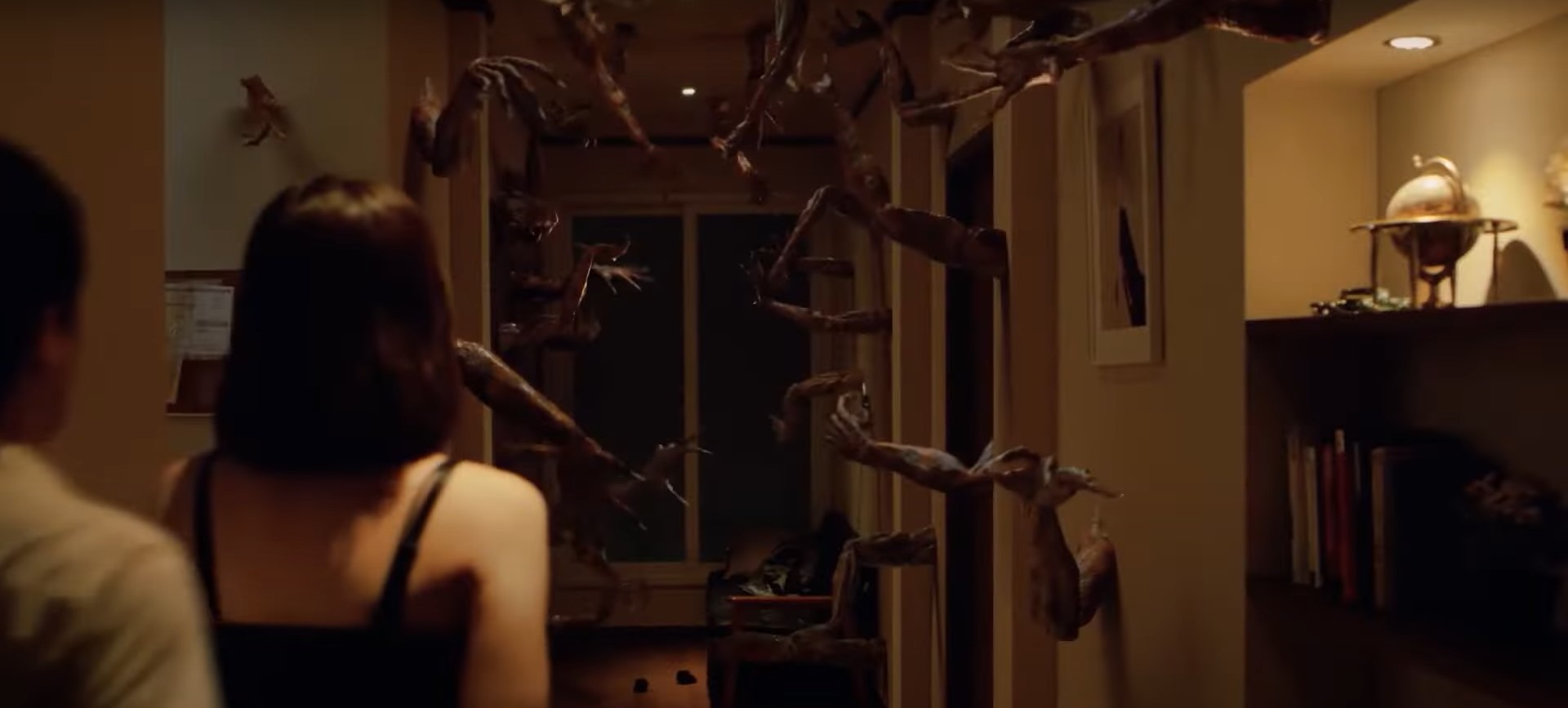
With an intimate setting comes an intimate cast to do battle with the mysteriously unknown monstrous hand.  Lee Jae-won is up to the task, or, well, placidly taking in the situation with subtle caution, as the expressionless alcoholic husband Bong-soo.  The regular Korean television actor infiltrates into his first leading man feature, or perhaps barely a feature with a film runtime of under 60-minutes, tackling close-quarter dynamics and a computer-generated thing with finger fingers, elongated fingernails, and a reach that turns the already compact bathroom into practically the size of a coat closet.  Considering the mention of his drinking problem more than once, Bong-soo’s alcoholism isn’t one of the more centric elements, especially at the chagrin of his wife Joohee (Jeong Seo-ha) to create a dynamic hurdle to arc over.  Once the building security guard (Soo-ho Ahn) and 3-person 911 team, with Park Sang-wook portraying lead paramedic, the energy devolves to a humorous suspicion of Bong-soo and the pigeon-hearted presence of the lead paramedic as the two men ever so lightly buttheads in a confounding position and through the progression of the ordeal, the squabbling pair form along the way a bond out of insta-desperation.  When the wife finally revives, another breakthrough moment between Bong-soo and his wife becomes realized that they’ll never take each other for granted again as they do slow motion poses and battles with an army of apartment wall-protruding hands who carry a deadly touch.  The jagged line graph tone maintains a comedic constant right through the heart of “The Hand” that lets the characters sway freely in various complexions without jarring their principles too flippantly. 

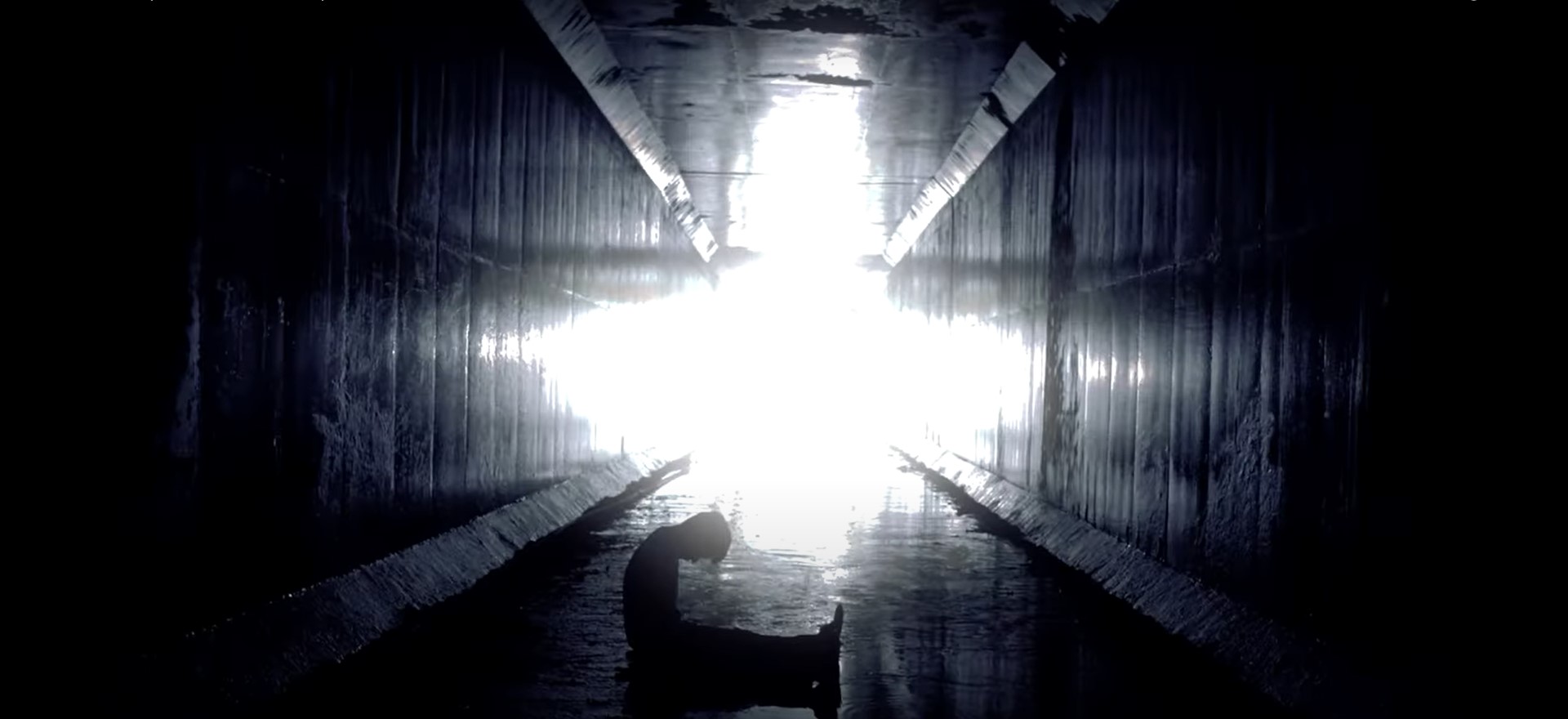
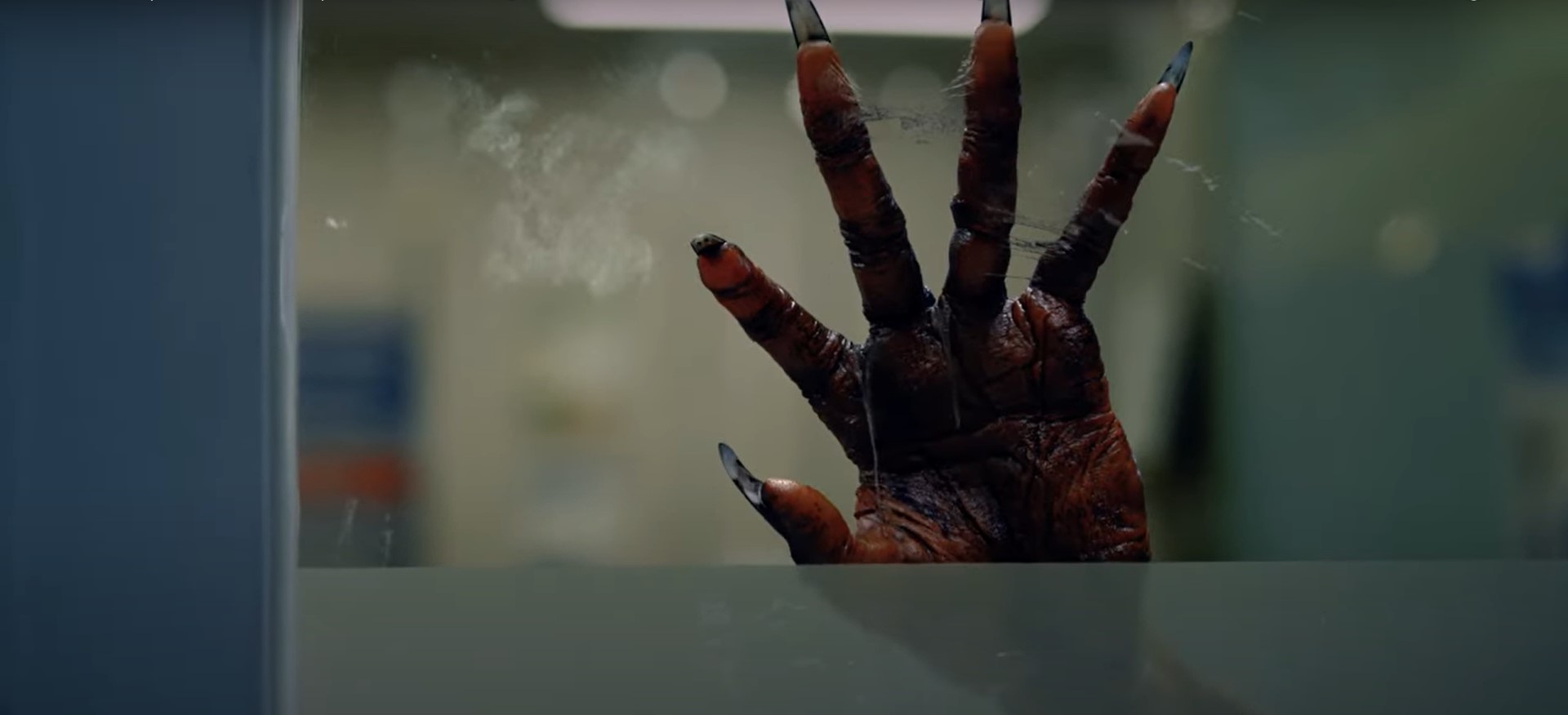
The titular hand is a fully operational character in itself.  A complete CGI mockup straight from the backstory sewers of Hell, conceived from a threadbare anecdote of a woman found dead in a nearby sewer tunnel with her arm missing a few days prior told by the paramedic leader.  That arm, with gnarled hand attached, is thought and assumed to be the same wretched one sticking ominously straight up and out from the toilet bowl.  Texturally, the synthetically composited hand looks pretty darn good with barely a trace of smoothed over plastic-splash veneer.  These scenes are also intermixed with a rubber hand cast with obvious contrast against the CGI hand.  That is until the arm extends feet beyond its chamber pot dwelling to tightly grip unsuspecting prey, like a crocodile lying in wait.  When in more a realistic scale, the hand’s movements are tremendously naturally looking with the help of green-suited animator and between appearance and mobility, the captured result, though miniscule in size appropriate for the indie film, has realistic attraction that edges “The Hand” out of the absurdity of circumstances and into more thrilling territory while still focus lit by comedic lighting.  The characters themselves are the more farcical models in comparison with representatives often aloof or arrogantly confident with ostentation as terror responses straddling between nonsensical and pragmaticism.  

“The Hand” arrives onto DVD home video from Synergetic, presented in a widescreen 1.78:1 aspect ratio on a MPEG2 encoded, standard definition, DVD5.  Decoding at a fairly high compression rate of 7 to 8Mbps, image quality has a fair amount of detail and color saturation from off the lesser disc capacity.  Facial details can appear soft throughout, sometime blotchy or waxy that fuses the contours and skin without delineation, and the CGI hand, though textured nicely, can have an early day video game blockiness about it in a handful of scenes.  The surround locations, such as bathroom and apartment, are hue balanced and display distinct visual variation.  The Korean Dolby Digital 2.0 mix is the only audio option available that comes with burned in English subtitles.  Dialogue renders over clearly inside the natural digital recording and prominent amongst the rest of the mix, isolating the changing levels of inflections and tones of what the moment calls for.  The English subtitles synch consistently with the action, but there are spot grammatical errors.  Aside from the play and chapter menu selection on the static menu, there are no selectable bonus features.  The after credits contains how the CGI scenes are composited together so stay tuned after the movie.  The scroll-like artwork with a monstrous hand, illustrated with a mock age-fading, is really neat visually and well-done.  Inside the bendy Amary case is just the disc with the same artwork in concise form.  With the region free playback, the Synergetic release runs at 62 minutes and, assumingly, comes unrated, as the rating is not listed on the back cover.

Last Rites:  Comedy and horror create stationary white-knuckle tension in “The Hand” despite not reining in a tightfisted backstory on the hand itself which ultimately turns the five fingered paw into more of a marginal footnote. 

“The Hand” Pops Onto DVD at Amazon! Click Here to Purchase.

Ancestor’s Didn’t Quite Incinerate All the EVIL. “The Ones You Didn’t Burn” reviewed! (MVD Visual / DVD)

Burn While You Got’em. “The Ones You Didn’t Burn” on DVD home video!

Siblings Nathan and Mirra are reunited at their childhood farm home after their father suddenly passes away from drowning.  The self-well-kempt Mirra handles the business end of their father’s farmland estate as the recovering drug addict Nathan struggles with his past urges while also helping with the cleanout of their father’s things.  They meet farmhand Alice who still maintains the crops and who is close to her unusual and quieter sister Scarlett.  Soon after, Nathan begins experiencing vivid nightmares on drowning and an unknown woman crawling out from the depths of the ocean.  He also feels the presence of malevolent forces around him and digs into his father’s past only to find that his ancestors were once witch burners and that the farmhand and her sister’s family lineage had settled from Massachusetts long ago.  In the midst of piecing the clues together, the siblings find themselves in the lingering black cloud of darker forces seeking retribution of a fiery ancestral past.

“The Ones You Didn’t Burn” is the 2022 released, independent horror from writer-director-and-costar Elise Finnerty.  The first-time feature film director from Long Island, New York infuses a slow dread of psychological thrills with a painted American folklore maquillage where past imprudence and costly mistakes catch up with the future generations stuck in a rut of their own problems. Filmed in and around Finnerty’s hometown, “The Ones You Didn’t Burn” is a family affair film with the filmmaker producing her first film co-produced by the immediate Finnerty family of father Dennis, mother Diana, and brother Sean.  Nicolas Alvo and Brett Phillips also co-produce with executive producers lined up with Estelle Girard Parks, Maxine Muster, Shannon Gallagher, and Alec Phillips financially footing the feature under the banner of Red Booth Productions, founded by Estelle Girard Parks and Elise Finnerty.

With the smaller production comes an intimate cast working in a handful of public locations and only a couple of home interiors and about a third of the cast are also working multiple roles in front and behind the camera, such as Elise Finnerty and Estelle Girard Parks not only the chief governors of “The Ones You Didn’t Burn’s” creative process but also as the inscrutable sisters Alice and Scarlett.  In principal roles, you receive exactly what writer-director Finnerty intends with her happy-go-lucky helping hand farm manager that strikes a small odd chord within the adrift Nathan, son of the drowned father who never recalls his father mentioning Alice.  Nathan, played by Nathan Wallace, is clearly exhibited and stated as a habitual user attempting sobriety but the more delineated the dreams become and the uneasiness that washes over him, mixed with the sudden, subconscious grief of a lost father and being peer-pressured by an immature, drug-fueled, and degenerate high school buddy Greg (Samuel Dunning), Nathan becomes mentally bombarded to the point of using again and breaking, though ambiguity leads us to believe that some witchery might be subverting his faculties.  Wallace shows great range in a downward spiral character arc, complimented by sheer intensity when that strangeness takes hold and shape.  Also feeling the pressure, in a different manner, is Nathan’s sister Mirra, sequestered by Jenna Rose Sander to make Mirra go solo sorting all the postmortem to-dos of her father’s belongings, extending out any hope or chance of Nathan and Mirra to reconnect in light of death.  In fact, the siblings become even more estranged and tensions simmer, especially when Mirra finds comfort in newfound friends, such as Alice and Scarlett, lending to more loss and disconnect for Nathan and other, again, possibly witchery waywardness to divide and conquer in the name of rancorous retribution.

“The Ones You Didn’t Burn” certainly is a slow burn filled with more fluff and reoccurring scenes than desired in an intriguing face value premise of a pair witches setting the wheels in motion to rid the land of witch burning descendants.  Insidious dreams and ubiquitous tarot card dinner flavor the film’s underlining horror but there’s not a ton of dynamics between characters as progression evolves almost without interactive sway, relying heavily on those dream sequences and Nathan’s zippy scrutiny into his father’s past as he comes up with not a lot, or rather circumstantial, evidence to deduct Alice and Scarlett as witches.  Finnerty certainly parallels Nathan’s supernatural trepidation with a more relatable one, drugs, stress, and lack of purpose that could be instigating a false drive to put a stop to the evil at work, affecting the only family he, a money-less addict, has left to rely on.  Finnerty provides some lucratively strong visuals with the stark night beach scenes of an unfaced woman crawling from out of the surf toward a bewildered Nathan in only what could be described as psychosexual and ominous.  Does Nathan fear beautiful women who have influence or authority over him and his family now that the patriarch is gone?  Mirra loaned him money and is successful professionally that initiated a denotation of inferiority only aggressively exaggerated by Alice and Scarlett’s inclusion of Mirra into a trifold takeover that will inevitably exorcize his junkie backside for good.  In any case, whether you believe Finnerty’s intention is to ride a fine line between witchcraft payback, and one being cut loose from his threadbare support system, “The Ones You Didn’t Burn” is a character-driven story that needed more character development and story devices but has tuned in performances and some eerie dreamscapes. 

MVD Visual in partnership with Jinga Films and Danse Macabre release “The Ones You Didn’t Burn” on DVD.  Presented in a widescreen 1.85:1 aspect ratio, the MPEG2 encoded, single-layered DVD5 settles for mostly natural grading in the exteriors with interiors being hard-lit by the natural light blocking features with the low-lit nightmares casting tenebrous drapes with key lighting techniques to isolate main objects.  Compression on here is decent with pleasant detail to show for it and only a few patches of softer nuances around skin layers.  The back cover lists a 5.1 stereo audio mix but the sole English language available, per my player technical readings, on the DVD is a 2-channel Dolby Digital stereo and I do believe the latter over the former as there is no singular output from the multi-channels; however, what’s render is par for the course and suits the release well with ample volume in all regards:  range, depth, dialogue, and a brooding, melancholic, and, at time, tension building soundtrack from composer Daniel Reguera.  Dialogue renders clean and clearly throughout.  English subtitles are optionally available.  Only other MVD and Jinga Films trailers, along with this feature’s trailer, are listed on the static menu in regard to bonus content with trailers of “After,” “Midnight Son,” and “Gnaw.”  On the standard DVD Amaray case front cover is an illustrated and portrait compositional of Elise Finnerty’s Alice character overlapping with yellow and black branches that give it that folklore and woody-witch coating.  The disc is pressed a same art but cropped and there is no insert or reversible cover included.  The region free DVD has a runtime of 70 minutes and is not rated.  “The Ones You Didn’t Burn” debuts Elise Finnerty as a competent filmmaker with a retrained witch tale with payback overtones and dysfunctional family undertones. 

Burn While You Got’em. “The Ones You Didn’t Burn” on DVD home video!

EVIL Wants Your Brain Fluid! “Vile” reviewed! (MVD Visual / Blu-ray)

These “Vile” Atrocities are now on Blu-ray!

What was supposed to be a relaxing camping trip amongst friends has turned into a torturous nightmare when four friends wake up to find themselves in the company of five strangers in a basement and learn they’ve all been kidnapped for a purpose.  Behind the illicit arrangement is an illegal drug manufacture whose formula is produced from the byproduct of the brain’s fear and pain induced chemicals.  With a 22-hour clock counting down from the first act of violence, the puzzled lot must fill a 100% quota before time runs out in order to be set free from the reinforced house they awoke in and the only way to do that is by hurting each other to fill the vials connected to the backside of their heads.  Framing a plan, a vote proceeds a numerical order of voluntary participation of torture, each contributing a fraction of the pain percentage needed to survive and be free, but egos, fears, and secrets cost them more than a few moments of unbearable pain.   

Before becoming Paramount Network’s golden nugget for creating the more recent acclaimed American television drama with shows like “Yellowstone,” “1883,” “1923,” “Tulsa King,” and “Special Ops:  Lioness,” Taylor Sheridan had first directed a small-time horror movie over ten years ago in 2011.  The title “Vile,” a play on words used to not only describe the cruel atrocities done from one character to another but also alluding to vial containers used to fill up with fear and pain fluid, is the brainchild of scriptwriters Eric Beck and Rob Kowsaluk.  Certainly, a different tone compared to hardnosed westerners and high-profile casted thrillers, Sheridan filmmaking roots from “Vile” mold his next stage directions of cruel character dynamics.  Beck produces the feature with Noël K. Cohan (“Into the Void”), Tina Pavlides (“100,000 Zombie Heads”), and Kelly Andrea Rubin (“Skeeter”) with presumably father Larry Beck footing some of the funding under the LLC of Vile Entertainment in association with Bosque Ranch Productions and Signature Entertainment.

An ensemble cast thrusts strangers into the throes of do-or-die but amongst the cast of characters, a delicate introduction of a core four put forth the wheels in motion of the sick extraction technique all in the name of drugs and profit.  The preliminary meet-and-greet of Nick (Eric Beck), Tayler (April Matson, “Primrose Lane”), Tony (Akeem Smith, “Holla II”), and Kai (Elisha Skorman) sets up love interests, Tayler’s secret pregnancy, Kai’s drug problem, and a playfully semi-morbid game of would you rather that foreshadows another choice pick of torture later the group has to contend with when joined with the other five test subjects – a dark and cryptic Greg (Rob Kirkland), a subtly anxious Julian (Ian Bohen, “5 Souls”), a selfish hothead Tara (Maya Hazen, “Shrooms”), a young and frightened Lisa (Heidi Mueller) and a level-headed Sam (Greg Cipes, “Deep Dark Canyon”). The variety of character provides varying shades of distrust, betrayal, and hope as factions form and convictions are about-faced, jostling those steadfast at first and solidifying principals for those teetering on the edge.  As whole, the cast works well together to provide adequate and satisfying suspicion as well as selling a particular attitude despite a couple of red herrings that are hidden really well within the framework. As individuals, lots of the dialogue pertains to self-explanatory states of the obvious that stick out like a sore thumb of colloquial filler with a story set in one location with the same nine people for approx. an hour long. ”Vile’s” cast rounds out with McKenzie Westmore and the unmistakable Maria Olsen (“I Spit on Your Grave 2: Deja Vu”) in a procedure-nothing televised head. 

As much as I disfavor comparing one film to another outside of sequels, series, or franchises, “Vile’s” voice is lost as an individual. Seven years prior, James Wan and Leigh Whannell began what would become one of the biggest contemporary horror franchises with “Saw,” spanning sequels through two decades, and concluding, thus so far, with this past year’s “Saw X.” What does this have to do with “Vile?” ”Vile” follows much of the same formula Wan and Whannel concocted in the earlier 2000s with a very to-the-manual approach of “Saw’s” collaring of individuals, media announcing a timed-task, and the players of the game have to hurt themselves, or others, in order to be set free. Fundamentally different with “Vile” has more to do pure greed and profit at the expense of those unfortunate to be in the path of profiteers whereas “Saw” forces transgressors into rebirth through pain and suffering. ”Vile” is also not as explicitly graphic with much of the torturous violence done out of sight, off screen, or in a blink of an eye. Nevertheless, the intriguingly staid premise takes the human condition to the limit and steps across the line of no return of committing what is self-destructively necessary to survive. Beck and Kowsaluk tweak the formula by a narrow margin but the manner of how the narrative plays out distances “Vile” to almost unitary means. For example, “Saw” almost always had a dual storyline that eventually converges with a shocking twist-tie conclusion. ”Vile’s” straightforward with a singular storyline that isn’t dichotomized with a parallel storyline, a periodization storyline, or any other type of storyline to be a crutch for the other, leaving audiences in the undivided present that’s an around-the-clock time crunch to live or die by the hands of themselves or at the mercy of others, and with a palpable enough twist that you’ll kick yourself in the chin for not predicting it ahead of time. 

“Vile” comes to Blu-ray from MVD Visual on the company’s Marquee Collection label. The AVC encoded, 1080p High-Definition, BD25 has the film presented in a widescreen 1.78:1 aspect ratio. Limited to a two-tone grading of steely blues and canary yellows, picture quality range has spasmodic bursts of interiority to agreeable presentations. More of the pre-ensnarement night scenes appear granulated by macroblocking, degrading the image to pre-high definition pixelated rate. Bitrate decoding jumps sporadically from mid-teens to mid-30Mbps, most likely due to an unstable data compression transfer. Compression appears better, though not flawless, later in the runtime with tighter contouring and a finer detail on a grungy, dirty, dilapidated house where the main set takes footing. The English Dolby Digital 5.1 and the uncompressed LCPM 2.0 are the available audio options, both of which lack commodious conviction with a suppressed volume. While the dialogue renders sufficiently with discernibility and clarity, much of the eye-averting torture sound design, the milieu audio, and even the rock-hard rock soundtrack retains an undeliberate lo-fi quality. English subtitles are optionally available. Special features include two deleted scenes that expand on more of the earlier character interactions, a behind-the-scene moment of director Taylor Sheridan mopping the kitchen set and singing, and the feature trailer plus other MVD Marquee Collection trailers. Tangible features include a cardboard O-slipcover, first pressings only, vaunting the nastiness to come and, again, appropriates a “Saw” cover with that nastiness of an extracted, bloody tooth in a pair of vice grip, a nod to the “Saw III” poster/home video art. The Amary case has reversible cover art with the original “Vile” artwork on the inside. The unrated, 88-minute MVD Marquee Collection feature has a region free playback. If “Saw” is deluxe imperial crab, then “Vile” is the suitable imitation equivalent with a steady pace of group-wrenching contrition and contempt that forgoes the games for straight up blunt force trauma. 

These “Vile” Atrocities are now on Blu-ray!

Your Train Has Come in on the Platform EVIL! “The Ghost Station” reviewed! (Well Go USA / Blu-ray)

Cho-Cho-Choose “The Ghost Station” on Blu-ray!

The Oksu train station’s past has incur many strange occurrences over the 17-years since it’s construction but more recently has seen a string of bizarre deaths. When a public service worker Woon-won witnesses a man’s death on the rails, he reluctantly informs friend Na-young, a struggler gossip journalist in need of a good, multi-click story after being hit with a lawsuit from her previous writeup and landing in hot water with the editor. As Na-young and Woon-won dig deeper to save Na-young’s begrudging career, they soon discover there’s more to this story than meets the eye as train station commuters and workers begin exhibiting scratches over their arms and neck. Those marked eventually die horribly. Bodies pile up as the story leads Na-young to the past of a razed orphanage and visions of grotesque children become the center of the young journalist’s investigation until her friend Woon-won displays the same marks. Now, they must solve the curse before it’s too late.

Based off the real Oksu Station operated by Seoul Metro in the Seongdong-gu district of South Korea and the short digital manhwa webtoon entitled “The Ghost Station of Oksu” from Horang’s Nightmare, the 2022 movie adaptation “The Ghost Station” waters the short story webtoon and grows a surrounding plot around the only adapted portion of a near empty Oksu platform except for one bench-sitting man and a stumbling lady who appears to be intoxicated.   The South Korean-Japanese co-produced picture is written-and-directed by So-young Lee (“Apt”) and Hiroshi Takahashi, the latter is the Japanese filmmaker behind the popular “Ringu” series which crosses orient borders by being the most important or influential in “The Ghost Station’s” inhabited identical J-horror elements.   Co-productions Mystery Picture and ZOA Films pull the train into “The Ghost Station,” produced by Yoo Jang-Hun and is theatrically distributed globally between Smile Entertainment and Contents Panda.

The webtoon is only a leaping point for the film version.  Not establishing any cited characters in the illustrated horror story, a whole new plot is built around and extended upon the webtoon narrative of the drunk platform woman that ends in a horrific accident for the young gawker on his phone texting ridicule commentary of her inebriation.  Story continues with a gossip Na-Young on the heels of being reprimanded for not receiving consent for her story of labeling her subject a him despite being very convincingly a woman in looks.  Bo-ra Kim plays the tenacious yet conflicted journalist, self-deprecating her career as clickbait material rather than honorable news reporting until the supernatural Oksu Station occurrences shed light on a bigger, corruptible conspiracy.   The “Ghost Mansion” actress sleeps through what should be a cold-clenching tale of sprog spirits and callous coverups that form a mighty-gripped grudge on those unlucky enough traipsing through the station yet doesn’t really affect her directly.  Oppositely, her friend Woon-wan epitomizes exaggerated fright within the performance of Jae Hyun Kim who can express translated fear in breath holding moments but outside of that Kim dons childish whimpering and yelling as if it’s a fad.  Together, the actors cancel out their characters flaws by embodying one investigative team as a public station worker and a journalist uncovering the truth and to save themselves the next victims of vicinity vindictive spirits.  “The Ghost Station’s” richer performances are yoked by stinted deuteragonists that actually drive the story but feel suspended in their integrated impact and relegated to being flashbacks or wedged into one particular location without a ton of exposition or background.  The dictatorial gossip editor (Kim Na-Yoon), the creepy alcoholic mortician (Kang-il Kim, “I Saw the Devil”), and the first victim’s externally anxious, psychosomatic dreaming sister (Shin So-yul, “Pyega”) are colorfully acted, complex in character, and plod the story along intrinsically, yet they’re underutilized hanging around the peripheral with only the sister edging out the other two with a more direct connection to the grudge or curse. 

Without unwrapping “The Ghost Station” before watching the film, the story progresses along without any cause for concern with a supernatural sleuth story of a horrible train accident causing a domino effect of curses.  Deeper into the feature, a water well becomes a focal object, then abnormal faces of ghastly children appear, and the principals are using keywords, like grudge, grudge this, grudge that, and where have we heard of this before?  With Hiroshi Takahashi “Ringu” films dappled intermittently with “Ju-on” insignias that turn the initially promising K-Horror into a full blown J-Horror in repeated attire.  While directors So-young Lee and Hiroshi Takahashi are able to garner a handful of scares through technique, makeup effects, and morose aesthetics and dolor, “The Ghost Station” has a creative deficiency as there are just too many coincidental “Ringu” and “Ju-on” suspense devices to craft an original curse tale despite the positivity just oozing out from the idea of two nations blending their respective horror niches into one project that dissects the integrity of the individual.  Na-young’s ethical dilemma as a tabloid journalist carries weight and is tiptoed around when her editor urges for better clickbait material, Woon-won struggles with self-preservation and a friendship bond, and other minor examples add up to the summation of choice.  Many made bad choices that resulted in an orphanage full of pissed off preadolescents using their spook powers for premeditated parricide.   

Walk down to the platform and wait for your train to come into “The Ghost Station,” servicing now on Blu-ray home video from Well Go USA Entertainment.  The AVC encoded, 1080p High-Definition, BD25 is presented in a widescreen 2.39:1 aspect ratio.  What the release showcases, as far as image quality, is a more than adequate transfer of the substantially tenebrous picture that renders shadows without analogous banding or splotching.  The low-light grading offers a polished appearance with deep, rich shadows to provide a natural ominous atmosphere and partially shroud characters without compromising distinctive detailing.  The Korean language audio options include a DTS-HD Master Audio 5.1 and a Dolby Digital 2.0 Stereo track. A more than viable digital audio recording that clear and comprehensible with formidable sound design for quotidian scare devices that abled to still produce fear, using the back and side channels to flesh out the scare factor in a fine-tuned direction. Dialogue’s renders nicely without any technical or interfering barriers. English subtitles are optionally available, come error free, and pace well with the rapid Korean dialect. Like many of the Well Go USA titles, not a ton of bonus features are inlaid and the same is said with “The Ghost Station” that only holds trailers for other Well Go USA Entertainment films. In a traditional Amary Blu-ray case, the front cover pays homage to the Horang webtoon. Inside, an advert insert is included with other Well Go USA films from the company’s Hi-Yah! collection. The not rated feature has an 80-minute runtime and has a region A playback only. ”The Ghost Station” undertakes a mesh of identity between K-Horror and J-Horror that sought to pull up to the platform as a singular, supernatural, scare package and, in the end, the film pulls in as a train of consumable terror.

Cho-Cho-Choose “The Ghost Station” on Blu-ray!