Millennial Martian Mayhem Is EVIL’s Wheelhouse in “Save Yourselves” reviewed! (Bleecker Street Media / Digital Screener)

Brooklyn couple, Su and Jack, find their noses constantly buried in their devices as the relationship between them begins to stagnate with unfulfilled measures.  In an effort to reconnect with each other meaningfully and detach themselves from the wedging worldwide web, they accept a close friend’s offer to use his upstate cabin as a rekindling retreat getaway from the mundane routine, away from the bustling city, and away from their highly addictive technological devices, shutting themselves off from the numbing side of the world to focus on each other.  As they become acquainted with their isolated surroundings and truly work on themselves, an attack from an alien race of pouffe balls has invaded Earth.  When they finally figure what’s happening, the serenity cabin therapy has been abruptly severed by besieging extraterrestrial furballs from space and they must rely on their little know-how to survive.

To all the modern millennial couples living comfortably in urban stasis and experiencing the world vicariously through the internet, “Save Yourselves!” is a calling and an unlikely savior you didn’t even know you needed from the writing-directing team of Alex Huston Fischer and Eleanor Wilson.  The duo’s introductory feature length film is a satirical sci-fi side-splitter of the celestial kind that, frankly, exposes the rudimentary sustaining people like Su and Jack who we all know exist and wouldn’t know how to start a fire with the quick strike of a match let alone save themselves from an apocalyptical alien invasion, but much like Su and Jack’s understanding of their surroundings and also to their defense, what does anybody know about surviving creatures from another planet?  “Save Yourselves!” is produced by Peter Traugott and Adi Ezroni of the New York based Keshet Studios as the company’s sophomore feature, Eamon Downey and Philip Erdoes of Last Rodeo Studios (“Scare Me”), and Joshua Blum of Washington Square Films.

Internet obsessed couple Su and Jack can barely not fiddle with their phones, laptops, and even Alexia for more than a minute, scouring the limitless online resource for information and entertainment that even infiltrates into their livelihood of administrative assistant scheduling and online popup box retail services.  “Mr. Robot’s” Sunita Mani sits into the internet top 10 list fixated mindset of Su with a complimenting structure revolving around her character’s meticulous life layout constructed by internet page browser tabs.  Equally as reliant on the power of the internet is her beau Jack, played by “Stranger Things’” John Reynolds in a hipster blend of Crispin Glover with the voice comparisons to Hanna-Barbera’s The Funky Phantom.  Mani and Reynolds accorded a charmingly naïve pair of social media engulfed millennials on a path of monotonous self-implosion and take their characters’ arcs over the growth threshold as their thrust to survive without knowing nothing of the tangible (Jack’s own word) world.  “Save Yourselves” is essentially the Sunita Mani and John Reynolds’ show, but the cast rounds out with bit part performances from Ben Sinclair, John Early, and Johanna Day.

Su and Jack are extremely likeable characters with some real and some fantastical unlikeable problems of social media addiction and space beings snatching their planet right under their touchscreen pressed noses. “Save Yourselves” knits a palpable double meaning that not only conveys the impractical saving of themselves from the impending attack of furry aliens, isolated in a thick, unfamiliar wooded ecosystem, but also save themselves from their own social network debilitated selves who rely too much on the glitzy pyrite of the Gram (Instagram) and Facebook to rule their lives.  Directors Fischer and Wilson gamble with a good chunk of the story’s unresolved aspects the plot points build up so well that might leave audiences scratching their heads while a lip-curling complexity freezes their mouths agape in wondering next steps for hapless couple Su and Jack. For the defense of the unexplained, the Earth invasion is an, as we know it, impenetrable fact of pure science fiction, glimmered in 1960’s fashion with resemblance to the Shatner era Star Trek “Trouble with Tribbles” alien pouffe balls (the filmmakers must have been “Star Trek” fans) of various shapes and colors beleaguering an assault with Spider-Man-like bio-lash to get around, an unquenchable thirst for Ethanol, and sonic fluctuance. When you type it out loud it sounds ridiculous, but “Save Yourselves!” harps back on the classic Sci-Fi features with a contemporary wit toward the inept abilities of today’s modern young adults and their reliance on social media.

Going off the grid nonplusses city dwellers with formidable diurnal life routines in the indie science fiction comedy “Save Yourselves!” that has invaded theaters and at-home platforms this week, distributed Bleecker Street Media. The 93 minute, rated R social commentary satire is shot mainly in an unfiltered, natural light with a handheld and steady cam, grounding the filming within the wilderness of New York’s upper state with a sound staged to recreate the tuning fork of kooky otherworldly sound bites and soundtracks. Since this is a theatrical new release, there will be no review on the A/V aspects. There were no bonus material included or any bonus scenes during or after the credits. “Save Yourselves!” is an eye opening gag of real time, real world dependents forced to outlast the odds and grow individually, and collectively, as independent people valued more than thought.

Pre-orde “Save Yourselves!” on DVD ahead of it’s October 9th release.

Flesh Combustible EVIL Ore in “Primal Scream” reviewed! (Dark Force and Code Red / Blu-ray)


In the future of 1993, a privatized and powerful mining corporation is extracting a newfangled element cleaner and more abundant than any other energy source known to mankind, but the element, known as Hellfire, is also the most dangerous as it causing the human body to spontaneously ignite the internal organs in a heap of electro-combustion, searing the body from the inside out. A private detective is hired under the pretense of an affair scandal but becomes intertwined in a power struggle to harness complete control of Hellfire that leads from explosive skirmishes on a mining station on Saturn to the many charred bodies scorched by the unforgiving Hellfire on Earth and the investigator is caught in the middle behind a veil of cloak and dagger criminal conduct, searching for answers and the truth.

A gumshoe narrative with a caustic boost of flesh destroying flair, “Primal Scream” is the 1987 independent science fiction action epic from first time filmmaker William J. Murray and an equally tenderfoot crew buckling down for their inaugural ignition into full-length feature film space. More recently familiar with Murray’s work on the Jersey shore thriller, “Exit 0,” as the director of photography, the writer-director got his big start helming “Primal Scream,” also known originally as “Hellfire,” a planetary, melodramatic perusal also set in New Jersey, shot primarily on location in Atlantic City. The title change from “Hellfire” was the brainchild of the distributor who bought the rights to the film, claiming “Primal Scream” as a more marketable title, but with a name like “Hellfire,” the spaceship models, web of lies, and evil corporations detective story would have garnered an audience. “Primal Scream” is a production financed by a movie theater concession stand franchisee, Howard Foulkrod, looking to be a part of movie-making team.

Before working with Murray in “Exit 0” as a heedful bed and breakfast front desk attendant with a pervading cocksure attitude, New York born Kenneth McGregor first and foremost collaborated with the filmmaker on “Primal Scream” as a washed up police officer turned private dick Corby McHale that became McGregor’s debut lead role in the low-budget sci-fi feat. McGregor could carry the weight on such a profound role that required physicality from a browbeaten scoundrel that could attract young new love as well as re-attract his former affairs. However, I wasn’t especially sold on McHale’s love interest, Samantha Keller, who came off strong toting up a lip-giving and gritty female officer who has history with McHale. Sharon Mason dons the role with her lanky, on the gaunt side, appearance that could have elevated the role in a incongruous, yet positive, light, but Mason withers down to a lovestruck puppy besotted with McHale back in her life, losing that salt of the Earth edge that keeps her sharp in repelling the scum around her as a beat cop. Jon Maurice was a real presence on screen as a weary and angry captain on the force and maintains a mutual respect for his former office and friend, McHale, though doesn’t look it. In his only credited acting role, Maurice has the towering posture of “Dawn of the Dead’s” Ken Foree or “Candyman’s” Tony Todd with a resonating voice, a gospel actor, and compliments McHale’s unkept and insouciant façade. Rounding out the cast is Julie Miller, Stephen Caldwell, Edward N. Fallon, Joseph White, and timeless showman Mickey Shaughnessy in his last performance before death.

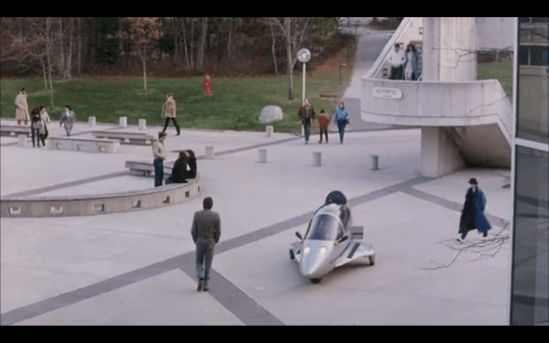
I find difficulty in thinking of one single aspect in where “Primal Scream” doesn’t deserve admiration. Do I think “Primal Scream” is a flawless attempt of a gargantuan dystopia of escapism? Not at the least, but for a pressurized, first time director, William Murray, his equally untried crew, and a cast of novice actors, the space ship model and pyrotechnics-laden gumshoe narrative palpitates wildly with tremendous heart for the amount of other intrinsic details that went into the feature, like the video phones and the ultramodern everyday vehicles, that didn’t produce a sensory overload of futuristic adornment and kept a practical milieu of face-to-face gambling bookies (location was set in Atlantic City after all) and ballistic projectile weapons despite a significant advancement in space travel. Hell, there’s even a sleek unrivaled-looking DeLorean in the first moments of the movie as a cherry on top. Granted, “Primal Scream” is set in 1993, nearly a decade outlook from production, and maybe undershot a realistic timeframe for interplanetary mining base construction. Another thing unclear is the story’s plasticity, murkily prefaced with a drop-in climax that is then refocused on the beginnings of Corby McHale’s seemingly diminutive hired involvement that leads to corruptive strife and dislodging of greed for the better of mankind. While trying to maintain a belief in the systemic universe the characters live in, the scenes are told through McHale as noted in the climatic introduction, but there are a few scenes outside that perspective box and don’t make filmic sense to the storytelling core. Ambitiously executed, “Primal Scream” dotes on films, such as “Blade Runner” or “Brazil,” of an Earth dystopian future and challenges us to totally recall our affection for the practical movie making magic.

In what I consider an odd release for Dark Force Entertainment and Code Red, I have to remind myself that William Murray’s “Primal Scream” is an oddity film with rich background and ludicrous-speed potential all around and makes a grand, high-definition Blu-ray debut distributed by MVDVisual. The region free release is presented in anamorphic widescreen, 1.78:1 aspect ratio, from a rather preserved source. The picture maintains a stable course throughout with some flare ups of scratches, blemishes, cigarette burns, and omitted frame jumps that were nearly inherent with 35mm productions. Yet, the coloring is excellent and balance with no diluting edge enhancements or cropping. A forced English language DTS-HD Master Audio 2.0 stereo mix is a palpable mix that is clear and unfractured by distortions. There remains a constant, low-toned crackle and hum throughout the approx. 85 minute runtime, almost as if it’s electronic interference, but the mix maintains a par score that offers beveled depth and a resounding range of bombastic explosions and the snap, crackle, pop of skin being corroded and cooked by Hellfire. Special features include an audio a new commentary by director William Murray and crew as well as the same group in a Making of “Primal Scream” featurette “Made A Movie, Lived to Tell,” showcasing current interviews recollecting 30 years ago their experience in making, and surviving, their first movie. Also included is the “Hellfire” 1981 promo reel. “Primal Scream” is more down to Earth than it is pew-pewing in the inky expanse, paralleling the dangers of new and unexplored elements and mining procedures, such as fracking, with a sleuth story rigmarole to save man from not only destroying their corporeal selves, but also destroying their souls from corruption.

Own Primal Scream on Blu-ray today!

May the EVIL Be With You! “Star Wars: Episode IX – The Rise of Skywalker” reviewed! (Disney / Blu-ray)


The rebellion suffers lost after lost against the oppressive First Order and news that the evil Emperor Palpatine lives casts an even larger shadow of fear and hopelessness across the galaxy. As Fin and Poe Dameron continue running small strikes against imperial targets, Rey finalizes her training as a Jedi with the help of Princess Leia, but as Kyle Ren discovers the Sith coven and the existence of Palpatine, his desire to search and track down Rey grows stronger before releasing a new First Order fleet of Star Destroyers with the capabilities to destroy entire planets. The Force pulls at Rey, guiding her to face her most difficult challenge: the truth about her parents and lineage. Rey faces crossroads that will determine whether she will continue to fight for good or cave into her anger and fear that’ll inevitably lead to the dark side.

Star Wars? What is Star Wars doing being reviewed on a blog that mainly covers the schlocky low-budget horror scene and the occasional obscure and weird Sci-Fi arthouse film? And the fact that “The Rise of Skywalker” is a Disney film makes this writeup the first ever Disney review for ItsBlogginEvil. No, don’t fret. I’m not selling out my love for the gore, scream queens, and pint-sized productions for the mondo-glitzy, big budget Hollywood epics nor am I making a soft right turn into bloodless PG-13 commercial commodities, but, and this is a big atypical but, “Episode IX” needs to be heard from those outside on the fringes. “Episode IX” is perhaps the darkest film of the cross-generational saga alongside “Revenge of the Sith,” or at least a close second, and, so it be, Disney was gracious enough to provide us a Blu-ray review copy of the J.J. Abrams grand finale to an adventure that has trekked through 40 plus years of galaxy-conflict, saw countless different alien species, gave us more pew-pews than we could ever hope to hear, three different versions of Anakin Skywalker, and the phantasmic super powers of what is known as the Force, all of which is encompassed by a fascist, utilitarian power. Co-written with Abrams is “Argo” and “Justice League” writer Chris Terrio from a story co-written also by “Jurassic World’s” Derek Connolly and Colin Trevorrow.

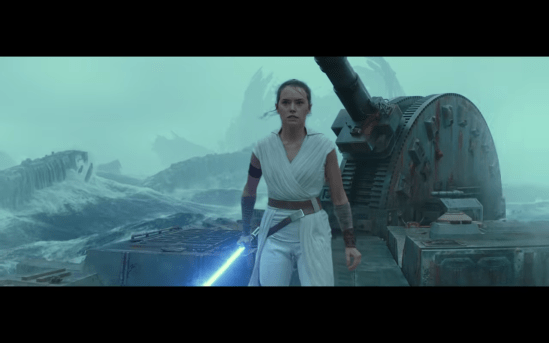
“Episode IX” begins with Kylo Ren (“The Dead Don’t Die” and “BlacKkKlansman’s” Adam Driver) discovering a pyramid shaped device that’ll Mapquest his way to find the secret Sith location where a familiar evil figure from the past returns and has built a gigantic fleet over the last three decades. This time around, Kylo Ren’s less of a toddler in the throes of brain development as he’s embattled with guilt and choice. Adam Driver does nail the performance with solemnity in his last performance as the son of Leia and Han Solo. The story’s heroine, Rey (Daisy Ridley), is also facing internal conflict with self-discovery as the prospect of knowing who she is sets her on a quest to discover her ancestry and what she might find might blur the sides of good and evil. The young actress who had a number short films and one horror title under her belt (“Scrawl”) before skyrocketing into “Star Wars” mythology returns to Rey as a Jedi hot off the Leia training course and thrusted immediately into the Force’s subconscious dark star, shielding her from the truth for fear of what may come of it. While Ridley shines, the Rey character sprints from, at this point in the Saga, point M to point Z, jettisoning much of the internal grappling to a mere blip on the ship’s internal sensors. Rey also feels entirely infallible, thrusting her character beyond the limits of mortality by completely overshadowing not only Kylo Ren, but also Emperor Palpatine. The other two new to the “Star Wars” crew, Poe (“Ex Machina’s” Oscar Isaac) and Finn (“Pacific Rim: Uprising’s” John Boyega), received similar shaft treatment of reworked characters from the original trilogy, possessing nothing new to offer. Poe a watered down version of Han Solo, a hot shot pilot who doesn’t understand the concept that together him and his fellow rebellious friends can defeat anything that stands in front of them; Lando Calrissian had to educate him with a bit of heart-to-heart exposition. However, Finn is perhaps the biggest undercooked character who has an inkling of Force within him that always simmers to the surface, but nothing is definite, nothing’s explained, and nothing is provided to perhaps the best known minority character in all of “Star Wars” behind Lando. Lastly, and I know the character write is up long and might be a little drawn out, Abrams really botched Carrie Fisher’s Leia that worked in awkwardly unused footage of the Princes/General from previous films. The simple and bland rhetoric used when Leia’s having a “conversation” with Rey is nearly painful to stand as Rey pours from an emotional spigot and all Leia can be, responsively, is cold, blank, and superficial. Mark Hamill, Anthony Daniels, Naomi Ackie, Domhnall Gleeson, Richard E. Grant, Lupita Nyong’o, Joonas Suotamo, Kelly Marie Tran, Billy Dee Williams, Ian McDiarmid, Harrison Ford, and Greg Grunberg co-star.

I adore “Star Wars” as much as the next nerd who grew up between the first and second trilogy. The blending between science fiction, westerns, and samurai tropes speaks volumes on how engrained George Lucas made space come alive with larger-than-life gusto that appeased not only fans of space adventure and wonders, but also fans saturated inside the spaghetti westerns and those with an affinity for Akira Kurosawa films. Those genre bending tactics really brought the film community together to appreciate the novelly detailed miniatures that came to life and the eccentric, sometimes outlandish, characters like Han Solo, Jabba The Hunt, Boba Fett, and Leia in that scantily-clad slave girl bikini. Yet, “Episode IX” irks me, irks me hard, as the once innovate “Star Wars” has been placed into a bingo ball spinner to have it’s originality called out once again in one ginormous homage to see, again, the Emperor, who seems very high and mighty upon his throne of Sith muscle, pitted against a ragtag team of good doers and their champion quasi-Jedi who has to make a between benevolent freedom or a junta power. That’s not to say that “Episode IX” is a total sham of a finale. Fans will receive the totality of a “Star Wars” film complete with light saber clashes, space battles, and the beautiful, yet sometimes violent, different worlds that ships can hyper speed to in seconds. The visual and practical effects are bar-reached and awe-inspiring by means of thousands of ships clustered together, the dim-lit bars crowded with varied character creatures, and the speeders racing through canyons and sandpits become heart-pounding thrill rides of excitement. The introduction of new characters, like the amiable and smile-evoking bot technician Babu Frik, the former Poe co-spice trader and survivalist Zorii Bliss, and another ex-Storm Trooper, Jannah, forms that similarity bond with Finn, are new blood that delight when on screen. Yet, these new characters are shamefully underused as minuscule support that garners only a speck of adoring fandom but little else to the story’s plotline.

“Star Wars: The Rise of Skywalker” comes home with a 2-disc Blu-ray and Digital Code release, sheathed inside a rigid slipcover, presented in 1080p, full high definition, widescreen, 2.39:1 aspect ratio. Video is top shelf quality of everything a “Star Wars” film should be with colors and details galore that are arranged purposefully and perfectly to aesthetically please a contrast against the bleakness of space. The extensive line textures are seriously sharp and along with the vast special effects professions who model, shape, and digitally imprint the liveliness into the work, but there are instances, such as on the Sith home world, where the visual effect of an arena filled with distantly scoped blurry Siths dampens the moment of Rey’s endmost consignment. It looked and felt cheap and didn’t properly convey’s Rey’s loneliness against all odds. The lossless English language 7.1 DTS-HD Master Audio caters to every pew-pew blaster sound, every ship zipping through space with an engine-like exhaust, and every electrical discharge of a light saber humming in the throes of dual. The dialogue, and Chewbacca’s guttural growls, are effervescently prominent with a natural tone and not commingled by the other tracks, making “Episode IX” some of the best sound work to date in any “Star Wars” film. Capping off the Saga soundtrack with the familiar John Williams robust overtone and coursed throughout an engaging orchestra that moves in synth with story’s dynamics. The bonus feature disc includes an over two-hour documentary entitled “The Skywalker Legacy,” a full length feature of orgasm supplementary regarding “The Rise of Skywalker” and diving deep into the mythos of “Star Wars'” history. Other bonus material includes the mechanics of creating a speeder chase on the Pasaana world, shooting in Jordan to utilize it’s dessert location to create an alien planet, exploring the D-O ship that’s new to the franchise, an interview with Warwick Davis who returns to “Star Wars” to once again don an Ewok character along with his son Harrison, and a cavalier look at the otherworldly creatures and highlighting those who play the part of these beings. For many, the book of George Lucas’ “Star Wars” has been closed as the final episode completely arcs the Skywalker story. Yet, for a few who wish to explore more, “Star Wars” is sought to be an open to a means for other characters to be explored, such as with The Mandalorian,” and, just maybe, that cute Babu Frik. “The Rise of Skywalker” exited in a cliche fashion, a warp drive to an already established and tiresome rehash of circumstances, while only supplying a healthy demand of star power and intense action inside a rapturous package overflowing to the brim with too much content and too little substance.

Complete the Saga! Amazon has “The Rise of Skywalker” on Blu-ray+Digital!

The Cycle of Life Can Be EVIL. “Vivarium” reviewed! (Screener/Vertigo Releasing)


Gemma and Tom are a happily in love young couple who are looking to purchase a starter home. They visit a real-estate agency for a brand new housing development called Yonder. Met by a strange and persuasive real-estate agent, they’re convinced to follow the unusual agent to tour the neighborhood that has been marketed as the family forever home with everything they could ever need and want. A row upon row of identical houses and yards go as far as the eye can see and before the tour of the rather ordinary house number 9 ends, Gemma and Tom find themselves alone inside with the bizarre agent gone. Their efforts to leave the mysterious residential suburbia proves impossible as each turn leads them back to house number 9. When a box containing a baby boy is left at the doorstep with a note to raise the child to be released, the young couple reluctantly reside into domestic confinement.

Vivarium defined is an enclosure, container, or structure adapted prepared for keeping animals under seminatural conditions for observation or study or as pets, like an aquarium or a terrarium. “Vivarium,” the 2019 movie, embraces the definition, twisted into an idiosyncratic neighborhood block of duplicity from the “Without Name” director, Lorcan Finnegan. Story concept is flushed out by Finnegan and “Vivarium’” credited screenwriter, Garret Stanley, in their second collaboration for the director’s sophomore feature endeavor that’s a panicking puzzle in every square foot of Yonder’s backwards backyard. The film resonates with echoes of Finnegan and Stanley’s seminal short film, “Foxes,” from 2012, revolving around a couple living in a remote and forgotten housing development and become drowning in obsession, madness, and malaise as shrieking foxes surround their isolated home. There’s an equating animalistic instinct to each film that brandishes many of the same motifs as well as joining themes that are corralled in Finnegan’s copious foreboding and disconnecting dehumanization narrative. “Vivarium” is produced by XYZ Films (“Tusk”), Fantastic Films (“Stitches”), PingPong Film, and Frakas Productions (“Raw”).

The happy, young love birds are played by Imogen Poots (“Green Room” and “Black Christmas” 2019 released remake), who has an underlining affinity for not typecasting herself in the same role, and Jesse Eisenberg (“Cursed” and “Zombieland”), who manages to step a foot outside his conventional performance of a rattle mouth, know-it-all. However, Eisenberg deserves the praise of a man with severed ties from reality as the actor embraces a reserved manic by channeling Tom’s obsessive need to dig, an aspect of his handyman profession he’s good at in perhaps providing an escape from cage-less confinement, and being the bearer of skepticism of caring for an abnormal child. Gemma has complications of her own confronting her educator responsibilities for young children. She struggles with internal conflict, does she still use her innate care and instruct a young mind or in self-preservation, take Tom’s passive aggressive approach? Poots and Eisenberg share a mutual, caring bond that defines Gemma and Tom kind of steady, kind of loose relationship that gradually devolves civilly, like the amicable breakdown of a marriage revealing lost, but not forgotten love between two people. Along with the surreal atmosphere, “Vivarium” grades well in the creepy kid department with the child in Tom and Gemma care, but don’t even bother giving a name. Dubbed with a playful man’s voice, a shrill scream ignited by displeasure, a knack for imitating, and always dressed in Sunday’s best, Senan Jennings’ middle aged boy presence is a supernova of chilling proportions with a performance that gives his co-stars a run for their money while Eanna Hardwicke is equally spasmodic and creepy as the grown up, young man version of the boy with a little more alienating know-how and clandestine about his origins.

Finnegan and Stanley pursue thought-provoking substance of human corporeal limitations and how we, as humans, cycle through them with such cavalier ease. The opening scenes examples this with the practice of the common cuckoo laying their mimicry egg inside the nests of other birds. As a brood parasite amongst birds, the cuckoo egg hatches and the cuckoo chick pushes out the mother birds’ inborn chicks and becomes the sole chick in the nest with the surrogate mother tending to the cuckoo’s dietary needs. When the cuckoo is matured, it is grossly larger than the mother bird and, also, mimics the bird species to an extent, much in the same way of the boy or young man Gemma and Tom surrogate as being the unintended mimicry that infiltrates and ousts the limitations of his foster parents. Finnegan and Stanley also explore the parental lifecycle with the theme that our children will replace us, extend our legacy, but we will ultimately be forgotten. “Vivarium’s” craft dictates a larger scale, disproportionate, otherworld teemed with secret subterranean corridors leading to other disturbing observatory immures, making for a stimulating meta-induced terrarium as we watch miniature versions of Jesse Eisenberg and Imogen Poots suffer inside a screen from the comfort of our couch.

If you’re stuck at home, living the quarantine life you’ve always wanted, “Vivarium” may just break of your introverted stance on home with it’s “Black Mirror” and “Twilight Zone” encouragement. Because of the COVID-19 pandemic, the Vertigo Releasing and Wildcard Distribution released film has circulated digital only on the following platforms in the UK: iTunes/Apple TV, Amazon, Sky Store, Virgin, Google Play, Rakuten, BT, Playstation, Microsoft, Curzon Home Cinema, and BFI Player. Unfortunately, I will not be able to comment or critique of the audio, video, or bonus features of this release due to the varying elements of a digital screener. Novel, suspenseful, and a great film to brood over, yet difficult envisaging, “Vivarium” truly resembles slithers of somber dimensions of an upside world with lashings of surveillance paranoia.

Amazon Prime Video is one way to watch! Rent or Buy “Vivarium” with Prime Video

EVIL Must Be Broken In Before Being Used. “The Wheel” reviewed!


In the near future, paraplegic inmate Matthew Mills volunteers under pressure to join a Satoshi-Telefair Industries experimental treatment program that not only promises to reduce his sentence, but to also to regain mobility in his legs. With nothing more than the hope to return to his daughter, Mills is enticed by the agreement and gives himself to a shadow company who regularly contracts with the military, facilitating deep underground at an isolated site. Shortly after signing the release form, he awakes in a dark, steel cell known as The Wheel and is able to move his legs again, but the jubilation quickly subsides as armored men with batons visit his cell to beat and break his body in order for the nano technology, injected amongst his anatomy, to rebuild damaged tissue and make him stronger. The ordeal torments him, but to the researchers observing every detail of his recovery and behavior, Mills is just subject 2-1, another potential subject destined for the Future Soldier Initiative where the unethical testing must continue.

Shady shadow corporations, experimental nano-material rehabilitation and enhancement, and high level science fiction noir from writer James S. Abrams and director Dee McLachlan with 2019’s “The Wheel.” As if not already obvious from filmmaker’s nationalities, “The Wheel” is produced by and shot by Australian production companies SunJive Studios and Film Victoria, a state government agency that advocates funding and other filming assistances for shooting films in sectors of Victoria, Australia. “The Wheel’s” steely posture mirrors the frigid winter snow of Melbourne, Victoria’s covered forests that’s beautiful, yet deadly in the conventional beauty of nature. Yet, “The Wheel” delves into the meddling of what makes man and what also drives man as the story persists on the subject of redesigning the human body, but what that notion doesn’t take into account is what if the human body’s reactions doesn’t go as planed and a clapback ensues with all the synthetic re-wiring behind it? This is what Abrams and McLachlan intended to explore.

Australian actor Jackson Gallagher stars as Matthew Mills, a cripple with a purpose. The “Patrick” actor has been adrift from the darker roles since 2013 until up now with his main role in “The Wheel” that demanded a certain physicality that involved fight sequences with one, or two, or even three opponents and some ariel ropes work. The physically fit Gallagher not only survives the daunting workload, but hastily pulls Mills through his character’s tough transition from hopeful paraplegic to overly confident ultimate fighting weapon without an earnest core of struggle. The same can be said with Dr. Allison Turner played by Kendal Rae (“Out of the Shadows”). Turner’s a rogue researcher who had her practicing credentials revoked after the mistreatment of lab monkeys and was sought after by the Satoshi-Telefair for her detachment qualities, but her Turner’s character also didn’t quite arc properly and resembled a midway plateau from the moment Mills became her research subject. The only character that stayed the course was Dr. Emmett Snyder, a loyal Sataoshi-Telefair researcher to the bone. When he’s not suplexing or drop kicking in a championship wrestling match, David Arquette does dabble in acting. The “Scream” veteran actor fills in a rather unlikely antagonistic role, but the wild eye Arquette remains taut in his performance. “The Wheel” also costars Belinda McClory (“Matrix”). Christopher Kirby (“Daybreakers”), Victoria Liu, and Ben Still.

The spoke of the “The Wheel” rotates on a monotonic and frosty shoulder axle colored in gun metal and iced with dystopian immoralities. Every breathing element and inanimate objects is in a state of distant identity being bestowed labels in a combination of letters and numbers. The utilitarian wheel, an underground experiment facility that shifts rooms up and down and can be rotated to the other side, has no windows or any kind of necessary function other than to test subjects. Where “The Wheel” goes full “Equilibrium” by lacking emotional depth and substance without a coup d’état of the bleak authority, “The Wheel” also lacks vigor to break the blank uniformity and tries to speed through Mills patriarchal fluff to provide reason for his endurance and to provide reason for audiences to care. The epicenter theme to Mills motivation and escape is the thought of getting back to his daughter by any means necessary and was deemed fit to lay by the waist side to rely more on the hand-to-hand fighting like an overly glorified 70’s martial arts film.

Umbrella Entertainment distributes the sci-fi, action film, “The Wheel,” produced by SunJive Studios and Film Victoria onto a region free DVD home video. The clean digital picture in a widescreen, 2.35:1 aspect ratio, has a crisp demeanor that exact a bunch of natural lighting outside with a bit of a lower contrast inside dark “The Wheel” itself. What I found more appealing the anti-aliasing of the drone footage over the snowy covered Victoria forest, suggesting a higher bitrate compression that offers a seamless and smooth recording. The 5.1 English language Dolby audio is offered up with no whiff of an Australian accent in a lossless track that sounds good on the surround channels during action scenes. Dialogue is clear amongst the ample range and depth of ambient layers of researches watching and speaking through comms from inside a box watching another guy inside a box. Like other Umbrella releases, “The Wheel” has no special features nor a static menu. “The Wheel” has ice in the veins, but no warmth in it’s heart that seems vertically challenged on a horizontal slope of dystopian disorder.

The Wheel on DVD