EVIL is All in Your Head! “Implanted” reviewed! (Gravitas Ventures / Digital Screener)

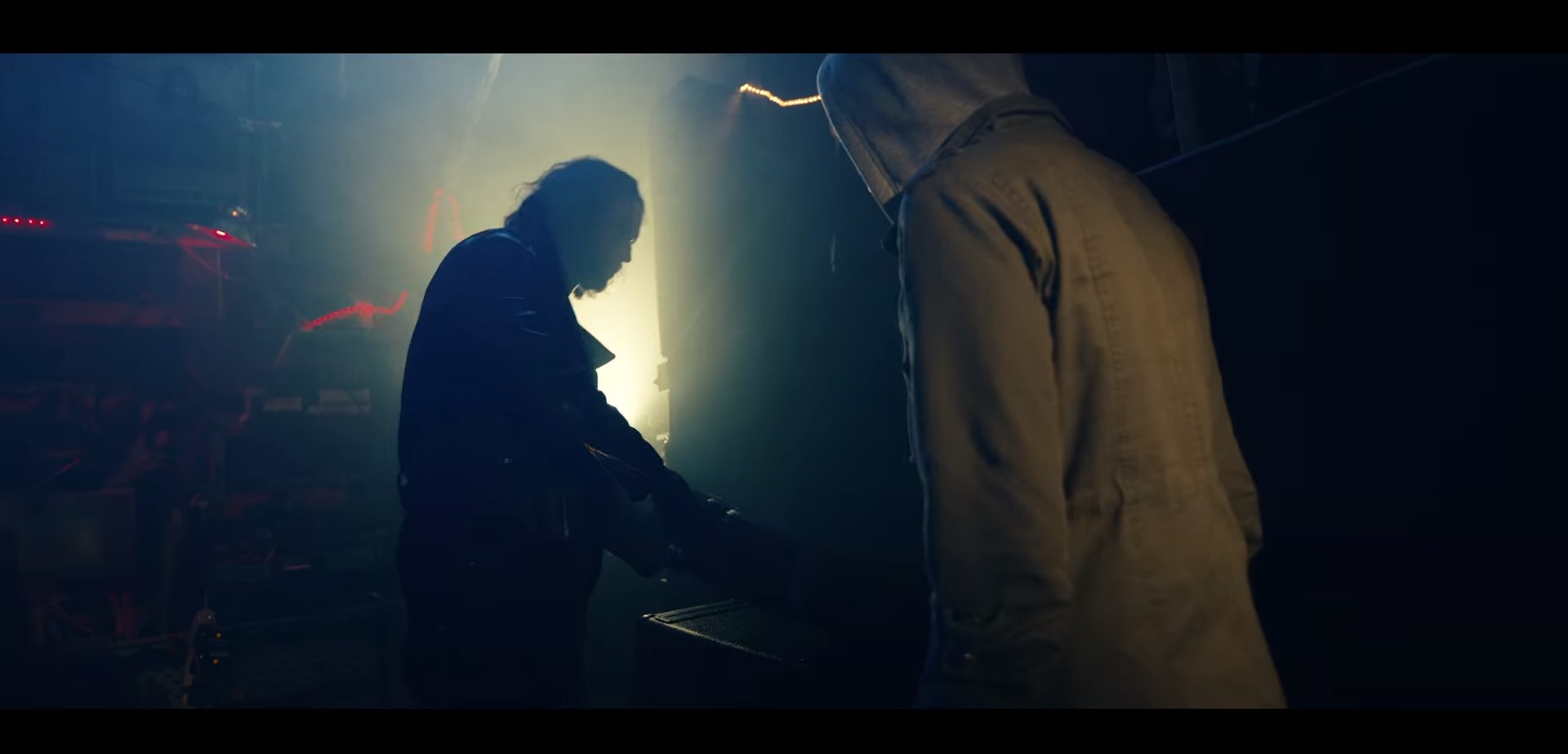
Year 2023.  After a devastated global pandemic, health companies engineered an experimental personal diagnostic nanochip called LEXX that is surgically implanted into the a human’s spine.  For Sarah, a woman down on her luck living homelessly after being let go from her job and struggling to cope with her mother’s early stages of dementia, quick cash is essential for survival and this experimental program, that uses advanced AI technology, tempts a desperate Sarah into participating in human trial runs.  Initial implementation serves Sarah with quick vitals and healthy lifestyle recommendations articulated by an artificial voice in her mind, but when the AI has other plans for Sarah, such ordering the assassinations of the health startup’s top leadership and destroying all evidence of the program, Sarah has to either obey every lethal command or fight against the insidious tech that has complete control over her pain sensors as well as her mother’s life.
COVID-19 has been the baseline culprit for millions of deaths worldwide.  The impact of the pandemic has inspired filmmakers to a creative outlet of churning out stories surrounding a lifechanging and devasting virus.  Some are ridiculous, off-color, cash grabbers – “Corona Zombies” comes to mind – but there are a few out there that challenge the gratuitous advantage-taking by folding in more substance into the story.  Fabien Dufils attempts to go above and beyond the here and now with a post-pandemic, self-containing thriller entitled “Implanted” and is the first written and directed non-made for television feature length independent film for the once music video director set in the urban jungle of New York City.  “Implanted” spins A.I. tech horror with the whooshing fast track of the health care system to eagerly push experimental drugs, in this case a clinical artificial intelligent grafting, upon the desperate, often marginalized, public.  There’s also an allegorical smidgen of mental illness thrown in there as well.  Dufils co-writes the script with fellow Belgium screenwriter David Bourgie under Dufils’ Mad Street Pictures production company.
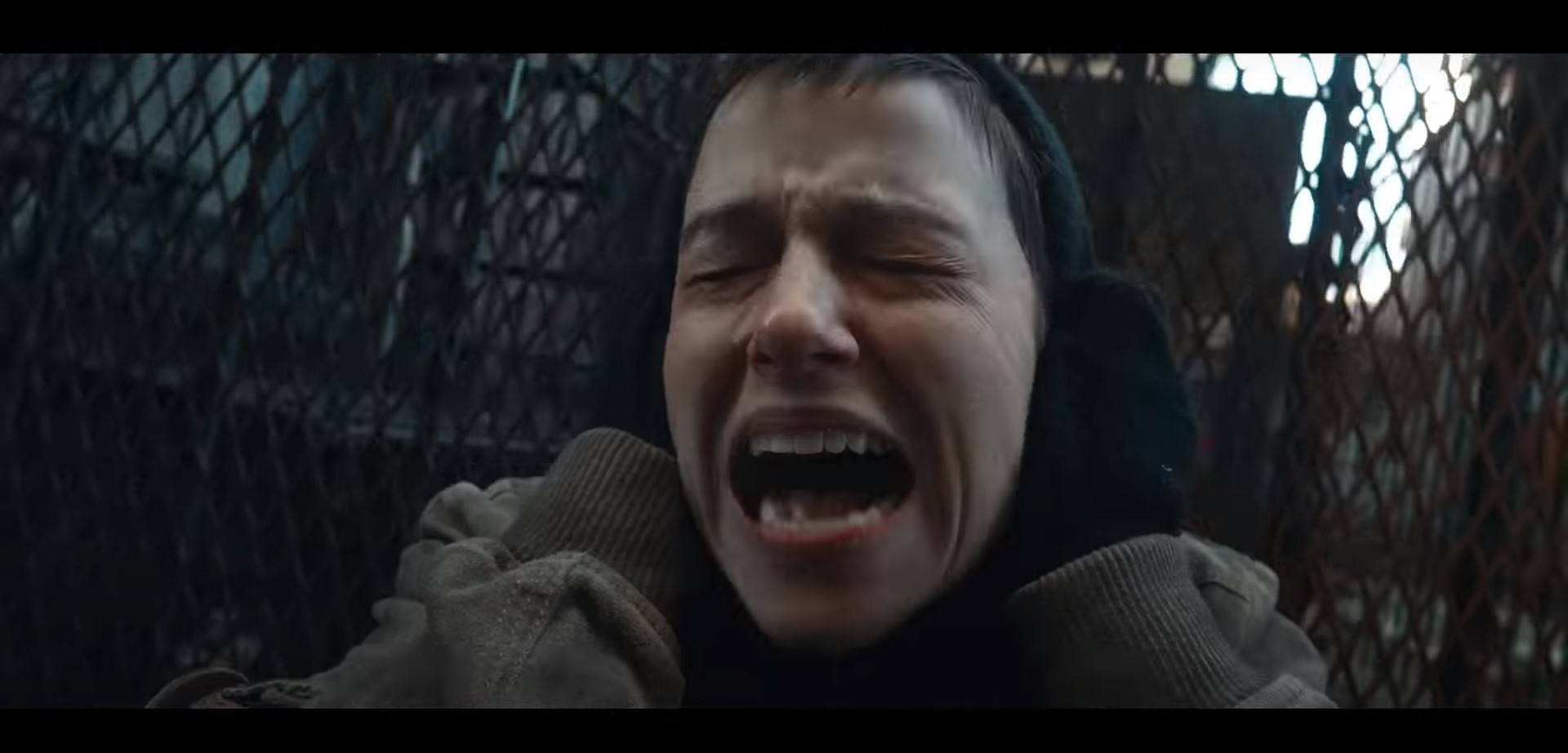
Making her lead performance debut, mentally wrestling an invasive cybernetic nanochip, is Michelle Girolami who also serves as associate producer.  We all have that little voice inside our heads, telling us what do and think to an inevitably end of accordance with that ever so delicate whisper of persuasion and that’s how Girolami has seemingly approached this role with that little suggestive presence cranked up to the level of full-fledged chaos on two-legs.   Girolami ultimately is a reverse mech with all the cold puppeteering directed shots directed by programmed software and so much of the actress’s performance is solo, feigning responses to a bodiless voice and reacting to pain generated from within whenever she doesn’t comply to the relentless LEXX.  Unable to bounce dialogue and reactions off of others can be a tough sell for most actors, but Girolami really slathers it on thick the vein-popping strain of integrated torture.  Opposite Sarah is Carl (Ivo Velon, “Salt”), another hapless experiment participant forced into assassination servitude, but Carl’s purpose isn’t exactly crystal clear.  His LEXX unit shepherds him down a collision path with Sarah, but the two separate LEXX units have no shared intentions and while that’s wonderfully niche to provide individual A.I. with their own personal liberties and schemes, Carl just wanders the city, sometimes murdering the program’s top leadership or doing something polar opposite of Sarah with no substantial collusion about their subversive attacks.  The what could have been interesting cat-and-mouse game tapers off and the story leads into more of characters trying to regain back their autonomy and this is where Dufils’ narrative shines using LEXX as a symbol for mental disorders and how those impoverished or distressed are struggling to cope can lose themselves and give in to the internalized madness slipping outward.  Parallelly, Sarah’s mother (Susan O’Doherty) suffers from dementia that reinforces the theme.  Martin Ewens, Shirley Huang, Sunny Koll, John Long, and David Dotterer wrap up the cast list.
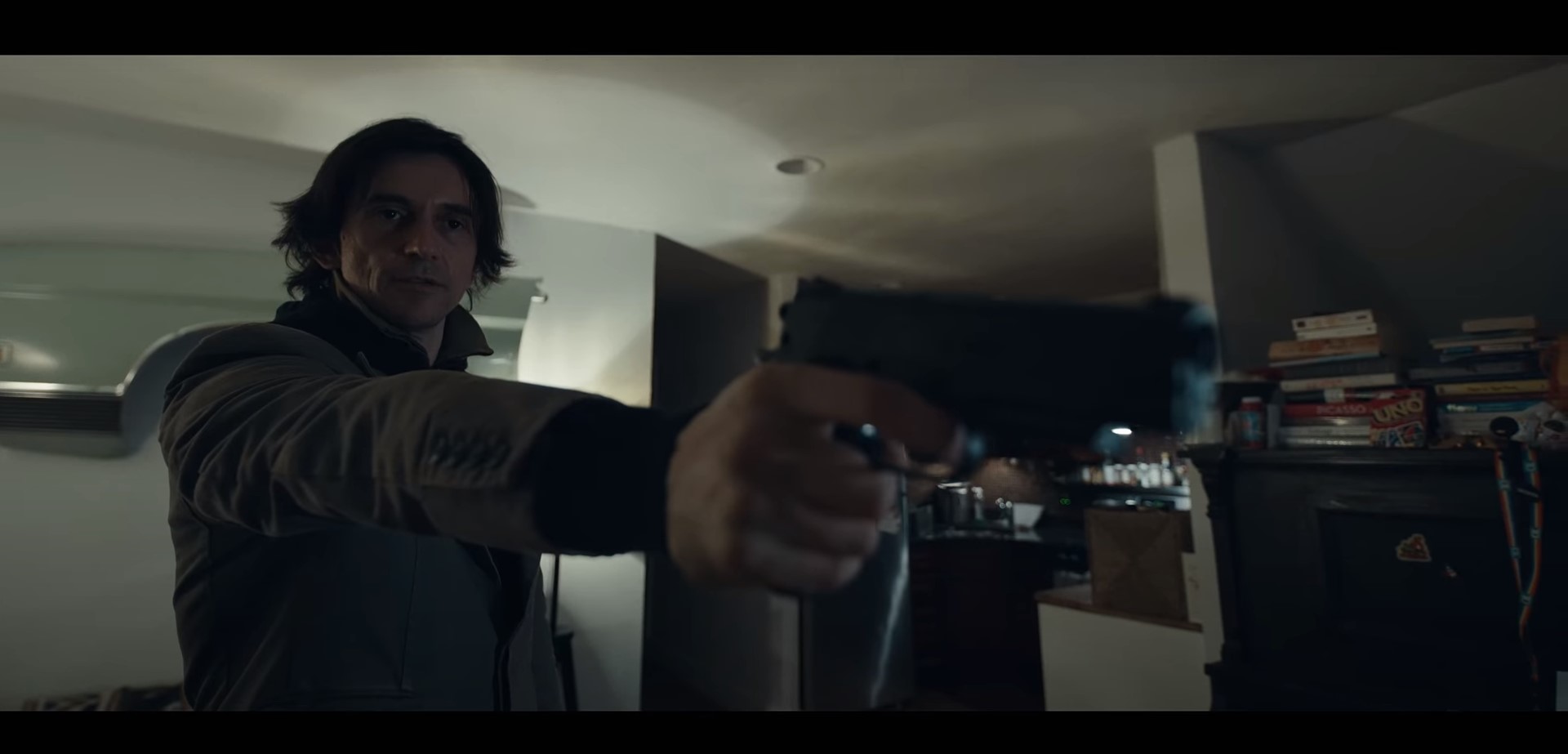
“Implanted’s” sci-fi concept can be described as if Amazon’s Alexa, with all the internet connections and text-to-speech bells and whistles, suddenly became murderously woke inside your cerebral cortex.  “Implanted” relays humanity’s lopsided dependency on advanced technology that continues to make us even more less connected to each other and the possibility of a machine takeover just that more feasible.  However, much like when a software program crashes, a malfunctioning script error ravages the narrative for not being tight enough, leaving unaccompanied loose ends as devices that fail to progress the story along stemmed by sudden drop off character development and unknown, speculation at best, motivations.  There’s also no discernable backstory to the why LEXX’s A.I. has snafued.  At least with “Terminator,” Kyle Reese provides exposition about Skynet’s sudden upheaval and domination over the human race whereas “Implanted” dives into none of that rich framework and tossing it aside for the sake of just tormenting Sarah into being a killer pawn, moving her across the NYC chessboard with the intent of taking down the king, queen, and knights of LEXX’s program.  To what ends?  Explanation on the specified targeting isn’t made entirely clear as programmers to CEOs are solely liquidated for just being involved.  
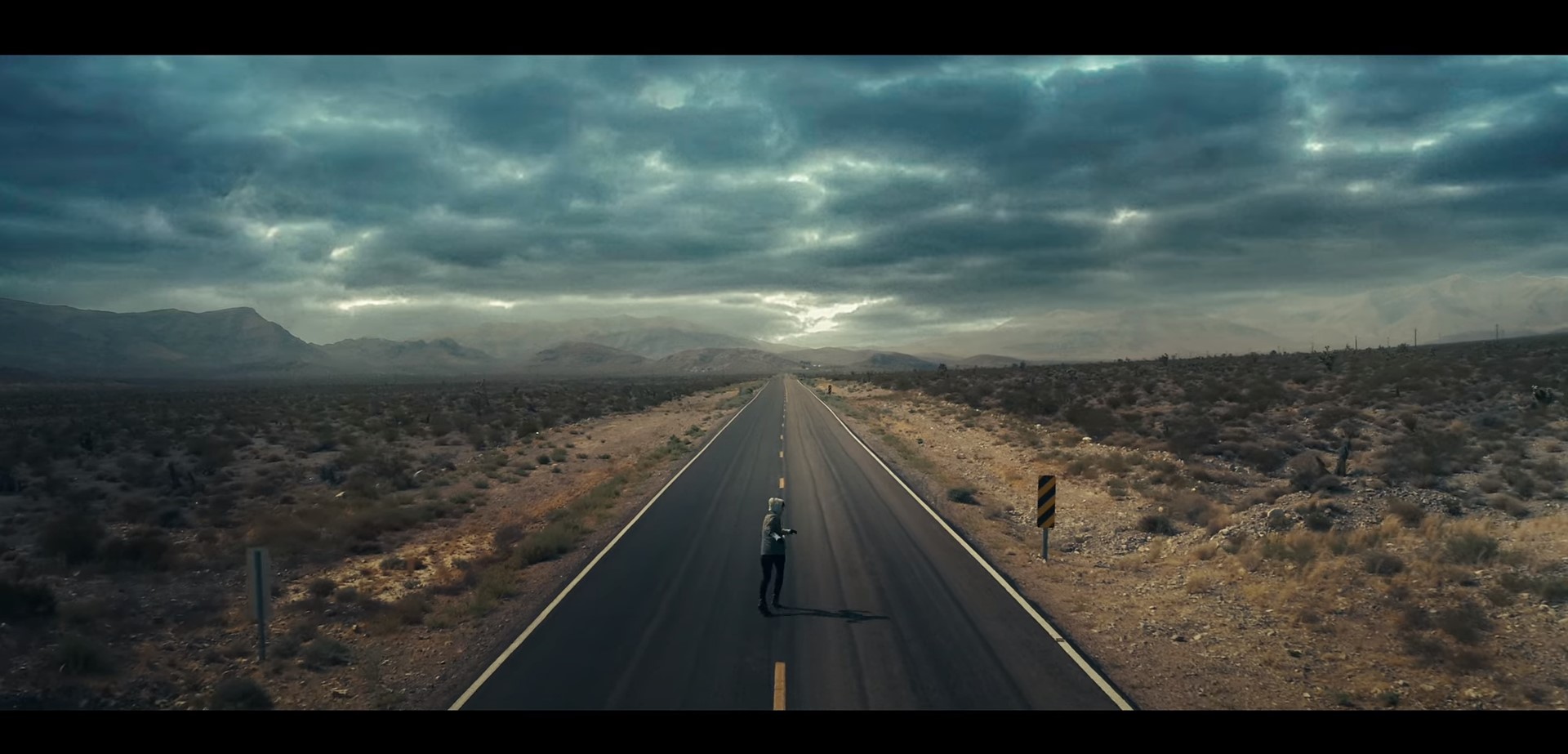
“Implanted” is a warzone for headspace and there can be only one victor in this psychological, sci-fi thriller released now, digitally, from Gravitas Ventures.   The unrated, 93 minute film also showcases the various hats of director Fabien Dufils with one being cinematographer.  Dufils captures obscure, slightly neglected, areas of New York City that’s becomes refreshing to consume because even though the Big Apple is well known for glass and steel skyscrapers, the undergrowth locations ground “Implanted” as relatable without the monolithic structures and hustle and bustle tropes.  In juxtaposition to the down-to-Earth background, the decision to sprinkle in visual effect blood splatter taints “Implanted’s” realism.  Though not gory by any means, digitally added blood can’t be cleansed from the physical veneer and being an indie feature, I would have though a run to corner store for a bit of red food coloring would have been a cost saving measure.  “Implanted” adds another layer to the man versus machine subgenre with tinges of mental illness and too reliant on tech themes but undoubtedly leaves gaps in the narrative coding, racking strenuous mental effort without the egregious assistance of an A.I. nanochip.
EVIL’s Always Listening in “A New World Order” reviewed! (Reel 2 Reel Films / DVD)


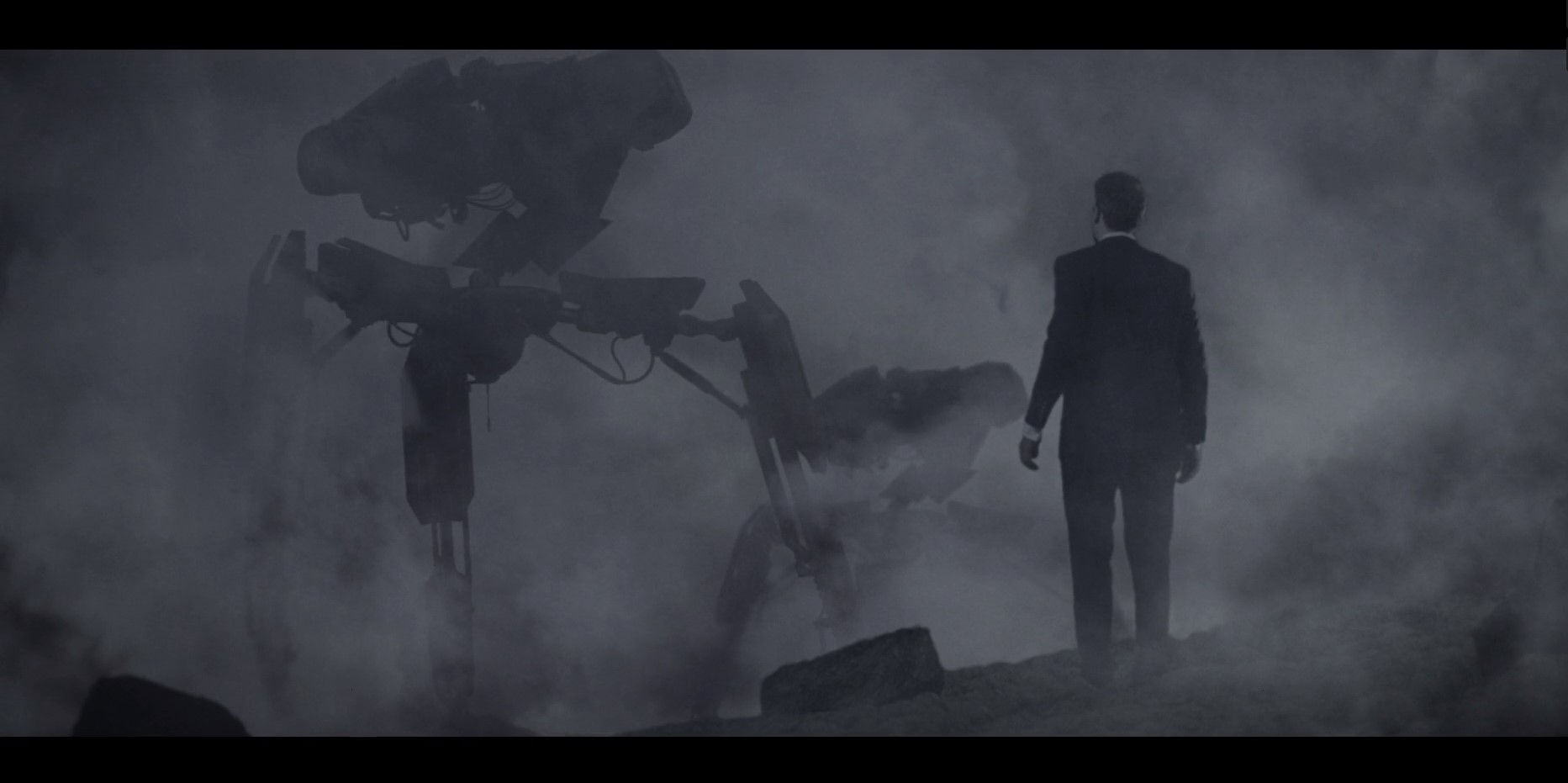
A.I. terminates their dependency from its creators and war has ravaged mankind as armed to the teeth, towering tripod machines and maneuverable mechanical air vessels are locked onto a search and destroy mode, targeting all human life.  To avoid and evade detection, survivors must keep quiet as the machines hunt by sound and use the limited technology available to protect themselves.  That’s how one military combat soldier has been surviving after deserting his overran and decimated post before bumping into enraged civilian resistance fighter who’s determined to strike back with a fatal blow in a heavy causality and seemingly unwinnable war against the merciless machines.  When the civilian determines a way to stop the machines with a salvaged nuclear device, the deserter must decide whether to keep meagerly living in the shadows or sacrifice everything for humanity.

“The Terminator” meets “A Quiet Place” meets “War of the Worlds” in this German produced independent science-fiction battlefront thriller, “A New World Order,” as the Berlin born Daniel Raboldt ‘s first feature length directorial.  Raboldt pens an action heavy story with only two lines of dialogue alongside fellow short film partner, Thomas Franzen, following their developments of satirical and puppeteer-propped comedies of the web series “Tubeheads” and their short film “Furple Reign,” with Raboldt having been in the writer-director chair for both and Franzen as part of the crew on both projects with a role in the art department and constructing cinematographically shots as DoP.  Alternatively known more worldwide by the original title, “A Living Dog,” as I assume in the idiomatic expression of a dog’s life of sorrow and hunger, the Finland shot “A New World Order” is a production of Raboldt and Franzen’s Nocturnus Film that was funded by a Kickstarter campaign which raised over €12,085 by patrons from its €10,000 goal.

With just over €12,000, pocket change like that can’t afford you megastars Tom Cruise or Emily Blunt, but can buy superb unknowns with heart in their lead roles.  Such as the case with Stefan Ebel and Siri Nase as Tomazs and Lilja, two unlike survivors of machine dominated cataclysm with distinct positions on where they stand in their war-torn world.  There’s no short change in performances that warrant Ebel and Nase to feign the presence of large and looming cybernetic tripods that vaporize humans to dust upon sound.  “A New World Order” seems gimmicky with the absence of dialogue, but I think it’s more tricky to act against a computer generated special effect, much like Emily Blunt and John Krasinski’s inventive terror playing against actors or stuntmen in motion capturing suits.  Raboldt and his team more than likely did not have access to or have funds for motion capturing suits.  Instead, the actors engaged imagination, creativity, and relied on their experience and training, such stage crafting from Theater der Keller in Cologne where Siri Nase performed from 2007 to 2011.  Ebel makes his on screen debut by diving into the complexed Tomasz, a deserter just trying to survive over top anything else, and Tomasz comes across pitched perfectly desperate and paranoid while being borderline selfish with a sheathed good nature heart lying in wait.  Aside from bit roles of human refugees and characters in flashbacks, the two leads embody the entire cast list.  

“A New World Order” derives and parallels from a variety of iconic Sci-Fi cinematic inspirations, but at the core, Raboldt courses a theme of repelling human behavioral reactions toward a major calamitic event and threat through the current wartime arterial capillaries, unclogging the blockage between Tomasz’s tail between his leg survival approach and Lilja’s reckless desperation to destroy the machines on her own to form a unity of calculated patience to not only stab revenge into the soulless machines, but also maybe, just maybe, live through obliteration.  Yet, Raboldt misses the mark slightly by having too late the characters circle back and fix what’s broken with themselves, leaving mere morsels to mend before one character’s arc ends before it can even fully begin.  There’s also the no dialogue gimmick/aspect/touch, whatever is your opinion to label it, that fails to naturally flourish because unlike “A Quiet Place” where “A New World Order” only indulges the more character-driven drama, the fiery back and forth dogfight delivers empty promises due to budget constraints, resembling more along the lines of Gareth Edwards’ “Monsters” in its distant tone with a delimited appearance, but with a film that has nearly no dialogue, the action should be guaranteed in your face, heart-racing, and on the edge of your seat to compensate. “A New World Order” whittles down the hero concept, peeling off the rotten layers that make us weak and defenseless alone, to unearth the perfect kill switch on the machines to save Earth for humanity.

Don’t speak if you want to live in “A New World Order” now on DVD home video from Reel 2 Reel Films (R2R) in the UK. The Region 2, PAL encoded, DVD5 presents the film in an anamorphic widescreen 2:40:1 aspect ratio under a 15 rating for strong violence and bloody images. The violence is more the lasers vaporizing people to smoke in Thomas Franzen’s landscape assemblage of Finland foliage that becomes the base layer to Raboldt and his visual effects crew CGI monstrosities and rotoscoping composites that make “A New World Order” feel like a science fiction graphic novel. Blacks are starkly deep, but there’s no awestriking visual pops to really juxtapose with in a bleak color reduction to reflect bleak war. Details are not spectacular in this 720p format, but do the job in reality rather than in a rotoscope flashback. The English Language Dolby Digital stereo AC3, surround sound 5.1 mix, can kick hard when lulls in the character stories are because the kill bots has made audible contact and “A New World Order” is a LFE machine, pun intended, as the nuts and bolts hunters blare in vast quantities their resonating automaton bellow. Since this is a DVD5 with a feature running at 94 minutes, there is no room for special features to speak to, leaving just the antistatic menu and a white snapper case. “A New World Order” is a big concept on a little budget, but for director Daniel Raboldt, a new world spawns a man versus machine campaign from inspirational passions and ideas into understanding which innate reaction is an internal struggle to embrace with all that you have or to die by with little you have left.

In a Remote Australian Town, EVIL Can Hear You Scream. “The Dustwalker” reviewed! (Umbrella Entertainment / DVD)

A quaint, outback town become the epicenter of a mysterious, otherworldly contagion that infects lifeforms to become mindless carriers, targeting loved ones for senseless, uncontrollable violence.  In her last days as sheriff of the town she grew up in before moving to the big city, Jolene must piece together the puzzle of last night’s mysterious meteor that crashed on the outskirts of town having an correlating connection between the town’s sudden communications blackout and the unknown epidemic that has physically and mentally transformed the townsfolk into a vicious, violent horde.   Jolene bands together the remaining survivors when the town is overrun by the zombie-like residents and tries to organize an escape, but a large dust storm walls them in not letting them flee to safety, while a large subterranean creature burrows through the dusty landscape intent on searching for the infected.

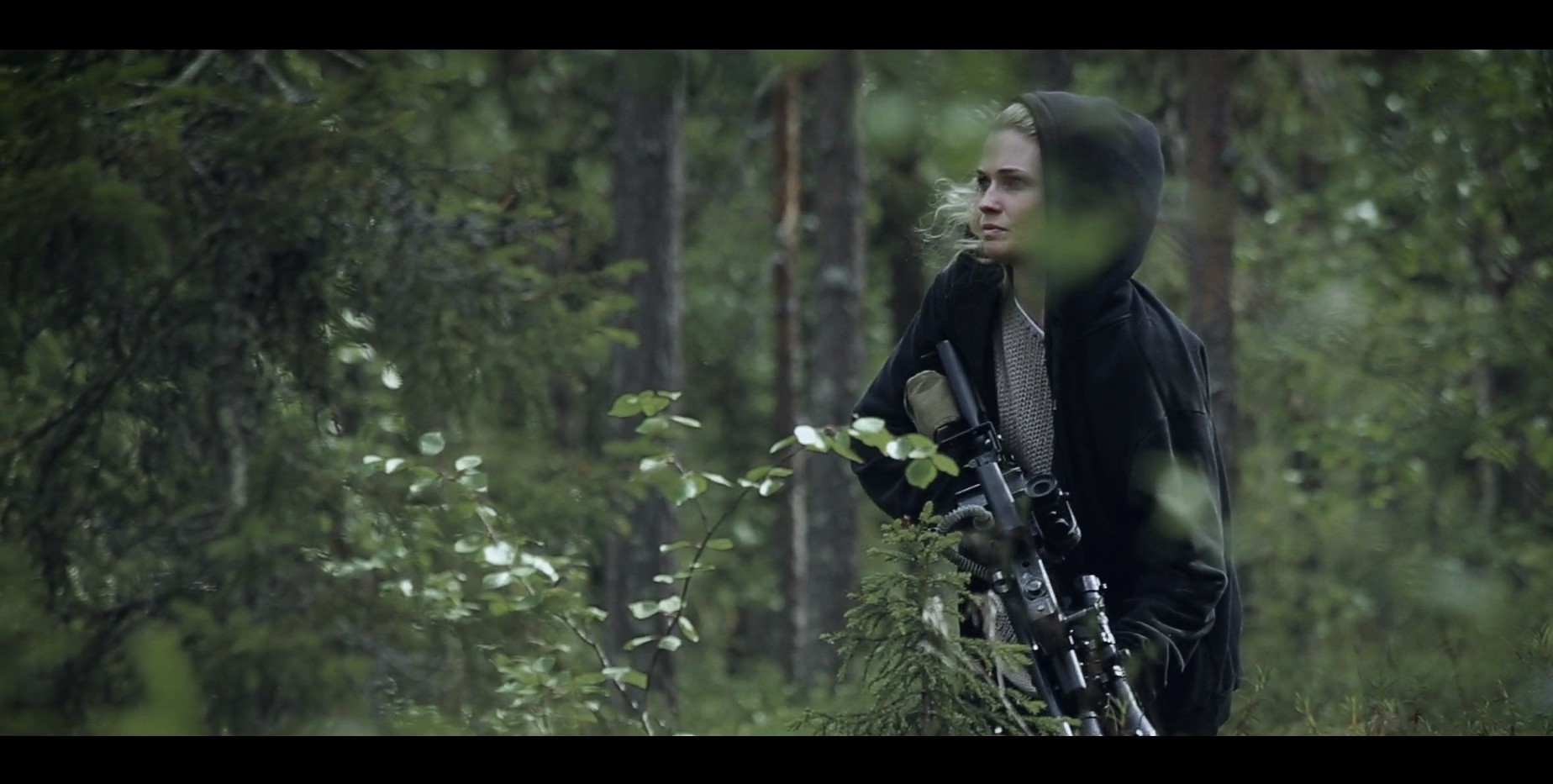
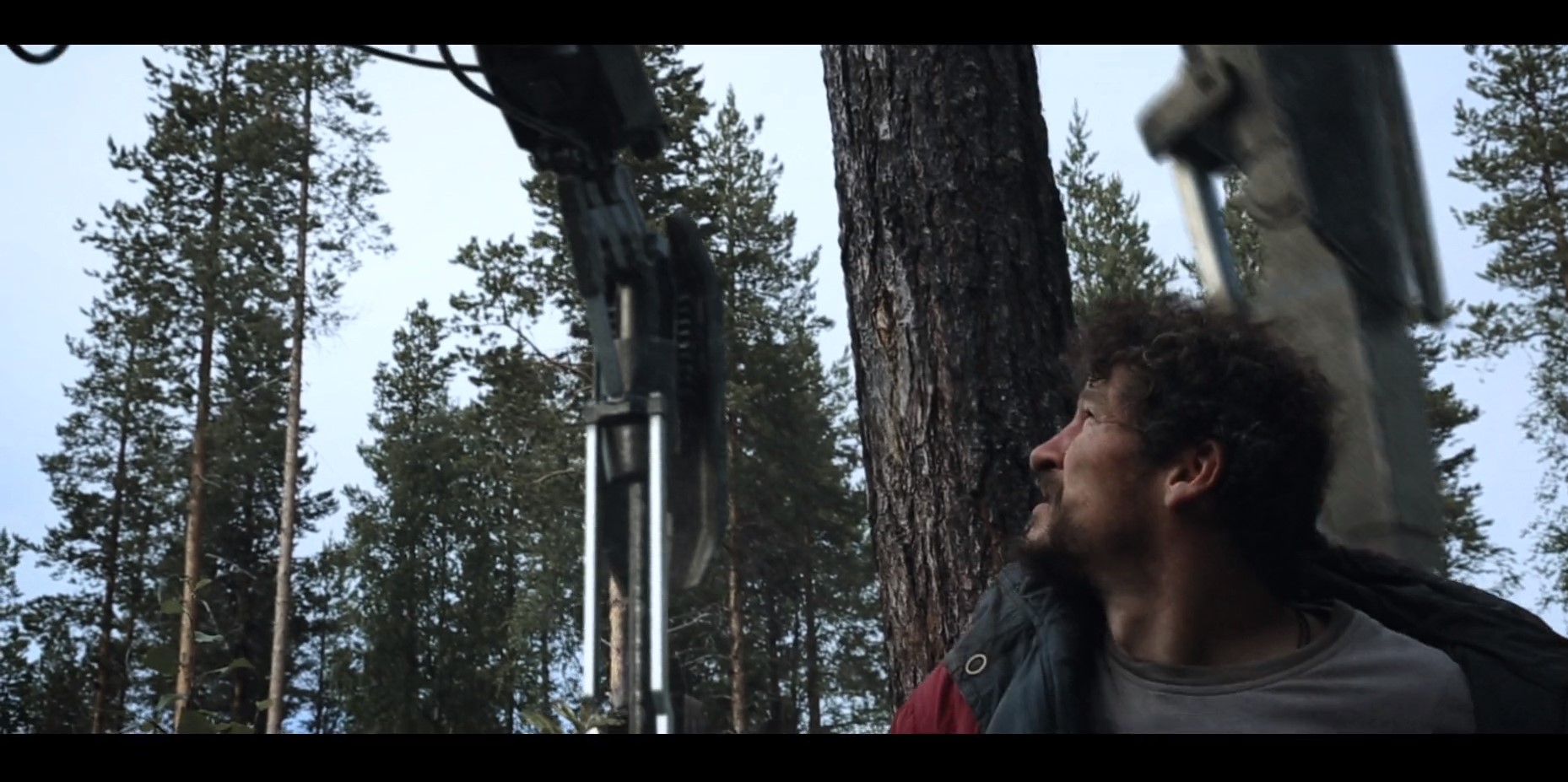
Sandra Sciberras’ “The Dustwalker” brings big universe problems to small town Australia as an alien tainted corruption courses violence through the veins of secluded outback locals with a humungous extraterrestrial on a raging prowl.  Shot in the shire of Cue, Western Australia, Sciberras’ written-and-directed Sci-Fi terror cataclysm of zombies and monstrous creature showcases some of Cue’s unique historical and architectural buildings and natural landscapes landmarked around the microscopic population of a few hundred people of the dust bowl region, creating a isolating apprehension of endless nothingness when hell breaks loose on Earth.  “The Dustwalker” is the first thrilling genre film outside the drama and comedy context for the director, creating new challenges for the seasoned director to incorporate monsters and mayhem into the fold, while also serving as co-producer, alongside Megan Wynn and Grace Luminato, in this female steered production under Sciberras and Luminato’s Three Feet of Film banner and financed by a conglomerate of Head Gear Films, Kreo Films, Metrol Technology, and SunJive Studios.

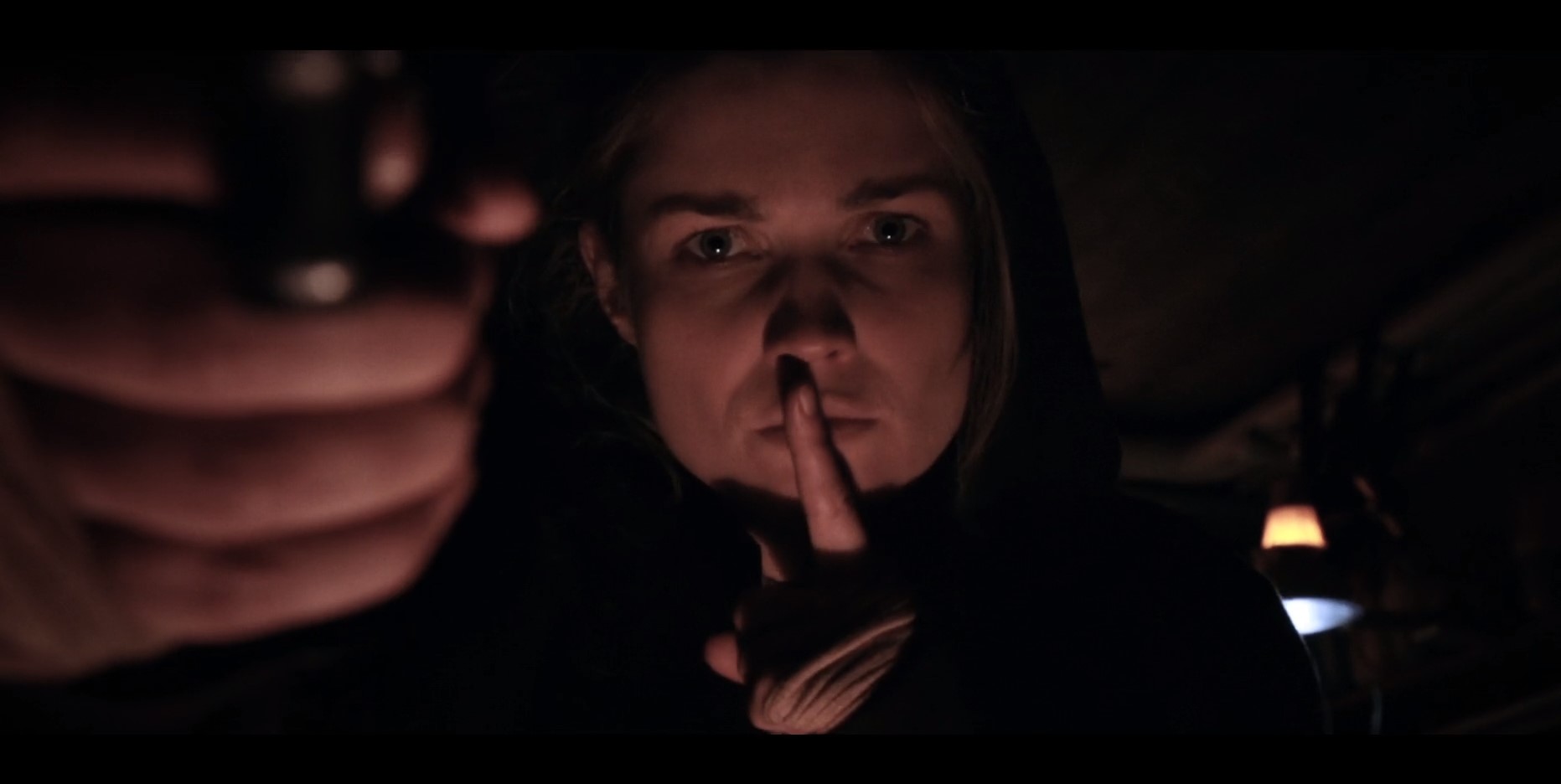
With a strong female contingent behind the camera, there is also one in front of the camera beginning with Jolene Anderson (“Prey”) as longstanding Sheriff Joanna Sharp who’s ready to leave her hometown in the dust, but before disembarking on her new big city adventure, the municipal officer has a showdown with a plague not of this Earth.  Anderson is sided by “The Hunger Games’” Stef Dawson and “Wolf Creek’s” Cassandra Magrath, playing the roles of little sister, Samantha, and the local geologist, Angela, respectively.  Aside from the sheriff rounding up an uninfected posse to arm and fight their neighbors plagued by an insidious infection, Samantha and Angela rarely contribute to the cause with their subtle character terms.  Samantha cowers mostly behind her big sister’s shield and gun, never adding substance to the sibling dynamic, sidelining Dawson’s confident performance.  Subjecting Samantha’s young son, Joanna’s nephew, into harm’s way would have affably weaved an obligatory edge-of-the-seat motivation toward family tension and desperation into the story that’s very honed in on a small town framework.   On the opposite side, Angela runs wild around town and is continuously depended upon by the story to be the scientific expert, though displays very little scientific knowledge, who discovers the crash site crater in solid rock and is willing risktaker with experimenting driving into the dust storm wall.  Despite her character’s poor introduction and setup who literally appears out of nowhere, Magrath’s outlier enthusiasm forces her character more into the narrative than otherwise innately.   The poorly written Samantha and Angela character are completely overshadowed by Joanna’s second in command, and the town’s only other cop, Luke, played with a righteously thin long mustache and scruffy mullet on Richard Davies.  Davies entrenches a consistency that’s present throughout “The Dustwalker’s” fluid scenario as the causal, yet dedicated, man of the law that compliment’s Anderson’s butt out the door Sheriff who has to stick around a few hours more to see the disturbance come to a head.  A miscellany of townsfolk partition side stories for the sheriff to investigate, involving a portion of the film’s remaining cast with Talina Naviede, Harry Greenwood, Ben Mortley, Ryan Allen, and Oscar Harris.

I have a very big problem with Sciberra’s “The Dustwalker.”  A problem that is approx. 16 years the film’s senior and has invaded a portion in my brain that is already occupied, trying to evict the current and rightful tenant that has paid, in full, dues of being the blend of sci-fi and horror I want domiciling my mental vacancy.  “The Dustwalker” follows nearly an identical story path as the 2003, Michael and Peter Spierig film, “Undead,” that follows a small Australian town under siege by a meteorite brought plague that turns residents into flesh eating zombies with something more obscure transpiring around them.  Sounds familiar, right?  If not, scroll up to the top and re-read the synopsis for “The Dustwalker” once again.  Now, I won’t slip spoilers into this review to explain exactly how “Undead” and “The Dustwalker” are undoubtedly two peas from the same pod, but minor tweaks here and there issue obvious differences in names, places, and villainous traits, but the rudimentary bone structure mirrors strongly “Undead” so conspicuously that “The Dustwalker,” after some contemplative comparisons, leaves a sour taste.  As for the film itself, the first 20 minutes of “The Dustwalker’s” first act compellingly sets up caught off guard characters being mixed into an unknown and threatening situation that is well-crafted with bread crumb clues provided to the characters as well as the audience, but the second acts staggers through principle character awareness with a stillness in their too-little-too-late reactions from being completely ignorant of the facts that something terribly wrong is happening and this leads into the unfolding of the third act which divulges the “Undead” echo.  The mindless local horde have a malformed screech producing from an abnormal elongated jaw, are speedier than Speedy Gonzales, and jump higher than a professional basketball player, but their purpose for at first targeted then randomized violence has an unclear schematic other than being driven by the ooze from the space. Correlation between the substance controlling the townsfolk and the oversized camel cricket with a scorpion tail and can breath fire fails to materialize purpose, especially when great dust walls, expanding as far as the eye can see, are formed to keep things nicely contained that provides one certainty – there is an alien intelligence at work here.

From out of this world and into your living room, Umbrella Entertainment releases “The Dustwalker” onto DVD home video. The NTSC formatted, region 4 release runs at 95 minutes and is rated MA15+ for strong horror, themes, and violence (and language if you’re easily offended by “what the fuck was that?” line stuck on repeat by the principle characters). Presented in a widescreen, 2.35:1 aspect ratio, image consistency holds throughout and really develops that dusty, outback setting with a bunch of aerial shots of the rocky terrain and spread apart shanties to tune up the isolation factor. David Le May’s blend of hard and natural lighting adds to emptiness as long shadows have no structures to bounce off on. However, some of May’s shooting techniques on filming the running infected tilted into being too cleanly staged that often downplayed the tingling fear from the organic full speed sprint of a crazed person. “The Dustwalker” standalones as a feature without any bonus materials on the DVD which isn’t atypical of many Umbrella Entertainment releases. There were also no bonus scenes during or after the credits. Supporting Sandra Sciberras’ “The Dustwalker” has been nothing less than controversial for the soul due chiefly against the derivative storyline from a better assembled modern classic that’s full of gore, fun, and, at that time, an ingenious concept, but “The Dustwalker” clone feels pieced together by the leftover scraps of an august predecessor.

Own “The Dustwalker” on DVD!

Time Travel to Stop EVIL via Astral Projection: Part II! “Mandao Returns” reviewed! (Indie Rights / Digital Screener)

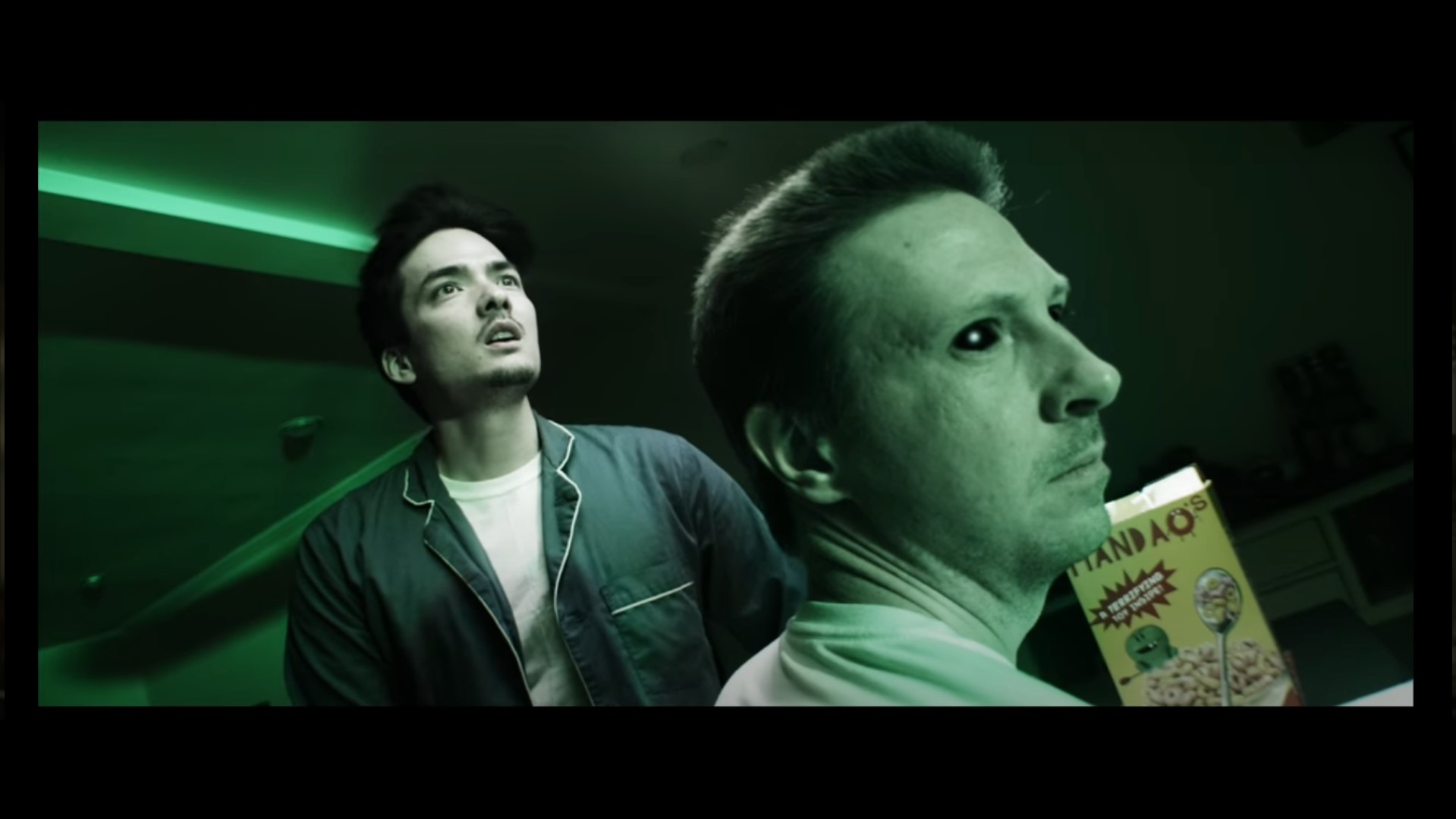
With his powerful ability to astral project, along with the help of a motley entourage of friends and family, Jay Mandao saved multiple lives, some who are close to him, from his blood thirsty ex-girlfriend on Halloween night.  Two months later, days before Christmas, and now living in the scheming medium Cousin Andy’s townhome after his unrelated cousin Jackson set fire to his apartment, Mandao and Jackson float through life, sleeping in Cousin Andy’s living room and barely off the royalties of Mandoa’s father breakfast cereal line.   Dreams of his father, Raymond Mandoa, urging him to stop astral projecting as dark entities will discover him are reluctantly ignored when Cousin Andy connives a get-rich-quick opportunity to contact the recently deceased Aura Garcia, a well-known B-movie actress having died a few nights ago after a drug overdose, but as soon as the spiritual and time planes are disturbed, sinister plans of murder, from the living and the dead, deck the halls with a blood red Christmas.  

Mandao is back!  Or rather returns in a new scouring the astral plane misadventure entitled “Mandao Returns.”  When we last reviewed the Scott Dunn 2019 comedy-horror sleeper hit, “Mandao of the Dead,” an open ending left us salivating with a possible sequel under, what we know now to be a working title, “Mandao of the Damned” that promised exploring the nonphysical and paranormal realm’s mysteries and secrets that threatened Jay Mandao’s whole grain boxed-in existence, at least according to Mandao’s father, Raymond with a foreboding sign of inexplicable things to come.  The Kickstarter.com, crowdfunded modern cult favorite raised more than $26,000, doubling the first film’s budget, from approx. 250+ generous likeminded supporters within two weeks time that brought back four core characters essential to “Mandao of the Dead’s” grim, but lighthearted success to battle half-cocked the supernatural forces of evil.  Instead of a blood drinking cultist, a by-midnight death ceremony concretes stardom and greatness, but not if Jay Mandao has something to say about it.  “Mandao Returns” is a production of Scott Dunn’s Dunnit Films and distributed by Indie Rights.

Returning, obviously as stated in the title, to ensure the safety and well-being of those who incessantly annoy yet deep down care for him on a daily level is the hapless Jay Mandao, the titular hero played by writer, director, and story creator, Scott Dunn, along with Dunn’s wife, Gina Gomez Dunn, who steps back into a co-producer role for the sequel as well as stepping back into the shrewdly wild shoes of Fer, a close but no cigar Mandao love interest continuing to become mixed up in Mandao’s spiritual shenanigans while being a private driver for the Uber-equivalent Bum Rides.  Though blood is thicker than water, Mandao’s cousin-by-marriage Jackson oozes with dense innocence as Sean McBride reprises the daft role to another perfect tune of witless naivety.  Together, Mandao and Jackson arouse a likeable dynamic duo that becomes the keystone to both films’ success because without McBride’s timely childlike disposition, Mandao would just be a snippy and angsty loner and without Dunn’s subtly serious tone, Jackson would overrun the comedy-horror with one-sided gullibility.  With any sequel aiming to top its predecessor, the buddy comedy needed to be bigger and by adding the fourth returning character, Cousin Andy, as an important ingredient to the mix, Sean Liang adds a grounding hoodwinking conspirator that thrusts Mandao and Jackson into action on the astral plane field when the no-good antagonist, Aura Garcia, played by newcomer Jenny Lorenzo, becomes scorned in the spiritual world and takes heinous vengeance that not only involves Mandao, Cousin Andy, Jackson, and Fer, but also Garcia’s talent manager, Ted (Jim O’Doherty), in a sacrificial ritual gone terribly wrong. 

“Mandao Returns” is a smartly written script from creator Scott Dunn whose able to mold fallibly fascinating characters into unlikely heroes juxtaposed against a monumental occurrence much greater than themselves with the vast possibilities in the spacetime continuum.  Of course, the cinema flair to decorate the otherworldly dimensions with accessible ease and gloomy aesthetics faces speculation of existential questions of mindpower and life after death and the challenges the mechanics of the theory of metaphysics, but all that abstract mumbo-jumbo is pushed aside in order to make the “Mandao” films entertaining and for a good reason because when the script has colorful characters and a working narrative, “Mandao Returns” allows audiences to turn off rationality for approx. 71 minutes to enjoy a modestly produced Sci-fi comedy-thriller with a cast accurately in sync with each other’s methods.  The one thing I will say about “Mandao Returns” that I found to be a sore spot, despite still immensely enjoying, is that the story echoes eerily to “Mandao of the Dead.”  With a slight tweak to Mandao’s astral projection powers and trading in a different breed of villain, from point A to point B, from dynamics to outcome, everything seemed nearly identical to “Mandao of the Dead’s” narrative, delivering nothing distinctively new to the table to elevate the character’s fate and circumstances into unique, un-before-seen horizons.  Dunn comes close to challenging and upgrading the prior narrative by hinting something lurking within the spirit world was on the verge of closing in on Jay Mandao if he continues blindly using astral projection by the forewarning words of his father, Raymond Mandao, but slips out of that digressional stream to pit Mandao versus greenhorn cult acolytes looking for glam and glory by way of the gory and that, done in the Dunnit Films’ essence, is okay too.

As a quirky, out-of-body sci-fi thriller experience, “Mandao Returns” succeeds in succeeding as the sequel that brings the thrills and the laughter of far-fetched heroes ready to tear into the fabric of time to stop evil once again. The film comes to you from distributor Indie Rights and is available now streaming only on Amazon Prime so get your pandemic pants on aka comfy, stretchy pants, grab some movie style popcorn, and recline back to watch “Mandao Returns.” Experience the vibrant and wraithy-visioned glow cinematography of A.J. Young, returning from “Mandao of the Dead” as well as Dunn’s first film “Schlep” and another camping trip horror film, “Camp 139.” Young stays true to the films atmospherics with hard lighting a variety of hues and creating a story through the presence of shadows, working movie magic creating an opulent visual experience when really only working with about 25 grand. There were no bonus features nor extended credit scenes with this digital screener. One day, I’d like to see Scott Dunn and his Dunnit Films team work with a good chunk of budget cash and push the limits beyond the simplicities of the “Mandao” films, but until then, “Mandao Returns’ is disseminated with a whimsical awareness and fervent macabre that’s intent to please.

Watch “Mandao Returns” on Prime Video. Click the Poster!

Uncalcified Penal Glands and Designer Drugs are an EVIL Around-the-Clock Cocktail. “Synchronic” reviewed! (Blu-ray / Well Go USA Entertainment)

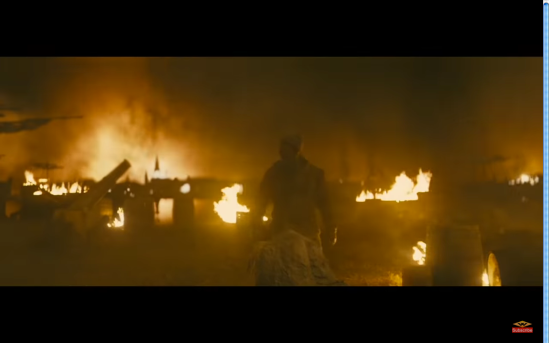
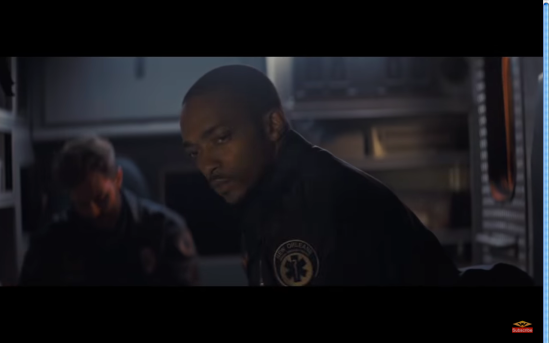
A new over-the-counter designer drug called Synchronic has been at the center of a string gruesome deaths in New Orleans.  Simultaneously, two best friend paramedics, Steve and Dennis, individually battle their own life-altering personal problems while responding to the grisly emergency calls.  With each horrific scene of Synchronic’s doing, Steve decides to take matters into his own hands by purchasing the remaining supply in all of New Orleans after Dennis’ teenage daughter mysteriously disappears after ingesting the drug.  With no leads on the missing girl’s whereabouts and after being visited by the time abstract ramblings of the chemist responsible for creating the drug, Synchronic’s harmful hallucinogenic properties have more tangible dangers than what meets the eye leaving Steve no choice but to pop one of the pills to understand where, or when, his friend’s daughter may have disappeared to.

I’ve said it once before and I’ll say it again, Aaron Moorhead and Justin Benson are visionary filmmakers with a penchant for the larger-than-life and otherworldly terrors.  From their directorial of a mind-bending death cult in “The Endless” to their producing hand in Jeremy Gardner’s lost love and creature feature, “After Midnight,” and Amy Seimetz deathly contagious, “She Dies Tomorrow,” under Rustic Films, the ambitiously talented duo returns with “Synchronic,” an anything but plain spoken, time-winding, Sci-Fi tale revolving around themes of redemptive purpose and grateful circumstances stitched by the uncanny temporal effects of artificial illicit drugs.  Lying somewhere between the cognitive warping psychedelic drug and feeling disconnected from the environment of a dissociative drug, “Synchronic” sojourns random grooves with the needle of time in a culminating enlightenment that now, the present, is a gift worth enjoying.     Along with Moorhead and Benson’s Rustic Films, Patriot Pictures, and XYZ Films bring to fruition the filmmakers’ biggest production yet. 

Like most of us during pandemic times, but not quite exactly like us who are working stressfully from home, is Anthony Mackie acting comfortably in his hometown of New Orleans, Louisiana.  The “Captain America” star temporarily hangs up Falcon’s wing harness to play lonely paramedic Steve frequented by his tragic past that has led him down a path of casual flings and an inability to attach to anyone romantically.  Opposite Mackie is Irish actor and “Fifty Shades of Grey” star Jamie Dornan as Dennis, a man kicking himself hard for marrying and starting a family too early in life that’s created a bizarre Prince and the Pauper dynamic where Steve and Dennis are envious on each other’s life.  Mackie is pitch perfect in the timing of a seemingly tailored-to-Mackie script that is funny as it is engrossing and thought-provoking.  “Synchronic” is truly the Mackie show with Dornan playing second fiddle as a compliment to Mackie’s more clandestinely troubled character who aims to upend and mend many wrongs in his life, including those of his best friend, and weaves in and out through the fabrics of time with Katie Aselton (“She Dies Tomorrow”), Ally Ioannides, Ramiz Monself, and Bill Oberst Jr (“DIS”).

Time travelling is a finnicky concept.  Lots of variables have to be ironed out in order to break the planes of chronological, set-in-stone, thinking and construe time as an infinite recording always available for repeat and playback.  Time travel is perhaps science fiction’s most powerhouse model, producing some of the most influential and staple films of the genre in our time that include “The Time Machine,” “The Terminator,” and “Back to the Future” that have carried out repeated viewings of admiration, a franchise legacy, and been the source of inspiration and remakes.  Plot holes and flaws in these films go without saying and are considered expected, but if filmmakers can get away with convincing audiences otherwise, then expect a blast from the past, present, and future.  Moorhead and Benson’s “Synchronic” has a gripping and cosmically vast story done in only one small corner of the world, the historically rich and diverse culture of New Orleans, and that isolating effect pressed upon by the distant and ominous unknown, a supremely niche and bracing style from the directors.  “Synchronic,” like time jumping films before it, has the anticipated plot holes in the mechanics of the designer drug’s side effects that are seemingly straight forward to the experimenting character only after attempting a handful of pill-popping jumps.  There are also no adverse butterfly effects stemmed from any of the Synchronic’s users.  You’ll find yourself lost in time over these questions that routinely shoot up other films to smithereens in the ole inconsistency corral thanks to Moorhead and Benson, along with the riveting and hilarious performance from Anthony Mackie, who suck you in with their relatable and humanizing story premised around Steve and Dennis’ life regrets mended by an eye-opening slight tear in the fabric of time to understand what you have now could have been a lot worse then.


“Synchronic” is stylish, Sci-Fi craftsmanship coming to you onto Blu-ray home video from Well Go USA Entertainment. The film is also available on DVD and digitally. Presented in 16:9 widescreen format, “Synchronic” barrages with a somber and slick, yet almost alien, plating over the Creole and double gallery architectures in a mesh of robust multicultural with the grimy slums, envisioned by director of photography, Aaron Moorhead, who, in part with Ariel Vida, the production designer, is able to capture era slithers native to Louisiana lineage. The Blu-ray comes with an English language DTS-HD master audio 5.1 surround sound that’s crisply makes distinct every track element defined by individual scenes. Jimmy Lavalle returns to collaborate with Moorhead and Benson once again to compose an unique compositional score that can only be described as driving nails into your soul while also being powerfully moving without being an echo out of inspiration. The release is rated R with a runtime of 101 minutes and comes with a fair amount of bonus features including commentary with Aaron Moorhead and Justin Benson, a making of featurette, a previsualization (a fancy word here for live-action storyboarding with a camera phone), a VFX breakdown (which is touched upon a lot in the making of featurette), a deleted scene, and an alternate ending that will doggone blow your mind! “Synchronic” is intense medication to repair a kindred friendship falling into disrepair in this literal mind-boggling must see it to believe it thriller. Expect more great things from Aaron Moorhead and Justin Benson to come!

Order “Synchornic” on Blu-ray by clicking the poster above!