Channeling the EVIL from the EVIL DEAD! “Slaughter Day” reviewed! (Visual Vengeance / Blu-ray)

SOV “Slaughter Day” on Bluray for the First Time Ever!

A pair of friends who run a small construction company drive up to an isolated cabin project in the outskirt nooks of Hawaii.  When they arrived, they encounter disgruntled employee John Jones who dabbles in the dark occult.  Having murdered already one of their construction crew members, Jones invokes the evil from the book of the dead, the Necronomicon, to bestow upon himself unnatural powers to seek revenge for years of abuse on the job.  Enslaving two other members of the construction Crew, Jones relentless goes after his former employers who must fight tooth and nail for every minute of their lives.  The fight stretches across the island and spills into the streets, abandoned factories, tropical brush, and even on the side of a mountain. 

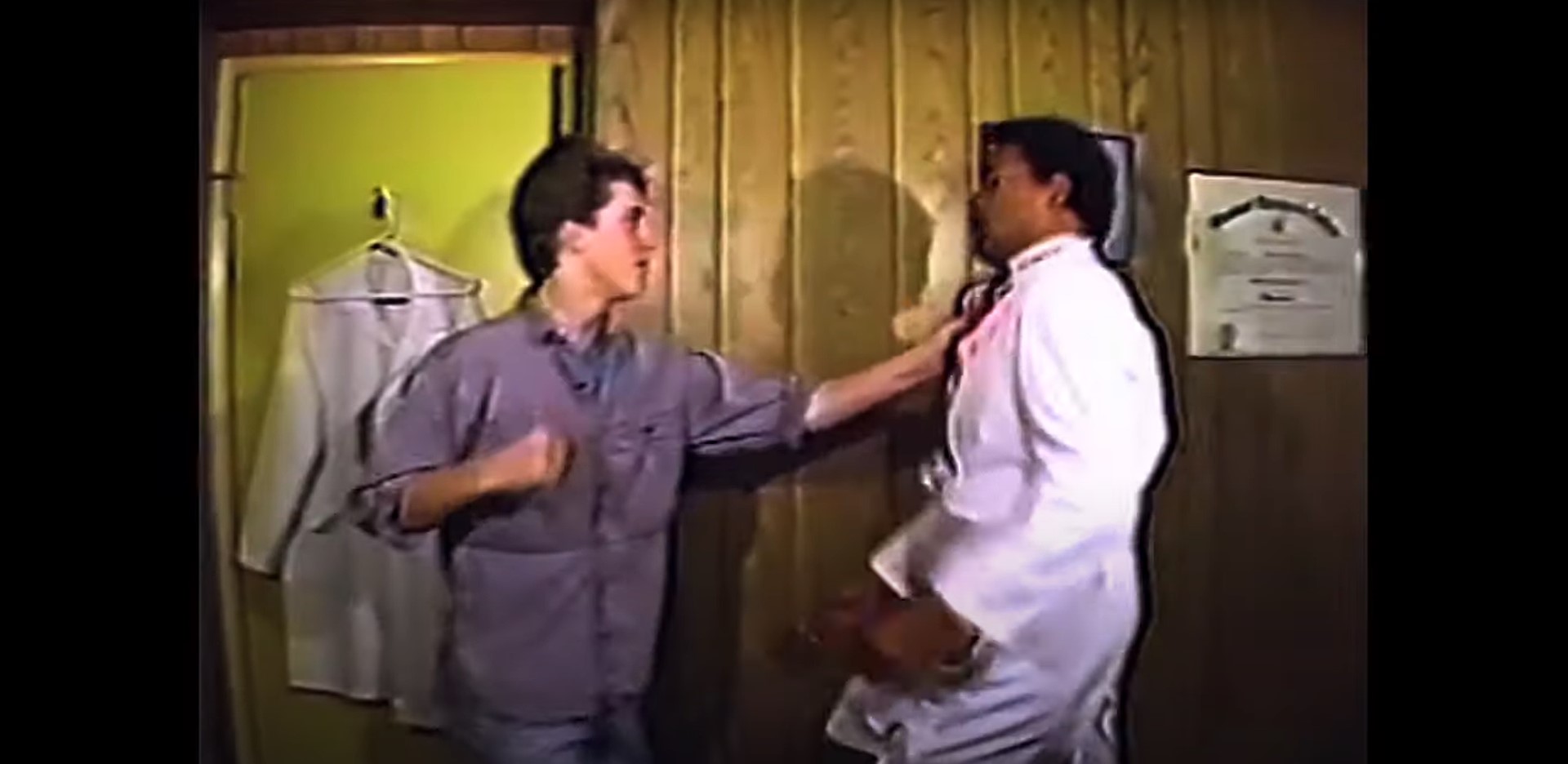
“The Evil Dead” meets “Double Dragon!”  A fierce bareknuckle fight against a malevolently possessed construction crew is the not-stop action and gore premise of the Brent Cousins’ “Slaughter Day.”  The heavily influenced Sam Rain and “The Evil Dead” 1991 shot-on-video occult survival horror is co-written by Brent’s twin brother, Blake Cousins.  The twins’ filmic debut concept where a maniacal occult enthusiast goes on the offensive with his vindictive side by conducting dark, Necronomicon evil against the two construction supervisors is pieced together, scene-by-scene, from the various shorts created when they were adolescents.  The four short films from their inspired youth were revisited and remade into a full length feature film financed by a nearly a next-to-nothing zilch budget, but with more than a little can-do attitude, a group of close friends and family, and a willingness to drench the cast in splatter bags fill of fake blood, Brent and Blake’s balls-to-the-wall, commercial grade equipment schlocker never lets up and pays endearment to the legendary video nasties that have stimulated their need for tangible blood-shedding effects.  “Slaughter Day” is a self-funded labor of love under the Cousins Brothers Productions and is made in one of the more tropical places on Earth, the Big Island of Hawai’i, with a few scenes shot in the town of Honokaa.
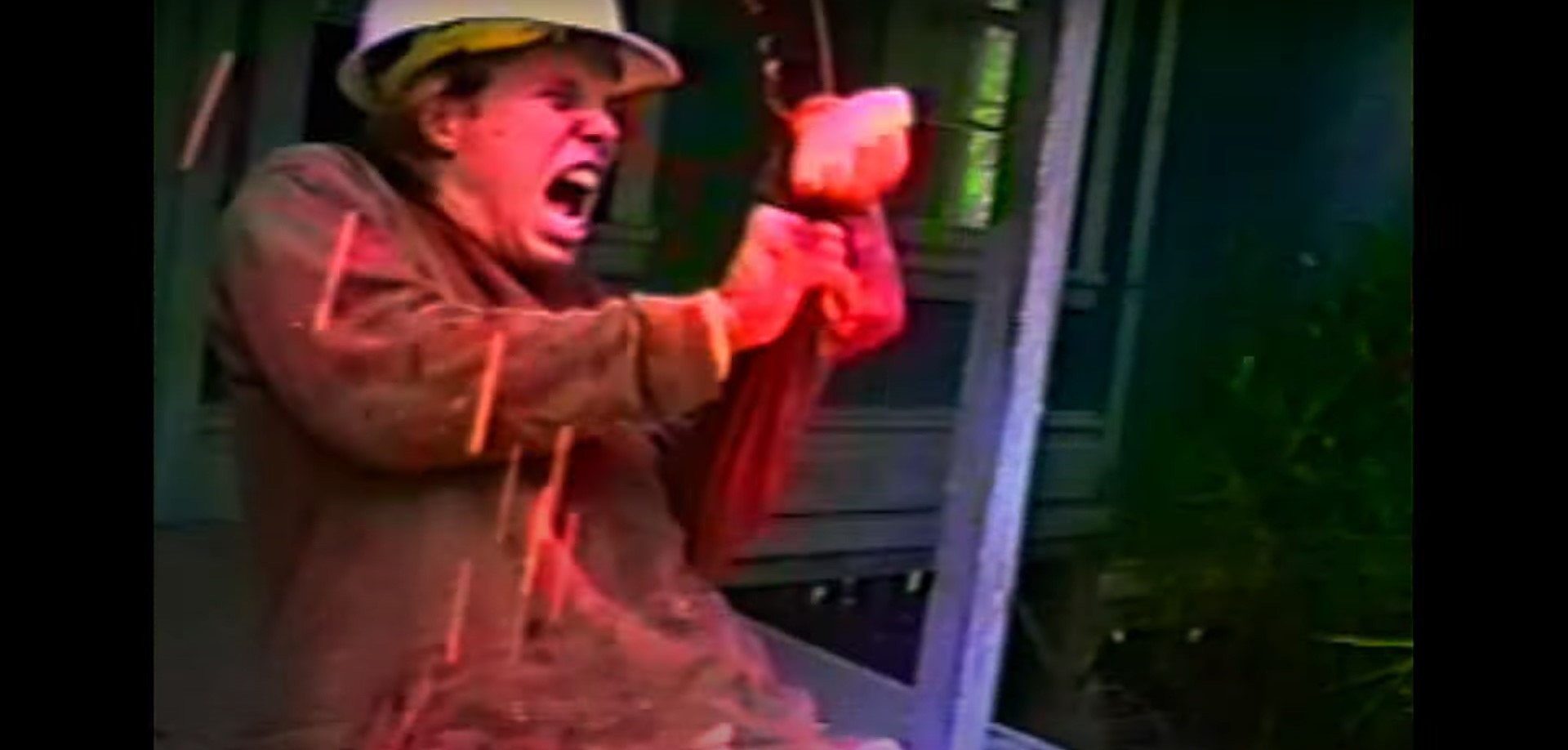
Aside from being one of the two writers, Blake Cousins jumps in the front seat to become one of the hapless heroes in the suddenly twisted, Hellish ride of that classic story of good versus evil. Blake embodies one of the few aspects that makes the viewing of “Slaughter Day” so infectiously exciting with a high intensity level somewhere around near redline critical. The intensity spreads to each and every actor in front of the camera and with Blake’s breakneck pacing as the film’s post-production editor, there’s a side-scrolling, beat’em-up video game quality about the whole run through. The acting isn’t terribly good with haywire yelling and screaming from start-to finish with a lack of professional training that gives way to under developing a story, but story be damned, the brother Cousins ambitiously puts caution to the wind by balancing out the acidic acting with exceptional camera work that occasionally would involve hazardous to their own health amateur stunt work. The unharnessed and unpadded fight sequence in the back of the pickup truck gets mad props in succeeding instead of squashing someone’s head under the tire. If everyone lives and you get the shot, it’s a win, right? The fight sequences themselves are extensive, as I aforesaid, the breadth of the short feature is like experience a live action “Streets of Rage 2,” and they have the smack of decent choreography with near miss blows and head whips. Some of the bigger fake hits lack sterling results but are nonetheless entertaining and expected. “Slaughter Day’s” cast is made up of essentially a closeknit group of friends with performances from Sam Bluestone, Dave Anderson, John Lambert, Kulaka Branco, Jeremy Couchiardi, Joe Ross, and Lincoln Ross who all have never again seen the gaffer lights of another film production.
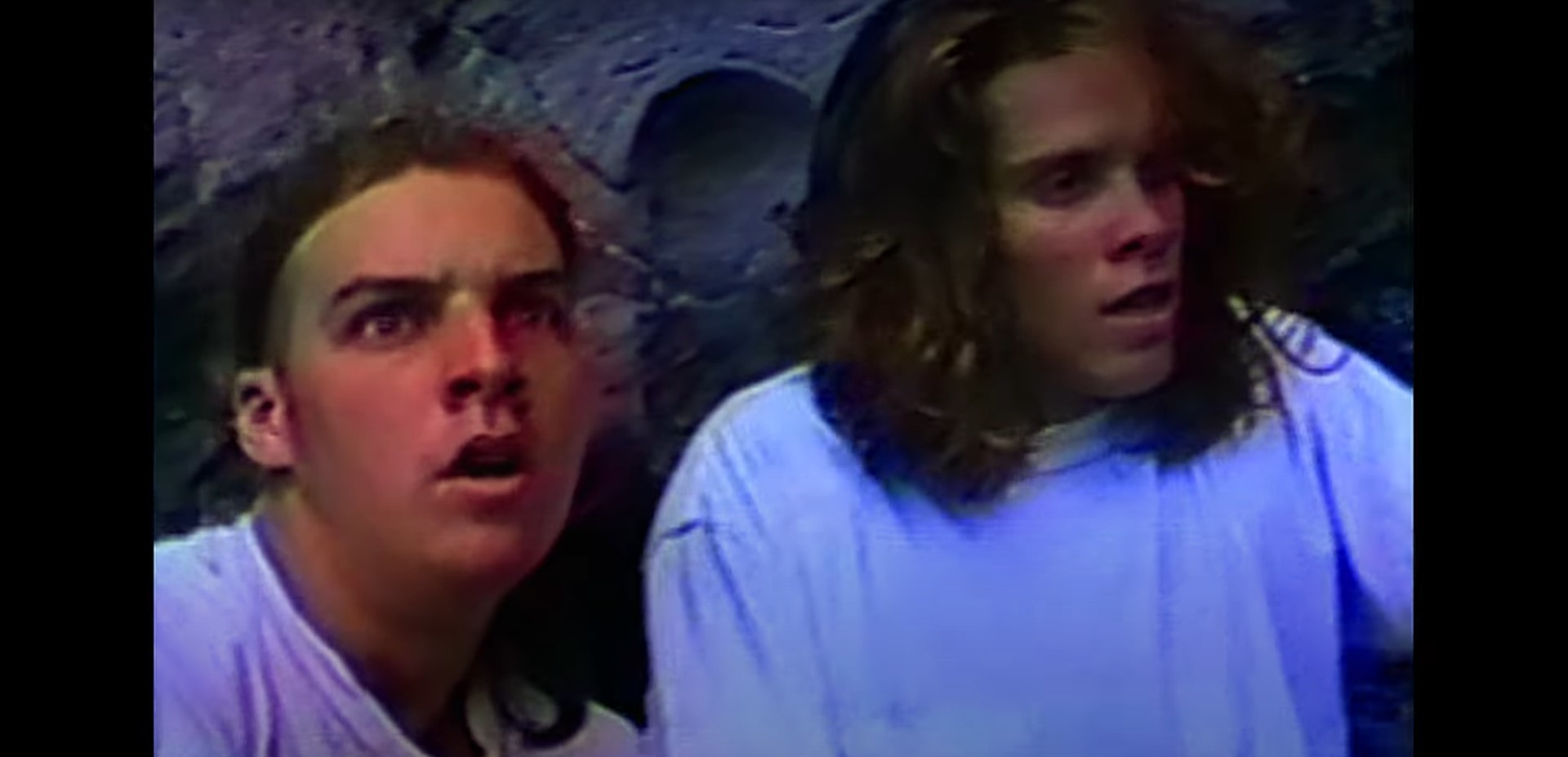
“Slaughter Day” has many flaws: bad acting, continuity mistakes, not much of a plot, etc. While honest attempst were made to rectify a handful of those sore points, those very same imperfections are what make “Slaughter Day” ironically perfect in the SOV canon. Some of the gags land relatively smooth, such as being John Jones being bent backwards in half and sucked into a copy of the pop media cultural influencing H.R. Giger’s Necronomicon book, and others kind of flounder in the lukewarm stew of unskilled technical know-hows. Yet, I do firmly believe the brothers achieved a memorable salute to Sam Raimi’s breakthrough 1981 video nasty, “The Evil Dead” in pulling more so the macabre-isms then comedic slapstick elements of the “3 Stooges.” Brent and Blake obviously understood what they wanted to see and how much familiar content they wanted to rework to open the recesses of our memory banks to access and recall “The Evil Dead” playbook, but then the flyby the seat of their pants filmmakers take their committed vision farther by adding certifiably crazy stunts and be big and bloody as all bloody hell! Severed limbs, decapitations, exploding shotgun bursts, and impalings are difficult for even the most seasoned effects artist, taking sometimes years to master a simple effect to perfection. With “Slaughter Day,” the brothers are unafraid to take risks, something the filmmakers proved with audacious stunts, by rendering a practical effect inclined storyboard or script thought to the screen tactic and owned it with a pinch of panache pizzazz!
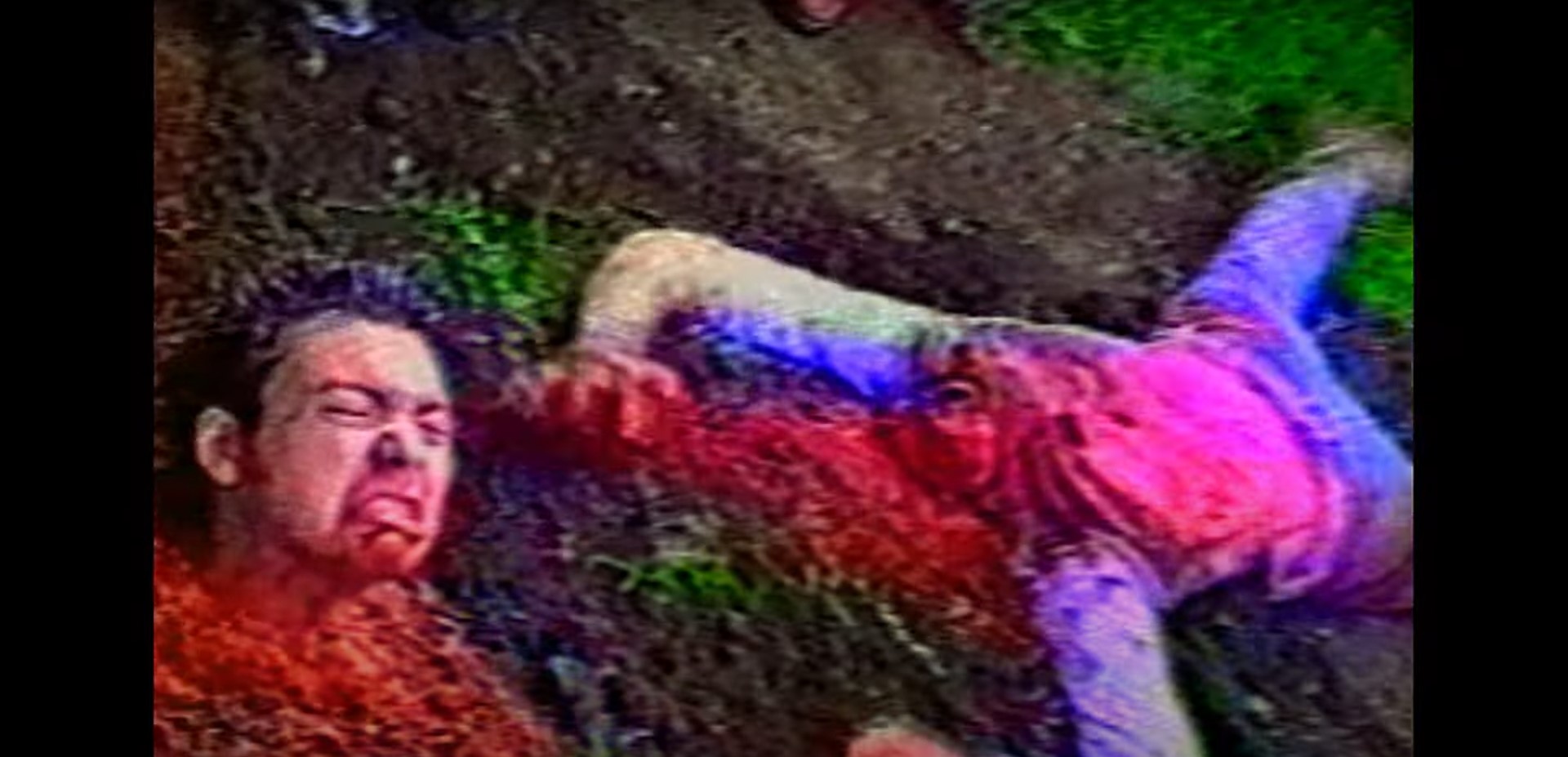
“Slaughter Day” might be release number five for Visual Vengeance but is clearly the Wild Eye Releasing cult-horror SOV sublabel’s second adulation of “The Evil Dead,” following “Bloody Muscle Body Builder in Hell.” The rough-and-ready S-VHS quality, presented in a full screen 1.33:1 from the original standard definition master tapes, can take on a grueling affect with a below par outcome. Tape lacks the proper color resolutions and that displays here immensely with full of deep and warm purples, reds, and yellows that you’d think the brothers were using gels to tint the picture. Tape wears, static interference, tracking lines… you name it, ‘Slaughter Day” visually had it. Delineation and details are deduced to a softer, overlapping ghost image that barely yokes together resolution pertinent pixels. Like always, Visual Vengeance’s disclaimer warns of the consumer grade equipment issues. These issues extend also into the English Stereo audio mix with a consciously underlay of static shushing, lo-fi dialogue recording, and zero depth and range to add more fuel to the “Slaughter Day’s” chaotic fire. Perhaps that’s why the dialogue is terribly rampant with the hope to invigorate and illicit engrossing captivation. The video game punch throw sound bites are a good touch and a innovative way to keep with the fighting game motif. The special features include a new audio commentary by directors Brent and Blake Cousins, a new audio commentary with Visual Vengeance’s own Matt Desiderio and Rob Hauschild, a quickly paced new interview with the Cousins Brothers regarding the genesis of “Slaughter Day” and they’re excitement about the new Blu-ray release, all four original “Slaughter Day” shorts, an earlier short entitled “Full Metal Platoon,” the “Slaughter Day” theme song, trailers from other Cousins films, such as “Rising Dead,” and the original trailer cut. Physical release features include a mini poster of the Visual Vengeance cover artwork, a three-page colorful essay from long time cinema contributing writer Tony Strauss, retro Visual Vengeance stickers that has graced all the company’s releases so far, a reversible cover art with new artwork as well as the original VHS art, and a cardboard slipcover with a heavily demonic and menacing Thomas “The Dude” Hodge design. The film comes unrated and has a runtime just shy of an hour at 58 minutes. I always get the warm and fuzzies when obscure works of art receive the red-carpet release treatment and “Slaughter Day” is an exemplar of SOV at its best while being innately its technically worst. Lots of ambition, lots of derived creativity, and lots of guts behind and in front of the camera to make a life-long dream of filmmaking come true.

SOV “Slaughter Day” on Bluray for the First Time Ever!

EVIL Bigfoot is All About the Amputating and Mutilating! “Suburban Sasquatch” reviewed! (Visual Vengeance / Blu-ray)

“Suburban Sasquatch” On Sale Now at Amazon.com!

A mystical, murderous beast of lore has suddenly appeared in the woods of a small Pennsylvanian town.  Hikers, fishermen, urbanites, and even grandmothers are not safe from the carnage dished out by Bigfoot.  Sniffing around crime scenes is eager freelance reporter Rick Harlan to unearth the truth about the recent string of grisly attacks and make a name for himself as a journalist.  Harlan finds himself in the middle of a police coverup, a Native American woman-warrior, and one suburban playground where a phasing in-and-out Sasquatch can make a killing whenever and wherever.  The Native American, Talia, is destined to square off against the evilest anthropoid her tribe has ever faced, one that thirsts for blood and does the unspeakable with the women it abducts.  The story and clash of the century may be Rick and Talia’s last in this brutal man versus beast showdown. 

As an aficionado of the horror genre, I’m on what seems to be an eternal quest to unearth the best (I’ll even settle for just good at this point) Bigfoot/Sasquatch film that really can scare the pants off viewers while providing a good storyline and solid special effects for the hairy big guy. Is that so much to ask?  The next undertaking to flash across our eyes, like a brisk fur of man-beast in the forest thicket, is the classic SOV-shot and shamelessly spooled special effects endeavor that is “Suburban Sasquatch.” The 2004 Dave Wascavage film is the sophomore project for the writer-director, following up from his deadly fungi party comedy-horror, “Fungicide,” with a shot at the title for best-worst, or is it worst-best, Bigfoot movie in the early 2000s. Shot in my old stomping grounds of West Chester, Pennsylvania, the suburban setting is authentically captured in that piece of the Commonwealth state with sprawling neighbors that give wide berth of land between houses and plenty of parks and wooded areas to Sasquatch-suit tramps. Wascavage produces the film himself, while also wearing multiple hats in many other crew roles and creates the feature under the filmmaker’s very own Troubled Moon Films, a production company that prides itself on low-cost video production and storytelling in which Wascavage self-proclaims Z grade movie making results.

“Suburban Sasquatch” is a pendulum swing between character perspectives, disassociating any one character from being a main lead and focusing more on a group of principals that even includes the suburban sasquatch itself.  If focusing on the heroes of the story, or the hero-ish types, then Rick Harlan (Bill Ushler, “Viscera”), Talia (Sue Lynn Sanchez), and the two officers – John Rush (Dave Bonita) and Steve Parker (Juan Fernandez) – would be your best bet as the unorganized protagonists deal with the beastly menace in their own way.  The acting is forced and rigid all around but not entirely at the cast’s culpability.  The script is extremely breathy and scenes last too long by lingering exposition that resulted in the film’s too-lengthy 100-minute runtime, likely drafted as a shorter run film but dialogue was added to flesh out a full-fledged feature.  Even so, performances are blankly vanilla and, to be fair, that’s to be expected inside the low-budget market. Dave Weldon, Rush, Parker, and even director Wascavage himself enact Bigfoot’s posturing and behavior familiar to a mountainous silverback gorilla with wild cupped hands waving overhead and while this seems silly in the obviously cost-efficient makeshift suit packed with unnatural folds of the stomach, a bulging bosom, and a mouth that chews like a latex-fitted gumming grandmother, the trio make the best of Bigfoot’s monstrosity and hirsute lumbering to the point of knowing what you’re getting in a sasquatch for the rest of the film. It’s all about consistency, especially when four actors interpret the movements. Wes Miller, Dallas Quinn, Troy Stephen Sanders, Loretta Wascavage, Edward Wascavage, and David Sitborn, who I thought had the most natural dialogue in the entire story, rounds out “Suburban Sasquatch’s” mania.

Has “Suburban Sasquatch” become the Bigfoot film of my long-awaited dreams? Unfortunately, no. However, what the 2004 inexpensive picture offers is invaluable cabbalism that theorizes one reason why Bigfoot is only briefly caught out of the corner one’s eye, a peripheral phantom, with a phasing feature that allows Bigfoot to go in and out of reality. Like a good b-movie horror writer-director, Wascavage also capitalizes on the creature’s stature by not only arranging a towering comparison against his enemy and food but also by fabricating a big hairy foot, larger than man’s chest, to emphasize more on the beast’s epithet. In order to achieve the height, Wascavage uses easy, practical tricks to jumboize, such as playing with different depths, but Wascavage, in another one of his many hats, also attempts his hand at crude computer generated graphics that stretch beyond the images’ limits to achieve his desired effect. Pixelated and warped without any depth or any amount of smoothness, the cut and paste photoshopped animation is jerry-built “Monty Python” at its worst in a so bad its worth seeing phenomena and certainly priceless for internet memedom, especially when coupled with severed appendages doctored from the local Spirit Halloween flying in all different directions in a Bigfoot’s fit of animalism. A couple of slashing eviscerations, a head-popping decapitation, caricature arrows and tomahawks, attack crows, and a whole lot of thwacks summarize much of the monkey business violence “Suburban Sasquatch” unfurls and while not completely bottom-of-the-barrel terrible, translating better than most SOV post-work, this Bigfoot berserker extends the search for a better entry in the subgenre.

Much like the first three predecessors on the Wild Eye Releasing Visual Vengeance banner, “Suburban Sasquatch” receives a massive, special features loaded Blu-ray upgrade coming in catalogued at number four. Also, like the first three volumes, Visual Vengeance precautions viewers about the source material quality, an array of standard definition master tapes. The region free release is presented unrated in full-frame 1.33:1 aspect ratio and the picture quality fairs better than most SOV releases. While still heavy on the electrical interference with dancing pixels finding difficulty delineating the image, there is less tracking line obstructions and no macroblocking. Details are standard definition quality with softer details, more like smudgy, in the natural color tones and lighting. The English language lossy stereo audio mix has no punch behind unlike Bigfoot who comes out swinging like Rocky Balboa in every human encounter. I would take a wild guess and say the audio is more mono as every aspect from the dialogue to the soundtrack sounds muffled or muted, likely door to poor audio recording equipment and no boom mic, making the actors’ articulation often difficult to hear. Sound effects are the only mix that has any kind of stereo potency with an overboard variation of the impact or ambient sound that adds to “Suburban Sasquatch’s” slipshod satire. Optional English subtitles are available. But if you’re buying the release because you’re interested in the special features, then Visual Vengeance has you covered with a brand new 2021 audio commentary featuring director David Wascavage, a second commentary with Sam Panico of B&S About Movie and Bill Van Ryn of Drive-In Asylum, and a third commentary track, a RiffTrax episode special, that provides hilarious MST3K-like comedy throughout the feature. Other bonus material includes an archival behind the scenes featurette, the designing of the Bigfoot costume, outtakes, the so-called CGI making-of, an interview from David Wascavage, a behind-the-scenes image gallery, the original teaser and theatrical trailer, and other Visual Vengeance trailers. The physical release itself comes with a cardboard slipcover with artwork with new artwork, a reversible Blu-ray cover with the original artwork on the inside, a two-sided insert, retro VHS stickers, and a mini poster. All that is missing, beside the link, is the kitchen sink. To conclude, Visual Vengeance ample format and bonus material enrichment doesn’t take away from the fact that “Suburban Sasquatch” remains the trashiest sasquatchsploitation on SOV ever!

“Suburban Sasquatch” On Sale Now at Amazon.com!

Nothing Left To Lose Wants to Plunge It’s EVIL Blood Into Everyone! “L.A. AIDS Jabber” reviewed! (Visual Vengeance / Blu-ray)

A Dirty Needle Party in the “L.A. AIDS Jabber” Now Available on a Blu-ray Collector’s Edition

Jeff has just received terrible news about his health. He has contracted the deadly disease AIDS. Already mentally imbalanced with uncontrollable rage and a preconceived kill list, his damning diagnosis enrages him to act on his list of quarries. Isolating himself as a loner by kicking his endearing girlfriend to the curb, a furious-fueled Jeff uses a syringe to extract his blood and turns the needle in a weapon of mass infection by condemning others to the same diseased fate, starting with a high-turnover prostitute he suspects infected him six months ago. L.A. cops are hot on his trail as the unhinged hypodermic needle jabber continues his stabbing-spree, puncturing contaminated blood into anyone who has crossed him. A news reporter becomes Jeff’s next target after chiding his attacks on televised news and as the police keep close tabs on the potential next victim, Jeff aims to outsmart them with a single pinprick tactic.

AIDS. The very mention of the acronym rocked the U.S. nation to its knees in the late 80s-early 90’s as the country went through an epidemic inflation and the numerous scared communities and unprepared medical professionals were still learning from and evolving to the disease that took lives in rapid succession. Initially, no one knew how it spreads and so the scientific body had to dredge through tons of research and trails to determine cause and effect and get a sense of the true death sentence percentage from those infected. This was the turbulent scare baseline of Drew Godderis’s “L.A. AIDS Jabber, also formerly known as simply “Jabber,” the 1994 shot-on-video feature that became Godderis’s first and only written-and-directed work to deliver, in turn, a lasting impression revolving around the AIDS epidemic with a spin on fear mongering. Self-produced on a microbudget and shooting on the weekends paled in comparison to the extended year of principal photography that became the tedious portion in the making of the “L.A. AIDS Jabber” come to fruition.

Godderis printed a casting call in the Los Angeles periodical Drama-Logue to find his principal players in this would-be crime thriller and lessened slasher of sorts. The film scored its leading man in the fresh-faced Jason Majik. Majik’s introductory leading role as Jeff the jabber hardened the then teenage actor to discover depth and motivation of a character but ended up playing on screen an angsty young man bent out of shape and taking his revenge against the world he saw unfair, downtrodden, and hopeless. There’s a love interest that would seemingly be a good de-escalation of drama or tap into the vein of choice between revenge and love; instead, Godderis completely benches Jeff’s love interest by literally having Jeff run away from his adoring girlfriend like a 5-year-old who didn’t get a lollipop. At the opposite side of the law spectrum is a heroine, a detective Rogers played by Marcy Lynn. Lynn’s by-the-book L.A. detective performance is practically wrought iron with her character not only determined to catch the AIDS jabber but also to be an antagonist against her fellow cops’ corruptive wrongdoings. Lynn does a solid job being the tough cop while also being a sensitive soul going through a workaholic-stemmed separation from her husband and child, another excursion, like Jeff’s tumultuous relationship with his girlfriend, that goes unexplored. Since the principal photography extended way beyond the usual indie feature timeline of 7 to 14 days with slight differences as well as major changes to the actors. Lynn’s weight fluctuates throughout the story and Lynn’s costar, Tony Donangelo as Detective Smithers, was quickly written off having died in an accident since the actor was no longer available. Justin Mack replaces Donangelo as Rogers’ new partner, Detective Smithers, and continues the pursuit the protection of the in danger female report (Joy Yurada) from being punctured by an AIDS infected crazed maniac.

Despite a fluid cast of changes and a shooting schedule’s full of weekend work and on a tight budget, Drew Godderis was able to pull off a provocative themed project without having to go into the details of how AIDS, back during the initial flareups and scares, transmitted mostly between homosexual men. Godderis purposefully skirted around the issue with the intention of not declaring a rooted spreader event. Godderis only ever so delicately alludes to Jeff’s pansexual flings. We know for a fact that Jeff has two sides to him: a gentlemen side who refrains from sleeping with his good-natured girlfriend and a libidinous side to get his jollies off by paying a hooker by the hour, the latter he suspects his point-of-contact with the disease. There’s a moment of monologuing early on, shortly after his diagnosis, suggesting to the audience other sexual endeavors that made purposefully ambiguous and this is where Godderis sidesteps the homosexuality angle without having to completely forgo it. As for a SOV feature, an earnest approach would be that even though “L.A. AIDS Jabber” is a killer title that rolls right off the tongue, the film itself doesn’t appeal itself in a Super Video cassette. The feature would have likely done better and would have certainly looked better if kept on the original recording format of 35mm, but due to constant technical difficulties with the camera, the decision to change video formats was decided since video was seeing better outputs. The story isn’t strong enough for the then already rickety format at the time and there’s not spectacle gore to subsidize the playing field. “L.A. AIDS Jabber” is more of a stab to the face approach toward a 1980’s hot topic whereas more cryptic stories, such as John Carpenter’s “The Thing,” use allegories with the ferocity facade of carnage hungry monsters to mask any kind of conspicuously conceived thought regarding AIDS.

Now, I’m not saying “L.A. AIDS Jabber” shouldn’t be on the Wild Eye Releasing SOV sub-label, Visual Vengeance, but as spined number three on the newly curated SOV-horror and cult line, Drew Godderis’ film probably should have been a later constituted release and not in the top five. That’s just my two cents. Yet, the newly illustrated and design crafted slipcover and Blu-ray cover art is top notch from a marketing standpoint and an overall aesthetic. Much like “The Necro Files,” this Visual Vengeance release also comes with a technical disclaimer regarding the acquiring the best-known source materials, standard definition master tapes, and that the quality of the image presentation is by far the best known to exist. Presented in a fullscreen 1.33:1 aspect ratio, the feature lives up to the disclaimer with highly visible aliasing, macroblocking, and soft details that render any delineation fuzzy at best. Blacks see the worst of the compression issues and daytime scenes are often one-sided washed in contrast. The lossy English Dolby 2.0 is unable to withstand some of Jeff’s temper tantrum moments yet still holds up well enough to provide clear enough dialogue throughout. There’s a slight hum from start-to-finish that can takes away from the experience but isn’t a fatal blow to the audio presentation. Special feature is where it’s at with these Visual Vengeance releases with bonus content including a new director’s introduction to the film, a making-of featurette Lethal Injections: The Making of L.A. AIDS Jabber, a lengthy and in-depth interview with star Jason Majik Bleeding the Pack, an interview with “Blood Diner” director Jackie King, interviews with Drew Godderis’ son Justin, who had a small role in the film, costar Joy Yurada, cinematographer Rick Bradach, actor Gene Webber, a 2021 location tour around L.A., photo gallery, and the L.A. AIDS Jabber 2021 trailer as well as Visual Vengeance trailers. The physical release holds just as much bonus material with a cardboard slipcover, collectible mini-poster, Retro Wild Eye Releasing stickers, and reversible cover art of the original Drew Godderis mocked up VHS cover. Interesting concept that misses the vein and tries to cash in on shockvertising by not necessarily making a statement in “L.A. AIDS Jabber” purely exploitation bio-hazard waste.

A Dirty Needle Party in the “L.A. AIDS Jabber” Now Available on a Blu-ray Collector’s Edition

No Film is Complete Without a Flying EVIL Baby! “The Necro Files” reviewed! (Visual Vengeance / Blu-ray)

A

I Want To Believe…That You Will Check Out “The Necro Files” on Blu-ray!

An unhinged serial rapist terrorizes the young women of Seattle, ripping into shreds their internal innards and even dabbles in tasting their flesh.  Two detectives hellbent on stopping his reign of terror intercept the killer in the middle of an attack.  Though too late to save the girl, the detectives shoot six slugs into the rapist, stopping his continuous, heinous sexual assaults and grisly murders…at least for nine months later, when a satanic cult resurrects the zombie cannibal rapists from the grave after sacrificing the rapist’s bastard baby from his only surviving victim.  The killing spree begins again and this time being undead provides superhuman strength and a larger penis.  The two detectives, now embroiled in their own corruption, must embark on another manhunt while two of the satanic cult members, seeking to undue the horrors they’ve unleashed, willingly summon a demon into the dead baby to counteract the zombie cannibal unbeknownst to them the demon baby will kill anyone it’s in airborne trajectory.

Just from the above synopsis, this film sounds nuts, darkly funny, and depraved all wrapped into one undisclosed file of sex, gore, and floating baby dolls.  And, you know what?  It’s all true.  The creator behind all this madness is Matt Jaissle who helms the shot-on-video “The Necro Files” as an underground horror spoof of a popular science fiction you made have heard of – “The X-Files.”  The Truth is out there.  Well, the truth is actually not in the sky, it’s under the dirt, it’s inside some scantily cladded woman being molested by a rotting corpse, and it’s in a doped-up cop looking to wipe all the scumbags off the face of the Earth.  The 1997 released is co-written between long time Jaissle collaborators Todd Tjersland (“Faces of Gore” series) and Sammy Shapiro, based off of Tjersland sleazy horror comic series “Psycho Zombie Love Butcher,” and is the third film from Jaissle that solidifies the filmmaker as a certifiable depravity and gore-meister that has themes of rape, necrophilia, heartless exploitation, and disembowelment clothed as clearly a comedy.  Filmed around the surrounding Seattle, Washington area, “The Necro Files” is produced by Jaissel with Tjersland serving as executive producer Washington state-based Threat Theatre International production banner.

The acting pool that “The Necro Files” plucked their talent from must have been severely limited with a cast more concerned about their robotic performances rather than the unsavory story content.  Fine by me!  I don’t expect award-winning caliber thespianism on campy SOV D-movies where the main focus is guts, girls, and the grotesque.  The two detectives, Martin Manners and Orville Sloane, and the killer, Logan, are the principals caught in the middle of everything that is eloquently evil of “The Necro Files.”   Isaac Cooper plays Logan the Rapist aka Zombie Logan the Rapist and the wild-eyed, chimpanzee-running Cooper doesn’t have a lot of dialogue with his unpleasant roles with many of talking parts going toward a third character of a drug pusher before having his head blown off by a traumatized and unstable Det. Manners.  By the way, Steve Sheppard, who plays Det. Manners, has the best monologue about wiping out scumbags while sitting in the police car, looking maniacal, and just admiring his handgun next to a more rational, more off-cue Gary Browning as his partner, Det. Sloane.  “The Necro Files” cast isn’t doesn’t end there as Snell’s film has a surprisingly sizeable, small role contingent, mostly of playing Satanists, drug dealers and sexual miscreant males, and women in compromising positions.  The actresses playing the latter roles are mostly under pseudonyms, alternate aliases that provide more to the film’s campy nature.  Names like Anne R. Key (Anarchy) and Jenn O’Cide (Genocide) are a couple.  Present day, Jenn O’Cide is actually a sideshow performer, belly dancer, and an overall alternative, fearless woman of the strange and usual fine (dark) arts while keeping her stage name.  Another is Dru Berrymore and no, not the “Firestarter” and “Scream” Drew Berrymore we all know of horror fandom.  This Dru Berrymore comes from Germany and is a pornographic actress who’s had bit pars in Katheryn Bigelow’s “Strange Days,” David Lynch’s “Lost Highway,” and even in “Die Hard 2”.  Each of these ladies, including a fourth in Theresa Bestul, are supposedly claimed from the local strip club and don’t mind being the plaything for undead’s wicked whims in their simply objectifiable credited rolls as Shower Girl, Doll Lover, Camping Girl, and S&M Amazon.  The cast rounds out with Todd Tjersland, Jeff Nelson, and Christian Curmudgeon and Jason McGee has hapless Satanists. 

“The Necro Files” bares very little resemblance to the show it spoofs but bares it all with an opening shower scene containing full frontal nudity.  From the get-go, “The Necro Files” plays into schlocky, campy attire with an unpretentious, unapologetic swagger.  The story doesn’t really make much sense and is terribly choppy from a continuation standpoint.  We’re fed fleeting moments of connective information that hardly tether scene-to-scene let alone the nine-month gap where Logan’s baby must be sacrifice by a Satanist cult to randomly resurrect one of the vilest murderers for unknown reasons and then immediately regret it as part of an oopsie, what did I do moment.  Yet, at the same time, these random bits of tongue-and-cheek leave the door open for unknown possibilities and seeing a clear path on how “The Necro Files” case will close is about as predictable as selecting all the Mega Millions lottery numbers right. Matt Jaissle’s gonzo-gore-a-thon is nonetheless a winning jackpot of underground, sadistic-splaying horror with an extensive as it is impressive DIY blood-and-guts effects and makeup by Jaissle and Tjersland. You can’t name your film “The Necro Files” and not have a deluge of viscera be a collective hematoma of popped blood vessels in every other scene in what’s an all ghoul and girls brazen bloodbath of demonism and dark humor.

“The Necro Files” is the second catalogued title for Wild Eye Releasing’s new kid-sister sublabel of extreme, SOV cult and horror films called Visual Vengeance. The Blu-ray release comes with a precaution of video quality, stating that the original elements were pulled from consumer grade equipment and SD video tape masters. The final product is better-than-passable and better-than-expected based off the source material as the 1.33:1 presented feature has an abundance of interlacing, aliasing, and macroblocking throughout. The video format plays into much of the problems with soft color palette and details in which not one single scene looks particular sharp enough to call Blu-ray’s best. For underground SOV horror, the quality is what was expected, if not better, and will continue to expect with future Visual Vengeance releases. Audio options give viewers two formats to select from: An English language Dolby Digital 2.0 and an English DTS-HD MA 2.0. The DTS track is the winner between the two audio arrangements with a slightly hefty decibel soundtrack and a better job isolating the already isolated lo-fi ambient and Foley. Dialogue, to the naked ear, sounds relatively the same with the lossy strength and level inconsistencies (again with 1997 video equipment issues), but overall free from obstructions. English subtitles are option. Special features include two audio commentary tracks with director Matt Jaissle on one and with Matt Desiderio of Horror Boobs and Billy Burgess of the Druid Underground Film Festival on the other, a brand-new graveyard self-chat with Matt Jasissle providing background color on making movies in general and a little history of himself, Dong of the Dead: The Making of the Necro Files with a talking head interview of Matt Jaissle, with spliced in movie clips, speaking on the complete genesis and completion of his film, the original and Visual Vengeance trailer, the super 8 short “The Corpse,” and a bonus movie, the sequel “The Necro Files 3000!” Physical release bonus material includes a reversible Blu-ray cover, a 2-sided artful insert with Blu-ray produced acknowledgements, a mini poster, a Wild Eye VHS sticker set, a cardboard slipcover, and the official “The Necro Files” condom not intended for actual use. Probably just a little something to ward off unplanned evil floating babies! The film comes unrated, region free, and the feature clocks in at 72 minutes with another 65 minutes on the sequel. “The Necro Files” is 137 minutes of sleazy-zombie humpfest that you won’t (you can’t!) forget.

I Want To Believe…That You Will Check Out “The Necro Files” on Blu-ray!

EVIL Masked as a Religion. “Bryan Loves You” reviewed! (MVD / Blu-ray)

All New Blu-ray release of “Bryan Loves You” on Amazon.com

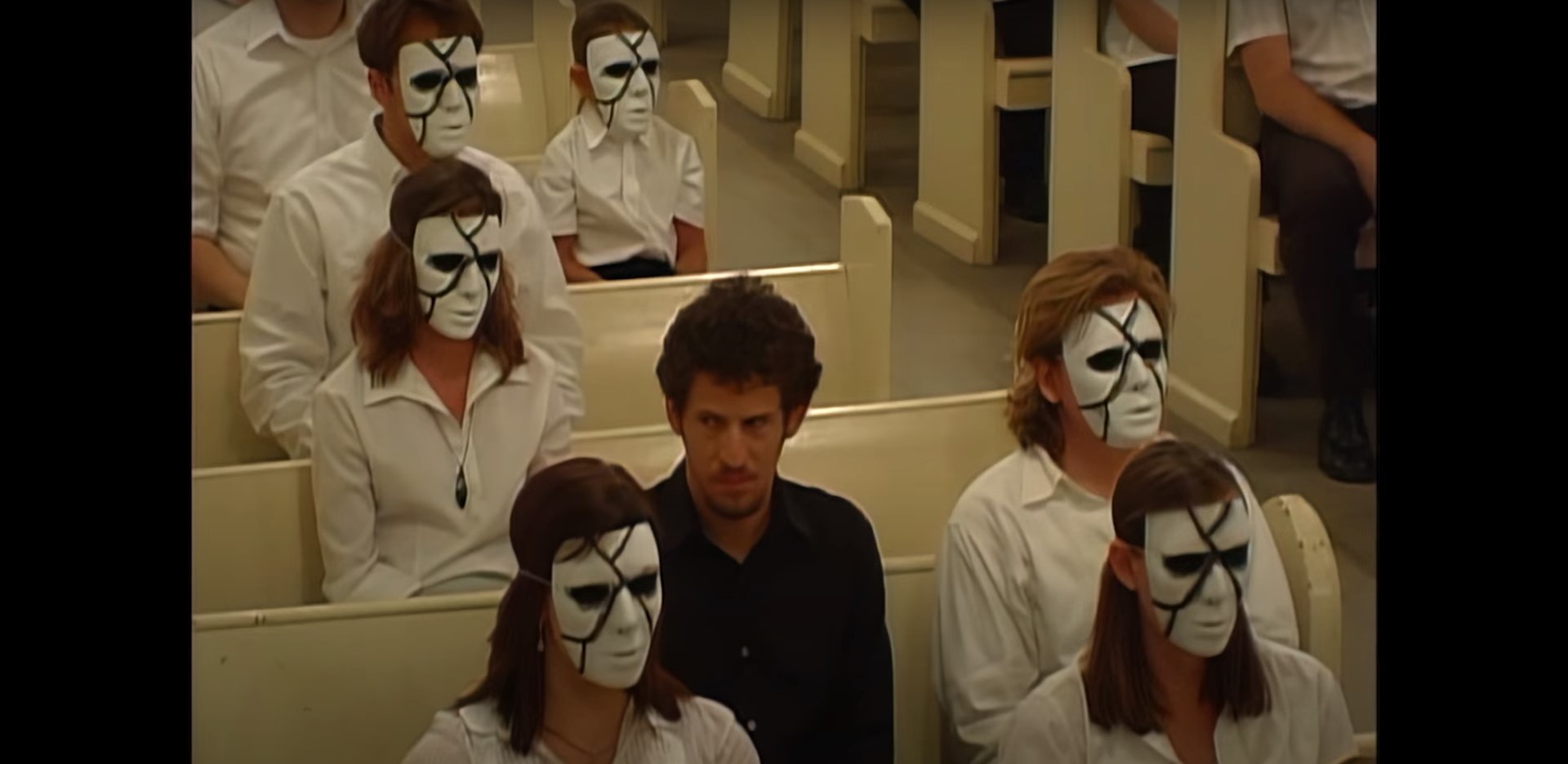
Something weird is spreading across a small Arizona town.  A chapter of a new religion has influenced most of the community into believing in Bryan, a pure and pious young boy from long ago who was brutally slain by the devil.  Jonathan, a local psychotherapist receives a camera from his uncle, also a health professional, with a self-recording that warns Jonathan that Bryan zealots are a dangerous, violent cult.  Deciding to document the situation himself, Jonathan repurposes the camera to clandestinely record the widespread Bryan gatherings and even infiltrate their church where they speak in tongues and wear the scarred mask of Bryan.  As Jonathan goes deeper into the uncomfortable insanities of Bryan’s world, the more Bryan followers takes an interest in reconditioning Jonathan. 

“Bryan Loves You’s” grainy SOV pseudo-documentary lacquer not only captures the icy blank stares, the unabating drone chanting, and the brainwashed coup of an insidious cult assimilating small town America, but the Seth Landau written and directed film also homogenously captures, all too presently well, that sense of ambivalent and conspiracy dread that knots apprehension uncomfortably in the pit of the stomach.  The 2008 released “Bryan Loves You” has the story set in 1993 Arizona made out to be a historical home video and CCTV recorded account of the analyzed and dissected suppressed footage coming to light for the first time incomplete with censored last nights and specific addresses to make the pseudo-doc appear more genuine and shocking.  Filmed in and around the suburbs of Scottsdale and Phoenix, Arizona, “Bryan Loves You” is a found footage subgenre production self-produced by Mike Mahoney and Seth Landau, under the filmmaker’s Landau Motion Pictures, and marks the debut feature film of Landau’s humble career that started roughly around 2003 as a production assistant on “Arrested Development.”

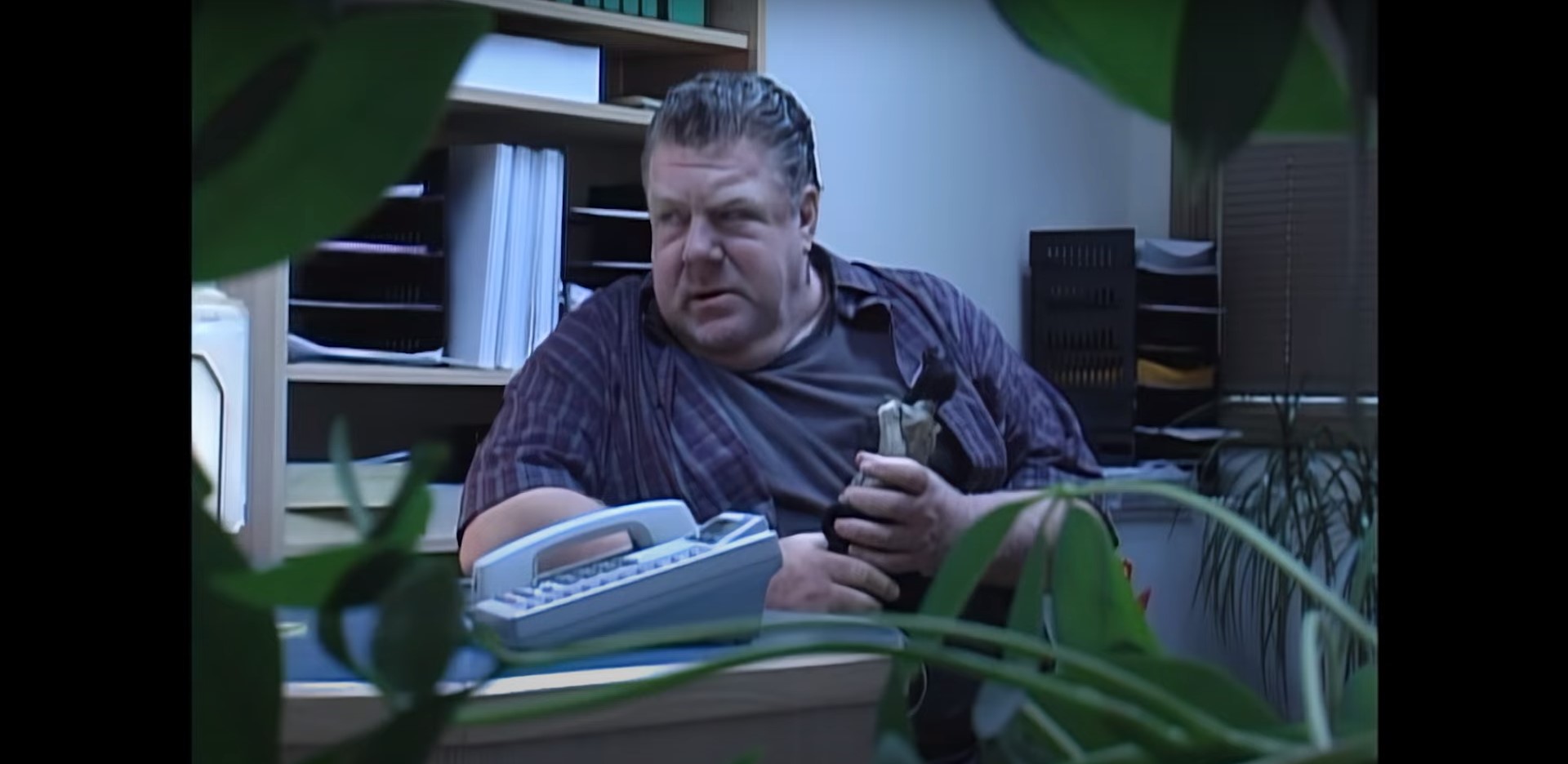
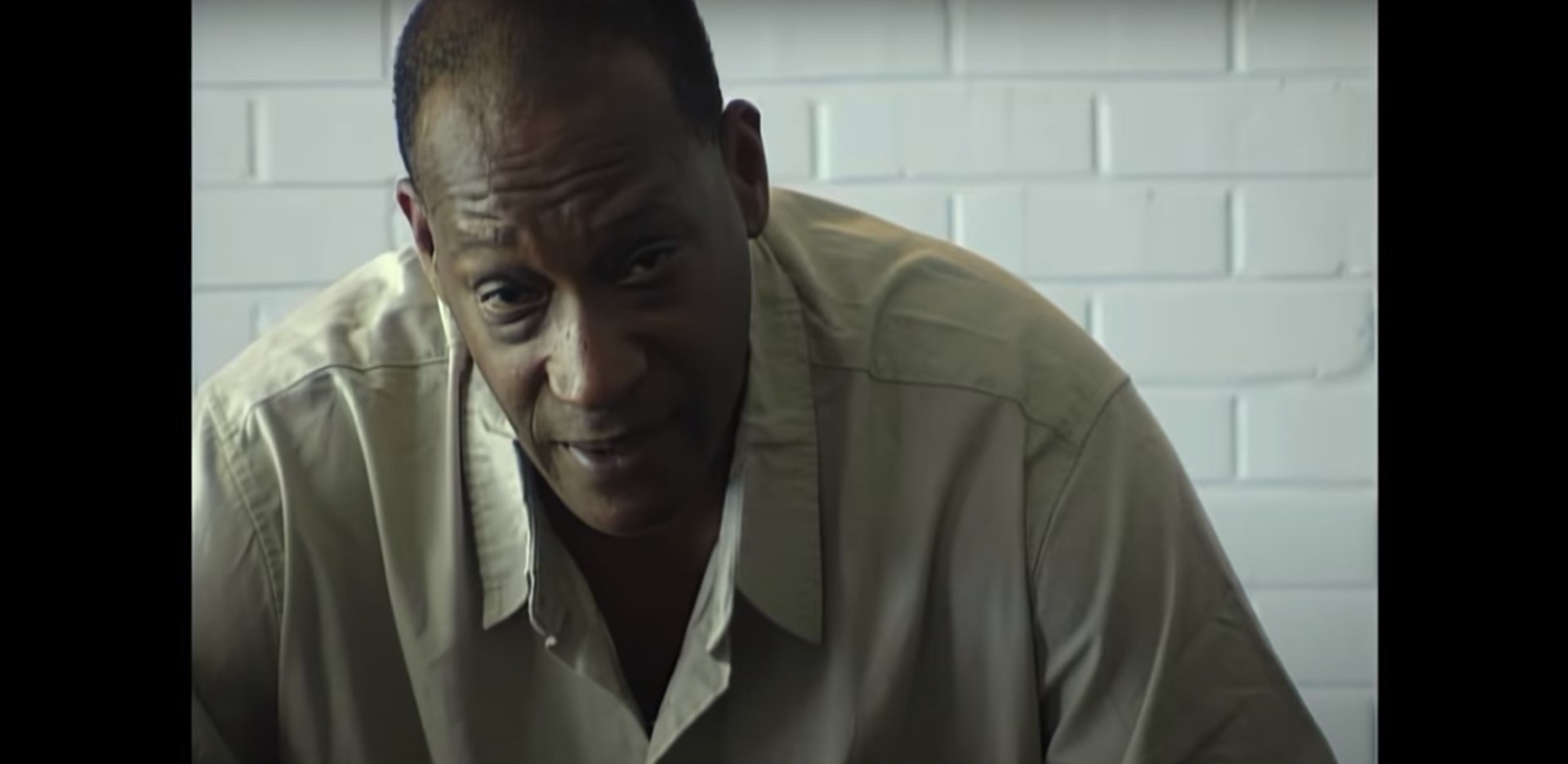
For the average popcorn movie goer, “Bryan Loves You” is about obscure as they come with a no-name director and a cast with relatively no-name actors with the exception of one that might have a chance of recognition by the common Joe Schmo.  Old heads may recognize George Wendt, one of the barflies from the sitcom “Cheers” and the Saturday Night Live sketch of Super Fans, in his brief and strange scene as a patient holding a doll that speaks to him about people who talk about him.  For chin-deep genre fans, Wendt is about the biggest A-lister you can have in an indie film and what’s unusual about “Bryan Loves You” is the stacked list of iconic made-by-horror names that make up the cast list.  It’s impressive.  Landau’s connection to the late great master of horror Stuart Gordon (“Re-Animator”) opened the door to George Wendt, who starred in Gordon’s “King of the Ants,” and, likely, led to the onboarding fan favorites such as Brinke Stevens (“The Slumber Party Massacre”), Tiffany Shepis (“Tromeo and Juliet”), Lloyd Kaufmann (“The Toxic Avenger”), Daniel Roebuck (“The Devil’s Rejects”), Chuck Williams (“Demon Wind”), and Tony Todd (“Candyman”).  Now, with these many names, none of them have starring roles and few have reoccurring scenes, but they are headlined to draw attraction for “Bryan Loves You.”  Honestly, the performances are hardly worth nothing.  Steves and Kaufmann have little dialogue and are shot at weird angles that makes them hardly recognizable.  Best scenes go to Tony Todd as a hesitantly disturbed and full of fear narrator standing in an empty board room and talking directly into the camera about what we, the audience, are about to witness, even directing viewers to turn away or to be ushered out of the theater (did this get a theatrical release?) if the content becomes too shocking to behold.  Seth Landau stars as the principal lead Jonathan who can’t be taken seriously as a psychoanalyst as there is no depth to the character in those regards.  Plus, as someone who’s supposed to uphold ethical standards, Jonathan breaks quite a few HIPPA regulations and breaks into houses with a camera, filming Bryan acolytes without their consent.  “Bryan Loves You” rounds out the cast with Tori King, Candy Stanton (“Exit to Hell”), Shane Stevens (“The Graves”), Jilon VanOver (“Bad Blood”), Tom Noga (“Anonymous Killers”), Jesse Ramiawi, Jacqui Allen (“Blue Lake Butcher”) and Daniel Schweiger (“Die-ner”)

Seth Landau’s found footage cult film is a rough cut of rudimentary psychological suspense restrained by its limiting low-ceiling budget.  The acutely hard cut editing and wonky framing is enormously puzzling within the narrative’s supposed single camera source documentary structure that suddenly diffuses into being a splice between Jonathan’s camera, which he loses halfway through the story, and a bunch of randomly placed CCTV footage across all of Arizona, in which some scenes are randomly placed in the desert where no structures are seemingly present to house a camera.  Who gathered and edited all this multi-video footage together?  Or does that play into the mystery, no matter how illogical, of adding to “Bryan Loves You’” unsettling allure?  What Landau does accomplish compares closely to what directors Eduardo Sánchez and Daniel Myrick were able to profoundly achieve with their unexpected breakout found footage blockbuster, “The Blair Witch Project.”  Now, I’m not saying “Bryan Loves You” had the audience gasping power as the “The Blair Witch Project” but the air in the story still feels very uncomfortably still, like in holding your breath, because something sinister is closing in and that type of disturbing presence, coupled with the erratic demonic behavior boiled to the surface if love for the almighty Bryan is absent, is all too relatable in today’s political climate.

Though “Bryan Loves You,” MVD Visual really loves Bryan right back with a high-definition Blu-ray release, remastered and upscaled from the original master source, a digital recorded standard definition, with an approved up-conversion of 172,800 pixels to over 2 million pixels per frame to achieve full HD.  For SOV, the handheld cam footage turns out more detailed than expected with suitable tinctures that are often less vivid in the found footage genre; however, there are still varying levels of quality from lower quality posterization to better than mid-grade delineation.  Though stated as presented in a widescreen 1:78:1 aspect ratio on the MVD Marquee Collection back cover, the actual ratio is a pillarbox 1:33:1 without straying from that display. The English language dual channel stereo track also has varying fidelity levels using the inconsistency of a built-in handheld mic but the good bones behind the range and depth retain the natural auditory proportionate. A few augmented audio tracks are snuck in for effect, such as the preacher’s demon-speak and the school PA system. English subtitles are optional. With a new Blu-ray release comes all new special features with a few short film-length interviews between filmmaker Seth Landau and George Wendt (44:50 minutes), Tiffany Shepis (50:49 minutes), Daniel Roebuck (59:35 minutes), and Brinke Stevens (31:46 minutes) touching upon more than just “Bryan Loves You” but also various career moments and other media cultural topics. Also featured are two commentaries: a 2008 commentary with Landau, select cast and crew, and JoBlo critic James Oster and a new 2022 commentary with only Landau. Plus, a brand new 2022 theatrical trailer. “Bryan Loves You” draws parallels to the 1993 Waco, Texas cult led by David Koresh of the Davidian sect preaching fire and brimstone, but writer-director-product Seth Landau adds his own supernatural concoction in a trade-in of doom and gloom for mindless devotion and diabolism that turns folks into followers and flesh-hungry fiends at times. Maybe not the prime cut of the cult genre but does stand out even if you don’t really love “Bryan.”

All New Blu-ray release of “Bryan Loves You” on Amazon.com