
An Unearthed Classic Now Available on Blu-ray! “Confessions of a Serial Killer”
Daniel Ray Hawkins drives an unsettling, nomadic lifestyle as he travels across different parts of the country. With no money, no place to call home, and little friends, Hawkins lives a life of mostly solitude, odd jobs, and equally as strange as him acquaintances spurred from his childhood, shaped by his promiscuously prostitute mother and a war veteran disabled father who gruesomely took his own life, both of which displaying their iniquities right in front of him. Hawkins also lives a life of torture and murder, being one of the most prolific American serial killers ever of mostly young women. When caught by authorities, Hawkins is willing to confess to everything and help unearth bodies from over decades on the road to ensure families he’s stolen from receive some sliver of solace. His anecdotal accounts of individual disappearances and murders shock authorities to the core, so much so that Hawkins may just be unstable and not telling the truth. That is until he informs them of and leads them to the cached polaroids and decaying corpses.

Based on the American serial killer Henry Lee Lucas, who notoriously claims killing over 200 people has earned him a trio of film adaptations, at least, with “Henry: Portrait of a Serial Killer,” directed by John McNaughton and starring Michael Rooker in the titular role, the subsequent lesser part II, and the more obscurely known Mark Blair written and directed production, “Confession of a Serial Killer.” Much like “Armageddon” and “Deep Impact,” or “End of Days” and “Stigmata,” both movies fall into the paradoxical twin film phenomena of sharing the same them and having both been released approx. within a year of each other. While “Henry: Portrait of a Serial Killer” may have taken the top spot with a bigger budget played in more widespread venues, Blair’s rendition was released prior and closer to Lucas’s active killing spree that saw an end in 1983, just didn’t get released in America until a few years later to not duel with McNaughton’s film and thus didn’t succeed as much. The Cedarwood Productions film was produced by Cecyle Osgood Rexrode, distributed by Roger Corman and his company, Concorde Pictures.

While he was not the first choice for the titular character of Daniel Ray Hawkins, production designer, the late Robert A. Burns, filled in the sociopathic shoes with great monotonic conviction. Burns, who has ties as Art Director and makeup effects on some of the most iconic and seminal genre films, such as “The Texas Chain Saw Massacre,” “The Hills Have Eyes,” and “Tourist Trap,” matches the makings of an unempathetic, unsympathetic, natural born killer with a glazed deadpan austere and matter-a-fact knowledge and every evil committed. “Confessions of a Serial Killer” would not be as laced with depravity if Burns didn’t push the demented drugs to keep audiences hooked on overdosed deviancy. Not a tall or broadly muscular stature, curly outstretched and receding hair, scruffily unshaven with a consistent 5 o’clock shadow, and wide rimmed glasses, Daniel Ray Hawkins epitomizes the very essence of a creep and accentuates the behavior even further with his leisurely composure and straight-faced simplicity. Other side characters exist around Hawkins’ maniacal run with the bisexual Moon Lewton (Dennis Hill) and his sister Molly (Sidney Brammer), who marries the pansexual Hawkins out of necessity rather than sexual desire, and while Moon and Molly share Hawkins deranged apathy, they are completely overshadowed by the more controlling and interesting lead principal character due to half the murderous anecdotes are solo ran and all of the perception in the stories is through Hawkins’ recollection, giving him more power in the trio in perceptional self-interest, if Hawkins is capable of such consciousness. The cast fleshes out with lawmen and victims in Berkley Garrett, Ollie Handley, DeeDee Norton, Demp Toney, Eleese Lester, Colom L. Keating, and Lainie Frasier in the opening stranded motorist scene that sets up Hawkins diabolical reach in turning a car into a trap.

Bathed in realism, “Confessions of a Serial Killer” does not embellish with surrealistic temperament. The story never dives into Hawkins’ head to show any indication or any kind of visual mental degradation or reality breakage toward being a coldblooded killer. His violence is spartan, acidic, and raw to the bone, leaving a gritty taste in your mouth, with only a bleak childhood to blame for his adult obsessions to kill that he describes as necessary as breathing. Blair distills the story to a “Mindhunter’” episode in trying to understand the killer and recover skeletons from his past, literally, through rational and respect ways rather than boiler room beatings and power-tripping threats. Blair’s concept humanizes the inhuman and having Hawkins’s reminiscence each account is like recalling childhood memories with a smirk and fond remembrance splayed across his face adds another layer of iciness. Grounded by pedestrian scenarios, “Confessions of a Serial Killer” disrupts the routine, the familiar, and the unscripted ways we live our lives unconsciously to the fiends living among us that look like you or me. It’s a very palpable fear Blair conveys under the semi-biopic film. The director does eventually let loose the reigns in the final third act with a finale account of Hawkins, Moon, and Molly shacking up with an amiable doctor, his suspicious assistant, and his shapely young daughter that boils to a head when one bad decision leas to another.
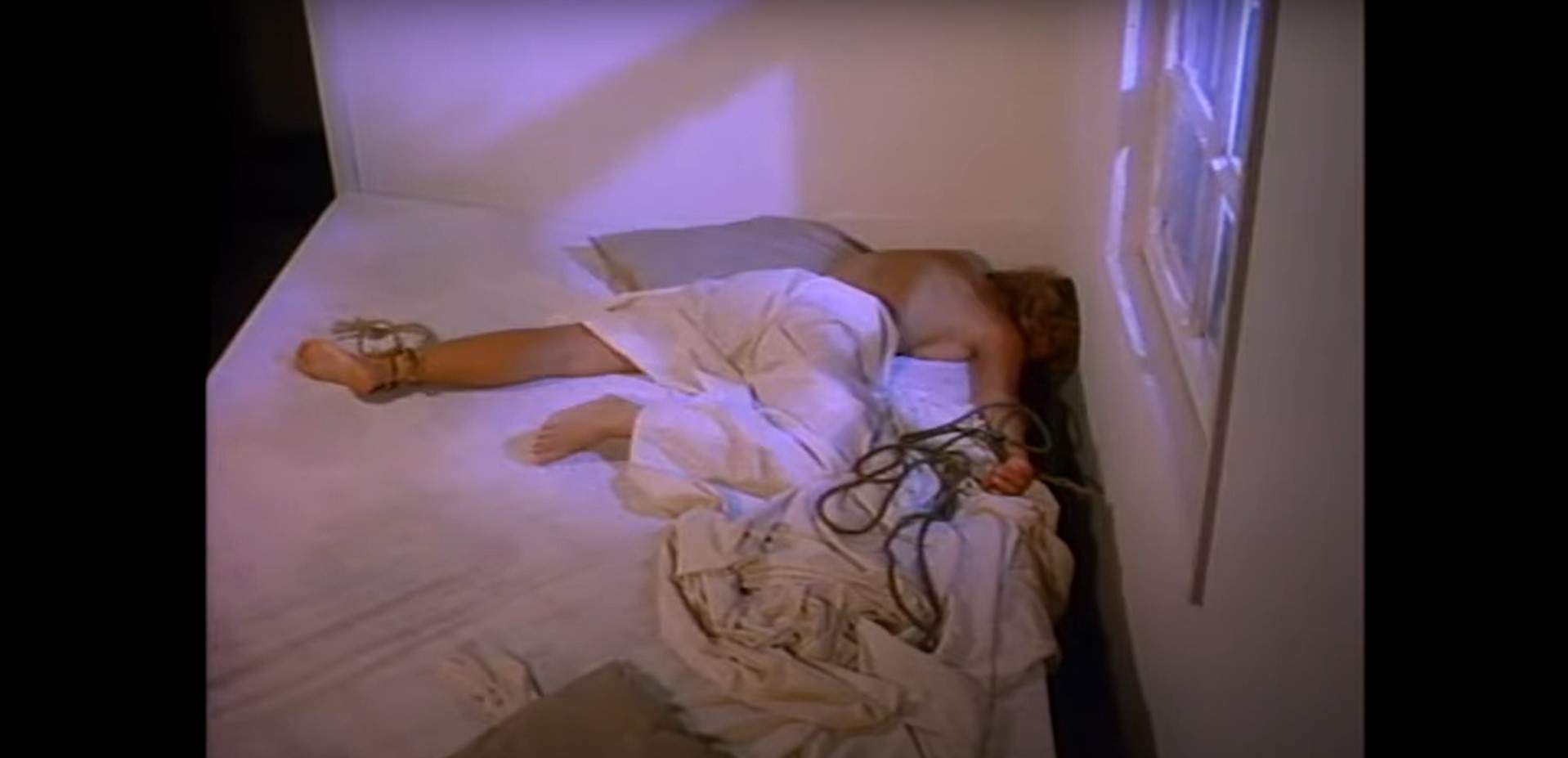
For the first time on Blu-ray anywhere as a part of Unearthed Films’ Unearthed Classics sub-banner, “Confessions of a Serial Killer” receives a high-definition, 1080p release on an AVC encoded, single ring BD25. Higher contrast and a lesser diffusion to create a harsher, flatter color scheme, the intention is to fully base the story in reality as much as possible, to structure an abrasive look of grain and low lighting that parallels the seediness the tale touts. inspired from the facts of an American serial killer without having to fully give recognition to the actual killer. Shadows are key to Hawkins nightly runs, adding back-alley value to his viciousness, and the more lighter scenes, such as brighter-by-color interiors or day exteriors, are ample with natural grain that cut into the details but don’t necessarily knock them out entirely. With the lesser capacity disc, compression doesn’t appear to be an issue with no sign of macroblocking, banding, or posterization. The English language LCPM 2.0 mono possesses lo-fi aspects kept true to the original audio master. The dual-channel conduit amasses the layers mostly in the forefront without ascendancy in the environment, creating a flat approach, rendering the audio mostly fixed and depthless with the action creeping onto the dialogue, but this also adds the realism of a real world chaos where cacophony reigns. William Penn’s effectively, inlaid soundtrack has hallmarks of Wayne Bell and Tobe Hooper’s “Texas Chain Saw Massacre in the minor key with added notes of an otherworldly tune fork keyboard and lingering bass elements that’s just infests with the sounds of deceit and death, reminding me also a lot of a George A. Romero’s “Night of the Living Dead’s” atmospheric arrangement. English SDH are an available option. The collector’s edition contents include a commentary with director Mark Blair, aka John Dwyer, director of photography Layton Blacklock, and actor Sidney Brammer (Molly), The Henry Lee Lucas Story by author and former TV news reporter James Moore, and a full-lengthy documentary Rondo and Bob examines Robert Burns being the foremost expert on uniquely deformed actor Rondo Hatton as well as examines Burns’ own career, a polaroid gallery, promotional gallery, and the trailer. Displaying the iconic poster, a profit from rip of Hannibal Lector with a devilishly masked killer behind bars, Unearthed Films’ releases the stark image onto a planar cardboard slipcover. Same image is used from the standard Blu-ray Amaray case with no reverse side. Disc is pressed with a memorable and anxiety-filled chase scenes. There are no inserts material included. The region A encoded Blu-ray has a runtime of 107 minutes and is unrated.
Last Rites: One of the better biopics on U.S. serial killers even if a little bit of speculation and sensationalism increases the already verbose notoriety of one Henry Lee Lucas. Scary and bleak, “Confessions of a Serial Killer” continues to remind us that no one is safe from the everyday sociopath.


 It's Bloggin Evil!