

An insane asylum located in the North West region of the United States attempts an experimental test to root out Vietnam soldiers faking signs of psychosis. A new commanding officer, a military psychiatrist named Colonel Kane, will take the lead of the experiment. But Kane’s methods are unorthodox and Kane himself seems distant from what’s expected from him, leaving the military patients, and even some of the personnel, wondering about his state of mind. Kane lets the committed soldiers live out their most outrageous fantasies and the further his practice plays out, the more that there might actually be something terribly wrong with the new commanding colonel.

“The Ninth Configuration” is the big screen adapted version of William Peter Blatty’s novel entitled “Twinkle Twinkle Killer Kane.” Blatty, who wrote the screenplay and directed the film, dives back into motion pictures once again after the success of another previous adapted novel; a little piece of work you may be familiar with called “The Exorcist.” In the span of seven years, Blatty was able to cast again the versatile Jason Miller, who had portrayed a much more serious Father Karras in “The Exorcist,” as one of the leading asylum inmates in “The Night Configuration.” From then on, the hired case was forming into a formidable force of method actors including Stacy Keach (“Slave of the Cannibal God”), Scott Wilson (The Walking Dead), Ed Flanders (“The Exorcist III”), Robert Loggia (“Scarface”), Neville Brand (“Eaten Alive”), George DiCenzo (“The Exorcist III”), Moses Gunn (“Rollerball”), Joe Spinell (“Maniac”), Tom Atkins (“The Fog”), Richard Lynch (“Invasion U.S.A.”), and Steve Sander (“Stryker”). This cast is a wet dream of talent.

What’s unique about Blatty’s direction of this film is the non-displaying of action and dialogue off screen. Whether it’s character narration, dialogue track overlay, or slightly off camera view, the spectator, for more about half the film or perhaps even more, isn’t being directed to focus on the current action or dialogue and this creates the illusion of hearing bodiless voices or activities, as if you’re part of the ranks in the mentally insane roster. Only until the truth or catalyst is reveal is when more traditional means of camera focus is applied.
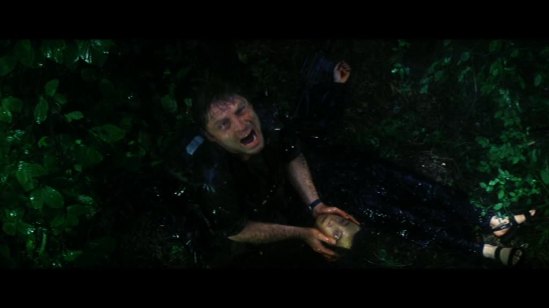
To make this technique work and to make it not become tiresome to the viewer, Blatty had to write some amazing dialogue and with him being a novelist and all, the dialogue was absolutely, 100 percent brilliant. Lets not also neglect to mention that with unrivaled dialogue, out of this world thespians must be accompanied to breathe life into the black printed words that are simply laying upon white pages. Scott Wilson’s and Jason Miller’s craziness is unparalleled while, on the other side of the spectrum, Stacy Keach delivers a melancholic performance that balances out the tone of the film from what could have been considered an anti-Vietnam war comedy at first glance that spun quickly with an unforeseen morph into a suspenseful thriller about the consequences of war PTSD and the affect it has on those surrounding.

Gerry Fisher’s cinematography encompasses the Gothicism of the remote Germanic castle to where every ghastly statue and crypt-like stone comes alive like in a horror movie. The setting couldn’t be any of an antonym for a loony-bin set. Even though the film is suppose to be set in North West America, the location used was actually in Wierschem, Rhineland-Palatinate, Germany at the medieval Castle Eltz and the story subtly explains how the castle came to be in “America.” To the opposition of such a barbarically beautiful castle, the score by Barry De Vorzon (The Warriors) in the first act into the second is playful, lighthearted, and childish in an appropriate story tone, but turns quickly sinister and angry during progression, building upon the revealing climax.
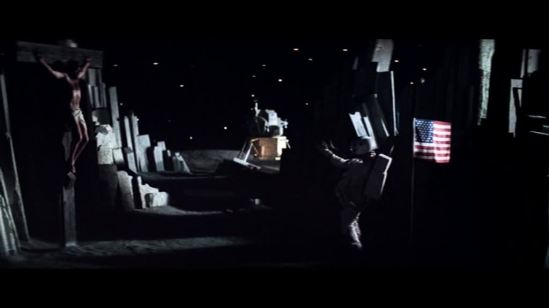
Classic film and TV distributor Second Sight brings this cult classic onto DVD and Blu-ray in the UK. Since this was a screener copy of the DVD, I’m unable to provide any audio or video technical comments, but the screener did include the generous amount of bonus material including interviews with writer-director William Peter Blatty, and individual interviews with Stacy Keach, Tom Atkins and Stephen Powers, composer Barry De Vorzon, production designer William Malley and art director J. Dennis Washington. There are also deleted scenes and outtakes and a Mark Kermode introduction. A substantial release for Second Sight and a fine film for any collection so make sure you pick up or order this Second Sight release today!
Tag Archives: the walking dead
#Programming_Evil. “Nightmare_Code” review!

Brilliant programmer Brett Desmond has been hired at a tech start-up to quickly complete the groundbreaking coding of a previous programmer Foster Cotten who went on a murderous rampage at the start-up’s tenth floor office right before killing himself. Desmond, struggling with the federal government breathing down his and his family’s necks due in part of him leaking sensitive classified material, works night and day and around the clock to crack Cotten’s code for ROPER, a behavior recognition program. A small work group remains with Desmond during the day, but at night, Desmond sleeps at the office, working aggressively to make the deadline and get his life back in order. The further Desmond or anyone else becomes familiar with the code, the code starts to modify their behavior, twisting their thoughts, and succumbing them to it’s will of the dead programmer.

From time to time again, the film industry on the subject of pioneer technology relays information upon the fears and consequences of intertwining arrogant brilliancy and controversial technology. From the genres of cyber punk to Sci-Fi horror, decades old films such as the virtual reality plotted “The Lawnmower Man” and “Virtuosity” to the more recent “Transcendence,” transferring consciousness into the machine, have been outspoken against the use of behavior modification and recognition programs. The idea behind the notion can said that the person envisioning the possibilities of such software will become obsessed, power hungry, or vengeful if the creation is taken away from them to which all three can be attributed to director Mark Netter’s 2014 film “Nightmare Code.”

Shot entirely through a surveillance-like setup and notebook web cams, “Nightmare Code,” for most of the duration, is viewed through four screens as like security footage. Netter and cinematographer Robert Fernandez designed this structure not for the sole purpose of a novelty exhibition, but to also confine characters in a small box coded by technology, as explained in an DVD’s bonus featurette, and creating a sense of isolation and distant connections that make the life of a programmer very lonely and depressing which develops in the characters very thoroughly. The story is told through the virtual eyes of ROPER, using it’s self-awareness and advanced modules to voyeuristically watch the small group of programmers and manically motivate their actions by use of altered video projections. ROPER also accesses the past, filling in the gaps that only the infamous story of the genius Foster Cotton can fill, and by accessing the past, the dead programmer’s coding can be understood for it’s malevolent behavior modification.

“Nightmare Code” is complimented by an underrated cast whom work well together through the smaller ROPER displays in the small screen film industry. Andrew J. West, better known for his role as the Terminus cannibal Gareth on “The Walking Dead,” takes on the protagonist role of Brett Desmond who battles legal and family trouble and West epitomizes isolation by effectively taking a man with a moral conscious in leaking immoral government information and leading him down a path of legal morality, but at the same time, being unfaithful, deceitful, and prone to corruption. He becomes pitted against antagonist Foster Cotton, played by veteran actor and long time supporting actor Googy Gress, notably recognized as a NASA mission controller from Ron Howard’s “Apollo 13.” The two foes never have screen time together as their stories live separate lives, tangled by their connection to ROPER, and so without that nourishment from the other actor, West and Gress use their talents to virtually interact with one another, developing a realistic struggling relationship that isn’t really there. The characters that surround Desmond and Cotton are negatively affected by both main characters and Mei Melançon’s supporting character Nora Huntsman figures into that coded nightmare as she becomes affectionate with Desmond. Even though he’s married, Nora feels the urge to fulfill her needs after separating herself from addictions: gaming, abusive boyfriend, and drugs. Melançon, who had portrayed a minor role as a major character, Psylocke, in the mutant world of “X-Men: The Last Stand,” had another hugely important role as a side dish techie lover, but her role doesn’t seem very present and that might because of the editing technique to create the dooming cyber vision.

Netter’s resulting editing style inefficiently told the story, I thought. We’re well aware that ROPER can mislead the performance buggy human race, but ROPER, in my mind, wasn’t responsible for some of the delayed or fast forwarded actions of the characters seen through the security footage as it stylishly seemed unimportantly and pointless. Luckily, these particular editing moments are far and few in between and don’t exactly hinder the narrative. What does hinder the narrative are the quick, considerably choppy, edited scenes. Netter creates long, sometimes drawn out, scenes to convey the office solitude, but then transitions to the numerous and quickly implemented scenes that spawn a constant stop and go narrative that loses the ominous factor. The longer scenes tend to generate gloom, dread, and despair. Supporting characters become underdeveloped in the quickly edited in scenes, affecting not only life recovering Nora, but also the rest of Desmond’s team – Louis, Kevin, and Ray – who become the underdeveloped characters and they are worthless to the viewer, essentially. Still, check out the Tonya Kay scenes as you might care about hers.

The Indie Rights Inc. produced film and MVD distributed release has a clean and sleek 1.78:1 anamorphic widescreen presentation. Colors seem balanced and bright. There lies some minor noise, but that only adds to the security cam charm. The Dolby Digital 5.1 audio is clean and balanced in all channels and douses with Ari Balouzian’s synth soundtrack that embarks to terrorize. Balouzian’s score reminds me of Ennio Morricone’s “The Thing” theme, developing a soundtrack character that contributes to the intensity of “Nightmare Code.” Extras includes the film with commentary and a handful of featurettes explaining briefly the characters, the production, and the fear on the technology horizon. Mark Netter, along with the cast and crew, has good source material here and though this sort of tech horror isn’t exactly novel, “Nightmare Code” is fiercely entertaining and forebodingly frightening on a low-budget, startup scale.
AMC’s “The Walking Dead” S5Ep3 ‘Four Walls and a Roof’
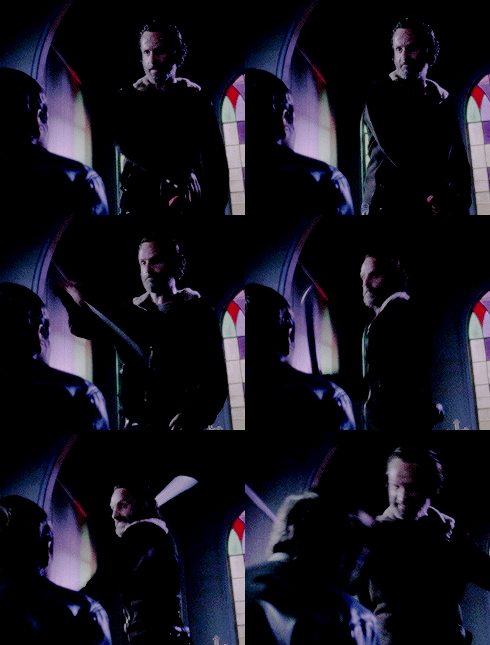
As one chapter closes, another opens when Rick faces off agains’t what’s left of Terminus and Daryl and Carol discover a whole new dire situation. Bob has been returned to the group sans a leg and informs Rick and company that his time is near as he was also bit on a run. Poor Bob. Lawrence Gilliard Jr. will be missed as Bob Stookey, a level headed, positive thinker who gave much of the group hope. His alcoholic and lonely past turned for the better when he met the group. He was a shining example all that was potentially good. Well, a good thing can’t last forever as this episode hints.
I’m a bit glad that Gareth, played by Andrew J. West, wasn’t another Governor character. Instead, Gareth becomes a short lived catalyst vehicle that may or may not have split Rick’s group into two halves – one half doesn’t trust anybody new and becomes violent against the against the grain riders and then there are those who believe everybody is good and you just have to sift through that darkness. Carl and Rick are the prime examples of each category which will make for good television later on in the series because I’m sure Carl will once again blame his dad Rick for something. However, Rick has been right for most of the show’s life.
I’m still curious about Father Gabriel. His guilt runs deep, but how did he survive for so long being a coward. Rick still doesn’t trust him, but Father Gabriel didn’t rat out the group with Terminus hooligans make their threatening entrance into the church looking for revenge blood. However, Rick decided he was going to keep his promise to Gareth and Sasha had some revenge on her mind against Terminus folks as well.
Next episode will be something we haven’t seen before; a new group of foes unlike the show has ever given us. We’ll find out what happened to Beth and where Carol and Daryl discovers her. This should be interesting as this gives Rick and his group a new path and takes them off their now stagnant stay at the Church and leave Terminus in the past for good.
Syfy’s “Z Nation” S1Ep7 ‘Welcome to the FU-Bar’

After the crushing death of Charlie, the band of survivors continue their noble trek to the west coast, but first they must go through the middle of nowhere Kansas. Low on supplies and nearly dead vehicle, their only shelter option is an open field compound that houses a moonshine bar, a weapon’s depot truck, and a sharpshooting contest where the grand prize is for the best zombie kill. Little do they know, a tsunami of zombies, aka Zunami, is heading their way creating a dust cloud that can be seen from space.
Episode seven is not my favorite episode by far as some of the hilarity charm has omitted from ‘Welcome to the FU-Bar.” Instead, we’re drawn in by Warren’s woes over the loss of her man squeeze Charlie and there is a whole coming to terms with the situation scene which was done decently enough to warrant a mention. Other worth mention parts is Murphy is one again, with every episode, showing scenes of becoming a zombie by this time taking a bite out of someone’s shoulder. However, his bite has some fortunate consequences.
10k finds a love interest, but I swear he finds one every episode and I believe this is a purposful cock block because the boy was born post-apocalypse. 10K doesn’t even know what porn is which Doc describes it as ‘great’ and that isn’t really helpful to a boy with raging hormones. 10K sparks a love interest with another skilled sharpshooter who is half Asian (how exotic), but as soon as he makes a connection with her, the scene is chaos with a zombie outbreak in the middle of camp and their paths divide. I have a feeling we will see her again real soon.

10K’s sexy honey
Not the bet episode, but not a dull hunk of shit either. Still some decent kill scenes by Warren and 10K who were really the main focus with Murphy’s troubles lurking in the background. We’re heading out of Kansas being trailed by a juggernaut of Zs whom the group is to encounter next episode and being trapped in a small town and only Murphy to be their salvation. Should be a real kick in the nuts.
AMC’s “The Walking Dead” S5Ep2 ‘Strangers’

My apologies for providing reviews days after a show airs. This past week has been hectic with a trip to Canada, work, and new baby! I’ve managed getting around to “Z Nation” and “The Walking Dead” this week (nor would I miss them any other week). “The Walking Dead’s” second episode in season five entitled ‘Strangers’ keeps us guessing. Rick has had bad deals with strangers (as the title of the episode suggests) and he holds a cloud of suspicion over everyone one that crosses his path.
This time a preacher named Gabriel has crossed Rick and his group’s path and Rick, being paranoid Rick Grimes, has his suspicions about the man of the cloth; he knows the preacher man is hiding something. Carl, being happy-go-lucky Carl, wants to believe that not everybody is bad, but his beliefs are starting to turn as he starts to see the clues surrounding Gabriel’s church – knife marks on the windows, “You’ll Burn for this” etched into the side of the church – and Carl is now seeing what Rick see’s: a man’s guilt and past.
On the tail of Rick’s group, the cannibals of Terminus have captures and started to munch on one of the group’s own. These folks are twisted and I’m talking about way, way out there. More looney than The Governor. I have a sneaking suspicion that more than one major player will die this season at the hands of the long pig delicatessen enjoyers. I’m also pretty positive that the deaths will be fairly significant meaning that the deaths will be of characters we actually like. I’m still waiting for Carl to bite it. Sigh.
‘Strangers’ certainly brings more questions than answers to the table. Carol still isn’t sure if she wants to stay or not. Daryl chases after those who stole Beth. The internal plans between Abraham’s group is still a mystery. Lets not forget the slimy food pit and the stanky zombies that inhabit the dark, dank water hole. Those zombies should have gotten one of them killed being I’m sure they can bite under water. I’m also digging Seth Gilliam as Father Gabriel Stokes. Gilliam does a great job creating a character we’re quite not sure about yet. His intentions seem pure, but his secret could cause Rick and his friends their lives. We’ll have to continue to find out more I guess…
 It's Bloggin Evil!