‘Twas the Night Before Christmas, When All Through the EVIL “A Creature Was Stirring” reviewed! (Well Go USA Entertainment / Blu-ray)

Purchase “A Creature Was Stirring” Here at Amazon.com

During the height of a 6-day Christmas blizzard, nurse Faith remains home to care for her mysteriously afflicted daughter Charm.   Faith diligently stays vigilant over her daughter’s inexplicable condition with test after test and maintaining Charm’s constant body temperature between 102 to 104.4 degrees, seemingly stabilizing Charm’s condition.  If the temperature exceeds beyond, Charm transmogrifies into a barbed humanoid creature.  While Faith works on a compound cure, Liz and Kory, a sibling pair of Jesus zealots, break into the house seeking shelter out of the deadly snowstorm.  Faith has no other choice but to let them stay the night until the storm subsides but the appearance of Charm’s at-home care and the young girl’s sudden seizures and erratic behavior sends Liz into savior mode, meddling into more than she can comprehend.  Yet, something else lurks inside the house, between the shadows, and beneath the veil of reality that is way more terrifying. 

Even though Christmas might be long over and all the gaudy and brilliantly lit decorates are stowed away back into Grandma’s attic that doesn’t mean the holiday horror train has to depart the station.  And I’m not talking about no Polar Express with the edging on creepy motion capture animation.  I’m talking about “The Cleansing Hour’s” Damien LeVeck’s Twas the Night Before Christmas-inspired titled “A Creature Was Stirring.”  The equivocal creature feature set in the throes of a raging blizzard and inside a very decked the halls house is penned by debut screenwriter Shannon Wells under the original title of “Good Luck, Nightingale.”   Aimed to be more than what meets the eye, “A Creature Was Stirring” blends the involuntary struggles of drug addiction with potent secretions of supernaturalism.  The U.S. production was shot in Louisville, Kentucky, produced by LeVeck, wife Natalie, as well as “Scare Package” producers Aaron B. Koontz and Cameron Burns with Vladislav Severtsev (“The Bride”) under the production companies Skubalon, 10/09 Films, and Paper Street Pictures. 

Topping the bill as Faith is “This Is Us” star Chrissy Metz, portraying a nurse practitioner and mother desperate on concocting a cure to her daughter’s strange, monstrous manifesting condition.  Metz brings the multifaceted mania between being rock solid and stringent with medical checks and procedures and being able to turn aggressive when the moment calls for it, especially swinging a screwed-spiked baseball bat.  This underlines an underlying secret or hidden predicament viewers will be dipped into and begin processing all the little traces of one-offs that don’t necessary make sense to an already peculiar narrative.  Then, there’s Charm, played by Annalise Basso (“Oculus”), in constant oversight, constantly mutable, and urging to constantly be free from her mother’s impervious iron grip to lighten up.   Basso retains angsty opposition while tossing moments of reflective consideration for her mother and for herself, disquieting the teetering tranquility when Liz and Kory come into play.  Respectively played by “Halloween” ‘07’s Scout Taylor-Compton and “Stake Land’s” Connor Paolo, siblings Liz and Kory stir the pot that’s slowly simmering to a boil as one religious dogmatist and one eager to break the constraints of his sister’s purity with sex and drugs complicate the strained mother-daughter relationship with their intrinsic quirks that expose a deeper, rooted-to-reality problem.  The now generational scream queen Compton dons colorful dreads and a large Messiah back tattoo amongst a high and mighty attitude while Paolo can be praised for the sarcasm brought out from the scripted dialogue.  Each of the four principals are inherently different and clash, in a good way, to provoke complications. 

Drug addiction has infiltrated horror years ago and have been the basis of many notable films such as Abel Ferrara’s “The Addiction,” Larry Fessenden’s “Habit,” and Frank Henelotter’s “Brain Damage” to name a few from the massive lot.  “A Creature Was Stirring” taps into that same vein as LeVeck’s injects and shoots up his own interpretation of horrors with withdrawals.  Long time addicts suffer through agonizing, powerful withdrawals that screenwriter Shannon Wells incorporates symptomatically with a figurative approach and while Wells’ story invokes colorfully rich characters and enigmatic tale of terror, brought to life by LeVeck’s vibrantly warm and glow Christmas adorned and atmospheric house, the finished feature, that really has nothing to do with Christmas oddly enough, feels uneven when revealing the irony of surprise doesn’t become catchall illumination.   The most ambiguous part about the tale is the spiny-signified creature, a mutated, zoomorphic porcupine of sorts, to represent ferocity of the withdrawn drug with its hypodermic needle-like defense mechanism and malevolence nature.  The shadowy man-thing is given such a threadbare association between Charm’s anecdotal encounter with large rodent and its manifestation metamorphosis into the fold that the hostile has hardly any staying power as a villain and, like a rodent, really does feel just like a mouse was stirring as it scurries arbitrarily throughout the house but not all is negative as there are scenes that make you go holy crap when recollecting character and creature interactive moments that suddenly click and make sense, often coinciding and juxtaposed against really neat interior cinematography bathed in mixture of hard light and soft glows. 

Well Go USA Entertainment presents “A Creature Was Stirring” on a high-definition Blu-ray home video.  The AVC encoded, 1080p, BD25 has soft illumination but a grading design that’s befits the ’tis the season paradigm with the primary color warmth radiating out from Christmas lights strung up around the house and the beaming brilliance of white battery-operated light-up decorations. Between the crude adornment lighting, some lighter translucent gels, and with a splash of black-and-white, Alexander Chinnic cinematography, presented in an anamorphic widescreen 1.78:1, resembles a rave clad fitting into the drug theme as an echo of the one character’s pill-popping, molly-dropping past. Details become diffused by the varying, indiscriminate incandescence and shadowy fields that play into the creature’s tenebrific threat, but those same shadows are often deep without posterization. The English 5.1 DTS-HD master audio achieves the goal of the very title of something stirring inside creating rustling movements and spiny-shifting clacking, coursing through the back and side channels and maintaining an even keeled LFE. Space awareness is key for close quartered tension and that’s rendered well in the design. Dialogue comes off without a hitch and is elevated above the rest of the tracks with no issues with compression faults or a fractured recording. English SDH subtitles are available. Like most Well Go USA releases, “A Creature Was Stirring” shoulders only Well Go USA preview trailers with no real bonus features of its own in the semi-static main menu but what we do get is a better than modest laid out standard Amaray Blu-ray package with a lightly titled embossed cardboard O-slipcover and on the back two different texture types, a polaroid slick abutted against the smooth cardboard. Image design is a greatly detailed silhouette of the porcupine creature looming over the house. The same image is also on the Blu-ray cover with a simple red-beaded or red-string light encircling the title on the disc. There is no insert inside. Rated R for violence, bloody images, drug context, language, and some sexual suggestion, the 96-minute Blu-ray comes region A locked. 

Last Rites: Chrissy Metz battling a deformative disease, drug addiction, an angsty teen, two home invasive siblings, and a large porcupine monstrosity all in the name of “A Creature Was Stirring” is the prickly cold turkey suspenser this side of the New Year.  

Purchase “A Creature Was Stirring” Here at Amazon.com

Best Friends Trying Their Best to Best EVIL! “The Boy Behind the Door” reviewed! (Acorn Media International / Blu-ray)

Best friends Bobby and Kevin are kidnapped by a stranger and taken to a remote house in the middle of nowhere. After Kevin is removed from the stranger’s trunk and is dragged into the house kicking, screaming, and pleading to be let go, Bobby breaks free of his restraints, but hearing his best friend Kevin’s screams leaves Bobby with no choice but to help him. Working his way through the house and upstairs unnoticed, obstacles stand between him and rescuing Kevin, including the boys’ kidnapper, a paying customer, and Kevin being shackled to the wall, locked inside behind an attic door, but that doesn’t avert Bobby’s intentions from thinking outside the box to save his best friend from a fate far worse than death. However, only a matter time before the kidnapper or the paying customer knows there’s someone else lying low the house and unearthing troubling secrets.

Child sex abuse is, without a double, a disturbing and touching subject to exhibit in cinema.  How to maneuver around the theme with child actors can be a delicate balance of commitment and understanding when considering the cast involved, especially if most would argue that a child’s brain is too immature or not developed appropriately to comprehend the impact of sexual abuse and to expose them indirectly could also be traumatic to their being.  The opposite of that argument has been proved over the decades with child actors having major roles in general with horror films.  Monsters of all shapes and sizes, guts and blood, and violent themes surround them and films such as “The People Under the Stairs” and “IT” have some of the most frightening and disturbing practical effect imagery that would cause sleepless night terrors for months and, yet kids star in them and are key to their success because, as we all know, children are not immune to real world dangers and threats.  So, why should be exempt from the creative imaginary ones? David Charbonier and Justin Powell finesses that line with a massaged contented breakout feature in “The Boy Behind the Door” written-and-directed by the lifelong friends and produced by Ryan Scaringe of Kinogo Pictures. Howard Barish of Kandoo Films, and Rick Rosenthal, Bert Kern, Ryan Lewis of Whitewater Films

***Beware… this section may contain spoilers*** Lonnie Chavis (“This Is Us”) and Ezra Dewey (“The Djinn”) play Bobby and Kevin who find themselves in the worst-case scenario of two unaccompanied pre-teens violently whisked away to an isolated farmhouse near one or two oil well pumps. I commend Chavis and Dewey’s hard fought, emotionally deep performances in battling against the creepiest of odds and feigning injury without being too over-the-top or inauthentic. Either if by being well coached or, more than likely, just good child actors, the level of anxiety maintains a solid 10 throughout with them. Their only scenes together where I thought the fusing of their friendship didn’t quite work was before the abduction where their dialogue and interactions as two young boys drifting across fields and profoundly thinking about their future deemed itself well too mature and far beyond being advanced for boys their age that the moment was a complete misfire for the story. Inevitably, the two friends run into a couple of creeps and exploitative racketeers in Micah Hauptman (“Phobias”) as the paying customer abandoning paid up time to chase down Bobby and Kristen Bauer van Straten (“True Blood”) in a twisted plot point of a white, late 40s to early 50s-year-old woman, who in the film could be someone’s mother, as the ruthless kidnapper of young boys for old man pleasure. Hauptman is more-or-less there in slimy spirit but doesn’t ooze enough egregious behavior to note as that trait falls immensely well upon the shoulders of van Straten with a mean streak that never lets up despite the rather paralleling of a hard R “Home Alone” antics between adults and children.

“The Boy Behind the Door” is a butt-clenching thriller because of the sheer fact children straddle the danger line on either side of spectrum. You have Kevin locked securely away in the summitted play and video room, shackled and waiting in screams, tears, and fears for his sure fate, and then there’s Bobby escaping his restraints and staying in the shadows, out of sight, trying to save his friend before he becomes either chained and exploited like Kevin or executed because of his strong will. Charbonier and Powell offer little-to-no fluff in pretending “The Boy Behind the Door” is anything but a fight for survival, a fight for friendship, and a fight against the utmost evil. The film isn’t full of strong one-liners or momentous moments that keep the story grounded and pure in its vilest state with tiptoeing around the one-woman operated child sex abuse ring without going into the full gross details. Charbonier and Powell’s story has many strengths, but it also has a few weaknesses waned upon the characters’ decision making. For instance, when Bobby has to break into the house, he throws a rock through the mud room door window without knowing where the kidnapper is and if they are in earshot of the window breaking. Later in the film, Bobby is trapped in the upstairs bathroom and when a squad car pulls up, instead of breaking the window he can clearly reach, he tries to yell through it and fiddle with opening the latch. Why does he simply not break the window and then yell for help? That particular scene drove me nuts and there a few other minor instances of the same caliber throughout in a story that well made enough to be compelling, to be horrific, and to be gripping in and around every house interior scene.

Tense, harrowing, and an ugly truth, “The Boy Behind the Door” is defensible horror at its best and a righteous strength of friendship. Acorn Media International distributes “The Boy Behind the Door” onto a region 2 Blu-ray in the UK! The PAL encoded release is presented in a widescreen 2.38:1 aspect ratio and, speaking digitally, the picture renders flawlessly the inkling of low-lit hope inside a world of dark fatalism and cynicism under the cinematography eye of Julián Estrada. The English language DTS-HD Master Audio 5.1 is crystal clear that occupies each channel with the right number of decibels to exact the range of sneaking through a creaky wooden floored house. Dialogue is clean and clear, especially at whisper breath. The Shudder original film comes with a pair of special features including a blooper reel of mostly Lonnie Chavis sneezing and goofing off which is nice to see kids being kids on set and a music video to the film which is more like a trailer with Anton Sanko’s dark synth-gripping score being an apogee of suspense. There’s never sympathy for these types of vile exploitation villains on and off screen and in “The Boy Behind the Door,” that fight back mantra resonates loud and clear in an unambiguous do-or-die between guileless innocence and pure evil.

EVILs Make Difficulties in Finding God. “Agnes” reviewed! (Magnet Releasing / Digital Screener)

Blemished man of the cloth, Father Donaghue, and a neophyte are summoned to perform the holy rite of exorcism on a possibly possessed nun, Sister Agnes.  Disadvantaged and forced by his own scandal, Father Donaghue is ordered by the local Bishop to oversee the matter before they ship him overseas to avoid further disgrace upon the Church, but the skeptical priest, who has performed many exorcisms in the past, has never once believed he was casting out a demon but, rather, relieving a guilty, tormented soul seeking divine forgiveness.  When the priests confront Sister Agnes, the situation is violent, wily, and unlike any possession Father Donaghue has ever seen before.  The incident casts doubt over Sister Agnes’s friend and fellow nun, Sister Mary, who leaves the convent to try and live on her own and find God in the real world her own way, but a little bit of Sister Agnes has seemingly rubbed off onto her. 

You gotta have faith, sang once by pop-rocker and songwriter George Michael (and Fred Durst, if want to go that route) and though Mickey Reece’s “Agnes” doesn’t necessarily croon a rebuttal, the Oklahoma City born filmmaker surely splits hairs with a formidable blockade that advocates the crisis of faith cinematic model with layered horror.  The “Climate of the Hunter” writer-director’s latest quasi-horror-comedy and full-throttle religious drama questions the validities of finding God on a personal level with a divergently cut screenplay co-written with frequent script partner John Selvidge, whose current post-production penned time-warping horror entitled “Wait!” coming next year.   “Agnes” is filmed in the heartland of America inside Reece’s home state of central Oklahoma and is a reteaming of Mickey Reece and producer Jacob Snovel of Perm Machine with Greg Gilreath and Adam Hendricks’ Divide/Conquer (“Black Christmas” 2019 remake, “Freaky”) as the production companies and is first feature presentation for Molly C. Quinn, Matthew M. Welty, and Elan Gale’s QWGmire Productions.

One-third of the head of QWGmire is also the “Agnes” leading lady as Molly C. Quinn, who doesn’t play the titular character, plays Mary, a nun and friend of the possessed plagued Agnes (Hayley McFarland, “The Conjuring”) with a tragic background that ambiguously parallels a similar path to the mother of Jesus, also named Mary for all you non-Christians out there.  Mary is tender, quiet, and self-effacing but determined to pave her own way without the means of charity, especially those of the unsavory-favor nature, and consulting God for answers.  Quinn is perfect to shoulder Mary’s innocent disposition and does carry her naïve meekness throughout up until Mary’s gradual decline toward her faith that turns the sweet and innocent young woman into a pragmatic doubter, spurred by Agnes’ sudden otherworldly turn from devout to impiety that becomes more than what meets the eye.  However, in kicking off Reece’s film, one would have thought the exorcism of Agnes would emphasize more heavily on Father Donaghu (Ben Hall, “Minari”) and soon-to-be priest Benjamin (Jake Hororwitz, “Castle Freak” remake), but despite the involved build up of Father Donahu’s sordid past that conflicts with the Church and his struggles with the exorcism, Reece and Selvidge ultimately do, in what feels like, a pulling of the plug on a storyline that followings in the footsteps of “The Exorcist.”  That is, in my opinion, the downfall of “Agnes’” story in elimination of really interesting character arcs right in their girthy throes, leaving audiences hanging on Father Donaghu, grocer owner/low-end gangster Curly (Chris Sullivan, “This is Us” and “I Trapped the Devil”), ostentatiously swaggering Father Black (Chris Browning, “Let Me In”) and even the titular character Agnes fails to flesh out fully.  Rachel True (“The Craft”), Zandy Hartig, Bruce Davis, Chris Freihofer, Ginger Gilmartin, Mary Buss, and “Guardians of the Galaxy” and “Suicide Squad’s” Sean Gunn as a standup comedian and Mary’s love interest.

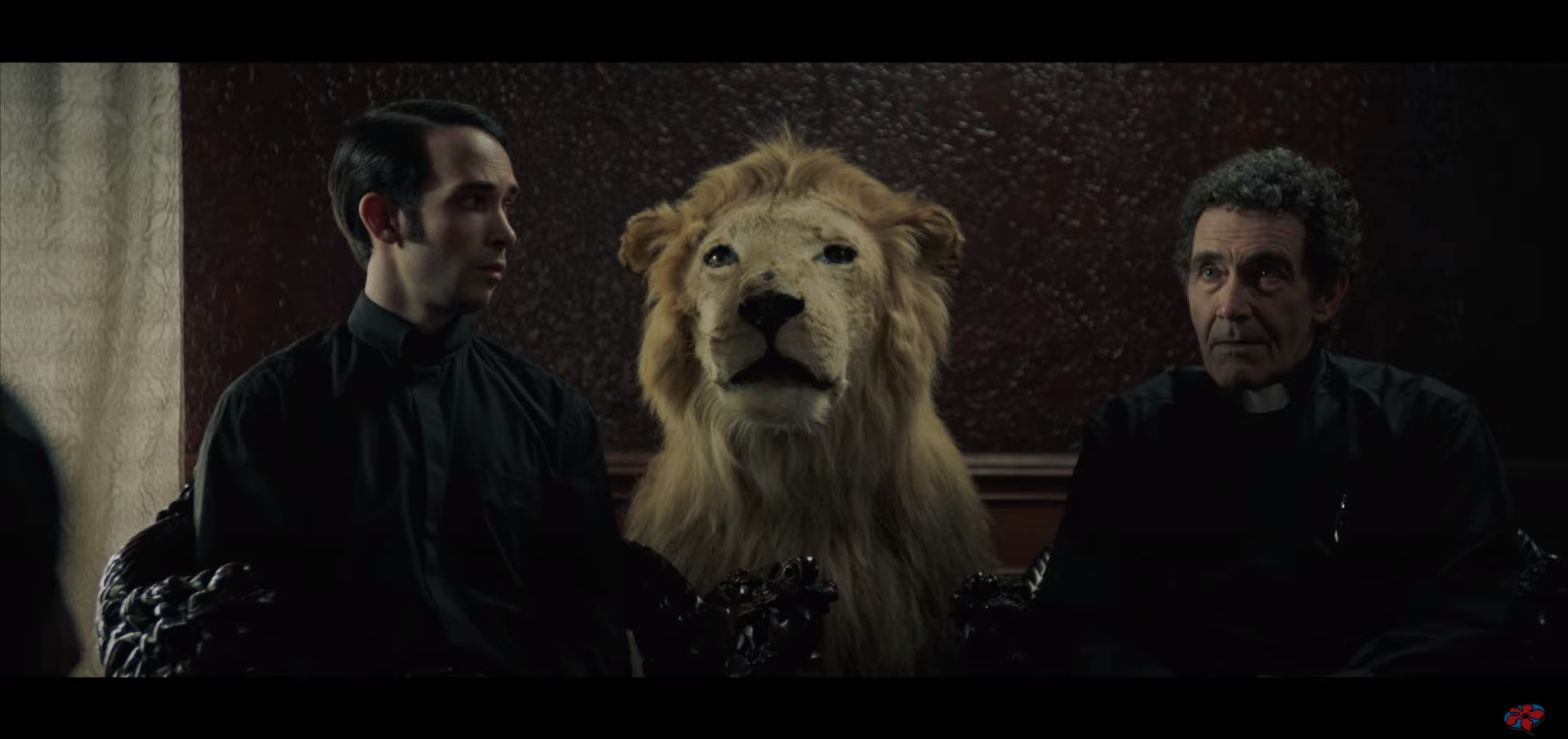
“Agnes” loosely follows a couple of Catholic patroness saints in Agnes and Mary derided in a contrary sense.  Agnes, the virgin martyr in Catholic veneration, opposes the Church in the film with flashbacks of her embracing an indulgent life along with her sexual insults that’s uncouth for the patroness saint of pure little girls.  Mary’s a little more recognizable with a previous, ambiguous account of her child’s death (aka Jesus Christ?).  Plus, there’s the religious imagery, amongst others in the film, of Mary with bleeding eyes as an analogous to the weeping statues. Reece blatantly shows most men and women of the cloth to be unorthodox Orthodox Catholics from Father Donaghu’s troubling allegations to the mocking head priests. Mother Superior throws around her superiority amongst the convent nuns and even the Bishop, who doesn’t ever say a word in his brief scene, appears smug and high and mighty with his stature, letting his assistant communicate (and excommunicate) all the ugly business. Only a non-priest, training to be ordained, in Benjamin is the only innocent, infallible Christian who captures the humble essence of God and the only one who can capable in rejuvenating Mary’s faith. “Agnes” is all about doubting faith whether be by demonic possession, the loss of a child, all forms of corruption, and more, but Mary keeps striving, struggling, and searching for that spiritual lifeline amongst seedy and unscrupulous faithless charlatans slowly poisoning her to be the same. However, the “Agnes” story divides too sharply leaving the acute crisis of faith to be nearly lost in translation and is practically a wandering spectrum of identity that’s roughly craft glued together by Reece.

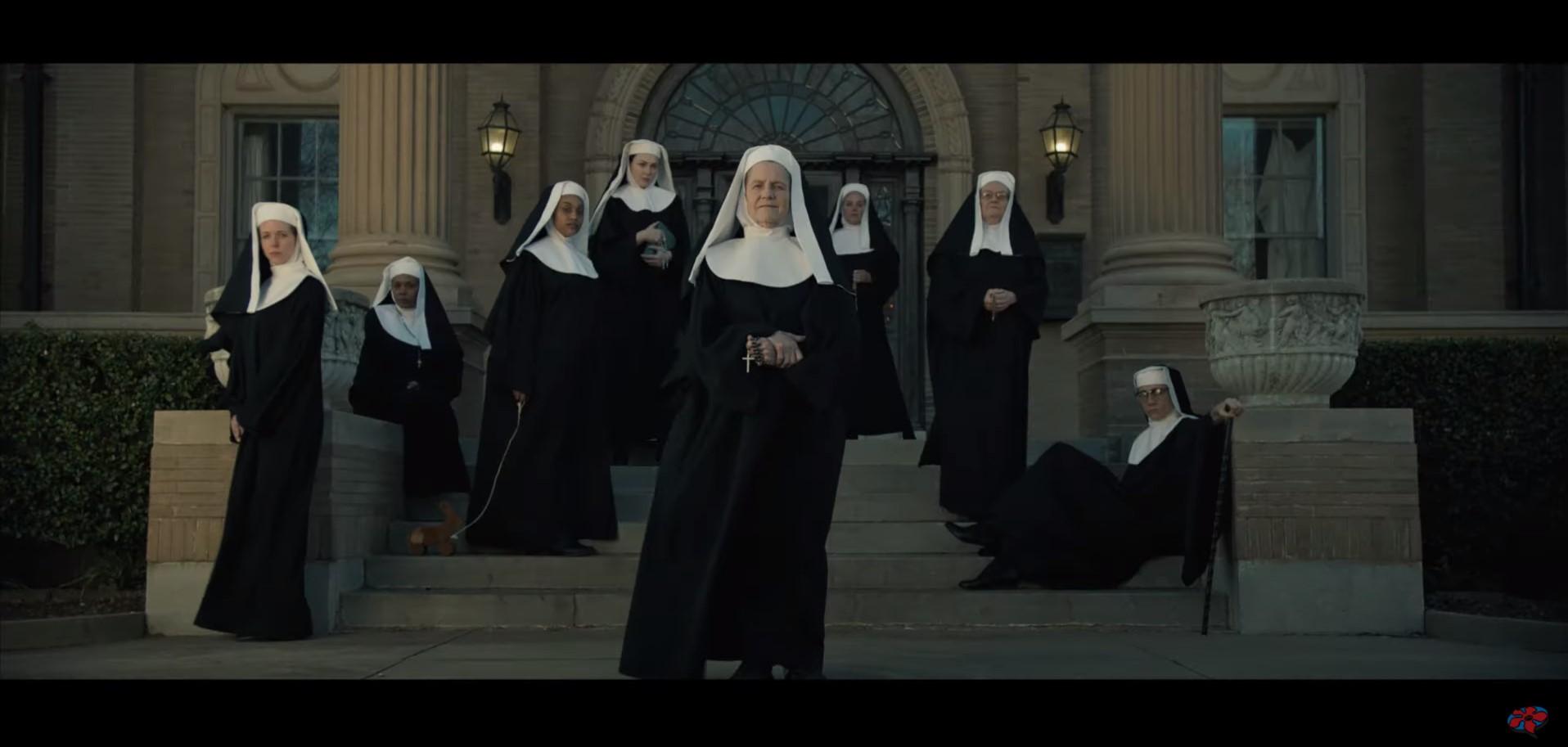
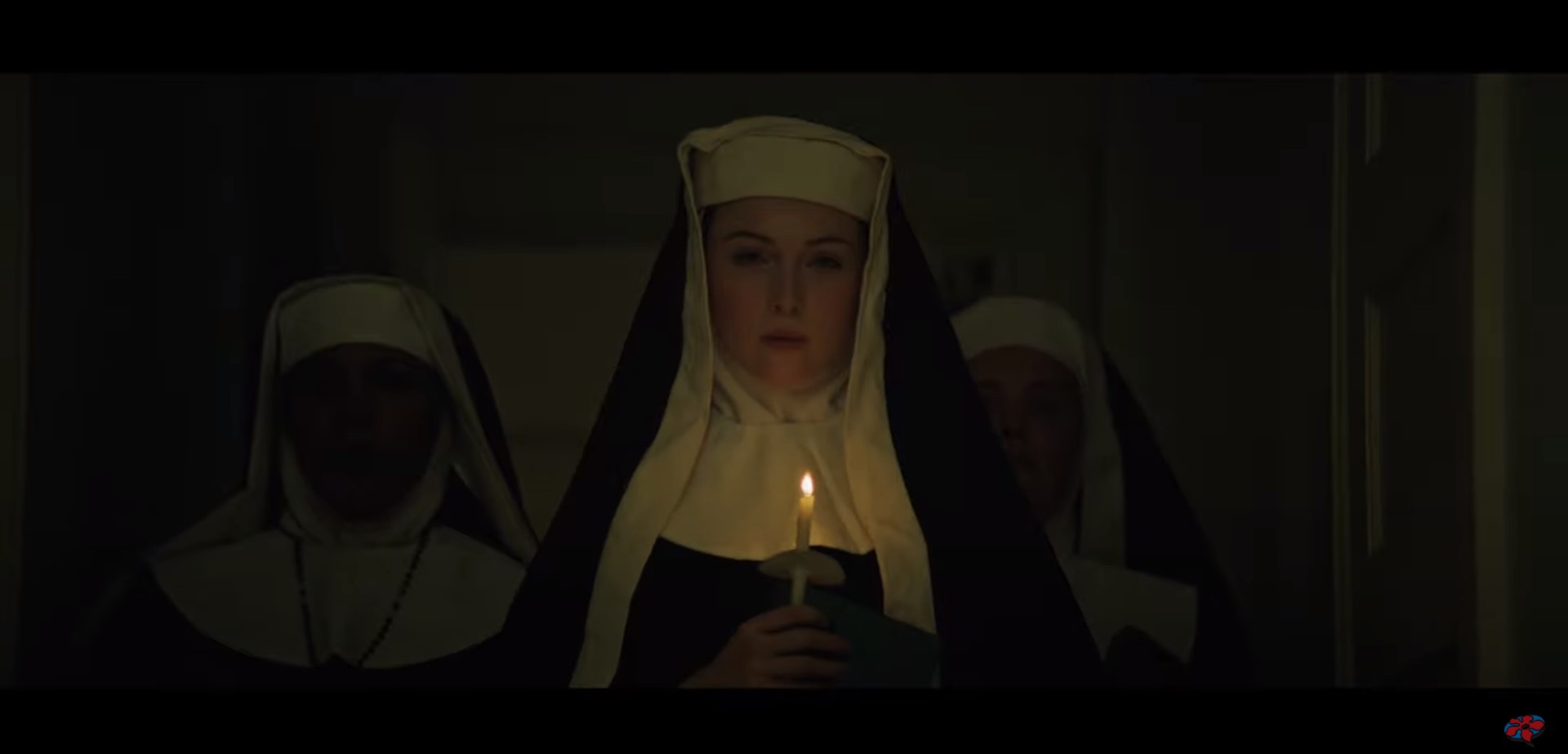
Some may see the film’s poster and excitedly expect Nunsploitation but the reality of “Agnes” digs at the hypocrisy of people and the endless search for faith. What it’s not is the sexual exploitation or sadomasochism of chaste nuns. Give Mickey Reece’s horror-comedy drama “Agnes” a faithful shot come it’s December 10th theatrical release from Magnet Releasing, a subsidiary of Magnolia Pictures. “Agnes” has a runtime of 93 minutes and presented in a 2.55:1 aspect ratio. Typical of any Mickey Reece film, his melodramatic horror-comedy fits into his oeuvre of talking head cinema so leave expectations of brooding and atmospheric milieus at the door for more realistic, down-to-Earth scenes, which is a bit surprising since the cinematographer behind “Hellraiser: Judgement” and “Children of the Corn: Runaway,” Samuel Calvin, has an eye for unhallowed aesthetics. Calvin does produce some perfectly poised shots with the flock of nuns and the ever slightly deviant angle to sharpen a scene. No bonus features were included with the digital screener nor were there any bonus scenes during or after the credits. “Agnes” floats on a haphazard timeline of dark, melodrama comedy for a desperate need of faith against the immense heartache, the crudely selfish, and the absence of morality all of which incessantly imposes upon the good to assimilate.