Obey EVIL’s Every Last Command! “Held” reviewed! (Magnolia Pictures / Digital Screener)

Emma and Henry Barrett celebrate their 9-year marriage anniversary by renting an isolated house complete with modern day automation bells and whistles. On the morning following their first night’s stay, they come to a horrifying realization someone was in the house and has displaced their clothing. As panic begins to set in and the couple try to flee, the house suddenly locks down, barring the windows and doors under the smart home controls, and a Voice commands them to obey every word in order to reveal devastating secrets and fix what’s broken in their splintered marriage by returning to antiquated ideas of a patriarchal system. Implanted with an electroshock device, Emma and Henry have no choice but to comply to every authoritative command, turning their romantic getaway into a house of wringing pawns.

Out of all of fight against misogynism and #MeToo inspired films that have been released in the last few years, Jill Awbrey’s scripted story is the most fascinating with an implausible overkill plot derived from, and this would be the scariest part, actual male frames of mind that were not systemically changed too long ago and are still ineradicably infesting a good chunk of male psyches today. The Fresno, California-shot film is entitled “Held,” a literally captivating suspense-thriller with whispers of James Wan’s “Saw” crisscrossed with, and I may get flak for this, Wes Craven’s “Scream.” “Held” is steered by Travis Cluff and Chris Lofing, directors of “The Gallows” and the subsequent “Act II”, with a follow up with edgy confines of a pintsize location embellished with hidden rooms and secret passageways bringing normalcy to the forefront of topsy-turvy inequity. Under Cluff and Lofing’s Tremendum Pictures banner, “Held” is also produced by the directors alongside Kyle Gentz and Cody Fletcher.

Jill Awbrey is not only the screenwriter of “Held” but also stars as the Emma Barrett, an internally traumatized woman weary of strange men asking none-of-their-business questions. Her feature film actress debut plays opposite of vet actor Bart Johnson. The television and “Simon Says” actor Johnson puts on his husband hat as Henry Barret frustrated and disheartened by Emma’s recent lack of intimate interest. All of the Henry’s resentment and Emma’s self-reproach fades away when the house comes down on top of them, literally, in a barrage of hidden spy cameras, an uncontrollable to them security system, and by an obscured voice coursing through various wall intercoms with ground rules and instructions. Before trouble finds them in the guise of a vacay rental, Awbrey and Johnson make a fairly convincing seasoned husband and wife with all the rapport familiarity trimmings; Awbrey instills a meekish quality that makes Emma reserved in not being assertive enough to help herself, a condition stemmed from a traumatic event in her past as the opening moment of “Held,” while Johnson follows Awbrey’s lead in an equally good job showing a nurturing and doting husband who wants nothing more than to take care of everything for his wife. When the panic sets in and the possibility of escape seems futile, Awbrey and Johnson have to use separate approaching methods and mindsets that become essential to “Held’s” time warp speeding male chauvinism undertones. The supporting cast is folded into “Held’s” firm two-lead narrative with precision story placement from Rez Kempton (“Stag Night of the Dead”) and Zack Gold (“Fear Lives Here”).

“Held” is a fight in hell for women who feel that there is life bares no choice in the matter, when their voice is silenced by fear, when the prospect of death is as strong as a masculine build, and when an atrocious past experience hinders personal growth. The commanding-to-demanding obedience tale freefalls from worse case scenario to the absolute worst case scenario of a clear cut redeeming need for change and to once and for all extinguish the old-fashioned binary thought of men being stronger, faster, smarter, better, and more dominate then women. Speaking of old-fashioned, Cluff and Lofing incorporate 1950s era technology, such as a tube television set, rotary phone, and computers with nobs and dials, into the vacation rentals’ futuristic hardware as a symbolizing blend of the seemingly evolved present day man being motivated and driven by antiquated thoughts. The filmmakers also work in nicely Awbrey’s misinterpretation of a Biblical paradise by parochial views by warping the fabled beginnings of man and woman for their own selfish desires. The plot point twist was uncomplicatedly easy to predict but wasn’t necessarily unwelcomed either as the turning point layered a crazy subplot involving a radical marketed and hairbrained scheme with such audacity it’s felt unbelievable. And there were a handful of select scenes that did feel unbelievable by computing more a comical reaction than a petrifying one as perhaps intended. What’s probably more even more of a quirk in “Held” is the script’s subdued dialogue that garnished with not one single obscenity, but the action, which includes multiple graphic stabbings, a self-surgery extraction, and one particular scene where Emma is choked slammed through a wall, conveys extreme intensity in a superficial imbalance with the dialogue. Underneath the tender discourse, “Held” has a crupper of brutal violence that never slips.

Those following Ephesians 5:22-24, reading wives should “submit yourselves to your own husbands as you do to the LORD,” will find “Held” as a blasphemous counterattack of disobedience against the strong arming of a behind-the-times complementarian marriage. “Held” will be released by Magnolia Pictures as a Magnet released film, presented in a widescreen 2.35:1 aspect ratio with a runtime of 94 minutes. The Frightfest 2020 film is a perfect union of imperfect times and feminism fight back and director of photography, Kyle Gentz (“The Gallows Act II,” “Zombies 2”) captures it all with a bright, nearly sterile, perspective full from closed circuit voyeurism, to aerial shots of isolation, and to shaky cam with flashing lights to produce ear splitting pain effect. There were no bonus scenes during or after the credits. The Garden of Eden has been man and woman’s place of paradise and destruction but for Travis Cluff and Chris Lofing’s “Held,” the battle of the sexes is more barbaric than it is biblical when Adam’s machoism stakes claim to Eve’s forbidden fruit.

EVIL in the Family Tree Makes for a Terrifying “Reunion” reviewed! (101 Films / Digital Screener)

Recently separated from her philandering fiancé, a pregnant Ellie moves in with her estranged mother, Ivy, whose staying at Ellie’s recently-deceased grandparents family home and packing up home furnishings to put the house on the market.  Strained with going through a pregnancy alone and tirelessly working on her theoretic book of modern medicine deriving from the roots of barbaric magic and medieval practices, Ivy pledges to take care of her while providing space to let Ellie continue research work, but the house lends to the painful memories long thought suppressed in Ellie’s mind, manifesting visions of her adopted sister, Cara, who died suddenly in house when they were children.  As the visions become more prominent, stronger, and real, Ellie questions her remorseful memories and her mother’s recollection of events that sheds light on her family’s horrendous secret of anatomical science.

From the start, the realization that Jake McHaffy’s “Reunion” isn’t going to be a happy one comes as soon as Ellie crosses the threshold into her late grandparents’ home and is immediately swathed with a blanket of unsettling ambiance.  The “Wellness” and “Free the Deed” McHaffy writes-and-directs his third film with a steadfast sense of dread in the New Zealand mystery-thriller that tackles human inbred themes of long suffering guilt, prenatal anxiety, and the role of an estranged family during a time of need.  McHaffy compounds layered fears by compositing them with the confines of an old dark and creaky house witness to all the past secrets.  “Reunion” is a production from a conglomerate of New Zealand and U.S. companies that embark on independent filmmaking endeavors by Greyshack Films, the strong female character supporting Miss Conception Films, Overactive Imagination, and Water’s End Films in association with New Zealand Film Commission, MPI Media Group, and Department of Post.

“Reunion” obviously isn’t going to be your typical relative gathering shindig with your bad joke-telling uncle wisecracking over his 10th Miller Lite or a nose picking brat of a cousin cheating at horseshoes near the pit; instead, “Reunion” a tightknit cast playing the roles of mother, father, daughter, and adopted daughter drawn together not by the sake of longing for bloodline companionship but by necessity and circumstance and imploding by the unfun games of revelations hidden inside the closest deepest and darkest of descendants. “Witches of East End” stars Julia Ormond in a nearly unrecognizable far cry of her more glamourous bewitching role in Joanna Beauchamp on the FOX produced Lifetime Television series. The English actress, who hails from Surrey, assumes the matriarchal presence of a helicopter mother overextending herself beyond the limits of her control in order to seize some kind of power she once had living in the archaic house. Ormond bounces off mother-daughter indignities with her sole child, Ellie, played by Emma Draper in her first feature lead performance. Thick tension between them causes reserved friction Ormond and Draper do well to nurture throughout while a stammering posture by “Lord of the Rings” actor John Bach as the wheelchair bound infirmed father adds a whole new layer of irregular rigidity to Ellie’s nerves and to Ivy’s patience. Aside from being blood related, father, mother, and daughter also have another thing in common – present in the moment of the death of Cara (Ava Keane). Peeling back each emotion output struggles, in a good way, to grasp the character mindset made murky by uncontrollable shaking and crying, sneaking and conniving, lies and deceits, and the disillusioned rambles that vortex around the house without pure clarity. “Reunion” rounds out the cast with Nancy Brunning, Cohen Holloway, and Gina Laverty as young Ellie.

Jake McHaffy’s “Reunion” has the hairs on the back of your neck standing from beginning to end with prolonged foreboding leading up to a shocking finale.  Between the manic and enigmatic performances from Julia Ormond and Emma Draper, a chance to rekindle the past feels like a distant thought and a lost cause being blockaded by the past’s poignant trauma they share.  McHaffy isn’t hesitant about revealing a stymieing history with flashes of image splices and flashbacks cut with an antiquated VHS-style playback producing a statically charged visual incumbrance.  The stress and strain burden’s Ellie’s pregnancy, dam breaking flood of memories, her research into the occult, and the surrounding chaotic state of the house contributes to teetering mental stability creating a visceral unintelligible and augmented reality that is too real for Ellie to keep an authentic perspective and the longer she stays and the more she’s immerse into Ivy’s poisonous maternal supremacy, only fabricating a new and scary world can Ellie dig herself out of her family’s troubling past.  There’s much going on in McHaffy’s story to be bog down fully understanding what you’re seeing and trying to piece together the puzzle is nearly impossible – I, frankly, still don’t understand much of it – but the beleaguered attention of beguiling imagery and that overwhelmingly wild ending entrusts “Reunion’s” place in psychological terror. 

Modern gothic has never looked this good as “Reunion” rises to be a stalwart of horror. 101 Films and MPI Media Group has released “Reunion” digitally this month of March, one year after the start of the pandemic that has kept families away from each other and when eases of restrictions set in that’ll shorten the gap between estranged loved ones that becomes a distressing reunion in itself. Quite a masterful brush stroke from director of photography Adam Luxton building the house into the frame and framework of the story, which goes hand-and-hand with a house that’s deemed a toxic surrounding symbolized by the black sludge that drips out of the sink and into Ellie, as well as crossing video outputs and weaving them in as well. Luxton’s imagery has formulation maturity that combines hard and soft lighting, blurring, a range of depth shots, delineated night scenes, and the capitalization of utilizing the clutter of boxes and knickknacks to tell an eclectic visual odyssey culminating toward an all-consuming finale. The 95 minute runtime film is presented in a widescreen 1.85:1 aspect ratio with no bonus scenes during or after the credits. “Reunion” creeps unsuspectingly into the skin, eyes, and soul as a metastasizing slow growth of appalling family drama.

And We All Thought Puppy Mills Were EVIL! “Breeder” reviewed! (Eureka Entertainment / Blu-ray Screener)

Avid and accomplished equestrian, Mia, yearns for a child of her own with husband Thomas as the clock on her ovaries continues ticking into her 30s, but something keeps her husband from digging himself out of a sexually frustrated trench, causing strain on their marriage.  Mia thinks his imperative financial venture, a collaboration alongside ruthless businesswoman and unorthodox scientist named Ruben, has made him sexually reclusive being wrapped up in a delicate investment of reversing the aging process that could crumble at any time, but when a beautiful and youthful neighbor goes missing after frantically showing up bloodied at her front door, Mia follows her trail to an abandoned candy factory where Ruben holds hostage young women for her violating biohacking experiments.  Becoming caged herself at the mercy of Ruben, Mia, and the rest of the women, are left to the sadistic and misogynistic whims of Ruben’s henchmen, the Pig and The Dog, in between the good doctor’s examinations. 

What happens when the powerful elite, using wealth and influence, circumvent ethical red tape in order to receive medical advancements as soon as possible?  Director Jens Dahl and screenwriter Sissel Dalsgaard Thomsen explore that radical and illegal biohacking ideology with an intense and extreme feminist view in their 2020 released, invasively graphic, horror thriller, “Breeder.”   Hailing from Denmark, not too many extreme films come out of the Nordic country, but taking a cue from their German neighbors from the South with a sexual and age dysphoria viscosity, “Breeder” takes an urban legend-esque approach to age defying that’s more Countess Bathory than anything Aveeno facial creams could ever manufacture in a story based on biohacking blended loosely with the French folklore of Bluebeard where an affluent man has an obsessive habit in murdering his wives, one after another, per director Jens Dahl.  “Breeder” might not be that black and, well, blue with a tough love message and an illicit theme of subversive genetical achievements produced by Peter Hyldahl, Amalie Lyngbo Quist, Penelope Bjerregaard and Maria Moller Christoffersen of Beo Starling (Beofilm) production company.

Leading the pack of caged, exploitered women in this human puppy mill comes with a hefty price of compromising positions and uncomfortable scenarios. The 32-yeard old actress, Sara Hjort Ditlevsen, plays an age appropriate Mia whose coming down to her last straw when coming to her husband’s inability to commit to their teetering marriage, but Mia comes with a twist in that she never gives up, achieving her end goal even if that means strapping on her riding boots and stirrups, dropping her panties, and digging those spurs into her hind parts while masturbating just to release the sexual tension. Ditlevsen gives a gradual fuming performance gaslit by the abusing sustained by the sadistic misogynist, monikered The Dog (Morten Hoist) who, in appearances, has the visual looks of a greasy Bill Oberst Jr. Jackson Pollock’d from a Mads Mikkelsen portrait and has the temper to match. The Dog and his partner, The Pig, played by Jens Anderson in an unbalanced contrast to the The Dog’s screen time, are harnessed and weaponized by a mad scientist role that was originally intended for a man before screenwriter, Sissel Dalsgaard Thomsen, had an epiphany that her feminist script was playing right into that systemic, male dominant, structure. Instead, the role was flipped, in gender only, and performed by “Wild Witch’s” Signe Eghom Olsen. Olsen gives a chillingly cold performance in Ruben’s contradictory indifference for life by snatching youth and beauty from young women, those who spite Ruben just by the mere fact of their innate good genes and healthy reproductive system, and selling the epitome of their stolen essence to the highest, or oldest, bidder in an age-reserval scheme. Ruben does have another motive with self-preservation as her rare genetic makeup makes finding a genome match nearly impossible, but she slays away a lot of women and a lot of infants in order to unearth her type. Anders Heinrichsen, Eeva Putro, Elvira Friis, Eja Rhea Mathea Due, Oksana Kniazeva, and Sara Wilgaard Sinkjær round out of the cast.

One of the “Breeder’s” core themes is the power one holds over another, but absolute control is not a singular reoccurring motif as power ebbs and flows from one character to another in a rolodex of examples that include Thomas’s financial control of Ruben’s rebellious operational decisions, The Dog’s inhumane dominance over captive women he loathes, and, on the receiving end, an enslaved woman’s embracing of a submissive, masochistic posture to The Dog’s punishing sadism, but control can be fleeting as seen in many movies yet proved to be in an abundance in Dahl’s “Breeder” with plot points that overturn sovereign power through a pendulum sway of brute, bloody force and hostage exploitation ugliness.  One bizarre recurrent through the cat and mouse power struggles is urination.  Yup, bodily fluids make an appearance, but go beyond the one-time shock value affect with three, count them three, acts of peeing in which two scenes reflect dominance as the powerful relieve themselves all over the, at that time, docile weak as a dog would when marking his claimed spot in the yard.  “Breeder” continues the varied questionable character tactics when primary plot turning points fail to impress plausible reactionary needs; an example would include when Ruben uses Thomas’ affection for Mia to control his unpredictable behavior, but the obsessed mad scientist, not to be bested by losing her financial support, lets Thomas run freely around her private abandoned factory of horrors which allows Thomas to become a monkey wrench in her biohacking laboratorial machine.  The same easy street escapes run rampant throughout and is even unintentionally spoofed when one women is able to escape not once but twice The Dog and The Pig’s rigorous grasps, taking “Breeder’s” serious new wave extreme a level down to a sickly stage of story blunders with rough draft written characters and scuffle.


If golden showers are not the extreme go-to for brutal survival horror, “Breeder” offers a variety of acrid amenities from stapling lips together to a trash can full of dead, dismembered babies and is homeward bound in the UK on Blu-ray from Eureka Entertainment under the company’s Montage Pictures banner.  Available February 15th, 2021, the first 2,000 prints of the Blu-ray will come with a limited edition O-card slipcase.  If you’re not a physical media aficionado (…loser.  J/K), “Breeder” will also be available digitally and will be presented in the film’s original aspect ratio of 2.35:1.  The Danish language DTS-HD MA 5.1 audio mix will be accompanied with optional English subtitles.  Since this review is based off a Blu-ray screener, I will not go into depth with the audio and visual conditions, but the cinematography work is from the sophomore feature of Nicolai Lok.  Behind the camera, Lok’s settles on a drab color schemes of mostly black and grey of a sterile environment, with the Lindberg house or inside Ruben’s medical popup tent, along with hard yellows, like mustard, to accentuate the rust and grime in closeups to medium shots within the tight confines of the abandoned candy factory turned into an unsweet meat market, but uses a fisheye lens on the regular to the effect I couldn’t pinpoint other than to fishbowl dysphoria an already narrow area. The end result made scenes unnecessarily warped for the viewers already stomaching a large amount of women battering. The special features included an October 2020 answer only interview with director Jens Dahl and screenwriter Sissel Dalsgaard Thomsen discussing in depth the reason they wanted to make this film. “Breeder” opens with Mia prancing her horse Karat and she inner dialogues how they move in tandem, but she questions the pecking order of master and prisoner between them knowing for certain she’s Karat’s jailor and that translates perfectly into her own subhuman treatment as a branded and caged animal for the pleasure of others; however, this type of depth thinking begins to rotate the hamster wheel but, as soon as momentum picks up on those tiny legs of collusion and betrayal, a gradual limp slows that hamster’s endurance with not enough plot developmental pallets to digest in order to keep up the effort.

In the S.H.U., The EVIL Comes From Within. “Caged” reviewed! (Shout! Studios / Digital Screener)

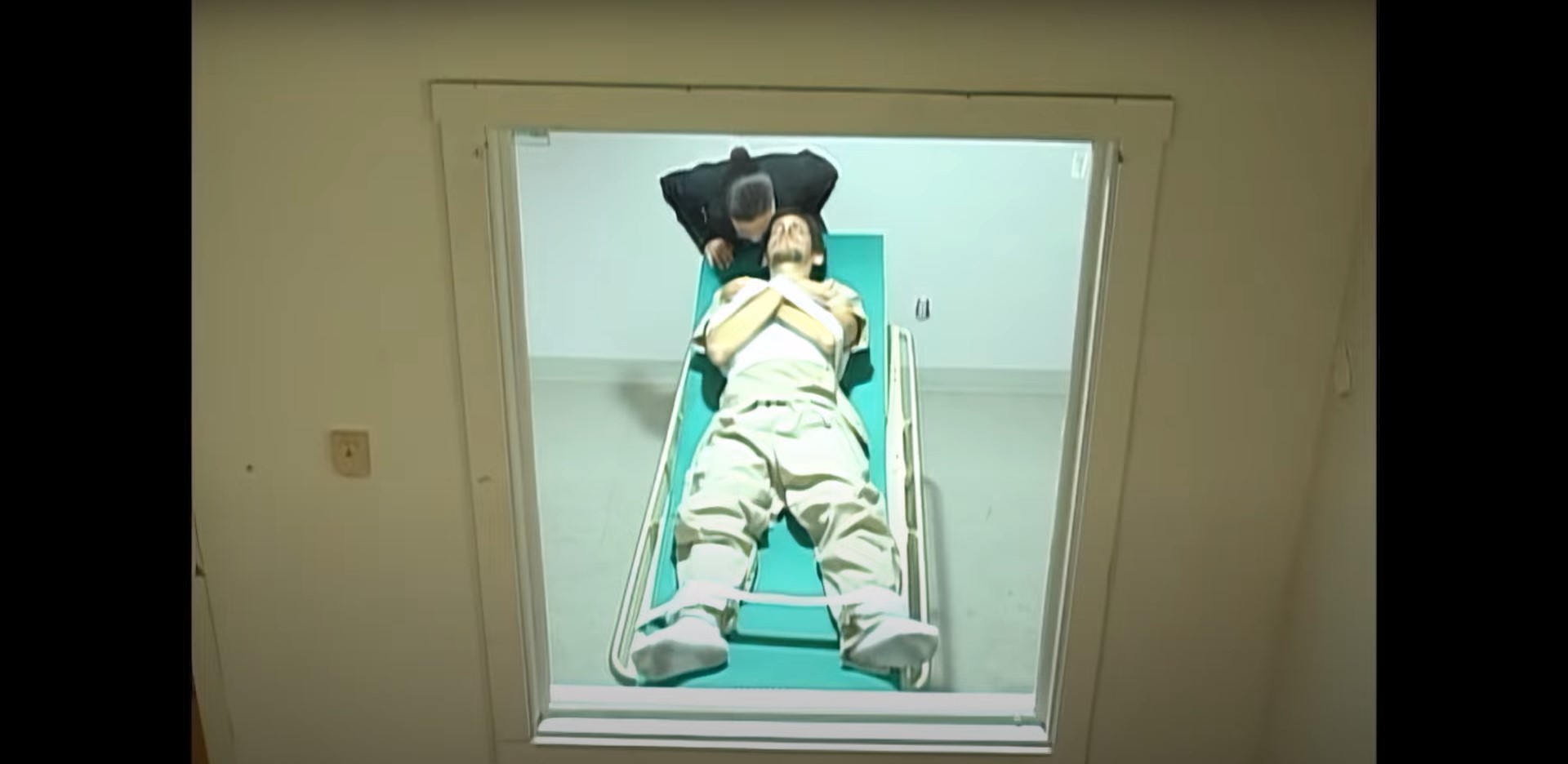
Psychiatrist Dr. Harlow Reid is sentence to life in prison after being convicted of murdering his wife.  With his assets frozen and his legal representation dropping him as a client, Reid is forced into being his own legal counsel.  To make matters worse, a female prison guard’s perverse pleasure is to slowly torture him while in her custody at solitary confinement.  His only means to enter general population is to behave and confess to the crime he contests, but he continues to maintain his innocence by refusing to sign the confession, remaining alone and withstanding abuse until he can write a formal plea to a judge to reconsider the facts in his case.  As the days turn to weeks and weeks turn to months, the usually stable minded Dr. Reid, alone with his thoughts, has his fortress of reality buckle under the heavy burden of isolation compounded with the maltreatment and his personal demons that struggle with the actual events in his wife’s sudden death, questioning himself that her death might have been at his hand.

Inside the clink is a maelstrom set in a pressure cooker. Ready to explode at any moment are cons of, mostly, unsavory personalities simmering with pent up anger, desperation, and ill-will positioned by equally fraught guards harried by timebomb temperaments and undervalued in training and payment. In Aaron Fjellman’s written and directed debut feature film, “Caged,” the strain festers toward being hell behind bars in a ruthless determination of survival. Also once known as the working title, “The S.H.U,” Fjellman constrains his American-made, and inspired, big house thriller with a minimalist approach set with a backdrop of chiefly the solitary housing unit to lock up viewers in, as witnessing accomplices, with a protagonist’s downtrodden path of mental degradation as well as being humanly degraded. Aaron Fjellman produces his film for production company Panic House Films and Shifty Eye Productions with the latter a company created by the film’s star, Edi Gathegi, serving on the board as executive producer.

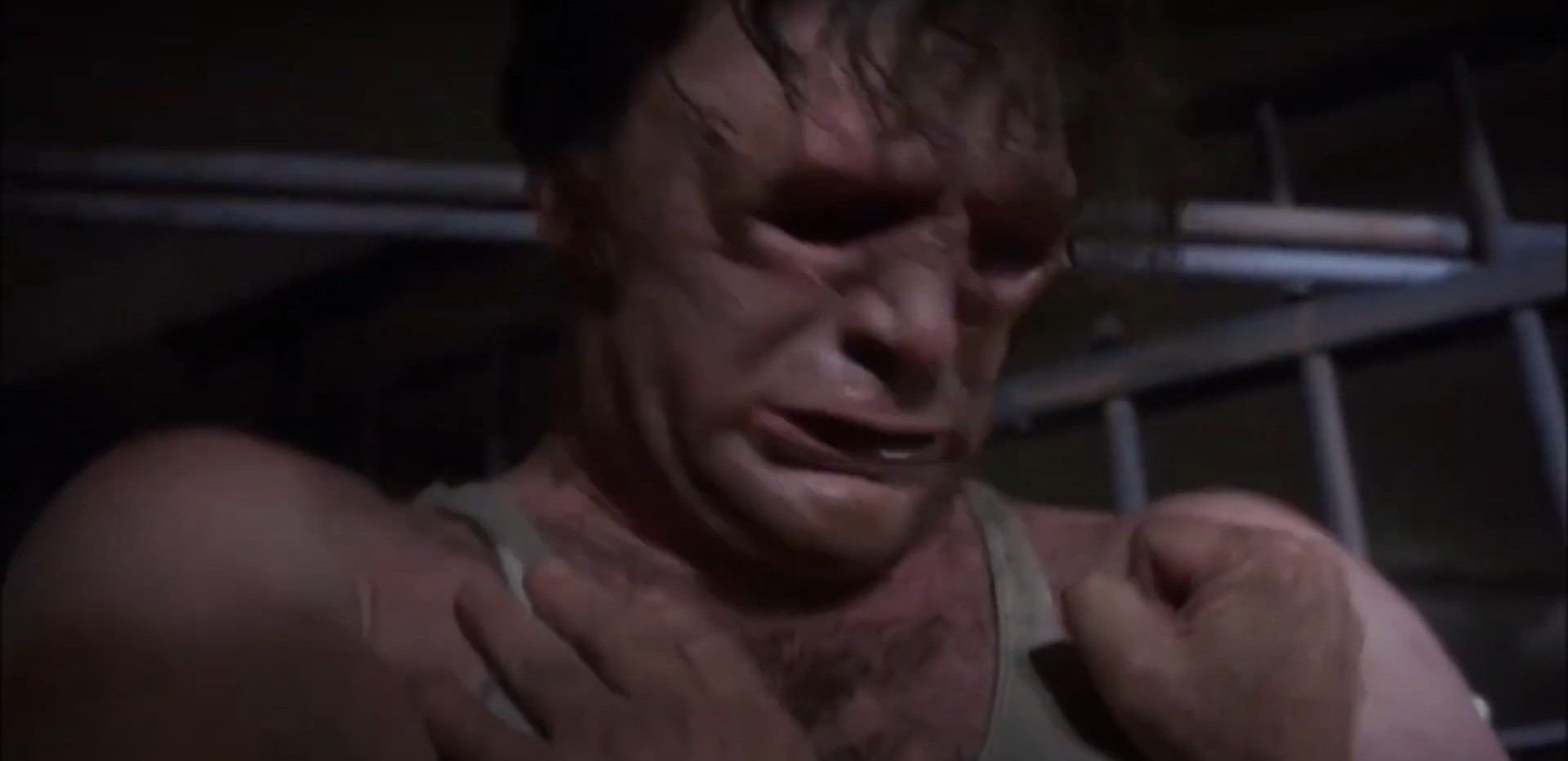
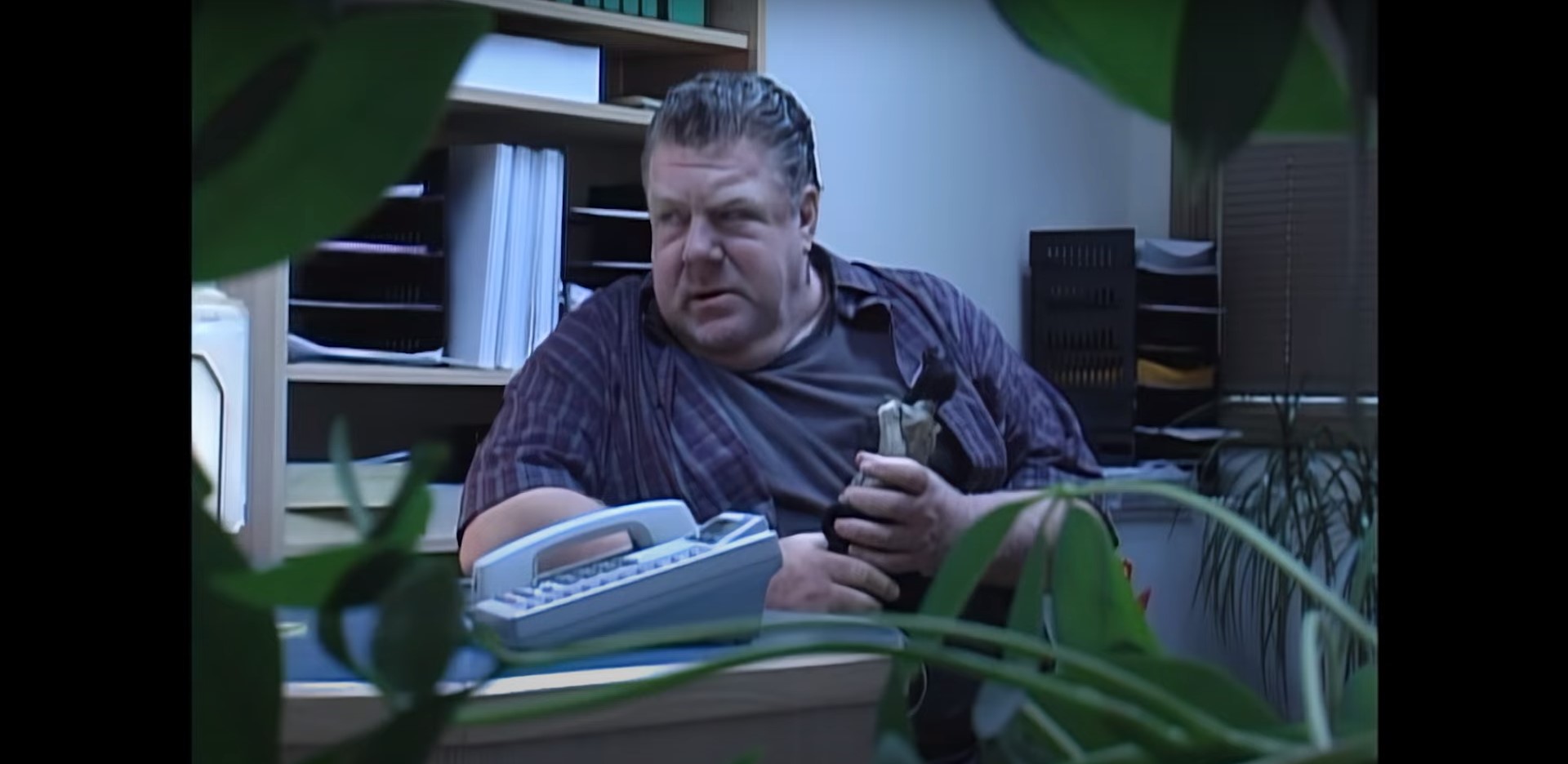
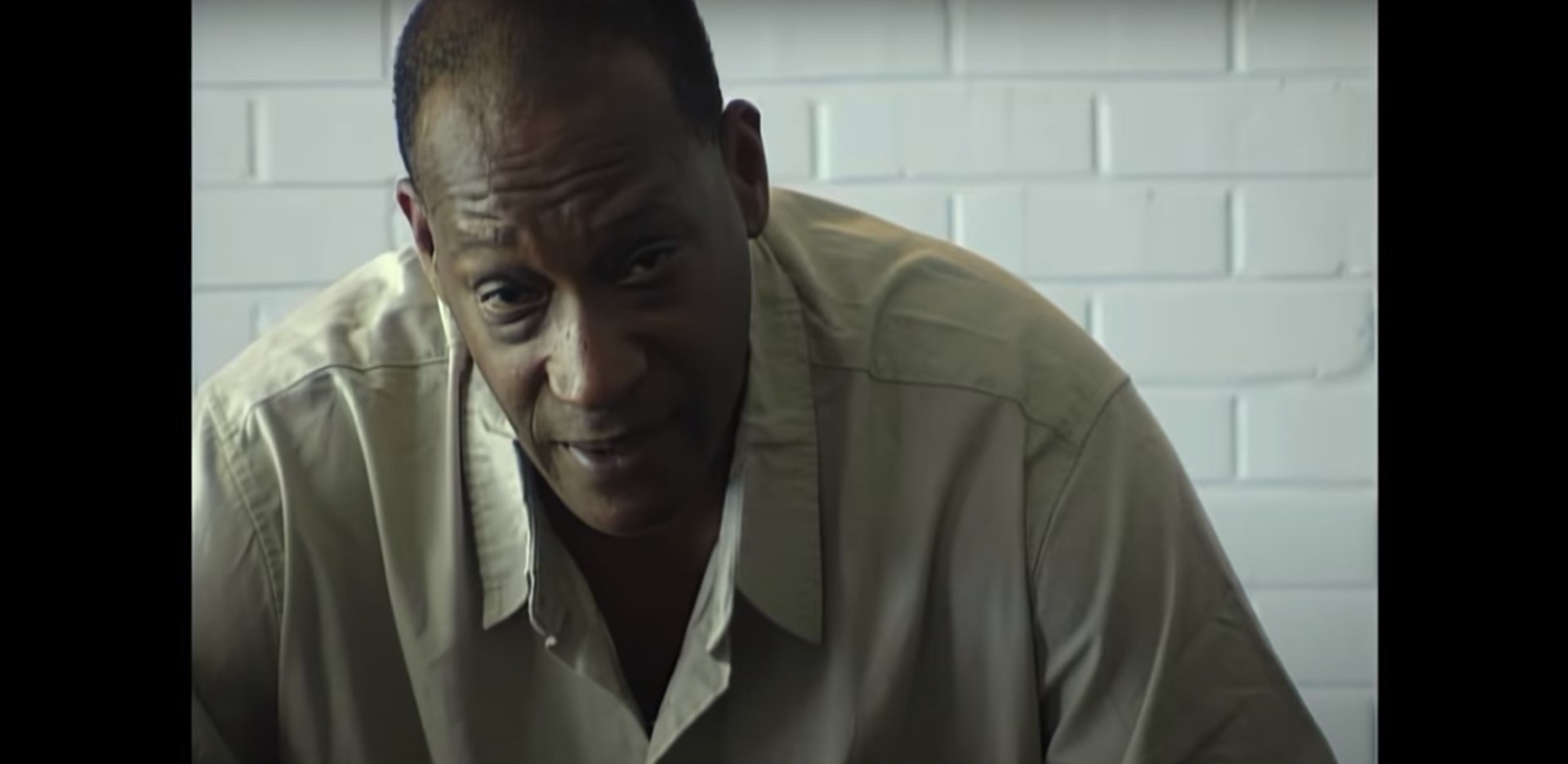
It’s no big surprise that Edi Gathegi dons the prison house jumper and clanking shackles in this social commentary thriller. The “Blacklist” and “X-Men: First Class” actor knows a good role when he sees with, especially inside the body and mind of one Dr. Harlow Reid. Gathegi regularly has to battle with himself filtered through the madness of the S.H.U. mind-breaking solitary with a little fanning of the flames from sadistic prison guard, Officer Sacks. In an extremely ghastly transformation, Melora Hardin goes from a classic beauty with a big smile and high cheek bones to baring an unflattering lumpy posture with hair pulled back in a tight, short ponytail overtop a demonizing trope of a scar down the left side of her face and an assured cockiness symbolized by the gum smacking that’s sometimes becomes the only thing in the camera frame. As Gathegi masters the ideals of a convict presuming himself innocent, Hardin lurks beyond his cell door as the devilish guard over his shoulder. Officer Sacks defines a face with a story and her story has a hard on for power over prisoners, especially affluent ones or, maybe, those of African American descent in a tinge of racist undertones as Fjellman notes on the racial injustices in the prison system. A smidgen of that notion is supported shown in Officer Sacks behind-the-back passive aggressiveness toward Warden Perez. “Annabelle’s” Tony Amendola truly delivers being a heartfelt ally, yet sturdy firm handed warden with Reid. Perez, an expressed Catholic, seeks Reid’s redemption through the admittance of wrongdoing and that becomes the steadfast barrier Reid has to hurtle that will test his convictions and his sanity. “Caged” rounds out with Mick Jagger’s son, James Jagger, as Reid’s unhinged S.H.U. bedfellow who speaks in hyperbole of inmate hauntings in an opaque analogy of guilt mixed with madness, and “Westworld’s” Angela Sarafyan told through flashbacks and supernatural induced psychosis as Reid’s wife, Amber.

To tell an inmate’s nearly yearlong story succumbing to the brutal and segregating abuses surrounding him in solitary confinement is a tremendous feat working into the mental cracks and exploring the fallacies. Yet, Aaron Fjellman made his fictional interpretation look easy by relating a surreal, but telling story in just 80 minutes, gripping with metaphorical concepts of an overcrowded prison system preying on uncontested obedience, even if the lengths taken to obtain complete compliance is trauma exacting torture of draconian policy, by primarily privately funded institutions with little-to-no funding or resources to manage. “Caged” is very fleeting with montage upon montage of Harlow Reid’s day-to-day, but never becomes a monotonous roundabout vivarium of Reid sitting hopelessly-looking in his cell. Gathegi’s put to work as a man determined to challenge the system that engages Reid to keep sharp and in shape by working out in various exercises, entertain an unhinged neighboring inmate with his ramblings and blurbs of crazy talk truths, and feverishly work on his legal case by any extraordinary measures, including using his own blood as ink. Yes, “Caged” can elicit a genuine sense of horror, a perspective on psychological terror, and be an eye-opening gasp of real life prison dread when good versus evil is mirrored in reverse with the good guys not being the prison guards. Fjellman imprisons us all in “Caged” by culminating the fact that no matter your social circumstances, the S.H.U. breaks everyone.

Orange may be the new black, but Aaron Fjellman’s bleak fretting “Caged” jars with somber authoritarian power. The new thriller released by Shout! Studios premiers unrated on VOD and digital January 26th. “Caged” is film by director of photography, Jessica Young, with an Arri Amira camera and presented in a widescreen format, 16×9 aspect ratio, and, typically, the Amira camera versatility is in the use for low-budget films, perfect for “Caged” in it’s nearly singular setting and two-tone, steely gray and black, atmospherics that naturally have devoid color vibrancy. CJ Johnson, who will soon see his musical scores in a pair of upcoming Friday the 13th fan films, lines “Caged” with a soft, building industrial score that tunes the disquiet in Reid’s racked inner conflict. With this digital screener, there were no bonus materials or any bonus scenes during or after the credits. Through the use of visual and audible horror tropes and with potent performances from Edi Gathegi and Melora Hardin, “Caged” is a ghost story told for the unspoken voices victim to long-term confinement.

Click the poster to pre-order “Caged” at Amazon!

EVIL Exploits Your Fears in “Phobic” reviewed! (Samuel Goldwyn Films / Digital Screener)

The most vulnerable are being chained to chairs and tortured by the terrifying weight of their own extreme phobias until their bodies can no longer take the stress, fatally collapsing where they sit due to heart failure.  Homicide detective Riley Sanders notices frightening similarities to her own abduction months earlier where the kidnapper tortures the stunned detective with an intense light on repeater.   Refusing to believe her abduction and the case she’s investigating are linked, her partner, Paul Carr, continues to insist that her traumatic experience might be key to solving the homicides and finding the killer.  As the detectives dig deeper into a radical psychiatrist’s phobia program whose patients are showing up the killer’s victim list, they find themselves at the center of a disturbing experiment that aims unleash an inner, and only ever theorized, phenomenal ability.

Bryce Clark’s psychological cop thriller, “Phobic,” tales an irregular and irrational serial killer objective derivative of David Fincher’s “Seven” twisted quietly with elements from the superhero universe. Darkly toned exploitation of forcing the worst of the worst fears upon the those already cripple down by their distinct aversion, the 2017 shot “Phobic” marks the return of a Clark written and directed full length feature since the filmmaker’s 2012 debut in both categories with a romantic-comedy starring Mischa Barton.  Both polar opposite films were shot on location in Salt Lake City, Utah, Clark’s residential city, surrounded by picturesque ice capped mountains overlooking the illuminated, pedestrian-saturated metropolitan area home to the story’s wicked psychotronic experiment that literally frightens people to death.  “Phobic’ is a production of Storylab and Pale Moon Entertainment.

Two detectives continue to peel back the arcane layers of the unusual case before them with detective Riley Sanders at the heart of the matter being linked to the recent string of methodical abductions tailored specifically with the victim.  “Looking Glass” actress Jacque Gray dichotomizes Riley not only as a persistent investigator eager to bring this case to an end but also as a struggling closeted neurotic with her own fears that bleed through the celluloid.  Clark makes sure to underscore Riley’s nightly routine before going to bed with her constantly turning on and off lights in her path to represent a lingering but indeterminate phobia response.  Riley is supposed to be this tough, but law abiding cop, who survived a harrowing ordeal, but Gray hardly expresses Riley’s scarred rigid soul, representing more so in the lines of coloring her disposition by the numbers that refuse to waiver outside normalcy.  Devin Liljenquist is even more so vanilla as Riley’s partner, Paul.  As his introductory feature film, Liljenquist’s doesn’t carry the range of a cop who cares, topping out with a straight-faced sleepwalk that challenges the stakes and can be considerably creepy, like subtly sexual grooming predator, when Paul is trying to convince Riley to open her fears with him.  The character audiences deserved, or better suited as Riley’s partner to provide contrast, would have been the third scarcely screened detective on the case that occasionally popped in as the first investigator on scene of a crime in Alex Nibley’s Detective Hank Ferry.  The slightly elder detective, complete with Nibley’s stark white, Anderson Cooper hairstyle, had a quick, dark wit and cavalier presence about him that breached the Riley and Paul uncharismatic stiffness with a relieving change of pace dynamics between colleagues.  You couldn’t wait to see Detective Ferry to make a reappearance, but sadly, his character is sorely underutilized for only a couple of moments.  “Phobic’s” in-and-out supporting cast includes James Jamison, Tiffani DiGregorio, Fred Spencer, and Ernie Lively as Riley Sanders secret-keeping father.

“Phobic” follows a basic detective thriller in tracking down a homicidal maniac with a niche kill tactic that bread crumbs one of the investigating officers into being subverted by a conflict of interest stemmed from her past. However, out of Salt Lake City’s blue skies, Clark suddenly pivots in his script, diverting from a dark, gritty Finchian narrative to an acutely forged new shape of revival and hope, a shape that bares no cape, no mask, or no bald, psychic power yielding man bound to a wheelchair playing headmaster of a school that serves as a façade for an elite team of powerful, do good mutants. If my hint wasn’t overly blunt, let me be utterly clear, “Phobic” has no distinct x-factor but goes from fears to fight with the psychotronic theory where energy and strength derive from stress and fear over the witnessing the impending doom of a loved one. Urban legend surrounding the notion of hysterical strength siphons away the psychosomatic element from the grooves of the cop thriller and Clark copiously throws in crucial red herrings to keep viewers muddling and not Professor X cerebral filling in the gaps unraveling an unlikely and unrealistic prospect of superhuman truth, but “Phobic’s” off-the-cuff pivot is a quick to squander all that’s been built in what’s essentially Bryce Clark’s house of cards to discombobulate an audience with polarizing story principles, rebranding an assayed horror-thriller into rabid conceit.


Easily one of the most idiosyncratic and unanticipated films of 2020, “Phobic” induced fear into audiences panic-stricken hearts this past December 15th onto multiple digital platforms courtesy of Samuel Goldwyn Films, the distributor that brought you “Daniel Isn’t Real” and “Pet.” Brandon Christensen’s tenebrous cinematography is shot on a 6k red epic dragon with ultra definition displaying full range of details in every scene and despite the somber tones created by a slew of gaffer up lighting, we get some really rich natural coloring, even in the baby blue eyes of Ernie Lively, when Christensen isn’t blue or red tinting the lens to underscore the killer’s aftermath crime scene. While the cinematography is good, the editing can be pestilent expression of style to represent Riley’s sporadic and continuous reliving of a reoccurring memory. The stock score is just that set on autoplay for nearly the length of the 81 minute runtime with engineered eruptions in the pitch to denote the jump scares. There were no bonus features included with the digital screener nor were there any bonus scenes during or after the credits. The bland acting hurts “Phobic’s” exploration of the psychological symbiotic energies between that of the mind and body, but the film boils down to have a fascinating perspective on the detective thriller by reshaping the surface with bold expectations of an uncharacteristic, dormant fear free all.

Own or Rent “Phobic” by Clicking the Poster!