

High schooler Jill takes a babysitting job, overseeing two sleeping children while the parents have date night. The phone rings and an assumed prankster tries to scare Jill, either asking why she hasn’t checked the children or doesn’t say a word, but as Jill fields calls throughout the night with the same terrorizing voice, the terrified sitter phones the police whom trace the call from inside the house. Jill barely escapes the deadly encounter that left two children victims to a psychopath; yet the now happily married, mother of two small children is faced with the same killer seven years later after he escapes from a mental institution. Hot on his trail is detective turned private eye John Clifford who will stop at nothing from stopping a maniac who will kill again. Years later, Jill and Clifford team up once more to investigate a similar case of a co-ed being specifically terrorized by an obsessive stalker through the span of five years to the point where his next move could be her last.

Perhaps one of the best, if not the best, openings to a horror movie ever, Fred Walton’s “When A Stranger Calls” puts a freeze on the heart, forces to choke down the breath, and tightens the already painfully clenched fists with sheer, thick tension bred from an urban legend of the babysitter and the man upstairs. Walton, and co-writer Steve Feke (“Mac and Me”), develop two successful thriller from script to screen, spanning over the course of 14-years. Walton’s uncanny ability to invoke fear through a conduit of simple objects, such as a telephone ring or in the thicket of dead silence, and leading a direction of motivational hesitation or slowness to the story and through it’s characters is dread absolute. There’s similarities between Fred Walton and “The Driller Killer” director Abel Ferrara with a scent of realism and grittiest blanketed with a knack for the abstract in certain facets. Though slightly fluffier to Ferrara’s shock value, Walton builds anticipation in not just his hit first film in 1979, but also in his made for TV movie in 1993.

Starring as the lead in both films is Carol Kane. The “Scrooged” actress shells out a white knuckling performance in Jill, the terrorized babysitter phoned inside the house by man upstairs. The harrowing night that will scar for Jill for life will continue through into the sequel, “When A stranger Calls Back.” As Jill grows through both films, so does Kane who builds the character a tougher exterior to match wits with second psychopath stalking a hapless co-ed. She’s teamed with legendary actor Charles Durning. Essentially in Walton’s “When A Stranger Calls,” Kane and Durning never have any scenes together, performing in almost two separate stories until the climatic that intertwined that collaboration. During’s a fine actor and can be the bull of any detective and/or private dick lead, but, to be honest, Durning always carried a hefty, front-heavy load that didn’t quite fit his character, John Clifford, chasing on foot a much leaner foe. “When A Stranger Calls” cast also includes Ron O’Neal (“The Final Countdown”), Tony Beckley (“In the Devil’s Garden”), and Colleen Dewhurst (“The Dead Zone”) while “When A Stranger Calls Back” also includes Jill Schoelen (“The Stepfather”) and Gene Lythgow.

A fleeting glimpse of brilliancy can go relatively unnoticed in Fred Walton’s “When A Stranger Calls.” Much of what makes the film so effective is essentially obsolete; for example, rotary phones are dinosaurs or even landlines for that matter. Also, the way Walton breaks up the film into a definitive three separate acts perfectly stretches the urban legend much more than warranted and the director also completes the story and character arcs. Dana Kaproff’s sophomore score can be characterized as menacing, suspenseful, and aesthetically unfit to the point of inspiring dreadful sensations that heighten the story’s already engrossing nature. In “When A Stranger Calls Back,” the opening is basically a mirror image of the original film with a slight (of hand) change and the narrative itself is captivating enough to get engrossed with, but there’s something about the made for TV movie that doesn’t quite sit right. Perhaps, the killer’s underdeveloped motives doesn’t make things crystal clear or just maybe the killer’s use of a ventriloquist and body art into his perverted and obsessive arsenal is too zany. Despite being a made for television movie, Walton’s followup film was premiere on Showtime back in 1993, giving the movie a not-so-diluted and PG-13 appeal; instead, bits of grittiness and some strip club nudity rivals the tone of it’s predecessor.
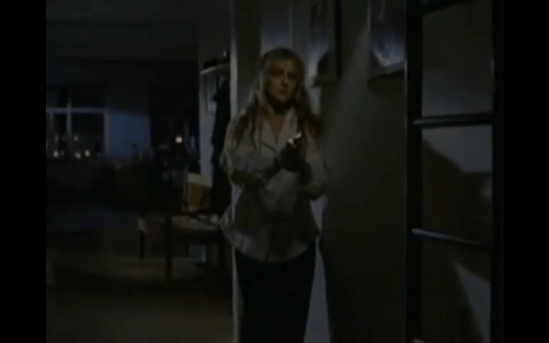
Second Sight presents “When A Stranger Calls” and “When A Stranger Calls Back” double feature on Blu-ray home video in the United Kingdom. Despite the upgrade, a DVD-R was provided for the review so technical aspects will not be reviewed. The disc did include bonus features such as Fred Walton’s inspirational short film “The Sitter” and interviews with director Fred Walton, Rutanya Alda, and Dana Kaproff, and Carol Kane. Carol Kane has more recently been the quirky and city-salty landlady that’s quick to whip sarcasms and clobber any hipster with a gentrifying agenda with a baseball bat in “The Unbreakable Kimmy Schmidt,” but Fred Walton saw Kane for how the actress could truly perform under a realistically terrifying moment, a moment that savors being on tenterhooks and frozen in time for almost the last 40 years as a classic and iconic scene in horror movie history. “When A Stranger Calls” and “When A Stranger Calls Back” is simple, yet deploys effective thrills with pure impending loom and dread in massive, lucrative quantities that may have been antiquated by time, but is epitomized as vintage and elegantly construed horror.
Tag Archives: thriller
The Evil That Doesn’t Kill You Makes You Stronger! “Jungle” review!

Yossi Ghinsberg yearned for more than the comfy, cushy life he was born into and being young and adventurous, Yossi travels abroad to backpack in Bolivia to pursue self-discovery and beauty in places far less travelled despite his father’s wishes. He quickly befriends fellow backpackers Marcus and Kevin and together, they lay tracks through the eclectic terrain of the breathtaking Bolivian landscape, but wasn’t until an Austrian geologist named Karl approached Yossi about a promise of unearthing gold and experiencing hidden tribes deep inside the lush jungle. After some convincing, the three friends venture into the jungle with only Karl to guide them and, at first glance, the wilderness is an escape from the noise and pollution of human corrupted inhabitations, but a drastic realization quickly washes over them when they’re force to separate and that the jungle is a cauldron of constant survival. Along with captivating beauty, fire ants, poisonous snakes, symbiotic organisms, jaguars, and torrential rains tip the iceberg of everything that embodies the sequestered jungle and Yossi must endure the trials and tribulations alone in order to make it out alive.

Based off the book of true events from Yossi Ghinsberg comes the motion picture retelling of Ghinsberg harrowing tale of survival in “Jungle.” The 2017 biographical adventure-thriller is penned by Justin Monjo (teleplay writer for TV hits like the sci-fi odyssey “Farscape”) and directed by “Rogue” and “Wolf Creek” director Greg McLean. “Jungle” showcases the night and day environment of one of the world’s most beautiful, yet deadliest locations, cascaded with awesome uncharted landscapes with an augmentation of great mortality once man is introduced. However, the thing with the jungle is that no matter what man’s objectives may be with the rainforest, whether it’s to destroy it or to embrace it as were Yossi’s intentions, nature treats all with the same merciless brutal as it’s kill or be killed. Yossi is in the midst of a man versus nature thematic element where Darwin’s survival of the fittest lays all well true and from his book, Yossi Ghinsberg went through a nearly three weeks of severe isolation, stomach-devouring starvation, and vigilant hyperawareness against the local wildlife. Yet, somehow, he survived.

To play such as downtrodden character needed an actor committed wholeheartedly to the story and, luckily for McLean and the rest of the crew, Daniel Radcliffe encompassed Yossi Ghinsberg and his plight with passion and dedication. So much dedication that the Harry Potter famed actor lost about 14 to 15 pounds in order to mimic starvation and really put his body close to the hazards Yossi had faced. “Jungle” has certainly solidified his range as an actor inside the genre of not only fantasy films, but also thrillers as well. From “Horns” to “Imperium,” the English-born, 5’5”, 28-year-old actor has placed a major footprint in the industry that stretched from low-budget to Hollywood stardom and doesn’t seek to stop in the near future. Radcliffe is joined by a pair of Australian actors in Alex Russell (“Chronicle” and “Bait”) as American photographer Kevin Gale and Joel Jackson as Swiss teacher Marcus Stamm on sabbatical. A standout performance, one that really rivals Radcliffe in cliffhanging suspense with cryptic intentions, is that of Thomas Kretschmann (“Blade II”) playing the Austrian geologist Karl Ruprecther. Fantastic chemistry between all four men with spot-on performances, especially not portraying their native heritage.

While Greg McLeans has no fear in getting gritty where gritty needs to be get, “Jungle” has a tame nature about it for a director well-known for Outback cruelty. McLean doesn’t exact the right amount of perilous attitude that was unfortunately bestow upon Yossi. Much of Yossi Ghinsberg’s book was not translated to screen such as his rectum being impaled by a large stick when he falls down a slope. The hard stop editing and pivot bounces the viewer around being out of control on a trampoline. When we meet Yossi for the first time and he encounters Marcus Stamm, a cascading event of one jointly pursuit with another that string along and attach Kevin Gale to a web of awkwardly editing scenes of traveling through Bolivia in what felt like a slapdash montage with the sole purpose of setting up the trio’s friendship in an unsympathetic way. Another issue with the editing was that the film had to keep reminding the viewers about previous events, such as when Yossi was bitten by a fire ant, and those scenes ended up being a redundant time filler that points audiences to being naive and inattentive to cherry pick previous actions.

Umbrella Entertainment releases “Jungle” on a rated mature, region B Blu-ray with crystal clear full high definition, 1080p presented in a widescreen 2.35:1 aspect ratio. Image quality bares no marks of compression issues nor any flagrant fouls in the coloring, whether natural or generated. Aliasing is also a non-issue. The 5.1 DTS-HD English soundtrack has moments of low fidelity at the beginning of the film where making out the dialogue can be challenge, but the jungle ambiance and the Johnny Klimek (“Land of the Dead”) score bring alive the eclectic atmospherics of the wild, wildlife. Bonus features include a featurette that extends up Danial Radcliffe becoming Yossi Ghinsberg, the making of the Yossi Ghinsberg story, cast and crew interviews, and the theatrical trailer. “Jungle’s” adventurous first half sets up the catalytic downfall into desperation and despair of a man versus nature thriller in the latter half, splitting Daniel Radcliffe into two auspicious roles of enchanting self-discovery and a fight for survival. The movie most certainly encourages one to read the book of Yossi Ghisbergs edge of death misadventure.
A Twisted Heap of Evil. “Accident” review!
Two young women, traveling toward a music festival near Lake Tahoe on a lonely stretch of isolated Californian road, hitch a ride with a pair of seemingly harmless guys with a fast, expensive car. Their elated joyride goes south when the car flips over during a torrential downpour and crashes near the edge of a lake adjacent cliff, but this isn’t just any car these kids have completely wrecked. The car is stolen and belongs to a powerful criminal kingpin hellbent on getting the car back in his malefactor grips. With being pinned under the upside down car, sustaining serious injuries, and being accomplices to grand theft auto of a wired traced car, the odds of survival are slim and time is running out as henchmen move into retrieval mode to track down the stolen car and kill anyone they come across involved.
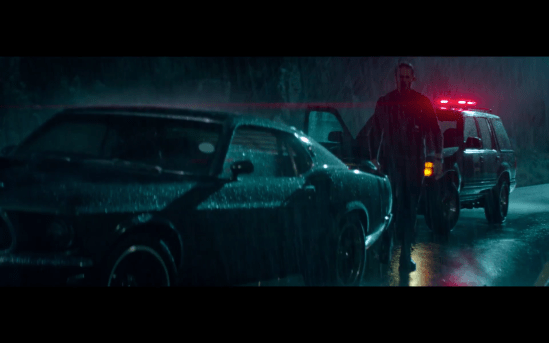
“Cheeseburgers and Ryan Gosling.” That direct quote fairly sums up the Dan Tondowski written and director action thriller titled unambiguously as “Accident.” The 2017 feature is Tondowski’s debut feature film; in fact, it’s his own credited feature film that embraces, or maybe just mirrors, the action sequenced camerawork of Russian filmmaker Timur Bekmambetov, director of “Wanted” and “Abraham Lincoln: Vampire Killer.” Tondowski begins his film impressively enough with a long take, nearly 7 minutes, of setting up the two women, Jess and Caroline, into their catalytic moment that forces into hitchhiking. After that, “Accident” becomes strictly popcorn cinema on a downward slop of insufferable filmmaking that maintains an afloat affliction with moderately entertaining special effects that include a slow motion car crash, an intense helicopter crash, and a 50 caliber machine gun.

Each and every single character in “Accident” was written without an ounce of redeeming value and Stephanie Schildknecht (“Death Race 2”) and Roxane Hayward (“Death Race: Inferno”), who were Jess and Caroline in the film, couldn’t rile up a brief moment why the plight bestowed upon them should have not have happened to them. The suspicion of how Schildknecht and Hayward received their roles might be due to the fact that they both look damn good in a bikini and black lingerie, featured when they strip to the said garments in a gas station bathroom during an back and forth dialogue. Don’t know why they removed their clothes, but that was certainly an aesthetic highlight. Tyrone Keogh (“Death Race 2” – if you haven’t noticed, three out of the four main stars have been in “Death Race” sequels) and Keenan Arrison portray the two car thieves, Fred and Thomas, who pick up Jess and Caroline to have everything they need, fast car and beautiful girls, so Fred states.
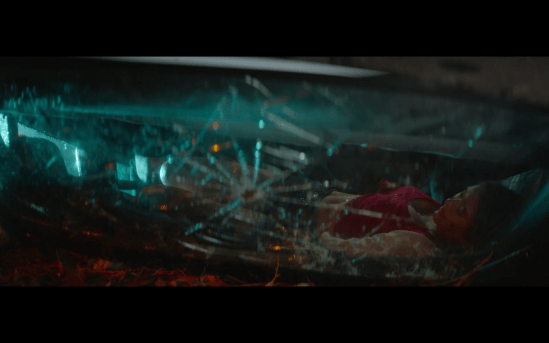
While the production value for “Accident” is top notch and ultra-glossy, that’s roughly the sole positive aspect of the film. The script by Dan Tondowski is a wild hose of loose-to-absent plots and subplots chased with misplaced dramatics and cringe worthy dialogue, the latter already stated earlier with the “cheeseburger and Ryan Gosling” line in the context of being the very one thing a person would want on the brink of death. The overall script as a whole is terribly superficial without much substance to care why these four joyriders should be saved from the pain that’s barreling their way and the answer to that is there is no recourse for any of the characters; no one single redeeming value is actioned or given in exposition to rejuvenate them to a higher standing. Jess is wish-washy with her life choices and a patsy to Caroline, Caroline deceives her mother and neglects her friendship with Jess, Fred wishes everyone dead to save his own butt, and Fred is a potential rapist with pivoting change of heart. Neither of them have self-respect and so when they’re thrown violently into a mix of blood and bullets, an agonizing amount of wait time goes by until their ultimate demise. The plot dissolves around the importance of the car and it’s connection to the great threat that descends upon the four naïve adolescents. At one point in post-crash, the carjackers find a suitcase thrown from the vehicle and they dig through it to only find clothing. The scene is awkwardly out of place and fizzled after the initial “AH-HA” interest that might have shed some light on what the hell was going on.

Exclusively on digital come April 3rd, Well Go USA is releasing Dan Tondowski’s action-thriller “Accident.” The feature-film will be not rated and have a runtime of 89 minutes. The image and audio quality will not be critique for this review due to the digital platform that varies in qualities and no bonus features were included with the digital screener. In closing, “Accident” crashed and burned after the nice 7-minute single take that dapples of nice imagery from then on out and figures to quickly run through the digital market, but with the Tondowski’s cinematography, I expect the filmmaker to only get better from here.



When You Hear Evil, Do You Get Involved? “The Neighbor” review!

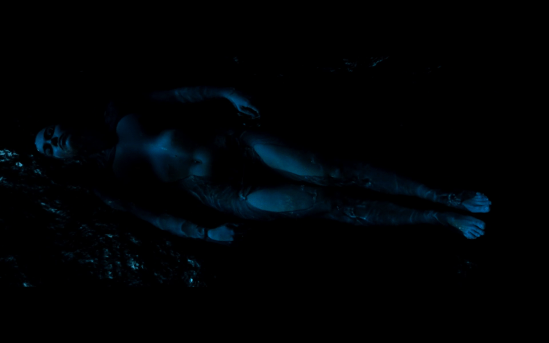
Mike, a mild mannered, middle-aged man, notices a young couple moving into the vacant house next door. His mundane marriage roots out a curiosity infatuation with Jenna, a young and beautiful woman, next moving in. Jenna and her husband Scott, a fast talking exotic car salesman, have recently only have been married for the short time of four months and Mike feels something isn’t quite normal with Scott when he witnesses and overhears violent behavior from his new neighbor toward his wife. Concerned for her wellbeing, Mike, at first, attempts to interject the best way he can without over stepping his bounds by offering to assist with Jenna’s work-in- progress garden or just chatting over the yard dividing wall when Scott isn’t around, but when he assumes things become physically abusive between them, Mike is forced to do more than just mind his own business at the request of his wife and friends. Is Mike willing to risk everything, such as his long term marriage, in order to help a complete and total stranger he barely knows?
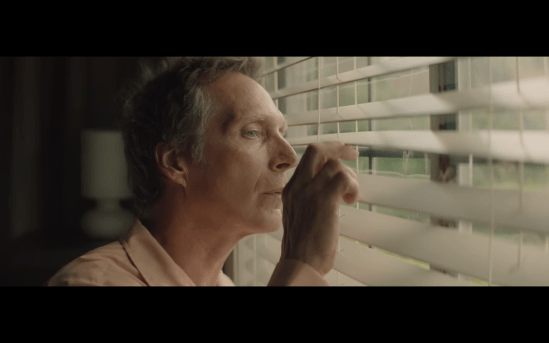
“The Neighbor” is a dramatic thriller from the 2011 crime drama “Catch .44” writer-director Aaron Harvey co-written with first time writer, long time editor, Richard Byard. Harvey and Byard attempt to explore the very common situation of what do you do when you’re exposed to marital violence and how much involvement one should put themselves into assisting the battered party. In short, you’re morally obliged to dial call 9-1-1 and report spousal abuse, but to ensure entertainment value for us viewers, the filmmakers pen Mike as something far worse – a concerned spectator. Instead, Mike wallows about by attending to his garden, working on his technical writing from home, or slicing tomatoes in the kitchen all the while being a part of the problem of the domestic violence next door and it’s not as if the violence is even in question as Jenna flat out tells Mike that Scott has a behavior problem whenever he drinks too much. Right then and there, Mike should be ringing the police the next moment a flare up occurs. Mike is the epitomized reason audiences would be vacuumed into the story as each and every one of us could potentially be a passive Mike in a similar situation.
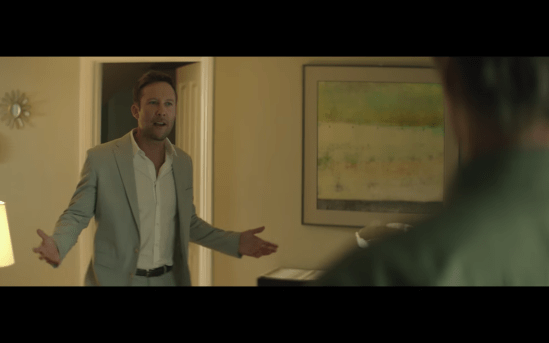
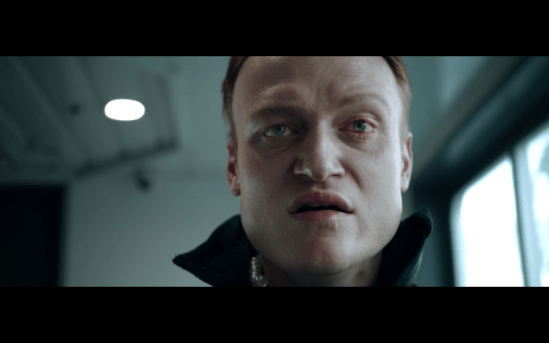
One of the more underrated actors in the industry today, William Fichtner, steps into the comfy slippers of the garden trowel wielding Mike. The “Armageddon” and “Drive Angry” Fichtner’s chiseled and unique facial features typically casts him as hard nose characters – military types, villains, etc., – but “The Neighbor” offers Fichnter a chance to play normalcy. However, Fichtner’s approach to a house husband bears an uncanny resemblance to Michael Myers from John Carpenter’s “Halloween.” With stiff, straight arms by his sides, soulless eyes, and an absent personality, Mike has the gait and the expressions of the William Shatner masked psychopath that’s churns out an awkward performance that blurs the character’s intentions between either being righteous and obsessed. The good looking couple next door are played by Australian born Jessica McNamme and Michael Rosenbaum, also of “Catch .44.” Rosenbaum plays an impeccable dick so well there’s a surefire chance that his character, the fast talking exotic car salesman, will be disliked and as a stark contrast, Namee’s channels a sweet disposition that surfaces the question, why these two are even together? Yet, the Jenna wish-washy stance with Scott makes her frustrating which Mike takes with an astonishing grain of salt. Jean Louisa Kelly, Colin Woodell, and Erich Anderson “Friday the 13th: The Final Chapter” costar.

With a solid cast with a few quirks, “The Neighbor,” under the directorial eye of Aaron Harvey, should have shaped up to be an apprehensive, nail-biting thriller. Instead, some aspects of the Harvey’s film didn’t feel right. For instance, Lisa (Jean Louisa Kelly) and Mike’s marriage was never rocky; the union might have been stagnant from just the day-in-day-out repetitiveness and the longevity of knowing someone from an extended period of time, but there’s a scene when Lisa abruptly decides to throw Mike out of their house. The moment is so random and so unexpected the momentum and the weight of the story changes, pivoting too acutely to compute why Lisa would doghouse Mike over his justifiable concerns over Jenna’s safety without prior marital complexities between them. The entire film almost feels like it’s from Mike’s perspective as everyone, from his friends to his wife and son, seem to unacknowledged his presence whereas Jenna brightens, smiles, and welcomes him in conversation, advice, and even a little intimacy, but that may or may not have transpired.

The Michael Bruce Pictures and Blood Moon Creative produced “The Neighbor” is currently in select theaters from Vertical Entertainment. With a runtime of 105 minutes, “The Neighbor” will drag out under an engaging plot that ultimately goes sluggish at the tail end and even though brilliant and colorful in his prior work, Fichtner is a complete shell of his former characters as a expressionless zombie softly hellbent on saving a train wreck of a young woman from her volatile husband. Overall, “The Neighbor” falls flat to technically write how to right a situation without being caught in the middle of the situation.

