Seeking the luxuries of peace and quiet in order to fulfill the work of an important academic theory, a young student rents out the basement of an old bunker converted into a family home. Surrounded by the solitude of snow and trees, the bunker is the perfect place for the student to concentrate on his work. Until the couple renting the bunker basement decides the student must continue the unorthodox home-schooling of their eight-year-old son to put him on the path of becoming the President of the United States. The student becomes mixed up in a peculiar family’s ambitious affair twisted far from normalcy and teetering on the borderline on insanity.

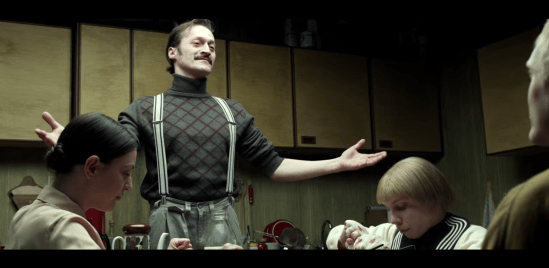
“Der Bunker” is the first feature film from writer-director Nikias Chryssos and Chryssos delivers an artistically abstract film about the modernistic conventional ways of growing up through childhood told through an obsolete perspective. Produced in Germany, the film makes light of how parents raise and shelter their children, especially their sole child. The home setting is literally a bunker, a fallout shelter from the age of war. “Der Bunker” particularly points out the American child raising culture with Klaus, the eight-year-old son of mother and father, going through semi-strict tutoring of memorizing the every nation’s capitals in efforts of becoming, one day, the President of the United States. Chryssos overkills the symbolism column with continuously displaying the staleness of a stuck-in-routine in over-parenting from the outdated 1950’s style of the clothes and retrofitted bunker to the eight-year-old Klaus being depicted by a 30-something actor Daniel Fripan.

Fripan is one of four cast members to star in Chryssos film and the only actor portraying a named character with Klaus, leaving all others generically labeled with father, mother, and the student; however, Klaus and the Student are essentially the same person, a dual presence who start off polar opposites that are trapped inside the bunker and looking to break free from it’s buried confines when their individual identities begin to blur. Fripan’s key to “Der Bunker” working conceptually as the ‘man-child’ with Fripan’s attributed short stature, innocently mature face, and a well-performed immature persona that solidifies the Klaus role as nothing more than child forced to grow externally, but not internally. Pit Bukowski’s more of an automaton when we first meet him wondering through the snowy terrain in search of the bunker. His Student character starts to dwindle as he literally becomes a fixture of the bunker as Klaus starts to shine and thrive in not only his studies but in his maturity, confronting his Mother’s will. Bukowski’s internal switch goes dynamically well with Fripan even though their physical façades remains intact. Mother and Father are portrayed by Oona von Maydell, daughter of “Das Boot’s” Claude-Oliver Rudolph, and David Scheller and both compliment each other by donning an opposite reversal of roles where Mother is the stern, firm hand of the family and Father stays home to clean and be a teacher for Klaus.

Chryssos’ telling of the family and the Student’s psychosexual relationship between the story’s bookends goes above and beyond the Oedipus complex. Oona von Maydell’s Mother has a power fastening all the male characters in an intriguing way despite her minor, yet undesirable, physical deformity plaguing as a patch on her right leg and also despite that her rational stemming from a grave voice, connected to her deformity, comes from beyond their world. As if destined to play the part, Maydell acts the lead as the family’s matriarch while also being subtly coy and provocative to bluntly upfront about her sexuality as a means of control; Maydell seemed very comfortable with her onscreen upper torso nudity in some awkward and uncomfortable scenes. Her onscreen husband, David Scheller, deems himself an academic, an educated man with knowledge more vast than that of the outside world because of this thirst for literature. Yet, Scheller plays a scattered Father whose torn between being a literal mentor, the punisher, and the glue to keep the bunker from being engulfed by giving into Mother’s symbiotic celestial being. Father copes with heavy medication that literally warps his mind when he can’t seem to control everything from the Student’s appetite to his convincing of the Student to take on the tutoring role for Klaus, even if it’s not plainly displayed. Scheller does a remarkable performance breaking down his character to a crumbling lame duck.

“Der Bunker” and the bizarre go hand-in-hand. Only a unique mindset with skewed vision could have pulled together such a twisted dark comedy tale of the mortal coil in holding your children to your hopes and dreams for them. Colorfully unapologetic, “Der Bunker” canisters another world sluggishly revolving through multiple levels of layers of psychosexual and frustrating concepts that flaunts a conventional cinema defiance attitude to establish bold filmmaking possibilities. In short, director Nikias Chryssos shoots high and doesn’t miss with his first run. The Artsploitation Blu-ray release features a vividly clear anamorphic widescreen 2.35:1 presentation of the Kataskop Film Production. Audio options include a Dolby Digital German 5.1 Surround sound with very detailed optional English subtitles. An abundant of bonus material is hard to pass up, especially with a director’s commentary and deleted scenes that expand more about the character’s traits and backgrounds. Rounding the extras are outtakes and trailers from Artsploitation film arsenal. This Blu-ray release is meticulously thought out to deliver a high caliber video and sound quality for such as odd German film concerning one youngish boy’s progressional path of self-reliance from a sheltered life style.
Tag Archives: topless
Evil is Starving for Your Parts! “Model Hunger” review!

Former pin-up model Virginia “Ginny” Smith lives a solitary life on the street of a quiet Buffalo, New York suburban neighborhood. Her modeling past was prosperous, posing erotically with curves similar to that of pin-up queen Bettie Page, up until a newer, thinner model named Chloe undermines Ginny’s magazine spread career. Feeling abandoned, physically tortured, and seeking revenge throughout the years, Ginny eats up the competition from thin, to the fake, and to the virginal…literally! Sal and his mentally instable wife Debbie move in next door to Ginny. Soon after, Debbie suspects that her elder neighbor might be up to no good as people go into Ginny’s house but never come out. Chalking up her suspicions to psychosis, Sal ignores Debbie’s accusations until he mysteriously perishes in a car accident. Now nothing can stop Debbie from investigating into Ginny’s cold blooded habits.

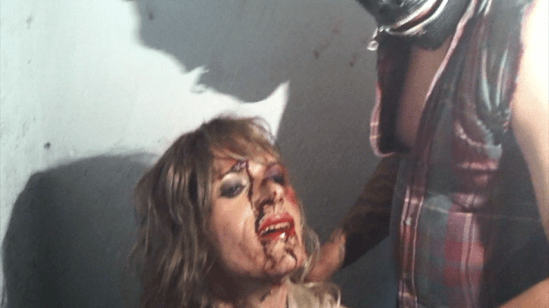
“Model Hunger” is the long awaited directorial debut from long time scream queen and B-movie horror icon Debbie Rochon that publicly displays the dementedness clinging to the inner walls of her brain. Helming from off the screenplay penned by “Seed 2” producer James Morgart, Rochon quickly denotes the position of anti-supermodel figure, turning the thin, the snooty, and those who encourage that sort of behavior into nothing more than a gloppy stew of human chow. “Model Hunger” parodies the serious nature of young women whom go to extreme lengths of imitating the model beauties of today, but the film isn’t a clear-cut horror-comedy per say; instead, the genre of a bizarre cannibalism life style or social commentary revenge film might better suite the self-centering tone.

The premise most definitely classifies as a film Debbie Rochon would personally headline; Rochon personalized “Model Hunger” to her taste, but this time, Rochon’s sister-in-horror, Lynn Lowry (George A. Romero’s “The Crazies”) headlines as the vengeful, cannibalistic Ginny Smith. Lowry puts the hot in psychotic with a Southern Belle twist, delivering a memorable performance as a cougar-gone-cannibal and her character scores much of the Morgart screenplay dialogue that is overwhelmingly philosophical and ranting compared to a more downplayed principal character in the film’s third horror star – the veteran Tiffany Shepis. Shepis is Debbie next door and though that sounds like a title of a boorish 70’s porn, Debbie struggles with being burned out from a psychosis state that results in plagues of nightmares and prescribed pills. Aside from maybe the pill popping, nothing about Debbie’s persona brings to mind a porn starlet.

Contrary to a pair prominent female actresses who bring talent and experience from cult films such as “Tromeo and Juliet” and “Shivers” and a highlight of co-stars including the wonderful Michael Thurber (“The Sins of Dracula”), Brian Fortune (“Game of Thrones”), Carmine Capobianco (Psychos in Love) and “Chainsaw Sally’s” Suzi Lorraine casted ironically as a voluptuously large television host of “Suzi’s Secret,” the James Morgart script just couldn’t pull all the talent together. Points of unfocused storytelling noticeably stemmed from the first few scenes involving uncouth and dolled up cheerleaders practicing their routine, receiving their fundraiser packet, and going door-to-door soliciting. These segments run a natural course of supposedly setting up Lisa Dee (cheerleader Missy in the film) and Samantha Hoy (cheerleader Katie in the film) as the film’s leads. The squad practice could have been completely omitted and the story would have worked just the same without bamboozling the main players Lowry and Shepis. The script drags to a slow drift during the second act by not proceeding with much character progression other than Ginny slaughtering snared victim-after-victim to fill her icebox of superficial-inspired characters.

Honestly, the expectation of graphic violence had a sky high bar set upon the shoulders of Debbie Rochon’s inaugural film, but the special effects violence was unusually tame to a point, containing nothing too new and too extreme until near the finale that involves a naked Jehovah Witness and a medical grade scalpel. Aside from the lack of gross gratuity, the effects were borderline choppy; a prime example to consider would be the obvious rubber baseball bat, wielded by Ginny, that sprung forward and backward, like something out Looney Toon’s ACME company, when striking against an object, but “Model Hunger” was riddled, subtly throughout, with equipment flaws such as equipment shadows in scenes and a continuously shaky camera.

Wild Eye Releasing’s unrated DVD is presented in a widescreen format with a Dolby Digital 2.0 audio mix. Aside from some awkward framing and a bitrate issue that causes a bit of blotchiness, the digital camera video looks good for the most part with an audio mix from “Friday the 13th” composer Harry Manfredini that’s well balanced. The director commentary, in the bonus features, is a highlight of the extras with Debbie Rochon letting you into her creative side of her film. The commentary is accompanied with deleted scenes, music video, an interview with Aurelio Voltaire, a Babette Bombshell short, trailers, and an Easter Egg! Overall, the underlining point is clear of reverse body-shaming in a very Hatfield versus McCoy scenario and Debbie Rochon, for her cherry-popping film, creates a solid horror entry that displays it’s quality scars and hiccups which the film, nor Rochon, apologizes for and that’s a filmmaker, and actress, I can get behind.
Battle Evil With Friends! “Me and My Mates vs. The Zombie Apocalypse” review!
Joel, Darryl, and Roy are mates who work at an Australian telephone exchange. Joined by Roy’s daughter Emma, her boyfriend Lachlan, and his friend Ryan, the surviving group of six hold out in the exchange while the world crumbles around them from a sudden and vicious zombie apocalypse. Trapped and desperate, the survivors bicker amongst themselves in trying to formulate the best plan of escape and who should be recruited for the company cricket team. One shotgun with eight shells, two paintball guns, a machete, a tiny homemade cricket bat, and a grenade is all that stands between them and a cannibalistic horde of zombified Aussies.

Writer-director Declan Shrubb’s sophomore film stars an eclectic cast of veteran and amateur actors from the 20 years of experience and upcoming TV series “Wolf Creek” actor Greg Fleet to the hilarity of stand-up comedians and radio personalities of Jim Jefferies and Alex Williamson. “Me and my Mates vs. The Zombie Apocalypse” is a tongue-and-cheek zombie comedy straight out of Australia, a country known for it’s intense and respectable homage heavy renditions of America’s video nasties from the 1980’s while also combining brazen wit that hurts so hysterically good. Shrubb’s film nowhere nearly disappoints, living up to the whims and visceral intensity comparable to that of 2007’s “Undead.”

Just in the simply put title alone, “My and my Mates vs. The Zombie Apocalypse,” should warrant that the 2015 film doesn’t take itself seriously, but Shrubb blends together various facets of humor, slipping in countless forms of comic relief from crude sexual humor to the harmless play on words while also sprinkling throughout with off-color dialogue. A majority of the characters initially feel aloof or appear as pot smoking knuckleheads; yet, the characters can rise to the occasion at times seemingly becoming a formidable force against the living dead, labeled by the exchange workers as ‘Rotters.” Surprisingly enough, the characters’ dumb luck practically leaves them unscathed or, if really unlucky, placed in the folds of another hair raising scenario to only escape in a goofy fashion.

Alex Williamson is by far a fan favorite as the hapless company cricket team recruit Darryl who spits out off-the-way quips that make him a likable blockhead much in the same way Goofy is a smart klutz friend to Mickey Mouse. Then Greg Fleet portrays Roy, a pissed off father and cricket coach, looking for the easy way out without his balls turning purple (you’ll have to watch the movie to know what I’m talking about). Fleet’s character grows immensely, withstanding many personal pains from not only the zombies, but from his so-called friends. However, Roy is a tough bird, a real nut puncher when needs to be, bringing his character to the forefront of the film. The third friend, Joel, played by Jim Jefferies was a character that had a role reversal from the actor playing him. Jefferies is an actual stand-up comic, but Joel had to be the most serious and smartest character of the bunch, whipping up communications in a jiffy with meager tools while not being too funny about doing it.

Like always in Australian or New Zealand zombie horror, the special effects realistically pit our heros against a nasty, grotesque bunch of undead and decaying ghouls whom can dig out your innards in no time flat to make a delicacy out of them. The zombies didn’t appear cheap with rotting skin, gnarly gashes, and effective blood smears and were portrayed actively well, even if applied with some brain smarts to be able to get past Darryl’s homemade and shoddy powerful electric fence. The macabre wasn’t too shabby either with a very Romero-Savini-esque death sequences that’ll be stuffed with plenty of pig intestines.

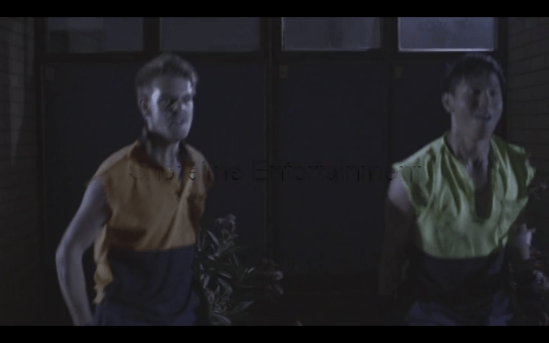
UK home entertainment distributor Matchbox Films courteously releases “Me and My Mates vs. The Zombie Apocalypse” on DVD. The 90 minute film was sent to Its Bloggin’ Evil for review via an online screener link (as you can tell from the watermark on the screen caps) and a review of the audio and video qualities, plus any bonus material, won’t be critiqued. With that being said, the movie itself nails being impressively amusing. Your sides will burst, your throat will hurt, and your eyes will transform into a torrential waterfall as Declan Shrubb’s horror comedy bites hard into becoming an apocalypse of zombie buffoonery.
Buy “Me and My Mates vs. The Zombie Apocalypse” at Amazon.com. Currently on sale! The laughs don’t ever stop!
Mountain Hag Gets Evil! “Girl in Woods” review!

Vividly haunted by the nightmares of her childhood, Grace Walker struggles with recouping from the brutal suicidal death of her father that has plagued her into adulthood. Her boyfriend Jim plans a romantic getaway for just the two them in the remote region of the Smokey Mountains. After a horrific accident fatally strikes down Jim, Grace is alone and lost in the thicket without her coping medication and without a basic knowledge of survival skills. Battling with starvation, unequipped with survival supplies, and besieged with a mental breakdown, Grace combats against her inner and outer demons in order to stay alive.

Eight years have passed since writer-director Jeremy Benson’s last film, the carnal exploitive “Live Animals,” and the filmmaker comes back strong with the upcoming deeply psychological horror “Girl in Woods.” While the title seems unoriginally simple, the character Grace is anything but simple; however, primitive is a more suitable description of both title and character in the end. Benson sets up the character by writing Grace as a woodsy no-nothing on the brink of insanity. As Grace hikes behind Jim, whose carrying a rifle, she’s complaining about the possible dangers of bears and snakes while attempting to use her pink incased cellphone in a kill signal area to gossip about Jim’s engagement proposal the night before. Immediately, Benson places an unstable, and the creature of comfort, Grace into panic and peril, the starting line of her laundry list of troubles. From then on, the director relentlessly pounds Grace with hallucinations set within the Tennessee backwoods, torturing her from the mind with mental deterioration stemmed by hunger and onset psychosis to her body with physical pain from a deep gash wound in her hand.

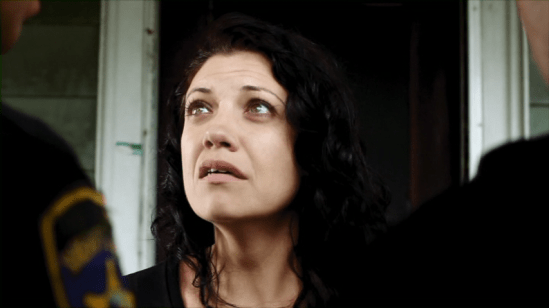
And who is this actress to which Benson mercilessly puts through the meat grinder? Veteran actress Juliet Reeves (“Automaton Transfusion”) fills Grace’s disturbed shoes with a formidable solo performance for much of the duration. The then 36 year old actress was pregnant with her second child during various filming shoots. The father of the child is with none other than her co-star, now husband, Jeremy London (“Alien Opponent”) who portrays Jim. Reeves is able to maintain a convincing lunatic lost in the woods despite the non-liner storyline where dream sequences and, supposedly, flashbacks intercut to build upon Grace’s tragic and unfortunate background. Reeves commits herself to the stages of psychosis, slowly transforming from a manageable, calm medicated state to severely severing all ties from external reality. Even when performing with her angel and devil conscious in the form of herself, Reeves doesn’t flinch, fashioning a frightening internal dynamic that’s damn realistic.

“Girl in Woods” ultimately becomes a collaboration between the subgenres of psychological horror and man versus nature. Benson’s story explores the possibilities of what might happen if a mental case like Grace is put into a dire predicament and the non-linear narrative simultaneously attempts to display how Grace is destined to be molded. Interestingly enough as a tidbit of analytical comparisons, “Girl in Woods” marginally parallels with a few popular scenes from the 1987 John McTiernan film “Predator.” When Mac, played by Bill Duke, chases down the extraterrestrial game hunter, he notes to Carl Weather’s Dillion, whispering, “I see you” toward the cloaked alien, which feels similar to when Grace spots the forest “demon” and chases after it, yelling, “I saw you” over and over. Other scenes sport the same similar inkling from Grace whittling makeshift weapons to going full blown guerilla attack commando on the “demon,” who oddly enough also makes similar vocal gutturals like the Predator.

As far as production value is concerned, “Girl in Woods” has an ambitious approach with a infinitely engulfing forest that lurks like an antagonistic villain and an in-your-face motif of self-inflicted suicides that’s extremely graphic and hard to absorb with the brain-splattering, wrist-slashing overdose potency. The CGI is kept at a minimum, but have one hell of a nasty bite that spurs the heart to a sudden pounding. The practical effects reign supreme over CGI and within the confines of a warped mind, the possibilities are endless and Benson exploits the potentials. Overall, fine performances by the rest of the cast: Jeremy London, John Still (“Live Animals”), Lee Perkins (Slime City Massacre), and the stunning Charisma Carpenter (“Angel” television series) as Grace’s mother.
Produced by GIW in association with Yield Entertainment and distributed by Candy Factory Films, “Girl in Woods” is an upcoming film you don’t want to skip over. Jeremy Benson has the talented eye of capture beauty within the horror and has the talented pen to wield craziness on paper. I’m not at liberty to critique the audio and video quality as I was provided an online screener, but “Girl in Woods” is being released on iTunes, VOD, DirectTV, Cable, Dish, Amazon Instant, Google Play, and Vudu so there are plenty of formats to choose from on June 3rd.
Evil Takes a Ride! “The Lady in the Car with Glasses and a Gun” review!

Dany Doremus, a lonely secretary roped in by her boss to work on a big project at his home, steals her boss’s car for a joyride to the sea as her boss and his family go away on holiday. When she makes numerous stops from town to town, the townsfolk approach her, claiming and swearing they know her even though she’s never been to this particular area before. If things couldn’t get weirder or even more suspenseful, a dead body is discovered in the car’s trunk. Dany wonders if she’s deranged and crazy or just a part of a some elaborate murder mystery conspired against her.

“The Lady in the Car with Glasses and a Gun” is a remake of the 1970 Anatole Litvak film of the same title. Though I’ve never seen the original Litvak film based off the award winning crime novel by Sebastien Japrisot, I’m sure director Joann Sfar’s film doesn’t stray much from the main artery that is the story, but Sfar spices up the tale through the addition of a young and feverishly heart-throbbing cast of actors and actresses. A murder mystery that sells sex more than thrills, Joann Sfar explicitly has Scottish born actress Freya Mavor and “Nymphomaniac’s” Stacy Martin do more than their fair share being sex symbol and straining the barrier of sexual tension, especially with a couple of highly eroticized topless scenes from both actresses. In a bombardment of thigh high mini skirts and tight at the waist dresses, the film setting is to reflect the 1960s to 1970s time period where if the story was in the technology age, “The Lady in the Car with Glasses and a Gun” might have had a totally different outcome.
Like any good crime novels or films, noir plays a bit part and with the Sfar remake, noir is ever present from beginning to end. Dany’s noir scenario has her being plagued by a retraced trip she’s never initially taken, being roughed up by a glove-wearing mystery person in a duo of giallo familiar scenes, and discovering a dead body in the trunk of her boss’s Thunderbird. All the pieces come together to form one big elaborate undertaking with the big twist at the end and while I’m not sure if the novel and the Litvak film do marvelous work in the detail to wrap Dany’s adventure, I feel Sfar’s missed the mark by not filing in the holes that construct a twist ending. Maybe Japrisot’s novel a bit vague too, but there’s certainly multiple voids that needed to be filled to plausibly and logically explain the ending.

As I said before, Freya Mavor’s sexiness couldn’t be any more potent. The relatively young in the industry actress has tons of potential outside the European film market. Stacy Martin has been on that fringe of the industry since her controversial breakout role in Lars von Trier’s “Nymphomaniac.” Both Mavor and Martin work well together, creating the tension between their characters while pulling off a lustrous vision. The male lead playing Michael, Benjamin Biolay, reminds me of a young Benicio del Toro with a very reserved demeanor and calculating coldness about him.
Magnolia Pictures proudly releases the remake of “The Lady in the Car with Glasses and a Gun” in limited theaters across the nation today, December 18th, and will also be available on demand. Another variation of an award winning story with modern actors set in a time period that has been long forgotten, “The Lady in the Car with Glasses and a Gun” stimulates the whodunit objective that keeps you on the edge of your seat for every second.