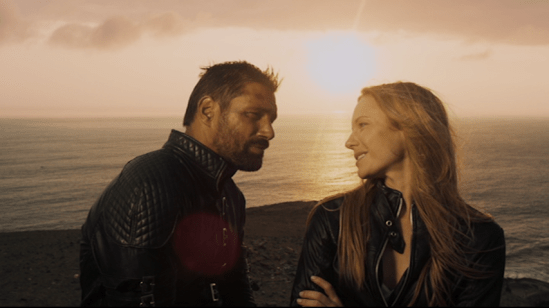
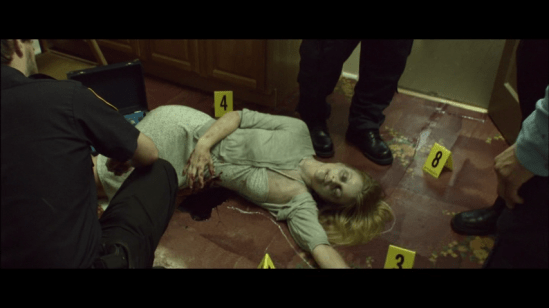
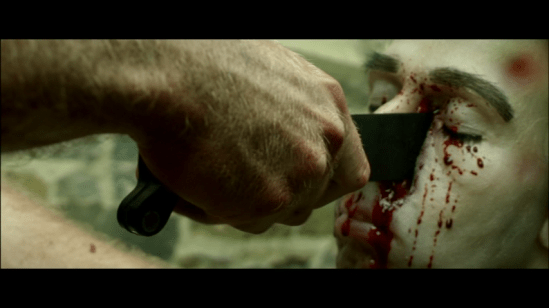
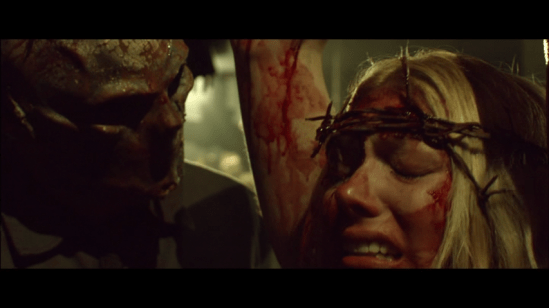
In 1933, the heart of prohibition-era regulation, a corrupt Southampton, New Jersey police department shakedown the illegal alcohol distilleries and bootleggers, forcing establishments to cough up payment for police protection. Chesterfields, the hip new brass club in the sleepy town, falls into the sights of enforcement officers, an alcoholic with post-war issues, Jack Malone and his partner Sam, who want the club owner, a ruthless black bandleader named Chester, to pay for his establishment’s booze sales and bootlegging, but Chester, and his conspicuously strange henchmen, are more than just bootlegging booze runners. The nightclub is a front for a vampire den that’s draining, bottling, and shipping the blood of Southampton residents and master vampire, Chester, operates the business with his human associate, Victor Renfield. An invasion of bloodsucking gangsters seep into the affairs of not only Jack Malone’s baffled police department, but also into the resident brothel that homes Jack’s longtime beloved lover, Rosie. Only Jack, the deranged town priest, and Willie, a boy caught in the middle, stand in between the corrupt, yet still innocent, souls of Southampton and the terrorizing dark forces that scratch at the town’s door.

Hybrid genre film “Bloodrunners” blends a spin of classic tale vampirism with early 20th-century gangsters that concocts a bad batch of cinematic bamboozlement. Filmed in West Chester and Marcus Hook, Pennsylvania, director Dan Lantz, who helmed adult film star Alexis Texas in “Bloodlust Zombies,” does construct a marvelous speakeasy, prohibition-era world out of the greater Philadelphia region’s most popular and historical locations. From the period piece costuming to the acquisition of an antique 1921 Ford Model A car, Lantz’s ability to build a story around such facets on pocket-sized finances that help bring 80 years past back to the present can certainly compete with settings of many big-budgeted Hollywood productions. Being a previous recent resident of West Chester, the landscape was convincingly alien to this reviewer. Co-star Michael McFadden co-wrote the script with Lantz and, together, they input a girth of 1920s to 1930s terminology and slang into a script that can’t quite coherently string along a narrative that works under cut and dry filmmaking involving anemic mains characters.

Alongside McFadden, the “Law & Order: SVU,” or rather from one of my personal favorite films from 1994 entitled “Surviving the Game” co-starring Gary Busey and Rutger Hauer, star Ice-T takes on being a master, bootlegging vampire when he’s not busting heads of pedophiles on the streets of New York City. Ice-T maintains a hip hop persona that doesn’t translate well toward the 1930’s, but the legendary gangsta rapper has kept the hip hop schtick throughout this career and never in a hundred roles, eighty-seven credited roles to be exact, would I imagine Ice-T to break from a moneymaking image. Like his co-star, McFadden comforts himself in familiar roles that pigeonholes his career made up of authoritative figures such as cops or gangsters with examples including being a gangster in Fox’s hit television series, the Batman spinoff “Gotham” and also portraying the notorious real life gangster, Jimmy Hoffa, in the upcoming Tigre Hill film “American Zealot.” Then, there’s Philadelphia native Peter Patrikios. Patrikios’ phenomenal take on the iconic Renfield character is a break in the monotony highlight, reviving Renfield back to a sophisticated right hand man instead of a relapsing bumbling aid for his master’s whims of daylight chores and being more memorable than the “Bloodrunners'” main headliners. Airen DelaMater, Chris James Boylan, Julie Elk, Kerry McGann, Jack Hoffman, John Groody, and Dan McGlaughlin round up “Bloodrunners'” roster.

When attempting to examine “Bloondrunners'” vampiric special effects, only this descriptive phrase comes to the forefront of my mind: “Bloodrunners” pits vampire gangsters against crooked cops in a “Matrix” styled, slow-motion action-horror. While that sounds rather exciting, selling these particular creatures of the night didn’t enlighten a firm stance that the modern vampire is alive (well, technically undead) and well. Instead, the Dan Lantz and Michael McFadden story stays the routine course that fills the overstuffed and out of control vampire barrel that desperately requires genre damage control from the first moment a scofflaw vamp enters the scene. Vampire action films haven’t been popular since “Blade,” unless adapted to television as in the case of FX’s “The Strain,” and “Bloodrunners” doesn’t fit the bill, boozing in as a blasphemous contemporary day vampire film.

Paoli, PA based production company Impulse-FX delivers Dan Lantz’s latest schlock horror “Bloodrunners” with Speakeasy Films releasing the film out to the world and landing on retail shelves March 7th. The trailer held promise with vigorous action stamina, but, in the end, just turned out to be a well-edited trailer for an action-horror-thriller that needed a touch of stability in the story. Portions of the story are deemed absolutely unnecessary to motivate the characters or are place mats interjected to connect characters, such as Jack Malone’s encounter with a specific German vampire who just coincidently happens to be one of the henchmen in Ice-T’s vampire gang. The Speakeasy Films dual format 2-disc, Blu-ray and DVD combo, presents the film 1080p widescreen 1.85:1 aspect ratio in which the Blu-ray is on a AVC 26Mps disc. The image was a bit shaky under the compression, fizzing at times, more so during darker scenes, that outlined compression artifacts that remarked upon lighter shades of grey and black. The English Dolby Digital 5.1 track is fine through the 95 minute runtime. Jack Malone’s raspy gangster voice doesn’t become muddled and Ice-T’s epic hip hop swag comes through without even a hitch. The soundtracks fades in and out quite a bit over the LFE, during the “Matrix” slow-motion, that leaves much unbalanced when the soundtrack becomes warranted. Bonus features are nice, including a gag reel, deleted and extended scenes, filmmakers commentary, and an official trailer. In conclusion, “Bloodrunners” teeters on the edge of being a full bodied beverage that never really carbonates into a high-alcoholic contestant in being a good, modern day vampire thriller.
Tag Archives: topless
A Double Bill of Evil! “Murderlust” and “Project Nightmare” review!

During Sunday’s services, a calm and confident Steve Belmont heads the Christian Sunday school youth class and seeks to be the permanent director of the Church’s suicide crisis unit that’s coming to the end of the planning stage. On Sunday’s, Steve performs as the model citizen whose ready to serve and give back to his community. During the rest of the week, the horse race track security guard can barely sustain societal worth, arriving late for work, constantly drunk, and has disdain for people being a speed bump in his path to greatness. All Steve Belmont has in life is the potential director’s job and his thirst, his unquenchable thirst for strangling women and dumping their bodies in the excessive heat of the Mojave desert. The local newspapers label his killings that of at the hands of the “Mojave Murderer” and his lust for killing call girls and young women runs a thin line alongside his Sunday best and when he begins to trust a Church regular, Steve’s mistakes begin to catch up with him.

“Murderlust” is the first feature on the Intervision Picture Corp’s double bill DVD release from director Donald Jones and writer James Lane. The 1985 suspenseful horror-thriller comes to DVD for the very first time and doesn’t just boldly display a story of another run of the mill serial killer but does so with remarkable performances and a body of work that’s well crafted. Lane pens the center character focus on Steve Belmont and his delusion of power, being an overwrought sociopath with a belief he’s better than everyone else, and Belmont’s brazen lures to secure helpless victims is nothing short of a con artist’s trait. The ability of convincingly seducing the congregation to his benefit provides him pseudo mystical powers that pull the blinds over their God fearing eyes while he continues to slack through a meager life and holds tightly his reign of terror near the Mojave. Basically, in Belmont’s mind, he is God.

Eli Rich plays Steve Belmont, who can only be described as a twisted blend between Michael Beihn and Nick Offerman, and Rich canisters Belmont’s psychopathic tendencies in an terrifying performance of exact realism. Not many films can pull off the on and off switch of a serial killer, even Patrick Bateman in “American Psycho” was sensationalized, but the relatively small time actor produced a manufactured fearful reaction. Rich splits Belmont into two personalities while still managing to be contain a menacing aurora to feed audiences with dread, fear, and suspense and while Rich might be doing more than just one public service for his community by picking up and strangling local street walkers, Belmont never transitions into that role of the likable anti-hero as he manages to forthrightly ostracize himself from friends and family. As Steve’s square statured and responsible cousin Neil, Dennis Gannon epitomizes the upstanding citizen character, but maintains a soft spot for his unscrupulous next door neighbor cousin. Rochelle Taylor’s role is something of a love interest for Steve, who can’t bring himself to kill her even when the opportunity is present, but the one film and done actress Taylor can’t bring “Murderlust” to the promise land with an overzealous portrayal of an eager beaver, love struck Church girl that doesn’t fit the bill of Belmont’s world.

After a couple of quick Mojave Murderer victims, one including the scene illustrated for the DVD’s front cover with a topless and unchaste Ashley St. Jon, Steve, along with the flow of the story, banks into a suppressive funk. The narrative’s pace slows when Steve attempts to organize his life around his murderess hobby, turning the suspenseful thriller into a drama segment that is more or less of a laundry list on how to obtain rent money for an aggressive landlord, until the demand to hunt tugs heavily at his pant leg and he can no longer ignore the urge. “Murderlust”, despite the captivating title, is nearly a bloodless horror thriller. Steve uses his signature method of strangulation, leaving smartly no blood trail, and only at the finale does blood spill when Steve deviates from his unsympathetic hunt, kill, and dump program.

Woodland campers and best buds Gus and Jon wake up to discover their gear has been shredded and dispersed. They’re soon pursued by a frightening force of unknown origins. Lost and hungry, the two friends stumble upon a mountain cabin where cabin owner Marci shelters them for a night. Rested and resupplied, but haunted by their dreams, the two continue on foot in search of a town; instead, they become split up and Gus finds himself in the bizarre belly of a government facility that’s conducting an experiment and root of Gus and Jon’s predicament. Gus must confront the inner workings of his mind and take back control of his thoughts or else all that he knows, his friendship with Jon, and all that he desires, his passion for Marci, will soon be lost to the unchecked government secret known only as Touchtone.

The second film on the double feature, “Project Nightmare,” starkly contrasts in genre with “Murderlust.” “Project Nightmare,” otherwise known as “Touchtone,” is a science fiction thriller piggy backing as a bonus feature and the 1979 conduit for confusion showcases how scarily surrealistic director Donald Jones can achieve. An odd film that materializes shortly after Gus and Jon’s plight begins and doesn’t let up the enigmatic ambiance as the audience will surge deeply into the rabbit whole. Even though told linearly, “Project Nightmare” feels, in fact, like a nightmare, peppered with sporadic scenes of uncomfortable imagery and repetitive ambient noises and soundtrack that jar the senses. Jones’ direction and style denotes an appeal of black and white scenes, but, in color, the film works better to give an ominous a stimulating visual and without that color, the story just wouldn’t work.

Charles Miller and Seth Foster star as the baffled and lost campers Gus and Jon. They’re joined by Elly Koslo, as Marcie, and Harry Melching, as Carl the government scientist, who provide indifferent character roles or just products of the imagination to support the dreamlike atmosphere. As a whole, the actors’ dynamic was obsoletely rigged but in an unsettling Lynchian fashion causing your eye balls to stay with the scenes. “Project Nightmare’s” experience will make you feel you’re watching a film much older than produced with the costumes, the language, and the wood paneled elevator and granted that Jones’ isn’t big budget, but the director was able to deliver with the minuscule budget available to fruition a sci-fi odyssey.

Intervision Picture Corp has a snazzy, two-headed snake in “Murderlust” and “Project Nightmare” presented in full frame 1.33:1 aspect ratio with a single channel Dolby Digital mono track. The original prints looks great with “Murderlust” slightly heftier in the cyan department during it’s 98 minute runtime. The single channel had better luck with the 74 minute runtime in “Project Nightmare and “Murderlust” had moments of softness where dialogue became a strength in exercising one’s hearing. Both issues listed didn’t hinder the final product; in fact, I’m quite pleased with the end result on both features. “Project Nightmare” has a natural presence that’s appeasing and “Murderlust” blankets itself warmly in, well, the associated Mojave desert. The bonus content on the Intervision release include two audio commentaries with writer-producer James Lane. The “Project Nightmare” commentary has partial audio. In conclusion, “Murderlust” might not be this tour de force of bloodletting hookers. The sheer realistic characteristics of a serial killer among us are more alarmingly exploited and continue the terrifying ordeal with “Project Nightmare,” a sci-fi sensory conundrum overloaded with spastic psychological terror from the Golden Age of film.
Murderlust
Revenge is an Evil Dish Best Served Cold! “Gelosia – Vendetta D’amore” review!

After Thomas’ voluptuous wife’s immaculate beauty falls victim to a horrifying and scarring fiery car accident, the sex-addicted womanizer, fueled by a constant stream of strong alcohol, dumps his maimed wife and obsessively hops from one unchaste woman to next, but in the darkest shadows lurks a hidden danger toward his newfound, unrestricted fast and loose lifestyle. A sinister plot of revenge against him begins to quickly unravel and Thomas’ stretch of unscrupulous carnal behavior is about to be ‘cut’ short because, as the ancient saying goes, “hell has no fury like a woman scored.”

Alberto Barone’s vengeful sex-thriller “Gelosia: Vendetta D’Amore” is a short film laced with irrepressible desires and consequences, doused in pure hatred and nihilism, and packaged as a vibrant grindhouse homage garnished with a tightly-knotted black bow. Milton Welsh stars as Thomas, a man on a bulldozing sexcapade, and with Welsh’s raspy, baritone voice and slick back, greasy hair makes him, on screen, the perfect, middle-aged creep, hooking up with the shameless, uninhibited women. The German born Welsh has indistinguishable looks and talents with the impeccable “Doom” and Rob Zombie “31” actor Richard Brake that brings a lot of despicable enjoyment to not only the performance, but also with the monologue by Welsh throughout the short film. Welsh’s previous credits include the 2011 remake of “Conan the Barbarian,” “Aeon Flux,” and, one of my personal favorite Norman Reedus films, “Antibodies.”

Welsh’s performing cohorts makeup solely of very well-endowed, very offensive-embracing women that include a porn star, a dominatrix, and a couple of veteran genre actresses starting with the Southern France born Manoush (actress in Marian Dora’s “Cannibal,” “Philosophy of a Knife,” and, most recently, “The Curse of Doctor Wolffenstein”) as Heidi, Thomas’ discarded wife. This dominating role didn’t feel quite right, slightly forced, from the possibility of this role not being in Manoush’s native tongue, constraining the gushes of violent emotions that should be exploding from within the character outward. Manoush directly interacts alongside “German Angst’s” Kristina Kostiv, as a very seductive Eastern European escort girl in a manner that blurs the motivations of the characters, but we’ll discuss that later in this review. Rest of the cast fills every man’s, sometime woman’s, prominent fantasy with sacrilegious Nunspolitation and naughty nerd girl scenario roles, respectively donned by Tara Rubin and German porn star Lana Vegas. Both Rubin and Vegas steal from “Gelosia’s” root message with their provocative performances that leave almost nothing to the imagination. Tattoo model Alexa van Unique gets kinky in a brief scene of dominance that’s short and sweet and gets the message across.

“Gelosia” is Italian for Jealousy, but Alberto Barone’s written and directed film doesn’t hit hard with one of humanities irrational and vile attributes. More in line with the subtitle of “Vendetta d’Amore,” aka Revenge of Love, Barone tells two-stories: One of the monologuing, sex addict that objectifies women more than he wishes to understand them and a vengeful wife with a dastardly plot of deadly retribution against him. I just don’t see jealousy as the major player this short film is titled after and that, at least for me, dilutes much of the radical content supporting the story including the naked women, the gruesome violence, and the admirable cinematography.

“Gelosia: Vendetta d’Amore” is sexy with shock value. Produced by Ingravisione, the exploitation thriller seeks to debut in late 2017! Overall, Barone’s ultra-exploitation leaves an indifferent residue with me as I’m still hung up on a few difficult to ignore hiccups, but I love the short’s perverse freedom as a whole that’s vivid and modern while staying classic in style. “Gelosia: Vendetta d’Amore” is starting to hit festivals as I type this, bringing all the castrations and sex to an arthouse theater near you!

[youtubehttps://youtu.be/9PR-KtfhaA4]
Evil Scores Big by Burning Rubber! “Death Race 2050” review!

In the dystopian America of 2050, commercialism presides over the middle and lower classes in the constructed wasteland that is United Corporation of States led by an impeccable and blood thirsty Chairman. A popular, carnage-laden sport known as the high octane Death Race has become beloved by all Americans, giving them an escape from their mundane and pitiful existence. The Death Race is simple: war-modified cars trek across the United Corporation of States in a 3-day race to score points by running down citizens of an overpopulated nation as an encouraged way of resetting the out of control producing rate and racers can also seek glory to reach the finish line with best time. Four-time champion, Frankenstein, is the returning crowd favorite and seeks to win a fifth crown, unless the powerful and conniving Chairman decides otherwise.

Under Universal Studio’s filmic sequel and reboot sublabel, Universal 1440 Entertainment’s “Death Race 2050” is a rip-roaring start toward 2017’s best intense action cinema and despite being pre-labeled as just another diluted and benign remake of the Roger Corman produced, Paul Bartel directed “Death Race 2000” from 1975, the modern day G.J. Echternkamp directed and co-directed film with Matt Tamashita honorably doesn’t lose the rich, yet full of cheap thrills, heritage that makes the original “Death Race” so fun, so entertaining, and so campy keeping the pandemonium on four high-performance, face-shearing tires. Even though Death Race has been quiet for over thirty years since 1975, the last decade has been riddled with Death Race films produced by the legendary low-budget filmmaker Roger Corman and all have been complimentary exclusive in their charm, mayhem, and versions of the lead character Frankenstein to thrill audiences, but it’s “Death Race 2050” that revs in true remake fashion of similar plot structure that changes all but one character.

New Zealander Manu Bennet carries the torch in portraying the original character Frankenstein, a four time champion with a leather covered body that’s been ravaged and cybernetically repaired from previous race crashes. Manu’s charisma and rugged image will win over audiences as he perfectly embodies a conflicted champion on the brink of doing what’s right; a tone very similar in all “Death Race” films. Manu is paired with actress Marci Miller, as Frankenstein’s passenger proxy, who dishes out the good girl sex appeal with a self-reliant rind. Beyond these two characters, even with a moniker like Frankenstein, the remaining characters make Mike Judge’s “Idiocracy” a college course of rocket science! Deliveries were timely, actions were precise, and performances couldn’t have been more meticulous in scenes with Jed Perfectus, the genetically engineered and ambiguous pretty boy played by Burt Grinstead, Minerva Jefferson, the wealthy ghetto rapper forged to life by Folake Olowofoyeku, and with Tammy the Terrorist, a cult leader with a celebrity high power portrayed by 2007’s “The Signal’s” Anessa Ramsey. The relatively unknown cast is whole-heartedly glued together by the flamboyant performance of “Clockwork Orange’s” and “31’s” Malcolm McDowell as the Chairman.

One could take a good stab in the dark on what the quality of the effects would be like for any Roger Corman produced film. In this instance, “Death Race 2050” channels much of Corman’s style with Echternkamp and his visual effects supervisor Anthony J. Rickert-Epstein (“Sharktopus vs. Whalewolf”) supplying rotoscope blood and dismemberments that pin-pricks a visual stimulate into the vein of the snobbiest of film aficionados and can be on an everlasting high. The simple, but effect, gasoline based pyrotechnics attest to the dedication of the crew and to the stunt work to know that if they miss their spot, they’re literally toast. However, the sometimes choppy, rapid editing drains some of the juice from the kills that attempt to piece coherent death sequences with humor and action. In fact, “Death Race 2050” redlines just like the modified, manslaughter vehicles used to rundown babies and the elderly to score points by quickly jumping to the next segment in order to sustain all the gory story’s girth.

“Death Race 2050” is adrenaline flowing wildly adjacent with gasoline, exploding with gore, and is terrifically enjoyable. Echternkamp’s script bares no sense with the sensitivities, secreting American wealth, greed, and stupidity in an environmentally degraded America filled with large high fructose corn syrup soda, an addictive cheese whiz byproduct, and borders that are named after corporate conglomerate of brands such as Walmart or Texaco. Universal’s R rated Blu-ray, DVD, and Digital HD release of the New Horizon film is an 1080p of the 1.78:1 widescreen presentation that makes the film look cheap due it’s hi-def attributes. The image quality is sleek and vibrant with a wide range of rainbow hues and the definition doesn’t ever thrown in the towel. The three option audio selection that consists of an English DTS-HD Master Audio has a lossless appetite that delectable distinguishes the channels where explosions are bombastically LFE and the gory parts are viscerally squishy. The dialogue is surprisingly clear through the amount of chaos. Bonus features include “The Making of Roger Corman’s Death Race 2050,” “The Look of 2050″ featurette,” a closer look at the cars in a segment entitled “Cars! Cars! Cars!,” a cast car tour, and deleted scenes. Even if the story’s timing is a spastic, “Death Race 2050’s” a guilty pleasure from start to finish line under the caustic cinematic eye of Roger Corman!

Dead Parents Create Good and Evil Children. “The Orphan Killer” review!

Audrey Miller is your borderline, but overall good, Catholic woman, but the Saint Michael’s Orphanage dance teacher withholds a dark secret from her past. Audrey, herself, is an orphan along with her estranged brother, Marcus. At the age of 6-years old, Marcus took the brutal death of their parents the hardest, transforming a young innocent boy into an emotionless and destructive shell of his former self and while they attended the orphanage where Audrey currently teaches, Marcus suffered at the hands of wrathful Nuns hellbent on forcing Marcus to repent for the sins he’s committed. Years have gone by and Marcus, donning the Nuns’ gifted mask to frighten other children away from him, has been confined to a neglected psych ward, but, now, Marcus has found an escape and seeks to hunt down his beloved sister, trapping her inside Saint Michael’s, to relay a message that blood never abandons blood unless it’s fatally punctured with a blade.

Matt Farnsworth’s 2011 “The Orphan Killer” is a cold-hearted, slaugtherfest, aiming to reap the Catholic church of sinners by committing the ultimate sin. Serial killer, Marcus Miller, becomes this generation’s misunderstood maniac, being the right hand of God and smiting blasphemous individuals in a one-night stint of blood drenched dirty work. Being the sophomore feature from writer-director Farnsworth, there’s plenty to be impressed with here from the setting up victim characters and the killing-ground stage to quickly canonizing Marcus after learning the atrocities his victims; Marcus blurs into the realm of anti-hero in a twisted sense of the slasher genre with religious undertones – such as Audrey wearing a barbed wire crown of thorns. He’s very familiar to that of iconic genre staples such as Jason Voorhees or Michael Myers, yet Marcus Miller’s unique origins background and murderous methodology doesn’t share with the already established grisliness. If Farnsworth is willing, this serial killer could be expanded upon with such a rich backstory.

Story wise, there are familiarities toward that of Michael Myers’ background with the bloodlines. Instead of Laurie Strobe being related to her coupled murderer, Audrey, played by stunning beauty Diane Foster, has, unbeknownst to her good fortune, to her still breathing psychopathic brother, Marcus, portrayed by David Backus. Both Foster and Backus have previously worked together on another Matt Farnsworth written-directed feature, his breakout indie film, “Iowa” in 2005 that also starred Rosanna Arquette {David Cronenberg’s “Crash”) and Muse Watson (“From Dusk till Dawn 2: Texas Blood Money”) and have great cat-and-mouse chemistry through love-and-hate sibling rivalry. Farnsworth also co-stars his own flick as Audrey’s cop boyfriend who becomes mixed up in the mess when Audrey doesn’t come home next morning. Unlike Audrey and Marcus, Officer Mike Hunt – yes, Mike Hunt – lacks substance and is portrayed a bit of a wild card when Audrey goes into dire stress. The cast rounds out with Karen Young, James McCaffrey, Charlotte Maier, Spencer List, Dana DeVestern, and John Savage.

The realistic, sometimes over the top, practical effects make the scene in a welcoming glorified shower of gore splatter. Marcus Miller’s killer tactics vary from victim-to-victim, whereas some slashers maintain one particular kill setting, making “The Orphan Killer” eye-catching and extremely engaging. The unbelievable production value for an offbeat slasher that’s so profane to religion temples and other holy aspect shouldn’t go unnoticed and I’m not just speaking highly solely of the special effects. The structural bones of a cathedral church setting and the amount of extras used in well choreographed dance recital and Miller kids’ flashback scenes show the committed financial backing put to work in Farnsworth’s film. Farnsworth edits his own work that’s slightly erratic at times, but overall successful with the action that’s involved and the displaying the severity of splicing together great practical kill scenes. I’d say his style is certainly earthy and sometimes there are glimpses of channelling iconic directors.

Produced mainly by Farnsworth’s company, entitled simply enough Matt Farnsworth Films, in association with Full Fathom 5, “The Orphan Killer” has rightfully found a friend at the Reel Gore Releasing home distribution label with a Hi-Def 1080p Blu-ray and DVD combo release. The 2.35:1 aspect ratio presentation sharply defines details, especially in the blacks, and does well with desaturating the hues to give it a gritty, dirty appearance that compliments the abandoned sections of Saint Michael’s. Two audio options are available, an English DTS-HD Master Audio 5.1 and Dolby Digital 2 channel; the 5.1 delivers a heart pounding score, but the soundtrack by Bullet Tooth releasing, featuring a slew of hardcore metal bands, oversteps into some dialogue sequences. However, Ventana’s cover of “Cry Little Sister” kicks off right after the opening credits; an early sure sign of good things to ahead. Bonus features include a “behind the Murder:” an exclusive video diary, teaser trailer, theatrical trailer, music clip, and a slideshow. “The Orphan Killer” has religious metaphors under a sacrilege of brutality and unleashes a retroesque Renaissance slasher for modern day terror.