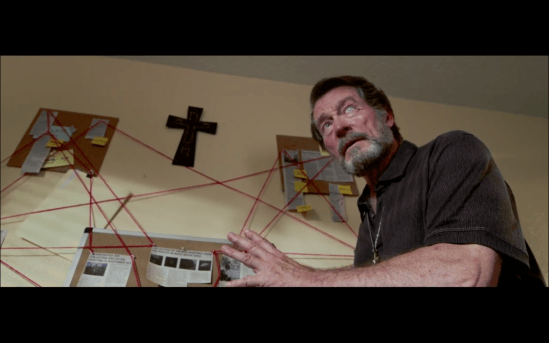
EVIL Must Be Broken In Before Being Used. “The Wheel” reviewed!


In the near future, paraplegic inmate Matthew Mills volunteers under pressure to join a Satoshi-Telefair Industries experimental treatment program that not only promises to reduce his sentence, but to also to regain mobility in his legs. With nothing more than the hope to return to his daughter, Mills is enticed by the agreement and gives himself to a shadow company who regularly contracts with the military, facilitating deep underground at an isolated site. Shortly after signing the release form, he awakes in a dark, steel cell known as The Wheel and is able to move his legs again, but the jubilation quickly subsides as armored men with batons visit his cell to beat and break his body in order for the nano technology, injected amongst his anatomy, to rebuild damaged tissue and make him stronger. The ordeal torments him, but to the researchers observing every detail of his recovery and behavior, Mills is just subject 2-1, another potential subject destined for the Future Soldier Initiative where the unethical testing must continue.
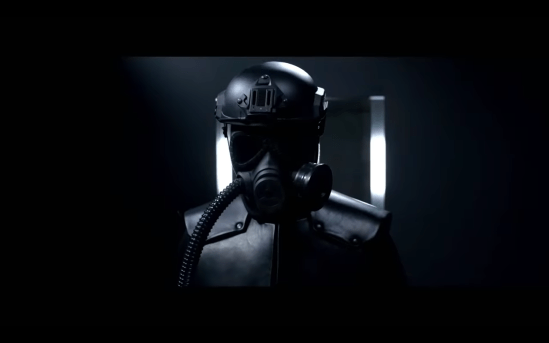
Shady shadow corporations, experimental nano-material rehabilitation and enhancement, and high level science fiction noir from writer James S. Abrams and director Dee McLachlan with 2019’s “The Wheel.” As if not already obvious from filmmaker’s nationalities, “The Wheel” is produced by and shot by Australian production companies SunJive Studios and Film Victoria, a state government agency that advocates funding and other filming assistances for shooting films in sectors of Victoria, Australia. “The Wheel’s” steely posture mirrors the frigid winter snow of Melbourne, Victoria’s covered forests that’s beautiful, yet deadly in the conventional beauty of nature. Yet, “The Wheel” delves into the meddling of what makes man and what also drives man as the story persists on the subject of redesigning the human body, but what that notion doesn’t take into account is what if the human body’s reactions doesn’t go as planed and a clapback ensues with all the synthetic re-wiring behind it? This is what Abrams and McLachlan intended to explore.
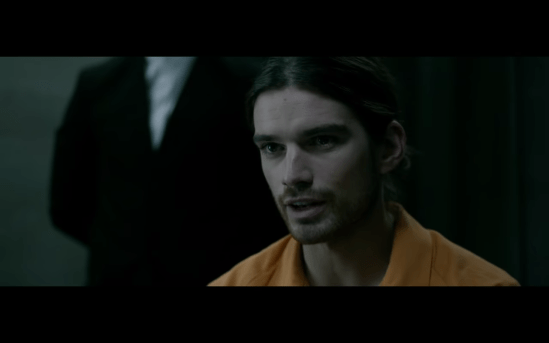
Australian actor Jackson Gallagher stars as Matthew Mills, a cripple with a purpose. The “Patrick” actor has been adrift from the darker roles since 2013 until up now with his main role in “The Wheel” that demanded a certain physicality that involved fight sequences with one, or two, or even three opponents and some ariel ropes work. The physically fit Gallagher not only survives the daunting workload, but hastily pulls Mills through his character’s tough transition from hopeful paraplegic to overly confident ultimate fighting weapon without an earnest core of struggle. The same can be said with Dr. Allison Turner played by Kendal Rae (“Out of the Shadows”). Turner’s a rogue researcher who had her practicing credentials revoked after the mistreatment of lab monkeys and was sought after by the Satoshi-Telefair for her detachment qualities, but her Turner’s character also didn’t quite arc properly and resembled a midway plateau from the moment Mills became her research subject. The only character that stayed the course was Dr. Emmett Snyder, a loyal Sataoshi-Telefair researcher to the bone. When he’s not suplexing or drop kicking in a championship wrestling match, David Arquette does dabble in acting. The “Scream” veteran actor fills in a rather unlikely antagonistic role, but the wild eye Arquette remains taut in his performance. “The Wheel” also costars Belinda McClory (“Matrix”). Christopher Kirby (“Daybreakers”), Victoria Liu, and Ben Still.

The spoke of the “The Wheel” rotates on a monotonic and frosty shoulder axle colored in gun metal and iced with dystopian immoralities. Every breathing element and inanimate objects is in a state of distant identity being bestowed labels in a combination of letters and numbers. The utilitarian wheel, an underground experiment facility that shifts rooms up and down and can be rotated to the other side, has no windows or any kind of necessary function other than to test subjects. Where “The Wheel” goes full “Equilibrium” by lacking emotional depth and substance without a coup d’état of the bleak authority, “The Wheel” also lacks vigor to break the blank uniformity and tries to speed through Mills patriarchal fluff to provide reason for his endurance and to provide reason for audiences to care. The epicenter theme to Mills motivation and escape is the thought of getting back to his daughter by any means necessary and was deemed fit to lay by the waist side to rely more on the hand-to-hand fighting like an overly glorified 70’s martial arts film.
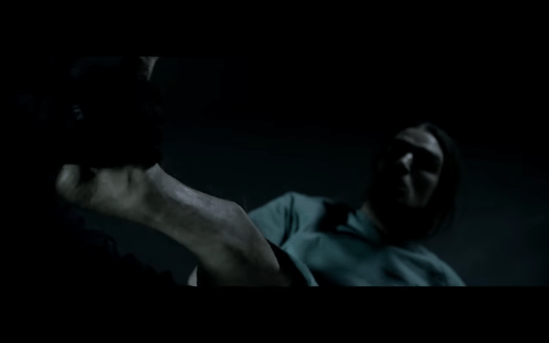
Umbrella Entertainment distributes the sci-fi, action film, “The Wheel,” produced by SunJive Studios and Film Victoria onto a region free DVD home video. The clean digital picture in a widescreen, 2.35:1 aspect ratio, has a crisp demeanor that exact a bunch of natural lighting outside with a bit of a lower contrast inside dark “The Wheel” itself. What I found more appealing the anti-aliasing of the drone footage over the snowy covered Victoria forest, suggesting a higher bitrate compression that offers a seamless and smooth recording. The 5.1 English language Dolby audio is offered up with no whiff of an Australian accent in a lossless track that sounds good on the surround channels during action scenes. Dialogue is clear amongst the ample range and depth of ambient layers of researches watching and speaking through comms from inside a box watching another guy inside a box. Like other Umbrella releases, “The Wheel” has no special features nor a static menu. “The Wheel” has ice in the veins, but no warmth in it’s heart that seems vertically challenged on a horizontal slope of dystopian disorder.

The Wheel on DVD

EVIL’s Brush Stroke of Genius in “Art of the Dead” reviewed!


The Wilsons’ are the perfect portrait of a nice family; they’re wealthy but charitable and kind without exploiting the humility of others. However, when Dylan and Gina Wilson bid and win on the SinSational art collection at auction and hang the enchanted paintings strewn through their mansion estate, a strange succumbing to sin overwhelms their moral fiber. The paintings of Dorian Wilde, an eccentric and obsessive 1890’s painter who achieved eternal soul longevity by making a pact with the devil, created the art, depicting primal animals symbolic of the seven deadly sins, by using canvas and paint out of flesh and blood of his victims. The Wilsons’ become corrupted and carry out the sins of Pride, Lust, Gluttony, Sloth, Greed, Envy, and Wrath and the only way to save the family from damnation lies in the hands of a former priest, Father Mendale, and a girlfriend, Kim, of the oldest Wilson boy engulfed by Wrath.

“Art of the Dead” is what people call when art comes to life, or in this case, death. From the selective “Emmanuelle” film series and “There’s Nothing Out There” writer-director, Rolfe Kanefsky comes a story woven with the seven deadly sins theme as a foundation that approximates a 90’s grade thriller of epically gory proportions. With a catchy, yet dead horse beaten “of the Dead” title, “Art of the Dead” uses the seven deadly sin theme and blends it with an obvious homage to the gothic literary novel, “The Picture of Dorian Gray,” by Oscar Wilde. The main antagonist, Dorian Wilde, is the merging of the author and his fictional creation. Oscar Wilde wrote the novel in 1891, the same era the story enlightens in which Dorian Wilde makes a pact with the devil. Unlike another notable film, “Se7en,” where a practical killer exploits the capital vices to thwart a pair of detectives, “Art of the Dead” introduces dark, supernatural forces of Oscar Wilde’s work into the fold that are not only abject in what makes us human, but also biblically condemning, spearheaded by a satanic maniac who will do everything and anything to maintain his precious work and eternal soul, Produced by Michael and Sonny Mahal of Mahal Empire productions, the financial investors have also backed a previous Kanefsky film, another occult gone astray thriller entitled “Party Bus to Hell,” and in association with Nicholas George Productions and Slaughtercore Presentations.

Another pair of producers are also a couple of headlining actors who are household names – “Sharknado’s” Tara Reid and “21 Jump Street” actor and avid painter, Richard Grieco. Reid plays a snooty and shallow art gallery curator who sells willingly the Dorian Wilde set knowing well enough of their malignant history, but Grieco has a personal connection toward a film regarding art more so than the dolled up Reid because of his nearly 20 year passion as an painter of Abstract Emotionalism. His character, Douglas Winter, is obsessed with the SinSational collection to the point where it uses him as an instrument to kill his artistically unappreciative family; a sensation washed over as parallel and broad among all artists alike fore sure. Jessica Morris (“Evil Bong 666”) and Lukas Hassel (“The Black Room”) also headline. Morris provides the sultry and lustful-influenced mother, Gina, and her golden hair and blue eyes has a fitting innocence that’s is tainted and provocatively shields the cruel intentions of lust and power while Hassel, a giant of a man, immediately becomes capitulated to greeds’ warty influence. Each actor renders a version of their paintings and each dons the sinful presence gorgeously with individual personalties and traits; those other actors include Cynthia Aileen Strahan (“Dead End”), Sheila Krause, Jonah Gilkerson, and Zachary Chyz as well as “The Black Room’s” Alex Rinehart and Robert Donovan along with Danny Tesla playing the demonic proxy of Dorian Wilde.

“Art of the Dead” embodies an innovated spin on a classic tale of self-absorption and deferring one’s own detrimental sins upon others to carry the burden. Kanefsky grasps the concept well and visually sustains a contextualized 98 minute feature that carries a straightforward connection to the Gothicism of Oscar Wilde while cascading a family tree (pun intended) of problems that pinpoint each sin’s affecting destruction upon the soul through a wide burst of dispersive poison. While the idea is sound enough, the script and narrative channelling hardly carries the equivalent weight of the idea and comes off clunky, cheap, and sometimes uncharismatic. “The Black Room” was the last Kanefsky film critiqued at ItsBlogginEvil.com and the script was noted with the characters that hardly progress up toward and out of the despondent and deviant muck and it was the filmmaker’s softcore cinema background that attributed to the characters over-saturated girth of lust, which elevated and hindered “The Black Room’s” incubus storyline. With “Art of the Dead,” Kanefsky redresses the lust to quench just the respective sin with the right amount of perversion, represented by the mythical, sex driven Satyr that was created beyond being a nice touch of storytelling, disturbance, and meta kinkiness. Kanefsky continues to proportionally feed each sin the same manner with the exception of Pride that lures in a specific victim; however, the paintings’ insidious nature wonders to a circumstantial level at best with Kanefsky’s tongue-and-cheek dialogue and uncouth playfulness of Dorian Wilde while possessing the flesh of a black-laced, Fredrick’s of Hollywood-cladded Gina.

Umbrella Entertainment and ITN distribution release “Art of the Dead” onto a region 4 DVD home video and is presented in a widescreen, 2.35:1 aspect ratio. The sterile and polished look of the image renders doesn’t invite stimuli to visual senses, but is superbly clean and free of blotchiness that can routinely be a contrast issues with darker, indie productions; however, the digital source is nicely maintained and the darker scenes and colorfully deep portions of the paintings, the viscous blood, the modernized Wilson house, and the anywhere else have quality caliber. Visual and practical effects are necessarily key for “Art of the Dead” to be successful and the film scores a combination of talent to enhance the ho-hum photography with renaissance man Clint Carney, whose visual effects work on his own written and starred in film “Dry Blood” was flawless and who also painted Dorian Wilde’s works of art, and some solid practical and Satyr creature effects work by “Child Play’s 3” Victor Guastini and the VGP Effects team. The English language Dolby 5.1 surround sound audio is clear, precise, and no inkling of issues with the range and depth of ambient sound. Like most standard DVD releases from Umbrella Entertainment, this release comes with no bonus material or even a static menu. To observe his work as a whole, filmmaker Rolfe Kanefsky has nothing to prove with a body of work spanning over nearly three decades, but in reducing “Art of the Dead as a singular film, there in lies a double edged sword. A true sin is to headline a film with actors with brief roles just to draw in investors and an audience, yet “Art of the Dead” also finds innovated modernism out of classical creativity, giving new life by homage, and displaying some maximum carnage fun with plenty oil and water color.

“Art of the Dead” available to own and rent!

When Alone, EVIL Will Be Your Company. “The Wind” reviewed!


Living at the edge of the 19th century frontier, husband and wife, Isaac and Lizzy, live in complete seclusion as far as the eye can see until another couple, Gideon and Emma, settle a mile away in a nearby cabin. Unused to the punishing conditions the frontier might yield, the St. Louis bred Gideon and Emma find living without the comforts of urban life challenging and rely on Isaac and Lizzy’s strength and experience for survival. However, the frontier’s harsh reality produces a malevolent presence that flows through the prairie, stalking and toying with the settlers, only revealing itself to Lizzy while the others act if nothing is going on or just acting strange. The sudden and violent death of Emma and her unborn child send Gideon and Isaac on a two-day ride to nearby town, leaving Lizzy to face the isolated terror alone with only a double barrel shotgun that never leaves her side, but in her strife, Lizzy learns more about her newfound neighbors and even unearths some troubling truth about her husband that even further segregates Lizzy from the rest of reality.

If there wasn’t one more single thing to demonize, director Emma Tammi conjures up “The Wind” to mystify the western frontier. As Tammi’s debut directorial, penned by short film screenwriter Teresa Sutherland, the supernatural film’s dubbing could be a rendering of a long lost Stephen King working title, but all corny jokes aside, “The Wind” really could from the inner quailing of Stephen King’s horror show mindset. The film’s produced by Adam Hendricks and Greg Gilreath under their U.S. label, Divide/Conquer, and released in 2018. The same company that delivered the horror anthology sequel “V/H/S: Viral,” Isa Mezzei’s sleeper thriller “CAM,” and the upcoming, second remake of “Black Christmas” with Imogen Poots and Cary Elwes. With a premise dropped right into the fear of the unknown itself and with some powerful production support, “The Wind” should have soared as an unvarnished spook show come hell or high noon, but the jury is hung waiting on the executioners ultimate verdict regarding Tammi’s freshman film.

Five actors make up all the cast of “The Wind,” beginning with the solemn opening night scene with frontier men, Isaac Macklin (Ashley Zukerman of “Fear the Walking Dead”) and Gideon Harper (Dylan McTee of “Midnighters”), waiting patiently outside a cabin door until Isaac’s wife, Lizzy (Caitlin Gerard of “Insidious: The Last Key”) walks out, supposed baby in hand, and covered in blood. The subtle, yet chilling scene sets the movie from the get-go, sparking already a mystery at hand and coveting most of the focused cast. The two characters unannounced at the beginning, swim in and out of flashbacks and toward the progression of Lizzy’s embattlement with “The Wind.” That’s not to say that these characters are any less favorable to the story as “Slender Man’s” Julia Goldani Telles shepherds a vivid description of subtle lust and extreme instability that rocks a strong and self-reliant Lizzy living priorly a stale reality. There’s also the introduction of a wandering and warm pastor that leads to chilling reveal questioning any kind second guesses there might be about Lizzy. All thanks to veteran television actor, Miles Anderson.

“The Wind’s” non-linear narrative teases two courses, one working forward and the other backwards to a catalytic moment that becomes motivational for majority of characters in the prior days and the beginning of the end for one in particular. Though the latter centralizes around Lizzy’s flashbacks and encounters with the evil spectral wind, her descent into madness conjures more violently through the discovery; it’s as if her current state of mind has been stirred, whirled, whipped, tumbled, and agitated from the past that keeps lurking forward into her mind’s eye. Tammi pristinely conveys a subtle message of undertones from the past and present that chip away at Lizzy’s forsaken reality, leaving those around her delicately exposed to her untreated alarms to the nighttime wind of a menacing nature. Teresa Sutherland’s script to story is illuminate tenfold by the wealth in production that recreates the rustic cabins and the callously formed hardships of the western frontier and if you combine that with the talents of cast, “The Wind” will undoubtedly blow you away.

Umbrella Entertainment delivers Emma Tammi’s “The Wind” into the Australian DVD home video market and presented in the original aspect ratio, a widescreen 2.35:1, that develops a hearty American untrodden landscape for the devil to dance in the wind. Cinematographer Lyn Moncrief’s coloring is a bit warm and bland to establish a western movie feel and really had notes of a Robert Eggers (“The Witch”) style in filmmaking with slow churn long shots and a minimalistic mise-en-scene, especially for a similar pseudo-period piece. Eggers invocation solidified itself more so in the Ben Lovett’s crass and cacophony of an instrumental score that adds more to the creepiness factor while remaining relatively framed in the time era. The Umbrella Entertainment’s release goes right into the feature without a static menu so there are no bonus features to dive into. “The Wind” might feel like an unfinished piece of cinematic literature, but remains still a damn fine thriller that seeps ice cold chills into the bones and ponders the effects of loneliness and trauma that’s nearly puts this film into the woman versus nature category, a premise that will be hopefully concluded by a upcoming book adaptation.

A Double Dose of Jason Blade Breaking Bad Guys’ EVIL Jaws in “Day of the Panther” and “Strike of the Panther” reviewed!


A secret strike force known as the Panthers enlist the best of the best when considering agents and those who pass the Panther’s rigorous training will become part of the fight for good organization. The Hong Kong Panther branch graduates two Westerners, Jason Blade and Linda Anderson, who become a perfect undercover team. When the pair uncover a Triad drug ring, the investigation sends Linda ahead to Perth in West Australia to initially track down Jim Baxter, a lethal enforcer in the drug dealing business. Anticipating losing the tail on Baxter and disregarding Jason’s wishes to wait for his arrival, Linda surveils and sneaks into the Baxter’s hideaway only to be falling into a trap that ends in her demise. Jason vows vengeance and infiltrates Baxter’s organization for leads and information, using his martial arts expertise to gain him complete trust and access to the kingpin.

“Day of the Panther” is part one of this two part film series which has been released onto Blu-ray courteously by Umbrella Entertainment and, perhaps, even showcases Australia’s most famous martial arts superstar! Released in 1988, “Day of the Panther” combines fisticuffs, roundhouse kicks, and an arsenal of quips into a panache of action hailing from the land down under. Hard to phantom that Brian Trenchard-Smith, man behind “Dead End Drive-In” and then later went on to direct demonic anarchy in “Night of the Demons 2” and a couple of those pint sized “Leprechaun” sequels, one including space, was at the helm, steering eight glorified and unstoppable fight sequences complete with “Street Fighter II” punch and kick sound effects. “Dangerous Game” stunt coordinator and writer, Peter West, pens the script that leads Jason Blade down a road of vengeance for a slain colleague in a formulaic and cliché trope driven plot, but this Ozploitation is more entertaining than uninteresting for a younger audience.

In “Strike of the Panther,” the break a politician’s drug addicted daughter out of a brothel and inclusive crime fighting Panther, Jason Blade, returns when Jim Baxter holds hostage’s his girlfriend, Gemma Anderson, after a deadly prison escape. Fortified in a ready to detonate vacant Perth power plant, Blade and his crime task force attempt to beat the information out from Baxter henchmen before sieging a rescue. Baxter declares his own brand of revenge toward Blade that not only includes high yield explosives that could wipe Perth from off the map, but the brute also summons every malign martial arts fighter he can muster to cloak themselves in amongst the power plant rafters, lying in wait for Blade and the police to storm their holdup. Blade must go for Baxter alone to not only save his girlfriend, but save Perth as well.

What is essentially Jason Blade part deux, “Strike of the Panther” retreads over old footsteps in this 1989 release with Brian Trenchard-Smith and Peter West filling in once against as director and writer. The obvious back-to-back shoots suggests that not much has diverted from the original tone of the film and with that truth, Jason Blade continues his trend of human punching bags without so much of breaking a sweat. The sequel, much like the first film, is good, clean action without much blood, without much cursing, and without much perversion. “Strike” might be edgier with a few more side boob scenes. That’s about it.

Martial arts expert Edward John Stazak is quintessentially the Chuck Norris of Australian cinema, but whereas Norris has a prolonged career in the film industry, with credits out the wazoo, Stazak’s success in the biz never took a jump kick flight. Not even with Jason Blade, a character who sounds like a fighter straight out of a Mortal Kombat installment, could boost a lustrous vocation. Stazak’s likeability is only shorn by his lack of expressive versatility as he’s virtually one dimensional, showing no range of emotion when the scene calls for it or even when in the rare instance of being bested at a fight, but the handsome, muscular Aussie can sell a hand-to-hand skirmish with one or ten opponents without wondering too far into cheesy coordinated territory, which Stazak co-assisted in the fight sequences alongside screenwriter and stunt man Peter West. The lack of a good and powerful antagonist also spikes “Day” and “Strike’s” well-rounded action status. Jim Richards as the tough Jim Baxter wasn’t a formidable adversary for Jason Blade. Baxter never challenges Blade’s weaknesses because Blade doesn’t have any weakness so it seems. Even with Gemma Anderson is kidnapped, Baxter never really leverages the opportunity. Jim Richards also looked out of shape in comparison to Stazak, who routinely went sleeves and, more frequently, shirtless to show off his physique, but Richards is also a well-known self-defense instructor who has worked with military personnel. In short, Stazark looked better for the camera. If you’re not an actual fighter, you’re an actual actor, such is the case with John Stanton and Michael Carman who brought a little thespianism to the “Panther” films. Stanton presented a fatherly figure, playing a Panther named Wes Anderson at the tail end of his tenure with the organization, to Stazak’s Blade. Andersen’s barely copes to the loss of his daughter, Linda, but that’ the Panther way or so it’s assumed as he puts it, “life goes on.” That such detached reality can be said about Zukor, the drug kingpin of Perth, played by Michael Carman (“The Devil’s Playground” and “Quigley Down Under”). Carman provides the aggressive affluent with has thugs to do his dirty work. Unfortunately, Carman does not continue with his Zukor role in “Strike of the Panther,” but Zukor and Wes are the fire and ice that motivate the marionettes into action at least in “Day of the Panther” while Wes pivots on a strange character tangent with supernatural abilities that’ll be explored later. As far as Love interests go, Paris Jefferson fills that void as Gemma Anderson. The “Xena: Warrior Princess” star becomes the niece to Wes Andersen, taking care of her uncle while she takes care of Jason Blade’s needs – wink wink. Jefferson’s stout feminine performance perfectly outcasts any kind of frail attributes typical of a damsel in distress that’s is trope-laden in action films; think Mary Elizabeth Winstead in “Live Free, Die Hard.”

Overall, as action films, “Day” and “Strike of the Panther” are fairly conventional martial art films for the 1980’s with a few eye brow raising quirks. For instance, Jason Blade is infallible. Perhaps, too foolproof as he single handily breaks down drug structures with a one-two punch simplicity, as if the level setting was on easy mode. Another what? moment stems from the character Wes Anderson in the sequel film when he suddenly obtains empathic powers after being grazed by a fleeing car and he’s able to reach Jason Blade on a subconscious level as he enters the power plant’s maze and takes on ninja-cladded warriors. Lastly, for back-to-back shot films where the release dates are stack closely upon each other, the need for an in-depth recap was terribly excessive that perhaps only required a tiny bit of exposition to fill in the gaps. “The Evil Dead” series is an ideal candidate for comparison of prologue recaps. Ashley Williams explains, with accompanying depiction variants, in “Evil Dead II” and “Army of Darkness” his misadventure to a cabin in the woods and his poor Linda becomes a Candarian demon plaything, but the Sam Raimi directed cult horrors are also at least five years separated. Brian Trenchard-Smith concentrates his direction of “Strike of the Panther” to detail almost every plot point through a Wes Anderson voiceover and rehashed footage. There are also awkward workout and dance scenes reused for the sequel that are not a nod back to the first film, but are used as current storyline. Talk about your deja vu!

Umbrella Entertainment release “Day of the Panther” and “Strike of the Panther” onto a double bill Blu-ray, a first for the Ozploitation gems. The two-films on a single BD50, region B disc is presented remastered in a high definition 1080p widescreen, 1.85:1 aspect ratio, from the original 35mm interpositive negatives, scanned and restored in 4k. Despite some minor strip issues (i.e. some cigarette burns and a few translucent scratches), the picture has tremendous stability in color and in natural grain. However, the framing seems a bit off as if the cropped, but that could also be very much intentional by cinematographer Simon Akkerman. The English language 2.0 DTS-HD Master Audio track has full-flavor robustness and balanced across the board. Remember those Street Fighter II sound effects? Dialogue has good distinction with solid range and depth with the soundtrack and ambience. No subtitles are available on this release. Unfortunately, there are no bonus features on this release either. The Brian Trenchard-Smith back-to-back films, bustling with endless wrangle, hail from Australia for the first time on Blu-ray and while might seem excessively obsolete in contrast to today’s action film, “Day of the Panther” and “Strike of the Panther” are ravishing relics that are extremely priceless to martial art cinema collectors.

Day and Strike of the Panther on a Blu-ray! WHAT!! Get it now at Amazon!

Edna is EVIL According to the “Reform School Girls!” Reviewed!


After being apprehended for robbery, underage Jenny is sentenced to 3 years at Pridemore reform school where she immediately clashes with an iron fisted dorm administrator named Edna and her intimate inmate enforcer Charlie Chambliss. With a few friends on the inside, Jenny’s group becomes the target of Edna’s biased infraction system and Charlie sets her domineering sights on breaking the girls’ wills into submissive followers. The school is controlled by an equally sadistic, evangelically abusive Warden Sutter and Jenny’s multiple attempts at reforming the reform school with the assistance of a sympathetic psychologist staff member, and even her attempt to escape, have failed with torturous consequences. As Edna tightens her grip, Jenny and the girls seethe more violently as the weeks pass up to an inevitable uprising, snapping the young girls’ spirits when enough is enough.

Wet, wild, and womanizing, Tom DeSimone’s 1986 satirically women in prison film, “Reform School Girls,” is a cavity invasive good time all around! DeSimone, who also penned the script, has a revolutionary background as a male gay porn filmmaker, but made the crossover into cult genre films after his successful runs with “Chatterbox” featuring exploitation starlet Candice Rialson and “Hell Night,” starring “Exorcist’s” Linda Blair. Yet, “Reform School Girls” is hardly separation from the director’s once moonlit experiences other than the cast is almost entirely made up of beautiful, naked women showering together and when they’re not fully nude and wet, they might as well be wearing nothing while cladded in skimpy outfits and lingerie as a few characters copulate insinuatingly instead of explicitly. The only thing DeSimone was probably uncomfortable with was his last two WIP features, “Concrete Jungle” and “Prison Girls,” as they struggled to find an appreciative audience and thus “Reform School Girls” was constructed to be a mockery of the whole WIP market, exploding it violently, and sensationally, with the genre tropes that, ironically, skyrockets this film’s cult success.

The incarcerated characters offer a wide variety of individualities that are ultimately filled by big personalities themselves. Sometimes, those personalities come with a little head scratching questions. Such is the case with lead actress Linda Carol who isn’t the headliner of the “Reform School Girls,” but she’s certainly one of the main leaders, Jenny, of an imprisoned pack. Born in 1970, Carol had to be no more than 14 to 16 years of age at filming and was cleared for a number of nude scenes, especially around other nude women, but Carol had fire in her performance; in fact, the cast from specified roles to the undesignated titled roles were all highly stimulating in their presence and demeanor. When first entering dorm 14, teased hair and underwear was the unofficial name of the scene that spoke about the genre of the decade in a matter of a few minutes. This is where we meet Charlie Chambliss, a buff, scantily-cladded, totalitarian gang leader of dormitory 14, played fluorescently by rocker Wendy O. Williams. The then mid-30-year-old Williams was a bit of a duck out of water in a role that was for a teenage girl, but the front woman of The Plasmatics was awfully charismatic, brash, and a real illustrated performer who exaggerated dramatics to the next welcoming level in her knee high platform boots. While Williams had sexy hot-to-trot flair, Pat Ast leisurewear offered nothing more than a dull white coat over matron garb, but Ast punctures through anything matriarchal and goes full blown maniacal as dorm keeper Edna. Ast goes over the top and beyond with a love to hate – scratch that – kill character. If you think the evil that embodies Charlie and Edna ends there, you’re wrong! “The Howling II: Your Sister is a Werewolf’s” Sybil Danning’s apex of evil, Warden Sutter, struts around the school like a German commandant with a soapbox of vile and wretched women in a perverted Biblical sense and mastermind behind the abusive culture at Pridemore. The cast concludes with Charlotte McGinnis, Sheri Stoner, Denise Gordy, Laurie Schwartz, Tiffany Helm (“Friday the 13th: A New Beginning”), Darcy DeMoss (“Friday the 13th Part VI: Jason Lives”), and Winnifred Freedman.

Shooting from the hip on first viewing impressions, “Reform School Girls” is nothing like we’ve ever seen before. Sure, we’ve all see women in prison films, from “Big Bird Cage” to even making an argument on Netflix’s “Orange is the New Black,” and we’ve also see cheeky 1980’s comedy that if made today would be grossly lambasted with politically incorrect protestors. Yet, DeSimone’s satire take undercuts the stern nature of the WIP genre with great flamboyancy toward institutional exploitation and the ugly invasive issue of sodomy and rape that the themes can be easily pushed aside without so much of an inkling of consideration. Explosions, gunfire, skimpily dressed women, shower sequences, bitter tongue and cheek, and anything and everything that was omitted from grindhouse market place in this film constructs a smoke and mirrors effect that pivots sharply before getting ankle deep into the issues, no matter the severity just as long as Pat Ast crunches her face into a luffa shape and appoints a barely clothed inmate to a mandatory cavity search and the viewers would be just as captivated.

Umbrella Entertainment and Lakeshore Entertainment release the International Cinevision and New World Pictures production of “Reform School Girls” on a PAL 4 region DVD, presented in a widescreen, 1.77:1 aspect ratio; a slightly cropped version of the original film format. Whatever is cropped out is too trivial and the image picture supplies a palatable presentation with bold hues and bare, but naturally colored, skin tones, despite some fake tanning. One noticeable fleeting moment of an 35mm stock cigarette burn in the upper left corner of a scene, but in-and-out in a blink of an eye. The stereo 2.0 Dolby Audio mono track has balance that singles out the robust dialogue against a leveled down ambient and score recording. The range is good amongst all the reform girl chatter in the dorm rooms. A handful of shower and bathroom scenes have some muffled echoed moments, but the discord in these moments is still extremely low. Surprisingly, there isn’t one single bonus material on this disc, not even a static menu as the film goes right into play feature mode. “Reform School Girls” makes light of wretchedness, revels in the fun of unsavory fraternizing, and is unapologetic of a carnal and wicked tone on and off the screen, harboring one hell of a women in prison cinematic guilty pleasure.

Umbrella’s DVD is available for purchase at Amazon.com!