

The Motel Mistress stands tall beside a highway on the outskirts of Bangkok. The adult-oriented love accommodate caters to the freakiest of the freaks under the soft glow of the hotel’s purple-pink neon marquee that’s shimmers on the rooftop during the tantalizingly active nightlife, flickering to a more conspicuous Motel Mist, but during the day, the near vacant hotel sits dormant and has scarce use. That’s all about to change when four visitors and one Hotel Mist front desk man become five strangers entwined into an uncanny affair that begins with illicit sexual desires between an extremely perverted and dangerous middle-aged man and a young school girl with ulterior motives and ends with a former child star’s refuge into, what he believes, is communications from beings not of this Earth. Salacious deviances, revenge, and strange occurrences check into the Hotel Mist, but will the five strangers check out?

From the erotically charged DVD cover from Philadelphia based home video distribution company, Breaking Glass Pictures, the Truevisions Original Pictures in coproduction with the 185 Films and Song Sound Productions produced “Motel Mist, written and directed Prabda Yoon, has the irrefutable markings of an unforeseen science fiction thriller from Thailand. Yoon’s introductory 2016 picture initially dodders on various genre borders that venture into the human complexities of interaction from an alienation or a subversive standpoint and wholeheartedly whips 180 degrees merging into exacting revenge and experiencing unearthly dimensions to an inevitable mesh correcting what’s characteristically abnormal. Though sexual romps in one-night-stand lodges have been marketed as quite the norm in Bangkok, Yoon pushes the creepy factor limits to the max, turning the dial on predatory intentions to an unreal reality.

The focus surrounds five characters with dialogued roles. The characters, with the exception of two of them, are essentially from all walks of life: a young hotel concierge with ambitions to be a fire stick performer, a middle-aged man with duel façade, a child star with unknown psyche complications, and then there are the school-aged girls with relatively the same motivation, but of a diverse personality type. We’re gently introduced to the middle-aged father figure Sopol, played by Surapol Poonpiriya, gazing at a newscast about a missing child celebrity on a car onboard touchscreen. Poonpiriya reels in slowly a conservative, perhaps even old-fashioned, fatherly figure where children shouldn’t swear and nose deep in cell phones isn’t a proper and good thing, but then the actor yanks hard back on the spoke, settling his character into a blurry role between niceties and deviances. Sopol’s an abhorrent wolf in sheep’s clothing, lavished and proud of his alternate life of an older man whose been with many younger women in his prefabbed BDSM motel room. His latest fair object is Laila, a young school girl in a short skirt with fresh innocence splayed from head to toe, performed by Prapamonton Eiamchan. Laila goes with the Tot’s flow by guiding her every move and letting him manipulate her like a doll of his pleasure. Eiamchan’s curious portrayal befalls her character’s with a relationship with masochism because of a more deep rooted motivational factor and the dynamic between Eiamchan and Poonpiriya pulls at the unsettling strings while also teasing visceral fantasies. Yet, oddly enough, Vasuphon Kriangprapakit cerebral performance being an antenna for alien correspondence is more intriguing. Kriangprapakit’s Tul is the crucial focal point that connects each character, playing against their vices that shepherds into a more savior role; in fact, Kriangpapakit could be considered appearing like the Thai version of the Messiah. While Tul requires a force invading into one’s mind bubble, Tot bubble seems to have popped with vague ambitions and being an overall motel lackey. Tot, a role suited for the talented Wissanu Likitsathaporn, sports green hair atop his punk rock outfit, and, like today’s typical millennial, enjoys conversing on the phone, especially with women. His sympathetic qualities aim to grant him amnesty for his cooperative nature, especially assisting covertly alongside Sopol, and being an agent of greed when figuring out his other daytime tenant, Tul, has a reward for his whereabouts. Katareeya Theapchatri rounds out the cast as Laila’s accomplice, Vicky.

As the subtitle insists, “Motel Mist” is a setting where there are no limits. Whereas that’s true for unlimited sexual pleasures and displeasures as well as thematics akin to the “Outer Limits,” “Motel Mist” has some limitations to challenge the experimental engine on which the film is powered. For one, the takeaway message has vague variables and not enough outright exposition to grasp viewers by the balls for that deep-in-thought, chin scratching moment that ekes forward the turning giant wheels in our heads, spinning conclusions and possible theories into plausible themes. For me, the takeaway message borders somewhere along the lines of the mysterious mechanics of the cosmic universe righting the wrongs between inherently misguided human faults and interactions. Whether that notion weighs in with any truth or not is most certainly up for grabs and could possibly way off the marker, but the enigmatic complexities are what make films, like “Motel Mist,” interesting to dig into and explore.

Breaking Glass Pictures calls for room service and has delivered “Motel Mist” onto DVD home video presented on a DVD9 with a widescreen, 2.39:1 aspect ratio and the region 1 Sci-Fi/Thriller runs just under two hours at 117 minutes. Often with a warm resemblance to Bangkok atmosphere, Yoon also seizes every opportunity with a vast color palate to shape the character developments in Room 7 with sultry red and Room 5 with a sterile black and grey. No problematic issues from a nice sharp picture in natural lighting juxtaposed a vivdly colorful. The frame work, by cinematographer Chananun Chotrungroi, captures micro stories with such aggression that it becomes a thing of beauty and with Yoon’s long takes, the sensation, no matter how unpleasant, lasts what seems to be an eternity. The Thai language stereo 2.0 dual channel audio mix has clean range and depth with parameters around mid-to-high levels of output through the variations of dialogue, ambient, soundtrack, and miscellaneous distortion tracks. There are English subtitles available and while seemingly translated okay, the yellow font coloring blend way too much into the background, making reading them difficult. Special features include a pair of behind the scenes with cast & crew and a trailer. Common perceptions of Bangkok could be extracted out entirely from director Prabda Yoon’s “Motel Mist” with a taste of illicit sexual affairs and the super bizarre in this unique science fiction thriller.
Category Archives: Chilly Thrilly


Make a Deal with EVIL, EVIL Will Come Calling! “The 27 Club” review!

Kurt Cobain. Robert Johnson. Amy Winehouse. Jim Morrison. Jimi Hendrix. All these recording superstars have one tragic thing in common: their fame engrossed lives ending horribly, sometimes violently, at the young age of 27 at the height of their careers. Their deaths are a part of an elite group called the 27 Club that incorporates effervescent celebrities from all walks of fame. When another popular rock star ends up mysterious deceased a night after his concert, the same concert that student journalist Jason attended, the eager academic finds himself at the right place, at the right time while researching and documenting the notoriety of the 27 Club. While hallowing out the club’s infamy, Lily, a wild and struggling musician, enters his life on a connective collision course toward his research that evidently surrounds itself around an ancient Latin-based text. The book is binding to those seeking rock star status in exchange for their souls and with a steep decline in her musical career, Lily provokes satanic rituals with exploiting help from the love struck Jason, but the only thing Lily didn’t count on was her unexpected love for him back.

The actual 27 Club lore continues to be an interesting notion. A curiously notorious concept that flew under the radar for this reviewer up until happening upon and diving into the Patrick Fogarty’s written and directed soul-bargaining tale regarding the idea’s parameters as the film’s foundation. Fogarty, the staple music video director for bands such as Black Veil Brides and The Burning of Rome, tests his hand at satanic, soul-swallowing horror, simply titled “The 27 Club,” for Cleopatra Records cinematic sub-division, Cleopatra Entertainment, and is co-written a mythos script alongside “Clownsploitation’s” Joe Flanders and Michael Lynn. Even if nothing more than a freak coincidence, Fogarty processes an innovative take on the 27 Club that has spanned over century and, perhaps, provides a little education and knowledge to those outside the music industry.

Many iconic rock stars rise from the grave to spit philosophical truths and knowledge, constructed as miniature prologues of a chaptered story, intertwined with a relatively unknown cast beginning with headlining leading lady Maddisyn Carter as the toiled Lilly seeking refuge in any drug or sexual partner her beautiful disaster can ensnare in a world of deaf tone destruction. Her character is intended to be refracted by the introduction of the 27 Club research journalist, Jason (“Mutants'” Derrick Denicola), who just happens to be around when another musician kicks the proverbial bucket, but Carter maunders through the relationship with Jason and unable to materialize compassion, losing any slither of internal conflict Lilly may possess. Todd Rundgren, Cleopatra recording artist and a member of the progressive rock band, Utopia, headlines polar opposite of Carter on the cover of the home media release only and not as a chief player in this possession plot. The role downsizes his long legacy in the music biz and though a small role and acting isn’t Rundgren’s first love, the rocker tops as being one of the film’s better moments as a record store wise-guy patron doing the right thing and a creepy video-chatty music professor. “The 27 Club” tortures the cast of remaining souls with Adam Celantano, Kali Cook (“Victor Crowley”), Zack Kozlow (“Devil’s Domain”), Mr. Chromeskull himself Nick Principe (“Laid to Rest” and “Chromeskull: Laid to Rest 2”), Jason Lasater (“Death Tunnel”), Zach Paul Brown, Emily Dalquist, Eugene Henderson, wrestling superstar John Hinnigan, Gogo Lomo-David, Tasha Tacosa (“Halloween Pussy Trap Kill Kill”), and, my personal favorite, Killjoy’s Victoria de Mare!

Novel backstory might be one thing, but a comprehensively sound one is another and while “The 21 Club” begins like a John Carpenter cask of embolism-depth imagination and beguiling, if not apocalyptic hinting, descent into oblivion, Fogarty’s film collapses when Lilly and Jason seek out a couple of drug dealers to understand the book’s portentous contents. Conveniency and rushed theatrics push a scene-to-scene overhaul that forgets to breathe and come up for air, losing that dramatic, dire consequence associated with a thriller. No consequences steep the pot to forge a luxury of sympathy or any type of relation toward the characters. Jason and Lilly’s dynamic was hot and cold at best and why Lilly kept Jason around after learning of his possession of the book is a complete mystery. The exposition isn’t conveyed properly in this instance and their coupling wipes on a thin wave toward the finale. There’s also the common motif of a sex tape – Jason records his and Lilly’s sexual encounter after a night of clubbing and Lilly’s record producer explicitly states if there’s a sex tape out there that might risk damaging her career – and then that information goes dark, nothing but crickets to line an explanation to why her sex tape would be important to the story. If a stipulation of her fame agreement with the reaper was to not lie or become involved scandalously entangled, the sex tape would be the perfect real world-relating catalyst that fully encompasses the fame-to-fallen storyline.

Cleopatra Entertainment and MVDVisual release a sweet, multi-format package perfect for home entertainment of Patrick Fogarty’s “The 27 Club.” The all region DVD/Blu-ray combo set also includes the compact disc soundtrack to the movie that features music from Todd Rundgren featuring NIN’s Trent Reznor and Atticus Ross, plus Die Klute, Bestial Mouths, The Anix, Jurgen Engler and more. The full HD, 1080p Blu-ray, which was viewed, is presented in a 1.78:1, widescreen, aspect ratio. The 97 minute digitally shot film has a wonderful color palate that often shutters from natural tones to one or two-toned primary color filters with also a desaturated approach to the 27 Club’s most recognizable members conducting a foggy room soliloquy. Banding issues have noticeable effects in various stages of darker scenes, especially surrounding a humanoid figure. The English language Dolby Digital 5.1 surround sound has insignificant bite through the multi channel conduit that denotes continuous issues with Cleopatra Entertainment’s home video releases. With a recording penchant for talent in the music industry, the expectation is high in delivering bombastic results flowing from one through five and presenting a singular comprehensive result, but the range and depth lack beside the powerhouse release and instead, find more solace in the third format of a traditional CD soundtrack content with great musical contents. Bonus features include two interviews with the film’s stars, Maddisyn Carter and Darrick Denicola, slideshow, trailers, and of course, a CD soundtrack all underneath a slipcovered jewel casing. “The 27 Club” spins a concoction of malediction around historical tragedy that’s more heinous hoopla and than harrowing horror and while the release bursts with razor sharp teeth and high pixelating resolution, channelling all the material rudimentary didn’t stay glued together in the end, hurting the character progressional arch and thinning out the hair-raising filament.

Pre-order “The 27 Club” available June 11, 2019!

One Tough Cop Takes Out the Failing System’s Trash! “Vengeance: A Love Story” review!

Fourth of July. A holiday that celebrates the birth of the United States of America becomes the physical and psychological dismantling of a widowed mother named Teena who is viciously attacked while taking a woodsy shortcut home with her young daughter, Bethie. Beaten nearly to the end of her life and dragged to a vacant boathouse, Teena is gang raped by each of her four assailants and while Bethie managed to free herself from her attackers, the child is helpless as she witnesses her mother’s near-death assault. Bethie’s testimony and positive ID of the rapist is a seemingly slam dunk win for prosecutors that will hopeful open a slither of recovering hope for Teena, but when the accused parents hire an expensively sharp attorney that spins and attacks Teena’s character that night, the case quivers on the edge that leans more toward a non-guilty verdict. Detective John Dromoor, who found Teena unresponsive after the assault, had previously met with Teen and was familiar as a humble, energetic, and friendly acquaintance, but now seeing the single mother struggling to cope not only from her rape, but through a justice system that’s feasibly flawed, the Desert Storm, Purple Heart veteran embarks onto a covert, vigilante path to rid the world of justice elusive scum.

“Vengeance: A Love Story,” inspired by the novel with an edgier, yet more shocking title, “Rape: A Love Story,” written by Joyce Carol Oates, provides the foundational narrative for the Nicholas Cage produced and Johnny Martin directed 2017 dramatic thriller that’s quintessentially an alternate model of rape-revenge of inherent brutality and toxic judicial bureaucracy challenged by moral renegades defending the decency with lethal force. Penned by John Mankiewicz as his only non-TV related project, “Vengeance: A Love Story” is not like “Live Free or Die Hard” or an “Independence Day” in the sense that’s not a 4th of July type film, granted those two aforementioned films are plump with large scale action and though Johnny Martin is a stunt man turned director, his third feature film, set in upstate New York near the Niagara Falls, doesn’t regale tales from his previous trade that includes stunt work in “Zombieland” to “Se7en” and many, many more.

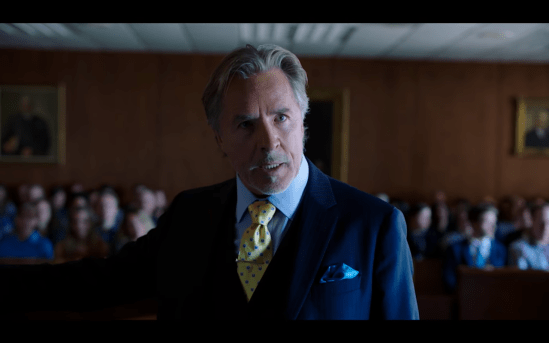
The introduction of detective John Dromoor staked out in his undercover squad car with a partner whose planning to pop the question to his girlfriend with a diamond ring. As his partner proudly displays the marital finger token, Dromoor is all business; in fact, Dromoor is all business, all the time. Reserved like Catholic deacon and deadly with firearms, Dromoor doesn’t have time to crack a smile and shows little emotion even when being a proxy of vigilante justice for an friendly acquaintance. “Mandy” star Nicholas Cage doesn’t rightly fit this role. The charismatic and eccentric actor runs through John Dromoor sedated with horse tranquilizer symptoms of stultified sluggishness, but when the moment strikes, like a rattlesnake latching on in a blank of an eye, the killer charisma of rugged resilience comes to the forefront, a quality Cage portrays well, and with vengeance in the title, should have reared up and lasted more often to let the very fervid fiber of the word sink in. When Dromoor meets Teena for the first time in the bar, prior to attack, romance seemed to beguile them between Dromoors lack of personality and Teena’s giddy, if not superfluous flirty radiance as she provides him her call me digits, but there was no romance, or at least no more romance provided, afterwards. Straying not so far from her cheerleader pepped character in “The Cabin in the Woods,” Anna Hutchison douses herself in a familiar upbeat tempo that quickly burns out when her character becomes the victim of gang rape scene. The wake of that scene challenges Hutchison to be more than just a pretty face, but an emotionally and physically battered woman suffering from traumatic stress and slut shaming. Hutchison’s goes through the various stages of trauma and the powerful relevancy has more staying power than the whole Dromoor vengeance byproduct, sending Nicholas Cage’s retribution into more of a subplot gray area. The remaining cast includes Talitha Eliana Batemen (“Annabelle: Creation”), Deborah Kara Unger (“Silent Hill”), Joshua Mikel (“Last Shift”), Rocco Nugent (“Dracula: The Impaler”), Joe Ochterbeck, Carter Burch, and “Miami Vice’s” very own Don Johnson as the hot shot prick lawyer, Jay Kirkpatrick.
Having coursed through the film’s various themes of rape, shaming, and the malfunctioning legal system, one more important theme inherently stands out with real pertinent clout issues. While two suspects, who are brothers, are arrested by Dromoor and his public servant colleagues, their venomous mother pursues hellfire guidance from a priest of the Catholic faith and as the father offers his spiritual insights, which is harmlessly conventional within the priest’s parameters, he also provides contact information for an expensive lawyer who represents the ill repute. Layers upon layers of thick symbolize can be extracted from the brief allegory, like an onion being unraveled toward a rotten core, unveiling the lengths and means of religious impurities. The fact that this priest knows of and has contact information for a powerful defensive attorney really speaks to Joyce Carol Oates’ deep-seated opinions rolled up in a single brilliant scene, but that’s where the momentum unfortunately ceases. There’s a schlepped through court hearing that’s entertaining enough and Dromoor’s barbaric rogue undertaking of the law that dishes out cold-hearted kills, but aspiration to convey more substance loses steam, the editing is systematically chunky, and Dromoor has this weird dynamic with Teena and her daughter that feels unintentionally stalker-ish and predatory. Yes, Dromoor protects and serves with unauthorized capital punishment, but without providing a deeper context of his purpose to what really motivates him to do what he’s doing, the act of retribution impressions another pressed upon imposition toward a mother and daughter’s prolonged anguish and feels more gross than justified.

FilmRise and MVDVisual distributes “Vengeance: A Love Story” on a full HD, 1080p Blu-ray presented in a widescreen, 1.85:1 aspect ratio, and the digitally shot video remains untarnished by nature or, lack of, age. No compression issues with the image quality and colors are super vibrant with a wide range of hues to take absorb. Skin tones, night scenes, and even the minimal visual effects address pinpoint consistency throughout. The English DTS-HD 5.1 surround audio track favors a strong, upfront dialogue track leveled with score and ambiance. The surround sound quality, when suitable, explodes through the channels with evidently solid range and depth. Runtime is 100 minutes and there are no other bonus features other than the film’s trailer, which has been consistent with FilmRise distributed releases. Nicholas Cage’s usual droll is riding the pine in “Vengeance: A Love Story” as if the Academy Award Winner wasn’t being paid enough to speak or act madly so he mentally sat this vendetta thriller out; however, the story has meaningful aspirations and the violence, though fleeting, is spiteful and merciless, framed around with tactless pacing, gratuitous macho shots, and circumstantial, at best, motivational retribution.

Click Above to Purchase the Blu-ray!

Bank Robbers Find Evil in “The Vault” review!

Leah and Vee, Two estranged sisters, their knee deep in debt brother, Michael, and a couple of money hungry hired hands take siege of an old bank to score a half a million dollar payday. With hostages bagged and tagged, security cameras disabled, and no outside communication to the police transmitted, the situation and plan seems to be going smoothly, but when the actual pay load is lighter than expected, desperation takes over and panic overwhelms when the prospect of load sharks will seek to take more than just fingers for payment. A more than helpful assistant bank manager is eager and willing to share information about how to obtain the 6 million dollars in an archaic vault beneath the upper levels just as long as nobody gets hurt, but the heist’s meddling into the basement’s vault stirs a malevolent evil force and their fates will be sealed inside an unsafe repository.

The 2007 “The Signal” director, Dan Bush, directs and co-writes 2017’s “The Vault,” a supernatural thriller co-written by “The Reconstruction of William Zero” scriber Conal Byrne. Tense and polished, “The Vault” has the makings of a velvety heist film that holds up formidably strong, setting up a hostage situation after a well-executed pilferage involving zesty characters with dire complexities that drive them to villainy. The opening credits provide glimpses into the duration along with associative theme, much along the same lines as Victor Salva’s “Jeepers Creepers” that scores the Harry Warren and Johnny Mercer’s jazzy “Jeepers Creepers” track from 1938 that inspired fear before the arrival of The Creeper. “The Vault” uses a song 30-years junior to “Jeepers Creepers” with Tommy James and the Shondells’s psychedelic pop track, “Crimson and Clover.”

The sisters could be exemplary examples of fire and ice; Vee’s hotheaded obstinacy and violent tendencies makes her a volatile wildcard whereas Leah’s calm, cool, and calculating measures maintain their heist from derailing into violent panic. Their estrangement boils from a tiff about Leah’s loyalty to her family as Vee burgeoningly bludgeons Leah and her their brother, Michael, that Leah will skate soon after their escape, leaving the family one-third complete yet again, but Leah being involved in this heist, coming to her brother’s aid from her possible story bred locale of South America, or wherever she might have been, has Michael questioning Vee’s steadfast position. “Orange is the New Black’s” Taryn Manning is a natural born roughneck on screen and Vee is no stretch from her Pennsatucky character on the Netflix hit comedy-drama. Manning opposites Clint Eastwood’s piercing round-eyed daughter, Francesca Eastwood, whose a complete badass in her own rite. The two actresses might be short in stature, but Manning and Eastwood effectively symbolize large personalities in “The Vault” to the point where no other character can come close to competing with them, not even James Franco as an assistant bank manager with an all-too-happy to help personality. Franco, who sports a sweet stash and wavy dark hair, provides a steeliness shroud around his character, whose credited as Ed Mass in the credits, but never specially mentioned by name. Mass is a pivotal character to the story and, if analyzed thoroughly, can be unsurprisingly figured out with relative ease, but the who, what, and why are vital questions that go unfortunately unanswered. Scott Haze rounds out the four main roles with Michael, the gentle brother to Vee and Leah whose deep in debt with collectors who have already diced off one of his fingers. Haze, who has worked alongside “127 Hours’” star in a number of films such as “The Institute,” “Future World,” and “In Dubious Battle” to name a few, doesn’t have much interaction with Franco, but is more a satellite in his own regard becoming the protector of his two more than capable sisters. Supporting cast includes Q’orianka Kilcher as lead teller, “Day of the Dead: Bloodline’s” Jeff Gum as bank officer, the late Keith Loneker as a shotgun toting cohort, Michael Milford as the safe cracker, and “Traffic’s” Clifton Collins Jr. as the shady detective Iger.

Initially, Dan Bush played his cards right setting up the pre-heist all the way through the locking down the bank and all bank employees and customers are bound and gagged. Conal Byrne’s characters spill enough backstory to water our mouths, eager to know more about the angst between the two sisters, the lopped off finger of their brother Michael, and how the turmoil between the robbers is spurred and transitioned to resolution with the introduction of the helpful assistant bank manager and his helpful information about more money in a dank, dark basement vault. At this point, the salivation is intense when only tidbits of bank’s frightening phantasms are given that place the ball on the tee, stomach high, ready to knock the living daylights out our hapless and woebegone thieves, but the surefire, can’t miss swing tops the ball that scuttles in and out of bounds. The second and third acts are a completely clunky with abrupt and disjointed storytelling involving a copout exposition on the bank’s wretched backstory that ultimately leaves that important Ed Mass character hanging out in the pointless wind. Near the tail end, the film just didn’t feel complete, bordering dangerously in choppy filmmaking waters without a woolly and unexplored antagonist at the helm and Bush can’t quite pull all the end strings together to tightly knit a harrowing climax, vacating character substance with disingenuous plot twists.

MVDVisual and FilmRise introduce “The Vault” for the first time on a full HD Blu-ray home video. The widescreen, 2.39:1 aspect ratio, presentation is a great digital asset that favors a night and day conception. Ground level on the bank is pure daylight or exact lighting that vibrant and clear, not a lot of noise, and no observation of aliasing. In the basement, the abyss like somber darkness doesn’t fade away any details, but in all fairness, the haunting figures in the dark are nearly saturated with creeping ill-lit blackness. The English Dolby Digital 5.1 and stereo 2.0 audio tracks evenly set the dialogue and ambient tracks with diverse depth, but with the 5.1 surround sound and basement dwelling apparitions that indirectly cause explosions, the range didn’t embark through the varying to and fro levels appropriately and, thus, impresses a lackluster lasting impact. FilmRise has been quite a bust for bonus content lately and “The Vault” is no different with only the theatrical trailer attached. “The Vault” has sturdy initial framework of agitated vehement characters and a clouded venomous basement, teasing the prospect of two powerful rams running to tangle horns, but, without warning, the narrative unfairly falls to pieces as if one of the male sheep decided to swerve last minute before the game of chicken came to a crash and morbid curiosity becomes sorely deprived of cinematic lethal misgivings.

Buy “The Vault” on Amazon.com

Evil Sows With Others’ Body Fluids! “DIS” review!

Ariel Konk, A former soldier fleeing from his regrettable past, seeks refuge in an isolate cabin located deep in the forest, adjacent to a lagoon. Struggling to live off the land and coping with loneliness, the soldier marches on, exploring his new, secluded surroundings. His loneliness comes to an end when investigating the ruins of a dilapidating building structure, spotting a masked half naked female and as he pursues her, Ariel witnesses her voluntarily jump from the highest level of the opened air building. Wrought with anguish, Ariel attempts suicide only to be knocked out before he could pull the trigger on his rifle. He wakes up being chained to the wall with a mute, mask figure drugging him and extracting his blood and semen fluids as necessary nutrients for a nearby Mandrake garden. A practice that has been executed many times before Ariel’s arrival.

“DIS” is a bordering arthouse horror film from writer-director Adrian Corona (“Nariz Ioca”). A blend from a horror influenced literary poem and a mythological folkore, Corona crafts a lurid, hyperbolic story that pulls, as Cornoa describes as a prefix of sorts, from Dante Alighieri’s epic journey through hell told in Dante’s Inferno, using the City of Dis that’s described as a lower hell for sinners who’ve committed violent and fraudulent transgressions, and interlocks that inspiration with the archaic lore surrounding the Mandrake plant that involves superstitiously condemning those to hell after reaping the intensely narcotic plant with the human shaped root and that would, also superstitiously, scream when pulled. “DIS” is full of interpretative terror through the 61 minute runtime that’s virtually expressive. Corona provides little dialogue to his script, keeping most of the dialect scribal incased within flashback confines, and let his actors’ raw emotions and visceral eloquence provide the tale that’s peppered with moments of visual shock and cathartic abhorrence.

I’ve said it once and I’ll say it again, Bill Oberst Jr. is one hell of an actor. The upcoming Rob Zombie “3 from Hell” actor has become a prominent staple professional in the indie horror film circuit, tackling the bizarre, the inexplicable, and the most difficult of roles with such vigor and passion that his motivation is seemingly inhuman. Right up there with “Deadly Revisions,” “DIS’ tops or equals being one of the best performances of his career, from the perspective of this reviewers’ cache of Bill Oberst Jr films. There’s quite a bit of difficulty catching up to the man who roughly does, whether as a lead or as support, 10 films a year! As Ariel Konk, Oberst captures the essence of pain and anger that saturates the character’s own personal delirium and hell with his past mistake catching up to his self-battered soul. The faceless figure who opposites Ariel feeds off the ex-soldiers repugnant and guilt-riddled past actions in a seemingly perverse mission that’s actually mandated by the suspected demon’s Mandrake lot. The plants are held in a nursery for engendering creatures, but what kind of creatures exactly? Other demons from the seed of murdered vehement people?
Remaining cast include Peter Gonzales Falcon, “Prison Heat’s” Lori Jo Hendrix, Manuel Dominguez, and Anne Voitsekhova.

The casual viewer will inherently disavow the hour spent watching “DIS” due to a number of reasons, whether it’s Ariel wandering the forest for more than half the film, or dialogue is fairly infrequent, or the chaptered sequence of events don’t perfectly describe just what the hell is going, or, just perhaps, the motif of genital masturbation and mutilation is just too much to stomach. Either way, “DIS’s” traction will slip and only a few are willing to get dirty and push the story forward with open mindedness and artistic appreciation. Speaking of artistic appreciation, Rocco Rodriguez’s cinematography is a character upon itself. The top of a Cofre de Perote volcano in Perote, Veracruz, Mexico during principal photography has breathtaking visuals that Rodriguez captures exquisitely and becomes a backdrop against the coarse material. Outside is vivid, bright, full of life, but when in the belly of the rundown structure, the manmade confines are claustrophobic and crummy, infernally ablaze for ritual, much to the akin of Dante’s Inferno. Rodriguez, again, depicts lustrous imagery that assists in telling Corona’s nightmarish story and that’s a skill all can recognize.

MVD Visual and Unearthed Films present Adrian Corona’s enigmatic and surreal “DIS” from 1922 Films onto high definition Blu-ray. The region A release is presented in a widescreen, 1.85:1 aspect ratio, and has the near epitome of perfect with, again, Rocco Rodriguez stunning photography. The lighting really comes to the fold that upheaves the brilliancy in the textures, such as in the building’s illustrious graffiti, and dares to switch to black and white when appropriate. Skin tones are fresh looking and natural in colored scenes. Only a minor aliasing issue around Obsert flared up momentarily, but ceased going forward. The Dolby Digital 5.1 surround sound has forefront dialogue, but not a bit soft, especially with Peter Gonzales, that made following difficult. There was not enough examples of range or depth to necessarily comment as Oberst was essentially alone for much of the film. Bonus features include an explanation introduction by writer-director Adrian Corona, a behind-the-scenes featurette that exhibits three takes of two scenes, a wonky static menu Q&A formatted interview with Bill Oberst Jr., a short film entitled “Portrait,” still gallery, and Unearthed Films trailers. Bill Oberst Jr. is, basically, a one man show knitted into an Adrian Corona allegory of unknown terror through conduits of literary works and medieval folklore, making “DIS” prime real estate for viewers seeking a film as an open book toward abstract gardening.

Like Indie Horror and Want to Support Bloggers! Please Consider Purchasing this title from Amazon by Clicking Here! Thank you!!

 It's Bloggin Evil!