

A father mysteriously goes missing when visiting aliens violently abduct him from his serene cottage home. Thought to be a deadbeat husband and father for abandoning his family, the man returns three years later at the doorstep of his wife’s London flat. A bewildered and conflicted wife struggles with his return while the live-in boyfriend makes it clear that he wants the man out, shelling out a vicious cold shoulder whenever in the same room, but the returned father seeks to resume his patriarchal position amongst his family; however, he’s not exactly the same person he used to be as he garnishes an exterior shell of a human and the interior of a hostile extraterrestrial with ulterior motives. His return has nightmarish affects on his traumatized son whose becoming a device of deviancy at the hand of his father’s otherworldly influence, issuing carnivelesque ill will toward other flat tenants. By the time the boyfriend suspects something, the not-so-friendly alien might have already established the intended invasion into a family so eager and willing to accept their sorely absent loved one.

Perhaps one of the most out of this world science fiction horror films ever made that’s set on Earth, “Xtro” is the Don Coscarelli-like bizarre horror film from British filmmaker Harry Bromley Davenport. Co-written the story with Michael Parry (“The Uncanny”), Davenport’s blended American and British financed 1982 unsettling venture was penned by Iain Cassie (assistant director on “Schizo”) and Robert Smith. Honestly, no other film comes within a comparison zone of “Xtro’s” sheer creativity that doesn’t just redesign the genre or it’s tropes, but, rather, embraces a new kind of fragmented oddity by telling an uncomfortable story consisting with the graphic birth of a full grown adult, the flesh crawling sensation of an adult man bending down to child level to drink from the bare skin of a child’s shoulder, and the exhibition of the dark pageantry of humor underlined death. Over an umbrella of horror shades metaphorically a fairly common family crisis baseline premise of an inattentive father’s return home to try to reinstate himself with conflicted wife and eager son only to, once again and concretely, destroy them internally.

Philip Sayer sets foot into the duplicitous titular space invader. The trained veteran actor had experience from the stage that translated to what could be considered performance art in “Xtro” to embodied a creature on the inside to his humanity on the out. Sayer costars alongside an unseasoned child actor, Simon Nash, as the young Tony and the pair make a inharmonious father and son with cankerous performances by Nash who doesn’t exactly fit, when considering accent and even appearances, his portrayed parents. Bernice Stegers is the other half of Tony’s folks and the “Macabre” star does a phenomenal job as the stiffly conflicted mother and wife Rachel Phillips, straining toward more what’s best for her love life rather than to the care of her son. The live-in boyfriend Joe, portrayed by Danny Brainin, limps by as a fairly useless character who doesn’t contribute either way to a conclusion. Other than providing a minor tether to Rachel Phillips life to normalcy, Joe can’t swallow his emotions and the best the character can offer is to abandoned his girl and son, another frail male in their life. Brainin’s performance is good for the character’s weak minded attitude. The cast rounds out with Maryam d’Abo (who goes onto to be a bond girl in “The Living Daylights”), Peter Mandell, and Anna Wing.
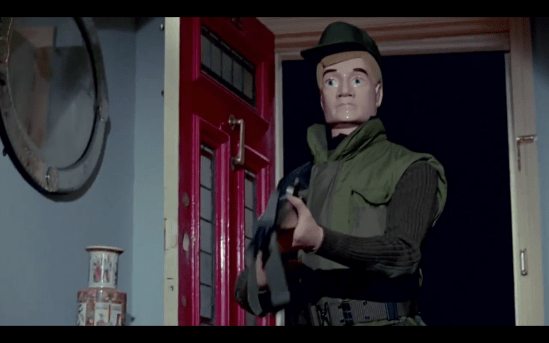
Though thought provoking and wildly entertaining through soul rattling imagery, “Xtro” is by far from a perfect film. Sure, the Tom Harris special effects pull at innard chords you may never knew you garnished and certain scenes would be the subject of mysterious gif images in the dark corners the internet that proclaimed creatures do live unknown amongst us, but the British science fiction horror film, a video nasty of the time, just might have been too absurd in the nonconformist form that struck unpopular opinions with audiences and critics because the villain wasn’t necessarily tangible and wielded a blood stained machete and more so involved obscure telepathic references that were non-explicit. There’s literally no connective tissue which makes this film so beyond the mind’s grasp. “Xtro’s” niche saw non-homaging aspects, but had familiar flavors such as a bit of Peter Jackson humor, a dry slapstick that’s hard to enjoy, but fascinating to take in at the same time. That’s the whole idea behind “Xtro” was to create an off-structured horror film that pushed the limits while not just replicating other great horror movies.

New Line Cinema’s “Xtro” is coming to a limited edition Blu-ray set from UK distributor Second Sight. The newly restored extended presentation of the transfer will also have option alternate ending plus will also be accompanied with the original video version. Unfortunately, a screener disc was provided for this particular review and comments about the image and audio presentations will not be commented on. The disc did include extras such as a brand spanking new 57-minute documentary that included new interviews with Harry Bromley-Davenport, Mark Forstater (producer), Bernice Stegers, Susie Silvey, Tim Dry (Tik), Sean Crawford (Tok), Robert Pereno, Alan Jones and Craig Lapper. Also included is a new featurette with Dennis Atherton, Harry Bromley-Davenport and Mark Forstater, ‘Beyond Xtro’ – a new featurette with Harry Bromley-Davenport and Mark Forstater looking ahead to new reboot, ‘Xtro – The Big One’, including exclusive test footage, ‘Loving The Alien: A Tribute to Philip Sayer’ featuring exclusive Brian May music tribute, and ‘Xtro Xposed’ archive interview with Harry Bromley-Davenport. A venturous Robert Shaye at New Line Cinema wanted to match wits with his own one-two punch version of a video nasty. The result was an out of body experience alien feature with unapologetic tastes and unafraid wills to push the shock market limits. “Xtro” might be one of the billions of stars in the film archive, but at least it’s one of a kind.
Category Archives: Chilly Thrilly


Evil Plots and Plans From Within! “Money Movers” review!
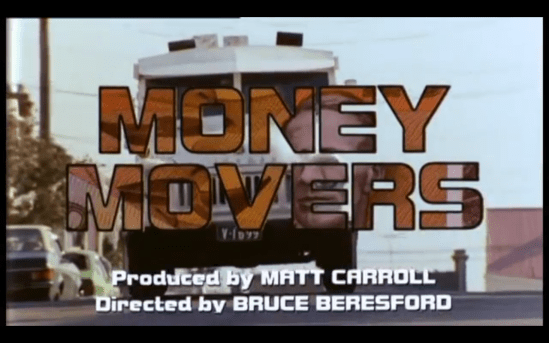
When a deadly robbery strikes one of Darcy Security Services armored cars, the security company’s chief executives aim to crack down on the already rigorous operational security protocols by implementing vastly unpopular and Union-irritating measures. The hit not only induces change to security procedures, but also opens up a can of worms that forces the hand of the three internal company men, who’ve been planning to steal from inside Darcy Security Services over the last five years, to accelerate their timeline. Their carefully laid out plan quickly becomes complicated when the mob gets wind of their elaborate heist, compelling the small three man crew to work for the crime boss without much of a choice as life and limb come to stake. Now the only thing that can stand between them and millions of dollars are two new Darcy recruits, a highly trained former police officer with a penchant for doing what’s honorable and a gun shy bloke targeted to be a prime suspect in previous armored car robberies.
Based loosely on a pair of actual robbery events authored by novelist Devon Minchin, “Money Makers” bares a ruthless resemblance to hardnose acts of crime as filmmaker Bruce Beresford captivates as the maestro behind the orchestration of Minchin’s book that’s gritty and enthralling on the big screen. The “Driving Miss Daisy” and “Double Jeopardy” director also pens a script full of bloody encounters and unflinching greed that delivers “Money Movers” as the first R-rated feature to stem out of South Australian Film Corporation, a production company that, up until then, co-produced dramas, mysteries, and family films, such as Peter Weir’s “Picnic at Hanging Rock” and “The Last Wave,” with McElroy & McElroy and later co-produced the widely successful Outback horror “Wolf Creek” starring John Jarrett nearly 30 years later.

While numerous characters are subject to suspect and their roles’ intentions are guarded to the very end, the plot, for all intents and purposes, circulates around Eric Jackson, a former champion race car driver who now tenures as a 5-year senior security guard at Darcy’s, played by Terence Donovan. Donovan gives the performance his all with a wide range of subversive behavior. From cool, calm, and collective to feral gumption, Donovan race ends in drenching ferocity that’s fueled by his fellow costars who meet him at his level of performance. The most recognizable face, at least for me, is “F/X’s” Bryan Brown who portray’s Eric’s brother, Brian Jackson. They butt heads with former police officer Dick Martin and his no tomfoolery. The late Ed Devereaux had an old school acting method, very impersonal and straight forward like a John Wayne-type, and that worked perfectly in the role of Martin who befriends the projected patzy Leo Bassett played by “Quigley Down Under’s” Tony Bonner. Bonner’s able to capture Bassett’s unconfident, yet smooth persona that’s complete opposite of his partner Dick Martin, whose confident, but brash. What’s curious about the characters lies under the surface of a domineering male lineup – the women. Not one female character is apparent in a co-lead role and each role has a presumable flaw to them. Candy Raymond is an undercover private eye who uses her body and wits for information, Eric Jackson’s wife, played by Jeanie Drynan, has an absent and naive approach, and a handful of minor roles involving non-verbal girlfriends and late night secretary carnalities. The cast rounds out with Charles ‘Bud’ Tingwell, Alan Cassell, Lucky Grills, Hu Pryce, Terry Camilleri and Frank Wilson.

“Money Movers” doesn’t scream perfection, but plays a major influential part in the infancy stages of violent crime thrillers that paved the way for such films like “Heat” or “Point Blank” and supplies another keystone in constructing the genre a solid foundation. “Money Movers” is bookend with graphic shootouts and peppered with conniving dealings and unsavory characters toward a shoot’em up heist climax that Bruce Beresford was able to depict visually and script confidently. In early scene, the storyboards could have been revised, restructured, or reordered to unearth a clear picture of establishing character backstories and setup that still process a puzzling connection between their nefarious intentions, but the ample storyline corrects course quickly without loosing too much time to ponder about the after effects of the early scenes.

Umbrella Entertainment re-releases “Money Movers” on a PAL DVD home video. The region free DVD is presented in a widescreen, 1.85:1 aspect ratio. Definition is key as the colors are, for lack of a better word, washed, but the clear cut outline that produces a sharp finish image grants this release of “Money Movers” a seal of approval that isn’t asterisked with blatant enhancements. The English Dolby Digital 2.0 track is on point with clarity in the dialogue and properly aligned, volumed, and untarnished ambiance. What’s interesting about “Money Movers” is the lack of a score that forces the viewer, subconsciously, to hone in more acute to the characters and their brazen actions. Bonus material includes “Count Your Toes – a making-of featurette with writer-director Bruce Beresford and cast members Bryan Brown, Terence Donovan, Tony Bonner, and Candy Raymond. There’s also the theatrical trailer and Umbrella Entertainment’s propaganda material. One of the first to be up on a prestigious pedastal of heist films, “Money Movers” is a violent, toe-cutting, experience armored with a great cast of acclaimed actors and filmmakers in this Ozploitation classic.
Returning Home to Unroot Evil! “Insidious: The Last Key” review!

Hot off the Quinn Brenner case, parapsychologist Elise Rainier receives a phone call from Ted Garza regarding paranormal activity at his house in Four Keys, New Mexico. The location happens to be the childhood home of Elise, where her father viciously abused Elise to stop her supernatural gifts and also where her mother was brutally murdered by a fearsome and hatred-energized demon known as KeyFace. Reluctant to return where memories revel in persistent and continuous nightmares, Elise and her two eager assistances, Tucker and Specs, take the case to aid the Garza’s request for a cleanse and to conclude the haunting and scarring chapter in Elise’s life, but the demon yearns power by luring Elise back to where it all began. With the help of her brother and two nieces, Elise’s family and friends aim to be a force against pure and undiluted evil hidden in the further.

Full disclosure….Insidious: Chapters 2 and 3 is not in my well versed cache of watched movies. I thoroughly enjoyed the atmospheric hit that is James Wan’s 2011 “Insidious” film starring Patrick Wilson, Rose Byrne, and the incredible Lin Shaye, but since that time, neither of the sequels have wandered into my unsystematic path. Except now. “Insidious: The Last Key” is the latest installment to the “Insidious” franchise and universe that’s directed by Adam Robitel, screenwriter of “Paranormal Activity: The Ghost Dimension” and written by franchise writer Leigh Whannell. In the grand scheme of chronological viewing, catching “The Last Key” first won’t divert and confuse too much from those on a methodical storyline timeline. Robitel’s chapter is a sequel to the prequel, “Insidious: Chapter 3,” and aside from an Easter egg here and there, there’s little reference and nothing substantial bonding to the next two films that are in sequential order.

Lin Shaye returns to reprise her role as parapsychologist Elise Rainier for the fourth time, picking up her character’s telepathic shtick like it was yesterday. Shaye’s one of acting talents that just flourishes like wild fire no matter what the type of role or movie she’s in or even affiliated with. Her ability to adapt and to get down and dirty with her characters proves why we love her thespian range from bust-a-gut comedies like “There’s Something About Mary” to indie horrors like “Dead End.” The now 74-year-old actress is more red hot now than ever as Elise Rainier whose even more popularized by her co-stars, writer, Leigh Whannell and and Angus Sampson as Specs and Tucker, whom like Shaye have reprised their roles for a fourth time. The comedic duo lighten up the dark toned premise, offering up dad jokes and snickering hairdos to offset to jump scares and gnarly KeyFace. Spencer Locke (“Resident Evil: Extinction”), Caitlin Gerard (“Smiley”), and the original 1971 Willard, Bruce Davison, play the supporting cast of Rainiers long lost, reunited family members caught in the middle of her quest for conclusion. Rounding out the cast is Kirk Acevedo (“Dawn of the Planet of the Apes”), Tessa Ferrer, Josh Stewart (“The Collector”), and contortionist, and Doug Jones’ Spanish rival, Javier Botet as KeyFace.

“Insidious: The Last Key” works on many positive levels: has a solid premise with Elise burning to finish the nightmare she had unleashed many years ago, subplots involving Ted Garza’s role and Elise’s abusive father, a dysfunctional family relationship between all the Rainiers, and some serious eye-popping scares throughout. The further also opens up more and becomes a vast area for exploration into all the creatures, ghosts, and demons that lurk in the otherworldly dimension, setting up future sequels and/or spinoffs. What doesn’t work as well is the rather anemic and lackluster climatic finale that took KeyFace from an extremely high frightfully monstrous pedastal, continuously building up the character to be the most powerful antagonist Elise has yet to encounter, and have the rug pulled right from under it’s horrid feet by squandering it formidability, flattening it with the single uppercut swing of a… lantern.

Adam Robitel’s “Insidious: The Last Key” finds a home on a Blu-ray plus Digital HD combo release by Sony Pictures and Universal Home Entertainment. The release is presented in high definition 1080p with a widescreen, 2.39:1 aspect ratio. The image quality just tops out with overly spooky cool blue hue that’s gloomy, dark, and ominous, all the attributes perfect for a supernatural thriller, while managing to sharply define the details on the actors and their surroundings. The English 5.1 DTS-HD track stings where jump scares are prevalent and appropriate. Dialogue has clarity with mild ambiance supporting the localized and conventional horror audible moments while brawny LFE bursts on-screen in a bombardment of scare tactics whenever KeyFace suddenly shows face. Bonus features include an alternate ending (complete with cheesy one-liner from Lin Shaye), eight deleted scenes, a look into the “Insidious” universe, going into The Further, Lin Shaye becoming parapsychologist Elise Rainier, and a segment entitled “Meet the New Demon – Unlocking the Keys” to KeyFace. Perhaps not the epitome of the franchise, but “Insidious: The Last Key” absolutely fits into the franchise’s ever expanding universe and unlocks more of the spine-tingling backstory to one of horror’s contemporary and unremitting heroines ready to confront evil.

“Insidious: The Last Key” purchase at Amazon!

Become Evil’s Best Bud in “My Friend Dahmer” review!

Senior year 1978, right before the start of his 13 year killing spree, Jeffrey Dahmer struggled to fit into the high school equation. Spending much of the time in his makeshift laboratory, dipping roadkill into jars of acid to retrieve the bones that were still intact, Dahmer didn’t have many friends to socialize his unbalanced behavior. His interest in dissecting animals and an unearthed fascination with the same sex drove him to stay in serene isolation, but when his parents, between the marital spouts and his father’s projections, pressure him to make friends, to live an active lifestyle, Dahmer reduces himself to being the class clown for acceptance, catching the attention of three students who befriend him because of his classless antics. Just as his life begins to form something that similar normalcy, the familiar urges overwhelm when he fantasizes about a young male doctor of sleeping with his fresh corpse. With the inkling to kill creeping to ahead, Dahmer drowns himself in alcohol while still maintaining what’s left of his friendship that suddenly feels more like his exploitation for the benefit of others.

What a hell of an origins story! “My Friend Dahmer” is the 2017 biographical docudrama from writer-director Marc Meyers that becomes the looking glass into the catalytic events, or even last moments of hope to reform, infamous serial killer Jeffrey Dahmer. The film is a visual adaptation of John “Derf” Backderf’s graphic novel of the title. Backderf was also one of Dahmer’s only friends in high school and relates his experiences through exaggerated illustrations of his graphic novel. With in the film, Meyers notably recounts the pages of the Backderf’s novel with a story that puts Dahmer justifiably at the epicenter that focuses almost entirely from Dahmer’s disturbed and warped point of view of inner body interest, homosexuality, and standards of social acceptance. Rarely, does Meyers stray from that structure in obtaining the external thoughts and opinions of Dahmer’s friends, and perhaps even enemies, who’ve made some sort of interaction, but being that the novel is a work of someone else’s non-fictional perceptions and not of Dahmer’s, Meyers puts weight forthright with Backderf’s opinion with the characterized Backderf interjecting here-and-there on accounts that significantly courses Dahmer’s actions.
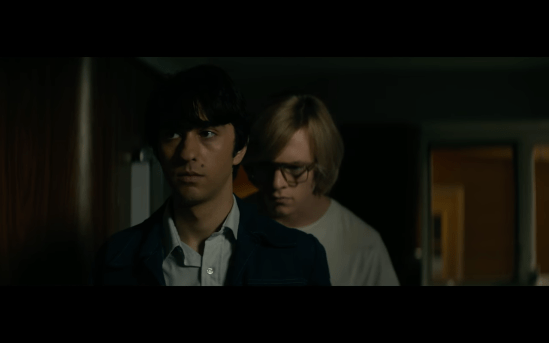
Surely an eye brow raising casting choice, Disney Channel actor and Kids’ Choice Award winner Ross Lynch enters into a polarizing role that is the pre-monster of Jeffrey Dahmer and creepily channels in a powerful performance the embattled younger image of the soon-to-be murderer, cannibal, and necrophiliac. Lynch portrays Dahmer as a rare emission of emotion and almost frighteningly stiff or mechanically with hunched shoulders just below his wavy blonde hair that wrap around the large and rounded rectangle glasses. New York City born actor Alex Wolff picks up the graphite pencil to spun out probably Dahmer’s closest friend John “Derf” Backderf. Perhaps in a way, Backderf had manufactured a piece of Dahmer’s destined genetic makeup and Wolff lays in the guilt, and the fear, thick when around Dahmer near the end. Anne Heche (“Psycho” remake) and Dallas Roberts (“The Walking Dead” and “Mayhem”) become Joyce and Lionel Dahmer, Jeffrey’s parents. Heche and Roberts seize every on screen opportunity to lay into one another, a persistent and regular difficulty that stemmed between Joyce’s mental and physical heath and Lionel’s withering patience for his anxiety riddled wife. The cast rounds out with Vincent Kartheiser Liam Koeth, Tommy Nelson, and Harrison Holzer.

Aside from the retelling of Backderf’s recollections, “My Friend Dahmer” shoots scenes right inside what was once Dahmer’s actual home in Ohio. That bit of realism adds monumental flavor to enrich the inherently dark subject matter of how a young Dahmer was subjected to compounding blows to his psyche in the short timespan that was his senior year. From his father tearing down his makeshift laboratory and junking his precious dead animal experiments, to his mother’s divorce inducing schizophrenia, and to being the class clown in order to make friends, Dahmer couldn’t maintain control over his ebb and flow urges and Meyer effectively highlights these chapters in Dahmer’s frayed playbook of life that tipped the scales of unfavorable malice.

FilmRise and MVDVisual present “My Friend Dahmer” on a AVC encoded 1080p High Definition Blu-ray with a 2.40:1, widescreen presentation. Through a vista of small town quaintness, picture quality immensely defines a cold embrace of a softer, fluffier effect. The color palette strongly reflects the whitewashed and faded of the era. The English Dolby Digital 5.1 stretches the ambient with a film that doesn’t necessary pack an audio punch. The dialogue is rendered cleanly and the retro soundtrack is a boost to docudrama with clarity and pace. Bonus features are a bit thin for a non-fictional individual with humungous notoriety and they include a brief interview with star Ross Lynch, Behind-the-Scenes slide show, and a theatrical trailer. “My Friend Dahmer” revitalizes the feelings and the chills that washed over us who are old enough to remember Jeffrey Dahmer’s grim-storied apprehension and, yet, director Marc Meyers is able to strip Dahmer of his monstrosity for 107 minutes and make him simply human as a young man with everyday problems without a ounce of parental, professional, or friendship guidance, funneling to the notion that we all have a little Jeffrey Dahmer in us.

“My Friend Dahmer” is on the Amazon today!


