Her night was supposed to be a wonderful occasion of celebration, a night to showcase her lustrous career as an established actress, a night where she was set to receive her crowning lifetime achievement award, but when the gowned Amanda stepped into a luxurious, fully-loaded limousine, the night that was to be a collective jubilee of the last twenty-years of Amanda’s life will be turned into a terror ride of unspeakable acts in the name of pure hatred. Once inside, the limousine’s inescapable locks detainee Amanda as a voice behind a voyeuristic camera commands her every subversive move and a sadistic chauffeur uses pain to thwart any of Amanda’s attempts of refusal in on an interrogation on four hellish wheels.

“The Glass Coffin,” aka “El ataúd de cristal” is a 2016 Spanish thriller from first time feature film director Haritz Zubilaga and co-written with Aitor Eneriz. From the moment Amanda steps into the limousine built like a tank, Zubilaga’s film goes from zero to sixty in a matter of minutes with thick tension and high horsepower suspense. “The Glass Coffin” is a depraved film. This isn’t a sugar-coated stuck in a glass box Hollywood thriller like “Phone Booth.” Oh no. Zubilaga and Eneriz hitch your emotions on a tow bar and drag them through the filthy muck without as so much of a care. Is this a game like Jigsaw would construct in “Saw?” No traps or snares here, but there’s an ominous shroud of mystery behind Amanda’s captor that could certainly give Jigsaw a run for his money. “The Glass Coffin,” in fact, goes more in tune with Joel Schumacher’s “Phone Booth” when considering the villain. Well, more like a Eurotrash, alternate version of “Phone Booth” antagonist anyway because aside from deriving the guilt and the sin from Amanda, there’s a sleaziness about the captor whose presence becomes more and more gothic the closer we learn more about them on top of their already extreme methods in the right-the-wrong stance.

Very similar to most films with a slim-to-no cast, like the Ryan Reynolds’ thriller “Buried, “The Glass Coffin” fits the bill as a one actor film. Paola Bontempi stars as the targeted starlet Amanda and the Canary Islands born actress musters enough courage to accept such a punishing role where her character’s humility and pride stems from a base layered motivation in not wanting to become the masked Chauffeur’s punching bag. Amanda goes from high time to gutter low in an ugly show of stripping moralities and ethics in order to reveal one true self. A pivot does occur, turning the shredding of facade into plain and simple revenge that becomes the flashy bullet points of European horror and Bontempi changes with it in one fluid motion of character revival and redemption.

The diabolical game is, well, diabolical and sincerely rich in providing an attractive story, but the film doesn’t go without it’s problems. Whether lost in the Spanish translation or just simply unexplained, an opaque mystery clouds Amanda’s captors, especially with the maniac Chauffeur and his bizarre relationship with the planning perpetrator, that puts a sour afterthought into analyzing “The Glass Coffin.” The Chauffeur was one realistic element of an intriguing conglomerate that tipped the ice berg of sinister deplorability and I was yearning for more of that; instead the game turned, the plot transformed, and “The Glass Coffin” took an approach that routed far into left field. Not a bad route to take as, like much of Zubilaga’s film, the moment had me at an astonished state as the film continued to keep me guessing what was going to occur next.

MVDVisual and Synergetic Films distributes the Basque Films production, “The Glass Coffin,” onto DVD home video. Short in giving any sort of physical or emotion breaks, the 77-minute runtime feature is presented in a vibrantly engrossing widescreen presentation and while at times soft on the auxiliary background, the image quality is flashy and sharp surrounding Amanda. Darker scenes in the tail end lose quite a bit of definition that makes eyeing the moment difficult to capture. The Spanish 2.0 stereo mix does the job and profusely invigorates the voice behind the camera, a voice made of nightmares and all that horrifying in the world. The English subtitles sync well, but I spotted a couple of typos along the runtime. There are zero extras on this release and even though a smidgen of behind-the-scenes material would have been curious to view, the film is a simple bliss. “The Glass Coffin” arches over the niceties and lands right smack into obscenity to destabilize integrity in a cruel ride of exploitation. I wanted more, the unfiltered, fully unadulterated, story of Amanda and her polar opposite antagonist, but I’ll settle for the Cliff Notes version. For now.
Category Archives: Chilly Thrilly
Evil Finishes a Long Over Due 90’s SOV! “Jungle Trap” review!

Dr. Chris Carpenter aims to assemble a team of grad students to search for lost idol artifacts from one of the last, and deadliest, known South American native tribes who were thought to be exterminated by a military force. Despite her severe objections, her ex-husband and anthropologist, Dr. Josh Carpenter, is hired by the university department head to lead the expedition to the infamous Palace Hotel, a proclaimed millionaire’s playground overtook by the jungle after the natives beheaded guests and staffed. Unequipped and ill-prepared, the team journey to the most remote parts of South America, winging the entire trip with their haphazard ambitions, and seek means of transportation any way possible even if that means flying in a cramped plane with an alcoholic pilot. Upon their arrival at the Palace Hotel, hotel manager Madam Trudea and her odd bellhop Obie welcome them to the incredulously pristine resort grounds where one-by-one the team ends up dead with their heads chopped clean off and shrunken to fulfill an vengeful oath of retribution.

twenty-seven years. twenty-seven long years since director James Bryan’s film “Jungle Trap” saw the light of viewership day. “The Executioner, Part II” and “Don’t Go Into the Woods” director interlaced his cult filmography with also notable adult features that starred recognizable talent with Ron Jeremy, Peter North, Kitten Natividad, and Kristara Barrington helmed under a pair of monikers Emil Hightower and Morris Deal that Bryan used to separate his classes of work. Unfortunately, Bryan’s colorful career came to a complete and sudden halt right before the decade turn into the 1990’s until Bleeding Skull! Video unearthed haunted hotel in the deep jungle film “Jungle Trap.” Filmed in 1990, Bryan and his co-writer/female lead, Renee Harmon, use the latest and greatest technology of the time, tape. “Jungle Trap’s” shot-on-video, aka VHS, appeal is an exuberance of maddening creativity only bested by the “Troll 2” style bad acting.

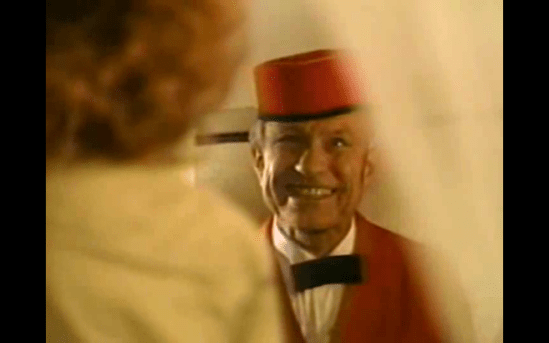
Co-writer Renee Harmon stars as Dr. Chris Carpenter, marking the sixth collaboration between Harmon and Bryan along with “Run Coyote Run,” “Hell Riders,” “The Executioner, Part II,” “Lady Street Fighter, and “Boogievision.” Harmon’s relationship to her character, Chris Carpenter, mimics that of Eva Gabor if she had somehow wound up in the thick Jungle instead of that farm on Green Acres. “Night of Terror’s” Frank Neuhaus had more appropriately succumb to the distressed anthropological victim accustomed with this horror and Neuhaus opposite of Harmon, performance wise, is night and day making their former relationship hard to fathom. If there’s one character that was genuinely creepy in “Jungle Trap,” Jan Vanderberg’s bell hopping Obie wins the prize. THe elderly Vanderberg has spry movements, wide-wild eyes, and a sinister smile that mingles around in the grey area of friend or foe. The remaining cast, including Heidi Ahn, Tim de Haas, Valerie Smith, Rhonda Collier, Glen Serebian, Bill Luce, and Bette Bena, share the same remarkably and overly dramatic bad performances that make “Jungle Trap” hard to skip.

I’m sure the picture is starting to materialize. “Jungle Trap” is nowhere near a good movie. However, vast improvements to render the “Jungle Trap” enjoyable, as well as to scrape by finishing the Bryan project, was courteously contributed by Bleeding Skull! Video’s kickstarter initiative. The company has a history of gathering unreleased film’s loose ends, tying them together, and creating a fetching film; in this case, “Jungle Trap” didn’t have a score, wasn’t edited, and was shelved for decades. Now, “Jungle Trap” isn’t a mystery in the public eye, has a semicoherent storyline with an edited in arbitrary opening, and, thanks to the synth-heavy Euro-trashy sounds of Taken by Savages, a gloriously catchy soundtrack has been laid down. The entire package puts more girth and more value into Bryan’s shamefully quaint horror.

Bleeding Skull! Video presents “Jungle Trap” on DVD, VHS, and VOD for the first time! Since provided with a streaming copy, critiquing the audio and video won’t be solid, but the shot-on-video image keeps the obsolete VHS quality attributes with tracking lines galore, blurry-soft quality, and a slew of inconsistent coloring that works under the maestros of Joey Ziemba and Annie Choi, high ranking members of Bleeding Skull! Video, synthesizing a score under the Taken by Savages moniker! There were no extras with the streaming screener, but the 72 minutes feature includes with the VHS and DVD a fold-out poster, making-of documentary, and Bleeding Skull! Video trailers. “Jungle Trap” is a mondo masterpiece, a terrific terrible, with a heart of gold (skull) and a kickass soundtrack from a colorfully careered director who now has this blast from a past as his legacy film.
Jack’s Back for an Evil Good Time! “Razors: The Return of Jack the Ripper” review!

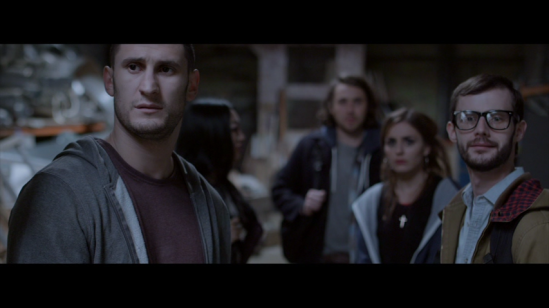
London’s infamous 19th century serial killer, Jack the Ripper, was never caught and the specialty knives he used to fillet his victims were never recovered, but in the darkly lit maze of an abandoned Victorian warehouse located in present day London, the spirit of the mysterious murderer of prostitutes lingers within the bricked up walls or so goes the urban legend. Six aspiring writers are invited to a screenwriters workshop at the Victorian warehouse for inspiration and orchestrating the event is an eccentric arts professor Richard Wise. The goal is write the most horrifying, potentially box-office busting horror story for a chance at penning a major movie deal. One of the six writers, Ruth, had received an enigmatic case full of old knives prior to her invitation, placing inspiration in her to write a terrifying script involving Jack the Ripper. When the knives go missing, the writers become trapped inside the warehouse as their involuntarily actions result in the return of Jack the Ripper to continue his unholy work of slaughter and the only way to stop him from carving his way into their ill-fated story is to solve the mystery of why they were specifically chosen to attend this particular workshop.

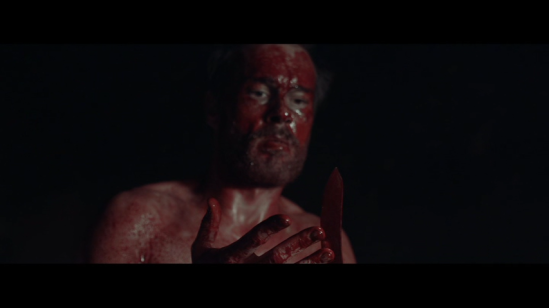
“Razors: The Return of Jack the Ripper” is the interesting first installment of a British horror movie franchise from writer-directors Ian Powell and Karl Ward. The co-filmmakers reach into the 19th century to bring Jack the Ripper into the present day, but Jack’s not the same; He’s a variant of him old self that involves the murderer being a pissed off malicious ghost in a concoctive tale that blends the modern-day remakes of “House on Haunted Hill” and “13 Ghosts” from near the turn of the century. Other than a physically present, if not more of a flickering presence, manifestation with a link to his prey of frightened writers, I won’t delve too much into details of Jack’s return and what he means to accomplish in hopes of not spoiling the story for you, but I have a sneaking suspicion that that won’t be a problem. The independent film attempts very little to bring the Victorian era swag into the fold. Even Jack the Ripper solely dons a dark wide brim hat and cape, that loosely associates him with the time period. Powell and Ward focus more on the group of bewildered writers and their conflicting dynamics on how they deal with their predicament – i.e. one character is very poignant on the dangers while one other brushes off superstitions and unnatural occurrences – but the pair of filmmakers fail to work the character Professor Wise into the mayhem and by not attributing purpose to the character, the professor inarguably becomes one of the many loose ends of a sunk horror franchise before it’s even set afloat.

The 2016 film stars Kelby Keenan as Ruth, the only character to have any damn sense, but won’t just leave even though she repeatedly states how much danger their in. Kelby’s the lead actress with Josh Myers (“Zombie Diaries 2”), Georgia Mcguire, Kunjue Li (who oddly enough have a bit part on an unrelated Jack the Ripper television series entitled “Ripper Street”), Jack Brown, and Ian Weichardt (“Freak of Nature”) to round out the group of writers. Together, their plight doesn’t come across potently enough; instead, Thomas Thoroe’s Professor Richard Wise strew them through the warehouse corridors in an unbelievable performance of the professor not having a clue about the turmoil that’s afoot. Jack the Ripper goes virtually silent, much like a ghost should, under the unkempt performance of Andrew Shire. In short, the cast haphazardly walks through the storyboards, overkilling reactions and not reacting enough during called upon scenes to the relative cause of action.

So far, in this review, you might conclude that Powell’s and Ward’s inaugural franchise film may be a dud and not spawn sequels. Honestly, I personally would like to see closer for the open ended characters and story; however, I preferably would not like Powell and Karl in the director chairs. Their style could only be described as spastic with way too many edited in interjections of arbitrary spook house filler. The body of work has the sheer tenacity of being more like a 92-minute music video that’s abundantly chorused with haunted house ambiance. Literally, interlaced cuts made more than half the film, barely leaving any story for the actors, and the back-and-forth edits could crisscross your eyes into a strabismus.

Breaking Glass Pictures and Magic Mask Pictures Limited present “Razors: The Return of Jack the Ripper” on DVD home vide. Usually the pride of indie LGBTQ films, Breaking Glass Pictures has a fair share of horror as well and, typically, do right by the release. In this one particular, the DVD is presented in a widescreen 16:9 aspect ratio that’s very detailed. The color hues are a bit dull, more so grey, than hoped. The English language stereo dual channel stereo track had no part in being saved. Layers upon layers of unfinished audio snippets run rampart throughout to the point where you can pick out the flaws at will. Dialogue is wish-washy with the full power of the voice being reduced to no more than a mumble of hearing every other third word from every character. The DVD does come with some special features, such as clips and interviews in a segment entitled “Lights, Camera, Speed!,” “Behind the Walls” is a short featurette about the film, and you can also play the film with commentary from the directors and cast. The film is dedicated to the late Khan Bonfils, who had a minor part in the introduction, after his untimely death on a separate project. “Razors: The Return of Jack the Ripper” is clunky at best. Poor Jack couldn’t rise from the dead to reclaim his infamy in this ghost show of scatterbrained storytelling.
Evil Attracts With the Fluorescent! “Feed the Light” review!

Sara, a desperate young mother, infiltrates a secret facility workplace under the false pretentions of becoming an employee of the critical janitorial department. After losing custody of her adolescent daughter Jenny in court, the child becomes misplaced when her custody awarded father, an employee, loses Jenny in the facility that’s conducting unusual activity involving the building’s light energy source. With everyone on constant edge and under the powerful and dangerous influence of the light, including her very organized and unstable employer, Sara is able to find a sympathizer in the head janitor and by exploiting his mental map and valuable knowledge of the building, Sara goes deeper into the structural bones of a nightmarish reality where evil lurks in the shadows and not everything is what it seems.

“Feed the Light” is a H.P. Lovecraft inspired sci-fi horror directed and co-written by indie filmmaker Henrik Möller with Martin Jirhamn sharing the co-write. The gothic tale stems from the Lovecraft short story “The Colour Out of Space” that tells the tale of a meteor crash landing in the hills near Arkham, Massachusetts, poisoning and deforming all the living creatures nearby that creates chaos amongst the locals. The light, that never dulls, becomes the driving force of everything malevolent and that carries over into Möller’s film, but isolates the setting to a dilapidated building instead of a natural landscape and focusing more on the people inside rather than vegetation or livestock as the Lovecraft short story builds upon. Originally shot in color, Möller thought best to suck the color out from the reel and produce a mostly black and white film, sprinkled with color at strategic moments, that would convey the importance of the ever-present light and interpret a far more dramatic effect to play out; a decision I whole-heartedly agree because if laced with color, much of the abandoned warehouse setting would be a monotonous eye-sore. Instead, black and white enhances the light’s presence, makes it almost seem to stand out amongst the greyscale, and give way to more inspirationally vibrant hues when they are revealed.

For Henrik Möller, this is the director’s first dive into feature films and for the filmmaker whose better known for his shocking shorts, “Feed the Light” doesn’t water down the deranged, creative machine that just steam-plows through a 75-minute runtime and still managing to be mechanically sound to comprehend the Lovecraftian tone. Lina Sundén fills the lead shoes as Sara and Sundén embodies complete innocence and bewilderment when her characters goes forth into this strange facility, but doesn’t show much fear as if a mother’s determination is her driving force to go beyond being what frightens her. Alongside Sundén is Martin Jirhamn, who you might remember me saying he co-wrote the script, as the sympathizing janitor. Jirhamn has collaborated on many of Möller’s shorts, feeling comfortable taking on the challenge of a full length feature by taking on more of a scripted role that has a face with two sides. Rounding out the cast of memorizing characters are “Not Like Others'” Jenny Lampa as an authoritarian boss of the facility who tries to keep Sara from going on Indian Jones and the Raiders of the Lost Ark in the basement and Patrik Karlson otherwise known as the VHS-Man and Jenny’s father in the film.

“Feed the Light” has undertones beyond that of Lovecraft. The story feels nearly anti-establishment, a surreal and extreme look at how doing the same job, in the same office, staring at the same fluorescent lights can make one loose one’s humanity. The boss is a strict enforcer of the rules and doesn’t shrug at the thought of one of her employee’s burning out as long as the job gets done, but it’s not burning out that’s the problem. The light symbolizes obedience and control, turning those with a soul into mindless workers. There’s an unseen power embodying them such as with the dog man, played by Morgan Schagerberg, who, literally, sounds and acts like a canine that just happens to have glittery dust goo ooze out of it’s anus. Yup, weird. “Feed the Light” is jarringly weird, but also laminates into the prospect of hidden doom that’s very similar to the truth is out there concept reveled in the “X-Files.”

The Severin sub-label, Intervision Picture Corp., usually subjects us to older projects, but embraces newer indie films such as Henrik Möller’s “Feed the Light” and with the help of CAV Distributing, Möller and “Feed the Light” can be exposed to every house hold on Earth as a region free Blu-ray in 1080p full Hi-Def. The full frame is a staple of Intervision and doesn’t necessary cause any distress over cropped images. There is a fair amount of interference, but again, only enhances the indie labels reputation. Other than that, the image is fine laid under a Swedish language dual channel audio track that’s well balanced with a brooding industrial soundtrack by Testbild, a Möller familiarity. There are two extras accompanying the feature: one is a making of featurette and the other is an interview with the director, Henrik Möller. “Feed the Light” is a science fiction oddity chocked full with surreal depictions and nightmare creatures with a Lovecraft base and a passionate director’s otherworldly view of how light and color powerfully dictate our everyday lives.
In a Seemingly Fresh Corpose Lies a Legendary Evil. “The Autopsy of Jane Doe” Review!

An unknown corpse of a young woman, found naked and half-buried in the basement of a home involved in a gruesome crime scene, is strolled into a small town family morgue and crematorium by a puzzled local sheriff. Without any idea who this woman is and how to explain the her presence at the scene, the sheriff wants a cause of death on his Jane Doe as soon as possible and it’s up to Tommy and his son, Austin, to investigate what caused her demise and to determine her involvement in the grand scheme of the grisly events. When the medical examiners begin to peel back the layers, each segment of the autopsy reveals impossible and unspeakable horrors underneath her cold flesh that go against their combined years of medical experience and the deeper they dig into her body, the more the autopsy room becomes a spine-tingling area as strange occurrences begin to happen to the father and son. Their only hope in stopping the ominous terrorizing presence and surviving the hell-bent stormy night is to continue the examination in order to unravel the enigma that surrounds Jane Doe.

“Troll Hunter” director André Øvredal helms a contemporary horror masterpiece with the Americana horror film,”The Autopsy of Jane Doe, that can be described as American folklore lit ablaze with modern day macabre that plays like a gruesome adult version of the children’s game Operation. Øvredal pulls inspiration from present day classical horror, including such films as the widely popular James Wan franchise, “The Conjuring,” by not embarking on an overkill journey of heavy duty effects or relying on gallons upon gallons of fake blood to sell his film. Instead, André Øvredal’s “The Autopsy of Jane Doe” is patient, subtle, and massively creepy, utilizing the dated morgue and crematorium basement setting to construct a dreadful, despairing dungeon atmosphere and focus on being very particular with every scene having a function to take advantage of the overwhelming brooding aurora and pop scare moments that can scare the pants off a mannequin. Øvredal heightens moments of complete pin-drop silence to amplify the terror and plays with camera angles that linger longer to leave an unsettling residue pooled in a spine-tingled soul.

Not only is the Ian Goldberg and Richard Naing script palm-sweaty frightening, tack on A-list actors like Brian Cox (“Manhunter”) and Emile Hirsch (“Killer Joe”) as a father and son team pitted against a dead body and “The Autopsy of Jane Doe” jumps up by tenfold as a must-see. Brian Cox is masterful as the widowed mortician whose numb to the pain of life and shock of work, making him a dedicated professional at uncovering the truth inside corpses, and he’s well companioned with Emile Hirsch, the mortician’s eagerly loving son and apprentice to the family business. The only problem is Austin doesn’t want to be a part of the family legacy, but is rooted by his continuously cloaked grieving father and you can see the struggle in Hirsch’s wish-washy character. The pair of veteran actors play off each other well being a medical super duo by conducting examination procedures and digging right into the corpse of dead, disfigured bodies like it’s just another day at the office. The gorgeous Olwen Catherine Kelly is dead on being a dead body. Though Kelly literally doesn’t move an inch for the entire runtime, her slim frame and blank facial expressions are truly haunting, if not also alluring to behold.

Immediately, my first impression of André Øvredal’s film had me stroll back to the past, nearly a decade a go to 2008, with the Marcel Sarmiento and Gadi Harel thriller “Deadgirl.” The premise of the film told the story of two high school aged boys discovering a seemingly near dead young woman in an abandoned asylum; the dead girl being played by Jenny Spain. Whereas each film have their separate horrific identities, their end games bare supernatural similarities. What also separates André Øvredal’s film from Sarmiento and Harel’s “Deadgirl” are the two protagonists; instead of two teen boys pulling hormonal hijinks on a motionless attractive female body, Tommy and Austin are strictly professional, focused on their task to answer the riddle lying inside the very fabric and bones of Jane Doe. The only gripe I can bottom barrel scrape out is how Tommy and Austin had this big ‘what if’ epiphany that becomes the very basis of the entire film and, in my opinion, felt that scene was extremely chintzy and a cop out.

Lionsgate Home Entertainment delivers “The Autopsy of Jane Doe” from production companies 42, Impostor Pictures, and IM Global onto UK DVD and Blu-ray. Unfortunately, a DVD-R screener was sent to me, resulting in no true examination of the audio and video qualities and the only extra on the disc was a Q&A with directorAndré Øvredal. Even if viewers might be able to guess the nature of the corpse – I did about halfway through – “The Autopsy of Jane Doe” is still way ahead of it’s genre brethren in being the best horror film of 2017 with an unlimited amount of sinister wretchedness that tugs at your soul strings and weighs heavy in your mind’s cache as soon as the lights go out for bedtime. I would recommend this title to anyone seeking an unadulterated horror experience.