

Six dead women relive pieces of their previous mucky lives embodied in one seamless soul that’s trapped in the literally gory innards of their serial killer’s home. Forcibly held in the limbo of a filthy purgatory, each woman find themselves in a different, and extremely hellish, part of the house and each carry the same gruesome autopsy laceration across the front of their chest, crudely stitched together and coming apart at the seam ready to pop open their insides at any moment. Unknown to why their confined, an ill-fated reason develops at the end of the maze’s demented journey through the home made of severed body parts, decorated with pieces of human tissue, filled with decomposing bodies, strewn with ghastly entrails, and drenched with blood.

Director Phil Stevens composes an avant-garde horror story orchestrated with no dialogue what so ever through the duration and spatially effective in close, uncomfortable quarters . Certainly unique from anything else I’ve ever witnessed, “Flowers” doesn’t apologize for being overly gory and disgusting, pursuing a stomach-churning reaction from all allegoric angles. Slip-and-sliding through the murderous muck and goop, each of the six dead women seem hysterically unfaded, yet more intriguingly curious to their surroundings, even if that means putting their hands through a tonnage of viscera and ripping their own flesh open. Indie films like Phil Stevens’s “Flowers” will never catch the eye of most mainstream audiences and will never know of their existence, but a few lucky viewers, like myself, get to experience the surreal work from the horror underground. Fans of Marlan Dora’s “Cannibal” or Jörg Buttgereit “Nekromantik” will revel in “Flowers’s” grisliness and gloomy nature.
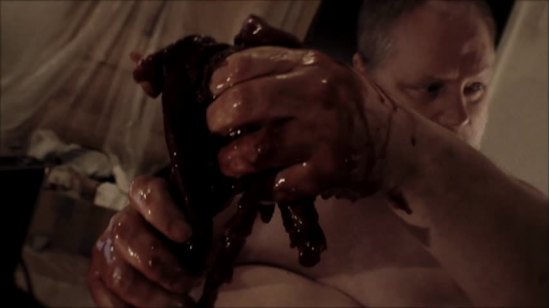
The cast is made up of six alternative lifestyle women, each one credited only as Flower 1 through 6, and take up a particular different segment and sprinkled into their story is their merciless and necrophiliac killer, only credited by the name The Exile. In sequential order, the Flowers are played by Colette Kenny McKenna, Krystle Fitch, Anastasia Blue, Tanya Erin Paoli, Kara A. Christiansen, and Makaria Tsapatoris and the killer is played by Bryant W. Lohr Sr. The majority of the actresses take on more than their literal roles in the movie. The physical body horror effects are applied by Anastasia Blue and Krystle Fitch to create open wounds across the actress’s chests and the uncleanliness costumes and wardrobes are provided by Makaria Tsapatoris, whose experience has been from the 15 year participation of the horror season attraction Eastern State Penitentiary in Philadelphia.

The abstract story is intensively focused on the women’s lives rather than their slaughterer The Exile. Their stories are personally tragic as if the Flowers are trying to purposefully or unintentionally ignore real life by way of drug abuse, prostitution, or both. Each actress has to put forth extra effort in their silent performances as dialogue is nonexistent and they’ve successfully compel themselves to act out the scenario, working with their surroundings and being, well, dead. The Flowers may not seem frightened of their killer’s house made of guts, but the Flowers are definitely disgusted, nearly tossing their insides in a few putrid cladded rooms. You may not want to eat while watching some of the segments. Very little is known about The Exile, a very large, but well kept man with a hankering to kill the gutter girls, bathe in their guts, and, sometimes, have sex with their gut-exposed dead body.

“Flowers” is available in two DVD editions, a standard one disc which is reviewed here and a three disc limited edition set, from Unearthed Films and distributed by MVDVisual. The technical video is presented in a widescreen 1.85:1 aspect ratio with a 2.0 dolby digital audio and, frankly, the two channel audio is all “Flowers” needs with no dialogue or major sound effects as a poetic soundtrack guides with harmony mostly through all of the audio work. The image quality is detailed and vividly enticing, but the colors are intentionally dull and for darker scenes that create ebony silhouettes that are practically not visible or coherent; these scenes only deter for only the first 20 minutes of crawling through the house’s bloody undercarriage and won’t ruin the remainder. For only the disc one edition, extras are fairly good with interviews with The Exile actor Bryant W. Lohr Sr., an audition tape of Makaria Tsapatoris, behind the scene stills, an isolated FX track, and commentary tracks with director Phil Stevens and associate producer “Ravage’s” Ronnie Sortor. I recommend the grotesque “Flowers” to any horror fan without a weak stomach and a mind for the abstract!

Category Archives: Chilly Thrilly
Evil Revolts! “The Last House” review!

Erotic escort Love falls for on the side boyfriend Ned, a regular client with who she’s madly in love and with who she doesn’t charge a dime for her services. When Love wants out of the escort business, her controlling pimp Sunny says otherwise by sending her and two other girls on Love’s final trick, an all night mansion party. When the girls arrive at the gated mansion, they’re greeted by three strange hosts: Cleb, Selma, and Hate. Each of the three girls partner up with each of the hosts and move forward to their separate rooms where the escorts fall victim to sadistic tendencies, but Hate has more in store for Love. Ned, concerned when Love didn’t call once all night, sets out on a rescue mission to track down Sunny and gain information in means necessary on the whereabouts of the girl who love struck him.
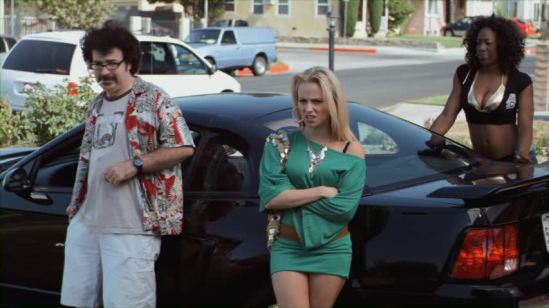
“The Last House” is a 2011 mixed subgenre film directed by b-horror director Sean Cain that was originally released under the title “Breath of Hate” and was penned by first time writer Wes Laurie. The ambitious story plays out cordially with a talented cast of actors behind the camera, but the story, though larger than life for a b-horror flick, follows a non-linear path that builds and builds for a grand finale and while that sort of tension usually creates a good setup, the ending nearly fizzles, not generating enough pizzaz and spark worthy the wait of the last five minutes of the total 91 minute runtime. However, the Laurie script fascinates and entertains throughout because of character structure through the aforementioned non-linear layout and because of the physical and emotional outpouring portrayed by the actors such as Lauren Walsch, Timothy Muskatell, Jason Mewes, and, especially, Ezra Buzzington.

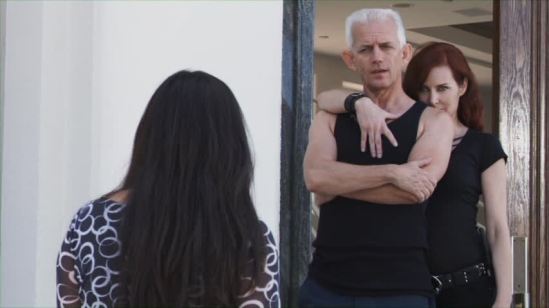
“The Hills Have Eyes” remake actor Ezra Buzzington steals the entire movie as Hate, leader of the three sadistic maniacs, and Hate, in himself, is an interesting character who seeks to start revolutions against humanity through brains and brutality and maybe even something more. Buzzington embodies a “Die Hard with a Vengeance” Jeremy Iron’s type personality with a calm demeanor on one face and a ruthless side on the other, but he single handedly separates the character from the likes of any other and creates Hate, with the help of a Laurie twist ending, to be potentially a long time running franchise character. There is a fierce downside alongside Hate where his lackeys were served a overshadowed injustice. Monique Parent plays another sadist, Selma, and her time on screen didn’t add to the girth and felt unnecessary. The then 46-year-old actress, with more than 100 film credits to her name, looked absolutely stunning, sizzling with lust for her cougar age. That should be no surprise to fans of Parent who are mostly familiar with her previous work in a number of softcore porn films. Sadly, Parent has no nude scenes though the part strongly suggests it; “Evil Head’s” Joanna Angel and “Amateur Porn Star Killer 3’s” Regan Reece take the burden of skin diligently – thank you Joanna and Regan. The third sadist, Cleb, is portrayed by Jamaican native Ricardo Gray. Gray’s take made Cleb, frankly, my least favorite sadist as Gray went overboard with a character that could been a menacing psycho-sexual deviant to a half-witted, Jurassic role-playing pervert. If there was perhaps more of Cleb’s backstory, a better picture of this sadist’s mindset might have reversed the first unfavorable impression.

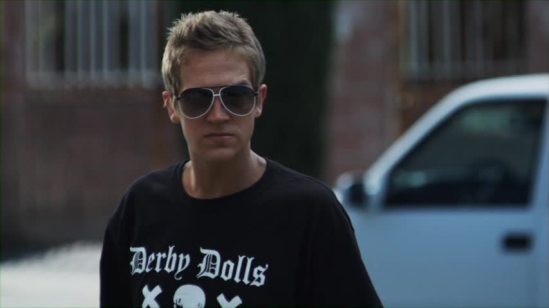
Jason Mewes has always played the part of the funny guy character. The same stereotype description can be laid upon other actors of similar character such as Hollywood studs Jim Carrey, the late Robin Williams, or the cult favorite Bill Murray. Mewes, a strong supporter of independent work, has most famously, for most of his career, teamed up with writer-director-actor Kevin Smith and produced some of the most notably comedic material to ever be released for about around a decade starting near the mid-1990’s. Not many audiences, aside from fanatical Mewes fans, are aware that the same Jay, of “Jay and Silent Bob” films, has had quite a few horror credits. From John Gulager’s “Feast,” to David Arquette’s “The Tripper,” Jason Mewes doesn’t just do comedy, but what makes “The Last House” unique from the other independent horror films is that Mewes is cast in a serious horror film whereas “Feast” and “The Tripper” are horror-comedies that still tap into Mewes endless vein of laughs. Instead, “Dead Girl” actor Timothy Muskatell takes the reigns on the comedy as a pot smokey, womanizing lackey and Muskatell is born for that type of part. Porn star Timmy Pistol also delivers some goofy laughs in a brief cameo with Jason Mewes and also, fun fact, Tommy Pistol and Joanna Angel were both in “Evil Head!”
Mewes, Buzzington, and even Parent are major, recognizable names in the movie industry, big enough that even audiences so attached to Hollywood stardom would still be familiar with them. Two of the names mentioned headlining “The Last House” are accompanied by one more name that isn’t familiar to mainstream audiences, but any knowledgeable horror enthusiast would surely recognize. “Sleepaway Camp” actress Felissa Rose is that third headlining name and, unfortunately, shouldn’t have been exploited. Rose’s on screen appearance runs a total of around two minutes as the mansion realtor, but her presence falls from the face of “The Last House’s” universe after her single scene. Her iconic name alone will draw in the horror masses, but when she filmed the minor role, Rose was near popping at 9-months pregnant and she didn’t have one single story merit line or action.
Distributed by Wild Eye Releasing, “The Last House” picture quality looks amazing presented in a detailed widescreen format. The audio quality comes and goes; at some points during outside scenes the ambience or the soundtrack plays at a whisper. When in more confined scenes, the tracks blare with some crackle. However, none of these will impact watchability nor take away from the film itself. “The Last House” aka “Breath of Hate” will make a deep gash into the independent horror scene and Wild Eye Releasing will help deliver Hate into your home entertainment on November 24th.
Turn the Dial to Evil! “The Horror Network Vol. 1” review!
From the demented minds of Brian Dorton and Douglas Conner, “The Horror Network” anthology has set sail on it’s first volume maiden voyage, shipping five petrifying and on the edge of your seat horror shorts right to your television set. Stories so darkly atmospheric and spine tingling that leaving the lights off while watching would be a horrible mistake. Each tale tells a different kind evil including demented demons, child stalking predators, family abusers, and a sadistic plaster saint. Certainly not intended for the faint of heart or the easily offended for each episode turns up the intensity, the fear, and the scares. Leave the lights on, take a blanket to hide under, and make sure you grab a couch partner to watch with you and then ask yourself, are you ready to tune into “The Horror Network?”
“3:00 A.M.”
A young woman named Georgia drives through the English countryside to get away for a few days. When she arrives at her remote farm house, a strange sense of foreboding overcomes her and weird, sporadic noises emit from all around her throughout the day and into the night. When the digital clock nearly reaches 3:00 A.M., she hears a concerning noise from downstairs and when she investigates, a ghostly presence lies in wait.

Before the anthology’s credits even begin to roll, the Lee Mathews directed film “3:00 A.M.” will for damn sure kickstart anybody’s heart. The atmosphere is violently tense when Georgia explores the strange occurrences downstairs and even before the night falls. Initially, the main focus kind of misguides you through much of, what were led to believe to be is, Georgia’s imagination from the one after the other false jump scares: a branch scratching at a window, a cat jumping out of the shadows, a jack in a box toy. Okay, maybe that last one is a bit obvious and not so much a surprising jump scare, but the toy does tie into the story near the end, giving the toy a reason to exist and a hint of menacing. Many of the jump scares are accompanied by screeching sound effects, like fingernails across a chalkboard, which would make any poor soul, who fears the dark and supernatural, jump out of their skin.
“3:00 A.M.” is a good introductory 10 minute short that sets the tone for the four other films in tow; a tone with a subtle message that insinuates the maturity of this anthology. Despite being a little redundant with the classical jump scares, especially with the cheesy jack in the box jump scare that could be seen coming from miles away, for director Lee Mathews, with “3:00 A.M.” being the only credit to his name, creating a nail biting short of that magnitude is fairly impressive and inviting.
“Edward”
Hal has mental problems. He can’t sleep. He can’t stop sleepwalking. He can’t seem to stop dreaming about death. Psychiatrist Dr. Aleksey is determined to root out Hal’s issues, but when Hal informs him about the news of a school friend named Alice being murdered, the good doctor decides to put Hal under hypnosis and determine just what’s going on in Hal’s mind. Under the semiconscious state, Hal recounts his last dream and sleepwalking incident where he describes in detail a man coming into his room from outside his window. The man has Hal follow him into Alice’s room, the same Alice Hal said was brutally murdered prior to going under hypnosis. When Dr. Aleksey discovers the truth about what happened to Alice, Hal’s hidden inner demon named Edward reveals himself, leaving Dr. Aleksey at wits end in trying to cure the incurably evil.
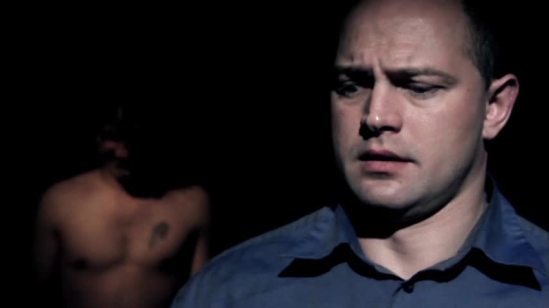
“Edward” is a gothic tale that isn’t too overly gothic in setting onscreen. The ominous presence, whether through the acting of Hal played eerily and perfectly by Nick Frangione or the chilling atmosphere, remains always present in the confined space of Dr. Aleksey’s office. The “Edward” short is a stray genre short from director Joseph Graham, a San Francisco based director who has been credited in directing feature films about homosexuality and the cultural-based stigmas – reminds me a little of the work helmed by Gus Van Sant. Graham’s “Edward” has an pitch black aura that seeks to let loose the horror-elements, yearning to be freed, because everything about the story of “Edward” is well told and well shot, as if you yourself were standing in the room with Hal and Dr. Aleksey, experiencing the fate of both men. However, Dr. Aleksey’s fate could have, and probably should have, contained more exposition, especially when the doctor arrives back home to his wife and sleeping child.
“The Quiet”

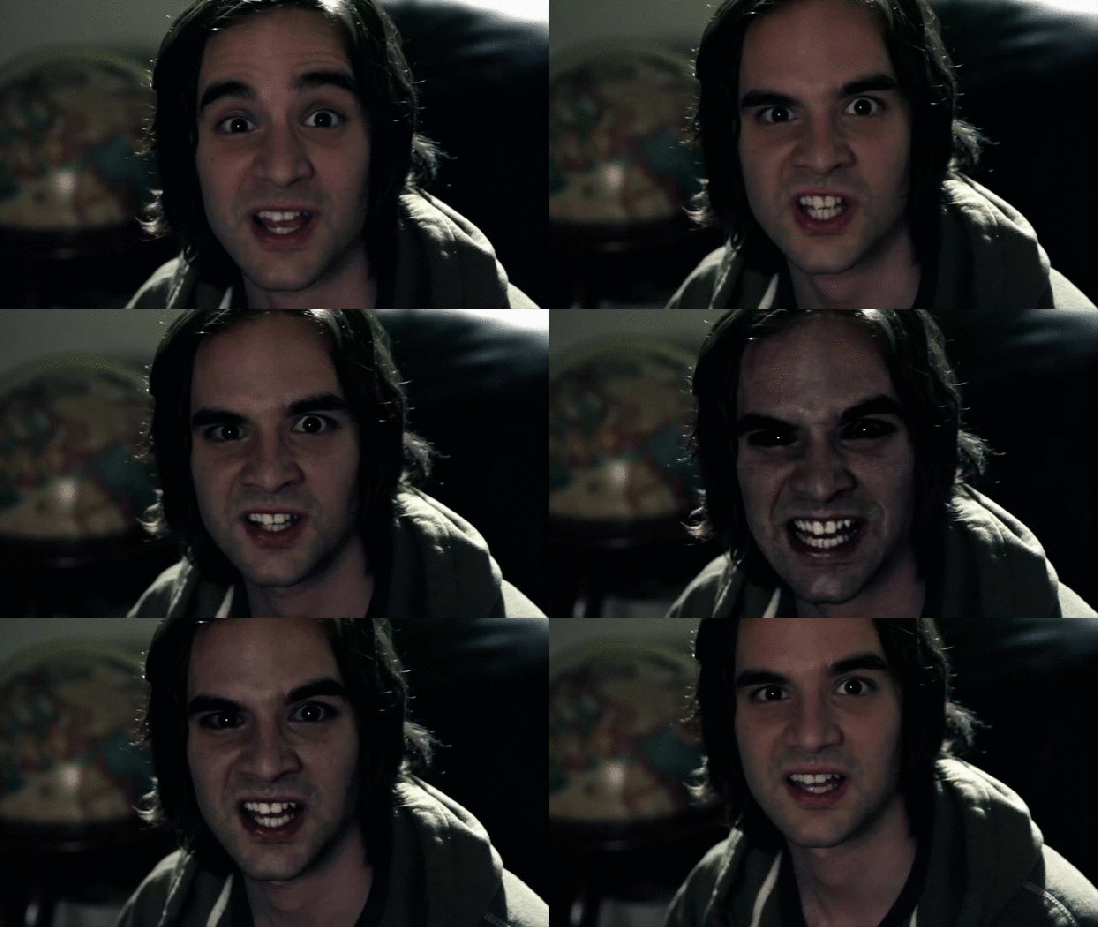
Alice, a partially deaf young school girl who particularly loves the quiet instead of using her hearing aid which eventually to taking the brunt of the cruel jokes from her classmates, rides the bus home from school. When she’s being dropped off at her remote stop, she forgets her cellphone on the bus. With her mother no where in sight, Alice decides to walk home alone, but when a suspicious blue van seems to be stalking her, she makes a break for the woods where she unfortunately loses her hearing aid. Lost in woods and unable to hear good, a cat and mouse game ensues between her and the man with the blue van whose on her closing in on her.
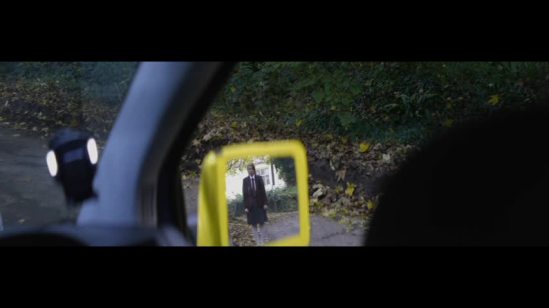
Unlike “Edward” where dialogue catapults the film into a tension-filled frenzy, “The Quiet” lives up to the title with the duration containing no dialogue until the twist ending. The built-in weakness of our protagonist Alice and the constant bullying of her helps the audience sympathize with her character more, making Alice a relatable person rather than a whimsical character everyone wishes instant death upon. The story has a strong beginning, continuing to build once the blue van man is introduced, but there are moments of unclarity that create more confusion than add value to the story; for example, the scenes of a padded room, a tortured little girl’s doll, and someone whispering, “I’ll love you forever,” don’t seem to connect up or match with the rest of the story, making the scenes seem out of place and unnecessary. The twist ending also becomes mysterious and diluted when were giving more information about the man in the blue van, but his intentions still aren’t made crystal clear, leaving way too much to the imagination and not in a good artistic way. Imwiththemproductions is behind the production of “The Quiet,” that’s supposedly based on a true story about a young girl being kidnapped when walking home with friends, and has a runtime of 21 minutes.
“Merry Little Christmas”

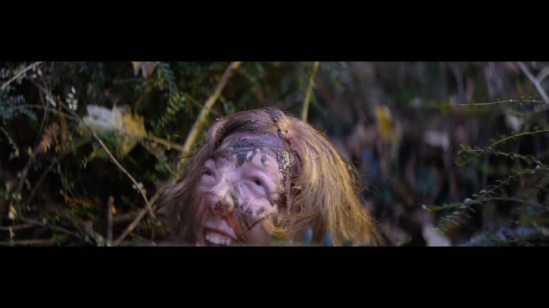
Christina and her mother Lola have lived many years with the scars bestowed upon them by Christina’s father, Lola’s husband. On the Eve of Christmas many years back, Christina’s strikes Lola unprovoked, continuously beating her, slashing her face with a straight edge razor, stabbing her, and raping her. Christina’s inner struggle constantly fights to restrain her internal, monstrous-illustrated hatred and self-destructiveness while Lola’s alcoholism and self-inflicted cutting addiction amplifies every Christmas Eve and this year, the mother and daughter grapple on keeping it together for one more year, but that battle will be lost in a fierce tragedy when they receive a phone call from the man who hurt scarred them for life.

“Merry Little Christmas” is the 20 minute Ignacio Martin Lerma and Manuel Marin visually graphic directed film from Spain. Surprising and suspenseful, “Merry Little Christmas” isn’t your old fashion gay and jolly-filled holiday film where Saint Nick brings all little boy and girls toys. No. In fact, Christmas is defined as a terrible point in time for Christina and Lola, a time when pain and fear are symbolic for tis the season. Lerma and Marin deconstruct the mother and daughter down to reveal their complexity and they’re characters are filled with various demons that become flesh in Christina’s mind when their abuser makes an unexpected phone call. A bravo should be awarded to Blanca Rivera for her bathtub scene, exploring her cutting addiction as well as attempting to learn to lover her body fully in the nude. The demon special effects are downright nasty, frightening and fantastic from “[REC] 2” and “[REC] 3” special effects guru Juan Olmo and the Doug Jones of Spain actor Javier Botet portraying the Demonio, or Demon. “Merry Little Christmas” is callous and cold without any remorse and no apology is needed for the cynicism or the brutally that it portrays.
“The Deviant One”
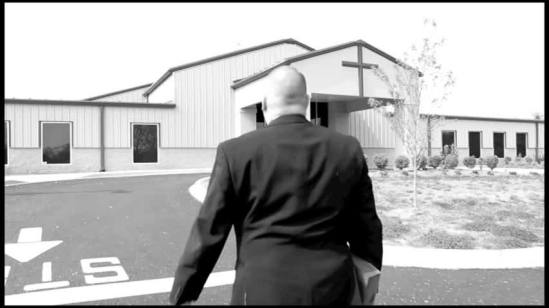
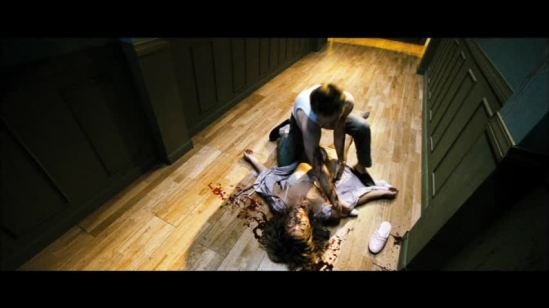
A young man becomes the victim of a suburban sexual sadist who lives a facade life of scripture and holiness. The atrocities committed might be the misinterpretations of the good Lord’s holy book and no one is safe from the deviant’s hungry claws and thirst for sexual and murderous gratification.

Perhaps my least favorite short from “The Horror Network” anthology, “The Deviant One” is helmed by the anthology’s co-creator Brian Dorton who also starred as the deviant neighborhood sadist. In the 8 minute black and white story of a young man’s death, body desecration, and body disposal, a lack of story glorifies the private life, but just doesn’t tell the tale fully of the deviant’s public church-going life. While the deviant walks up to a church, I wanted scenes of him standing at the pulpit, in front of shoulder-to-shoulder filled pews, opening the bible, and reading from the book, preaching his version of the scripture upon those ears listening. An opportunity was missed to strike at the heart of church hidden hypocrisy. On a positive note, Dorton, as the deviant, plays and looks the part so uncomfortably well that it’ll be hard to distinguish his off-camera self from his on-screen character.
“The Horror Network” material is nitty gritty with loads of passion behind the camera and from the crew of all the shorts. One of my favorite anthology releases of 2015 from Wild Eye Releasing. The DVD contains shorts that were shot in various formats and aspects ratios so I won’t be too harsh on the quality of the picture, but I will say that the noticeable posterization in “The Deviant One” and “Edward” stood out from the rest. The audio tracks do need fine tuning as there was some faint, but obvious feedback and the dialogue tracks were slightly overpowered by the soundtracks. The extras include an extended cut of Dorton’s “The Deviant One” which contains dialogue and additional scenes of Dorton, but the short works better without the clunky, kindergarden dialogue and Dorton’s testicles as he makes love to a severed head – yup, testicles. An image gallery and trailers for the shorts round out the rest of the bonus material. The DVD art, from “Merry Little Christmas’s” demons, amazingly exhibits and sells this release and stays true to form from the disturbing short. I expect volume two to exceed the fear bar!
A Video Diary of Evil. “The Death of April” review!

Megan Mullen, freshly out of college life, feels a strong urge to pick up and move from her comfortable California family home to the new surroundings of New Jersey. She can’t explain her why to move, but she quickly finds an apartment in East Rutherford where she settles in easily, creates a video journal for her friends and family back home, begins her new job as a school teacher, and gains a wonderful boyfriend. Everything seems to be going perfect for Megan until unexplainable, seemingly paranormal, acts happen in her apartment: doors open and close mysteriously, objects move on their own, and her soul doesn’t feel like her own. As she continues to her video journal, she further believes her apartment was once rented by April, a young girl similar to Megan who ended up brutally murdered and found on a riverbank, and that she is haunting her. This is Megan’s story told through a documentary revealed by her friends and family to the supernatural speculation of what causes Megan’s torment and downfall.
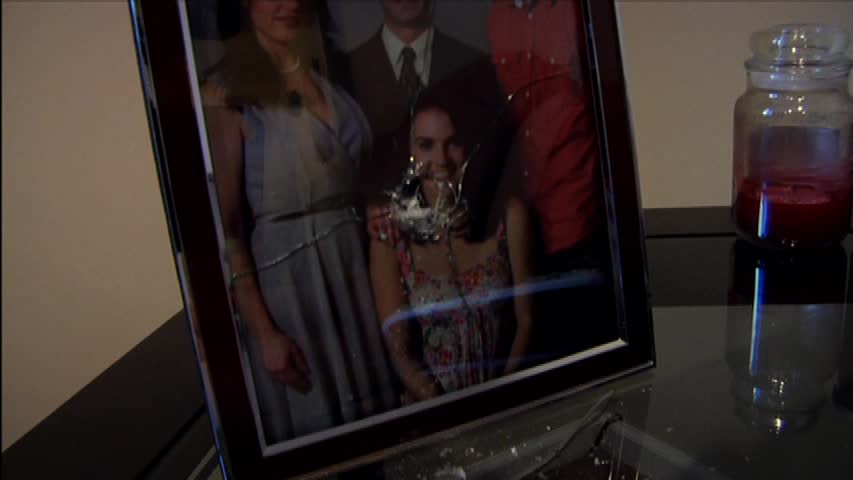
In the spirit of new releases on or around horror’s big night of Halloween, Director Ruben Rodriquez’s 2012 paranormal mockumenatry “The Death of April” comes to life on for the first time on DVD from MVDVisual. Similar to the “Paranormal Activity” series, the pseudo documentary about a dangerous, abode dwelling spirit or spirits bombarding their supernatural havoc upon helpless inhabitants. While the release time is appropriate and has a modest appreciation for creepy atmospheres, “The Death of April” fails to bring something new to the genre table and I can’t see the easily overlooked “The Death of April” being the catalyst to spark more interest in a ghostly genre that becomes overpopulated, by the major studios, during the month of October.
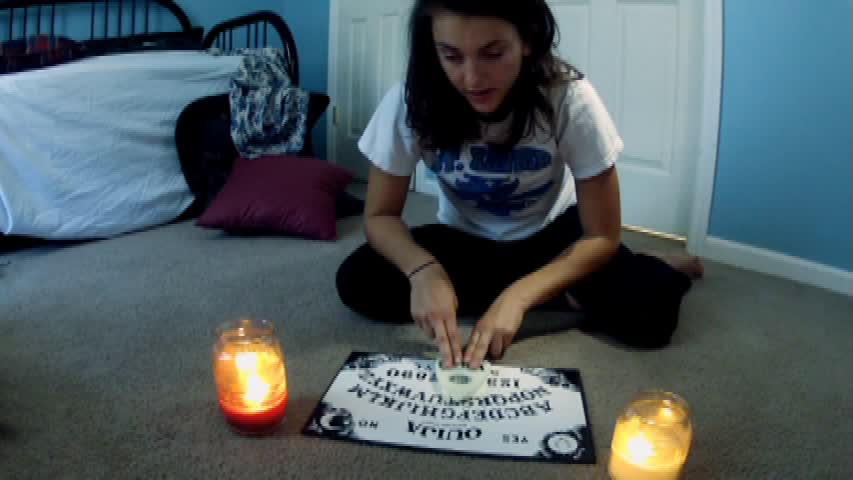
Backed finically by the Mojo Creative Group that was founded by Ruben Rodriguez, the mockumentary introduces a modest talent of actors and actresses including Katarina Hughes as Megan Mullen. Hughes, in her first feature film, delivers the much needed energy to a slow, stagnant script, but the contrast exaggerates Katarina’s overzealous happy-new-girl-moving-to-a-different-coast attitude. Her co-stars Adam Lowder as her brother Stephen Mullen, The Knick’s Chelsea Clark as her best friend, RayMartell Moore as her boyfriend Tim, and Stephanie Domini as her mother, who by the way looks almost the same age as Megan, sold their story, their take, of Megan’s downward events. That being said, Lowder, Clark, Moore, and Domini couldn’t lift the script out of the deep trenches of the uninteresting and mechanical motions.
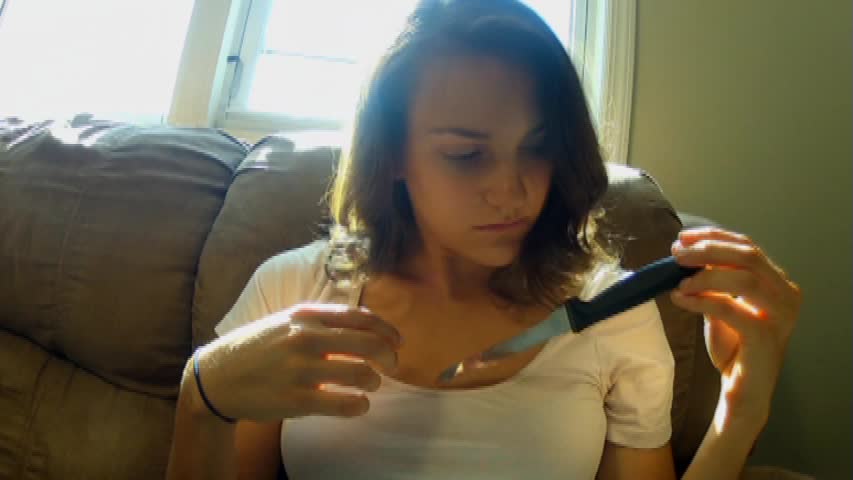
The script, which was also written by Ruben Rodriguez, could be considered to contain two interpretations, one literal and the other more concealed. The more literal interpretation is my least favorite of the two. Megan’s family constantly disowns the fact that she might actually be haunted by an apartment spirit; in fact, her family and friends negatively pelt her with denials and accusations, never once considering Megan’s theories of an aggressive April spirit. This is where the script becomes redundant as Megan’s brother Stephen and also her mother Stephanie reiterate over and over about how close their relationship with Megan was and how she had firm family roots in California and also proclaim the excuses of how she’s looking for attention or not coping with a new surrounding very well. Rodriguez’s script suffers by not displaying alternate ways in exploring how her family and friends should handle Megan’s paranoia or paranormal problem. Even when they’re is undeniable video proof with the video starting to distort and capturing uncontrollable movements from inanimate objects, nobody believes Megan and that would drive anybody to the loony bin. The second interpretation with, perhaps, a more underlying metaphor is that Megan is slowly going nuts. Her brother Stephen does mention her previous slightly creepy issues with Megan before her big impulsive move to the east coast. Almost like her impulsiveness and her energy-filled antics seemed manic and her sanity practically dissolved when she moved thousands of miles away from her support group in California. Megan’s mind could have invented April and her family, knowing that she’s had weird issues in the past, chalks this up to just being another mental issue. Of course, the video diary proof, even with her brother and friend witnesses, nearly excludes the second theory and that her “desire” to move far away from her family stems from April pulling her in that direction.
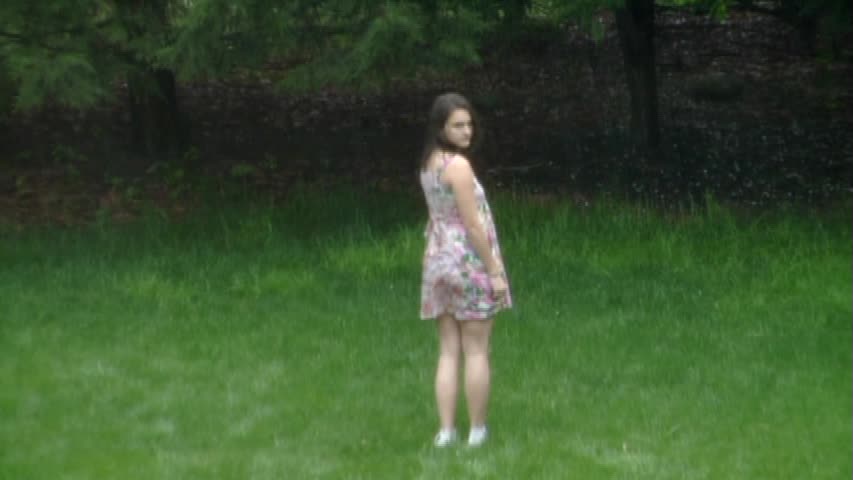
“The Death of April” won’t make waves on the PKE meter. The picture quality of the MVDVisual and ITN distribution DVD release looks clean considering that most scenes had intentional video quality posterization and distortion for the web and home video diary appearance. The front cover art is slightly misleading with a foreboding, rundown gothic style house in the background when actually Megan lives in a sectioned off duplex apartment in a suburban neighbor of a New Jersey home that doesn’t look necessarily evil at all. Also, who I’m guessing is spirit of April on the front cover with a Ouija board in her clutches sports sexy booty denim shorts as if to lure a certain audience to the release. We’re not sold on “The Death of April” as too many before it’s time have come across and planted their seed and sprouted firm in place.
Evil Reeks in an Old Magician’s Mansion. “Death’s Door” review!

A young group of people are mysteriously texted an address for an unknown party. When they arrive, the address takes them to a dilapidated mansion with innards displayed as if time has ceased to exists. When the group tries to leave, all the doors to the outside won’t open, condemning them to the horrors of a magician’s vengeful spirit and his very large and frightening assistant who looms around the mansion’s endless corridors. As the group continues to butt against each other in distress and disbelief, one-by-one they fall victim to the magician’s gruesome parlor tricks behind every door and the only way out of the mansion may be dependent on their families’ legacies.

With a premise similar to the 1999 remake of “House on Haunted Hill” where a group of people are mysterious invited to a creepy house and end up in a death trap, I wouldn’t say director Kennedy Goldsby’s “Death’s Door” aka “The Trap Door” is entirely, 100 percent unique. In fact, much of the film is undeniably the same compared to William Malone directed remake, yet less entertaining and without an all-star cast and a vaster budget. “Death Door” lures with the headliners of more attractive and experienced stars with the Jamaican-born movie and television actor Obba Babatundé and the “Friday” franchise actor, and overall a big, badass monster of a man, Tommy “Tiny” Lister. Yet, like most smaller projects, I’m sure Obba’s and Tiny’s handful of scenes were the majority of the budget pie, leaving a few dollar bills at the bottom of the barrel for special effects that were desperately needed for a film about a ghoulish magician.

The effects were completely inadequate and can’t even equate to the same stature used for “House on Haunted Hill.” Off screen deaths, quick edits and cuts, camera angles, shoddy CGI, the over use of red tints, shaky camera, flash backs, and a prop skeleton tried to sell plausibility when really just added to absurdity. Aside from the lackluster effects, the Goldsby penned script logically doesn’t flow and fails to develop acts. While seeking for an exit, separate groups of characters aimlessly wander the house, trying door after door, and then the next scene could be one of those characters mixed in with another separate group, creating some continuity confusion. Also, much of the script settles to a stagnate, housing an unnecessary long montage of the group being bored, napping, looking glum, or walking from one part of the room to another. To put the cherry on top, a random nude scene is oddly inserted into a montage into the magician backstory portion. There’s no telling who the naked breasts belong to or why they’re naked to even begin with as the exploitive and titillating shot crops out the head and the setting is awfully generic, not placing the body in any familiar surroundings related to the mansion.

I will say that very few of the acting skill sets were not at a total loss. The fast-talking, wise-crackin’ Bruce played by Chico Benymon was entertaining; the character’s angst-fllled stand-up-comic style character goes against the grain, fleeting any ideas of ghosts or any form of malevolency. Tommy “Tiny” Lister is always top notch. The big man doesn’t even have to say a word and he’s downright menacing, even if his character, Jomo, stuffs emotionless Latina’s into tight spaces and fails to soil the pants of the mansion’s guest when quietly walking around them. Sarah Wagenvoord, who I was hoping had the mysterious naked breasts scene due to her massive…well, you know, should have played a more prominent role du in part to her character’s outcome. Actors Michael Bernardi, Felix Ryan, and Danielle Lilley maintained an average performance through a mirco-budget production. The rest foundered to capture any kind of terror or despair or just even trying to be a normal character, overacting the parts as if trying to put passion into reading straight from the script.

The video quality of the MVDVisual DVD comes with hardly any flaws in the video stock or any loss in the natural coloring. The stereo audio is a bit unbalanced between the LFE and the dialogue tracks, deducing to some loss dialogue over the pounding hammering sounds. The extras includes the Kennedy Goldsby directed music video of “Shorty Wassup” by Hip-Hop artist Sizzol Pop. The last piece of bonus material is a behind-the-scenes featurette from the actual haunted house set where the crew has personal encounters with the spirits. “Death’s Door” is a fools gold, a trap, that promises deadly snares, haunting ghoul, and many scares. The ending comes to a complete halt with only tall tales of what might have dastardly happened to most of the characters in the rickety mansion. I would recommend far better old mansion spook stories.
 It's Bloggin Evil!

