A Charlatan Who Surrounds Herself With Evil! “Vampz!” Review!


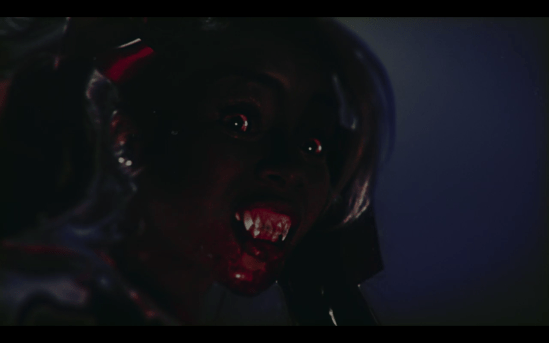
After countless interview screenings, Simone struggles to find a suitable roommate just like herself with an insatiable longing to be one of the undead, specifically, a vampire. As she strikes out applicant-after-applicant, her twin brother Sam persuades her to lock in on Ashlee, a beautiful, yet energetically ditzy cheerleader new to town who shows up late at night looking for a place of her own and with looming rent bills sucking her dry cash, Simone begrudging agrees on the dimwitted and un-vampiric prospect. Unbeknownst to Simone, one of her former screenings turns out to be a coked out vampire hunter and with Simone declaring herself a vampire during the screening, the oblivious and hopped up hunter’s ability to distinguish between the real McCoy and a wannabe has severely disintegrated as he aims to drive a long, wooden stake through her heart, but when the Hunter comes to claim his bounty, he inadvertently teams up with Simone and Ashlee against a tenebrous conspirator with a penchant for control of ghouls and monsters to not only save their lives, but also their friends.

“Vampz!” is the filmic version of a chaptered web series, that found a crowdfunded presence from circa 2012. Much like in the same vain as the “Hell’s Kitty” DVD release, “Vampz!” didn’t partake in any re-imagining, re-shoots, or even a re-cast for the movie; in fact, the so-called 2019 movie, helmed by director Ramsey Attia and scripted by Omar Attia and Lenoard Buccellato, is actually the web series spliced together to construct a 76 minute feature. To maintain comedy integrity that calls for hyperbolic reactions, profanity heavy dialogue, and some really nifty and amusing pop cultural intertwining, like Queen’s Bohemian Rhapsody dialogue rendition had me biting my smirking lip in assurance, Attia and Buccellato’s script never deviates from course. There’s are also other subtle homages that can be easily identified throughout. Between the TV web series and the film, no cast alterations or implementations have been made and so all of the established humor from the web series is still engrained from the actors and having never seen “Vampz!’ the series, gauging what, if any, soul from the original product is lost in the nearly decade old translation cannot be confirmed, but “Vampz!” has resilient comedic bite, going for both canine fangs into the throat in the face of being an independent picture.

Lilly Lumière at the forefront with her character Simone Castillo, an aspiring bloodsucker in all its fashionably formulaic vampire glory without being the recently bastardized Hollywood version a.k.a. “Twilight” trilogy, becomes the eyeliner nucleus of the story. Lumière presents an eye rolling, goth decked out quasi-vampire with a die hard approach to the banal side of the vampire mythos. Simone becomes the BFF target of Ashlee, who from the depths of the night shows up at her doorstep seeking the room for rent. Ashlee doesn’t seem to be Simone’s type, a high-spirited cheerleader tryout who is new to town; in fact, Ashlee represents all that is distasteful to Simone’s undead facade. Christal Renee has the vivacious personality type to pull the give me a S-U-P-E-R hyped Ashlee! Then there is Denis Ark as psychotic vampire hunter Marcus Denning. Ark is not just certifiable on screen, but he’s also certified off screen as a personal fitness trainer. With 20+ years in martial arts and sports training, Ark tackles the moderately physical role with ease and provides some point blank comedy. “Vampz!” remaining cast of misfits include Louis Rocky Bacigalupo, Guy N. Ease, and Cliff Hunter.

Shot in Peterson, New Jersey, “Vampz!” has a very Jersey feel, not to be confused with having an Italian Jersey Shore feel, despite being just a hop, skip, and a jump across the water from New York and even with that chip on the shoulder emanating from off of the screen and on the penny-pinching, crowd funded budget, the web series is without a doubt well done. The humor is touch and go with some misguided antiquation, but the effects capitalizes over that portion of content, especially when a creature or two appear for their grand entrance into the storyline. “Vampz!” has solid special effects working heavily to lead the charge into turning what could have been ho-hum film into a quasi engaging creature feature that deviates from the staggering conventionalism and genre tropes.

MVDVisual and Ruthless Studios sinks their teeth into the A Rear Naked Studios Production of “Vampz!” releasing the Ramsey Attia horror-comedy onto DVD home video in its full web series storyline. Presented in a widescreen, 1.78:1 aspect ration, the region free disc picture doesn’t provide a flavorful presentation. Attia and his team went faux grindhouse approach by adding grain and “missing scenes” on a pseudo-polyester film base, but the film looks washed and uninviting with droll hues. The English language dual-channel stereo track lies above the fray image with ample range of ambient sounds and a prominent dialogue track. Depth hardly comes through with most of the ambient remaining on a level plane that doesn’t resonate elsewhere from between outside and inside the finale factory or in between room-to-room. There are no bonus features included on this DVD that has curious cover art. Front cover pictures a badly photoshopped composition of a short red haired woman wearing an boxy amulet overtop a cutoff top and drinking blood out of a martini glass with a plastic straw. There’s also a white snake wreathed around the V and A of “Vampz!” and the same snake is also wrapped around the shoulders of a silhouette figure on the back cover but there are no snakes in this film, nor is there an high class, red-headed vampires drinking blood out of a martini glass so the cover is misleading. “Vampz!” garnishes heart and soul of the modern classic horror creature while adding a cascading charm of moderate-to-light hearted comedy to mask the rough edges of a home grown brew grindhouse film thats bemusing to perceive from a deceptively cheap DVD cover art.

Click DVD cover to Purchase “Vampz!”

Satan’s Evil Indestructible, Hairy Servant! “Beast of the Yellow Night” review!


At the tail end of the second great war, Philippines based U.S. army deserter and Japanese sympathizer, Joseph Langdon, runs for his life as the Philippines police and guard track him down through the jungle for committed heinous acts that not only include treason, but also rape and murder. Exhausted and dying from his wounds, Langdon will do anything to stop the process of pain and death, including making a deal with Satan himself. In exchange for saving his life, Langdon commits himself to eternal servitude at the malevolent pleasures of Satan by inhabiting various souls and bodies through the decades and extracting the latent evil from his interactions with people, but Langdon finds himself again exhausted and exacts free thought and a rebellious stance against his master after inhabiting an American business man and given back his own face. The Dark Lord, as amusing as he wicked, bestows upon Langdon the ability to transform into a flesh hungry man-beast whenever his desires boil to the surface and he becomes the most wanted man in the Philippines, but how can they stop a monstrous fiend they can’t kill? The answer lies solely with the damned Langdon himself.

Rarely does a horror film birthed from the Philippines reach my critical virtual desk and, fortunately, “Beast of the Yellow Night” lands smack-dab in my lap as an absolute jewel from the early 1970’s from writer-director Eddie Romero. The 1969 “The Mad Doctor of Blood Island” director, who’s heritage is Pilipino, had visions of grandeur for his large scale features that stem from an infinitesimal budget, but with enthusiastic energy from former musician and beach party, teen heart throb John Ashley, the duo cofounded their theatrical finance company, Four Associates Ltd, to produce their very own horror feature films straight out of the Philippines which “Beast of the Yellow Night” was one of first to be released, if not the very first to be produced. Additional funding was provided by a little known distribution company, New World Pictures, jointly founded by the genre-setting Corman brothers, Roger and Gene, and thus forth “The Night of the Yellow Beast” was built upon a rich and solid cult foundation that began a Philipino-film circuit conversely well-known in the U.S. and put Eddie Romero on the proverbial map of relatively unknown and granular cult directors while providing a branching out of yet another successful credential façade for John Ashley that doesn’t involve country music or being just another pretty face in the beach party moviegoer crowd.

If you haven’t guessed by now or if you’re just as dense like myself, John Ashley also stars in his co-produced creature feature and Ashley, who goes without saying that he stands in his own rite, is also the Paul Naschy equivalent of the Philippine Islands with his all hands on deck attitude toward filmmaking and being the man behind the gnarly man-beast makeup that more than likely takes hours to apply. His performance as even tempered Joseph Langdon is a stark contrast from the wild and vicious beast with a flesh appetite and knack for mauling that herd this film into the werewolf category according many descriptive plots, summaries, and reviews, but “The Night of the Yellow Beast” actually resembles more of a Dr. Jekyll and Mr. Hyde familiarity as Langdon doesn’t transform when the full moon is high, but rather at the whims of his tormentor, in this case it’s Satan rather than an ill-fated elixir, and then he morphs more rapidly and explosively during exhilarating and endorphin stimulated moments like intimacy to further exacerbate his dreadful curse on Earth. Langdon and beast Langdon are befriended by a blind, long-tooth ex-con, Sabasas Nan, played by “The Big Bird Cage’s” Andreas Centenera and Centenera captures the gentle nature and extended wisdom of a man at the tail end of life and looking to right the wrong for his past mistakes. Sabasas Nan is similar to the blind man in the tale of Frankenstein that doesn’t judge, become frightened, or even shun the ugly shell of a monster, but though visionless, both blind men are able to clearly see into the soul of what used to be once a man. “Beast of the Yellow Night” also stars leading lady Mary Wilcox (“Love Me Deadly”), Leopoldo Salcedo, Eddie Garcia (“The Woman Hunt”), Ken Metcalfe (“TNT Jackson”), and labeled as the Filipino Peter Lorre, Vic Diaz (“Black Mama White Mama”) as the pot-belly Satan and Langdon’s mischievous master.

Eddie Romero’s deep and intellectual script sticks out amongst the fray of time lapse and post-skirmish makeup effects that teeters “Beast of the Yellow Night” on a B- to C- movie. Not that the special and makeup effects were completely awful or subpar by any means, but the directing filmmaker pushes the boundaries to scribe the pull strings of a man’s soul, really digging into the anguished flesh of redemption and mankind’s mortal coil, which puts a lightly coated dampening on Langdon’s transformations from man-to-beast that hasn’t yet reached the Paul Naschy level of editing and progressiveness toward his horror films. In fact, the “Yellow Beast’s” effects are merely one step below that aforementioned level. However, the beast is no wolf of any sorts, but nor it isn’t a man in a cheap leathery or latex rubber mask that materializes a rather mangled, mangy beheld fiend with razor sharp canine teeth shown through a ferociously hungry and breathy-snarling maw set below equally ravenous eyes that yearns for the blood of man. For 1971, the effects are exceptionally marvelous, but Romero’s script just blows the practicalities out of the water being ahead of its time and sorely overshadow the effects work.

MVDVisual and VCI Entertainment proudly gift to us “Beast of the Yellow Night” onto 2-disc all region DVD/Blu-ray home video. Produced from a 2K scan of the original 35mm negative, VCI Entertainment’s widescreen, 1.85:1 aspect ratio presentation in full Metrocolor is mondo cult cinema exhibited on a high level and despite some blotchy patches, the corrected coloring and cleaner picture are by far the best we’ll ever see while still sustaining a healthy amount of beneficial cinematic grain. The prologue has coloring issues with about 20% of the right side of the film strip in sepia harboring in sepia town, but becomes corrected after the title and credit sequence. The English and Tagalog, the national language of the Philippines, mono audio track has lossy bite that’s expected and yet, still maintains ample dialogue track and a solid and balanced in range ambient track. Optional English subtitles with SDH are also included. Bonus features include a 2018 commentary track by writer and filmmaker Howard S. Berger and the head of Mondo Digital, Nathaniel Thomspon, old and insightful video interviews about John Ashley and the Filipino films of the 19870’s with Eddie Romero, Sam Sherman, Patrick Wayne, Peter Tombs, Eddie Garcia, Gloria Hendry, Sig Haig, and Jan Martin, a Remembering John Ashley featurette that includes interviews with wife Jan Ashley, filmmaker Fred Olen Rey, Steve Stevens, and Andrew Stevens, original theatrical trailer and TV spots. Plus, a thorough inner liner essay from Howard S. Berger that goes examines “Beast of the Yellow Night” and the films of that era that are a metaphor for much, much more. “Beast of the Yellow Night” is a simple message cause and effect. If vileness becomes you, then villainy will forever run fluidly through your icy veins in this Eddie Romero and John Ashley monstrous picture that pulls at the tattered strings of a downtrodden soul.

Amazon has it on sale, now! Go Go Go!

The Great White Evil Hexad! “6-Headed Shark Attack” review!


In 1984, a floating marine biological station near Baja, Mexico becomes the target of an unnatural, genetically modified creature – a massive six-headed great white shark! The attack leaves the station afloat, but all the scientists fall victim the six, serrated jaws. Twenty-five years later, William, a couple’s therapy boot camp instructor hones in on assisting estranged lovers rekindling the romantic fire by having the couples journey to a remote, rocky island just off the Baja coast. Struggling to cope with his own divorce turbulence, William takes the reigns of the camp therapy business that was cofounded with his ex-wife, hoping for comfort through the program’s reconciliation message, but when the six-headed shark kills two of his colleagues, William’s new mission is for the safe harbor of his customers. However, every time one brains of the shark is damaged or destroy, the head is ripped off by another head and new one regenerates in it’s place and the beast can also hunt on land, fathoming as turf and surf’s most deadliest unstoppable creature known to mankind.

A SyFy Channel original premiere from The Asylum Home Entertainment group has astonishingly struck pure chaotic shark gold yet again with “6-Headed Shark Attack,” the latest monstrous sequel that follows that same flamboyant titular tradition. Director Mark Atkins, who is no stranger to b-movie shark horror with “Planet of the Sharks” and “Empire of the Sharks,” dives right into the water with his first multi-headed shark attack film that’s penned by Atkins along with Koichi Petetsky, a recognizable name from his scribe work on the recently reviewed “Megalodon,” another The Asylum and SyFy love child. To be honest, “6-Headed Shark Attack” is also this reviewers first venture into the multi-headed shark attack universe and, to be truthful to my audiences again, the absurdity of Atkin’s monster shark roister is reminiscent of the classic monster films that include giant ants and killer shrews!

William’s disheveled intangibility is being held together loosely by the wiry binds of his marriage counseling profession and though the painstaking process of divorce rattles his soul, the potentiality of being eaten by a 6-headed shark doesn’t phase his determination in saving survivors trapped on the remote island. Brandon Auret slips into the William’s embattled shoes and the actor, who been a steady Neill Blomkamp favorite South African for the steampunk-laden director’s films such as “Chappie,” “District 9,” and “Elysium,” finds himself as lead man versus mutant shark, but the multi-lingual and rugged Auret fails to sell the performance that falls flat with tremendous eyeshot quality of awkward hesitations and unsavory emotions. Blomkamp’s high concept science fiction doesn’t quite parallel Atkins’ budget flair that spotlit around great white shark country’s South African filming location that seems unfitting for Auret’s usual Hollywood wheelhouse. The female lead is bestowed upon fellow “Empire of the Shark” vet Thandi Sebe as Mary, one half of one of the four flailing couples, and Mary’s strength and common sense separates her from the pack and even her husband played by a very bushy haired stunt coordinator Cord Newman. The malaise between James and Mary push to a general distressing love triangle that’s been fabricated by a violent and vindictive James; Sebe and Newman aren’t the quintessential unhappy power couple, but they do make a stain that stands out. The remaining shark victims includes Naima Sebe, Tapiwa Musvosvi (also “Empire of the Sharks”), Chris Fisher, Meghan Oberholzer, Jonathan Pienaar (again, “Empire of the Sharks”), and Nikita Faber.

Like most of The Asylum productions, “6-Headed Shark Attack” is made on the extreme cheap. That isn’t to say that the extreme cheap and is extreme garbage as each film that is churned out as a SyFy original has some sort of redeeming quality to it. For “Megalodon,” the shark had characteristic features, like scarring, even if the Megalodon was two dimensional. “6-Headed Shark Attack” also saves itself from full outright embarrassment with schlocky, barmy charm such as a shark walking on land like a scorpion shark, using four of the heads as legs to charge toward steeplechased landlubbers, but the 6-headed shark has no definition from the visual effects team, losing some of the realism much need, or rather desired, in the computer generated leviathan.

MVDVisual and The Asylum Home Entertainment chum the water with “6-Headed Shark Attack” presented the digitally shot film in the original widescreen format, an 1.78:1 aspect ration. The shark was already touched upon that the visual effects lacked the creases, the scarring, and the overall personality a mutant shark should possess, but the look of the rest of the film needs to be questioned as well. The South African shoreline is exquisite and serene that’s beautifully captured by director Mark Atkins who also has an equal hand in being a cinematographer. Yet, the sunny, rocky island favors a washed look (no pun intended) that stems from an overexposure during the digital recording and loses some of the details in obvious portions such as large jagged rocks seemingly smooth or the granules of sand blending together to be one tan blanket on the beach. The English language 5.1 surround sound has no qualms for the most part other than The Asylum go-to stock score tracks by Christopher Cano and Chris Ridenhour, the musical duo behind “Megalodon.” Trailers to the film are the only extras available on a static menu. Having never seen 2, 3, 4 (is there a 4?), “5-Headed Shark Attack,” “6-Headed Shark Attack” seems to not be anchored down by series continuity despite reuniting the cast and crew of “Empire of the Sharks” and “Megalodon” and is a standalone creature feature constrained to being a run of the mill exploitation of man-eater mania.

Buy 6-Headed Shark Attack at Amazon.com!

Evil’s Gonna Need a Bigger Boat! “Megalodon” review!


A covert Russian submarine is trying to drill into the Southern Pacific communications system to benefit from United States secrets, but when the gung-ho captain decides to push the drill team to maximum velocity, the submarine inadvertently release a pre-historic, though to be extinct Megalodon. A nearby U.S. military vessel intercepts the heavily damaged Russian sub with a submersible and saves three uncooperative, Kremlin patriotic survivors from Davy Jones locker while barely escaping jaws of the powerful Giant shark. The aging U.S. sea captain, Streeper, and accompanying admiral, King, rely heavily on Commander Lynch to maintain constant attention on the circling predator, while Streeper attempts extracting vital information from the Russian operatives to further establish the hostile tense and disruptive Russian-U.S. relations. When the shark turns its ravenous attention to the vessel, the crew must use their smarts and what’s on board to go head-to-head against a ferocious, battle ready Megalodon!

You really have to hate-to-love The Asylum for producing and capitalizing on highly lucrative films. This past summer’s “The Meg” was a major blockbuster success for not only director John Turteltaub but also for Warner Bros and as if the Carcharocles megalodon wasn’t exploited enough, The Asylum’s “Megalodon” aimed to reap from Jason Statham face-off with “The Meg.” Director James Thomas, who delivered another knock off with “Tomb Invader,” a cash in on last year’s “Tomb Raider” reboot adaptation to the popular video game, submerses himself into the SyFy movie. The SyFy channel is no stranger in shelling out monstrous shark movies; let’s just name a few to paint a picture of what’s being described here: “Sharktopus,” “2-Headed Shark Attack,” “Ghost Shark,” “Jersey Short Shark Attack,” “Malibu Shark Attack,” and let’s not forget to mention the channel’s most prolific and preposterously entertaining “Sharknado” franchise. Unfortunately, sharks an easy target for villainy that viewers can easily digest and be enthralled by their mysterious nature, but to buffoon them with genetic mutations unnatural superpowers stiffens not only their actual gentle prowess, but also attenuates legitimate shark films. That’s not to say that Thomas’ over-saturated titled “Megalodon,” penned by “6-Headed Shark Attack’s” Koichi Petetsky, is a mega hit, but at least the shark isn’t radioactive, isn’t a spliced abomination, and can’t dorsal slice through sand, ice, and earth. The back to simplicity for the man-eating shark is a breath a fresh air in my book.

“Reservoir Dogs’” star Michael Madsen headlines with his name splayed right about the titular creature about to swallow a submersible. Madness, sporting a military non-regulation curly hairstyle, portrays an naval officer, Admiral King, at the end of his lustrous career. King’s lame duck presence is a formulaic means to an end that will decide the fate of more prominent characters so Madsen, as an unconvincing and unconventional U.S. admiral, has screen time that’s limited mostly to the first and third acts and scarcely peppered in between the dynamics of Captain Streeper and Commander Lynch. While Streeper and Lynch essentially share the lead and neither have the star-studded power to be an influencing purchase-me-now headliner, the two onscreen officers are structured as a one-two punch against two opposing forces. “The Demonic Dead’s” Dominic Pace, as Captain Streeper, has promising capabilities as a military ship commander as Pace maintains his usual type casted tough guy role from prior credits while his counterpart, Caroline Harris, plays passively strong in Streeper’s shadow that’s supposed to display edge-bordering defiance but never comes to fruition. As Pace and Harris jockey for lead, Russian submariners, Captain Ivanov and Yana Popov, sheathed a more interestingly perspective on duty versus mortality. Ego Mikitas (“Nazi Overlord”) and “Fear Pharm’s” Amiee Stolte lined “Megalodon” with a sub-story, no pun intended on the sub, as bullheaded survivors aiming to complete their clandestine mission without lifting a finger to assist the opposition. To be fair, the James Thomas script didn’t exactly put the U.S. in good light, scribing Streeper, Lynch, and others as pushy information extractors and the Russian are stereotypical misers of information. If I was being intensely interrogated while a massive shark circled our boat, I would also question the intentions of my captors and not give them squat. Other shipmate actors include Scott Roe (“Transformers: Dark of the Moon”), Sebastien Charmant (“Halloween Hell”), Elizabeth Cron (“SuperHot Apocalypse”), Paulina Laurant (“Triassic World”), and Luke Fattorusso.

“Megalodon” provides a laugh track of production inadequacies and a cinematography from Paul Thomas could be said to be straight out of the Michael Bay school of filmmaking, but as far as SyFy premiered movies and The Asylum Home Entertainment films go, “Megalodon” is a Giant Shark sized leap of success. The CGI shark has surprised me being an object of crude, but of commending detail that exhibits an ancient beast marked with battle scars and also exhibiting realism with the donning of an acceptable gray-blue hue. Plus, the shark doesn’t have atomic level laser vision, can’t breathe fire underwater, and has the normal shark fins instead of octopus tentacles. Thank the shark Gods! While the megalodon passes plausibility of natural facts, it’s swimming motion and trajectory checks the box of clunky territory with a rudimentary, two-dimension view of the shark swimming at an unnatural diagonal angle away and toward the ship, like something out of the NES “Jaws the Revenge” video game. The CGI ship and submersible is more of an immediate concern than the CGI shark as Roger Rabbit has more realism. Suffering succotash! Actual location of the ship is a the USS Lane Victory, a defunct military vessel from WWII turned museum that’s docked off California and the museum aspects tactlessly are not veiled from view and, if a modern day military ship is supposed to go toe-to-toe with a megalodon, a ship with brass communication tubes. The obvious museum décor ships “Megalodon” into a strange and bewildering backwards alternate universe that causes confusing and complexities with a quarry full of questions.

MVDVisual and The Asylum Productions presents the SyFy original film, “Megalodon,” onto DVD home video. Original being the suspiciously key word here as original never really goes hand-in-hand with The Asylum produced films. Presented in the original widescreen format, “Megalodon,” for what it’s worth, has distinction despite the questionable special effects. No blotchy or aliasing detected and the coloring renders consistently. The 5.1 surround sound audio tracks has clear verbal dialogue, ample gunfire and explosion range and depth, and no distortions to note. The painfully generic stock score is an ear sore, but has balance and isn’t an overly commanding and obtrusive presence. The trailer is the only special feature available, but to broaden upon the lack of bonus material, the Asylum DVD releases always have kitschy graphic cover art and “Megalodon” is front and back gold standard that exaggerate the film’s action-packed appeal. Director James Thomas’ dual story batters the pre-history shark narrative to nearly null, but “Megalodon’s” unwavering action chums the water that begins with a large shark taking a bite out of a foreign reconnaissance submarine and ends with Michael Madsen extinguishing a cigar on the said shark’s large snout in pure Michael Madsen fashion.

Please consider support ItsBlogginEvil by purchasing products through this link! Thank you!

Evil from the Sky! “Devil’s Gate” review!


In the small rural community of Devil’s Gate, Oregon, a boy and his mother disappear without a trace. FBI Special Agent Daria Francis spearheads the investigating to atone for a regretful previous child disappearance case. She’s accompanied by a local deputy, Colt Salter, to assist her. During her brief investigation upon arriving at Devil’s Gate, Agent Francis comes to the determination that Jackson Pritchard, the father and husband of the missing boy and mother, is directly involved in their sudden disappearance. The investigation turns from a seemingly straight forward, open and shut case to a colossal mystery that’s beyond their comprehension when arriving at the religious dogmatist’s boarded up and disturbing cladded farm house where unearthly forces lay claim to the Pritchard family home for sinister reasons. With one of the beings caged in his basement, the desperate Pritchard seeks an exchange with the creatures he labels as the fallen angels in attempt to regain his wife and son, but as the night falls, trapping Agent Francis and Deputy Salter with Prichard inside the residence, they become surrounded by the fire in the sky creatures aimed to reap not only the world, but their souls.

Like an enigmatic report straight from the non-redacted portions of a nail-biting X-Files case, “Devil’s Gate” is a we are not alone sci-fi horror film from 2017 under the apocalyptic eye of director Clay Staub and co-written by video game plot scriber, Peter Aperlo. The considerably financed project is the first feature film for both filmmakers in their respective roles with Staub having served as an assistant director on other paranormal plotted projects like Zack Snyder’s heavily praised remake of George Romero’s flesh-eating zombie classic, “Dawn of the Dead,” and Matthijs van Heijningen’s underrated “The Thing,” a prequel to John Carpenter’s film of the same title. One quality that we can all can be pleased about is that Staub carries over from his previous experience as a genre filmmaker participate is the use of gore in the “Devil’s Gate” because, honestly just by looking at the cover and reading the plot, the bloodletting expectation was low on the totem pole. Staub doesn’t unload a gratuitous splatterfest of alien and human entrails, but subtly sanctions the right amount of extrasensory chest bursting and finger snapping goo that plays an ill-fated role of circular or motivational circumstances for the characters.

Putting the pieces of the Pritchard mystery together is Agent Francis who is a to the point and tough national law enforcement officer with a bleeding heart complex after her very first assigned case went tragically sour that looms an unexplainable root cause cloud over her straight blonde hair. Desperate to cure her past, Agent Francis rushes into Devil’s Gate, bypassing the notable chicken fried steak meal offered by Deputy Salter upon her tarmac arrival and defying the local Sheriff’s heed to not interview husband Jackson Pritchard, that sorely causes her to land in the virtually the same predicament of just trying to get the right thing done no matter the unclear ancillary evidence. “12 Monkey’s” television star Amanda Schull spearheads the character with the characteristics aforementioned with drab appeal, lacking the emotion and the intensity her character is supposed to be exhibit when trying to solve a case of personal redemption as well as the fear from an higher ominous power that can shoot lightning down from the sky and flash velociraptor toe-claw sized fangs. Colt Salter might be a small time, Podunk deputy, but the born and raised Devil’s Gate officer can match wit with his FBI counterpart. Salter strikes me as a character who doesn’t stray far from home, mentioning various times, in various ways, his parallel path to high school friend Jackson Pritchard. Shawn Ashmore, from Joe Lynch’s “Frozen,” opposites his costar Schull like Mulder and Scully type as well as an all-around good guy who happens to stray from his protocol path once Agent Francis puts her federal fingers into his already investigated investigation. Like his performance in “Frozen,” “X-Men” franchise, and even in FOX’s television thriller “The Following,” Ashmore is a pretty solid actor, showing a range of emotion that transcends him from easygoing deputy to mortality fearing when mankind’s on the verge of extinction comes into the equation. An equally solid performance by Milo Ventimiglia, who recently starred in “Creed II,” really sells the crazy portray by Jackson Pritchard, a God-fearing man with a long lineage of misunderstood family heritage that leads him to the uncanny bombshell that has been bestowed upon his family farm. Ventimiglia, in his roughest, toughest country twang, creates such an anxiety-riddled and frantic character that unravelling his fate is not too clear which is refreshing to be able to retain mystery to a role as we can kind of figure out how Agent Francis and Deputy Salter when fair in the end game. Rounding out the cast is Bridget Regan (“John Wick”), Javier Botet (“Slender Man”), and “Star Trek: The Next Genergation’s” Jonathan Frakes, still sporting that iconic beard even if it has grayed, as the town Sheriff.

In spite of some really cool visuals, especially of the man underneath the mask, Javier Botet, inside a ghoulishly white extraterrestrial suit that only his elongated and thin body (and perhaps also Doug Jones’) could snuggly fit into, “Devil’s Gate” tells a narrative that hails from a lot of re-spun material. Whether intentional or not, viewers more than likely won’t be able to help themselves as they’ll eagerly point to the television screen and say, ““Independence Day” did that first,” or exclaim, “didn’t Donald Sutherland star in the same kind of thing???” I know I did. However, Staub and Aperlo don’t completely ape the concepts that surely haven’t inspiring them, making the effort more endearing, and visually crafted a well-blended plot into an enjoyable and captivating story; a story that has been mostly devoid of underlining messages and symbolism other than the themes of religious zealots are extremely bad for the world and living with past regrets can be hazardous for your health if not properly accessed. “Devil’s Gate” focuses more directly on just entertaining another version of visitors from another world and how those no-so-little-green-men play an assimilating role into humanity.

Umbrella Entertainment releases “Devil’s Gate” onto a region 4 DVD presented in widescreen 2.35:1 aspect ratio. The vast Midwestern landscape with the foreboding rolling clouds stretches from top to bottom with an exact sharpness and crisp from the digital picture. The textures in the broad, yet barren-esque fields look especially detailed, more so with the wind and brownish-yellow color. Speaking of color, the hue is a filter of shadowed purple and on a sepia side that works the dread atmosphere. The English 5.1 Dolby audio track has ample range and depth. Lightning strikes boom equally from the five channels, alien shrieks trembles through, and the dialogue is not obstructed. Surprisingly, there are no bonus features with this release as the Stateside counterpart even has a trailer in the extras. There isn’t a static menu either as the film goes right into play feature mode. c