Jessica is plagued by recurring horrific and lucid nightmares of a horse-headed figure that brings death to her dreams. When she has a nightmare about her grandmother being impaled to death by the horsehead monster, she’s immediately phoned by her mother Catelyn informing Jessica that her grandmother has passed away. Jessica travels to the family’s countryside estate for the funeral and is welcomed by her stern mother. Jessica’s nightmares worsen the first night and she becomes trapped in her own dreams as she can feel the haunt of the horse-head figure in the corner’s of her mind. When Jessica soon realizes that her’s grandmother’s death and her mother’s cruelty might be more involved and connected with the horse-head creature, she attempts to stay in a semi-conscious sleep state to puzzle together the mysterious pieces and to control her nightmares once and for all.

The freshman feature film from Romain Basset contains such promise and maturity and Basset shows daring courage to create a horror-fantasy of this caliber thats very aesthetically symbolic and worthy of being awarded qualities of early Dario Argento’s films with intensive surreal and haunting facets. “Horsehead” embodies the character Jessica’s head in creating and blending an atmospheric jigsaw and visceral puzzle of a world while being a mirror in which you can glance back into time, far back beyond your own existence. “Horsehead’s” unique tribute blend contains the bizarre and frightening worlds of Tarsem Singh’s 2000 film “Cell” intertwined with one’s life story similar to the past and present tales of “A Christmas Carol” with Ebenezer Scrooge. However, Jessica’s past is much more dark and grim than Scrooge’s will ever be and her future won’t end in her being generous and kind to a crippled poor boy named Tiny Tim.

Certainly a visually stunning film, “Horsehead” tries turn the mind on it’s end, leaving the suspended muscle dangling near the edge of insanity. Jessica’s reality becomes no more real than her nightmares as the horse-headed monster is has comparable dream-bending qualities to the the same effect as Freddy Krueger of “A Nightmare on Elm Street” but “Horesehead” is a lot more gothic and whole lot less sarcastic than the fedora sporting child murderer. The creature has haunted Jessica’s lineage for at least three generations, presumably starting with her late grandmother and is a symbol of Jessica’s strict-bible-following grandfather who becomes the epicenter of all the family’s issues. Her dreams hold a dark mystery to her family’s continuous cycle of troubles and use horrific symbolism to express, in stages, the truth behind their ancestral secrets.

As much as I love the symbolism in this film, I’m worried about the psycho-sexual portion the film markets, splashed as a tagline right on the Blu-ray cover. Yes, the once little girl from Robert De Niro’s “Ronin” actress Lilly-Fleur Pointeaux does become involved briefly in highly sexual situations in her electric dance music soundtrack nightmares in a down the rabbit hole type of situation, but really serve no purpose to Pointeaux’s character in reality because no much is conveyed except for her profession as a dream psychologist and she has quarrels with her mother, especially on why her mother refuses to informer on the identity of her father. Gala Besson, who plays a younger version of Jessica’s grandmother, also briefly bares skin for a more gruesome and twisted scene that would make Pinhead smile with such pleasure. Perhaps the psycho-sexual scenes stem from the heavily implied incest relationships in the story between father and daughter, sister and sister, and mother and daughter. If incest is the answer to my question on why the film blatantly markets psycho-sexual, than the taboo subject matter makes “Horsehead” that much more risque and that more interestingly ambitious, creating a film that’s hard to swallow and shocking to behold when put into that perspective. Some dream interpreters believe that being chased by a white horse, in which case the horse-headed creature is of off-white color, may represent chaste or having issues with intimacy. This might explain some of Jessica’s unusual sexual scenes in her dream sequences involving relatives.

You might recognize a name from the past in the Italian horror genre: Catriona MacColl, an United Kingdom actress who portrays Jessica’s uptight mother Catelyn. MacColl is best known for her early 1980’s rolls in the Lucio Fulci films “The Beyond,” “City of the Living Dead,” and “House by the Cemetery.” With MacColl and Pointeaux’s as the overpowering female characters, “Horsehead” rounds out with weak male characters such as Jessica’s stepfather Jim, played by Murray Head, and an estate servant George, played by French acting vet Vernon Dobtcheff.

Overall, “Horsehead” delivers solid acting, dons great editing, and has better than average makeup and effects making “Horsehead” a winning release, yet again, for Artsploitation Films. The Blu-ray release is perfectly graced with a stunning 2.35:1 widescreen transfer with a 5.1 Dolby Digital mix, evenly balanced with appropriate LFE during the EDM nightmares. The picture is quite clear with some digital noise interference but only on some minor facial closeup scenes and no damage on the prints. Even though “Horsehead” is a French film and most of the cast is French, the movie is in English and it’s not dubbed English either. Bonus features also include “Inside Horsehead Making of” and four short films that have a total runtime of 81 minutes – a movie in itself.
Category Archives: Creature Features
Craving an Evil Appetite! “Frankenstein’s Hungry Dead” review!
A group of mischievous and detention bound high-schoolers are handed two choices: either spend the day in a classroom after school or take an educational trip to a wax museum in Salem. Instead of spending the entire day in a classroom, a trip to a wax museum seemed to be the lesser of two evils. Little do the hooligans know that the museum’s curator Charles Frank is the relative of the infamous Dr. Victor Frankenstein and Charles Frank, a pseudo name for Frankenstein, has continued the ghoulish work his elder kin started long ago. Trapped inside Frankenstein’s wax museum of horrors, the high-schoolers are pitted against Frankenstein’s flesh eating creations with no way out. What was suppose to be a fun and devious night of intercourse and dancing turns into a bloody-blood bath of unspeakable horror.

This isn’t my first rodeo with director Richard Griffin’s work. The last It’s Bloggin’ Evil Griffin review, “Sins of Dracula,” didn’t strike the right key notes and became only a shell of a honoring horror film. “Frankenstein’s Hungry Dead,” also known as Dr. Frankenstein’s Wax Museum of the Hungry Dead,” was made a year earlier than “Sins of Dracula” and reminds me more of a true Griffin film. At first, I was afraid “Frankenstein’s Hungry Dead” would dull the mood as rebellious youth have yet again landed themselves into a death trap and this scenario just seems to be regurgitated over and over again in horror cinema. Eventually, and to my surprise, Griffin digs and builds out of that redundant hole and still manages to display his ever long homage to horror and horror icons comically. The thing about Griffin is is that he relies on mashing many genres together. For example, “Frankenstein’s Hungry Dead” is a mesh of Frankenstein, the Romero zombie genre, and a little bit of naziploitation to give the film some flavor. Second and third act strengthen the film’s roots and the comedy really pops during these acts making the film comical and gross at the same time.
Another conventional Griffin film schtick is the long-winded dialogue. I tend to get breathless just listening to the dump truck loads of exposition that seamlessly spew out of the actors’ mouths. The dialogue to death ratio just doesn’t add up and this film does get a bit talkative with a script that doesn’t quite measure up to Shakespearian work. The dialogue tends to be juvenile and obvious in a sense that every scene is laid out by description. Unless you’re Michael Thurber playing Dr. Frankenstein, there lies no reason behind other characters to have more scripted lines than there are end credits.

Speaking of Michael Thurber, Thurber has cemented himself as part of Griffin’s entourage a long with others who are also casted in this film: Johnny Sederquist, Jesse Dufault, and Jamie Lyn Bagley. However, Thurber’s versatility seems quite amazing. My first experience with Thurber was as a hard nose cop hellbent on vengeance in “Murder University” and I think he’s the best part of Griffin’s films. Thurber’s portrayal of Charles Frank combines a “Young Frankenstein’s” Inspector Kemp with a long lost, and black sheep, cousin of Hammer Horror legend Peter Cushion. Johnny Sederquiest and Jesse Default are starting to grow on me more and more with their acting styles. Their outrageous over acting is childish but hypnotically effective in humor. Bagley has been the more serious actor of the bunch, staying away from the horribly cliched parts and sticking with simple, easy to miss characters such as her breakout role as nerd girl heroine Katherine.

Overall, “Frankenstein’s Hungry Dead” is less about Frankenstein’s creature and more about the creation of flesh eating zombies and reaping hell upon meddling teenagers. Certainly a different take on the mad scientist genre and the Frankenstein legacy, but Griffin does mix things up for not necessarily the worst and I’m sure Mary Shelley would agree, if not really mind at all. The MVD and Wild Eye DVD release distributes a fairly standard unrated package that doesn’t disappoint and would be a winner in anybody’s B-movie collection.

The Mold Knows Evil. The Mold Knows! “Motivational Growth” review!
Ian Foliver is a pessimistic, depressed, and reclusive young man with a touch of agoraphobia. When his best friend, an old Commodore tube Television named Kent, bites the bullet with a busted boob-tube tube in his unkept apartment, Ian determines that life is no longer worth living because that television named Kent was his only friend, his only ray of daily sunshine and that life-worthy activity had just suddenly died. Feeling that life is no longer worth living, Ian gathers up household chemical products and decides to gas himself to death in his bathtub, but when trying to clog the bathroom air vent, he slips and falls landing on his head. When he wakes up, Ian is face-to-face with a growth of conversing mold. The Mold, as it refers to itself, wants to help Ian – clean up his apartment, shave and bathe, and attract the attention of his attractive next door neighbor who Ian stalks and ogles daily through his front door peephole. In return for this helpful motivation to live, The Mold demands that Ian follows The Mold’s precise instructions which might not be as helpful as Ian first thought.

The Don Thacker directed dark comedy is a surreal voyage into the internal life struggle of Ian Folivar, played beautifully by Adrian DiGiovanni, who directs his own downward situation making the audience part of Ian’s life. Ian is a character that is aware of his flaws but can’t accept his life and his analysis is that “life is shit” and is dangerous so shutting himself in his small apartment fairs way better than living the conventional life. “Motivational Growth” shares commonalities with prior cult favorites; one of those favorites is the Peter Hyams directed and John Ritter starring film “Stay Tuned” to where Ian becomes sucked into eccentric television programs he was viewing before Kent blew a fuse. Also, another cult favorite film, Don Coscarelli’s “John Dies at the End,” which shares that wacky fantastics of dark and ironic situations. All three of these dark comedy romps are in a small, rare genre group that dares to be different and do well at it.

The Mold is an unique, life-like creation of filth that can actually make you feel the fungi-filled griminess lying within between the nooks, crannies, and crevices of your body. A job well done by Thacker and his The Mold puppetry team led by special effects supervisor Steve Tolin of TolinFX. They really did an amazing job creating a practical effect living-being that works in sync with the iconic voice of Jeffrey Combs whose voice fits as The Mold’s persona – confident and inspirational with a hint of cynicism. The interactions between Ian and The Mold becomes symbiotic where Ian needs The Mold to rejuvenate his depressed life back to order and back to the land of the living while The Mold needs Ian to fulfill it’s inauspicious desires for Ian’s “well-being.” When Adrian DiGiovanni interacts with The Mold, he’s interacting with an actual character in the room and not a hokey-hapless effect. You have to hand it to DiGiovanni in forming a believable dialogue and relationship between himself and an inanimate object such as the lowest scum, excuse me – fungus, on Earth.

What I adore about “Motivational Growth’s” plot is the mysterious time period that it’s set in as many references point to the late 1980’s to the early 1990’s with the video game imagery, the television personalities, and the hairdos and clothing lines of characters in Kent’s hosted top shows Ian mindlessly views. Ian, himself, is stuck in time not knowing what a Plasma TV was which would fall right in line with the time frame above since Plasma’s didn’t start rolling around until the mid 90’s. I also like the peculiar characters Ian encounters even though his setting his solely set in his cramped apartment. Box the Ox, played by the intimidating Pete Giovagnoli, pinpoints his character perfectly as a seemingly overbearing, yet somewhat absent and simple minded, landlord who threatens Ian with off-the-wall metaphors, thus making him fun to watch and see how Ian attempts to interact with Box until Box cuts him off all the time even if Ian is provoked with a question by Box the Ox. Ken Brown as Plasmoday is by far my favorite. With a creepy face and creepy mannerisms, Plasmoday had too short of a role and I thought he would make a return to Ian’s abode to lick his TV again, but in the character’s short amount of screen time, Brown is able to up-play the oddity that embodies Plasmoday with such passion that it’s hard not to love the character.
“Motivational Growth” molds itself into greatness amongst cult movies. The nitty-gritty portions are grossly stimulating and will sure to have you jump in the shower for a quick rinse. Whether or not Ian is suffering from brain trauma, purgatory, or just to awake to a nightmare scenario, the story is left open for interpretation, giving the audience a chance to determine the ending for themselves which is always fun in my little black book. The MVD Blu-ray is spectacular technically. Super clear with no disturbances in the transfer. The Hi-resolution downplays the obvious practical effects on The Mold but that only brings more charm to the film. The sound is clear and the extras are plentiful. I’d suggest “Motivational Growth” to anyone – even to a neat freak with cleanliness issues.
Evil Terrestrials and Their Toys! “The Device” review!
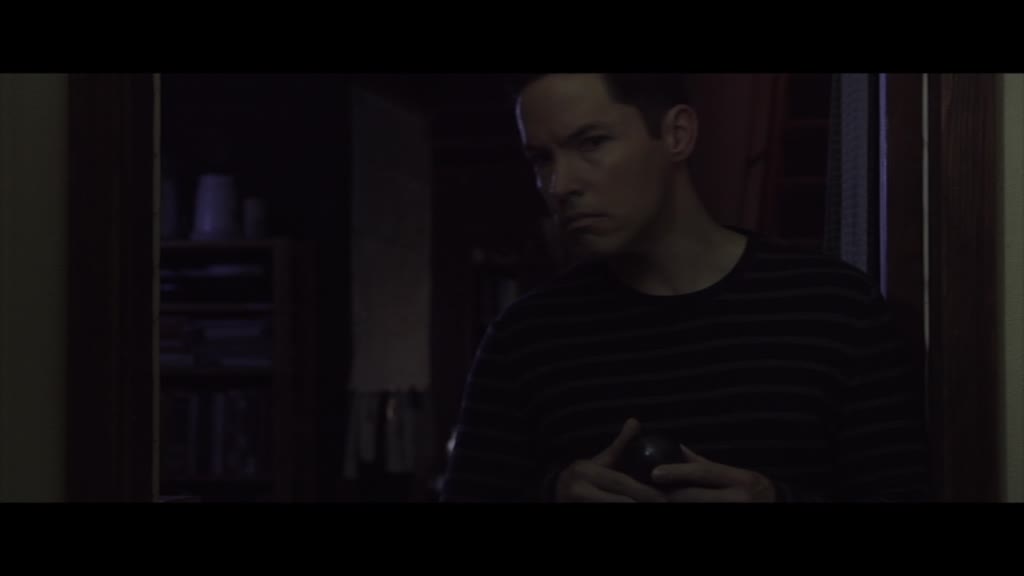
After years of being distant from each other, Abby and Rebecca reunite at their isolated family cabin to release the ashes of their recently deceased mother into the nearby lake. They stumble upon what seems to be a crash site of sorts and come into possession of a small sphere object. The sphere has become the object of Abby’s husband’s obsession and Abby starts to have nightmares of weird beings experimenting on her body. When Calvin becomes withdrawn and Abby learns she’s pregnant, Rebecca reveals her beyond the stars tale of why she’s kept her distance away from her sister and from their family cabin. A tale of abduction and unwanted incubation.
“The Invoking” director Jeremy Berg has carefully constructed a film where the characters actually feel human. What I mean by this is that the characters don’t feel overly transcribed and built up to a point where their on screen personas are unbelievable and stereotyped. Abby (Angela DiMarco) and her husband Calvin (David S. Hogan) just work and come home while Abby’s sister Rebecca (Kate Alden) just lounges around the house as a guest and this feels more like normal life and gives a big sense of reality to this little sci-fi film. When the other world beings do make an appearance, whether in Abby’s nightmares or in the finale act, their presence thrilling disrupts the normality.

The alien creature by the Killer Makeup FX company does a not too shabby job on the suit for actor Gabriel Congdon as The Visitor. Congdon’s simplistic take on the alien doesn’t draw too much attention to, at times, the bit of costume cheesiness that oozes out especially when the alien hand bangs against the window of Abby’s house. However, I’m still very pleased with the outcome and the Visitor’s amount of screen time strives toward their anonymity that works well within the patiently paced story.

The story itself is nothing audiences haven’t experienced before. “The Device’ strikes familiarities with other more well-known films such as “Fire in the Sky,” “Astronaut’s Wife,” and even a little with the medieval fantasy film “The Lord of the Rings.” I keep imagining David S. Hogan’s, who delivered a strong performance and showed off some good acting chops through most of the film, character Calvin caressing the black sphere and gargling, “my precious;” he certainly has the face to make a great Golum. Also, where other critics might believe “The Device’s” pace is too slow, some might find the steady pace to be a nice build up, deconstructing character personas and removing their humanity and morphing them into meager savages. However, what really kills the film’s fairly solid structure is the ambiguous and confusing ending that would make the previous first two acts nullified.

I do appreciate the special appearance by Russell Hodgkinson who plays Doc on “Z-Nation” and I do appreciate, on a more serious note, the effort that went into “The Device.” With that last remark, I can’t help but to think that some scenes could have been reshot to omit movie making mistake thus placing “The Device” on a higher pedestal. For example, when Abby and Calvin are at the isolated cabin and their having a heart-to-heart talk outside on the deck, you can obviously see a car with it’s lights on driving in the background and this absolutely ruins the authenticity of the scene.

“The Device” won’t knock your socks off for it’s a basic sci-fi alien feature where subtlety is key, but this epitomizes indie filmmaking and we can’t take for granted that all films are not made equal. “The Device” is about obsession, it’s about facades, it’s about lack of communication; basically, the device itself is a metaphor for all that could be what’s wrong within a relationship whether it’s between two lovers or two families and I think that’s where “The Device” gets it correct without making a huge splash with the sci-fi material.
An Evil Chessboard of Blood and Guts! “The Demon’s Rook” review!

Young Roscoe is lured to an underground dwelling dimension by an ancient demon of peace. The demon takes Roscoe as his pupil and mentors him for years the ways of the powerful dark arts, but when Roscoe unknowingly opens the gates of hell by releasing three powerful and evil demons from their vessels, his master is killed and Roscoe flees back to his quiet earthly town with the evil demons in tail. Now the three pure evil beasts ascend topside and reek havoc amongst the quaint little town using mind control upon their human prey, re-animating the dead back to life, and conjuring the evil out of innocents’ souls. Roscoe has the only supernatural power to stop them, taught and passed down to him by his late demon master, but will he have enough strength to save what’s left of his humanity?

First off, “The Demon’s Rook” is my first favorite release of the 2015! A freshman film from James Sizemore rises to the top and absolutely destroys, or rather obliterates, any horror release I’ve watched and reviewed the past two months. Sizemore eviscerates the 1980’s and early 1990’s horror, tangles and twists all the elements together, releasing a grotesquely creature-feature of awesomeness.

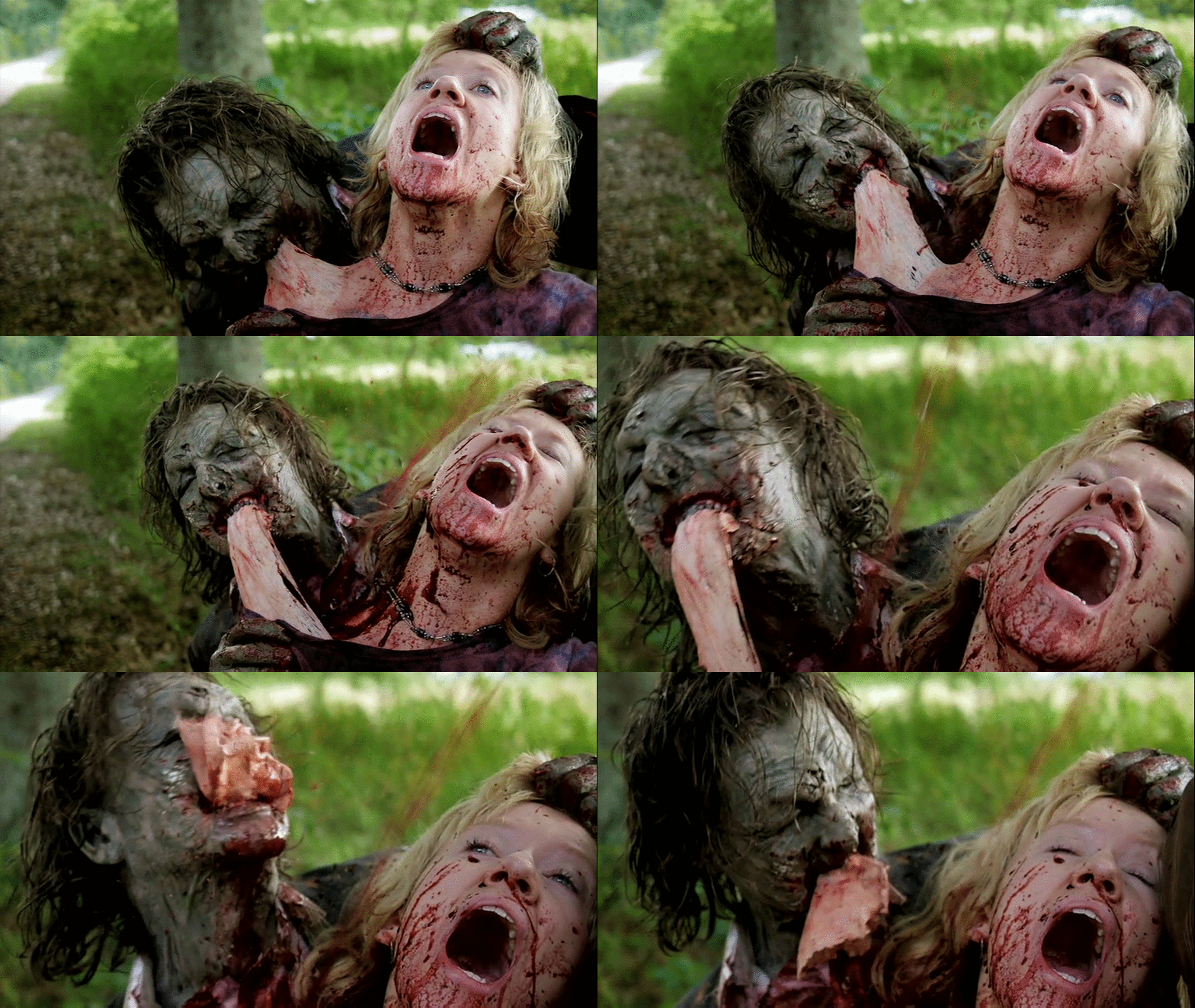
The detail on the practical effects are so finely tuned and done well that in trying to point out the rubbery, obviously fake demon body parts was seriously pointless. Every thing from costumes, to makeup, to exploding heads were rock hard solid in the results, even the sometimes over-zealous gore scenes in other gory films were exact and on point with camera angles, the right amount of blood, and not too hard to swallow when it came down to suspending disbelief.

The fantastic-driven story combines many horror subgenres from, the obvious, demonology, to the living undead. This doesn’t feel like another “run for your life while we’re being chased” type film as there are various facets and layered tangents to the story. Many characters are introduced and are quickly, but properly, disposed of and, for a film like “The Demon’s Rook,” this type of catch and release is suitable because death becomes a character and without death, in a movie with demons and zombies and black magic, you need death to breathe and live and in order to fully embody that death character you need victims and Sizemore, along with co-write Akom Tidwell, breaks the bank with disposable characters.

Tim Reis’s cinematography is beyond brilliant with the use of prominent coloring. The red, green, blue dense fog settings create an atmosphere like none other while the editing, cut also by Tim Reis, is easy on the transitions and easy to follow. Sizemore tackles the special effects department and seizes the moment to be relentless on the use of fake blood. These Georgian filmmakers will need to be watched closely as “The Demon Rook” is underground gold and I wouldn’t be surprised if we see rush of more films into production from this crew. The dialogue is my only small beef with “The Demon’s Rook” as it’s bit bland and a bit expositional, but I’m really reaching to find a flaw here. Most of the ambiance and dialogue becomes a bit jumbled at the beginning with sudden stops in sounds creating goofy transitions. However, this all seems to clear up fairly early.

Technically, the Cindedigm DVD looks amazing in a clarity sense with only a few blurry moments during forest scenes in it’s 16:9 widescreen format. The sound is balanced and consistent throughout even during the scenes or montages tracks from rock bands come into play. No sign of audio stifling nor hijacking. Plus, a good amount of extras come with the release such as deleted scenes, a making of, a gag reel, and bonus short film from Sizemore entitled “Goat Witch” which is just as amazingly disturbing.

Bringing old time practical monster classiness to the modern age is risky business, but director James Sizemore’s and Akom Tidewell’s passion and thirst for hallmark classic demons and zombies resurrects legends back to the indie scene and by adding in his own terroristic tastes, the Black Rider Productions duo also conjures up something new with the vibrant coloring. I would compare Sizemore to the satanic or cult likes of Rob Zombie, to a young George A. Romero with the zombies, and to a special effects genius such as Tom Savini. Don’t consider Sizemore a hack of icons; he’s certainly not, but he displays his own style by slowly sliding that sharp blade into the stomach with perverseness pleasure and that, my friends, is Sizemore’s contribution to chaos.