One Hundred and Twenty-Nine Men, Two Ships, and One EVIL Beast Trapped Together in Icebound. “The Terror” reviewed! (Blu-ray / Acorn Media International)


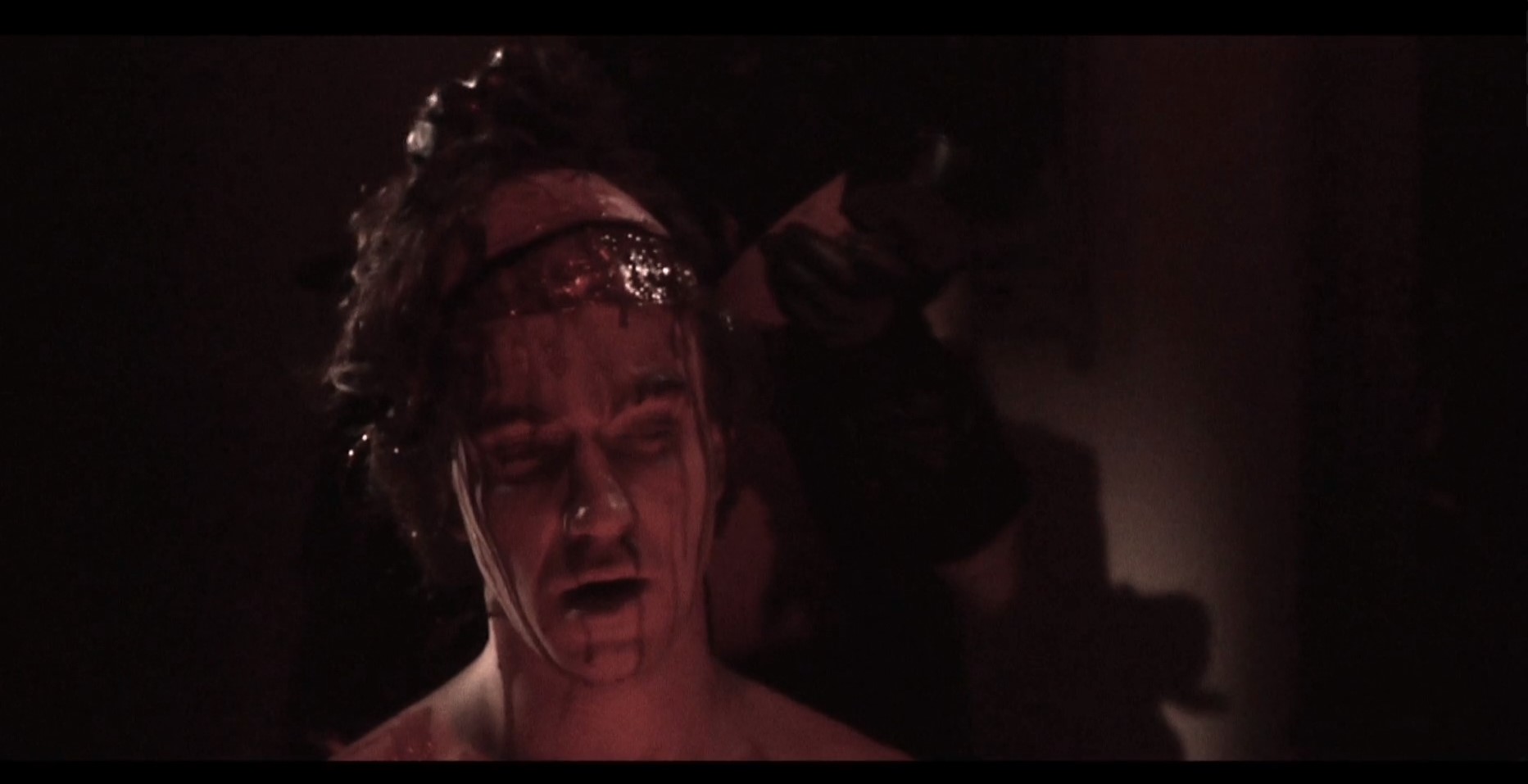
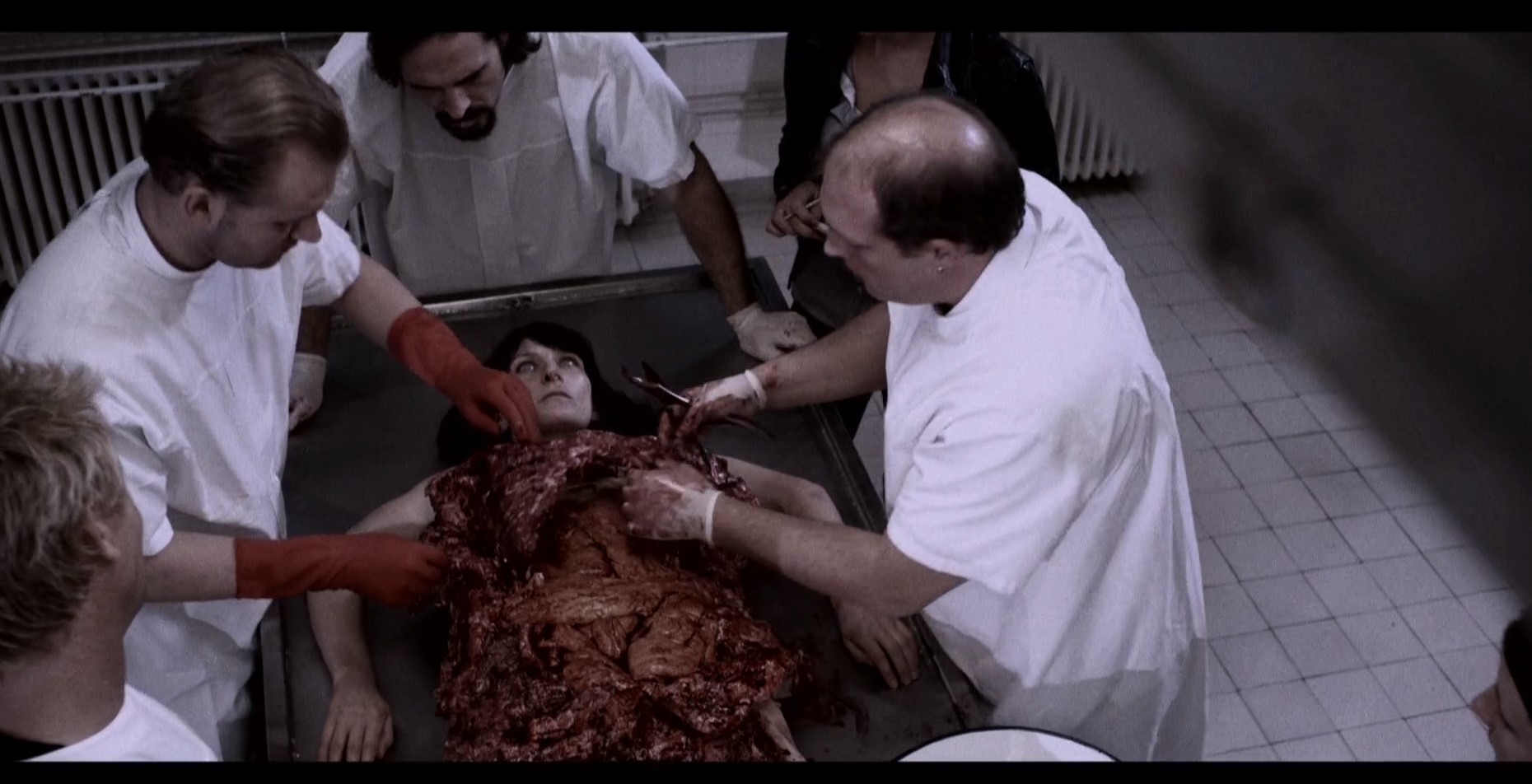
Departed from English ports in 1845, two exploration sailing ships, HMS Erebus and HMS Terror, sought to chart a northwest passage through Artic waters above North America.  Bound for King William Island with over 120 men between the two vessels, the traversers found themselves icebound as the Winter months froze the arctic waters completely and solidifying their positions within one large ice mass.  Their story doesn’t end there as months pass, even through the summer, and winter’s firm grip shows no sign of rising above zero degrees, sweating the brow of the few experience Arctic officers.  To top off their troubles, a vicious polar bear, or some kind of supernatural beast connected to Innuit people, hunts down and ravages a few unfortunate Royal Navy seamen.  Low of provisions and spirits, a combination of infinite winter madness and trembling fear weigh heavy on the seafaring fellows frozen in an icy cold Hell. 

Straight from the ill-fated expedition in British maritime history, the mystery surrounding Captain Franklin and his crew’s death and disappearance in the Arctic is given the hypothetical explanation and supernatural treatment in season one of the AMC series “The Terror.”  However, the tale is more relative to the adapted novel of the same name written by American author Dan Simmons who specialized in science fiction and horror.  Adding elements of a monstrous presence stalking them in the shadows of a bleak tundra, Simmons’ historical fiction turned television series blurs the lines of non-fiction and fiction with chilling atmospherics and the indelicacies of human nature when necessities for survival are pushed to the extreme and are in short supply.  “The Terror” is backed by a strong executive producer team in Ridley Scott (“Alien”) and notable historical television producer David W. Zucker (“Mercy Street,” “The Man in the High Castle”) with writers Max Borenstein (“Godzilla vs. Kong”) and Andres Fischer-Centeno (“Under the Dome”) penning the screenplays with Tim Mielants, Edward Berger, and Sergio Mimica-Gezzan directing a total combined 10-episodes under the Scott Free Productions and Entertainment 360 flag. 

The AMC television thriller scores an amazing cast of seasoned English and Irish actors refined in their skills of becoming a part of the history their work reflects.  Chiefly surrounding the top three principle commanding officers, “The Cook, the Thief, His Wife & Her Lover’s” Ciarán Hinds as Captain Sir John Franklin, “Underworld: Blood Wars’” Tobias Menzies as Commander James Fitzjames, and with a foremost focus on “Resident Evil:  Apocalypse’s” Jared Harris as Captain Francis Crozier, an unique dynamic courses through the speckled personalities of each commander in the face of duty for Queen and country and in the certain finality to their crisis from the God-fearing Franklin, to the command prodigy Fitzjames, to the more sage practicality of Crozier.  Each also have their own flaws that inadvertently put a blight on the already ill-fated mission of charting a passage through the frigid bleakness of the Arctic ice and how they interact with a doubt inching motley crew of novice and experience sailors, especially between the stark contrast of fellow principle characters in the amiable Harry Goodsir (Paul Ready), whose personality is reflected by his name, in confliction with the more menacingly conniving shipmate Cornelius Hickey (Adam Nagaitis).  Both Ready and Nagaitis perfect their roles in convincing the audience on how we should feel about moral compass as they become the nerve center that drives the tale of continual darkness.  Praiseworthy performances definitely go to the entire cast, that also includes Nuuk native and Greenlandic band frontwoman, Nive Nielsen as well as Ian Hart, Alistair Petrie, Trystan Gravelle, Tom Weston-Jones, and Richard Riddell, pinpointing and bringing to life the mid-19th century Royal Navy speak, look, and mannerisms that adapt over the length and breadth of “The Terror’s” forlorn themes of two ship’s crew stranded in what could be said is a strange and alien terrain that evokes madness and fear in the longer you reside. 

The information surfaced about Franklin’s lost expedition with the discovery of possible cannibalism evidence discerned in the early 90’s and, more recently, the found wreckage of both the HMS Erebus and HMS Terror within the past decade add insurmountable coils of surreal realism around the true tragedy of both ships when embellished supernatural elements of an Inuit spirit animal stalking, hunting, and ravaging the crew.  Simmons novel and the series go hand-and-hand story wise but pull visually inspiration from Sir Edwin Landseer’s painting entitled “Man Proposes, God Disposes” where one polar bears tear at what’s left of a ship’s mast and another swallows what looks like human ribcage remains in a surely more a powerful image that’s aligned with the series in the offering an outcome of when it comes to man versus nature, nature will unduly win on it’s own frozen turf. AMC and Ridley Scott undoubtedly knew how to showcase a character driven story where over the time relations build and deteriorate between crew, officers, and a mingle of both and in that stretch of time, the passing of time itself has seemingly stood still as the nights become longer, routines are made, and the ships are stuck on the ice like a warm tongue pressed against a frozen metal pole, but, in the 10 episode series, the story stretches over a nearly two year period and the production is able to connect together next scenes to the previous ones without having to address each and every moment or exposition enough information to avoid the explanatory segue. This method of filmmaking always leave a smidgen of unknown, leaving viewers like us on tenterhooks and in an agitated state that we’ll never fully understand or fulfill that missing part of the mysterious portions and lapses in time. The unfortunate real life story itself casts an alluring wonder and I would even go as far as maritime excitement even if stemmed out of tragedy; that’s how “The Terror,” affixed to the rising ice in an infinite frozen sea of stalagmites, dresses every episode with a less is more garb. “The Terror” endures for a long time in the mind set to replay the desperation and the poignancy of the character’s madness, fear, cold, hunger, and the rest of their godawful bad luck.

A story relished with new fright and unsullied violence with every repeat viewing is now available on a two-disc, region 2 Blu-ray from Acorn Media International. The 10-episode series is presented in a widescreen, 16:9 aspect ratio, on two PAL encoded discs with a total runtime of 453 minutes. The image pails in comparison to the perilous subject matter with a more softer, hazier picture than the harsh, snowy environment setting. Yet, I find that the subpar high definition not to be a complete distraction as much of story plays out in the dark or in the thick of flurries meant to obscure the eyes from seeing reality before biting your head off. Two different audio options are available on the release – a DTS surround sound 5.1 and a Dolby Digital PCM Stereo 2.0. Both tracks have high audio discernible marks as a well-balanced whole with the dialogue cleanly present, the ambient noise, especially the continuous wood creaking on the ships being squeezed by the ice, finely tongued for ever musket shot and snowy foley, and a respectfully insidious soundtrack that makes the body’s blood curl. Option English subtitles are available. I do think the bonus features are a little on the cheap side with only AMC’s behind-the-scenes commercial break segments making the cut on this release, complete with the AMC logo in tow, but the special features include Ridley Scott on “The Terror,” a look at the characters, the boat and visual effects, and concluding with an inside look at each episode featurettes. By the end of the last episode of “The Terror,” you won’t feel chipper, you won’t feel happiness for a long time; yet, you’ll want more and wished season 2 continued the story, but after an impressionable gnarly grand finale, “The Terror” season one is one of the best televised horror shows to come out in a very, very long time.

On Valentine’s Day, Were You Struck by EVIL’s Arrow? “Cupid” reviewed! (High Flier Films / Digital Screener)

In one interpretation of the legend involving the god of love, Cupid is betrayed by his mother, Venus, the Roman goddess of beauty, when she poisons Cupid’s consort, Psyche, over conceited jealously with the tainted tip of his own arrows of love and desire.  Enraged, Cupid denounces love and if he can’t have love, no one will love as he sells his soul to Death in the underworld and becomes a demon of execution summoned by those who abuse love.  When the incessant bullies as Faye’s school push her too far, Faye evokes Death through a black magic ritual and contracts with the master of the netherworld that all those in her high school shall never know love.  Death summons the scorned Cupid to do the ghastly bidding that places not only Faye’s tormentors in Cupid’s destructive path, but also her friends, her teachers, and herself.    

Post-Valentine’s Day horror movies always seem appropriate as if love itself is fleeting, elusive, and nothing but trouble and elicits a bit of cathartic relief for unfortunate souls unable to find love come February 14th.  Nothing screams more about anti-love than Scott Jeffery’s arrow-through-the-heart and twisted Roman mythology story, “Cupid,” that festers from a lower fork in the road possibility of the god of love and desire aggrieved to become malevolent and spiteful in a cheeky, campy rampage.  Jeffery isn’t afraid to take on the challenge of transforming Cupid into a heart-stopping death-dealer as the film’s writer-director who has credential history of being a serial B-horror movie filmmaker with a resume of titles stemmed from myth, legend, and tall tales having produced and written the Frau Perchta inspired “Mother Krampus,” the Gorgon fueled, “Medusa:  Queen of the Serpents,” and producing that little dental-snatching hag known as the “Tooth Fairy.”  Jeffery aims to demonize the match-maker in the UK production from his Proportion Productions alongside co-producer and CEO, Rebecca Matthews.

The heart of the story begins with Georgina Jane (“Pet Graveyard”) as the hopeless romantic schoolgirl, Faye, reading from a book of black magic spells to bewitch the high school’s hunky male teacher, Duncan Jones, played by Michael Owusu in his introductory feature film performance.  Though Owusu is a handsome devil that plays authentically into his role, Faye’s character surpasses shallow and gullible traits as she’s desperate enough to try enchants for an older man to fall for her teenage body and soul and naïve enough to think that her charm passage actually worked enough to warrant sending scandalous pictures of herself over the phone to whom she believes to be Mr. Jones when in actuality is a Faye browbeating clique led by the insufferable rebellious student Elise, a role callously perfect for “Pagan Warrior’s” Sarah T. Cohen.  Jane tries to squeeze out as much as she can as the victim of Elisa’s volley of vile bullying tactics but also somehow cope the receiving end of embarrassment of kissing a shocked Mr. Duncan and as the two instances clash in a heap of dump on Faye day during Valentine’s, Faye retreats back to her fantasy safe haven as she tries to summon Death in vengeance.  This time, the incantation works and in flies with two large white wings and Roman sandals is Bao Tieu caked in some pretty atrocious facial makeup with a horizonal cleft nose, exposed teeth in a skull’s bare smile, and some serious baggage under the eyes.  I’m assuming Tieu’s short stature and small frame makes him suitable to portray the Cupid look often depicted as a child or as a slender, nearly feminine man in mythology art, but in “Cupid,” as the harbinger of death, the overall package feels less menacing and more absurd appropriate for the B-horror mockup as the dialogue-less winged villain hunts down rather easy prey using a campy assortment of atypical, Valentine’s Day weapons like heart shaped cookie cutters, a bouquet of roses, and mushy, sharp-edged greeting cards alongside Cupid’s go-to bow and arrows.  “Cupid” rounds out the cast with a majority of Scott Jeffrey entourage actors who’ve been in many of his produced films, such as Abi Casson Thompson (“The Candy Witch”), Ali Barouti, Georgie Banks (“The Mermaid’s Curse’), Kelly Juvilee (“ClownDoll”), Jake Watkins (“Toothfairy 2”), Adrian Bouchet (“HellKat”), and Nichola Wright (“Witches of Amityville Academy”).

Valentine’s Day holiday has seen a fair share of engendered horror films. While “Cupid’s” heart doesn’t beat to the same lovestruck drum as George Mihalka’s “My Bloody Valentine” or Jamie Blanks “Valentine” that scoff at romance by killing every love sick person in the room, Jeffrey’s take on Valentine’s Day stays on the slasher subgenre path, but takes a tongue-and-cheek route despite the earnest performances. I mean, really, who gets ninja starred in the back with Valentine greet cards or have their skin sliced out with heart-shaped cookie cutters? Jeffrey’s killer concepts have immense heart, no pun intended. Where “Cupid” begins to stray lies in the left out important details and the fast-and-loose character development that leaves a rancid taste of an expired box of chocolate in your mouth. For instance, Faye, a high school girl of maybe 16 or 17-years old, has what seems to be an archaic artifact of ancient black spells in her possession for reasons we don’t know how she obtained. Do we then conclude that Faye obsessively meddles casually with the black arts? Or did she visit Ray Stantz’s Occult Book store in NYC? There’s also a rich backstory, if not tale-telling, in Faye and Elise’s contention for each other involving a relationship scandal between Faye’s mom and Elise’s dad that’s only scratched at the surface and never really brought to light, but would have greatly help in explaining Elise’s wickedness toward Faye, who briefly blames her mother’s aggressive libido for all her high school problems. In what is, in all serious, an allegory for bullying spun high school mass murder, “Cupid” heavily ousts the outlier as a person lost in the fray of struggling to cope and turns to evil to solve their problems by taking out everyone in an instant. The only thing different is Jeffrey doesn’t arm Faye with a rifle; instead, he weaponizes her impulsive desires in the form of a demonized Cupid. Another character who doesn’t flesh out is Duncan Jones who drops out of medical school in order evade debt for the rest of his life; instead, he’s a substitute teacher with feelings for a colleague and his biggest prospect is chaperoning the Valentine’s Day dance. Instead of nurturing Jones’ arc from the beginning of the film, his medical background is only brought in later to serve as the needle in the arm for all the blood junkies out there as “Cupid” gets gory with a hacksaw scene that comes out of left field compared to the rest of the movie. “Cupid’s” story wilts like 6-day old roses starting to smell like rot, but is still thorn sharp as a campy, fun slasher braided with classical mythology and mass shooting undercurrents.

Valentine’s Day has come and gone, but you won’t be able to get away from “Cupid” that easily as the Scott Jeffrey written-and-directed holiday slasher soars in onto DVD from Uncork’d Entertainment and High Fliers Films in the United Kingdom. The PAL encoded DVD has a runtime of 84 minutes. There were no details provided on the DVD specs and since the screener provided was a digital screener, no critique will be made on the A/V aspects other than director of photography Ben Collins’s cinematography that deploys a better way to experience “Cupid” with perforated soft glows of vibrant tints in the most weirdest of places, like the school bathrooms, during tense supernatural expectations or when Cupid is on the prowl, giving more interest toward the scenes that might seem more run of the mill ordinarily. There were no bonus materials with this release nor were there any bonus scenes during or after the credits. Abuse love and love will abuse you right back tenfold in this death-summoning, tale-twisting holiday themed horror “Cupid.”

This Dinner Party Dishes the EVIL! “Happy Times” reviewed! (Artsploitation Films / Digital Screener)

A small, but affluent, Los Angeles Jewish community dine together at a Hollywood mansion in celebration of the Shabbat.  Mixed feelings about each other compounded with mixed drinks stir the emotions of heated topics, including business ventures, religious attitudes, social statuses, marital qualms, and hidden desires.  Lines are being drawn and sides are being taken when one thing leads to another and undisclosed secrets become evident in a clash of suburban violence that pits friend versus friend, colleague versus colleague, and husband versus wife to the death. 

Director Michael Mayer reminds us that you should never mix business with pleasure with a keep your friends close, but your enemies closer black comedy entitled “Happy Times.”  The brawl of survival centered around Israel immigrants living in the U.S. is the second written and directed film from Mayer, following polar oppositely against another Israel themed, 2012 picture, “Out in the Dark,” a gay drama in the backdrop of the two rival and patriarchal sides of the Israeli-Palestinian conflict.  The only conflict in this 2019 thriller-com is of the gravely plentiful and concentrated kind inside a L.A. mansion turned battle arena that sees about as much confrontation as the war-torn Gaza strip.  Co-written with Guy Ayal, “Happy Times” is a collaboration produced by Erri De Luca and Paola Porrini Bisson of OH!PEN and, the Israeli born, Gabrielle and Tomer Almagor’s Urban Tales Productions in association with Michael Mayer’s own company, M7200 Productions.

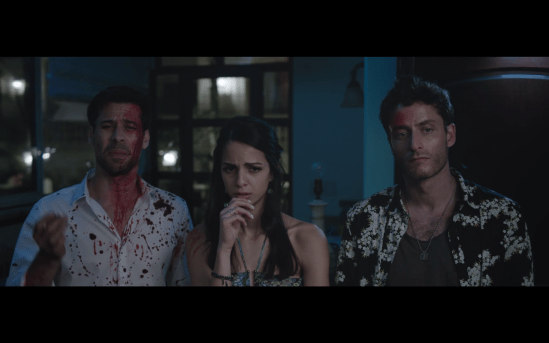
The Israel-nationality cast can be an immersive experience and a sign of good faith casting from the filmmakers as well as a show of open diversity from the production studios that casting Hebrew speaking, Israel background actors implies a serious interest and respect embroidered into the project. Mayer, born in Haifa, Israel himself, is a breath of a fresh air of non-appropriation in a time where whitewashing can still be prevalent in the movie industry. Israel born actresses Shani Atias, Liraz Chamami, and Iris Bahr command the screen not only as Israeli women in lead roles, but as different personas that interact and keep lively the one night, single dinner party narrative. Chamani especially dazzles in the details as the dinner hosting socialite wife and mother, Sigal, who exacts an assertive Jewish woman with a cooped up attitude and a knack for handling her own while also worried about her social status, an extravagant exhibition of a screen trope that you might experience on shows like “The Marvelous Ms. Maisel” or movies like “The Slums of Beverly Hills,” enacted on point when she’s handing a frightened dinner guest, outside their Jewish circle and fleeing from the scene, tin foil wrapped leftovers with a wide menacingly unsure smile, while holding a medieval crossbow to go frag another party guest, in the plain view driveway. The wives’ counterparts are equally as Jewish and equally as prominent in the fold of the affair with Ido Mor as a unscrupulous businessman co-hosting the dinner, Guy Adler as a construction manager with money problems, and Alon Pdut as an unhappily married Ph.D engineer bothered by his fellow dinner guests’ lack of education and tact. In all, most of the characters are undilutedly snobbish with the exception of Sigal’s struggling actor cousin, Michael, played by Michael Aloni, whose magnified Hollywood liberalism deconstructs the Hebrew bible as racist and inaccurate among other colorful adjectives and becomes the catalyst that begins all hell breaking loose. Stéfi Celma, Mike Burstyn, Daniel Lavid, and Sophie Santi become the filament around the principle leads that strengthen the kill or be killed melee in “Happy Times.”

As if dinner parties weren’t already stressful enough, having to make trivial small talk, possibly acquaint or re-acquaint with unaccustomed faces, or pretend to enjoy the slop being served as food, “Happy Times” turns the internally exasperating dinner party debacle on its head with guests and hosts who are just too terribly comfortable with each other as volatile personalities explode like little active volcanos plumed to reach every corner of the house in a deadly playground for unstable, on-edge adults spewing their strident emotions and Mayer is able to maintain a layered pace with a narrative that’s snowballing quickly.  Where “Happy Times” struggles is the redline occurrences that trigger things to go very badly.  Though hardly trivial episodes between the guests, involving innocent infidelity affections or a slight practical joke stretched beyond devastating consequences, the harried moments afterwards diverge into a blown out result while more nefarious consequential revelations are held back, in after the fact chaos, and these differently graded spurs seem unbalanced, if not flip-flopped, in the story.  The characters themselves adequately course into being delightfully insane and as about as relatable as the internal frustration against our friendly-façade enemies, but there’s a part of me that personally wanted more development.  Military vet Avner, for example, exhibits symptoms of post-traumatic stress disorder (PTSD) as the horror sounds of war play in his head when under stress.  As he stares into oblivion when the rage fills into his face, especially by a nagging, browbeating wife who doesn’t seem to be aware of his condition, the subconscious killing-machine overcomes the mild-manner tech engineer.  There’s also Yossi’s opaque tax evasion scheme, Michael’s thespian struggles, and Mati, the late arriving Rabbi, who pockets money on the side from Yossi and Sigal that factor into an erratic equation that’s a mind field surprise every step of the way.

“Happy Times” relishes in unpredictable violence as a round table of feast or famine hatred in this dog-eat-dog thriller coming to you from the Philadelphia based distributor, Artsploitation Films. Slated for a February 9th, 2021 release, the unrated film will be presented in a widescreen, 2.39:1 aspect ratio, in a gorgeously rich color of a modest, natural color scheme. Kazakhstani cinematographer, Ziv Berkovich, distills a solid, yet uninspiring, photography of mostly still cam mixed with subtle steady cam, rooting firmly to particular rooms without capturing the flow of a big mansion, reducing much of the in clover luxuries of the hosts. The Hebrew, English and some Spanish 5.1 Dolby Digital mix offers well balanced layers of audio tracks with dialogue clarity and establishing good range with depth not really set up because of the close up or medium shot frames. Guy Aya;’s score offers a good blend of a violin-screeching from a murder mystery dinner theater with the inklings of traditional Israel folk sprinkled in to create an anxiety riddled brew of trouble. There were no bonus material included with the digital screener nor were there any bonus scenes during or after the credits. The best of times and the worst of times doesn’t compare to the bloodletting of “Happy Times” in a wildly amusing dark comedy with every impulsive-driven and tension-wrought scene chockfull with bated breath.

Pre-order “Happy Times” on DVD or Blu-ray at Amazom.com (Click the poster)

Sit Back. Relax. And Wank Off to EVIL’s “Live Feed” reviewed! (Unearthed Films / Blu-ray)

While on vacation in China, five friends traverse the local festivities and drinking holes, relaxing in the surroundings of an alien culture of their getaway destination, but when one of them accidently bumps into a depraved Chinese Triad boss, they believe to have nearly escaped a localized international incident with the help of a Japanese vacationer who seems to know quite a bit about this particular Triad boss.  To blow off steam, and to blow off some loads, the friends patron the Venus Theater, a sleazy porno theater offering 1-hour couples VIP rooms.  Their short-lived, and short-comings, visit turns into a terrifying nightmare of broadcasted kill rooms as they find themselves trapped inside the theater owned by the Triad boss for his personal snuff cinema experience and fine dining of cannibal cuisine.  Fried dong and balls are 100% MSG free. 

With a Ryan Nicholson directed film, you never know just what to expect.  From our reviews of the Vancouver native’s work, his teen slasher “Famine” was an angsty disappointment, his destitute slaughterhouse “Collar” collided technical gaffes with sordid satisfaction, and his most renowned direction on the bowling-themed retro-slasher, “Gutterballs” displayed a primal brilliance that rolled one hell of a strike down the lanes of indie filmmaking, but the late, great gore hound filmmaker always lit up our screens with a single reoccurring theme – flashes of red.  Lots and lots of red blood that is!  The blood geysers and gushes in heaps in Nicholson’s 2006 release, the written and directed, “Live Feed” that touts SOV violence in an arcane snuff style.  Co-written with his father, Roy Nicholson (“It Waits”), the self-taught, special effects prodigy bursts onto the full length feature scene with an introductory exploitation and survival horror full of ambition, insane effects, and a narrative bred specifically for fountaining blood.  Self-funded under Nicholson’s Plotdigger Films, the ”Live Feed” legacy continues to output interest in the gore and snuff subcategories with updated home video distributed releases throughout the years, keeping the resourceful, twisted humor filmmaker alive and well in our hearts and collections. 

The story revolves around five friends, or more intimately, the hapless stars of a snuff theater production, who are not the most chaste or morally concerned individuals finding themselves center stage because of their wanton whims and uninhibited fortes.  Out of the touristy Americans in a given the impression of being a strange and sordid foreign land, one of them quickly becomes established as the primary beacon of hope as an unassertive wiser in Emily played by Taayla Markell in her first lead performance.  Though their long history makes for easy persuasion into participating, from a distance, in their lewd behaviors, Emily’s hemmed in around familiar perversities derived from her good friends and even her finance.  Mike, a muscular, drug-fueled blowhard develops his crass charisma from “Stan Helsing’s” Lee Tichon, Mike’s current and former girlfriends, Sarah and Linda, in tinge of tattered relationships by Caroline Chojnacki and Ashley Schappert, and Darren, Emily’s douchebag, philandering fiancé played by “Skew’s” Rob Scattergood, lead Emily astray from her own self-preserving inner voice when their arrogance and laxed attitudes place them in hot water with a sadistic Triad Boss.  Stephen Chang fills in the gangster roll with a plastic energy that’s over-the-top and absurd just like the two women who hang off each side of his arm in hackneyed fashion, offering very little to outshine as a sadistic megalomaniac.  Luckily for the out-of-towners who are soon-to-be-goners, they coincidently meet the conversant Miles Nakamura (“Mortal Kombat: Legacy’s” Kevan Ohtski) who round houses his way through a torrent of bad guys to save his newfound American friends, but for what reason goes over our heads other than the potential guilt of knowing he left them to their demise.  Greg Chan, Mike Bennett, Ted Friend, Colin Foo and introducing boner-fide stripper, Charlene McCulloch, with an in your face pole dance rounding out the cast.   

Whether in a stroke of good luck or an ill-timely misfortune, Eli Roth’s highly popular and profitable “Hostel” was released a year earlier in 2005 and while Nicholson’s surely cantered behind that gore porn locomotive in the early 2000’s that sauntered a path for many filmmakers to make unbridled torture and tits productions in the wake, “Hostel” undoubtedly provided some hinderance by scraping some of the shock value from off the sticky theater venue floors of “Live Feed.”  The characters were also nothing to write home about, or in this case, to write highly about, as the circumstances that churn the dynamics amongst their closed circle friendship don’t dissolve until well onto the cusp of being dismembered and thus becoming a moot investable or relatable venture that was, in a way, still crawling for the finish line with spotty payments on Darren and Emily’s acute about-face relationship, the only turbulent character context that saw contentious action.  Yet, there is wonder why “Live Feed” even attempts to brittle or outright break the bonds between friends and lovers in a film that’s all about the blood, about the blood, no trouble, as I channel my Megan Trainor phrases that probably sounds better in my head than in my review.   Unless Emily and Darren’s woes play later into the story, as a point of significant break from the other or in a glimmer of salvaging something between them, the purpose is purposeless and the blood should pool together the entire snuff narrative without an emotional hiccup.  Speaking of blood, the effects between Jason Ward (“American Mary”) and Ryan Nicholson couldn’t have been better executed with a pliable, tangible, and free from visual imagery arsenal at their fingertips with prosthetics upon prosthetics of grisly skirmish matter.

“Live Feed” has it all:  cannibalism, decapitations, sex, bondage, medieval torture, kung fu, snakes, pole dancing, barbecued penis, sword play, a “Big Trouble in Little China” old man Lo-Pan lookalike, and gallons of spattering blood.  All of the above now arrives uncut and uncensored onto an Unearthed Films Collector’s Edition Blu-ray release.  The region A BD50 presents the transfer in a widescreen, 1.85:1 aspect ratio, enclosed with various formatted styles from the poor resolution of SOV to a full-bodied and unstrained digital playback lit up with vibrant neon lightening by director of photography, Sasha Popove, to create an illuminating florescent color splay of a universal Asian urban district.  The sundry of styles can be weighty on the sequences that challenge what should be natural segues into the next scene, but the format choices, from mostly handheld vantage points, interrupt the flow with a nonsensical fluidity.  Unearthed Films amassed a legacy-stamping amount of extra content with a commentary with Ryan Nicholson and cast, a making-of segment entitled “Behind the Blood” which is geared toward being a tell-all on how they spun and produced “Live Feed’s” fruition, a return to the Venus Theater location with a low-key walkthrough of scene locations and you get a little X-rated show during a live project run, deleted scenes, alternate scenes and ending, the video feed footage, photo gallery, trailers, and a short film entitled “Womb Service” of the softcore feature playing background of the feature story. There’s also an “Adult version” of “Live Feed” in the bonus material that includes the original runtime feature but with edited in hardcore footage; however, personally, did not notice any sultry inserts. Maybe they’re brief and missable…? In the experience unravelling Ryan Nicholson’s work, “Live Feed” is the filmmaker’s second best movie with wholehearted intention to jazz it up with as much blood and exploitation as possible and his loss, as a person and an exorable filmmaker with room for ghoulish growth we’ll never experience, stings to this day.

“Live Feed” blu-ray now on sale at Amazon.com. Click the cover to go to Amazon.

Chronicling the Cannibalistic, Necrophilism EVILs of a Serial Killer is for Adult Eyes Only! “LoveDump” reviewed! (A Baroque House / Digital Screener)

July, 2003 – a hollow-hearted serial killer, Denise Holmes, moves into a motel room of a populated metropolis of the West Coast.  Journaling every perverse and murder-lust desire in a diary, the unspeakable acts of sex and death blend together as one as the urge to kill grows bolder, leaving a trail of gore in the wake.  Paranoia begins to sink in after the last execution of an innocent victim and desecrating their bloodied, decapitated head in an inerasable moment from the mind. What you’re about to hear are the audio recordings of Denise Holmes’ diary inserts, read by Detective Jamie Reams whose giving a tactile voice to a wraith-like monster.

Over the years, the term Horror has been exploitatively glamourized for capital, trendsetting and bedazzled with glitzy gems of tamed teenager torment that sold the strung up, struck down, and sliced-and-diced adolescent carnage-fodder into each and every way the human brain can conceive with only a tweak of difference adorned with each ornate kill. Horror has also become garish with gorgeous women for the gratuitous donation of bare skin for the camera and the audiences to entice and gawk at the beauty in death. I’m not going to lie, I eat every millisecond of film of the good, the bad, and the ugly when it comes to horror, and, truthfully, horror has been making a strong stance in the last couple of years and I’ve been embracing the subtle tingling of mind game thrillers to the overtly ostentatious gore-soaked slaughterhouses of a genre with the broadest spectrum known to the cinematic universe. The filmmaker under the alias of SamHel pushes our tolerance for extreme content to the breaking point with the written-and-directed 2020 adult-fetish exploitation, “LoveDump,” an independent film from the USA under the production company, A Baroque House, that set out to pay homage to the graphic adult and fetish horror films of 1990s Japan.

The 33-minute short film only stars two performers in non-speaking, purely physical roles. First up, Wolvie Ironbear, an intersex non-binary adult content pansexual specializing in gothic and kink fetishisms, depicts the notorious necrophiliac serial killer, Denise Holmes, and Apricot Pitts, an unshaven fetishist whose also in the adult content creator realm, as a hapless prostitute who becomes a slayed statistic of sadism lured in by Holmes to greedily satisfy the nagging ghastly degeneracies. Most of the runtime runs with Ironbear licking at the chops, contemplating the next libidinous victim. Thick in the air is the sordidness moisture of solo self-gratification with unorthodox sex toys: a pig’s head, human blood, and other interesting, socially ignoble objects not fit to describe without dismantling in spoiler territory. Ironbear has to be a killer and a pretender, playing into a pretense that is a wolf in a sheep’s kinky-gimp clothing when Pitt’s prostitute steps into the motel room. Together, Pitts and Ironbear are electric, sexy, and give a damn good X-rated show of lust and macabre that turns the fever of carnality into a gruesome display of monomania participation.

“LoveDump” is not an attractive title, but suitable for unattractive content of desecrating the dead to the likes of Jörg Buttgereit’s “Nekromantik” and Marian Dora’s “Cannibal” while striving to be akin to Japan’s extreme horror like “Splatter: Naked Blood” or the notoriously sought after Guinea Pig films. “LoveDump” has an outrush of a snuff film that emanates a deep, dark secret club with elite memberships under pseudonym-ship in the producer and production departments. The makeup and special effects prompt disconcert of an upholding quality for an indie picture and, so much so, the affect of the human soul skin-crawlingly good that we can’t find ourselves looking away when the urge to be squeamish is strong. SamHel’s film digs niche graves that not everyone will have the courage enough to step into by choice. For myself, “LoveDump” is purely curious voyeurism, ingesting and digesting the film as an informational vessel of visceral paraphilias and without a solid plot to chew on, “LoveDump” is a straightforward stitch in time gorging more on graphic imagery than story and that is where the A Baroque House flick loses me to an extent.

Don’t expect palsied love-stricken hearts to be oozing with jubilee affections; instead, expect a romantic bloodbath of narcissism in a solo courtship like none other in SamHel’s ultra-gory “LoveDump” on a limited edition DVD and Blu-ray from A Baroque House. The camera work by the monikered Excessive Menace renders a SOV resemblance from the 90’s with a lot of unsteady handheld shooting as well as adjusting the clarity of focus, but the frames do flicker noticeably which can be a minor nuisance. Almost all the sex and gore scenes are in an extreme closeup the gives you an extreme eye feel for the commingling faux blood and real semen. One of my only gripes is with the angles in the intercourse with Apricot Pitts that didn’t translate over well without the proper focus and lighting to be as a graphic as possible. Since provided with a digital screener and the screener provided is a rough cut of the short film, there were no bonus material included, if there were any. The limited edition physical packaged Blu-ray will include the full HD uncut version of the film, a still gallery, a behind the scene making of, and trailer. I assume the LE DVD contains the same features, but are not specified. Be warned! “LoveDump” is not teeny-bopping horror filmed for any Joe Schmo to casually sit down to Netflix and chill with their partner, unless they’re into switch BDSM with an ichor fetish and, in that case, “LoveDump’s” an avant-garde aphrodisiac bred out of extreme and unwavering compulsions.