You can’t keep these damn kids out of the corn fields! If you didn’t know this, “Children of the Corn: Runaway” is the 9th installment in this undying Stephen King spawned franchise and was helmed by “Feast’s” John Gulager!
Here’s the press release from Lionsgate:
PROGRAM DESCRIPTION
From director John Gulager (Piranha 3DD, Feast) comes a horrifying new chapter in the Children of the Corn series when Children of the Corn: Runaway arrives on Blu-ray™ (plus Digital), DVD, Digital, and On Demand March 13 from Lionsgate. Based on the original story “Children of the Corn” by Stephen King, the tenth installment of the legendary horror series follows a young woman who can’t escape her nightmarish past. Written by Joel Soisson (Children of the Corn: Genesis, Dracula 2000), the Children of the Corn: Runaway Blu-ray and DVD will be available for the suggested retail price of $21.99 and $19.98, respectively.
OFFICIAL SYNOPSIS
Children of the Corn: Runaway tells the story of young, pregnant Ruth, who escapes a murderous child cult in a small Midwestern town. She spends the next decade living anonymously in an attempt to spare her son the horrors that she experienced as a child. Ruth and her son end up in a small Oklahoma town, but something is following her. Now, she must confront this evil or lose her child.
BLU-RAY/DVD/DIGITAL HD SPECIAL FEATURES
· Deleted Scene
CAST
Marci Miller (“About Abigail,” “Viper,” The Ringer of Rimachi)
Lynn Andrews (“Borderlines 2” the Video Game, “Ghost of Goodnight Lane”
Mary Kathryn Bryant (“Hellraiser: Judgment”)
Jake Ryan Scott (“Bunnyman Vengeance,” “Warning Label”)
PROGRAM DESCRIPTION
Experience a terrifying new chapter in the legendary Hellraiser series when Hellraiser: Judgment arrives on Blu-ray™ (plus Digital), DVD, Digital, and On Demand February 13 from Lionsgate. The tenth film in the classic horror series tells the story of three detectives as they struggle to solve a horrifying murder, but instead find themselves thrust into the depths of Pinhead’s hellacious landscape. Including horror icon Heather Langenkamp (A Nightmare on Elm Street, Wes Craven’s New Nightmare), and written and directed by Gary J. Tunnicliffe (Hansel & Gretel), the Hellraiser: Judgment Blu-ray and DVD will be available for the suggested retail price of $21.99 and $19.98, respectively.
OFFICIAL SYNOPSIS
The dreaded Pinhead returns in the next terrifying chapter of the classic Hellraiser series. Three detectives trying to stop a diabolical serial killer are sucked into a maze of otherworldly horror, where hellish denizens including the Auditor, the Assessor, and the Jury await to pass judgment.
BLU-RAY/DVD/DIGITAL HD SPECIAL FEATURES
· Deleted & Extended Scenes
· Gag Reel
CAST
Randy Wayne – “Escape Room” and “Death Pool”
Heather Langenkamp – “Star Trek: Into Darkness” and TV’s “Truth or Dare”
Paul T. Taylor – TV’s “Sheltered” and “Alternative Math”
Rheagan Wallace – TV’s “Malcolm in the Middle”
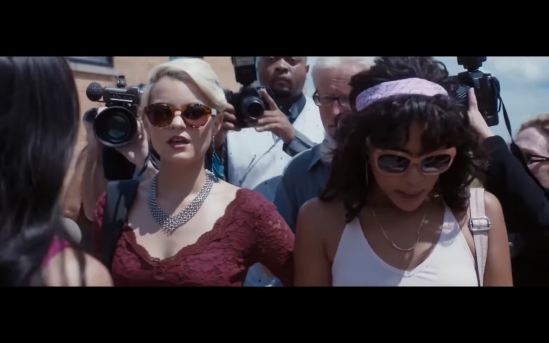
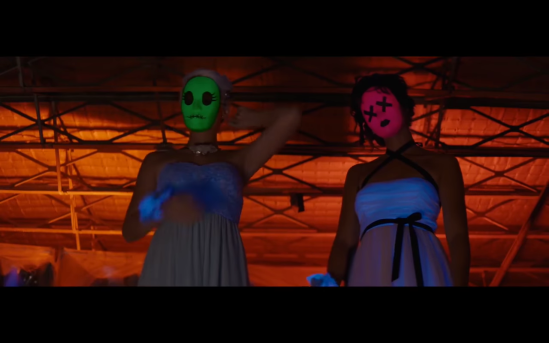
A small mid-western town has been terrorized by a string of gruesome murders and two local high school girls, Sadie and McKayla, seek to lure the killer out to not stop his onslaught, but to be put under his machete wielding wing. The best friends use their twitter page, @TragedyGirls, to platform their grisly kills as devastating tragedies and to be supportive outreaches in order to be beloved by all and to obtain social media stardom as a facade over being iconically elusive serial killers, but when their plan to capture a mentor fails, a wedge drives between them when Sadie begins to fall for longtime friend, and video editor for their twitter page, Jordan Welch. That’s all the fuel needed to spark McKayla into a deadly paroxysm in order to get her best sociopathic friend back by her side.
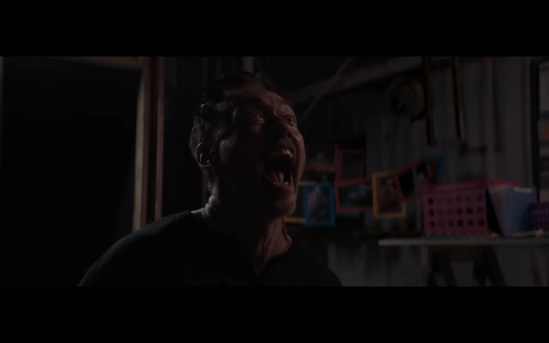
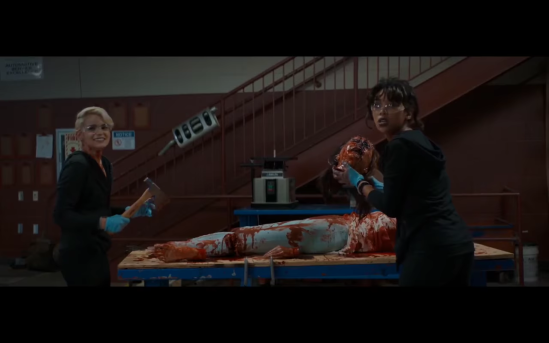
“Tragedy Girls” is the uptempo horror-comedy by writer-director Tyler MacIntyre along with fellow co-writer Chris Lee Hill, both whom previously helmed another horror-comedy entitled “Patchwork” in 2015. “Tragedy Girls” aims to put the slasher genre on it’s head by turning what should be two sweet high school girls into the sadistic hunters instead of the usual genre trope of hapless prey and incorporate the dark side of social media, using platforms, such as Twitter, to gain notoriety through exploitation of others’ very lives, but the use of social media doesn’t sticker MacIntyre’s film as tech horror. Instead, typical ditzy-dynamic adolescent drama is integrated into the gory melee Sadie and MacKayla fabricate for fandom. There’s plenty of blood and death to go around through a mix bag of slaughter with some being inspired by other horror films, channelling such classic as “Friday the 13th” and “Carrie.”
“Deadpool’s” Negasonic Teenage Warhead, Brianna Hildebrand, and Alexandra Shipp, who’s also a Marvel superhero in X-Men franchise as Storm in “X-Men: Apocalypse,” star as besties Sadie and MacKayla. Hildebrand and Shipp are doubly frightening as two sociopathic killers and equally as scary as silver screen teenage girls glued to their phones while keeping up with their good fashion sense, but their pixie cut and cheerleader personas are as embellished as their underlining dark craft to make “Tragedy Girls” over-the-top and shocking on a “Save by the Bell” level. Though the two are stone cold, homicidal maniacs, a love interest is added for Sadie. The “The Hunger Games'” Jack Quaid, son of Meg Ryan and Dennis Quaid, fills the shoes of the lovesick Jordan Welch and Quaid does a fine job being the smartest guy in the room, but still being blindly dumb to the situation unfolding around him and Sadie. Surprisingly, a number of various genre vets rear their heads in this film, starting with “The Strain’s” Kevin Durand. The 6’6” tower of pure muscle Durand embodies a Jason Voorhees like villain when masked; unmasked, he’s about as stupid as they come and Durand can do stupid very well. Part of the comedy, of this horror-comedy film, stems from an uncharacteristic role played by Craig Robinson as a very unfit, local firefighter hero, fittingly named Big Al. The “This is the End” and “Ghosted” star bores through his minor role of Big Al with very little dialogue as Robinson is well known for wit, but the comedian has one of the better scenes with a 2-on-1 fight scene with the two demented school girls. The last recognizable face being mentioned flames out as quickly as it’s flamed in from the Sci-Fi genre. Josh Hutcherson, another “The Hunger Games” star, goes James Dean as MacKayla’s emo ex-beau, Toby Mitchell. Hutcherson’s character doesn’t quite fit the “Tragedy Girl” mold that pushes the limits later on in the film and his portrayal of Toby Mitchell is awkwardly misplaced as overzealous and forgettable. Rounding out the remaining cast is Timothy V. Murphy (“The Frankenstein Theory”), Nicky Whelan (“Flight 7500”), Keith Hudson, Savannah Jayde, and Katie Stottlemire.
“Tragedy Girls” will do well as it’s a solid horror-comedy with a la carte gore. None of the characters seize the progression of the trope reversal story and with the exception of Hutcherson’s Toby Mitchell, the actors conform precisely to the animation of their character’s scribed personas. Hildebrand and Shipp are the epitome of that last statement. The pair of actresses have a real life proprietary appearance about them and to crossover those looks and meld them into Sadie and MacKayla will forever establish them as the true tragedy girls. “Tragedy Girls” isn’t just about flip-flopping the genre rear ended up; writers MacIntyre and Hill pen a film that’s also about female empowerment with two strong actresses filling the shoes of two self-sufficient badasses committed to doing what’s conventionally labeled male subversive behavior and accomplishing it on whole other level. Even if on the wrong side of the law, the tragedy girls stick together through the good and the bad to overcome various high school and beyond high school hurdles that attempt to thwart not just their friendship, but their cyberspace popularity.
Gunpowder & Sky proudly distributes “Tragedy Girls,” a film by fresh faced production companies like Its The Comeback Kid and New Artist Pictures, onto VOD now and DVD home video February 6th. Since provided with an streaming link for review, a well-rounded critique on the DVD’s technical specs, picture quality, audio tracks, and bonus features will unfortunately not be commented on, but the very film itself should entice the most casual horror film goer who usually doesn’t stray off the mainstream path. With familiar faces and plenty of bloodshed, “Tragedy Girls” holds water against competitors in a flooded genre. Don’t forget to follow them, #tragedy_girls or @tragedygirls, or else you’ll be next tragedy exhibited in their wall feed!
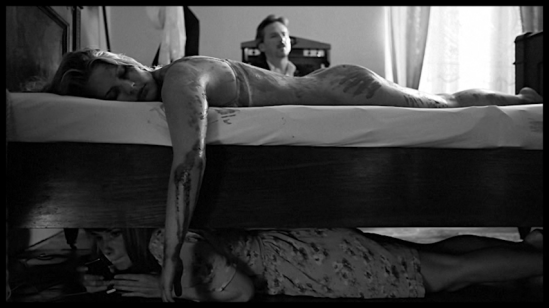
An absent Séverine wants to take a holiday away from her boyfriend Tom after she awakes from a dream where she has fallen in love with a man in a top open, white car. Frustrated and desperately in love with her, Tom agrees to a pact with a bar room stranger to stage a faux kidnapping of his lovely girlfriend and Tom would her hero, swooping in to rescue her from “evildoers” and hoping to rekindle her passion for him, but the Tom’s newfound stranger friend has a more devious agenda up his nicely tailored coat and white collared shirt sleeves; one that involves kidnapping young women to star in their snuff movie productions. When the plan begins the unravel and actual intentions are exposed, Séverine’s forced into a deadly cat-and-mouse game against unsympathetic sadists who have laid the prep work foundation into getting to know their victim and know every inch of her youthful body, but Séverine won’t submit without an unflinching, vicious fight as she trudges through areas of an old villa compound, looking for to escape or kill her captors.
If you search for a combination of the classic Hitchcockian style with a smidgen of cold blooded savagery, Mathieu Seiler’s “True Love Ways” would be at the top of the search result. The 2015 German, black and white thriller surpasses being a surprising sleeper film and goes directly into a notorious favorite category helmed by the Switzerland born director who integrates a complex lead character into an unfathomable story of selfishness, unscrupulous power, and sheer determination. Despite the sepia overlay, the colorful venomous of the characters explodes brilliantly, adding vim and vigor to a story that begins with a slow burn to quickly escalating in an anxiety-riddled and captivating narrative pivoting to one harrowing moment to the next. Seiler, who also wrote the script, blends a detailed art house thriller with feminist undertones that surface the severe ugliness in man whose either selfish with his needs, sexually deviant, or insecure. There’s even a case where Séverine’s father isn’t safe from being scrutinized. Séverine’s the strongest character in the bunch by overcoming one obstacle over another while managing each male driven situation with disregard and hostile improvisation.
Steering Séverine’s reactive and survivalist rampage is Berlin native Anna Hausburg. The then 25 year old actress embodies a major milestone in maturity for her physical performance. The entire film is driven by physicality, not dialogue, and Hausburg prove her grit and sexuality seemingly effortless. Hausburg is joined by Kai Michael Müller as Séverine’s unassertive husband Tom. Together, Hausburg and Müller couldn’t be more distant from each other while David C. Bunners interjects with a sly director of snuff film operations. Bunners has a modest performance, but if you accept it, let it sink in, you’ll experience his devilishly, rugged good looks and sophisticated business intelligences just ooze out into a white collar sleaze, perfectly suitable with Bunners’ method on his character. His production crew, played by Michael Greiling, Axel Hartwig, Beat Marti, and Marcel Schneider, are equally skeezy in a choreographic manner whom each have a role to play. Rounding out the cast is Christian Samuel Weber, Anja Margoni, Alina Sophia Wiegert, and Margarita Ruhl.
Seiler’s “True Love Ways” is open to many different interpretations. One that seems to bubble up over and over again in the analytical gear works is that could the entire ordeal, Séverine’s ordeal, be all a lie. Not just a single cell lie, but a couple of angles that undercut the linear option laid before the viewers. For instance, the first lie would be that the dark, heinous snuff producers are all in Séverine’s head. Too many coincidences from the specifics from her dreams to come true in such a manner and she always has this mysterious ailment, near the beginning, that’s never explicitly explained. Second lie would be is this Séverine embraces the darkness of her captors; is she herself unstable after the ordeal that the very sever boredom of regular life? The predictability of it all from her vivid dreams have turned her to seek the man who wants to exploit her and who “freed” her from the incompetent men in her life – Tom, her father, etc. Seiler’s abstract bookends shed light upon slithered clues that reveal potential possibilities of where Séverine’s stands as a hero or anti-hero lead character.
MVDVisual and Synergetic Distribution present “True Love Ways” onto home video DVD. Like the monochrome tone, the DVD cover is elegantly simple with blood covered Anna Hausburg, looking disheveled and holding a blood stained axe, standing in front of a white background encasing the 95 minute film. Presented in a 1.85:1 aspect ratio, the black and white appears absolutely timeless, especially with Mathieu Seiler’s directorial style. However, slight aliasing can be detected in fast paced scenes that liquify the detailing and there’s a bit of digital noise amongst the black objects, like the Old Villa door. The German 2.1 stereo has slightly lower fidelity, but has a still absolute and manageable to understand. There wasn’t really much to test for dialogue depth or range as the film progresses physically rather than with dialogue so many woodsy chase sequences, running through the Villa house, and cars speeding down an isolated road to which all ambient nicely enough. There are no extras included on this release. What starts out as a melodrama between a withering couple turns barbaric under a perennial style of filmmaking. “True Love Ways” provides two-tone carnage with some gore, some sexuality, and a lot of inhuman nature that signifies what’s great about this German indie picture with cascading undertones.
Don’t miss out on “True Love Ways!” Available at Amazon.com
In a world under sieged from a highly contagious virus, known as the ID-7 virus, that blocks the uninhibited and explosive impulses, workaholic Derek Choe attempts to make a footprint at his ruthless, white collar firm, but lands on the receiving end of a frame job that results in a pink slip and being escorted out of the building. Before being able to walk through the exit by security, an ID-7 invasion as quarantined the office and symptoms are seeping to the surface. All hell breaks loose amongst co-workers, exacerbating the already highly caffeinated, extremely strung out, intensely coked up, and amoral aggressive behaviors of a volatile workplace environment, and an infected Choe aims to reach the top floor to violently express to the firm’s board on why they should reconsider his termination, but a drug-fueled, and also infected, boss strives to make that endeavor challenging with the assistance of his lower tiered, corporate suits.
“Mayhem” is a HR nightmare! The Joy Lynch 2017 directed action-horror film is “The Firm” meets “The Raid: Redemption!” Luckily for the viewers, “Mayhem” is a hardcore insight into unlocking all of your deepest, darkest inhibitions to the tun of explicitly telling off your boss with every four letter expletive in the book, giving your rotten colleague a firm piece of your mind, or just knocking everyone’s teeth down their smug throat. Yeah, it’s that kind of movie. Lynch (Wrong Turn 2: Dead End) runs with the first time feature film from screenwriter, Matias Caruso, who designs a virus, called the ID-7, that removes or ceases to function what defines us as human, from compassion to sympathy, in order to frankenstein a demented rendition of Donkey Kong and Caruso’s characters basically all have singular mode – asshole – but that subversive level stems from an infection induced state and the characters, deep down, maintain a slither of their original selves in an extremely dark comedic sense.
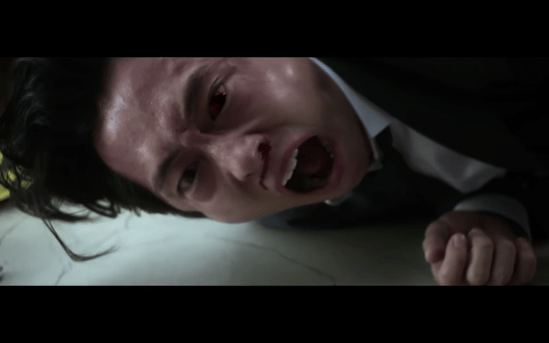
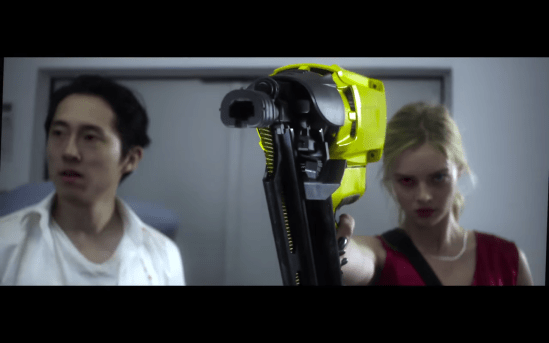
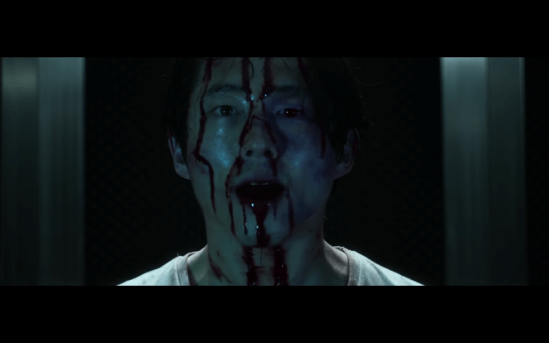
On the coattails of his character’s brutal demise on AMC’s “The Walking Dead,” Steven Yeun remains in an dimension plagued by a different kind of viral infection. Instead of blowing the brains out of walkers, Yeun brilliantly and entertainingly fills the ambitious workaholic shoes of account manager Derek Choe who literally battles his way to the top after being canned by his unscrupulous consulting firm and when the ID-7 overwhelms each and every employee. Choe is a far cry from Glenn on “The Walking Dead,” a pure hearted character with a good moral compass. Yeun’s character’s moral compass is skewed without doubt and double skewed with introduced by the virus. Choe forms an unlikely pact with a desperately disgruntled borrower Melanie Cross fighting against the firm, and the firm’s bank, looming foreclosure and the sassy, blond ass kicker, embraced by “The Babysitter’s” Samara Weaving, can chew gum and kick tail all at the same time. The pair are pitted against the some of the office’s most ruthless suits, such as a sociopathic HR enforcer known as The Reaper (played by “The Walking Dead” vet in Dallas Roberts), a manipulative snake charmer Cara Powell (Caroline Chikezie of “Æon Flux”) and at the top is none of than the big boss played by “Hellraiser: Revelations'” Steven Brand. Not only does “Mayhem” have colorful, well-scribed anchoring characters, but the supporting parts are just as well-quick-e-quipped too with Kerry Fox, Claire Dellamar, André Eriksen, and Mark Frost (“Faust”).
“Mayhem” relishes in the ferocity of that of a Mark Neveldine “Crank” franchise, but lacks a certain coherency untuned to seamlessly sustain the story to the end. Moments of purely poor editing don’t convey the full message intended, leaving much desired when considering the hero and heroine’s plight through the firm’s ruthless hierarchy to the top. These moments don’t make or break the story and are minuscule in portion size but are large enough to thwart going unnoticed. Another annoyance of how the story is told is the off screen violence. With a feature entitled “Mayhem,” by very definition states, “violent or damage disorder, chaos,” one would imagine that any and all violence would be in full display, showcased proudly and exhibited without ambivalence, and the beginning starts off energetic enough with an explosive scene of a conference room brawl involving the attendees in a all out melee, a half naked couple sexing right on the conference table, and ending the scene with a murderous gashing of one’s carotid artery. Narrating why these berserkers are killing and humping each other is Steven Yeun’s Derek Choe, setting up the ID-7 as the uninhibited virus. The violence that pursues goes into a hot or cold state where the latter involves off-screen violence, especially between Chikezie and Clarie Dellamar’s characters in a fight to the death between boss and assistant, but in a heated exchanges that had more girth in the dialogue, their actual bout screens over to Choe and Cross’ blank stare expressions and the determination of who bests who goes into a big question mark status.
RLJ Entertainment releases “Mayhem” onto various formats include a not rated DVD, Blu-ray, and streaming platforms. I am unable to comment or critique on the audio and video qualities of the film as I was provided a streaming link that didn’t include bonus material; instead, I’ll comment on how Lynch and the rest of filmmakers did a remarkable job constructing an ambiguous building structure along with the help of the two Stateside based production companies Royal Viking Entertainment and Circle of Confusion. Though the film was shot in Bulgaria, the location could have been right in downtown of your nearest city and that fairs in “Mayhem’s” success to establish anywhere as a victim to the virus or a workplace go array in the world. The next time you want to take a heavy duty Swingling stapler to you’re supervisor’s noggin for assigning to many TPS reports to you, check out “Mayhem” to instill that visceral courage and audacity to do so all the while being entertained by utter, unadulterated violence and violent thoughts and actions that usually spur underneath the breath of a common office environment.











 It's Bloggin Evil!