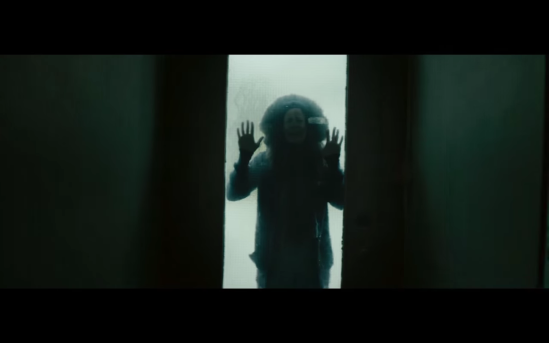
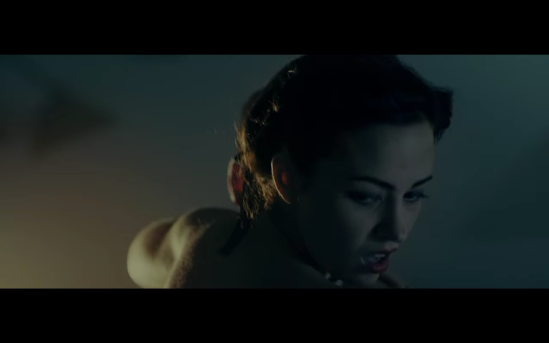
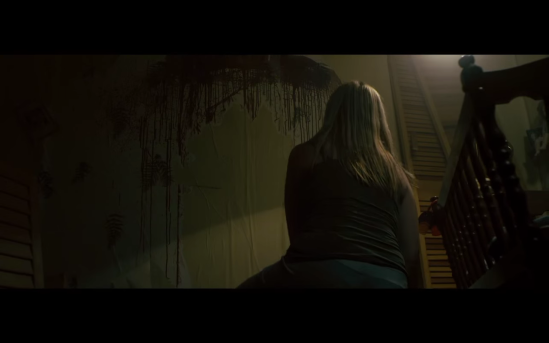
Sara, a desperate young mother, infiltrates a secret facility workplace under the false pretentions of becoming an employee of the critical janitorial department. After losing custody of her adolescent daughter Jenny in court, the child becomes misplaced when her custody awarded father, an employee, loses Jenny in the facility that’s conducting unusual activity involving the building’s light energy source. With everyone on constant edge and under the powerful and dangerous influence of the light, including her very organized and unstable employer, Sara is able to find a sympathizer in the head janitor and by exploiting his mental map and valuable knowledge of the building, Sara goes deeper into the structural bones of a nightmarish reality where evil lurks in the shadows and not everything is what it seems.

“Feed the Light” is a H.P. Lovecraft inspired sci-fi horror directed and co-written by indie filmmaker Henrik Möller with Martin Jirhamn sharing the co-write. The gothic tale stems from the Lovecraft short story “The Colour Out of Space” that tells the tale of a meteor crash landing in the hills near Arkham, Massachusetts, poisoning and deforming all the living creatures nearby that creates chaos amongst the locals. The light, that never dulls, becomes the driving force of everything malevolent and that carries over into Möller’s film, but isolates the setting to a dilapidated building instead of a natural landscape and focusing more on the people inside rather than vegetation or livestock as the Lovecraft short story builds upon. Originally shot in color, Möller thought best to suck the color out from the reel and produce a mostly black and white film, sprinkled with color at strategic moments, that would convey the importance of the ever-present light and interpret a far more dramatic effect to play out; a decision I whole-heartedly agree because if laced with color, much of the abandoned warehouse setting would be a monotonous eye-sore. Instead, black and white enhances the light’s presence, makes it almost seem to stand out amongst the greyscale, and give way to more inspirationally vibrant hues when they are revealed.

For Henrik Möller, this is the director’s first dive into feature films and for the filmmaker whose better known for his shocking shorts, “Feed the Light” doesn’t water down the deranged, creative machine that just steam-plows through a 75-minute runtime and still managing to be mechanically sound to comprehend the Lovecraftian tone. Lina Sundén fills the lead shoes as Sara and Sundén embodies complete innocence and bewilderment when her characters goes forth into this strange facility, but doesn’t show much fear as if a mother’s determination is her driving force to go beyond being what frightens her. Alongside Sundén is Martin Jirhamn, who you might remember me saying he co-wrote the script, as the sympathizing janitor. Jirhamn has collaborated on many of Möller’s shorts, feeling comfortable taking on the challenge of a full length feature by taking on more of a scripted role that has a face with two sides. Rounding out the cast of memorizing characters are “Not Like Others'” Jenny Lampa as an authoritarian boss of the facility who tries to keep Sara from going on Indian Jones and the Raiders of the Lost Ark in the basement and Patrik Karlson otherwise known as the VHS-Man and Jenny’s father in the film.

“Feed the Light” has undertones beyond that of Lovecraft. The story feels nearly anti-establishment, a surreal and extreme look at how doing the same job, in the same office, staring at the same fluorescent lights can make one loose one’s humanity. The boss is a strict enforcer of the rules and doesn’t shrug at the thought of one of her employee’s burning out as long as the job gets done, but it’s not burning out that’s the problem. The light symbolizes obedience and control, turning those with a soul into mindless workers. There’s an unseen power embodying them such as with the dog man, played by Morgan Schagerberg, who, literally, sounds and acts like a canine that just happens to have glittery dust goo ooze out of it’s anus. Yup, weird. “Feed the Light” is jarringly weird, but also laminates into the prospect of hidden doom that’s very similar to the truth is out there concept reveled in the “X-Files.”

The Severin sub-label, Intervision Picture Corp., usually subjects us to older projects, but embraces newer indie films such as Henrik Möller’s “Feed the Light” and with the help of CAV Distributing, Möller and “Feed the Light” can be exposed to every house hold on Earth as a region free Blu-ray in 1080p full Hi-Def. The full frame is a staple of Intervision and doesn’t necessary cause any distress over cropped images. There is a fair amount of interference, but again, only enhances the indie labels reputation. Other than that, the image is fine laid under a Swedish language dual channel audio track that’s well balanced with a brooding industrial soundtrack by Testbild, a Möller familiarity. There are two extras accompanying the feature: one is a making of featurette and the other is an interview with the director, Henrik Möller. “Feed the Light” is a science fiction oddity chocked full with surreal depictions and nightmare creatures with a Lovecraft base and a passionate director’s otherworldly view of how light and color powerfully dictate our everyday lives.
Category Archives: Death
Visions of Evil From a Disturbed Mind. “Lung” review!

An unidentified man, wearing medical scrubs and gloves, wanders through town, encountering hellishly gruesome scenes of death. He wanders barefoot through a ghastly journey that might figuratively expresses his back story of how he came to witness such visions and be relatively undisturbed by the horror they represent. The filthy, gory, and ill-fated moments might also be hallucinations brought upon by a traumatic occurrence that wrenches him out of reality and into grisly purgatory. Either way, the nameless man is a lost soul with no ambition, no emotion, and no direction to guide him through an inner conflict of blood-soaked entombment.

Unearthed Films’ 2-disc collector’s edition of “Lung I” and “Lung II” continues with the distribution company’s legacy of delivering the best underground cinema to the forefront of home entertainment. Phil Stevens, director of positive-reviewed “Flowers,” writes, stars, and directs both feature films about the wandering man in a foggy, distorted haze, but “Lung II” is not a sequel to “Lung I.” Instead, “Lung I” is the softcore version of events whereas “Lung II” is a hardcore redux – think along the lines of “The Evil Dead” and “Evil Dead II” – that’s much more detached from rationality and by collaborating with “American Guinea Pig: Bloodshock’s” Marcus Koch seizing upon the special effects, you can damn well count on “Lung II,” and certainly “Lung I” as well, being bare-faced dark, violent, and twisted. In more a sequential reality, “Lung” is part of the Phil Stevens’ proposed trilogy entitled the Violence of Dawn with “Flowers” leading the horrific charge. This review will focus more on “Lung II.”

Stevens stars as the unnamed lead, waking up lost under a creek bridge, dressed in medical scrubs, and haunted by unspeakable, bloody post-violence mayhem while continuously battling his evil doppelgänger self. Is this just a strange nightmare or a telltale sign of this man’s troubled past? Then, again, Stevens’ impassive take feels more like wandering through one hell of a dream, an endless journey into one’s post-traumatic warped mind rather than spelunking into one of a murderous soul’s, even if one of the moments of trauma could be his wife – or girlfriend – cheating on him and he catches her in the act with ill-fated consequences. Characters also related to the medical profession, such as a psychologist (David Copping) and quick flashes of a nurse (Angela Jane), are a part of this visceral vision quest. Finally, we come to The Exile character. The Exile might sound familiar if you’ve read my review on “Flowers” as he’s the only character, portrayed once again by Bryan W. Lohr Sr., that connects the two films. The Exile continues to mystify us about his presence, an extremely large and intimating brute with a deathly blank stare and a “don’t fuck with me” attitude.

Unlike “Flowers,” Stevens went the devoid of color route, constructing a black and white feature that, like “Flowers, goes without as much as a sentence of dialogue. Actions, expressions, and every sense of the word “art” tell the story. Non-linear editing and brutally realistic scenes of savagery in the confines of special effects exercise and sparks your brain’s neurons to try spitfire pieces together to cement a coherent narrative. Stevens is almost able to re-tap into and revitalize the silent film genre with “Flowers” and “Lung”, and with the help of a vehement brooding score by Mark Kueffner, I believe this type of experimental horror story telling can fascinate just about anyone without a weak stomach.

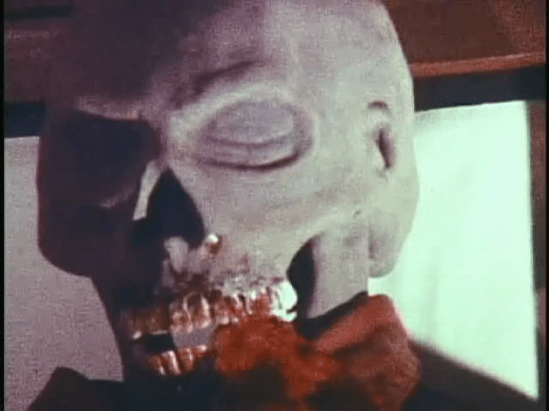
Unearthed Films and MVDVisual’s 2-disc DVD collector’s set a beautifully monochrome piece of art with roached infested severed heads, a halfway decomposed homeless man, and a pile of refrigerated sexual organs meshed together like something out of Brian Yuzna’s “Society,” but more gnarly. Im interested to see how Paradis, aka Paradis III, comes to conclude the trilogy and see how Unearthed FIlms releases Phil Stevens’ visionary tales. The Borderline Cinema and Extreme Horror Cinema “Lung” is comprised of two discs that entail “Lung I” Feature Film, “Lung II” Feature Film, Directors Commentary, Editors Commentary, Isolated Sound FX Track, Making of Lung 2 (which is very informative and fun to watch underground cinema come to the fold), Mark Kueffner: Lung Composer Featurette, Martin Trafford: Artwork Featurette, “Cats” Short Film, “Descent” Short Film, and Unearthed Trailers. “Lung” will not tickle everybody’s taste; surely sick and part of a niche network of darkly persuaded and humored people will most likely get it, but there’s still very much to appreciate here from director Phil Stevens and his eye for detail and disturbia. This gore and shock is worth a look and worth a chance.
Get Jacked! Get Evil! “Bloody Muscle Body Builder In Hell” review!

Living free from job responsibilities and able to workout whenever he wants, body builder Naoto is living the high life. His daily workout is interrupted by his former photojournalist ex-girlfriend in search of the next haunted house for her latest article and she calls Naoto to inquire his father’s old, creepy home that’s now in Naoto’s possession. Accompanied by a professional psychic, the three conduct a house call to get a presence reading and take pictures of the rundown, abandoned home. They find themselves trapped inside with Naoto’s father’s darkest secret malevolently toying with them and holding them hostage with her cursed power bestowed upon her death, 30 years ago, forsaken to her by the hands of Naoto’s fahter.

In 2014, first time director Shinichi Fukazawa’s endearment for Sam Raimi’s “The Evil Dead” has encouraged the filmmaker to tribute a film that has dubbed “The Japanese Evil Dead.” With all the depictions of Raimi’s film, including from a shotgun, an axe, and even a severed sarcastic-spewing mangled demon head, “Bloody Muscle Body Builder in Hell” views just as good as the sounds. Taking his film to the next level by going back in a time warp, Fukazawa de-amplifies the image quality with a lo-fi flare that adds chaotic charm bathed in retro-VHS vision as every desaturated hue and blanket of coarse grain is a step back in time. Fukazawa implements his own sturdy brand of macabre to branch his version of “The Evil Dead.” For instance, Fukazawa removes the Necronomicon, the book of the dead, all together. Instead, the director doesn’t forth put an outright explanation behind the cause of the cursed’s murderous revenge other than holding a jealous grudge and the lack of motivation is okay because “Bloody Muscle Body Builder in Hell” is a modern day video nasty.

Shinichi Fukazawa, himself, stars as Naoto, suffering every ding, boink, and bop as our hapless hero that’s aims to strike similarities to Ashley “Ash” Williams and his gift of being the king of Three Stooges foolishness. Fukazawa plays a more conservative character in comparison, but does manage spit out memorable one-liners made genre famous by Bruce Campbell, like “groovy.” THe lead actress, Asako Nosaka, holds her own as a lovely damsel in distress who can double on a dime as a Mike Tyson speed bag puncher. The trapped pair make a convincingly distressed protagonists, especially in such a small Japanese home that’s the equivalent to a cabin in the woods. Last on the roster is Masaaki Kai filling in the psychic’s shoes and conjures an performance that’s could fit right in with the Kandarian Cheryl, Scott, Linda, and Shelley demons.

“Bloody Muscle Body Builder in Hell” is a 2014 effects driven, blood hungry roller coaster of pure mayhem entertainment. The ingeniously creative special effects, on a shoe string budget, are made of eye-popping, skull-crushing, and limb-parting goodness that every horror fan can appreciate and love. The lo-fi cinema and melancholy horror fixes to not impress those who have a taste for the CGI eye candy and won’t knock your socks off with the latest and greatest technological, animated advances in effects that attempts to mock real life, but accomplishes the opposite in the fabricated grindhouse reel with overexposures and rough edges that are more fitting for the subject matter. Fukazawa does embody Raimi’s creative editing and angle vision that makes Fukazawa’s film feel very attached to “The Evil Dead” franchise.

The well-meshed video nasty mingles Japanese culture with a loving tribute to Raimi’s “The Evil Dead” franchise and kicks off Shinichi Fukazawa’s most interesting silver screen career. Terracotta Distribution’s “Bloody Muscle Body Builder in Hell” is a tightly packed 62-minute joyride with squirrelly, demented demons with heavy emphasis on the blood and the gore. Image quality is poor and that’s a good thing! The low-tech fullscreen and unrefined quality are a tall-tell sign of a SOV gruesomeness surrounded by a fuzzy Japanese dual channel stereo. Extras includes a Graham Humprey time lapsed video of him creating his DVD artwork, a behind-the-scenes gallery, a dismemberment of scene clips, and Japanese and Terracotta trailers bringing up the tail end. “Bloody Muscle Body Builder in Hell” packs a punch, delivers the death, and gorges itself in the gore in this UK DVD from Terracotta Distribution! and is a lovely blend of comedy, horror, and praise that’s powerfully short and sweet from a freshman director who aims to make a statement while giving appreciation in his own culturally established way.
Subletting Manager is an Evil Shrew! “The Resident”review!

Joanna and her fiance, Geoff, enter a sublet agreement sight unseen. With her fiance being a struggling actor with gigs teetering on the line and domineering most of his time, Joanna struggles to find ways to pass the day alone in her apartment on unpaid maternity leave. The creepy, unwelcoming apartment doesn’t feel like home when Joanna has yet see another living soul in the building, but hears footsteps on the next floor above, violent wall banging thumps next door, and extremely unpleasant dreams that seem to cause her to lose time in reality. When Geoff neglects her pleads to leave the sublet, Joanna becomes enthralled with a newfound journal from an off limits room and as soon as she starts to read from the pages, her life in the apartment strangely follows a parallel path of the journal’s previous owner, a house wife named Margaret, that leads to jeopardizing everything Joanna knows: her sanity, her husband, and her baby.

“The Resident,” aka “The Sublet” as known in other parts of the world, is the debut psychological horror directed by the writer of “Jack Brooks: Monster Slayer,” John Ainslie, who also co-wrote the script with Alyson Richards. The 2015 film is also produced by Chad Archibald, whose name might sound familiar if you’re a regular reader of this review website where you can read about interesting horror feature films like “The Resident.” Archibald helmed the body horror delicacy “Bite” the same year. Together, the qualified credential crew steps up to a challenge with “The Resident” that, on the surface, appears to be another run-of-the-mill tired premise of a young couple coping with a malevolent presence and with a common subplot involving a stay-at-home mom being the unfortunate victim. Ainslie and Richards, obviously, go through the stages of that realm, knocking down the expected pillars of conventionalism, but the duo do touch upon a couple of things. For one, they make “The Resident” very interesting and entertaining by seriously messing with Joanna’s state of mind, forcing her to question every little aspect of her mundane existence in that small sublet. The second thing is is that the whole story can be seen a metaphor for postpartum depression that’s driving psychosis right into the thick of Joanna’s unhappiness. More than once, Joanna mentions how ugly she feels and she becomes overly jealous of Geoff’s ex-girlfriend, even if rightfully so.

“Bite’s” Tianna Nori gluttonously takes on Joanna’s dwelling punishment. Nori’s par performance sells sufficiently, but doesn’t completely enthrall Joanna into the depths of madness, leaving a rather tame aftertaste. The same can be said for Mark Matechuk, who plays opposite to Nori with Geoff. His struggling actor shoes fit his two-bit stiff and starchy outfit, but Matechuk and Nori do work well together even if some scenes feel forced and scripted. By far, Rachel Sellan was my least favorite of the three main actors with her portrayal of a snobby, yet beautiful, ex-girlfriend of Geoff’s. A world built solely on the inner walls of the apartment, literally 95% of the film is inside this constructed sublet, has more personality and life than the organic material composing an orchestrated dialogue and I personally don’t blame the cast. I believe the sublet, the construed presence, subversively overshadows the intended characters. Krista Madison, James Murray, Mark Ettlinger, and Jeff Sinasac make up the supporting cast.

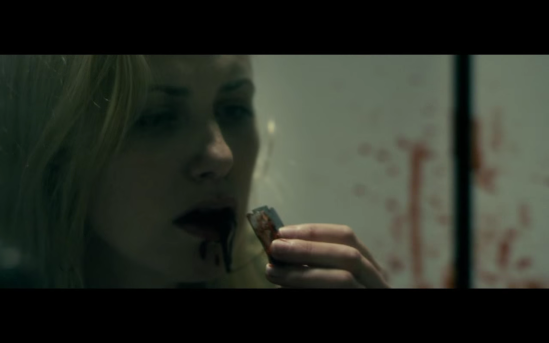
“The Resident” has modest effects that spur mostly off screen, but on the rate instance when mise-en-scene effects happened, they didn’t go unnoticed. “The Resident” brought and delivered the appropriate psychological nightmares associated with brain-warping spirits, shelling out an introverted dreaminess in Joanna that only she could experience with those unfortunate family and foes surrounding her witnessing only the outer chaos. Sometimes the story gets lost in itself when attempting to further Joanna’s skewed circumstances. Is Joanna dead already? The answer is possibly. Every external scene of the apartment building or even the brief scenes of Joanna with the stroller sets the moments in dreary rain and when going further into the film, Joanna is no longer able to leave the apartment. She even becomes a part of her own missing person’s investigation conducted by two belligerent cops, played venomously by Mark Ettlinger and Jeff Sinasac, who inform Joanna that her family hasn’t heard from her in days. It’s the final scene that sets the whole rest of the film in stone, that solidifies Joanna’s mental state, and yet the simple moment still leaves questions and reflection. That’s a considerable tall tell sign of good story telling from Ainslie and Richards.

Canadian production company, Black Fawn Films, headed by Chad Archibald have another successful odious anecdote in their arsenal of horror and the company has quickly gained momentum in becoming a juggernaut in sustainable low-budget horror. Second Sight will be heading the home distribution portion of the title with a May 22nd release onto DVD and On Demand. Unfortunately, a press DVD-R was provided and the audio and video qualities can’t be commented on nor can any critique on the bonus material. John Anislie has the tools and the means to labor a chilling trap of supernatural spookiness. With a cast of similar caliber, “The Resident” would have made it higher on the list, but manages to keep a solid bleep on the radar when the next scene always begged the question – what’s going to happen next?
Evil Wants You to Say it’s Name! “The Bye Bye Man” review!

Elliot, Sasha, and John move into an old manor home just off the university’s campus. The tight knit three friends stumble upon a tattered nightstand with scribbled nonsense inside the drawer and underneath the incoherent writing and scratched into the wood is The Bye Bye Man. Once you hear the name, a searing imprint has been made into the mind, opening up a layer within the universe that invites a grim reaper-like figure to come horrifically collect individuals who have been infected with the name. The mysterious malevolence will impose hallucinations, or tricks, upon the mind to induce others to commit evil acts on another and will stop at nothing until those who know his name are either end up dead or spread his vileness. For Elliot, Sasha, and John, their close relationships will be tested, they’re bodies will be challenged, and their minds will be altered in a race against the clock in order to beat death, to defeat The Bye Bye Man.

“The Bye Bye Man” is an Universal Pictures and STX Entertainment distributed boogeyman concept from 1995’s “The Last Supper” director Stacy Title. Title, who hasn’t been active for about ten years since her last directorial, helms the project written by her husband, an appropriately named Jonathan Penner, who also had a co-starring role in “The Last Supper.” The inspiration stems from a collection of horrific tales from Robert Damon Schneck’s “The President’s Vampire: Strange-but-True Tales of the United States of America,” but “The Bye Bye Man” borrows heavily from well-crafted horror brethren too, birthing a mythological personification of death that doesn’t wield a scythe, but rather being a master, underneath a dark hooded cloak, to a hellish beast that munches on the faces of The Bye Bye Man’s victims. “A Nightmare on Elm Street,” “Final Destination,” and a little bit of “Scream” become the selected examples that are the genetic makeup of TItle and Penner’s film, but doesn’t grossly rip from the said works, two of which are the late Wes Cravens masterpieces. Instead, Jonathan Penner reconfigures the nightmare man, a modern day Freddy Krueger type stalking every soul during the day and night hours, whom establishes his own brand of Rube Goldberg deaths through deadly vision inflictions that pray upon a human’s moral subconscious. “Don’t say it. Don’t think it” sets as the 2017 film’s tagline with the notion that perhaps little white lies are, literally, lifesavers or that the truth can be hurtful, and or knowledge can be powerful, but can also lead to your own demise.

“Ouija’s” Douglas Smith succumbs to his lead role of Elliot, an educated and patient young man who seems to have everything despite tragic misfortune that’s whisked through the character development. From friends, to a supportive brother, to a loving girlfriend, Smith transition seamlessly to languishing burden during a spotlight scene with co-star Carrie-Anne Moss (“Matrix”) that’s raw and cuttingly empathetic. The story centers around Elliot, but Sasha and John have pivotable relationships to Elliot, two essential roles given to two British actors, former girl of Prince Harry, Cressida Bonas, and television actor Lucien Laviscount. Both Bonas and Laviscount expensed drab performances, mechanically and, often, monotonically coming and going from scene-to-scene without mingling well into the rest of the film’s grim and dire trimmed overalls that basically left Smith out to pick up the slack. Along with Carrie-Anne Moss, who always seems to be typecast in a women of power role and, in this case, a detective, “The Bye Bye Man” sports other veterans of both horror and general film, but; instead, take a backseat to a younger generation of actors. “HellBoy’s” Doug Jones silently strolls through one of the easiest prosthetically garbed performances of his illustrious career as the titular character, genre stable Leigh Whannell (“Saw”) commits to a haunting performance as a murder-suicide martyr, and the legendary Faye Dunaway portrays a longtime widow of the aforementioned madman. Michael Trucco (“Wishmaster 4: The Prophecy Fulfilled”), Jenna Kanell, Cleo King (“Hood of Horror”), and Erica Tremblay round out the supporting cast.

Universal picking up a horror title resembling an infantile kids feature and releasing it theatrically might with relatively unknown, mostly non-American cast, will scratch some questioning heads, but with a well oiled supporting cast consisting of many years of guild service, a director, despite being inactive for many years, maintaining a sensible and visionary eye, and a story, aside from a few underdevelopments, that captivates with edge of your seat scares and with next moment eagerness, “The Bye Bye Man” has great potential. With smoothing out details of Elliot’s and The Bye Bye Man’s backstories and construing more of a slow burn method when getting the characters involved with the ‘don’t think it, don’t say it’ villain name, Universal would have increased their gross profits by double and the world would be happy once again. Unfortunately, that scenario was not the case as credits bombarded “The Bye Bye Man” as about as borrowed and as hokey as any low-budget horror film can be, but “The Bye Bye Man” surpassed the production budget by triple and to me, someone who generally has the same stance as most credits, that’s a win for Stacy Title and company.

The Intrepid Pictures and Los Angeles Media Fund production “The Bye Bye Man” makes a Universal Pictures Home Entertainment debut on a two-version unrated Blu-ray and DVD combo. The MPEG-4 AVC, 1080p Blu-ray disc contains a razor sharp image in the 1.85:1 presentation. Depth and shadows phenomenally define the space, especially in closer quarters and the ariel shots. A motif of bleak black and grim grey is consistent throughout, creating a tone through the darker shades, with vivid hues to gloriously fend for themselves amongst the achromatic reel landscape. The English DTS-HD Master Audio 5.1 surround sound doesn’t feign in the balance category with dialogue prevalence not short of excellence and, much like other atmospheric horror, the spooky elements are outlined in various levels from a coin dropping to a train horn. Bonus features are surprisingly zilch with no extras on either format; I guess there wasn’t much to say during or post-film. In all, “The Bye Bye Man” is a total hack with plot holes. A completely borrowed and revamped product with a terribly childish title promising nothing to the genre, but that doesn’t necessarily mean “The Bye Bye Man” can’t be entertaining, providing a wicked sense of humor and a morbid final destination outlook with unexpected casting choices and a barely bordering PG-13 horror rendering.