For One Exhausted Truck Driver, EVIL is on the Move! “Goodbye Honey” reviewed! (Freestyle Digital Media / Digital Screener)

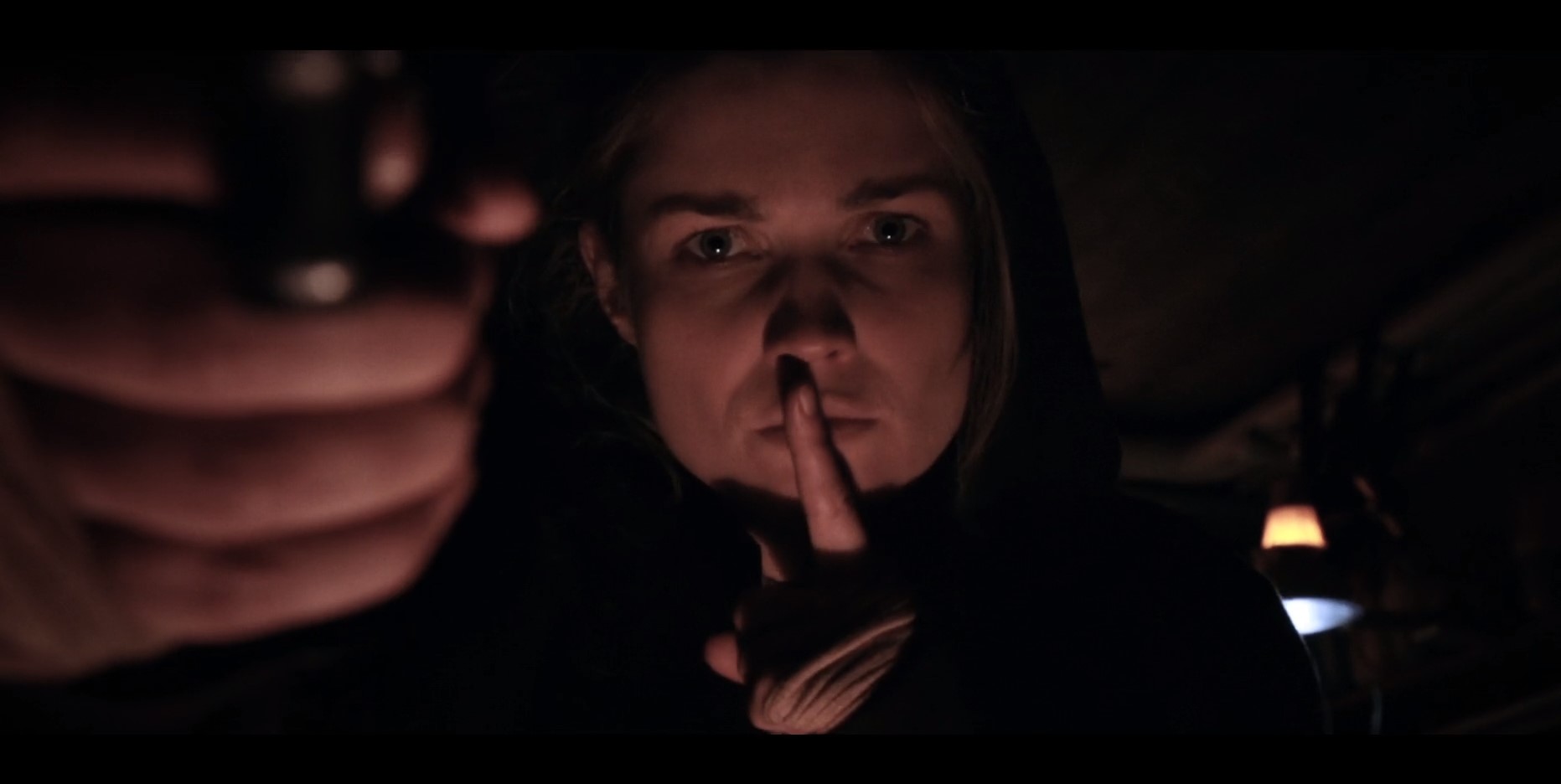
Dawn has been driving for over 30 hours straight schlepping a customer’s belongings from point A to point B. Unable to keep her eyes from closing, she pulls over and parks in an empty lot of a state park. Before Dawn could close her eyes, a mysterious and frightened woman approaches her asking for help, informing Dawn that she has been held captive for months. Treating with suspicious eyes, not fully trusting this young woman’s thinly laid out accusation, the exhausted truck driver is eager to protect her truck from would-be thieves and vandals, but decides to assist though her phone is broken and her truck keys are lost, leaving the two women stranded in the middle of nowhere with a radical abduction story and the captor is not too far behind. What seemed to be a quiet night of deserved rest and relaxation for a truck driver who just drove straight-through without much as taking a break is about to unfold an eye-opening, harrowing ordeal that puts the two women in for the long haul.

Would you trust a harried and jonesing-looking straight knocking on your day cab door of your straight moving truck in the very early AM hours of the night? This iffy scenario plunges audience into that exact pressure point of Max Strand’s feature film directorial debut of “Goodbye Honey.” The 2020 abduction-thriller is also written by Strand and co-written alongside Todd Rawiszer, collaborating for a second time since 2011 for their cannibalistic-comedy, the family kills together, eats people together, “The Labbinacs.” Generally most abduction thrillers takes the viewpoint of the captive, but for “Goodbye Honey,” Strand and Rawiszer take the perspective of an outsider with unlucky happenstance and makes persevere over their own hang-ups in the dealt lousy hand called life. “Goodbye Honey” is produced by Joshua Michaels from the Examined Dots Pictures, a subsidiary of the video media company, Examined Dots Media, and is the first feature length film production from the company.


The point of view from the trucker sparks a clean slate inception of events as Dawn is oblivious to the entire occurrence that has scared and scarred this young woman whose animal instincts have kicked in and is working against her advantage with Dawn as desperate spurs her to act instead of thinking logically about what to do.  Pamela Jayne Morgan (“The Manor”) headlines “Goodbye Honey” in her first breakout role of 2020 stepping into not only an impromptu lifesaving moment but also into the steel toed shoes of a trucker’s life behind the wheel that features sleeping in her cab, eating lunch in her cab, and being driven into the ground by a demanding, world’s most dangerous, profession.  The only uncouth trucker habit Morgan does not do in her cab is urinate into a bottle.  Oh wait, she does bottle potty!  However, the circumstances surrounding that moment is not because of her profession and only adds to the many layers, including her tragic background and lost ambitions, that makes Dawn a complex character working the mental gears to do what she can to survive and save a life in terror’s grip.  And just like Dawn, we’re weary to believe the fantastic accusations coming out of Juliette Alice Gobin’s lip-quivering mouth who sizes up to the very still with fright the shaken and traumatized abductee in Phoebe as she narrowly escapes her captor, played by Paul C. Kelly (“Devils Prey”).  Gobin debuts her talents in horror with flawless strokes that paints Phoebe more of a misunderstood threat than a distressed victim of kidnapping.  Morgan and Gobin’s hot and cold dynamic perfectly rouses doubts as nothing, at first, is entirely clear.  “Goodbye Honey” has an indie size cast, but the performances are robust with layered intensity from the principle roles to the momentary characters played by Peyton Michelle Edwards, Rafe Soule, Jake Laurence, and Keara Benton.

There’s always been this uniquely bizarre fascination of which story angle an abduction thriller should play from and in “Goodbye Honey’s”, the story doesn’t follow a linear narrative of the abductee but backtracks with anecdotal flashbacks as Phoebe divulges the events leading to her snatching and how’s she’s been isolated in a small room for months to her only hope and savior, an emotionally downtrodden and physically fatigued Dawn.  While not entirely new, as we’ve seen a structure similar in John Oak Dalton’s “The Girl in the Crawl Space” that relives the victim’s held captive experience through mental flashbacks and therapy sessions, “Goodbye Honey,” bills far superior dread unlike the 2018 film, which suffers from monotonous exposition and topical offshoots.  Strand plops us in the unravelling thicket of action with gripping what-ifs potentially lurking in the midnight shadows surrounding Dawn’s painted white beacon of hope on wheels.  Character curveballs also hit empathetically hard with twist and turns coming out of the ears of all the narrative pawns and not just confined to the black and white abduction that brings them together. As much as Phoebe needs Dawn’s help to escape the clutches of her captor, Dawn also needed Phoebe’s accidental life purpose healing that fills the void in Dawn’s life left by the passing of her husband and reaffirms her passion for helping people no matter her personal circumstances.  Oddly enough, I found Kelly’s captor lacked substance to the story other than the characteristic ploy of revenge that agitates the action as his endgame for Phoebe isn’t exactly clear other than spouting, “she needs to pay.”  The serendipitous connection between Dawn, Phoebe, and the abductor has designer destiny stitched into the natural fabric of life in an almost comical happenstance of events, but makes for good entertainment nonetheless knowing that there is a circle of connectivity, a sense of purpose, and a reason to fight back in “Goodbye Honey’s” pressure cooking recipe.   

On May 11th, “Goodbye Honey” was released on digital HD and on cable VOD in North America from Freestyle Digital HD after a successful stint of festival wins including Best Thriller Feature, Best Actress (Pamela Jane Morgan), and Best Supporting Actor (Rafe Soule) at the Garden State Film Festival, Best Lead Performance (Juliette Alice Gobin) at the Nightmares Film Festival, and Best Actress (Morgan) at NOLA Horror Film Festival. Todd Rawiszer didn’t just co-write the film he also shot the film, his first feature film credit at a cinematographer. Inside 96 minutes and with a narrative taking place over a single night, Rawiszer casts a variety of hard lit shadows with glimmers of intermittent portable lights and neon reds kept tight with medium to closeup shots and rarely venturing out beyond that range with clarity as much of the wide shots or long shots are obscured, in a haze, or blurry to the eye as Rawiszer never wants you to know what’s exactly out that far. A pair neat editing montages by Jay Yachetta, with the meal plate and door slamming alongside Phoebe going mad with stir crazy is some of the best work I’ve seen a long time that can trigger an epileptic episode and still be insanely cool in the cruelty. Top those montages with an aggressive sound design and you’re head will surely pop off with unsettling jubilation. No bonus scenes during or after the credits are included. Regardless of budget or the stigma of low budget pictures, nothing but good vibes and good things to say generally about Max Strand’s “Goodbye Honey,” a startling trembler of persistence to outlive a night of terror that stars two stellar leading ladies at the heart of the film’s success.

Rent or Own GoodBye Honey on Amazon Prime!

HELLelujah! God Does Not Deliver Us From EVIL! “We Still Say Grace” reviewed! (101 Films / Digital Screener)


A family living in deliberate solitude looks to God to provide them with everything they need to sustain.  Harold’s two teenage daughters have never experienced beyond the 14 acres of land their father and mother own, but the youngest, Maggie, can’t help but think of the wonders outside her father’s god-fearing, draconian sheltering.   When three teenage boys travelling to California suddenly break down on Harold’s remote land, an eager Maggie can’t wait to taste a mere glimpse of their perception of the outside world.  Being a good Christian man, Harold welcomes the hapless travelers into his home and convinces them to follow the rules and stay the night, but the boys’ seemingly happenstance car troubles is manipulated into an unavoidable sign of God’s will, or at least so in Harold’s eyes, and he decides to carry out a predetermined family suicide pact for him and his family to be welcomed into the gates of Heaven.

The one think learned, or maybe had shed more light on, out of this pandemic is the unstable relationship people have with God.  Religious extremist have weaponized the Powerful and Almighty against every day people like you and myself with contentious, hate-filled vocabulary such as damnation, burning, hell, etc., for those who do not seek his glory the way asininely seek it.  “We Still Say Grace” epitomizes that very lifestyle of devout fanaticism that has also been highlighted with buffoonery as the very same people who verbally condemn others usually don’t walk-the-walk but only talk-the-talk or are a charlatan involved in a more sinister plan.  “The Lodge’s” Brad Helmink and John Rauschelbach write and direct the film that has become their second feature horror film produced by the filmmakers under their Brothers Shamus Pictures, Mark Sonoda of Dauntless Studios, Room in the Sky Films, and Lexicon Entertainment. 

Now, I’m not a religious man or spread the word of the divine in my reviews, but God love Bruce Davison as the “Dahmer” and “X-Men” actor is a silver fox crazy man of God living rurally with his wife and two teenage daughters.  Davison relentlessly rallies Harold’s madness and is having a good old time performing as a man with a hidden agenda.  Harold is an intriguing character with little-to-no information about the character’s background or reasoning for being unreasonable, but that doesn’t seem to faze the legendary actor who had cut his teeth into horror 50 years ago as the original rat-speaking avenger, “Willard,” as Davion trots down a path of deceitful radicalism and manipulative exploitation.  Those he unscrupulously cons with pious smoke and mirrors are his own family in wife Betty (Arianne Zucker, “Days of Our Lives” daytime soap opera), Sarah (Rita Volk), and Maggie (Holly Taylor, FX’s “The Americans”).  As a viewer who is currently, at this very moment, chin deep in catching up on FX’s Cold War espionage thriller series of Soviet spies living as ordinary Americans in Washington, D.C. as they carry out missions in the name of Communism, I found difficult in separating Holly Taylor from her the 2018 series that ended its successful run in 2018 when she was a teenager.  Taylor’s roll in “We Still Say Grace” typecast the actress as another teen though having filmed the movie as a young adult woman, but the lighting is different and I don’t mean in a literal illuminating sense.  Taylor steps out from “The Americans’” 80’s setting and into, what I presume, is the 1990’s based off some wardrobe choices, car models, and the time frames that fit into those constructs and while she still has this inkling of suspicion that her parents are up to something, a parallel that has carried over, there hasn’t been this much ill-fitting reverence of a man hellbent on belting those he breaks bread with on a daily basis.  There is hesitancy and fear in Taylor eyes and that’s breaks up her from a reoccurring teenager role.  When the three teens (Dallas Hart, Frankie Wolf, and Xavier J. Watson) show up at the front door, that’s when things go, more than usual for Maggie, terribly awry. 

Aside from Bruce Davison, the other performances muster little faith in their roles with overplayed tropes, especially the stranded teens who could be plucked out as the Three Stooges of horror they’re so easily identifiable across the genre.  The premise itself isn’t exactly novel of a Bible thumping person teaching and preaching self-sacrifice, aka suicide, as a way to transcend beyond the heathens of this Earth but marketable and attainable as a small independent production with a California desert location, minor but effective special effects, and a handful of actors where much of the money is spent on talent.  “We Still Say Grace” is structurally very loose with character development and plot points, leaking continues dribbles of minor shifts that never patch themselves up on the backend.  For example, Harold’s not the black and white evangelical nut he seems to be but that is where his arc pauses and doesn’t backtrack into reasoning.   Helmink and Rauschelbach do better on the scene setups and interiors that make Harold uncomfortably fearsome and hostile in any context as he sometimes looms in the shadows of his farm chic house or toys with people, even his own family, like rats in a maze as he guides them along to their doom.

Premiering for the first time in the UK courtesy of 101 Films, “We Still Say Grace’s” penitent themed horror-thriller releases digitally this month of May.  As for the imagery presentation, and take this with a grain of salt with any digitally released film, the nearly 94 minute runtime seems to be filmed with a sun derived dust and light haze that I would compare the appearance more akin to trying to look through the bottom of a hard water stained glass.  Under the cinematography of Douglas Quill, the haziness plays into the rustic and dusty atmospherics that give age to the story and Quill frames Harold as a dominant and isolated figure, especially amongst the holy trinity ablaze in human flesh, as if he was the sole antagonist against the world.  The moment for shattered lives remains intent on the very edge of our corneas with the holy hell of “We Still Say Grace’s” patience brittle villain ready to gaslight and sacrifice anyone resisting against the grain of God’s good graces. 

One Hundred and Twenty-Nine Men, Two Ships, and One EVIL Beast Trapped Together in Icebound. “The Terror” reviewed! (Blu-ray / Acorn Media International)


Departed from English ports in 1845, two exploration sailing ships, HMS Erebus and HMS Terror, sought to chart a northwest passage through Artic waters above North America.  Bound for King William Island with over 120 men between the two vessels, the traversers found themselves icebound as the Winter months froze the arctic waters completely and solidifying their positions within one large ice mass.  Their story doesn’t end there as months pass, even through the summer, and winter’s firm grip shows no sign of rising above zero degrees, sweating the brow of the few experience Arctic officers.  To top off their troubles, a vicious polar bear, or some kind of supernatural beast connected to Innuit people, hunts down and ravages a few unfortunate Royal Navy seamen.  Low of provisions and spirits, a combination of infinite winter madness and trembling fear weigh heavy on the seafaring fellows frozen in an icy cold Hell. 

Straight from the ill-fated expedition in British maritime history, the mystery surrounding Captain Franklin and his crew’s death and disappearance in the Arctic is given the hypothetical explanation and supernatural treatment in season one of the AMC series “The Terror.”  However, the tale is more relative to the adapted novel of the same name written by American author Dan Simmons who specialized in science fiction and horror.  Adding elements of a monstrous presence stalking them in the shadows of a bleak tundra, Simmons’ historical fiction turned television series blurs the lines of non-fiction and fiction with chilling atmospherics and the indelicacies of human nature when necessities for survival are pushed to the extreme and are in short supply.  “The Terror” is backed by a strong executive producer team in Ridley Scott (“Alien”) and notable historical television producer David W. Zucker (“Mercy Street,” “The Man in the High Castle”) with writers Max Borenstein (“Godzilla vs. Kong”) and Andres Fischer-Centeno (“Under the Dome”) penning the screenplays with Tim Mielants, Edward Berger, and Sergio Mimica-Gezzan directing a total combined 10-episodes under the Scott Free Productions and Entertainment 360 flag. 

The AMC television thriller scores an amazing cast of seasoned English and Irish actors refined in their skills of becoming a part of the history their work reflects.  Chiefly surrounding the top three principle commanding officers, “The Cook, the Thief, His Wife & Her Lover’s” Ciarán Hinds as Captain Sir John Franklin, “Underworld: Blood Wars’” Tobias Menzies as Commander James Fitzjames, and with a foremost focus on “Resident Evil:  Apocalypse’s” Jared Harris as Captain Francis Crozier, an unique dynamic courses through the speckled personalities of each commander in the face of duty for Queen and country and in the certain finality to their crisis from the God-fearing Franklin, to the command prodigy Fitzjames, to the more sage practicality of Crozier.  Each also have their own flaws that inadvertently put a blight on the already ill-fated mission of charting a passage through the frigid bleakness of the Arctic ice and how they interact with a doubt inching motley crew of novice and experience sailors, especially between the stark contrast of fellow principle characters in the amiable Harry Goodsir (Paul Ready), whose personality is reflected by his name, in confliction with the more menacingly conniving shipmate Cornelius Hickey (Adam Nagaitis).  Both Ready and Nagaitis perfect their roles in convincing the audience on how we should feel about moral compass as they become the nerve center that drives the tale of continual darkness.  Praiseworthy performances definitely go to the entire cast, that also includes Nuuk native and Greenlandic band frontwoman, Nive Nielsen as well as Ian Hart, Alistair Petrie, Trystan Gravelle, Tom Weston-Jones, and Richard Riddell, pinpointing and bringing to life the mid-19th century Royal Navy speak, look, and mannerisms that adapt over the length and breadth of “The Terror’s” forlorn themes of two ship’s crew stranded in what could be said is a strange and alien terrain that evokes madness and fear in the longer you reside. 

The information surfaced about Franklin’s lost expedition with the discovery of possible cannibalism evidence discerned in the early 90’s and, more recently, the found wreckage of both the HMS Erebus and HMS Terror within the past decade add insurmountable coils of surreal realism around the true tragedy of both ships when embellished supernatural elements of an Inuit spirit animal stalking, hunting, and ravaging the crew.  Simmons novel and the series go hand-and-hand story wise but pull visually inspiration from Sir Edwin Landseer’s painting entitled “Man Proposes, God Disposes” where one polar bears tear at what’s left of a ship’s mast and another swallows what looks like human ribcage remains in a surely more a powerful image that’s aligned with the series in the offering an outcome of when it comes to man versus nature, nature will unduly win on it’s own frozen turf. AMC and Ridley Scott undoubtedly knew how to showcase a character driven story where over the time relations build and deteriorate between crew, officers, and a mingle of both and in that stretch of time, the passing of time itself has seemingly stood still as the nights become longer, routines are made, and the ships are stuck on the ice like a warm tongue pressed against a frozen metal pole, but, in the 10 episode series, the story stretches over a nearly two year period and the production is able to connect together next scenes to the previous ones without having to address each and every moment or exposition enough information to avoid the explanatory segue. This method of filmmaking always leave a smidgen of unknown, leaving viewers like us on tenterhooks and in an agitated state that we’ll never fully understand or fulfill that missing part of the mysterious portions and lapses in time. The unfortunate real life story itself casts an alluring wonder and I would even go as far as maritime excitement even if stemmed out of tragedy; that’s how “The Terror,” affixed to the rising ice in an infinite frozen sea of stalagmites, dresses every episode with a less is more garb. “The Terror” endures for a long time in the mind set to replay the desperation and the poignancy of the character’s madness, fear, cold, hunger, and the rest of their godawful bad luck.

A story relished with new fright and unsullied violence with every repeat viewing is now available on a two-disc, region 2 Blu-ray from Acorn Media International. The 10-episode series is presented in a widescreen, 16:9 aspect ratio, on two PAL encoded discs with a total runtime of 453 minutes. The image pails in comparison to the perilous subject matter with a more softer, hazier picture than the harsh, snowy environment setting. Yet, I find that the subpar high definition not to be a complete distraction as much of story plays out in the dark or in the thick of flurries meant to obscure the eyes from seeing reality before biting your head off. Two different audio options are available on the release – a DTS surround sound 5.1 and a Dolby Digital PCM Stereo 2.0. Both tracks have high audio discernible marks as a well-balanced whole with the dialogue cleanly present, the ambient noise, especially the continuous wood creaking on the ships being squeezed by the ice, finely tongued for ever musket shot and snowy foley, and a respectfully insidious soundtrack that makes the body’s blood curl. Option English subtitles are available. I do think the bonus features are a little on the cheap side with only AMC’s behind-the-scenes commercial break segments making the cut on this release, complete with the AMC logo in tow, but the special features include Ridley Scott on “The Terror,” a look at the characters, the boat and visual effects, and concluding with an inside look at each episode featurettes. By the end of the last episode of “The Terror,” you won’t feel chipper, you won’t feel happiness for a long time; yet, you’ll want more and wished season 2 continued the story, but after an impressionable gnarly grand finale, “The Terror” season one is one of the best televised horror shows to come out in a very, very long time.

Sometimes, The Choice Itself is EVIL. “A Woman Like Eve” reviewed! (Cult Epics / Blu-ray)


Eve is a stay at home mother of two who ensures the house is in tiptop shape and that dinner is promptly on the table for her working husband, Ad.  When Eve has a break down at the Mother’s Day family dinner table, Ad purchases her a train ticket to enjoy France’s sun and sand with her best friend, Sonja.  There she meets an alluring woman, Liliane, living freely and humbly in a commune.  An attraction flourishes between them after Eve returns to home to the Netherlands and can’t stop thinking of her time with Liliane.  Soon, they become romantically involved with Liliane travelling back and forth from France and that sets the stage for conflict as Ad discovers his wife’s yearning desires for Liliane to horrid and confusing for their young children not to mention also their marriage.  Eve is caught in the middle between the woman she desperately wants to be with who still lives in the commune and her children she can’t deal to part from in a tug-a-war of emotions wrought by a failing marriage, society perceptions on lesbianism, and damaging court room battles for children custody.

When thinking about the history of LGBTQ+ films and the filmmakers behind them, director Nouchka van Brakel’s “A Woman Like Eve” should be at the top of any film aficionado’s list despite flying, unjustifiably, under the radar for decades as the Dutch film makes a profound statement with, at the time, unmapped gender fluidity of the 1970’s timeframe that included the women liberation movement that sought to free domesticated women from the limitations of household responsibilities, it cracked the barriers on what constitutes as healthy union between two people, and dove into the intricate internal struggles of a keystone person being pulled between two very different lives of family dynamics.   Co-written alongside Judith Herzberg, the 1979 romance drama, natively titled “Een vrouw als Eva,” has a very different kind of evil than the werewolves, vampires, zombies, serial killers, and ghosts typically showcased in our reviews and that is those narrow-mindedly frighteningly submerged in antiquated traditions peered through the perspective of a feminist director in Brakel.  Matthijs van Heijningen, who produced Dick Maas’s elevator-horror “The Lift” and also Brakel’s prior work on “The Debut” and later work on “The Cool Lakes of Death,” produces the Dutch tale under his indie banner, Sigma Pictures.”

“A Woman Like Eve” would not have been as provocative with thickly layered nonconformist and spirited topics without the compelling performance of the film’s two leading ladies in Monique van de Ven (Paul Verhoeven’s “Turkish Delight”) as Eve and  Maria Schneider (“Last Tango in Paris” costarring Marlon Brando).  Van de Ven captures a woman tormented by not only what “proper” society, society being her friends and family, tells her to be, but also distresses going against the grain of her innate guilt and nurture for her two small children during a time of emotional transition that impels her to pursue a relationship with not just any other person but another woman.  That other woman being Liliane, an established outlier of what’s considered normal as a lesbian living how she wants in an outskirts commune, and while Schneider’s performance treads lightly through what should be mountains of emotions, especially in a role that has a foundation of someone been out of closet, doesn’t care what anyone thinks, and has tethered a line of security to her soul fulfillment center, Liliane still maintains as the steady constant that never wavers from who she is and what she wants.  Toss in the German born and “A Bridge Too Far” actor, Peter Faber, and you can see the gunpowder burn for miles in tense and uncomfortable discourse when Eve confides into Faber’s character, Eve’s husband Ad, about her proclaimed love for another woman and then we witness Ad patronize her with what he calls an epidemic of woman independence and shrugs her true feelings like scraping foods scraps from a dinner plate and into the trash. Faber can get downright ugly with the homophobic bigotry that begins to carousel Eve’s ebb and flow of having any kind relationship with her separated husband until justice system proceedings for children custody. Marijke Merckens, Renée Soutendijk, Anna Knaup, Truus Dekker, and Mike Bendig round out as the support characters caught is the web of Eve’s love affairs and legal issues.

Feminist filmmaker Nouchka van Brakel depicts tremendous themes of a woman’s status in what could have been a universal position for women all over the globe. Seen as only housekeepers, dinner makers, and children bearers or caretakers, women were placed at a standstill after suffragists fought for the right vote at the turn of the 20th century but that fire inside them stayed lit and you can see that with Eve in the opening scenes as she’s longing and looking for something more than to be a house wife. She eventually obtains something more with love for Liliane, the second theme Brakel implements extends upon unfettering women is with lesbianism. Lesbianism is shown to bring down shame upon family, friends, and even just society in general as Eve was offered no solace from those she had a prior relationship with after coming out, a choice seen as a radical and an integration part of that women’s independence movement. Brakel wanted to explore uncharted passion between woman and woman and, in doing so, lifted the curtain on on various foremost concepts that are still…still being talked about today where inequality in the workplace through sexism and salaries still wage a battle of the sexes and homosexuality is still too taboo for even the modern day system. “A Woman Like Eve” has surely inspired and been of homage in more modern pieces, such as “Blue is the Warmest Color,” and should be exhibited more educationally on it’s abundance of relatable themes and not just be another work of unseen cult fiction but be rather a praised film of realism based on nonfiction.

To watch Eve toil in her new life is like climbing Mount Everest; it’s a long, arduous journey with challenging, sometimes spirit crushing, obstacles to overcome in order to reach the top, but once above the cloud, the tooth and nail fight for what’s finally yours and yours alone can be worth it. Unfortunately for Eve, her cumulus glass ceiling is poignant. “A Woman Like Eve” importance is shamefully overlooked and that’s why I’m grateful Cult Epics has brought Brakel’s film, for the first time, on DVD and Blu-ray in North America. Basing this review off the Blu-ray release, clocking in with a 103 minute runtime, the newly restored high definition transfer from the original 35mm print, shown in 1.66:1 aspect ratio, looks respectable from a moderately preserved transfer. An occasion scratch and some real delineation issues with night scenes factor in only little impact when the story is shot mostly in bright daylight and is well light all around with lots of natural grain. No cropping, compression artefacts, or enhancing was detected and the coloring appears very natural without any overcorrecting or mistakes in the primary or secondary hues. The new Dutch/English/French language DTS-HD master audio 2.0 renders dialogue clearly and positioned as the foremost track with a solid sync with the error-free English captioning. There’s a slight lower key hum throughout and some crackling and popping but none of those are a hinderance to the viewing. As far as bonus material, the region free, unrated release contains a 2020 interview between Brakel and film journalist Floortje Smit at the Eye Filmmuseum, a poster and still gallery, and the theatrical trailer on a dual-layered disc. The limited edition package includes new and original cover art on a reversible case sleeve. Probably seen as antiquated celluloid, I see Nouchka van Brakel’s LGBTQ proud and woman empowering film, “A Woman Like Eve,” as historical treasure dug up by Cult Epics, carefully spit-shine restored, and encapsulated forever on physical media for all to enjoy.

Purchase “A Woman Like Eve” on Blu-ray or DVD

The EVILS of Trauma Band Together to Take Down the Bad Guys. “Riders of Justice” reviewed (Magnet Releasing / Digital Screener)


Estranged form his family due to war torn military deployment, Markus must now come home to take care of his teenage daughter after his wife dies in a violent train accident.  A statistic mathematician, Otto, aboard the same train believes the train accident was no accident at all but a hit on a high profile informant testifying in the coming days against the head of a ruthless gang known as the Riders of Justice.  Joined by his eccentric friends, a therapy-inundated hacker named Lennart and an OCD computer whiz named Emmenthaler, they present Markus a convincing theory that his wife was a casualty of a gang’s complex assassination.  Unable to resist, Markus and his newfound friends set a course to unearth and destroy those who they think are responsible for his wife’s demise. 

With my unhealthy man-crush on “Valhalla Rising” and “Hannibal” star Mads Mikkelsen aside, “Riders of Justice” initial plot teased very little interest in what seemed to be another wife or child dies kill-them-all revenge action-thriller.  “Riders of Justice” also marks the 5th time Mikkelsen and director-screenwriter Anders Thomas Jensen collaborate on a project over the course of the Jensen’s entire 20 year directing filmography.  Jensen, who co-write the film adaptation of Stephen King’s “The Dark Tower,” ping ponged the story idea of the Denmark production with fellow “The Dark Tower” writer and “The Girl with the Dragon Tattoo” adapted writer, Nikolaj Arcel, in a story that brings tormented trauma victims together, latching on to idea they find themselves useful for, and inadvertently find the counsel they need through a dangerous operation in hunting down coldblooded killers.  Sisse Graum Jorgensen serves as producer under the Zentropa Productions entertainment banner and Sidsel Hybchmann debuts in her first producer role after a seasoned run as an associate producer alongside Graum Jorgensen on previous projects and between Graum Jorgensen and Hybchmann, “Riders of Justice” has a strong female producer contingent supporting a nearly all-male cast in bed with their lovable misfit characters that aims to be more about acceptance than revenge. 

Did I mention I have an unquenchable need to see every movie Mad Mikkelsen has starred in?  With “Riders of Justice,” Mikkelsen sports a long, skunk-colored beard with a shaved head in a not-so-typical look for one of, if not the, biggest movie stars to come out of Denmark.  Mikkelsen takes on this look for Markus, a military deployed father who rather be running covert drills and operations with his brothers in arms rather than being a father and husband in what becomes evident an underlining issue with his character.  As Markus tries to comfort his daughter Mathilde (“Andrea Heick Gadesberg) the only way he knows how as a regimentally stoic head of the house, but for being away so long, he knows very little of his now teenage daughter.  Mikkelsen’s natural gift for austere should be award-winning as becomes a lethal enforcer, a role he does extremely well, for a group of traumatically damaged outcasts looking for a righteous cause, beginning with Denmark’s Seth Rogan doppelganger, Nikolaj Lie Kaas, as a fellow train passenger Otto, a brainy mathematician who momentarily befriends Markus’ wife by offering up his seat that ultimately leads to her death.  Otto’s guilt, surging through him a pair of different ways, leads the brilliant mathematician to reach out to Markus with the help of his equally smart, yet equally maladjusted friends Lennart (Lars Brygmann “Flies on the Wall”) and Emmenthaler (Nicholas Bro “Nymphomaniac Vol. 1”). What ensues next are inadvertent events that spin Markus into a plot to assassinate an entire gang based off the statistics of one mathematician’s conspiracy theory evidence and along for the ride are the mathematician and his misfit buddies who might just be too smart for their own good. Every single performance is dead on spectacular with every character lush with tragic communal backstories and are clubbable in their own unconventional rite within the circle of Markus’s fearless vengeance at the center as they are drawn together by their own neurosis behaviors. Gustav Lindh, Albert Rudbeck Lindhardt, and Roland Møller round out the “Riders of Justice” cast.

The one sheet doesn’t do Jensen’s film any justice with a bearded Mikkelsen standing face front taking up much of the negative space, strapped with an automatic rifle around his back and a handgun in hand with the faded images of helmeted dirt bikers riding in the background. Let me tell you this: There were no dirt bikes in the movie. Not one. Mikkelsen looks great, as always, but the poster makes “Riders of Justice” reminiscent Mark Wahlberg’s “Shooter.” “Riders of Justice” stands outside that circle of militia or gorilla tactic action by being about 50% comedy and good comedy at that from Brygmann, Bro, and Kaas who elevate “Riders of Justice” from another run of the mill actioner about revenge, a subgenre plastic bag Liam Neeson can’t seem to escape from, to a heartfelt piece about belonging and mentally recuperating through helpful outreach with a standard whoop ass fare plotline.  Though some of the investigating work pinpointing the gang comes about far-fetched, I still believe “Riders of Justice” is one of the best films released this year, touching upon several multiplex themes of mental health, the urge to reach out for help to battle your issues, father and daughter relationships, and a sense of fitting in and having a purpose as an ostracized member of society. 

“Riders of Justice” has a lot of heart as well as a lot of brutal violence balled up in one remarkably empathetic film.  Magnet Releasing will be releasing the film everywhere May 21st with a limited run May 14th in New York and Los Angeles theaters.  Serendipity plays a huge role in Jensen’s vision of life against the odds and how people can ultimately rally together, sometime unexpectedly, to overcome obstacles often daunting for individuality with a sense of humor that can trump the dark behaviors of a depressive story core.  Kasper Tuxen’s cinematography in the hard lit scenes often confines the actors in a small car or around a table that not only screams cloak and dagger positioning but also exacts a sense of fellowship as they do everything together from planning, to surveillance, to assassinations, to even impromptu counseling sessions. The bookending story fable of happenstance leading from sadness to happiness christens “Riders of Justice” that debatable label, often argued with films like “Die Hard” or “Lethal Weapon,” of whether it’s a Christmas film or an action film. Fans will not have to stay for the credits expecting to see a bonus scene as there isn’t one; instead, enjoy the 115 minutes of fractured individuals coming together to be unlikely heroes in this hilarious shoot’em up ballbuster from Denmark.