In Milan 1951, a prestigious magician, Dante the Great, is tragically killed when a deadly trick goes wrong. Fast forward 30 years later, the magician’s son, Lorenzo Manzini, has trouble finding his own success following his father’s footsteps as a struggling magician. The night before his grand debut, a woman has been gruesomely murdered on the very stage his father had died. As a compulsive gambler and an excessive drinker in over his head in debt, Manzini goes on with the show, but the events following his performance inspire a grisly, sadistic murderer to uses magic tricks to kill and point all evidence toward him. Hounded by a mysterious, chain-smoking detective, a frantic Manzini must split his efforts toward his own investigation into the murders, but as the bodies start to pile up and the evidence grows even more against him, there may not be anything left in Manzini’s bag of tricks to prove his innocence.

In the old traditions of an Italian murder-mystery, “Abrakadabra” is the 2018 released giallo inspired film from the Argentinian filmmaking brothers, Luciano and Nicolas Onetti, along with Carlos Goitia serving as the third wheel scriber on the script. The trio have worked previously on one other project from 2017, another horror of course, with the haunted ruins premised, “What the Waters Left Behind.” With the Onetti’s being brothers, their collaboration runs deeper, sharing an affinity for the genre that has inspired the duo to collaborate on another giallo thriller, “Francesca” in 2015 and “Deep Sleep,” where Nicolas served as producer to Luciano’s writing and directing duties. “Abrakadabra,” as well as “Francesca,” are not only far cries from the haunting and terrifying reminiscence of the ruins in “What the Waters Left Behind,” but also varies in direction, cinematography, and production design that more in lines with giallo hallmarks, such as extreme closeups, awkward camera angles, and posh interiors. “Abrakadabra” is a production of the Nicholas Onetti and Michael Kraetzer New Zealand founded company, Black Mandala, and another Nicholas production company on a more localized level with Guante Negro (Black Glove) Films co-founded with brother, Luciano.

Despite being dubbed in a fine-tuned homage of an Italian overlay track, the actors involved are hail from South America, as where the film is shot. The story centers around Lorenzo Manzini, played by German Baudino (“2/11: Day of the Dead”), and Baudino shepherds Manzini toward the brink of desperation, spinning out of control from the malevolent forces that seem to be binding his hands to gruesome murders. Baudino captures the marks of the giallo fervor in his animated performance, especially when running through a memorial park with arms flailing and a streak of fear across his face, but since it’s a murder mystery swarming around Manzini, the magician’s encounters with other rich characters comes key to unravelling Manzini’s dubious circumstances. His lovely assistant Antonella (Eugenia Rigon), the lurking chain-smoking detective (Gustavo Dalessanro), and a hospice-housed convicted murderer (Abel Giannoni) become cryptic pawns that turns “Abrakadabra’s” into a deadly game of chess soused deep into the thralls of a calculated whodunit. The remaining cast, including Clara Kovacic (“Jazmin”), Ivi Brickell, Raul Gederlini (“Francesca”), Pablo Vilela, Alejandro Troman, and Luz Champane, are perhaps the weakest link in the chain to hold “Abrakadabra” back from being a well-rounded giallo. There presence seemingly come into the fold without much creditability to their substance toward the story are, some of them, are easily dispatched with the same loosy-goosiness that firmly dilute their characters.

You have to give the Onetti brothers tremendous credit. Their attention to detail techniques, production design, and overall wardrobe schemes accomplished a toppling feat in taking the natural aesthetics, textures, and sounds of an Argentinian setting shot film and transformed all the blatant aspects to resemble an Italian giallo filmed in Italy from the 70’s or 80’s. Yet, does the veneer alone make “Abrakadabra” a good giallo film or just an immaculate carbon copy? The Onetti’s certainly know enough to exact a perfect replica as seen in “Francesca,” which was my first experience with the Onetti brothers, but “Abrakadabra” is a step backwards form “Francesca” from a story standpoint with some mishmash editing and character underdevelopment around the midsection of the second act that immobilizes the story from going forward properly, leaving the lead character Manzini in a circular rut rather than a tailspin to the climax. The prologue of Dante the Great’s accident and the twist ending that harks back to a opening Harry Houdini quote, “What the eyes see and the ears here…the mind believes,” solidifies as the best riveting acts of the Onettis’ film that becomes equalized negatively by a drab dynamic interior. In any case and though an Argentinian production “Abrakadabra” is an invigorating slice of Italian cinema with razor-sharp characteristics and a well shrouded and gloved killer.

Open sesame on the inaugural, limited edition Blu-ray, release of “Abrakadabra” from the new genre distributor on the block, Cauldron Films, who plans to release a full slate of cult films from 70s and 80s in the coming months. Limited to only 1000 copies, the Blu-ray release will include inserts of promotional artwork, a limited edition high quality slipcase with original poster art, and a CD soundtrack with music by Luciano Onetti. However, I won’t be able to review in full the finished package or the audio and video qualities as this review is based off a disc screener, but I can tell you reaffirm that DP Carlos Goitia’s scenes are amazing well established, lit, and a glimpse into the past. The Luciano Onetti score can be invasive at times, but a pure product of the electro-synth rock that goes hand-in-hand with the giallo cinematography. Audio options include an Italian 5.1 surround sound, and an Italian and English 2.0 stereo that come with optional English and Spanish subtitles. Accompanying the unrated 70 minute film is the theatrical trailer and raw behind-the-scenes footage without subtitles. As Cauldron Film’s maiden release, “Abrakadabra” is anything but hocus-pocus with a bloody homage to Italian giallo films complete with a vital synthesizing soundtrack and a shocking twist finale.
Category Archives: Evil Reviews
EVIL’s Madcap and Meshuga Rabbit Hole! “Frankie in Blunderland” reviewed! (Wild Eye Releasing / DVD)

Frankie is the epitome of underachiever living in small, scummy, suburban house with an antagonistic and obtruding houseguest, Tommy Spioch, indisposed to ever new living accommodations and a brash Katie, Frankie’s wife, who loathes every fiber in his body, but reaps the benefits of his income. Fed up with how the way things are, Frankie impulsively decides to do something about by trying to kill Spioch, but when Spioch kidnaps Katie, Frankie wusses out on his freedom from their oppressors and pines to find Katie by hitting the streets. Frankie encounters the strange and unusual as well as the macho confrontational characters along the way, involving a spider with human face, a homeless man with paradoxical wisdom, naked fairies, Mormon aliens, and a hideous marionette-like boy.

In the midst of writing this review, Lewis Carroll is probably rolling over six feet underneath his English gravestone with the bastardized fantasy-comedy variation of his classic literary tale of “Alice in Wonderland with the 2011 released film, “Frankie in Blunderland,” from director Caleb Emerson (“Die You Zombie Bastards!”). Emerson, who is also a frequent editor for “Tosh.0,” helms the pretzeled script written by the late Marta Estirado, who passed away before the official release of the film, but “Frankie in Blunderland” is the Spanish-born writer’s debut screenplay twisted with browbeating cinema anarchism while juxtaposing circumstantial life defeat with an adventitious urge to be better despite the odds. Shot mainly in the greater Los Angeles area of Echo Park and Eagle Rock, “Frankie in Blunderland” is an Emerson funded, low-budget project that courses the weird and unnatural, a pair of descriptors that aren’t so abnormal on and off the streets of Los Angeles.

After assisting his editor skills with “The Gruesome Death of Tommy Pistol,” which was starred, produced, written, and directed by Tommy Pistol himself, Emerson locked down Pistol, whose credited under his real name of Aramis Sartorio, to be the titular character, Frank Bellini. If you’ve been audience to any of Tommy Pistol’s *cough cough* porn, you’re well aware of the male performer’s more-than-professional uninhibited nature to do anything on screen. The same uninhibited nature transcends out of adult industry and into the off-Hollywood narrative as Satorio unloads a wide array of unbridled range that allows Satorio to not only be a despondently enfeebled and sheepish Frankie, but also extend to his self-assured Tommy Pistol persona on the latter half of the character arc. Thea Martin and Brett Hundley (“The Trek”) play Katie and Tommy Spioch respectively as the adverse versions of Frankie’s wife and best friend. Katie and Tommy sincerely embark on the utmost effort in making Frankie feel like a worthless wanker by belittling him continuously on every whim he allows Katie and Tommy to get away with while they also stir the lobotomizing love triangle with their own sidebar skirmishes and much like the Lewis Carroll’s “Alice in Wonderland,” every character that shows up in “Frankie in Blunderland” is antagonistic to one and another in a bizarre battle royale of an irritational reality. The colorful characters continue with performances by David Reynolds (“House of 1000 Corpses”), John Karyus (“Poultrygeist: Night of the Chicken Dead”), Caleb Emerson, Gio Paloma (“Dawn of the Head”), John Christopher Morton (“Girls Against Boys”), Vincent Cusimano (“Blade the Iron Cross”), John Brookbank, Bryan Planer, Sadie Blades, and special appearances by “Slime City Massacre’s” Debbie Rochon as a human-spider and Evan Stone as a well-endowed fairy.

Like a full-feature skit from Eric Wareheim and Tim Heidecker, “Frankie in Blunderland” will activate your receptive inertia dampeners, slowing your comprehension down to the point of a snail’s speed on what exactly is going on with Frankie and his misadventures through an alternate reality of the real world all the while encountering the obscure and abnormal characters along the way, rekindling that trippy, if not hallucinogenic, sensation one gets when watching any other bizarre renditions more faithful to the Lewis Carroll’s classic but with more dry wit and blood. While I feign to know all the answers about the meaning behind Estirado’s outlandish script, I’m truly at a loss for words at understanding it, a feel much of the cast has also stated, and to interpret “Frankie in Blunderland” is to be a perceptive cinematic aficionado disconnected for reality, but from what themes I think I do perceive, Frankie reverses course on moral obligations for self-importance to become a quasi-anti-hero in bizarro world. For much of the film, Frankie is tormented, internally and externally, as he subsequently beats himself up over the abuse he meekly swallows from wife Katie and no-so-best friend Spioch and as act one continues to punish the mildly manner Frankie, there comes a point where Frankie is a glutton to own his maltreatment, learns to evolve from it, and becomes one with the disparaging masses in order to be part of the salt-in-the-wound collective that attempt to beat into submission or just downright destroy those unlike them, seen with characters like the loafer Mike West, the unsightly disjointed puppet boy, and a doughy-soft security guard named Peanutch, whereas a fem-bot, Maggie Robot, whose secretly a robot posing as a woman, can simulate into the natural order of the Blunderland society. When Frankie begins to thrash against and degrade these said characters is when he ascends beyond his suicidal thoughts and shoving aside his timid nice guy persona for more turbulent attitude toward life. If this speculation is anywhere near being accurate, then “Frankie in Blunderland” is a revolutionary view of unorthodox measures to rise up above despair in a day of stupidity enveloped by a ludicrous satire.

Perhaps not very extreme, but certainly raw, “Frankie in Blunderland” lands onto DVD under the Wild Eye Releasing sublabel, Raw and Extreme, and distributed by MVDVisual. The re-released Wild Eye Reelasing DVD is presented in a widescreen, 16:9 aspect ratio, housed with a new illustrated artwork liner that’s akin to the Ghana hand-drawn posters and, more than like, keeps with the first pressing’s lossy compressed image and spastic image jittering shifting between different levels of picture and detail degradation. The vapid coloring devours any story-telling vibrancy, leaving the scenes seemingly lifeless and aesthetically devoid, especially when Frankie has his loopy, unconscious discharge of repeated scenes and avant garde imagery after passing out thinking he killed Tommy Spioch. The visual effects are almost cut and paste crude, but add to the chaotic charm of Frankie’s living nightmare. The stereo dual channel audio mix is equally as lossy noticeably muffled by the compression, leaving also a faint and lingering hum through the 82 minute duration. The position of the dialogue remains even, if not behind, the ambient and soundtrack audiophiles and without any depth and range to compensate the lack of gusto, dialogue is lost in a lackluster limbo of lame and loitering linguistics. On a microbudget of this level, don’t expect in depth special features, but considering the content, I’m happily surprised of what’s available which includes a Caleb Emerson director’s commentary, cast and crew interviews with Aramis Sartorio, a peculiar interview with Thea Martin, and director Caleb Emerson, along with six teaserettes which are short clips from the film, and rounding out with Wild Eye Releasing trailers. “Frankie In Blunderland” is a labor of love for Marta Estirado and a sure fire way to kill a couple of brain cells in this degradingly funny demoralizing epic.
To Be EVIL, You Must Capture EVIL! “Thir13en Ghosts” reviewed! (Blu-ray / Scream Factory)

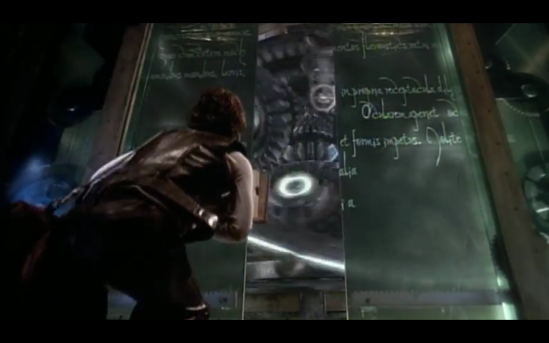
A maniacal and obsessed ghost hunter, Cyrus Kriticos, traps 12 tormented and violent spirits with the help of an avaricious, but anguished psychic, Dennis Rafkin, but when trapping the last ghost, the worst of the worst, a barbaric mass murder in life and in death named Juggernaut, Cyrus is killed in the process. His death leads to the inheritance of a one-of-a-kind house to his widowed nephew, Arthur, and his two children who are barely scraping by after the unexpected fiery death of their beloved wife and mother. When they enter what seemingly feels like a godsend house, immaculately structured entirely out of glass and metal, they find themselves trapped inside after tripping a series of mechanism that turn the isolated and elegant abode into a labyrinthic machine. Stuck inside with Arthur and his family are Dennis Rafkin and a ghost friendly liberator, Kalina Oretiza, who explain that the house is actually an evil machine with a goal of opening the eye to Hell and that the ghosts, imprisoned in the basement, are components that are being set free one-by-one in order to fulfill the ritual.

In the world of remakes, only a select few ever surpass the original. In fact, on rare occasions, do remakes actually replace the original due in part to being beyond respectful as well as masterful amongst critics and genre fans that have bestowed the reimagining an untouchable rendition to which no one can find anything wrong with it; this films include John Carpenter’s “The Thing,” David Cronenberg’s “The Fly,” and Chuck Russell’s “The Blob,” with Zack Synder’s “Dawn of the Dead” and Tom Savini’s “Night of the Living Dead” receiving well-deserved honorable mentions, because let’s face it, topping George Romero’s original work can be said to be blasphemous slander. What about those remakes in between? Those just above the pile of awfulness that generally makeup remakes? I consider Steve Beck’s “Thir13en Ghosts” to be one of this mid-level remake films that registers well with fans, but on the flips side of that coin, doesn’t ascend to total prominence over its predecessor. Written by longtime Full Moon Entertainment writer Neal Marshall Stevens (“Hideous!” and “The Killer Eye”) and Richard D’Ovidio (“The Call”), “Thir13en Ghosts” is a 2001 near-total rework of the 1960 William Castle directed and Robb White scripted “13 Ghosts” that used gimmicks like 3D specter glasses to draw audiences into the theater. “Thir13en Ghosts” was the second film after another William Castle remake, “House on Haunted Hill,” of the newly formed, William Castle nod-to, Dark Castle Entertainment, a division of Joel Silver’s Silver Productions formed by Silver, Robert Zemeckis (“Back to the Future”), and Gilbert Adler (“Bordello of Blood”) that honed initially on producing stylishly modern takes on classic gothic horror, such as “Ghost Ship,” the remake of “House of Wax,” and “Orphan.” What came out of this collaboration between Steve Beck and Dark Castle Entertainment is a complete dismantling of the wood paneling and lament flooring story for a modern marvel to emerge of unique terror that hasn’t been duplicated since.

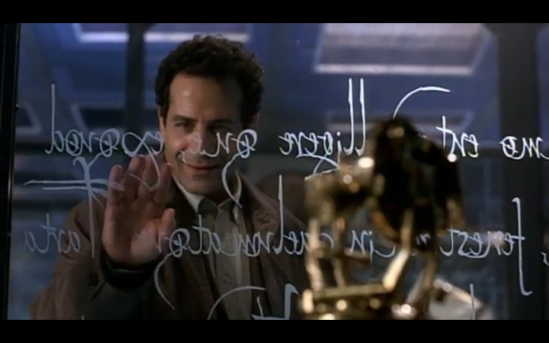
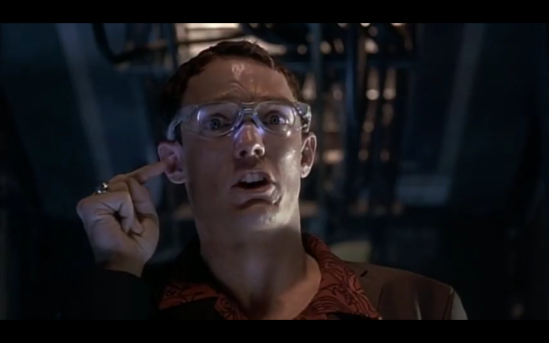
“Thir13en Ghosts” has an impressive, if not all-star, cast with diverse range of styles and experiences that it’s almost dumbfounding on how the filmmakers were able to contract some of these talents, including F. Murray Abraham, who has had an already eclectic credit list with “Amadeus,” “Surviving the Game,” and Mimic, and Tony Shalhoub who hand standout performances in “Addams Family Values,” “Men in Black,” and “Galaxy Quest.” Abraham and Shalhoub bring a sense of classical and methodological structure in a stark contrast between rationality and irrationality built upon an indifference of solitude and a sense of family. Then, there’s the comedic relief in the midst of danger, Matthew Lilliard (“Scream”) as the suffering psychic who uses his wit tongue to spur others and introducing hip-hop artist, Rah Digga, in one of her only motion picture performances to alleviate suspension with more tongue-and-cheek moments. Lilliard and Digga offer up two different comic styles while sustaining the underlying severity of being trapped inside an evil machine full of violent ghosts. Shannon Elizabeth, who we all know by now as the stunning “American Pie” girl, Nadia, or as I know her as the unfortunately raped and murder victim of a killer snowman in “Jack Frost,” plays Arthur Kriticos daughter, Kathy, who still a fresh faced newcomer to Hollywood despite being a hot commodity after her topless role in “American Pie.” The superb support roles don’t end there with notable roles from JR Bourne (“Ginger Snaps Back: The Beginning”), Matthew Harrison, Alec Roberts, John DeSantis, and EmBeth Davidtz, Sheila from “Army of Darkness,” as the ghost liberator.

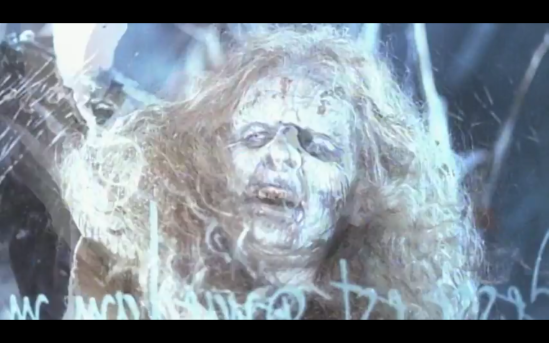
It’s hard to believe that “Thir13en Ghosts” is nearly 20-years old. I still recall my 17 year old self sitting in for a theatrical showing, remembering the opening gargoyle growling as the Dark Castle Entertainment logo reveals itself during the opening title credits, and coming out of the maze-like, gory-ghost film having experienced something special, even if then I didn’t understand why, only to years later realize that I’ve never seen something like “Thir13en Ghosts” before in my life. How does a remake reinvent itself so much that it can separate itself from the original film while also beguile with fresh ideas and no take a slew of browbeating chirps from those who holdfast that the original is the one and only? Most remakes cheaply throw gore to the wind, adding buckets of blood in hopes to satisfy horror buffs, but what winds up happening is that we ultimately get bored, having experienced blood and guts from singular storied films. “Thir13n Ghosts’” premise isn’t the only worthwhile experience that deserves praise, but also the spectacular production design by Sean Hargraves that thrusts the glass house concept into new heights with the house actually becoming an interestingly steampunk character itself and the prosthetic effects from a team spearheaded by a trio of the best special makeup effects artists in horror today, such as Howard Berger, Robert Kurtzman, and Gregory Nicotero., turning ghoulish encounters to ghastly visions that convey truly a tormented soul in the 12 ghosts. Though the story itself isn’t perfect, flawed at times with static character development and a few plot holes involving the ghosts and sequences of events, “Thir13en Ghosts” remains a cult favorite gaslit by frightening imagery, a solid cast, and unforgetting production design that started 21st century horror off brazenly strong.

Collect all “Thir13en Ghosts” on the Collector’s Edition Blu-ray courtesy of Scream Factory sheathed in a cardboard slip cover and has a reverse artwork liner that has the original poster artwork and new vivid illustration by Joel Robinson. Presented in a 1080p, high definition widescreen, 1.85:1 aspect ratio, from the original 35mm negative, “Thir13en Ghosts” shares a consistent image and vibrancy layer with the DVD version with an enhanced color stability. No edge enhancement or cropping adjustments rendered or any other blemishes to speak of, but the softer details could have been sharpened to gave a hard edge around the non-spiritual energy. The English language DTS-HD Master Audio 5.1 boosts the already hefty soundtrack that’s full of explosions and ghostly swooshes and moaning hums, finished off with grand, orchestra soundtrack by John Frizzell It’s been said that audience had to excuse themselves from the film due in part to the overbearing noise coupled with the strobe-like imagery, but the overall audio and visuals are a combined one-two punch of sensory power that works well. The Scream Factory release has new interviews in the bonus material, including sit downs with actors Shannon Elizabeth, Matthew Harrison, and John DeSantis and producer Gilbert Adler. There’s also a audio commentary with director’s Steve Beck, production designer Sean Hargraves, and special effects artist Howard Berger. There’s also an in-depth look at the creation of the thirteen ghosts in a small featurette, their backstory profiles, and the theatrical trailer. However you want to call it, whether it’s “Thir13en Ghosts,” “Thirteen Ghosts, or “13 Ghosts,” this new century remake still holds up to today’s horror lot with spellbinding phantom pandemonium in a glass box!
“Thir13en Ghosts” on Blu-ray on Amazon.com
The Maestro Delivers Us From EVIL! “P.O. Box Tinto Brass” and “IsTintoBrass” reviewed! (Blu-ray / Cult Epics)

Tinto Brass, whose very name is synonymous with erotica cinema, presents a tantalizing series of letters and videotapes, written and recorded for him by adoring women executing their most sensual fantasies, exploiting their carnal desires, and giving the director a peak into their wet dreams. Brass’s lovely young assistant retrieves numerous submissions from his P.O. Box and as Brass scours through the countless correspondences, attempting to penetrate through the mundane to find that special something from his female fans, the stories become animated from text to short film visuals that involve spread eagle voyeurism, reluctantly desiring wife swapping, and a little husband and wife role playing to spice up their drab marital sex life by incorporating home movies. Each woman is able to confide in the maestro who harbors a gift for delivering classy and joyous erotica to not only the cinema market, but also into his admirers’ private lives.

While America became gradually engrossed by the Showtime syndicated erotic drama series, “Red Shoe Diaries,” hosted by “X-Files” David Duchovny that showcased unconnected sensual stories from women who bared it all in heated encounters with male companions, the Italians’, who were experts in erotica cinema that this time, had their very own, slightly more explicit, version released in 1995 in full-length feature form, cleverly titled “P.O. Box Tinto Brass,” from director, and as titular presenter, the erotic master himself, Tinto Brass. Originally titled “Fermo posta Tinto Brass” in the native dialect,” “P.O. Box Tinto Brass” arrives on a new and restored 2-disc Blu-ray release from Cult Epics and acts as a celebration on not only the filmmakers’ immensely arousing body of work, but also a celebration on the director himself who has the uncanny ability to unearth the hidden away desires in all from his tongue-and-cheeky intimacy story arcs that relieve suppression for exploration of our natural sexual ambitions without the culpability instilled by taboo cultures. Granted, some of the material presented might feel dated and not as salacious as every John and Jane Smith can now utilize their God-given bodies to amass a modest fortune across the world wide web of sex, but to understand today’s culture, which still seems a fair share of sexually oppressive forces, we must look at Tinto Brass’s gift in normalizing what once was bedroom only material. Brass, who sport smoking a signature cigar throughout the film, uses his platform and becomes the vessel of expulsion to remove the privacy and shaming barriers that hinder healthy sexual appetites and, literally, creates a tactile representation of sexual jubilee with little-to-no seething judgement other than that of the character’s own restrictions. There are a ton of Brass trademarks shots that include, but not limited to, the hairy vulvas, a playfulness toward the vagina, exhibitionist flaunting, loads and loads of butt and breast angles in and out of clothes, elaborate location patterns on a grand, maybe art deco, scale, and, perhaps his most notable trademark, the expansive range of setting up elegant shots reflected off mirrors. As a whole, “P.O. Box Tinto Brass” brings a lighthearted and free atmosphere that’s uninhibited and sexy during and between each segment and while Brass is no doughy-eyed David Duchovny, I would be remiss in the lascivious eyes of Tinto Brass if I didn’t mention that after immersing ourselves in the “P.O. Box Tinto Brass” anecdotes, me and my wife had the most passionate, free verse sex we ever had since we’ve tied the knot 8 years ago, an experience that’s akin to an economically-friendly version of sex therapy. Thank you, Maestro!

This leads us into the second disc of this Cult Epics epic release with a 2013 documentary, entitled “IsTintoBrass,” from a longtime Tinto Brass colleague and good friend, Massimiliano Zanin, who delves more into Brass’s political, experimental, and monumental work compositions that shaped the director into who is now the renowned eroticism auteur with a belief and a slogan that the ass is the window into the soul. Thought being born, bred, and flourish as an Italian filmmaker, “IsTintoBrass” speaks volumes about his French influences and his life guiding time at the Cinémathèque Française in Paris where he met Henri Langlois and Lotte H Eisner who exposed Brass to rare, unseen films His time Cinémathèque Française afforded him praise on his first films, such as “Who Works Is Lost” and “Attraction,” that were to the likes of French directors like Jean-Luc Godard and were labeled as a blend of part French New Wave movement and pop cinema. Zanin guides us through Brass’s continuous battles with censorship boards whose biggest problem with his filmic formations was not the nudity, but the supposed transgressions against conventional cinematic norms, especially with “Salon Kitty” that was an atypical example against the latter half of his career and used sex as a means of power of another person. His entrenched struggles didn’t end there as the documentary also shed lights on filmmaker’s most controversial work, “Caligula,” which became not his work due to a an underhanded producer who decidedly desired more sex than story and fought Brass, in more than one court of law, for the rights. Notable friends, colleagues, and film critics go through the eclectic Tinto Brass timeline, recalling and reexamining his decisions and aspirations into a multinational praise of his work. Some of these speakers included Franco Nero (“Dropout”), Helen Mirran (“Caligula”), and Sir Ken Adams (“Salon Kitty”). Plus, there is plenty of T and A to go around,

If Tinto Brass didn’t have a stroke in 2010, Zanin’s documentary wouldn’t have been made three years later as it’s a highlighted tribute of one remarkable Italian filmmaker’s life achievements stemmed from something as terrible as a life threatening ailment; yet, that’s how these things usually go, right? A retrospective acknowledgement, usually overwhelming positive in general, of a great artist whose work is greatly admired, frequently in a posthumous manner. In this case, Zanin saw fit to encase a historical record on Tinto Brass before meeting his maker, beginning with a really vigorous look into his inspirations at the Cinémathèque Française, chalking up much of his earlier work to his time spent looking through reels upon reels of avant garde films, but then Zanin quietly fades out of the path that elevated Brass as the cherished erotic connoisseur. Zanin’s story takes this awkward tangent to only skim the surface of Brass’s erotic films, which is strange since Zanin’s known and collaborated with Brass the last 20 years, about 13 years when this documentary was released, and penned a pair of his Brass’s saucy scripts, “Cheeky” and “Monamour.” Yet, the last 20, if not 30, years is surprisingly fleeting in Zanin’s capsulated effort to immortalize Tinto Brass. Still, the overall film is perhaps more endearing than Tinto Brass would have ever imagined, especially as brash and as perverse as his image portrays him outside the parameters of the filmic dome. Inside that dome, Brass has obtained throughout the decades a following of professional admirers and adoring fans who see him for what he truly is, himself. “IsTintoBrass” isn’t a gratuitous or perverted exhibition of an old man’s horniness; it’s an intoxication of what it means to actually be free from the repressive nature of censorship, the rapturous high of being an unchained artist, and being an obsequious master craftsman of cinema.

Cult Epics delivers a 2-disc limited edition Blu-ray of Tinto Brass’s “P.O. Box Tinto Brass” and Massimiliano Zanin’s “IsTintoBrass.” “P.O. Box Tinto Brass” has been newly restored and re-mastered in 4K high definition from the original 35mm negative and presented is a widescreen, 1.85:1 aspect ratio. The picture is absolutely stunning that revels in the burst of primary colors Brass was keen to implement. The details and the tones on the naked skin flesh out every beauty mark, fiber of hair, and every pore. Typically, Tinto Brass films run purposely a little soft to create a dreamlike, if not fantasy-like, setting to obtain a jovial mood setting for the uninhibited moments, but the details are still strong throughout. “IsTintoBrass” is presented in a widescreen, 1.85:1 aspect ratio, from a 2K transfer scan of digital video, aside from the snippets of Brass’s work. Video presentation is like crystal that obviously wouldn’t distinguish any kind of transfer anomalies because there wouldn’t be any. The Italian language 2.0 Mono LCPM/DTS-HD Master Audio 2.0 Mono (“P.O. Box Tinto Brass”) and the DTS-HD Master Audio 5.1 Surround (“IsTintoBrass”) are clearly discernible in all regards, especially in the Tinto Brass directed feature form ’95 with a clarity in the speech, a softer ambience that supports the dialogue rather than be level with it or overwhelm it, a range that mingles to support the dialogue as well. English subtitles are available on both discs. To smooth off any rough edges is a score by Riz Ortolani (“Cannibal Holocaust”) with a vibrant, cheeky score that fits perfectly into Brass’s wheelhouse of curvy, adventurous women. Bonus features on the first disc includes a 2003 interview with Tinto Brass who gives a brief background on his cinematic start, poster and photo gallery, and the trailer. Disc 2’s bonus material includes an interview with writer-director Massimiliano Zanin providing his reasoning for this documentary, a Tinto Brass achieve photo gallery, a couple of short interviews praising Brass’s passion, and trailers The package is also a work of art sheathed inside a cardboard, black and blood red slipcover and inside the casing is a 48-page booklet of Gianfranco Salis stills from the Tinto Brass achieve which are beautiful and almost Playboy-esque. To experience Tinto Brass is invaluable enough, but to experience his films in high definition is without a doubt worth it’s weight in gold with the powerhouse release of “P.O. Box Tinto Brass” and a retrospective documentary “IsTintoBrass” from Cult Epics!
EVIL Uses EVIL as a Conduit in “Amulet” reviewed! (Digital Screener / Magnet Releasing)

Tomaz, former Eastern European soldier of war is now living homeless in London, squatting overnight in rundown buildings with other displaced individuals and families. When the building he’s sleeping in goes up in fire, he’s injured upon escape and wakes in a hospital to learn that a nun found him and his belongings, leaving him a note to visit her upon his release. The nun, Sister Claire, offers him food and a bed in exchange for dire house maintenance for a sickly mother, Miriam, and her caretaker daughter, Magda. As time passes, Tomaz begins to fall for Magda, but her odd behavior and the dying Miriam’s severe skeleton living accommodations in the attic as well as her frail, pail body nag at Tomaz’s conscious that something is awfully amiss. However, his present enigma isn’t the only thing tugging at his tormented conscious when faced with the shocking truth of his residence.

Actress turned filmmaker, Romola Garai, makes her full-length feature debut with a fissionable creepy, punish-thy-sinners, slow burn horror film entitled, “Amulet.” The UK production is written and directed by Garai, who previous work includes main cast acting roles in Joe Wright’s World War II dramatic thriller, “Atonement,” the sci-fi horror “The Last Days on Mars” along with costar Liev Schreiber, and filling in some tremendous shoes in the prequel to the 1987 rom-edy, “Dirty Dancing,” “Dirty Dancing: Havana Nights.” Now, Garai peers through camera lens, orchestrating from the director’s chair, an eerie body horror tale that involves demons, past regrets, and a diabolical, antiheroic nun conniving for the sake of humanity. Speaking of which, humanity is one of the central themes that “Amulet” explores in hellish fashion as our actions determine the outcome of our various shade of humanity forged ourselves and how we will be judged accordingly. “Amulet” is a production of Head Gear Films and Kreo Films FZ, and Metrol Technology, who have all collaborated on “Cargo, as well as in association with “Shed of the Dead’s” Trigger Films.

Cast in “Amulet’s” only male role is the Romanian born Alec Secareanu as Tomaz. The graduate of Caragiale Academy of Theatrical Arts and Cinematography actor envelops himself into a trouble ex-soldier without a country, unwilling to return to a worn-torn land in hopes to relieve himself from reliving the past. Secareanu exudes tenderness for Tomaz in order for audiences to empathize for a homeless man who has agreed to assist Magda and her ill mother. Garai engrains Tomaz with such sentimentality, it’s proves difficult to see the man any other way until the filmmaker incorporates Magda into the mix, a capricious role imparted upon to “Blade Runner 2049’s” Carla Juri. Juri moderately reprises her eccentrically free performance from the 2013 comedy-drama, “Wetlands,” as a seething promiscuous and alluring woman but, in the darker vision of “Amulet,” Magda is a servant of her dying mother who has a lying in wait, sheathed vocation yet to be revealed until Tomaz’s curiosity becomes too much. Secareanu’s and Juri’s performances define the characters with no details left out, but the overall best performance goes to Imelda Staunton as Sister Claire. As professor Dolores Umbridge from “Harry Potter and The Order of the Phoenix,” Staunton was maniacal as she was sophisticated, channeling that same energy into Sister Claire as a double-dealing nun with a fraudulent ebullient attitude. Sister Claire was molded surely for the English actress whose high cheekbones, tight mouth, and round eyes give her a perfect blend of meek malice. “Amulet” rounds out the cat with Angeliki Papoulia and Jacqueline Roberts.

“Amulet” scores well as a feminist’s film, more so as the debut film from a woman filmmaker, that takes the horrifying actions of men and, literally, demonizes their red herring benevolence, but, in Garai’s style, that isn’t overly provocative and megaphoned from a soapbox. The doleful, sometimes frivolous, tone regales in a bleaker light of conniving and withholding intentions. While “Amulet” relishes inside an original thought, the story ebbs with disjointed connective dots. The story itself isn’t linear as we’re moved back and forth between Tomaz’s tenure at Madga’s residence and his wartime past being posted up far from the frontlines in isolation, a moment Tomaz continues to relive while dreaming during his time his hands are self-bound with tape, a curious event that becomes important to note as the story unfolds. While the story isn’t linear, that is not why the audiences’ problematic pursuit will be challenging, but more so with the discerning of the amulets role amongst the trifecta of outcomes for Tomaz, Magda, and Sister Claire. The amulet, which is unearthed by Tomaz in the middle of the woods during his draft, is a woman with a shell headdress. Shells are a common motif throughout, serving as a warning of what to come. In some Christianity folklore, shells are a sign of light and salvation and, in a way, serve as Tomaz’s path toward salvation from a lost soul to provided a purpose with unholy consequences. It’s all interpretation, but “Amulet” is a novel look at blending religious predestination with a grim mythological tenor as an excellent melting pot source of ghastly affliction.

From Magnet Releasing comes the twisted tale of transgressional talisman, “Amulet,” from first time filmmaker Romola Garai. Since this film will release potentially in theaters and definitely on demand on July 24th, the digital screener will not be reviewed on it’s audio and video technical aspects, but Laura Bellingham, the direct of photography working on her debut full-length feature as well, introduces an uncomfortable warmth that engulfs the characters. It’s a reoccurring fire like theme, from Tomaz’s hotel inferno to Madga and Miriam’s home, that could be synonymous to the accommodations of fire and brimstone. Dialogue clarity is good and the ambience is equally fine. The soundtrack by Sarah Angliss didn’t do much for story, striking a pretermit chord in order to focus more on the story. There were no bonus features included with the digital screener nor were there any bonus scenes during or after the credits. “Amulet” is the very definition of feminist horror that bludgeons the stereotype and is well executed to deliver not just a subvert message of importance, but a damn fine film of dreadful body horror and artful mythos.