Its Just Not Any Evil Film. Its “A Serbian Film” review!


Milos, an aging porn star, struggles to provide for his wife and son. Though still working here and there with mediocre gigs, Milos longs for the glory days as the stud every starlet desires for a scene with, but for Milos, his family comes first and foremost. When an admiring former colleague offers him a meet and greet with a provocative director presenting a contract that would set his family stable for life, Milos assures himself doing the right thing along with the permission from his wife. He meets with Vukmir who captivates with progress pornography art, a new age of adult material, that will be novel and exciting that’s enshrouded with obscurities about who exactly the seasoned star is performing with and what exactly he is supposed to do in this project. What unravels before him is Vukmir’s mad vision that not only breaks every law and moral fiber know to mankind’s sexual nature, it completely obliterates the rules toward sexual deviances in an underground criminal industry that banks on the wealthy’s sordid tastes.

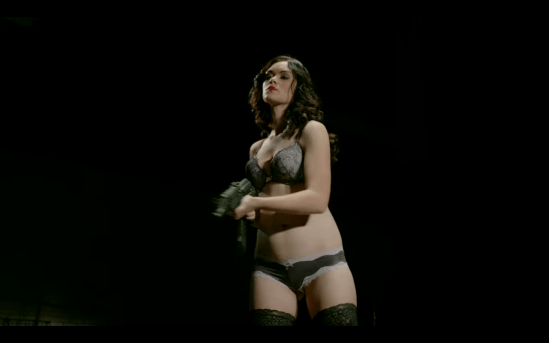
A long time has this reviewer been patiently waiting for the opportunity to screen Srdan Spasojevic’s written and directed multi-country banned film, “A Serbian Film.” Also known as “Srpski Film” in Serbia, the 2010 exploitation that features substantially graphic material with themes of necrophilia, pedophilia, and snuff rarely finds a suitable medium for an uncut presentation as Spasojevic’s feature consistently, and perhaps rightfully so, goes under the governing censorship board’s scalpel to selectively trim the excessive violence, the crude depiction of children, and all the other shocking material that’s rammed unwillingly into your backside. Fortunately, or unfortunately depending on how one perceives artful censorship, the most accessible copy of “A Serbian Film” has limited cuts that total approximately one minute worth of footage left on the cutting room floor to just eek one out from the ratings’ club. Though listed on the DVD back cover as unrated, this cut will be the one reviewed below from U.S. distributors Invincible Pictures and MVDVisual.

How does an actor run with a performance that incorporates vile and degrading perversive qualities and circumstances upon a character? I don’t know and I don’t know how, but somehow Srdjan Todorovic killed the performance as Milos. Todorovic’s veteran filmography credits establish him as a natural switch between characterizations and choking up on the reigns of each facet to achieve maximum reaction. Milos is a physically challenging role with many difficult scenes and Todorovic found inspiration out of thin air; I’m sure the Yugoslavian born actor needed a months’ worth of showers to remove the disgust from off his flesh when the film wrapped. Another complex character is Marko, Milos’ dangerously envious cop brother who chomps at the bit for Milos’ sexual longevity, stellar porn career, and his gorgeous wife. Slobodan Bestic could have passed for a Serbian Hugh Jackman from “Swordfish,” complete with little dangly earring. Bestic’s performance is unnerving, haunting, and downright salacious that waves in and out of a potentially dangerous man with a hankering for carnal informalities. Speaking of which, Vikmur epitomizes the very definition of being a lunatic. The lavish filmmaker has grandeur style with repugnant tastes in content. Sergej Trifunovic puts on the shiny shoes and fancy suits to become the venomous underground kingpin with a torrent of tasteless videos and the “Next” actor really plays the bad guy well, really does a showmanship disenfranchising Milos and those that love him their ability to enjoy free will. The remaining cast include Jelena Gavrilovic, Katarina Zutic, Luka Mijatovic, Miodrag Krcmarik, and Andela Nenadovic.

A unforeseen aspect of “A Serbian Film” that rings surprising is the engrained story of an extremely fallible hero. Srdan Spasojevic proved shocking, exploitation horror doesn’t have to be completely allegorically benign and the filmmaker has even mentioned that his film is a composite piece of abusive power from authoritative figures forcing people against their will, as if spellbound, to do atrocious acts and while these acts might not be atrocious as rape, sexual assault on children, or using an erect penis to kill someone, Spasojevic creates moments where his statements are affirmed. The transition between act 2 and act 3 backs Vukmir against a wall, trying to salvage his star’s contract by debating material that’s good for all. Spasojevic hones in on Vukmir’s raving soapbox speech to Milos about how he and his company govern the country and how they are the backbone of his of the sovereign Sebrian nation, the true delusion of power and the wool over the sheep’s eyes as the action point.

Invincible Pictures, the same folks who distributed Kevin Smith’s “Yoga Hosers,” and MVDVisual present “A Serbian Film” as a re-release onto DVD home video. Presented in a widescreen, 16:9 aspect ratio, the image warrants no mention of issues as a clean picture in a dry-yellowish tint while still maintaining some natural lighting and depth in the gruesome details pop every sensory nodes. Banding problems are faint at best and the edits are what they are sense the film is slightly trimmed anyway. The Serbian language 2.0 stereo mix pounds with a pulsating electronic-rock score and shows the ranging with the screaming, whimpering, crying, and the sloshing of blood and semen fluids. The English subtitles are error-free and have hardline text that make reading them more easily. Though usually bonus features are preferred, in this case, just having “A Serbian Film” alone on this DVD release didn’t feel necessary to have the share the film with the bonus features, creating an intimate moment between viewer and feature. “A Serbian Film” sears a glowing hot lasting impression right into the mind and soul, twisted and perverse in an unfathomable immoral compass too messed up beyond the most descriptive of descriptions. “A Serbian Film” is best viewed alone, without food, and with your sensitivity left outside.

Must-by “A Serbian Film” on DVD!

Evil Wants To Profit From Your Death! “Red Room” review!


When Kyra awakes inside an unadorned room of the second floor of an isolated farm house, the woman, who last remembers herself walking to her car from an afterhours night club, finds her wrists and ankles bound together alongside two other women. The women, Lilly and Allison, have been locked inside the room for days, kidnapped the same way, and treated with an inhumane care that more-or-less maintains their physical beauty. Uncertainty questions their fates, but one thing is for sure, when their captors come to remove you from the others, like selected head amongst the cattle, and relocate you to the red room, that’s when the screaming starts and you’re never heard from again. Between the three captives, anger and fear struggle for common ground on a plan of desperate escape and with the iron grip of their abductors honed into their every move, Kyra’s determination to escape breeds sturdier when the possibility of death is more than likely imminent, but before their inevitable snuff, the red room holds sickening world-wide pleasures that anticipates their particular company.

Poised to be callously unsettling and keen to rip apart compassionate souls, “Red Room” hails from Ireland as a ghastly and shocking exploitation thriller from writer-director Stephen Gaffney. A production of Gaffney’s Deep Web Films and co-written with Erica Keegan, “Red Room” slides ever so covertly into the internet’s interlining of unspoken grisliness that exploits people for the darker desires of other people and Gaffney runs through the typical rational of the irrational abductions, such as sex trafficking, and though that’s certainly taboo enough to quench viewers with a powerful story in itself, the director taps a sex and death geyser a few filmmakers have reaped, perhaps more so retrospectively, the machiavellian benefits in finding a home in a rather thin genre with films that are akin to the plot, including works of malevolent personal satisfaction as such as in Dusty Nelson’s “Effects” or the investigated side that encompasses the snuff world in Joel Schumacher’s “8mm” starring Nicholas Cage.

The 2017 film thrills to inflict tortuous anticipation for what lies ahead of the tethered three women. Amy Kelly’s Kyra is the only colleen to be shown physically abducted and while Kelly maintains a fine performance as the strong female protagonist with no-choice-but-to-escape attitude, Kyra’s character arc has a confounding impact where Gaffney involves non-linear scenes into the story, providing the events leading up to her abduction and also other more linear scenes with her mother on the phone with the police irate with her disappearance, but none of those scenes had significant impact to Kyra’s predicament or motivation and felt out of place. Kyra doesn’t necessarily talk about her child much either, which is always a powerful motivator for anyone with a need to live. Instead of carrying on with Kyra’s needless background, Richard, played by John D’Alessandro, could have benefited from the excess framework capacity of how he became groomed by his stern father, a role fit for a cruel king by “Game of Thrones'” Brian Fortune, and how his calm, sensible, and business casual character admixed himself with various complex villainy, roles donned by JP Albuquerque and Rodrigo Ternevoy, and how they became a triad of high end brunette liquidators of sorts. The other two women with Kyra, Alison (Saoirse Doyle) and Lilly (Sohaila Lindheim) spread the reactionary affects in a petrified Alison and a realist in Lilly when contrasted to Kyra’s defiance, but Alison carries the crux of the story, the reason why there is a story, that falls right smack dab in the red room and, frankly, she becomes the star of the gritty show. “Red Room’s” tops out the cast with another “Game of Thrones'” star Eddie Jackson and Fiona Twamley Hewitt.

“Red Room” has been compared to “Hostel” with a plot that does walk a familiar path of a pay-to-die morbidity and that comparison is a fair assessment with the ancillary connotation that “Red Room” could be seen as an extension or a byproduct of Eli Roth’s sadist of a film. However, a microscopic obstacle provides just enough to dispute that claim, to whither back a formidable opponent in the game of who has the most visceral body of work, and that evidence lies in Gaffney’s creative style. The filmmaker, for lack of a better term, pulls punches, not delivering the full on aggression required to provoke and stimulate the masses. The scenes of gore are ghastly to a point and that’s not necessarily the issue that’s more so with the unravelling of their inhuman nature that doesn’t genuinely denote a persuasive emanation of their victims damnation. We see a little of spark with JP Alburquerque’s Andras who is clearly insane with an limitless immoral conscious whereas the others teeter about more of the business margins or struggle with a tough guy image.

From Stephan Gaffney’s Deep Wed Films in association with Sicario Pictures enters “Red Room” onto DVD home video from Breaking Glass Pictures. Presented in a widescreen, 2.35:1 aspect ratio, on a one-sided, doubled layered DVD9, the Canon C300 Mark II digitally shot feature cleanly and sharply provides quality throughout that falters occasionally with some choppy video speed controlling in the more extreme scenes. Color palette isn’t lush with brilliant hues, but with the darker tone of the film, the expectation of vividness lies more so with graphic content and adds to the value. The English language Dolby Digital 5.1 surround mix is meaty and balanced, strong enough to even tune uneducated ears to the Irish accents. The dialogue is rightfully upfront with fine range and depth with no issues on mic placements. Bonus features include a short and sweet radio interview with director Stephen Gaffney, cast interviews, test screen reaction with the finale climax, a director’s audio commentary, a single deleted scene, and a concept promo. Ireland makes a play for extreme horror with Stephen Gaffney’s “Red Room,” a twisted and a humanly fathomable thriller with a cold-hearted gape at the worst of human nature that lingers into the vast virtual and essential disconnect amongst online gawkers that will never face the exploitive repercussions of what wets their appetites as they sit behind computer screens.

“Red Room” DVD available at Amazon!

Evil Shall Not Steal! “Purgatory Road” review!

The Kirby brothers, Vincent and Michael, witness the attempted suicide of his father who placed a snub-nosed barrel shotgun underneath his chin and pulls the trigger. As adult, the brothers process the trauma in their own ways with Michael unable to jumpstart his life that has been exploited by his brother who has joined the priesthood. Now as exonerated Catholic priest, Father Vincent continues his crusade in absolving confessional patrons of their sins, but with a twist. Hell bent on exacting death through absolving upon those who steal in any capacity, Father Vincent travels the rural areas of Mississippi in a beat up congregational and confessional mobile camper to soapbox his wrath sermons and to rid the world of those who surface his childhood trauma. When another psychotic killer ascertains Father Vincent’s radical cause and wants to join devious purposes, the aversely complicate Michael can no longer abide by his brother’s carnage of guilt path and isn’t keen on spending his life with another heartless killer, urging himself to exit the threesome and starting a life of his own with Ruby, a diner waitress who has taken a shine to him, but Father Vincent and his newfound accomplice won’t let him go that easily.

Just what the Catholic Church needs… one more film depicting a priest using God to benefit his own greed! Mark Savage co-writes and directs the damnation of thieves film, “Purgatory Road,” with a post-viewing requiring a penance of one Our Father and ten Hail Mary’s! Co-written with “Stressed to Kill’” Tom Parnell, “Purgatory Road” is a horrific hallmark of adverse Americanisms such as religious fanaticisms, self-indulgence, mental instability, corruption, and narcissism. All these qualities can potentially lead to one common bond that Savage makes centerpiece and that would be murder. Savage’s extreme vision isn’t all that far from today’s reality where cases of the mentally and the spiritually unstable and religious acolytes plan, stage, and carry out killing sprees almost weekly, corrupt politicians and the uppermost devout pocket secrets and bribes, and egotistical maniacs pick and choose basic civilities to divide groups against each other. I don’t see “Purgatory Road” as shocking and taboo, but rather as 98 minute revelation, not in a Almighty sense, but as a break in the opaque lens that is today.

Father Vincent firmly believe in his actions, without doubt and without shame, and uses any tool, or person, to fatally smite thieves, but has no absolute joy in the way he responds to pilferage acts. The guilt over his father’s attempted suicide drives him, sucking the vibrancy, the energy, and the happiness from him, and the fact that his father still lives, as a basement dwelling, cannibalistic creature, makes the matter even more dire to Vincent. The fraught priest ended up being an ideal performance for Gary Cairns (“Malignant”) who noted in the behind-the-scenes interview that his personal issues at the time brought out the all-around worst in Father Vincent and despite the character written as a fire-breathing, wrath of God man of the cloth, Cairns is able to weather his role as a seemingly idyllic Catholic priest with something to hide from credits-to-credits. Michael Kirby might be complicit, but isn’t wholeheartedly on-board with his brother’s blood shedding that drives another relevant nail into a Cain and Abel type tale. Michael’s longing to part from his brother is difficult for him, whether he also feels guilt for his father’s misfortune or an attempt to try and steer Vincent from complete and utter chaos, and even with a chance to escape the madness, Michael unintentionally flounders the attempt that ultimately becomes his climax to kill. Luke Albright (“Devil’s Pass”) engrosses himself as the black sheep amongst wolves in sheep clothing. Though his character is scribed as conflicted, Michael has downplayed emotional trauma that extremely binds him to his brother and makes him just as equally disturbed when disposing of his brother’s victims. Savage and Parnell’s narrative angle might not focus on the emotional level of Michael, but Albright flourishes the angst that internally rips him apart within the confines of every contentious scene that involves Cairns’ character. The brothers are driven further apart when Mary Francis, a sadistic and cannibalistic serial killer, discovers their undertaking, forces herself to join them in the cause, and catches the eye of Father Vincent, who displays some physical touch withdrawals and loneliness with the vulnerability of his corpses. Mary Francis is easy on the eyes, casual in her affairs, and empowering with a high sex drive that would make any man weak at the knees in a normal world, but Mary Francis is far from normal and Trista Robinson (“Jurassic City”) offers her short build, cutesy voice, and piercing eyes that favorably compliment Mary Francis’s dark features and equally dark soul. The character is an unsuspecting brut heart whose well-written as she describes to a radio talk show host her boy or girl fascinations as a drab hunting sport where spilling their blood and robbing them is the last great and excitable moment of the relationship, signified and sealed with a single kiss. The rest of the cast rounds out with Sylvia Grace Crim (“Happy Death Day 2U”), Geoff Falk (“The Livingston Gardener”), Chace Beck (“Meltdown”), and Douglas Cunningham.

Shot on location in Mississippi, “Purgatory Road” offers a really cool story that’s not produced on a studio lot and is kept out of the rural areas of California and any other locations that bear no resemblance to the deeply Southern pious roots of the 20th state of the U.S. Savage was able to obtain raw locations that best fit the delusional and fanatic tendencies of Father Vincent and with the gruesomely beautiful special effects and makeup by “American Guinea Pig: Bloodshock’s” Marcus Koch and Cat Bernier, the murderous role of not only Father Vincent but also Mary Francis are furnished to frightful fruition of two fiends you just don’t mess with in the devout South. Koch and Bernier texturize severed body parts and provide a wide diameter for blood splatter as an intensifying tool, but don’t overly exaggerate the gory garnishes that might re-direct attention from the story.

Unearthed Films and MVDVisual’s Blu-ray of Delirium’s “Purgatory Road” has Unchristian values worth indulging that includes a widescreen 1.85:! aspect ratio. The digital shot film uses a Canon EOS C300 Mark ll in a full HD setting and the image quality has phenomenal sharpness with natural skin coloring and excellent details that come to focus on the outside faded, dirty paneling of the rustic RV and in the fleshy, blood wet limbs of the Koch and Bernier gory special. Cinematographer Andrew Giannetta has a working eye for the horror element of “Purgatory Road’s” red-light district familiar frame work with appropriate fog and tint to augment the gothic murkiness and dread. The Dolby Digital 2.0 audio track is favorably well-balanced with no kickback or unintelligible miscues. “Purgatory Road” might have an RV kill room, but the RV isn’t involved in high speed chases or fiery explosions, so the dual channel works well for this type of low-key thriller. There are bonus features aplenty with a commentary with writer-director Mark Savage, a gallery slideshow entitled “The Grisly Art of Marcus Koch and Cat Bernier,” writer Tom Parnell speaking about his experience as a screenwriter behind his main profession as a lawyer, a lengthy featurette of the three lead actors speaking about their involvement, how they came to the project, and what the film and/or story means to them personally, and a Purgatory Road Q&A featuring Mark Savage. Impenitent swindlers beware! “Purgatory Road” is all fire and brimstone braced with a strong cast of compelling talent and a horrifically transfixing tale of blood is stronger than holy water.

Political Extremist Molds An Evil Spawn! “Trauma” review!


In 1978 Chile, a powerful political extremist exploits the Chilean army to conduct and carrier out the physical and sexual abuse against the people of Chile, including forcing his own son, Juan, to have sex with his tortured mother and executing her right in front of him while in the fornicating act. Juan’s father continues to further the abuse with fear, terror, and misogynistic berates until he’s finally fatally coup. Fast forward to 2011, Juan’s an unstoppable madman as he terrorizes the locals over the years without authoritative regulation and also four female outsiders on holiday for a girls’ weekend. Juan and his son force their way into their residence, tyrannizing, raping, and even killing one of them before leaving his cruel mark in his wake, but with the help of a local officer, the remaining three survivors seeks to make sure Juan, and his equally screwed up family, never harm anyone again. However, Juan is prepared, held up inside a compound subterfuge, well-armed and well-unhinged.

Perhaps based loosely off the atrocities of of former Chilean President Augusto Pinochet in the 1970’s, Artsploitation Films’ distributed “Trauma” goes to the unapologetic extreme, building upon an already unsavory narrative into the bred morbid disposition of the human psyche. Written and directed by “Zombie Dawn’s” Lucio A. Rojas, “Trauma” is a cold, blunt object with a razor sharp bite and has a penchant for the twisted. The Chilean director’s film isn’t the only game in the market of extreme movies, but does manage to create a motive of separation between most with the offending character experiencing traumatic corruption by someone close; in this case, Juan’s father 40-years earlier by oppressing the boy through physical pain and scrambling his son’s mental state by removing any humility, compassion, and reasoning that manufactures the perfect ruthless butcher. Pinochet used his military power to be a lethal strong hand when desired; Rojas spices it up by adding forced incest, rape-after-rape, and implementing a subconscious malevolency.

“Trauma” stars “To Kill A Man’s” Daniel Antivilo as the despicable Juan. Antivilo is patient and soft in his approach to a deranged character that doesn’t display that wild abandonment in psychotics. Juan goes on to slowly terrorize four lovely outsiders from the city in Andrea (Catalina Martin), Camila (Macarena Carrere), Julia (Ximena del Solar of “Perfidy,” another Rojas film), and Magdalena (Dominga Bofill). The four actresses offer up different character perspectives and personality that should divide the dynamic or, at least, complicate it; there’s a strong sense of lesbianism between them, even exhibiting traits in those who don’t identify as such. Antivilo macho savagery pitted against the four stunning, but strong women does create a black and white, stark-producing character placement. Outside that dynamic, one character has no dialogue and, yet, manages to high level physical role that’s barbaric, humiliating, and spacey and that role is inside of Juan’s schizoid son, Mario, is donned by Felipe Rios who has the strung out appearance of a long, drawn out face and muscularly thin. Eduardo Paxeco, Claudio Riveros, and Florencia Heredia round out the cast.

Rojas does a beautiful job in the juxtaposition department, paralleling the bleak, grimy, and yet agreeable life of Juan and his equally as certifiable family next to the full of life and vigor in the unsuspecting women that Rojas’ introduces off with Camila and Julia engaging in a steamy girl-on-girl love making scene that doesn’t leave much to the imagination and, then, slides into their instant road trip the day after. Rojas had built up Juan’s pain and suffering toward being molded into a monster whereas the women fly by the seat of their pants, churning out memorable moments in a flash whereas Juan’s unfortunate course was a slow burn throughout his long, hard life. The parallelism flips from Juan to the women up until the moment their lives intertwine and this is where things get messy with Roja’s script. Between Julia, Camila, Magda, and Andre, three of whom are related, tension builds as Julia plays the flirtatious and brazen field between hooking up with the cousins as stroppy Andrea steams in a passive stew on the sideline. This subplot never goes explored, going uncooked right in the middle of a hot flame where passions and couples’ plights evolve the story. The abrupt presence of Juan puts a cease and desist on any other subplot that ultimate funnels “Trauma” to be a rape-revenge flick with a graphic content.

Artsploitation Films continues to distribute internationally provocative films that always delight as well as disgust (in a good way). With Lucio A. Roja’s 2017 film, “Trauma”, casualties pile high and damage control is non-existent, fitting the Philadelphian-based company’s axiom that presents the film onto a high-definition Blu-ray. With a widescreen, aspect ratio 2.35:1, the image quality is quite good. Details are very promising here and really need to be with the gore. The face explosion and the jaw unhinging deaths are certainly not stodgy as the scene on these moments linger more than most would, soaking up the full effect of the viscous covered chunks out from the face crater by a high caliber handgun is a thing of beauty. The Spanish 5.1 surround sound syncs up well in all aspects from dialogue to ambiance. English subtitles are available and line up well enough though speedy at times. Dialogue is clear and present, Ignacio Redard score is heard, and no signs of any kind of distortions or other issues. Bonus features are limited to just the theatrical trailer. “Trauma” might have vastly skewed the actual events the film is based off of to pen a story, but what a gorgeously gory-filled and exploitively-charged narrative that can be a tell all for the cause and effect of political extremism at it’s worse. Director Lucio A. Rojas puts Chile on the controversial and extreme horror map.

The Evils of a Transgendered Occultist! “Miss Leslie’s Dolls” review


On a dark and stormy night after a school football game, a teacher and three students take shelter at a cottage adjacent to a cemetery. If the cottage wasn’t creepy enough, the sole occupant owner surpassed the bar. She calls herself Miss Leslie, a middle aged woman with an ill-fated story of her friend and mother’s fiery demise from long past and a quirky penchant for making life-size female dolls that set inside an illuminating shrine. Though they feel uneasy about the creepy surroundings, the visitors stay and get cozy, especially with each other, but Miss Leslie has ulterior, deranged motives. Her dolls are not just lifelike, they once were vibrant lives of women Miss Leslie sorely wanted to inhabit their feminine confines of youth and beauty from over the years, but now they are an undecomposable shells, encase in Miss Leslie’s special doll making brew to timelessly capture their lovely physiques. They are also beautiful, yet painful reminders of her failed attempts to transfer her essence into their adolescent bodies.

Every so often you come across a film with a gigantically absurd hard shell cover with the gooey insides of eye-rolling cheesiness and you just have to ask yourself, how in the world did something like this ever come to fruition!? Yet, somehow, someway, these productions of an oddball variety always have an intense allure about them and end up being just one of the coolest rarities to grace the glazed-over irises. Joseph Prieto’s “Miss Leslie’s Dolls” is the epitome of this very phenomena. “Miss Leslie’s Dolls” is an exploitation, nearly softcore porn, horror with a deranged killers with severe mental issues that range from communication with dead to, what can be now construed as antiquated, complications of gender identity. One of the last directed films from Prieto, who also helmed “Shanty Tramp” and “Savages from Hell,” also penned the screenplay alongside longtime collaborator and producer Ralph Remy Jr. The script reads like an insatiable bedside thriller novel, an object of complete obsession through the entirety and well long after being completed; “Miss Leslie’s Dolls’” has a rich gothic lining, a strong sexual appetite, and a timely LGTB subject that involves debate on mental illness or inherited gender orientation.

Not many actors performed in drag. Sure, there was Jack Lemmon and Tony Curtis in “Some Like It Hot” and there was even Anthony Perkins from “Psycho,” who some might go as far as saying that “Miss Leslie’s Dolls” might draw inspiration from with the whole mother fixation, but only a small faction of fans, especially in the genre, might know Salvador Ugarte. The Cuban born Ugarte has great poise as a woman imprisoned in a man’s body. Miss Leslie just isn’t a deranged killer in drag; the character has deep rooted issues stemming out of not only being a woman embodied incorrectly, but also seeded by an engulfing obsession with capturing beauty to obtain it for herself, an addition from a result of a permanent scarring left behind by Miss Leslie’s homicidal rampage in the character’s history. Ugarte has the mannerisms and the gait down so unerringly that’s the performance is downright creepy, but there was one aspect of womanhood that Ugarte’s masculinity couldn’t mask: his voice. The actor is horrendously dubbed, adding charm to the bizarre concept. Ugarte’s joined by “Little Laura and Big John’s” Terri Juston, Marchelle Bichette (“The Gruesome Twosome”), Kitty Lewis, and Charles Pitts of “Supervixens.”

Contrary to the above, “Miss Leslie’s Dolls” has some drawback. Though the characters might be entertaining and interesting, especially with the Bourbon obsessed and hot for teacher Roy and his terrible gangster accent or the fact that Ms. Alma Frost is a smoking hot, twenty-something year old prude teacher to her pupils who are practically the same age as her, they’re washed over with an aloof mentality, consequently looking past or just blatantly oblivious to Miss Leslie’s obvious male features, her inauspicious ramblings, and the fact she has a shrine of creepy and realistic dolls of women that fill the room with the smell like rot and death. Perhaps too busy running through the cemetery at night in skimpy bedroom garments. Yes, this does happen. On top of that, Miss Leslie harness of occult powers goes relatively unexplored, yet very much utilized as an important portion of the film near the last act. Despite being passively mentioned and rather undercut from more than most of the film, Miss Leslie’s occult mischief is plucked right from left field to further the enigmatic aurora of Prieto’s mystical exploitation.

Network proudly presents “Miss Leslie’s Dolls” on an UK 1080p Hi-Definition, region free Blu-ray home video, remastered from the original film elements once thought to be have been forever lost. The newly scanned transfer came from a surviving print and presented in the film’s original theatrical aspect ratio of 1.85:1. The restoration included detailed grain management, the automated and manual removal of dirt and damage, and the correction of major color instability, warp, and density fluctuations. (In full disclosure, Network sent me a DVD-R screener and that is what the following critique is based off of) Though in some frames there flares up some instability, from my perspective, the first act and half really came out well with the vivid, yet natural, coloring. However, once inside Miss Leslie’s basement, woozy blotchy moments of Leslie fiddling around makes the particular scene a bit off putting. The stereo mono track is fair for the 1973 film that has it’s share of distortions and editing pop faux pas, but the dialogue is fiercely prominent, despite the inherent awfully laid dub track, and equally well balanced with ambient tracks. There were no bonus material on the release. Transvestitism horror is quite a rare experience that always has a lasting impression, cerebrally popping visuals of grim visions commingling with the blood, the viscera, and the other supplementary violence. “Miss Leslie’s Dolls” deserved this Blu-ray release and Network did right by Prieto’s obscure grindhouse feature that will sear into your skull.