Cecile and Brigitte have served two of their twelve month sentence for inappropriate sexual acts involving prostitution and stripping. International authorities, including an American Senator, remove the two ladies of the night from their incarcerations and have them audition a private and provocative dance routine that will spring them from prison life and place them into a contract for hire that the pair of beauties find difficult to refuse. Cecile and Brigitte use their God-gifted talents to slip undercover as a pair of lesbian dancers in order to spy on Mr. Forbes, the Flamingo club owner on the Canary Islands who moonlights as a sadistic sex trafficker. Forbes kidnaps, rapes, and then, with the help of his wife Irina Forbes, hypnotizes well-known and famous women to be the ever faithful lovers of Mr. Forbes wealthily clients and to stop the egregious trafficker, any smoking gun evidence must be photographed for the international police to make a move on an arrest.
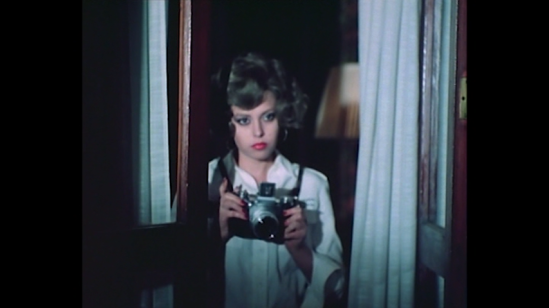
Jess Franco is the maestro of guilty pleasure shlock and the 1980 violently erotic, crime drama “Two Female Spies with Flowered Panties” is no different inventoried with ubersleaze spiced in folly comedy and tense sadism. The sort of mixed bag genre film only writer-director knew, and understood, how to achieve on a minuscule budget level in hastily conditions, but “Two Female Spies with Flowered Panties,” whether designed or by chance, stemmed from the combination of old and new footage, re-edited out of the original title, “Ópalo de fuego: Mercaderes del sexo,” and told a slightly different tale with slightly rearranged character backgrounds and graphic scenes, and featured two different locations that were later labeled Las Palmas of the Canary Islands to tie it all together. Severin has included both versions on a limited edition Blu-ray (“Two Female Spies with Flowered Panties”) and DVD (“Ópalo de fuego: Mercaderes del sexo”) release to experience both versions.
Franco’s long time common law, then legal in 2008, spouse Lina Romay, under pseudonym Candy Coster stars as Cecile in really a non-seductive, non-promiscuous, and only pinched with erotica role. Unlike Romay’s “Bare Breasted Countess” (aka “Female Vampire”) role, Cecile undercuts the erotic tone with more gratuitous comic and threatening nudity. Relishing into a staple of erotica are all of Romay’s supporting cohorts consisting of “Zombie Lake’s” Nadine Pascal, “Women Behind Bars'” Joëlle Le Quément, Susan Hemingway of “Love Letters from a Portuguese Nun.” Interesting enough, Hemingway isn’t credit in either version of the film. Pascal offers playful dilly-dally while practically be nude throughout whereas Quément slips into a deeper carnality with an unhinged relationship with her sex trafficking husband Mr. Forbes while Hemingway just provides a taken-advantaged vessel to plunder her dignity, soul, and body for easy money. Surrounding the gorgeous vixens are ruthless, dirtbag men played by Claude Boisson as the club owning sex trafficker and “Elsa Fräulein SS’s: Olivier Matthot as the sleazy American Senator Connelly. The role with the most opaqueness between the two versions of the film goes to Mel Rodrigo as Milton, the club’s gay artist organizer with an existential crisis and a quick to rebel attitude.
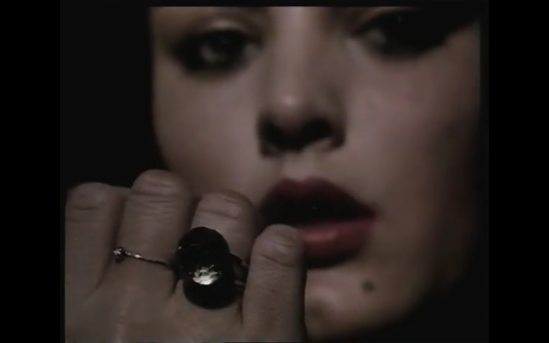
Though charming in its own delectable unchaste ways, Jess Franco deploys a haphazardly glued story inflamed with by chance moments shrouded with psychosexual tendencies. Sexually ostentatious and manic, “Two Female Spies with Flowered Panties” wildly pivots like an out of control sprinkler, spitting lustful filth, jovial comedy, and menacing suspense everywhere while still, by way of only Franco can accomplish, accurately hitting the intended mark of downright Eurotrash entertainment. A shocking, yet hardly noticeable, factor of the director’s is his film withholds any large amounts of blood or gore; in fact, gore is absent and the blood is sparse, especially during the girls-on-girl torture scenes involving bondage, a switchblade near the hind parts, and a cinder-weaponized cigarette, but the element that sparks gritty fortitude in those same said scenes, shot intently with fraught close-ups and well positioned shadows, could culminate a subversive tone that ultimate could convey a scene without words.

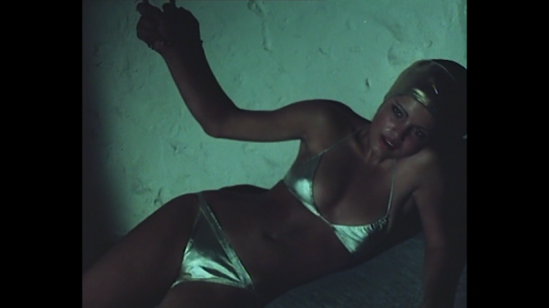
Severin’s limited edition 2-disc release of the Eurocine produced “Two Female Spies with Flowered Panties” has rightfully been graced with the Blu-ray treatment. The release also has the Spanish edit version of “Ópalo de fuego: Mercaderes del sexo.” The Blu-ray is a 1080p encoded AVC transfer presented in a near stand definition aspect ratio format from a restored into HD, uncut print. The overall color palette appears fairly washed with only some segments, especially peering out over the water or inside tight quarters, stand out with rich color. Darker scenes are heavily splayed with turquoise that, again, give the washed overlay, but the richness of the shadows with grindhouse print grain is stellar. Franco’s struggle with focusing, as part of technical self embattlement or as part of an against-the-grain auteur, are prominent throughout. The two LCPM 2.0 tracks are dubbed only in English or French and while not tracked in the native Spanish, either track will serve as a palpable substitute despite the English track being transcribed awfully cheesy and the French track with consistent hiss. Bonus material includes “Two Cats in the Canaries: An Interview with Jess Franco” is an undated interview with Franco recalling his love for the Canary Islands and being a genre maverick. There’s also a 1993 interview with long time Franco composer Daniel White conducted by “Cannibal Hookers'” Donald Farmer, a thorough analyst of Franco and “Two Female Spies with Flowered Panties” by Stephen Thrower, location outtakes, and a theatrical trailer. While “Two Female Spies with Flowered Panties” is not the best example of Jess Franco’s credits, the vicious erotic thriller is arguably ambitious and epitomizes the style of the legendary filmmaker with sultry, fringed performances and an unforgettable narrative lined up in a one-two punch package from Severin Films!
Category Archives: Exploitation
Evil Walks Among Us in “The Zodiac Killer” review!

Jerry is your average, everyday Californian man. He’s tall, handsome, and can hold down a good government job as a United States postman, but Jerry has another side to him. A dark side that’s hidden beneath a façade of apparent normalcy. His random acts of senseless violence and murder have Jerry a great advantage over the rest of society, especially the police, as he commits homicidal tendencies right under their noses without an inkling of a motive and stretching out his urges to kill days, weeks, and months a part under the guise of the notorious Zodiac Killer.

Based on the factual and claimed murders of Northern California’s infamous serial, director Tom Hanson helmed the thriller “The Zodiac Killer” and released his finished project in spring of 1971 when the serial killer was still very active. In a little history tidbit, Hanson had the idea to premiere “The Zodiac Killer” at the Golden Gate Theater in San Francisco in attempt to lure the Zodiac Killer to the screening by way of having patrons writing “what-ifs” as the real Zodiac Killer and then analyzing the handwriting to the letters the real killer submitted to the police and news outlets. Of course, the stunt didn’t work, but did bring about awareness of the prospect that everyday people – neighbors, gym teacher, mailman – could be a deranged, blood thirsty wolf underneath sheep’s clothing. In their first and only writing credits, Manny Cardoza and Ray Cantrell penned the script.

With a minuscule budget and a performance driven script, “The Zodiac Killer” could only speculate on the person behind the deaths and though in today’s filmmaking standards, some points in the dialogue and the action are awfully outdated in it’s rigidity and over exposition, but when getting down to brass tax and looking deep at the root’s message, the effective troubling performance by lead actor Hal Reed, as Jerry the Zodiac, transfixes viewers as the tall, handsome, and baritone-voiced actor bore an eerie on-off switch between pure good and polluted evil. Before knowing Reed’s true self, not every character was black and white as Hanson attempts to a lineup suspects, especially with a truck driver named Grover (Bob Jones) whom had a knack for pretending to be a wealthy businessman on his nights off in hopes to score naive bar tail. Whether flawed by design or by the obsolete nature of filmmaking, the curve ball attempt to throw the viewer for a loop doesn’t stick and for every second, Hal Reed is the titular maniac even if not proclaimed at first sight. Ray Lynch and “Invasion of the Bee Girls'” Tom Pittman round out the cast as the two police officers not hot on the Zodiac’s trail.

For early 1970’s, “The Zodiac Killer” is graphic, verbally and in imagery with an example being Jerry enthusiastically jumping up and down on a car hood while an elderly woman is pinned between the hood and the engine or Grover calling every single female character a “broad” or a “bitch” in the film; “The Zodiac Killer” certainly strikes a chauvinistic chord from a male’s point of view with not only Grover’s attitude toward women, but also portraying women as shrewd, powerless, and as sex objects. Culturally, this attitude toward women might have been accurate for the time period as well as many of the portrayed Zodiac attacks though numerous of the attacks were only claimed by the Zodiac and not actually confirmed. In any case, Hanson’s rendered theories are well thought out and entertaining in spite of their tragic background.

The American Film Genre Archive, Something Weird Video, and MVDVisual present “The Zodiac Killer” on a 2-disc DVD/Blu-ray set exhibited in the film’s original aspect ratio of 1.33:1, keeping the black bars on the right and left of the screen to preserve the format. The new digital transfer was scanned from the only existing 35mm theatrical print through to 4K resolution on a Lasergraphic film scanner and the image has a real clean look to it despite some minor print damage with horizontal scratches and burn flares. The print also suffers from a color degradation, voiding the coloring and replacing it was a washed look. The DTS-HD Master Audio 2.0 mono track has a mighty bite that’s surprisingly clean and clear despite the obvious low fidelity. Special features include an interview with director Tom Hason and actor Manny Nedwick, a commentary track with Tom Hanson, Manny Nedwick and the AFGA crew, and a tabloid-horror trailers from the AGFA archive. Also, the release has a sleek illustration with reversible cover and an inner booklet complete with the film’s tidbits, transfer information, and distribution company credentials. Plus, a bonus movie “Another Son of Sam” (1977) that’s been scanned in 2k from the original 35mm theatrical print. The Zodiac might have ceased a wrath of carnage and made a brazen exodus from California before being caught before his or her identity became known, but the killer’s notorious legacy lives on with this stellar release of Tom Hanson’s “The Zodiac Killer” and serves as a chilling reminder that vicious killers walk among us.
Evil Lusts, Stimulates, and Impregnates! “The Black Room” review!

Paul and Jennifer Hemdale snag a great deal on their dream home withstanding an ugly past considering the previous homeowner who disappeared without a trace and a woman ending up badly burned. Despite the stigma surrounding the house, the Hemdales vow to turn their first home into a marital love nest, but every instance in which one of them is ready to break in the new home underneath the sheets, the other falls flaccid, as if something is keeping them from making love. Beneath the first floor, in the darkest part of the basement, there lies a locked black room with ritualistic pagan writing sprawled inside every wall, floor, and ceiling surface and an demonic incubus, lying in wait for the perfect opportunity to reinstate a master plan to take over the world. When Paul becomes a host for the incubus, the body count rises when repairmen, friends, and family come calling to their home and Jennifer must discover what’s causing her husband to act like a perverted jerk before she too falls into the incubus’s malevolent grip.

“The Black Room” mixes dark demon humor with perversions in a butt-cheeky horror comedy written and directed by Rolfe Kanelsky, whose credits in “Nightmare Man” and “Emmanuelle 2000: Emmanuelle’s Intimate Encounters” have sure to have aided in the director’s seamlessness in blending an erotic tone with an aggressive horror element. Kanelsky’s cavalier approach to the 2016 film, “The Black Room,” hints at the Sam Raimi approach with the unexpected and the bizarre mischief of the demon and a violin heavy folk-artsy soundtrack style with jump scare after jump scare techniques, but without going full blown with “The Three Stooges” antics as Raimi is well-known to implement. Instead, Kanelsky’s far more subtle and isn’t afraid to be verbally pun awful, even during more positionally vulnerable scenes involving actresses. Whereas most horror films uses horror as an exploitative tool or an ultimate means to be hacked to pieces, “The Black Room” transforms nudity, and sex, into a running joke much like a Troma production would gravitate to, with “Tromeo and Juliet” being a prime example, and then punch the joke into hyper drive by either being overly gory or ridiculously impractical.

In all honesty, “The Black Room” is the second Cleopatra Entertainment title reviewed at Its Bloggin’ Evil, with the first being a clunky deal-with-the-Devil thriller entitled “Devil’s Domain” by director Jared Cohn, but Cleopatra’s latest entry into the demonic hierarchy enrolls more star power to provide legitimacy in the horror realm by casting horror hall of famed actress and “Insidious” series star Lin Shaye as the snarky previous house owner with a dwelling secret and as well as “Species” series and “Ghost of Mars” actress Natasha Henstridge as the lovely Jennifer Hemdale. Shaye’s dedication to any project, big or small, places the four-decade-careered actress as a beacon of hope for the indie project and Henstridge, still oozing that blonde bombshell of sexiness image, is the proverbial cherry on top. Shaye and Henstridge bare a heavy cast presence without having to bare much skin, but there’s a fair amount of nudity to behold from actresses Augie Duke (“The Badger Game”), Jill Evyn, Alex Rinehart, cheesy horror goddess and “Killjoy” actress Victoria De Mare, and a full frontal nude debut by Milena Gorum in her first credited film. When you’re done ogling over the female roster, a tall, baritone voiced Lukas Hassel illuminates as the sleazy parasitic host of an sex-crazed incubus, embracing every tall, dark, and handsome aficionado to dream of Paul Hemdale in a variety of gore-raunchy segments while maintaining a straight face about the filth that seeps from his character’s mouth. Rounding out this cast is a “Skarkansas Women’s Prison Massacre’s” Dominique Swain as the film’s third headliner on the Blu-ray cover and intro credits, one of my personal favorite supporting actors James Duval (“Cornered!”), Caleb Scott, Robert Donovan, and with genre favorite Tiffany Shepis.

While the story’s nuts and bolts of “The Black Room” consists of demons, possession, and world domination, lots of sex, sex talk, and sexual situations litter every scene. Yes, the demon is an incubus and by very definition of the term, a demon who makes sexual advances on women while they sleep, whole-heartedly defines the amusing premise. Maybe with Kanelsky’s background in softcore erotica, sex comes second hand and writing all the associations with the act is easier for the filmmaker who installs both main characters, Paul and Jennifer, with an insatiable sex drive from beginning to the end. Even with side characters untarnished by the incubus’s powers, such as the perverted water heater repairman, become a slave to the story’s grossly sexual tension. Now, I’m not complaining, but the continuous play on sex is odd without the slither of a moral growth. After all is said and done and the characters walk away from a deadly supernatural cluster-you-know-what, neither Paul and Jennifer progress, knowing nothing more from when they first started, and plateau to a level right from the start when first purchasing the dreadful dream home.

Cleopatra Entertainment and MVDVisual present “The Black Room” on a region free Blu-ray with 1080p on a 2.39:1 aspect ratio. Coloring is everything and the range of hues in “The Black Room” vividly crisp off the screen and the filter lighting smoothly goes unnoticed when sudden changes from natural to red flare up. For most of the 91 minute runtime, a clean image plays out a levelness throughout, but film grain presents itself in last moments of said titular room and the digital effects are gaussian soft that it’s penalizing. The English Dolby Digital 5.1 mix has a compressed audio that’s not up the spec when considering Cleopatra is a major record label. The dialogue is clean and prevalent, but sorely soft at times with ranges between ambient, soundtrack, and dialogue fluxing more on the lower volume totem poll rather than being beefy and in charge. Audio is passable, being free from damage and distortion, but a little more range would do this demon dance some justice. Bonus material includes commentary with director Rolfe Kanelsky, star Natasha Henstridge, supporting actor Augie Duke, and producer Esther Goodstein, a slew of extra and extended scenes, a severely anemic behind-the-scenes short, a brief blooper reel, slide show, storyboards, and the film’s trailer. When considering between the two demonically-charged Cleopatra Entertainment productions “Devil’s Domain” and “The Black Door,” there’s no contest as the latter is technically a much better film and a lot of fun to watch and sure to be every gore and sex-hound’s wet dream with titillating special effects, especially with an invisible entity seducing a sleeping Alex Reinhart with a major titty-twister, and a dark sense of humor of unholy pleasure.
Sit Back. Relax. Let Evil Take You For a Ride. “The Glass Coffin” review!

Her night was supposed to be a wonderful occasion of celebration, a night to showcase her lustrous career as an established actress, a night where she was set to receive her crowning lifetime achievement award, but when the gowned Amanda stepped into a luxurious, fully-loaded limousine, the night that was to be a collective jubilee of the last twenty-years of Amanda’s life will be turned into a terror ride of unspeakable acts in the name of pure hatred. Once inside, the limousine’s inescapable locks detainee Amanda as a voice behind a voyeuristic camera commands her every subversive move and a sadistic chauffeur uses pain to thwart any of Amanda’s attempts of refusal in on an interrogation on four hellish wheels.

“The Glass Coffin,” aka “El ataúd de cristal” is a 2016 Spanish thriller from first time feature film director Haritz Zubilaga and co-written with Aitor Eneriz. From the moment Amanda steps into the limousine built like a tank, Zubilaga’s film goes from zero to sixty in a matter of minutes with thick tension and high horsepower suspense. “The Glass Coffin” is a depraved film. This isn’t a sugar-coated stuck in a glass box Hollywood thriller like “Phone Booth.” Oh no. Zubilaga and Eneriz hitch your emotions on a tow bar and drag them through the filthy muck without as so much of a care. Is this a game like Jigsaw would construct in “Saw?” No traps or snares here, but there’s an ominous shroud of mystery behind Amanda’s captor that could certainly give Jigsaw a run for his money. “The Glass Coffin,” in fact, goes more in tune with Joel Schumacher’s “Phone Booth” when considering the villain. Well, more like a Eurotrash, alternate version of “Phone Booth” antagonist anyway because aside from deriving the guilt and the sin from Amanda, there’s a sleaziness about the captor whose presence becomes more and more gothic the closer we learn more about them on top of their already extreme methods in the right-the-wrong stance.

Very similar to most films with a slim-to-no cast, like the Ryan Reynolds’ thriller “Buried, “The Glass Coffin” fits the bill as a one actor film. Paola Bontempi stars as the targeted starlet Amanda and the Canary Islands born actress musters enough courage to accept such a punishing role where her character’s humility and pride stems from a base layered motivation in not wanting to become the masked Chauffeur’s punching bag. Amanda goes from high time to gutter low in an ugly show of stripping moralities and ethics in order to reveal one true self. A pivot does occur, turning the shredding of facade into plain and simple revenge that becomes the flashy bullet points of European horror and Bontempi changes with it in one fluid motion of character revival and redemption.

The diabolical game is, well, diabolical and sincerely rich in providing an attractive story, but the film doesn’t go without it’s problems. Whether lost in the Spanish translation or just simply unexplained, an opaque mystery clouds Amanda’s captors, especially with the maniac Chauffeur and his bizarre relationship with the planning perpetrator, that puts a sour afterthought into analyzing “The Glass Coffin.” The Chauffeur was one realistic element of an intriguing conglomerate that tipped the ice berg of sinister deplorability and I was yearning for more of that; instead the game turned, the plot transformed, and “The Glass Coffin” took an approach that routed far into left field. Not a bad route to take as, like much of Zubilaga’s film, the moment had me at an astonished state as the film continued to keep me guessing what was going to occur next.

MVDVisual and Synergetic Films distributes the Basque Films production, “The Glass Coffin,” onto DVD home video. Short in giving any sort of physical or emotion breaks, the 77-minute runtime feature is presented in a vibrantly engrossing widescreen presentation and while at times soft on the auxiliary background, the image quality is flashy and sharp surrounding Amanda. Darker scenes in the tail end lose quite a bit of definition that makes eyeing the moment difficult to capture. The Spanish 2.0 stereo mix does the job and profusely invigorates the voice behind the camera, a voice made of nightmares and all that horrifying in the world. The English subtitles sync well, but I spotted a couple of typos along the runtime. There are zero extras on this release and even though a smidgen of behind-the-scenes material would have been curious to view, the film is a simple bliss. “The Glass Coffin” arches over the niceties and lands right smack into obscenity to destabilize integrity in a cruel ride of exploitation. I wanted more, the unfiltered, fully unadulterated, story of Amanda and her polar opposite antagonist, but I’ll settle for the Cliff Notes version. For now.
All Evil Wants is to Make Art! “Bag Boy Lover Boy” review!

Albert’s just another lowly speck among the multifaceted masses of New York City. The lonely street hotdog vendor barely scrapes by in what could be considered a life, earning next to nothing to keep him on life support in the city that never sleeps. To impress a beautiful girl, a girl of his dreams, Albert accepts a position offered to him by an eccentric photographer and hopes to learn about creating art with a single click of a photographic camera, but Albert becomes the obsessive fixation of the photographer’s next breakthrough exhibit. Albert’s simpleton nature and the photographer’s edgy intensity pushes the aspiring artist to lure women into offbeat modeling sessions in the away photographer’s NYC flat. When he can’t retrieve the inspirational art out of his models, a frustrated Albert goes to extreme lengths to ensure his art is performed to his particular, elementary taste.

“Bag Boy Lover Boy” is the 2014 inaugural feature film debut of director Andres Torres who is one of the few directors out of countless others able to resuscitate the compellingly frightful grit of New York City long ago. I’m talking about the era of pre-Rudy Guiliani New York City in the 1980’s where graffiti splayed walls and the blue fluorescent of dilapidated charm was present on every grid blocked street. Torres, along with co-writer Toni Comas, supplements one of a kind character personalities very appropriate to inhabit the sinister ladened Big Apple. Characters who aren’t dolled up or even genuinely beautiful. Those characters who are easy on the eyes don’t have the inner soul to match, residing in them an defect of some sorts that makes “Bag Boy Lover Boy” feel all too real.

Jon Wächter, a director-actor with behaviors not too alien to that of his character, centers himself as that very bag boy, lover boy of Albert, the awkward citizen with a one track mind and living to fulfill no dreams, hopes, or goals. Wachter owns his role by giving no hints of aspiration to fortune or achievement until Albert meets the cynical Ivan, appropriately casted with New York City-based actor Theodore Bouloukos, is able to hone in on the streets’ muckiest ground level and incorporate a Ron Jeremy charm that’s shrouded sleazy, but devilishly smart. Ivan draws out of Albert a simple interest, a hope to create art through photography, but Ivan has other, more prosperous, plans for the gullible nitwit as model in his own artwork. Albert’s mind focuses solely on photography and not modeling, placing Ivan in a rather haste position to con his centerpiece with poor words of self-worth advice and filling Albert’s head with misogynistic directions when Ivan goes through his rather rough motivational spiel during shooting gigs. Albert then can’t separate reality with his newfound dream that puts “models,” played by Teena Byrd (“Ninja Versus Vampires”), Sarah O’Sullivan, and Adrienne Gori, in harms path. Kathy Biehl, Karah Serine, Tina Tanzer, Marseille Morillo, and Saoko Okano make up the rest of the cast.

What I found most interesting in Torres film is Albert’s perception of himself. After a couple of, what he thinks are successful, shoots with the women he lures and drags up to the Ivan’s flat, Albert perceives himself as this eminent rockstar, exhibited very boisterously in a fantasy scene within Albert’s dingy one room apartment. What’s really ironic about the whole story is that Ivan honestly could deliver every bit of the wealth, women, and respect he promises to Albert and with these promises, he could obtain Lexy, the girl he hopes to win over, but with such a narrow mind, unable to go beyond to foresee a positive future, Albert self-destructs into infamy with only some non-permissive nudity polaroids to show for it. Torres and Comas Shakespearean-like comedic tragedy concept is a consistent conundrum for each and every one of us, not just the slow and low like Albert, but for us who think in the short term, despite whether what we accomplish now might not be a desire or may not be our sole purpose in life. Even peering into Albert’s erratic, overly-exaggerated, if not visually stimulating, mind stories are not to different from what perhaps the rest of us experience.

Severin Films presents the EXU Media production of “Bag Boy Lover Boy” for the first time on DVD and Blu-ray home video. The region free, not rated, gorgeously illustrated Blu-ray is presented in full HD 1080p. The image quality boasts vibrant colors and really exemplifies the naturally gross visual aspects of New York City streets. Various skin tones come out nicely unfiltered and untouched, especially the pasty Wächter and the olive skin of Tina Tanzer, with only brief moments of filters to accentuate subversive content. The dual channel English stereo isn’t half bad. Even though English is not Jon Wächter’s first language, the Sweden-born actor’s dialogue is clear and coherent. The rather mixed bag soundtrack and the Barbara de Biasi score have boastful fidelity and remarkable clarity. Extras include a meaty audio commentary from director Andres Torres, Theodore Bouloukos, and editor Charlie Williams, The Student Films of Actor Jon Wächter: “Got Light” and “The Never-Starting Story,” and the film’s trailer. “Bag Boy Lover Boy” is surrealistically realistic while being slightly exploitive and courageously risky. A satirical film with the proper fortitude to challenge our judgements about life and the paths chosen while leaving an uncomfortable aftertaste of profligate opportunities. Torres also leaves with us a film that we’ll never forget.