All Doctor Victor Wolffenstein wanted to accomplish is to invent an occult practiced serum that would permit eternal life, but his pure genius was corrupted by an egomaniacal drive during his time of research in a small village of 1930’s Germany. When Dr. Wolffenstein began gruesomely experimenting with the body parts of the resident dead, local inhabitants labeled him an abomination against humanity and God and sought to expunge him from life by cutting out his tongue and burying him alive in a wooden coffin. Before his ultimate fate, Wolffenstein injects himself with his latest serum batch and curses the villagers prior to his damnation. His serum works, giving the malevolent doctor decades to perform his vital experiments for the next 80 years, but portions of his body start to decay and rot. To keep his tissue viable, this time he steals body parts from the living!

Director Marc Rohnstock’s German gore film “The Curse of Doctor Wolffenstein” finds residence on a callously displayed Blu-ray/DVD combo set courtesy of the blood aficionados over at Reel Gore Releasing. While the premise sounds like nothing more than one deranged doctor’s thirst to slice and dice at his little black heart’s whims, running parallel to Wolffenstein’s monstrosity narrative done in the dank dull light of a mad scientist’s bloodstained lab is the declining story of five young partygoers living life to the fullest travel to a rave festival and when their car breaks down in an eerie and isolated village, beginning the Rube Goldberg process of landing on the front door step of Doctor Victor Wolffenstein’s castle home. The two stories are structured almost purposefully divisive to distinguish on one hand the relationship ups and down of Mike, David, Tina, Jenny, and Emily and while on the other hand, the good doctor straps victims to his cold metal slab, performing invasive experiments on them, and finishing them off by slashing right into the thick of the noggin with a machete, solidifying a hard motif that eventually becomes a the doctor’s MO.

A big part of the Rohnstock 2015 gore film is Wolffenstein’s numerous machetes to the cranium kill that explodes a geyser of dark red blood all over the place. The special effects and makeup by Oliver Müller literally had the blood rushing to brain, splitting the skull to unleash the blood splatter, and Müller does offer a bit more than sustaining as a one trick pony. Realistic arm dismemberments and reattachments, decapitations, exploratory surgical openings, and much, much more are a part of this gore-God’s repertoire. So much gore is present that gore itself becomes a character. That’s saying something since Rohnstock exploits his short lived, ill-fated red shirt characters that roster many recognizable Germans such as porn star Lena Nitro and one of the great gore and shock directors Olaf Ittenbach!

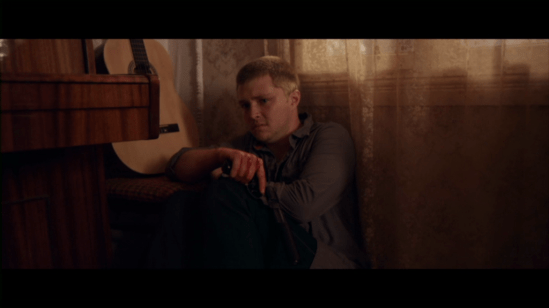
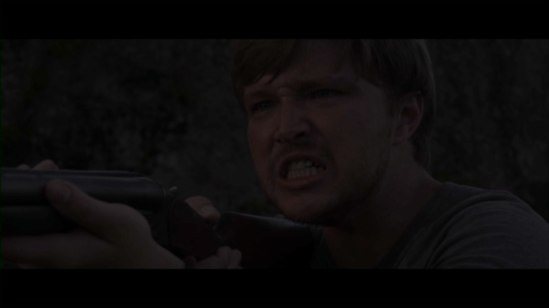
Without a doubt, “The Curse of Doctor Wolffenstein” is a labor of love that subtly borrows from the films of the director’s fandom. There’s a bit of “Evil Dead,” a piece of “Night of the Creeps,” and a flair of Hammer Horror in a mix that defines Rohnstock’s writing and director perspective and style. As the co-founder of the film’s production company Infernal Films, Rohnstock and his Infernal Films team have free reign over the overall structure, style, and tone of this fantastic flesh filleting of a film. What Infernal Films couldn’t really control was the relatively young cast of Isabelle Aring, Robin Czerny, Roland Freitag, Stephanie Meisenzahl, and Julia Stenke whom are pitted against the dual role performance of Mika Metz, playing a miserable mechanic and Doctor Wolffenstein.

Reel Gore Releasing’s gorgeously slipcovered 2-disc Blu-ray and DVD combo release doesn’t hold back standing behind a flick that gallops in blood, bares it all with female nudity, and even has an orifice invading creature with enough ooze to lube it’s way down with ease. Video quality wise, the image is heavily showcased in a cyan hue that’s feels unnatural. The day or brighter scenes look good enough for hi-def in the widescreen presentation in a 16:9 aspect ratio. The German DTS-HD 5.1 option with optional English subtitles is flawless in all areas of the audible tracks. There is also a DTS-HD 2.0 with optional subtitles. Bonus features include a showcase reel in a behind-the-scenes featurette, a German only bloopers reel, “Trapped & Stabbed” short film by director Marc Rohnstock, the film’s trailer, and a still image slideshow. Gore films have always been a hit or miss with this review, but “The Curse of Doctor Wolffenstein” has reclaimed my faith in the intensity of content that’s not suitable for most viewership in one way or another.

Category Archives: Exploitation
Dutch Avant-garde is the Next Evil on the Butcher’s Slab! “Meat” review!
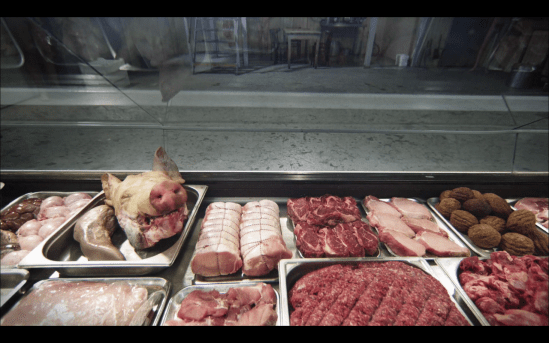
A young and beautiful butcher shop assistant succumbs to the middle-aged butcher’s sexual advancements and fantasies at the workplace after she catches glimpses his sorrow, but when the butcher ends up naked on the shop’s floor with his throat cut, the assistant becomes the number one murder suspect for an inspector who coincidently looks almost identical to the deceased butcher. As the investigation deepens into the assistant, the inspector’s solemn, solitary life blurs to an assimilation into the butcher’s and his suspect turns from being a prime target to being a crucial part of the his physical and mental altering integration into the dead butcher.

“Meat” is a powerful transcending film seismically barreling through a Lynchian structure consigned to provoke the consequences of unhappiness and the consequences of poor choices during unhappiness. Directors Victor Nieuwenhuijs and Maartje Seyferth have orchestrated a moderately expressionistic arthouse Dutch drama told in a spiraling sexual context. The meat in “Meat” and the sex in “Meat” clearly share a correlation, peppered as motifs from start to end, and the positive and negative dimensions of the two are so obscured that pinpointing the differences between them are impossible, but both are for sure the last hope for the butcher and his assistant Roxy to embody the essence of sex and meat for opposite reasons. Whereas Inspector Mann simply drags wholeheartedly through his existence, expressing his numbness toward his mundane job and harshly breaking up with his lover without an ounce of compassion. Its until the butcher’s case lands in his lap does the Inspector shows signs of life again.

If you notice that lead actor Titus Muizelaar’s dual roles have purposefully generic labels. The butcher is credited as just the butcher while the Inspector has a proper name, but the name Mann is just as indistinguishable as if the character was christened Guy. The synonym character was intended for blending, to blur their personas, and to transform one into another. To explore the transformation, “Meat” begins a parallel between the butcher who, in a metaphorical sense, has his cake and eats it too and the inspector painstakingly limps from one spot to another. A contrasting experience between the two firmly establish their individualities. Then, the film shifts gears midst a catalyst with the butcher’s mysterious death, forcing the female assistant, an uninhibited role performed uninhibitedly by Nellie Benner, to be the resilient gateway for the inspector. Third gear shifts into the inspector being more and more intrigued, if not extremely envious shown very subtly, by the butcher’s seemingly unchained facade. Each character emits an expressionless stature with a deep-rooted ugliness burrowed inside and each desire a change in their turmoiled lives, whether it’s sustaining love, seeking love, or able to love in order to battle every aspect of oppressive depression.

The uncomfortable open and intimate relationship between the butcher, Wilma Bakker’s Tiny, and the shop owner and the psychosexual workplace harassment involving the enthusiastic, video-documenting assistant filets the juicy bits from the bone with numerous innuendoes and explicit carnal exhibitions taking brazen residence within the animal blood stained walls of the butcher’s small meat market. You’ll never look at steak, pork chops, and leg of lamb the same way again! Only when “Meat” transitions into that second gear does the erotica becomes less erotic and more forced and horrifically exploitive. Scenes of undisclosed rape and of blatant genitalia speak upon that aforementioned correlation of raw meat and sex; no choice is given to the cow when the cow is killed and slaughtered for the cow’s delicious beef and the same can be said in sex as it’s taken without much consent and it’s being reaped for the benefit of others.

Graphically infrasexual and skewed beyond simplicity, “Meat’s” refreshingly loaded with unpleasantries and basted moistly with an outer layer of perversion that drips into an oven of thriller surreality. The Artsploitation team lives up to the moniker by, after being long overdue, crafting a home video release of 2013’s “Meat” aka “Vlees” onto DVD and on digital home video. The digital screener provided for review doesn’t give much insight into the audio and video qualities or speak to the testament of the special features. However, “Meat” is a phenomenal film that’s well-aged and ready to be rubbed, tenderized, devoured in all senses of the meaning.
Mexico’s Stomach-Turning Evil is Here! “Atroz” review!

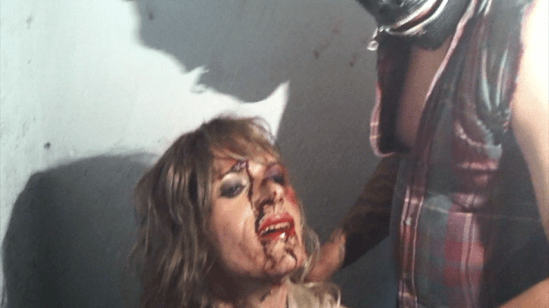
In a wake of fatally striking down a young woman with their vehicle, two errant and drunk men, Goyo and Gordo, are arrested for the gruesome crime at the scene of the accident While handcuffed in the back of a squad car, an unorthodox police chief named Juarez discovers a video tape recorder in the front of their mangled car with a tape revealing the violent torture and killing of a young transvestite hooker. One tape leads to another, and then another, individually exhibiting a trail of cascading blood and merciless torture in the deaths caused by Goyo and his unstable and dysfunctional life. Juarez digs further into Goyo’s ghastly cases going through each horrific tape setting up Goyo for a shocking conclusion from his past he long thought was dead.

“Atroz” will make you never want to tour Mexico! I can fully understand why “Cannibal Holocaust” director Ruggero Deadato fully backs Lex Ortega’s graphic horror film an associate producer and presenter as the two films, separated by decades, are much alike with the majority of their likeness in found footage techniques, frighteningly realistic imitations of murder, and their artistic and austere grandeur of filmmaking narration. Ortega also sustains an effective horror feature through the confines of a problematic ultra micro-budget. Along with aid from a talented roster of actors and crew, no way was Ortega’s film was not being made. “Atroz,” translated to “Atrocious,” opens with the unsavory side of Mexico’s impoverishment that contributes to much of the Central American nation’s disturbing amount of unsolved murders. The montage opening is so powerful and moving that what precedes shocks as a gritty insight of what everyday Mexican residents might experience one way or another in their lifetime and though Ortega goes that extra mile to be obscene and disgusting in every way possible, the director supports his work with seeding a traditionally patriarchal society with gender identity afflictions that evolves organically and is purposefully displayed in reverse order to add more, if it wasn’t possible already, to the shock value of “Atroz.”

The outer story involving Goyo’s interrogation about his stash of tapes is only the tip of the iceberg, sheltering three background influencing stories about Goyo that set up more familiarly in an anthology manner. Inked with intricate arm sleeve tattoos and perforated with metal facial piercings, Goyo and his larger friend Gordo, which means large man in Spanish fittingly enough, seem nothing more than your typical lowlife gangbangers. However, Goyo and Gordo are more disturbed than any Mexican cholos from the first torture tape of a transvestite prostitute, a punished, bit-part role awarded to actress/singer Dana Karvelas. The next two tapes are just as hard to swallow and stomach from the assorted fluid being consumed, to the explicit varying degrees of rape, to the vivd genitalia multination, and to just the sheer ultra violence depicted makes “Atroz” the gorehound’s holy grail of horror. Never have I’ve witness a film so graphic to come out of Mexico and, by golly, I thought the world needed this Lex Ortega film. In most cases, extreme gore and shock features run a course shortly after hitting the play button on your home entertainment device, but with “Atroz,” a drive to learn more about what motivates Goyo’s unholy acts unravel little-by-little and that quality is usually omitted and uncharacteristic of explicit gore horror.

Performances are firmly established all around with Carlos Valencia and Lex Ortega himself leading the charge as Juarez and Goyo. While Ortega doesn’t necessary have much of dialogue role with Juarez during interrogations, the undiluted carnage he lays down on the tape recordings are a rare and twisted characterization hardly visited by the indie circuit and certainly not given the light of day from Hollywood, being mostly sidelined to an underground context. Rare is it to have one actor who can impersonate malice upon others that when a doppleganger appears in Goyo’s younger years video tape, “Atroz” becomes that much of brighter highlight as a dark film birthed from Mexico. Carlos Padilla truly frightens as the younger version of Goyo staged in an abusive household with an unsympathetic father, an naive mother, and lots of physical and verbal mistreatment. Goyo’s a psychoanalytical unicorn, an epitome of the mind’s deranged wealth, and a testament that his surroundings molded the very fibers of his intentions do commit evil. The sight of blood is all it takes arouse Goyo and “Atroz” provides the character an ocean of sangre ready for lapping.

Practical effects wizards Jamie Lopez and Alfredo Olguín produced unrivaled effects on a budget that didn’t provide a second chance if the effect didn’t spin right the first round. Absolutely flawless did the duo’s work gleam in the blood it was soaked in and firmly how I held on for dear life my testicles when seeing a set being cleaved graphically severed. Lopez and Olguín have a combined 23-years of experience in the special effects game and that surfaced buoyantly at the top of “Atroz’s” shocking content. In the nature versus nurture debate, “Atroz” sides with nurture putting Goyo in the impoverished and traditional meat grinder that is Mexico and spat him out where wades in a chrysalis until bursting out into a state of lust for an endless stream of revenge and blood. Ortega accomplishes nurture’s wickedness by tenfold and Lopez and Olguín exemplifies it even more.

Unearthed Films and MVDVisual’s limited edition 3-disc Blu-ray and DVD set includes a JH5 & Eggun soundtrack. Presented in a widescreen 1.85:1 aspect ratio, the 79 minute runtime feature sports no blemishes and falters on any flaws, baring and setting a fitting desolate tone through a number of camera options. There’s also and English and Spanish language Dolby Digital 5.1 with optional English subtitles intent on properly channeling every port of your surround sound system. A pair of issue lie with the subtitles involving quite a few typos in English and some synchronization problems delaying captioning a full second or two after dialogue has proceeded. Bonus material includes the short film of “Atroz,” a crowd funding video, behind the scenes: music and sound design, behind the scenes: practical effects, behind the scenes: production, Unearthed trailers, a behind the scenes image gallery, and, of course, the aforementioned soundtrack. Whatever you do, don’t consume any food before and during experiencing the gore charged “Atroz,” Mexico’s most deranged cinematic delicacy to date!
Evil’s One Kaboom Step Away! “Landmine Goes Click” review!

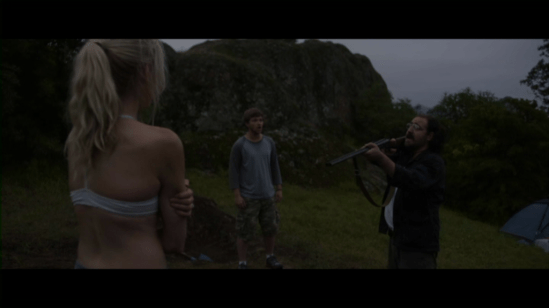
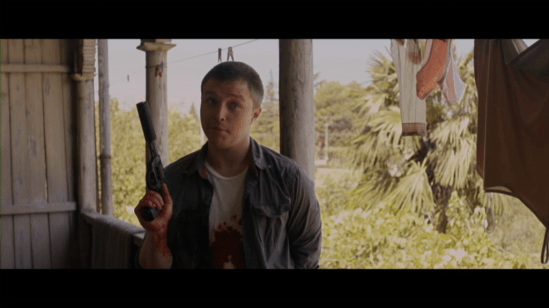
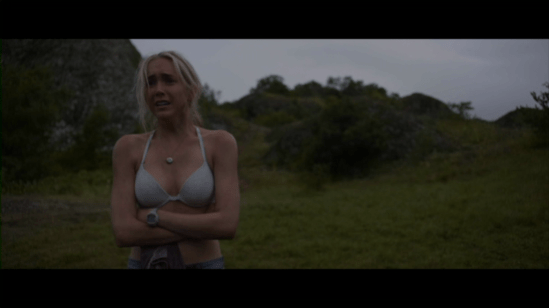
Three backpacking American tourists and good friends Daniel, Alicia, and Chris tour through the Georgian countryside, looking for that one last hurrah before Daniel and Alicia tie the knot. When the trip seems to be going well, Chris steps on an old landmine, leaving him grounded and motionless to the spot. The next series of events will determine their fate as an psychopathic local and his Rottweiler happen upon the frightened and helpless Americans. Caught in a maniac’s twisted game, their only chance for survival is to play by the local’s Machiavellian rules or otherwise take their own life-risking chances by stepping off the a shrapnel-exploding, flesh-piercing, life-ending mine.

“Landmine Goes Click” bares no one identity. The Georgian thriller from director Levan Bakhia cleverly abridges four genres together, resulting in one intensely merciless story of unfortunate and deadly circumstance intently set to destroy one’s emotions. Bakhia teams up again with writer Lloyd Wagner, both who’ve previously worked on heated horror chiller “247°F,” and are joined by Adrian Colussi to substantiate a story that’s dices through a range of plot subdivisions from thrilling and exploitive to revengeful and tragic.

Kote Tolordava, the late Georgian actor who tragically died of a heart attack shortly after filming, defines the look and the manner of a sleazeball psychopath. A straggly comb over laid upon unkempt shoulder length hair with a stubbly five o’clock shadow that rests beneath a bushy Georgian bred mustache combined with an over extended gut stretching a bulbous silhouette in a white under shirt that’s covered with a breast opened, military-like navy colored coat sizes up Tolordava’s Iiya character as a harmless human joke, but pair that look with a loaded Remington, a muscle-laden Rottweiler, and a taste for taking advantage of the situation and you have a maniacal genius ready to reap the benefits of your misfortune. Tolordava’s wears Ilya’s clammy skin as if it’s his own, playing the local kook with a sadistic hard-on.

But Sterling Knight, as Chris, carried the film to a jarring conclusion, especially in the last acts. My initial reception of Chris was a big question, why does Chris, whose unable to move from the landmine, severely antagonize a creature like Ilya? Once the characters progress to a level of no return, to a level of depravity and maliciousness, understanding Chris was no longer an enigma and how Chris follows up with Ilya begs, absolutely begs, for retribution. Knight’s day and night performance tells tales of his acting talent. Don’t let the youthful face, the deep blue-eyes, or the Justin Beiber vocals fool you, Sterling Knight demonizes handsomeness.

With Tolordava and Knight, Spencer Locke, K-Mart from “Resident Evil: Extinction” and “Resident Evil: Afterlife,” had the toughest role to be burdened with as Alicia being an object of affection for not one, not two, but three characters and, in two of characters’ cases, in a malevolent way. Locke’s scenes were the most difficult to gape at, but her character ends up being the driving force behind almost everything that happens, even to divulged information prior to the beginning of this film to which we are not privy. Alicia is essentially the epicenter that crumbles the foundations of lives around Daniel, Chris, and even Ilya and like an epicenter, Alicia becomes the butterfly effect that ripples devastation from a single event. Like I said, a role that bares a heavy burden.

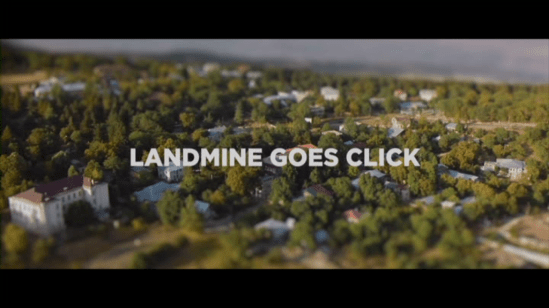
Bakhia utilizes effects that can be easily overlooked. His use of miniatures of the Georgian countryside, compositing them with the live action motor vehicles, is a stunning visual, alluring to our minuscule selves in the world. Also, the director, I noticed, does many long takes by swerving the camera from side-to-side that may consist of a stationary position or even tailing to characters, obtaining individual reactions and letting the scene play out without as much as a single edit for a lengthy period of filming. My first experience with Bakhia at the helm isn’t spoiled with gaudy gore or an outlandish unrealistic script; “Landmine Goes Click” thoughtfully provokes our inner animal and is constructed and edited similar to the style of Oscar winner Martin Scorsese. No film goes without flaws as I thought some of the fade to black editing was oddly placed and the overlapping during genre transition didn’t settle with the mood at the time. However, I’m not a big fan of exposition, but I thought there was enough exposition to get us through on how Chris managed to step on a landmine and also to what really happened to Alicia. Any more footage would have been overkill, making the 110 minute runtime that much smoother.

“Landmine Goes Click” rightfully found a home as an Icon Home Entertainment Frightfest Presents. Spurred with volatile tension and a dynamically charged cast, “Landmine Goes Click” is the tip of the Levan Bakhia ice berg and watch out for more films from Sterling Knight, an actor that can steal a scene, or in this case, a movie right from under another talented actor Kote Tolordava. Since the disc sent to me was a screener, I am unable to review the audio and video qualities, but I can say that there wasn’t much bonus material aside from an introduction of the film by Frightfest’s Alan Jones and Paul McEvoy and the other Frightfest film trailers. Like a good concealed explosive device, “Landmine Goes Click” exploitatively shreds through your soul, cleaving barbed shrapnel to linger and rot in the confined spaces of psyche.
The Evil Doctor is in! “Doctor Butcher M.D. (Medical Deviant)” review!

New York City hospitals are being terrorized by a crazed maniac or maniacs stealing the body parts of the deceased and local authorities are discovering the half eaten remains of torn apart bodies in the streets. When a medical orderly is caught in the act of cannibalism by nearly devouring a corpse’s heart and then commits suicide by diving out high rise window, the Doctor’s assistant and leading anthropologist Lori Ridgeway recognizes the tattooed symbol of Kito on the orderly chest, a symbol from a long forgotten tribe in the Moluccas Islands. Worshipping a cannibal God, the primitive tribe still practices the form of anthropophagy. Lori’s colleague, Dr. Peter Chandler, has been placed on a research team to root out New York City’s recent cannibal problem and when the Kito symbol clues him and his team of a possible lead, an expedition team forms to travel to the Moluccas Islands in search of the existence of inhabitants. Dr. Chandler rendezvous with a long time acquaintance, Dr. Obrero, whom has lived on the islands for years. When Dr. Obrero arranges a boat and his right hand man to accompany the expedition, Dr. Peter Chandler and team step foot into a hellish nightmare, bloodied with unspeakable and aggressive cannibal acts. Just when nothing could be worse than flesh hungry cannibals, hideously disfigured zombies frighten even the primitive locals. The island holds a dark secret and Dr. Chandler aims to unveil it no matter the cost!

Finally! The definitive 2-disc edition of Aquarius Releasing’s “Doctor Butcher, M.D.” aka the Italian cut “Zombie Holocaust,” from the Flora and Fulva Film production companies, has been released and, oh, how glorious the Severin Films release is with a super sleek Blu-ray reversible cover art – “Doctor Butcher, M.D.” title as the main cover and “Zombie Holocaust” title on the reverse side – and the high definition gore that hasn’t been gooier and oozier than ever and all in thanks to the upscaled 1080p full HD resolution transfer. Uncut with eye-gouging effects, eviscerated and mangled bodies, and packed with a slew of medical terrors and oddities, the Marino Girolami’s directed video nasty from 1980 just might get itself banned once again by the international censorship boards.

The schlock runs thick through a plot that’s eerie similar to Lucio Fulci’s Zombie (aka Zombie 2) with many of the locations and sets repurposed for the Girolami picture involving exotic land cannibalism, a mad scientist, and, you guessed it, zombies. Yet, “Doctor Butcher M.D.” rightfully receives being a detached entity, an “Annabelle” to “The Conjuring” of sorts, even when both films star Scotland-born leading man Ian McCulloch. With uncanny and grisly disemboweling special effects that turn a stomach inside out and give you a reason to make use of that barf bag provided by Severin Films as a bonus insert, some death effects didn’t go quite as planned such as, in example, when the cannibal orderly dives out a multistory window and the stunt-dummy loses an arm when crashing onto the floor. The next scene has the actor, with arm intact, lying in a pool of blood. Another scene involving Doctor Butcher and his cranium saw nearly doesn’t sell the effect when the saw itself isn’t spinning at all during close ups of a cranium cap removal. However, none of these miscues matter as the rest of the special effects trumps any other gore film of this decade.

The American bought rights to “Zombie Holocaust” were destined to be re-edited as the film had to bulk up on Americanized tastes, slightly targeting specific, well versatile audiences of New York City’s infamously sleazy and exploitive 42nd Street, which is now defunct. The additional and pointless scenes that were intercut from a scrapped Roy Frumkes’ horror anthology, “Tales That Will Tear Your Heart Out, at the beginning of the film didn’t transition seamlessly enough to cause an unfavorable reaction, but only added on to the powerful zombie train that spawned from George A. Romero and the Living Dead films. The antics of Terry Levene, an American producer and 42nd Street icon, led to guerilla marketing, an overlapping score from the late “Blood Sisters'” composer Walter Sear, and the superbly cut trailers had guaranteed butts in the seats at Levene’s, amongst others’, circuit theaters. Plus, the T&A from cult Italian actress Alexandra Delli Colli might have had something to do with putting butts in seats as well.

The story hadn’t changed much between the alternate film versions of the Romano Scandariato screenplay and the story itself is wound looser than a turn of a century Gary Busey. Thin motivations drive characters to do the stupidest things possible such as go on an expedition to a cannibal island, go to a cannibal island without state of the art weaponry and more bodies than a modern day NFL football roster, or go straying away from the safety of your group to stroll through the island’s bush alone. The obviousness is aggravating to say at the least, but omit the blatant stupidity of the characters and no one would die a horrible and gruesome death that fastens our morbid tastes to the screen. The story’s spontaneous and adventurous nature appeases thrills of a long-lost culture on an island of hell that’s ready to be explored and re-discovered and ready to taste fresh blood and organs once again.

Severin Films have outdone any previous release of the reconfigured “Doctor Butcher, M.D.” and the original “Zombie Holocaust” when discussing the video presentation. The 1080p performs at a high bitrate with a vibrant display of natural colors that diminish much of the natural grain and negative damage and exhibits finely tuned and leveled darker tones from the original 35 mm negative; a HD presentation that, and this goes without saying, naturally outperforms the the transfer from Shriek Show’s “Zombie Holocaust” DVD release in the early 2000s. The English DTS-HD Master 2.0 audio mix on “Doctor Butcher, M.D.” performs greatly without many given distortions or loss of audio while the “Zombie Holocaust” on disc two has the same DTS-HD Master option, but also gives an alternative with a linear PCM Italian only audio mix without subtitles. Walter Sear’s Stateside score and Nico Fidenco Italiano score tribute their respective nations clearly through the mastered audio mixes with Fidenco’s score surfacing here and there on the Aquarius Releasing edit. Severin Films provides an impressive list of new bonus material on each disc, with the first disc having insightful interviews with Aquarius Releasing’s Terry Levene, editor Jim Markovic, filmmaker and documentarian Roy Frumkes, “Temple of Schlok’s” Chris Poggiali, Gore Gazette editor and Butcher Mobile rider Rick Sullivan, and Gary Hertz all discussing their involvement “Doctor Butcher M.D.” and their ties to 42nd Street. The second disc focuses more on “Zombie Holocaust,” interviewing male lead Ian McCulloch and McCulloch sings “Down by the River” in another segment, FX masters Rosario Prestopino and Maurizio Trani, actress Susan Buchanan, and a look at New York City then and now piece where “Zombie Holocaust” shot certain scenes.