EVIL Infiltrates to Seduce All Your Women! “The Vampire Lovers” reviewed! (Scream Factory / Blu-ray)

“The Vampire Lovers” Now Available at Amazon.com!

The Karnstein family’s notorious legends of evil spread vast throughout 18th century Germany. Once thought their wicked leeching of nearby villages exterminated after the Baron Joachim von Hartog dispatched all the villainous vampires after his sister fell victim to their seductive fangs. However, years later, the aristocratical General von Spielsdorf and his niece Laura find themselves in the unexpected company of a houseguest with Marcilla, the beautiful daughter of a new neighboring countess. Days later, Laura unexplainably dies from continuous nights that drain her of energy and flourish her mind full of nightmares of being strangled by a large wild animal. In the wake of her death, Marcilla also disappears. Sadden by the news of her friend’s death, Emma and her father take in the daughter of a travelling countess named Carmilla to provide Emma with cheery, distracting company in a time of distress, but the mysterious cycle of enervation and nightmares start back up all over again and it’s up to the survivals of Laura’s death to stop death before it’s too late.
Unlike any other Hammer horror film you’ve ever seen before prior to 1970, “The Vampire Lovers” blazed the trail for permissiveness of the era’s newly reformed certification system that moved the bar from 16 years order to 18 and kept in line with society’s leniencies toward the favoring sex and free love.  “The Vampire Lovers” opened up to not only a new line of exploitation and violence at the turn of the decade but also introduced the longtime fans to new faces, especially actresses, who would accumulate labels and prominence inside the genre that last until this day.  Based from the story of “Carmilla” from Irish writer Sheridan Le Fanu, relatively new at the time Hammer director Roy Ward Baker (“Scars of Dracula,” “Dr. Jekyll & Sister Hyde”) took the Harry fine and Michael Style adapted original story and ran the distance with the screenplay from Tudor Gates whose writing forte was not specifically well-known within horror genre nor was horror Gates’ personal interest, yet Gates tweaked the Le Fanu female vampire tale to accentuate more of lesbian themes in a very turmoiled time when lesbianism, or just being gay, was seen as a disease or an unstoppable influencing evil force amongst the young people.  Fine and Style serve as producers in this co-production between Hammer Films and American International Pictures.
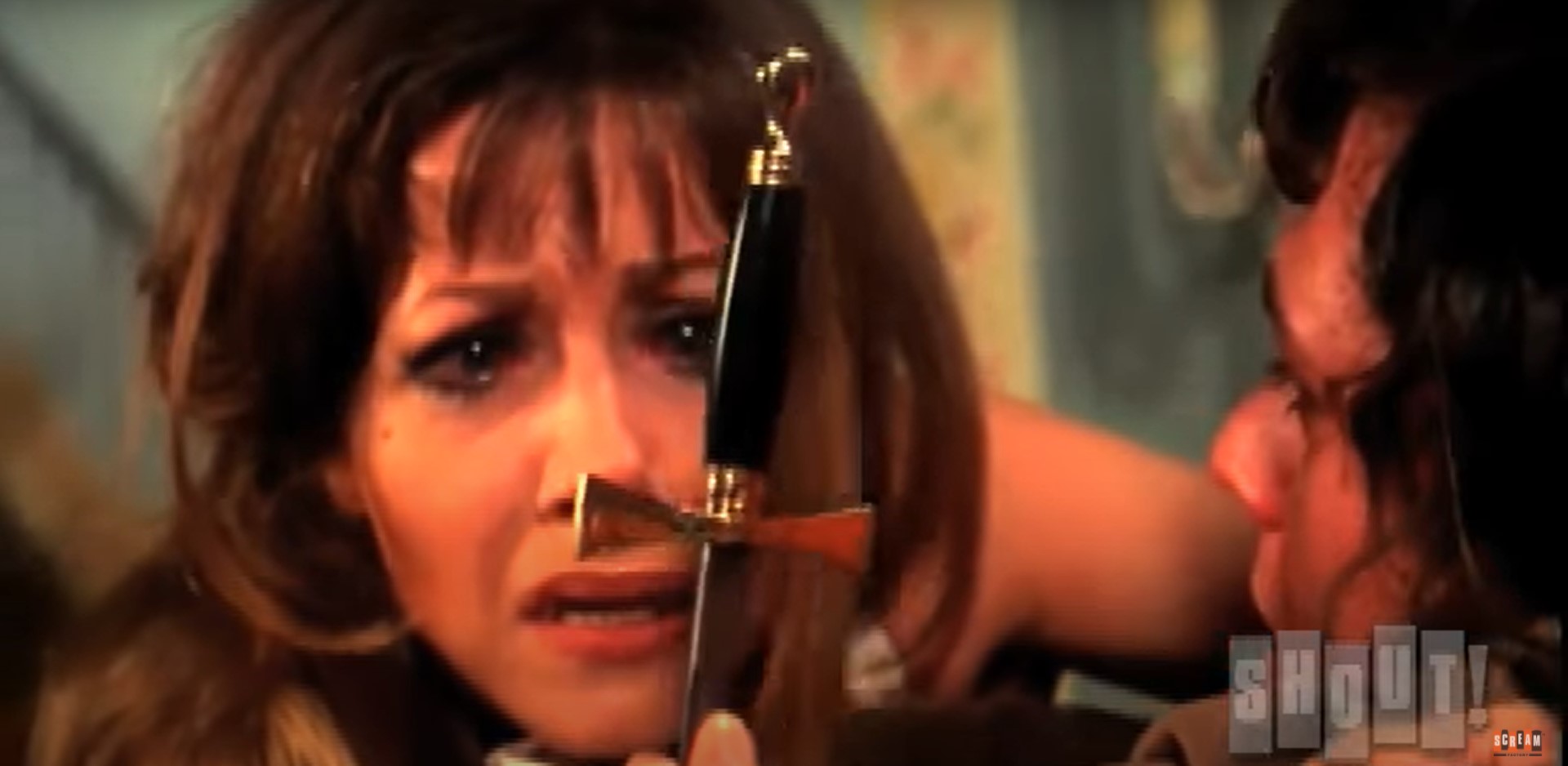
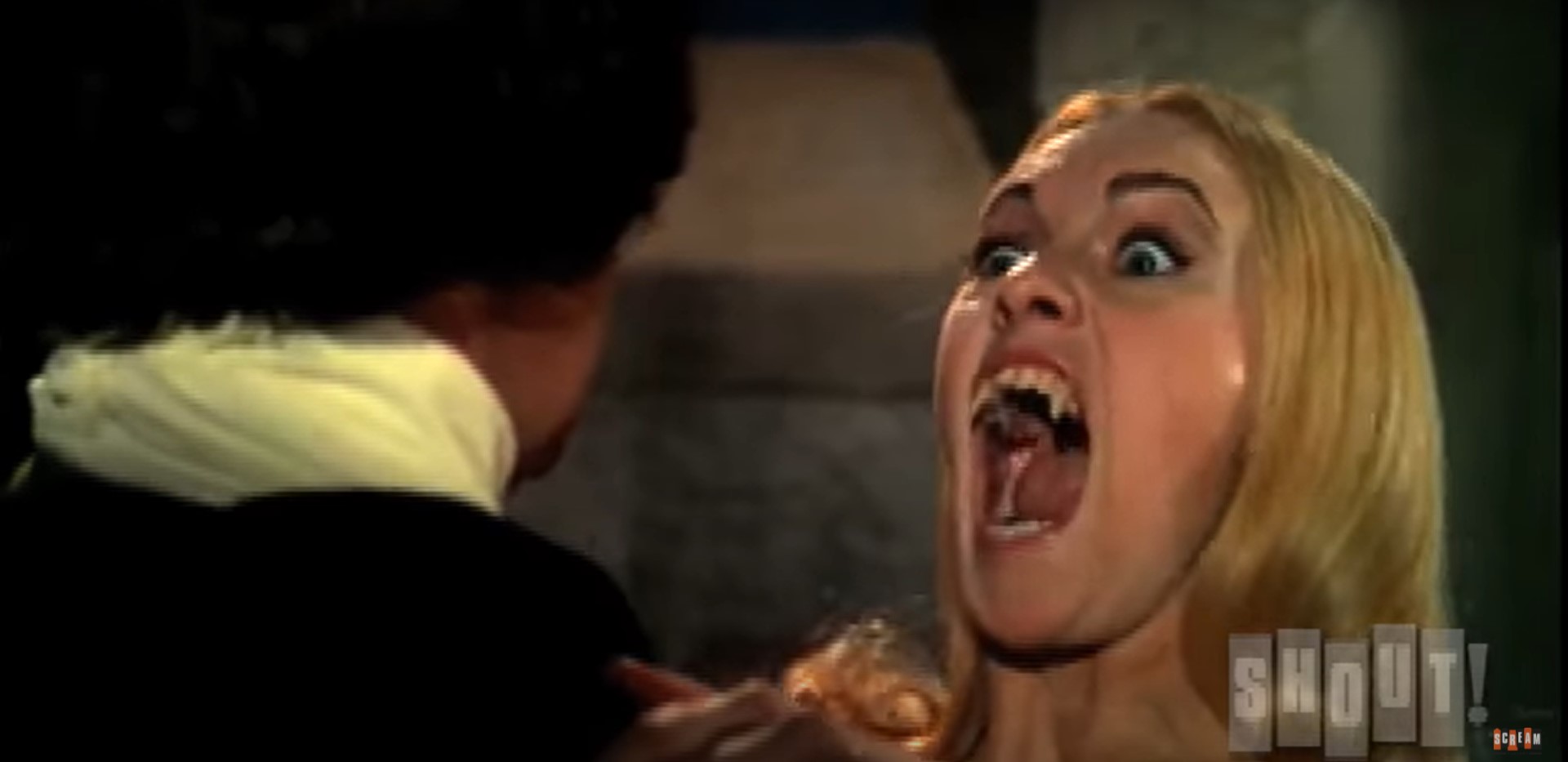
“The Vampire Lovers” comes under an atypical rule of the protagonist role or roles.  Previous Hammer films oriented themselves with a male lead from Christopher Lee’s domineering monster Dracula to the fearlessly courageous vampire hunter played by Peter Cushing, but “The Vampire Lovers” has Hammer trade in the masculinity presence for femme fatale with the introduction of Ingrid Pitt (“Wicker Man”) in the role of the hungry Karnstein vampire, Carmilla as well as Marcilla and Mircalla as the sneaky creature of the night infiltrates estates. Pitt’s exotic look and uninhibited attitude discerns obvious sex appeal for the Polish actress who can also act with gripping emotion that develops compassion for her malevolent facade. Add another pretty face and innocently sensuous woman arm-to-arm to Pitt with then 20-year-old Madeline Smith (“Frankenstein and the Monster from Hell”) and you have a two-front protagonist made up of women. Tack on the dark features and piercing blue eyes of Kate O’Mara (“The Horror of Frankenstein”) and “The Vampire Lovers” evolves into the something unlike anything we’ve ever seen from Hammer horror trifecta as once the scene settles into the narrative’s girth, the dynamic turns into a love triangle of unspoken women intimacies and jealousy, under the guise of supernatural persuasion, rears its ugly head. The menfolk really do feel absent from the excitement despite being pivotal pieces to the story and despite being the iconic representation in face and name of Hammer films. Peter Cushing’s longstanding work with the company has branded him forever legendary in the eyes of horror fans young and new. As the benevolent General von Spielsdorf, “The Horror of Dracula” Cushing looks wonderfully regal, gentlemanly dashing, and epitomizes the very essence of a strong male figure who also takes a very noticeable backseat for much of the second and into the third act. Same can be said for that other vampire portrayer who’s not Christopher Lee, Ferdy Mayne (“The Fearless Vampire Killers”) as the village doctor with a scene plopped here and there to inch the story along as a motivational vessel and another player caught in the Karnstein fang-game. “The Vampire Lovers” sees through to move plot significant characters, played by notable actors, to and from the storyline with performances from George Cole (“Fright”), Jon Finch (“Frenzy”), Dawn Addams (“The Two Faces of Dr. Jekyll”), Pippa Steel (“Lust for a Vampire”), Harvey Hall (“Twins of Evil”), and Douglas Wilmer as the Baron Joachim von Hartog who give a great opening expositional prologue that sets the background and tone of the film.
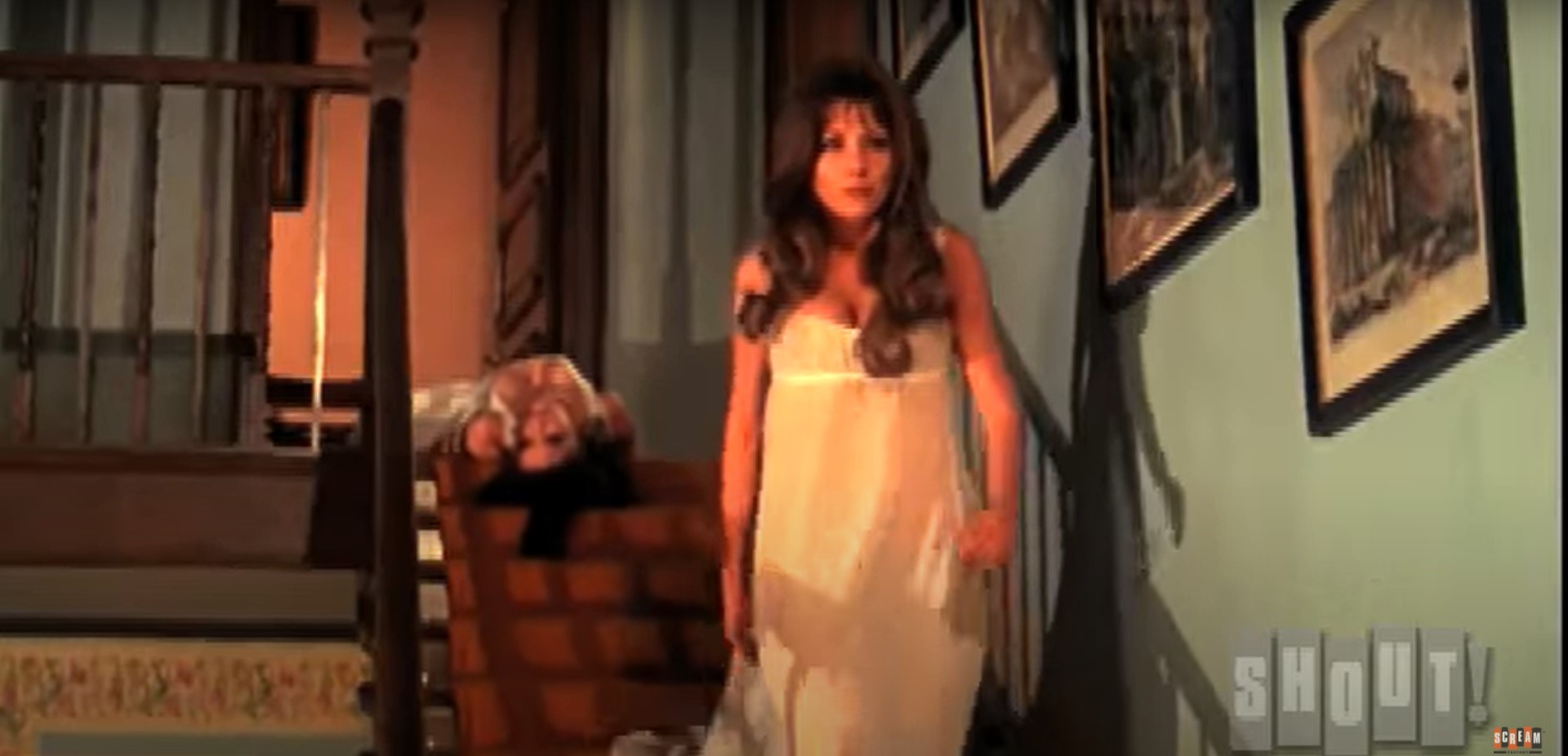
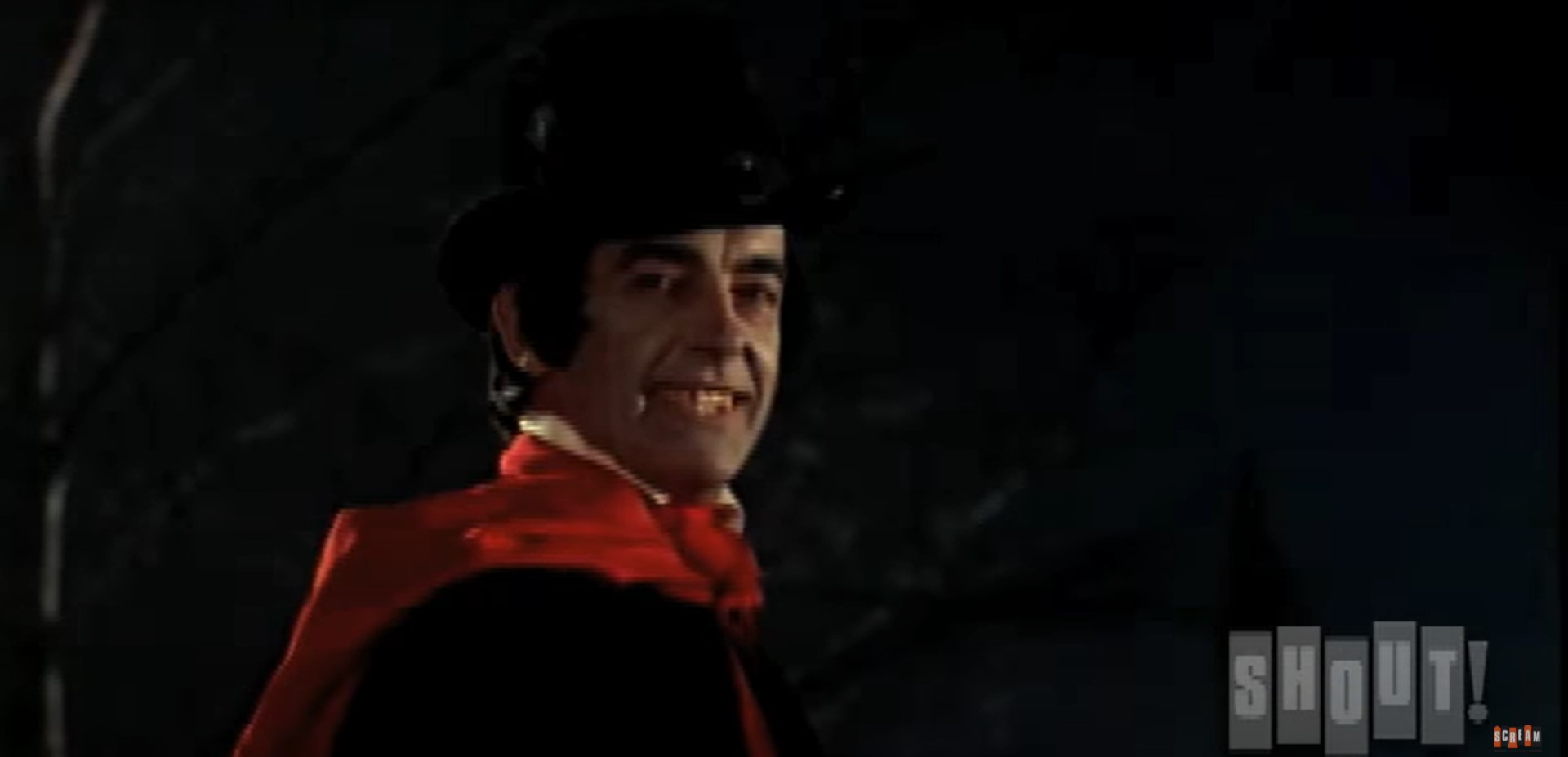
Laced in the traditional gothic style we all know and love from Hammer Films, “The Vampire Lovers” has grandiose late 19th century interiors and costumes with the latter gracing the starlets with strikingly bright tropical colored dresses that are elegant beyond the more stiff, and sometimes more imperialistic, outfits representing the period.  In a way, the outfits contrast against the brooding gothic prominence that speak of subversive liberation much paralleling the very thematic elements of lesbianism, sexual motifs, and a nearly an all-encompassing female lead.  If sex was ever a subtle insinuation in previous Hammer film it was not so subtle in “The Vampire Lovers” that consistently and constantly thickened the sexual tension and produced blunt scenes of eroticism between two or more women.  Even with the powerful commingle of womanhood desires, as much as it was depicted to be devasting to their lifeblood, Tudor Gates’ narrative still pit them up against nearly impossible odds when the male characters, no longer duped by the formalities of chivalrous intentions, figure out what’s really happening under their noses, in their households none the less, and band together to put a to a heart-staking stop to the macabre madness aka metaphorical lesbian evil.  The story has the women’s lusts and desires, whether their choosing or not, be an outlier from normalcy, yet on the other hand, nudity flourishes within the new laxed certification guidelines that see in some way, shape, and form four actresses baring skin in what what would have been considered risqué X-certificated scenes prior to 1970.  “The Vampire Lovers” is by far a perfect film with a lack of character context, such as with the male vampire on horseback indulging his penchant for observing Camilla’s attacks from afar and doesn’t proceed to explain further or with more insight to who he is and what his position may be within the Karnstein family ranks, as well as the narrative format with early on into the story being bit choppy and disorienting when Carmilla assaults nightly the General’s fair niece as a furry beast in the confines of a lurid nightmare.
Deserving of a collector’s edition, Shout Factory subsidiary horror label, Scream Factory, presents a new Blu-ray release of “The Vampire Lovers” scanned in 4K of the original camera negative.  Scream Factory should be extolled for their color grading toward Hammer transfers as the release looks stunning with quality stability and richness that brings the era alive.  Transfer also appears free from any kind of major blemishes and barely of any smaller ones. The English language DTS-HD Master Audio mono has resolute fidelity in the best possible audio offering “The Vampire Lovers” will likely see now and in future releases with a clear dialogue track and a Harry Robertson score that relives the classic studio orchestra in compelling fashion. The release comes with a slew of special features including an exclusive new interview with film historian Kim Newman, who also shows up again in archived interviews in the “Feminine Fantastique: Resurrecting ‘The Vampire Lovers'” (Scream Factory lists it as Femme Fantastique on the back cover) featurette commentary snippets from John-Paul Checkett and David Skal and other historians and collectors of Hammer Films. Audio commentaries with director Roy Ward Baker, star Ingrid Pitt, and Screenwriter Tudor Gates, audio commentary with film historians Marcus Hearn and Jonathan Rigby, two interviews, one of them new, with co-star Madeline Smith that span about 10-15 years apart, Trailers from Hell: Mick Garris on “The Vampire Lovers,” a reading of Carmilla by Ingrid Pitt, a single deleted scene of Baron von Hartog radio spot, still gallery, and the theatrical trailer round out the bonus material. The 89-minute, Region A encoded, R-rated version runs solo as the only main feature and the transfer Scream Factory uses, or licenses, is the edited version of Ingrid Pitt’s bath scene that cuts away to a medium closeup of Madeline Smith holding a towel for Pitt who’s standing up in the tub and then cuts back to Pitt’s bare backside. However, in the “Feminine Fantastique” featurette, you can experience the unedited brief full-frontal of Ingrid Pitt standing up in the tub if that tickles your fancy. The collector’s edition sports reversible cover art with original poster art on the inside and a newly illustrated, and superbly beautiful in its simplicity, front art by Mart Maddox sheathed inside a cardboard slipcover of the same Maddox art. Turning a corner into vast opportunities for more violence, explicit nudity, and unrestrained vampire gore became a new dawn for Hammer Films without entirely prostituting themselves with wayward tactics to the point of unrecognition as “The Vampire Lovers” still emitted gothic characteristics and a partial token cast and now made even more alluring with a feature packed collector’s edition from Scream Factory!

“The Vampire Lovers” Now Available at Amazon.com!

A Stuntman and Rock-n-Roll Magicians Have EVIL Under Control! “Stuck Rock” reviewed! (Umbrella Entertainment / Blu-ray)

The MUST OWN version of “Stunt Rock” Now on Blu-ray at Amazon.com!

Grant Page is a world-famous veteran stunt man from Australia and his new big project, a high octane, thrilling action move feature packed with car chases, fire sequences, and death-defying falls set in Hollywood, California.   When he arrives, his cousin Curtis picks up from the airport and shows him around, ending up at the recording studio where Curtis’s band Sorcery is lays down tracks for their upcoming album.  Between Grant’s thrilling high flying, quick burning stuntman work and the band’s theatrical heavy rock and magic trick performances, a showcase of entertainment energizes the soul as well as entertains it.  Before long, a column journalist Lois Willis aims to get Grant’s story on occupational health and lifestyles.  They’re joined by Grant’s costar of the film, leading lady Monique van de Ven, and together they rock out and enjoy the daredevil antics like one big life party. 

Unique in format and content, “Stunt Rock” reflects upon the ostentatious career of director Brian Trenchard-Smith. Before immersing himself in straight-to-video sequels of “The Omega Code,” “Night of the Demons,” and “Leprechaun,” Trenchard-Smith had a talent for being unabashed and taking risks in making something different. Thus, an 86-minute one-part showcasing demo reel, one-part fictional story, and one-part heavy rock music video was born from a slew of Trenchard-Smith shot achieve footage highlighting the impressive physicality resume of the one and only Grant Page. In 1978, “Stunt Rock’s” short theatrical run assumed the picture too radical for the general public with a motley crew of characters and a get-to-know Grant Page storyline that interjected the heavy rock, or borderline glam rock, of Sorcery, a five-piece band accompanied by two magicians whose illusions and pyrotechnics were performed live on stage as the musicians rocked out. Only recently has “Stunt Rock” re-emerged onto home video due in part to the advocating acolytes of the now defunct by not forgotten band and has become a wonderous and enriching blast from the past of reliving decades old history, contrasting artistry cooperating under one umbrella, and a deluge of rock and master class stunts. Also known as “Crash” or “Sorcery,” Martin Fink produces the quasi-action docu-musical with Trenchard filming under his own banner, Trenchard Films.

Grant Page, a man you may never recognize in name or face but probably have seen his broad list of service work at least a dozen times or more. “Mad Dog Morgan.” Yup, Page did the stunts. “No Escape.” Yup, that too. “Mad Max.” That as well! Between performing the stunts and a stunt coordinator, Grant Page has achieved over 100 credits to his name, but not until receiving the lead role in “Stunt Rock” is where he actually got to be himself…literally. Trenchard-Smith’s goal was to put Grant Page on a platform having worked with the stuntman on previous films, such as “Deathcheaters” and “The Man from Hong Kong,” putting his career, and life, on the line numerous times. Page is charming and collected under his rugged facial hair and glasses atop a muscular physique as he’s paired to cohabitate with the latter half of two-word title. Grant Page is stunt whereas Sorcery is rock. Consisting of, at the time, members of the Americna rock group were front man Greg Magie, bass Ritchie King, guitarist Smokey Huff, drummer Perry Morris, and Keyboardist Doug Loch who always wore a glitzy or colorful stocking mask with had his vocals adjusted to a higher pitch. There were also two highly skillful stage performing magicians in Paul Haynes as the bearded King of all Wizards, Merlin, and Curtis James Hyde as Haynes on stage villainous counterpart, the Prince of Darkness aka Satan. In between the two rip-and-roaring personas is a reporter working on a column piece and Grant becomes her angled subject. Brian Trenchard-Smith’s wife of 40+ years is Margaret Gerard in the role of Lois Wills, a love interest who doesn’t quite understand Grant’s obsession with intentional self-destruction as a profession but quickly falls for the big hunk despite any real tangible flirtation. Across the aisle at the other end of female perspective is Monique van de Ven playing as herself. The Netherlands actress, who mastered the art being in a catch-22 love triangle between her longtime husband and her adventurous and new female lover in “A Woman Like Eve,” is positioned in “Stunt Rock” as certifier of the fake movie Grant is there to stunt for being the leading actress eager to do what Grant does, the stunt work, at the chagrin of her asset protecting agent.

“Stunt Rock” may not be our bread-and-butter material for review, containing a severe lack of ghastly horror, creature horror, sleazy exploitation, gore and shock, phantasmagoria schlock, etc.  Instead, what “Stunt Rock” is is a pure, 100%, grade A cult classic title that goes beyond the baseline criteria for critique, as if the film even needed our insignificant stamp of world cinema approval.  Absolutely not, as “Stunt Rock” speaks for itself, literally so in the very title, delivering essentially what the film is selling, documenting, exhibiting, and entertaining along with the caveat to be a career booster and an endearing tribute for director Trenchard-Smith’s much adored and highly respected Grant Page. The way Trenchard-Smith fashions his own shot stock footage of Page’s exhilarating and adrenaline junky spectacles into flashbacks, split screens, and just a reel of collected examples whenever Page goes into specific memories of stunts, a montage of similar acts, or even how he feels before or during the performance never bogs down into arrogant gray area on the part of feature’s star. Only the director behind the one-two punch “Day of the Panther” and “Strike of the Panther” could pull of “Stunt Rock’s” insanity on celluloid, rock on reel, and a cloud nine high on a combination of both.

“Stunt Rock” is more than just assemblage of electrifying stunts as it also brings down, as well as breaks down, stunt work as not this grandiloquent behavior but more about precision, planning, and self-care with some mild levels of egomania to do things bigger, better, and more dangerous. All of this great content is now on coming at you on a Blu-ray home video from Umbrella Entertainment as the 8th spine on their Ozploitation Classics label. Presented in a widescreen 2.35:1 in full high definition, 1080p, the region free Australian release is a fury of packed goodness, in all sense of the term. Rated PG, “Stunt Rock” is about as wholesome as a PG film came come that even comes with an opening disclaimer about not trying these stunts at home, so parents open your children’s eyes to “Stunt Rock!” As far as image quality is concerned, Umbrella’s release perfects the natural-looking colorization by adding a pop of robust color, unintrusive grain, and baring miniscule blemishes. Most of the film is shot in 35mm, but some of the older footage Trenchard-Smith shot on Grant Page is in 16mm and the varying levels of difference in the details can play tricks on the mind with the stark contrast. The English language DTS-HD Master Audio 2.0 is a solid track. Dubbing can tilt an audio imbalance in the depth around certain dialogued moments, but for the most part, no compression issues leave a clean and clear outcome with even an array of well-recording Sorcery tracks and capturing all the fine details in their pyrotechnic and smoke and mirror shows in front of a live high school audience. This Blu-ray is packed with special features beginning with an exclusive virtual interview with Brian Trenchard-Smith and his wife/leading lady Margaret Gerard at their home in Oregon going over every facet in the genesis and aftermath of “Stunt Rock,” plus 2008 interviews with Grant Page and the director from Not Quite Hollywood segment, 2008 audio commentary from Page and Trenchard-Smith, 2009 audio commentary from the director, producer Marty Fink, and actor Richard Blackburn, a 2009 introduction to the film, extended interviews with Sorcery guitarist Smokey Huff and Marty Fink, 2009 audio interview with the band’s drummer Perry Morris, Brian Trenchard-Smith’s Alamo Drafthouse Appearance, Cannes Promo Reel, a HD theatrical trailer, an exclusive new Trenchard-Smith approved trailer reel, and more audio commentary from the director in Trailers from Hell. And that’s not all! Beyond the colorfully retro-esque slipcover and snapper cast with reversible cover art with the film’s posters on the inside is a 14-page collectible comic book with the abridged illustrated version of the film. “Stunt Rock” is an amazing, one-of-a-kind film with now a one-of-a-kind Blu-ray release from Umbrella Entertainment sure to be a must-own for any fans of Brian Trenchard-Smith, Grant Page, or Sorcery!

The MUST OWN version of “Stunt Rock” Now on Blu-ray at Amazon.com!

Hide Your Children! EVIL Comes For Them! “Achoura” reviewed! (Dark Star Pictures / Digital Screener)


“Achoura” now available on Prime Video!

Broken by witnessing the kidnapping of their friend Samir, Ali, Nadia, and Stephen’s lives are plagued by the past and turmoiled in the present as adults.  When Samir is miraculously discovered alive, a realization of truth begins to flood back into their memories as the kidnapper’s intentions were to stop a malicious, child-devouring entity by stowing the demon away in Samir’s body as an encapsulating prison.   The demon, known as the Bougatate, uses the joyous celebration of the Muslim holiday Ashura to snack on beguiled youth and is now free to feed upon ripe, happy children once again, especially Ali and Nadia’s young son.  The four friends must band together and seek to destroy Bougatate on his own turf, a decrepit rural French house engulfed in nightmarish lore. 

Nothing says originality and mind-broadening concepts more than when international filmmakers weave the fabric of their folklore, the sequin of traditions, and the raw materials of cultural customs into their fabrication of creativity.  Director and co-writer Talala Selhami takes us on that very journey through Morocco with a tale based off the concepts of a shifty Djinn-like urban legend terrorizing children of the Ashura celebration with a shadowy, jaw-opening and jowl-extending monster devouring children like a snake in this 2018 released supernatural, child-be-vigilant thriller, “Achoura.”  Selhami’s sophomore film comes 8 years after releasing the cutthroat hiring practices of Corporation authority over the applying individual in “Mirages.”  The French-born director helms a script penned by Jawad Loahlou and David Villemin showcasing the horrors of loss, sometimes forgotten, amongst the Arab-Berber population.  The half-crescent coast of Casablanca becomes the main shooting location for the Moroccan-French co-production under Moon & Deal Films, Overlook Films, Orange Studio, and Black Lab VFX produced by Selhami and Lamia Chraibi with executive producers in Caroline Piras (“Among the Living”) and Rachida Saadi.

“Achoura” has been described as the Moroccan “IT” where four childhood friends reunite to face a preadolescent predator known as Bougatate.  That analogical sentiment is extremely on-point to the detriment of “Achoura’s” North American release; I, myself, before reading any other external comments, had thought “Achoura’s” story walked the same line as the 2017 remake and strongly resembled Pennywise in intentions and, in some ways, specific ways he – or rather it – tricks and consumes children.  The four friends are also similar to certain characters in the Loser Club, but the Sofiia Manousha is the least affected by her past, reimagining what happened to her friend, Samir (Omar Lotfi), as nothing more than being an abducted whim of a pervert’s fantasy.  Samir is the younger brother to Nadia’s estranged husband Ali (Younes Bouab), a brooding, sleepless detective ceaselessly on his brother’s case as he dives deep into old investigative interview footage and cigarette packs he continuously bites the filter off of each cancel stick.  The pain Ali bottles up is complete poison wonderfully conveyed as well as the interpretation of trauma from the last friend of four in painter, Stephen or Stéphane as the character is credited.  Played by the Spanish born Iván González, whose worked on a pair of intense thrillers – “The Divide” and “The Crucifixion” with director Xavier Gens, Stephen singles himself the only person that remembers what actually happens as González glosses the artist with starry eyes and a verbally shaken recollection of monstrous images.  The one performance thought to be the weakest link was Omar Lotfi’s Samir, an imprisoned man-child imprisoning a demon with him, and Lotfi’s infantility as a grown man freed from confinement and a demon crossed too intractable goofiness, leading the Samir away from being a sympathetic character into more of a cartoon of one.  The cast is relatively comprised of the four friends with minor parts here and there in roles from Mohamed Wahib Abkari, Jade Beloued, Abdellah El Yousfi, Celine Hugo, Gabriel Fracola, Mohamed Choubi, Noé Lahlou, and Moussa Maaskri as The Guardian incarcerating Bougetate inside Samir, who we assume is the same boy from the film’s prologue setup but never actually verified.

While “Achoura” draws many comparisons to “IT,” Selhami sepulchers itself into an overwrought, yet hugely overworked subgenre of shrouded gangly presences lurking from the darkest corners of the room to bring antagonism toward children.  “The Babadook” comes to mind with the manifestation of grief descending upon a single mother and her child.  Same theme can be extracted from “Achoura’s” grief and trauma over the loss of their friend and how they represent the condition in different ways:  Nadia chooses to reimagine the event to a safer, saner memory, Stephen expresses his horror through painting, and Ali’s guilt drives him to unhealthy habits in looking for his brother.  The Bougatate is akin to a pedophile robbing children of their innocence, a motif that extends from the very beginning of the story with a preteen boy expressing his affection for a girl his own age before Bougatate seizes upon them.  Their innocent and charming clandestine affair is kept from her betrothed husband, who’s creepily decades older, in a mind-boggling and unpleasant idea of children arranged marriages that sets the misguided tone for a sordid underlayer that sparks Bougatate’s resurgence into the world.   Though I like the tone of the film albeit a vague carbon copy of others like it, what I find to be tone deaf is the often clunky special effects surrounding the entity’s polished look.  One attribute belonging to Bougatate is the legion of flies that constitute his form in what has diminutively become just a bunch of nano byte specks moving in menacing unison and swallowing (or being swallowed) anything in their path. The non-linear format that double culminates the unravelling in present and in flashback past retains a sustainable 90-mystery.

One of the last horror films to be released in 2021, “Achoura” came to digital platforms and DVD home video this past December from Dark Star Pictures, the same company who released the phenomenal Veracruz folklore and Bruha horror, “The Old Ways,” and the Mickey Reece’s perfectly subtle nod to vampires and depression in “Climate of the Hunter.” Since a digital screener was provided, commenting on the DVD audio and video quality is a no-go, but the Mathieu De Montgrand offers harsh hard lit scenes vast in depth, a breadth of landscape between the countryside of France and Casablanca shoreline, and excellent action and tracking shots to instill the appearance of a big-time movie. Montgrand is definitely not just a point and shoot cinematographer as he can build suspense purely on his angles along with Julien Foure’s editing of the flashback montage that tells a bigger side of the four friends’ history yet to be revealed. “Achoura’s” bleak analogy of children’s innocence being consumed by the complexities of adulthood problems understands the unstoppable crossbreeding crisis of blending youthful naivety with seasoned reality to the point of no return that one day all unspoiled exuberance will simply be eaten into oblivion.

“Achoura” now available on Prime Video!

Kissing Cousins and a Foreboding EVIL Feline in “Seven Deaths in the Cats Eye” reviewed! (Twilight Time / Blu-ray)


“Seven Deaths in the Cat’s Eye” now available on Limited Edition Blu-ra from Twilight TIme!

Set in the 1970s, the aristocratic McGrieff is on the verge of collapse with financial ruin that’ll cost the once respectable family their castle set in a small Scottish village.  Full of intrigue and ominous mystique, foreboding supernatural superstitions surrounding the McGrieff name, but that doesn’t frighten the young London residing Corringa from visiting her aunt Lady Mary’s castle.  Not before too long, Corringa’s mother, Lady Mary’s sister, mysterious dies in her bed and in the wake of her death more bodies are found with their cut throats all in the presence of the Castle’s roaming domestic feline.  Suspects range from Lady Mary herself in desperation for her sister’s sudden fortune to her unstable, gorilla-saving son James to also her in-house doctor lover who’s also sleeping with a live-in promiscuous woman intended for the young James.   Melodrama runs rampant and so does a killer who cuts down McGrieff Castle residents one-by-one in the dark corridors and gothic-laden rooms.

The Gothic-“Clue” of the 1970’s, “Seven Deaths in the Cat’s Eye” is the wildly entertaining Italian-produced giallo horror from the “Castle of Blood” and “The Long Hair of Death” director Antonio Margheriti credited under his more English-sounding pseudonym of Anthony Dawson.  Otherwise known with more animal ferocity as “Cat’s Murdering Eye,” as well as simply “Corringa, or in the native tongue as “La morte negli occhi del gatto, this mad family murder-mystery thriller is speculatively based off a novel by Peter Bryan, an extremely English sounding author whose original novel has yet to be revealed as the adapted base for Margheriti’s film or if a book even ever actually existed on what is more than likely, in my opinion, based off an obscure Italian author’s oral narrative or short story since the country at that time had laxed or nonexistent copyright laws – a method that produced a mass amount of unauthorized piggyback sequels for quick cash in on the popularity.  Either way, “Seven Deaths in the Cat’s Eye” is a thrilling, uncontained, and verbose black letter giallo co-written by Margheriti and Giovanni Simonelli (The Crimes of the Black Cat), produced by Luigi Nannerini (“A Cat in the Brain”), and is filmed in Italy under Capitole Films who appealed to westernized audiences with low-budget popular genre films at their peaks. 

At the heart of the story is Corringa, a progressive and modern Londoner travelling to join her mother and aunt at Castle McGrieff a few days earlier than expected after being kicked out for sneaking out on late nights from her all-girl Catholic boarding school and consorting with boys.  The “Dark Places’” English actress Jane Birkin embodies Corringa’s free-loving and innocent spirit becoming the white sheep amongst the Castle’s broody and plotting inhabitants.  Corringa is thrusted into the happenstance heroine of unravelling a mystery that causes her to freak out upon every discovery whether be the gruesome and distressing visual she walks into to the mere mention of someone’s throat being sliced open that sends her running and screaming into the arms of her cousin James, played confidently cool with a hint of madness in a red herring role by American actor, Hiram Keller.  The “Smile Before Death” actor had a small stint working in the Golden Age of Italian cinema with “Seven Death’s in the Cat’s Eye” being one of those projects, but his role of James is an interesting one as the Lord of the Castle who is considered mad, uninterested in either women or continuing the family lineage, and keeps a former circus gorilla caged up in his room.  One other at a loss and gross side of James, and also of Corringa, is their incestuous affair.  Yes, that’s right, the first cousins get it on like Donkey Kong as they share the bedsheets whilst embroidered in another arcana that’s more in the life and death taboo category.  Yet, all the characters are essentially in some wanton fashioned relationship with each other.  While cozying up to the Lady of the Castle, French actress Françoise Christophe (“Fantômas”) in order to gain favor within lordliness, physician Dr. Franz (Anton Diffring, “The Man Who Could Cheat Death”) also porks the “French Tutor” Suzanne on the downlow for some lust and relaxation.  German actress Doris Kuntsmann plays nomadically alluring to the dark-haired red herring outlier who is hired off the streets from her solicitating sex position by Lady Mary and Dr. Franz to be James’ break from his internal shell, bedfellow companion.  Meanwhile, the promiscuous Suzanna tries to sack up with Corringa in this full house of varied sexual appetites.  The ensemble cast continues with Dana Ghia (“My Dear Killer”), Serge Gainsbourg, Luciano Pigozzi, Venantino Venantini, Konrad Georg, and Bianca Doria. 

With an international cast, “Seven Deaths in the Cat’s Eye” enlists heterogeneous talent to continuously keep one on their toes surrounding every dead body that winds up throat mangled or moved from the original death stroke spot and Margheriti certainly has a firm grip on our attention between the polyamorous and dissolute sexual anarchy and the tension toned suspiciousness that ceaselessly keeps not only the characters on edge of each other but also rattles audiences anxiously squeezing their pressurized minds wrapped tightly around a castle-sized amount of distrust and suspects. “Seven Deaths of the Cat’s Eye” evokes the mad family subgenre with Margheriti’s family contending to be one of the most psychosexually and depraved group of backbiters and backstabbers of its time. Margheriti and Simonelli’s story is sensationally complex without being terribly complicated by beginning with the death of an unknown man where rats gnaw and eat away his decaying flesh. From then on, the narrative works ever so hard to purposefully not touch upon or identifying the mystery man’s demise until the bitter encounter end with a revealing finale exposure of a shocking killer that speaks volumes on the filmmakers’ intrinsic misdirection, a machination that keeps characters endlessly on the fence with their motives, and a conversation that is indecorous in a gothic setting.

If you’re looking for a different kind of giallo, “Seven Deaths in the Cat’s Eye” is that atypical wild card and now the Antonio Margheriti 1973 film has been released onto a limited-edition Blu-ray from Twilight Time and distributed by MVD Visual. The unrated, region A Blu-ray runs 95 minutes long in a 1080p high-definition resolution, presented in a widescreen 2.35:1 aspect ratio. I wouldn’t say the image is a complete polished look, but the transfer restoration from Rewind Film and the Screen Archives Entertainment has excellent detail surrounding the textural complications of the cast, interiors, and exterior settings, especially the graveyard. There are minor instances of banding around the skin in low lighting and the illuminating contrasts is rather low, leaving quite a few frames in the dark so to say. Although an Italian production, English is the language spoken and amongst an international cast, dubbing over certain performances was more than likely done, but the overall dialogue track didn’t match precisely the image in about a quarter of a second delay on the English LPCM 2.0 stereo track which also very muffled like being underwater. However, the “Cannibal Holocaust” composer Riz Ortolani has a score of majestically inspirational proportions as far as horror soundtracks go with a tingling guitar riff that sits heavy in the pit of your stomach as the master of orchestration compositions brings this feature to ahead with this arrangement. The Italian LPCM 2.0 is a more obvious lips out of synch dub but offers an equally robust Ortolani soundtrack. While there are no bonus features on the release, the Blu-ray package itself comes with a 11-page color booklet with images and an essay by author Mike Finnegan along with a reversible Blu-ray cover art containing images from the film and a snazzy disc cover art designed by Twilight Time. Much deserved and sorely underrated, “Seven Deaths in the Cat’s Eye” is back on the prowl with a new limited-edition release to sink your teeth into.

“Seven Deaths in the Cat’s Eye” now available on Limited Edition Blu-ra from Twilight TIme!

Superpowers Can Be Just as EVIL as They are Good. “The Unhealer” reviewed! (Scream Factory / Blu-ray)

“The Unhealer” on Blu-ray home video from Scream Factory!

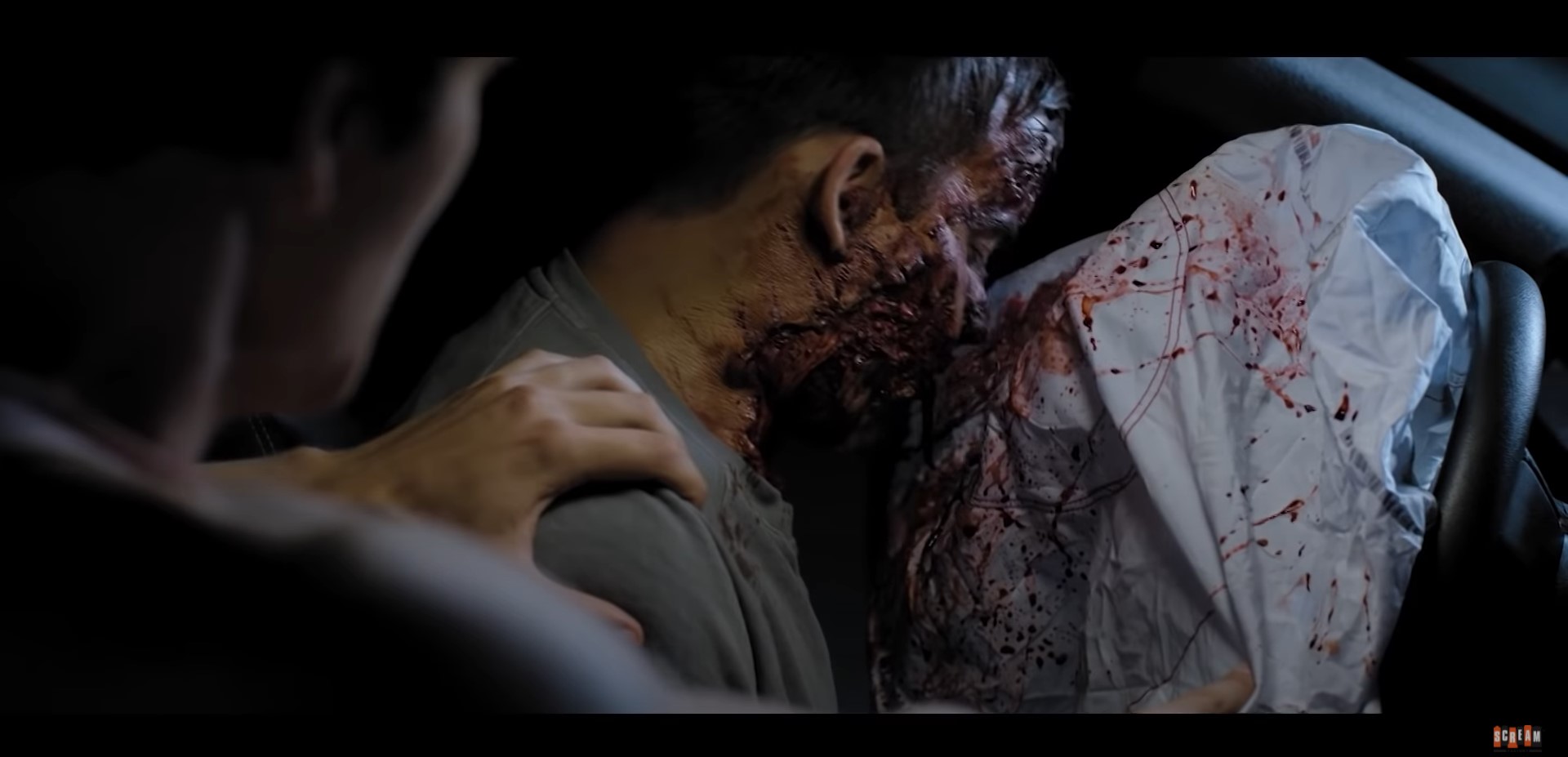
An old graverobber unearths the supernatural powers of an ancient Native American burial ground that gives him the ability to heal as well as to be resilient against injury with self-restoring powers.  When exploiting the local residents of his newfound “Godly” gift, a botched healing of a bullied teenage Kelly with severe pica disorder transfers the powers to him, curing his disorders and restoring his health while also leaving the old graverobber to die.  With a new lease on life, Kelly pursues his dreams, standing up to his relentless tormenters, and even finding the courage to ask out a girl, but when the powers prove to be addiction beyond control and the bullies never let up on their aggression on him, Kelly uses his newfound gifts to exact a deadly course of revenge. 

“Pet Sematary” meets “Christine” – a Stephen King-esque bully-revenge, supernatural thriller “The Unhealer” from the Argentinean born director Martin Guigui.  The music video and feature film director returns to American horror nearly a decade later after helming the 2011 “Beneath the Darkness,” starring Dennis Quaid, with a thrilling teen angsty script penned by first time screenwriters Kevin E. Moore and J. Shawn Harris that recalls a narrative very familiar to the late 80’s to early 90’s with oppressive high school bullying by the jocks and the turning point revenge by the receiving end pipsqueak.  Originally scripted under the title “Pica Boy,” “The Unhealer” reveals the dangers of severe polarities between one disorder to the next with the humbling fragilities trapped inside one’s own psychological disorder to the over-confidence of feeling invincible due to physical anomalies that result in no pain being suffered, losing one’s empathetic reasoning.  “The Unhealer” is produced by writer J. Shawn Harris and his sibling actress, “Night of the Demons 2” and “Night of the Scarecrow’s” Cristi Harris along with star Natasha Henstridge and “Why?” filmmakers Corbin Timbrook and Galen Walker with Horror Business Films and 7 Ideas serving as production companies.

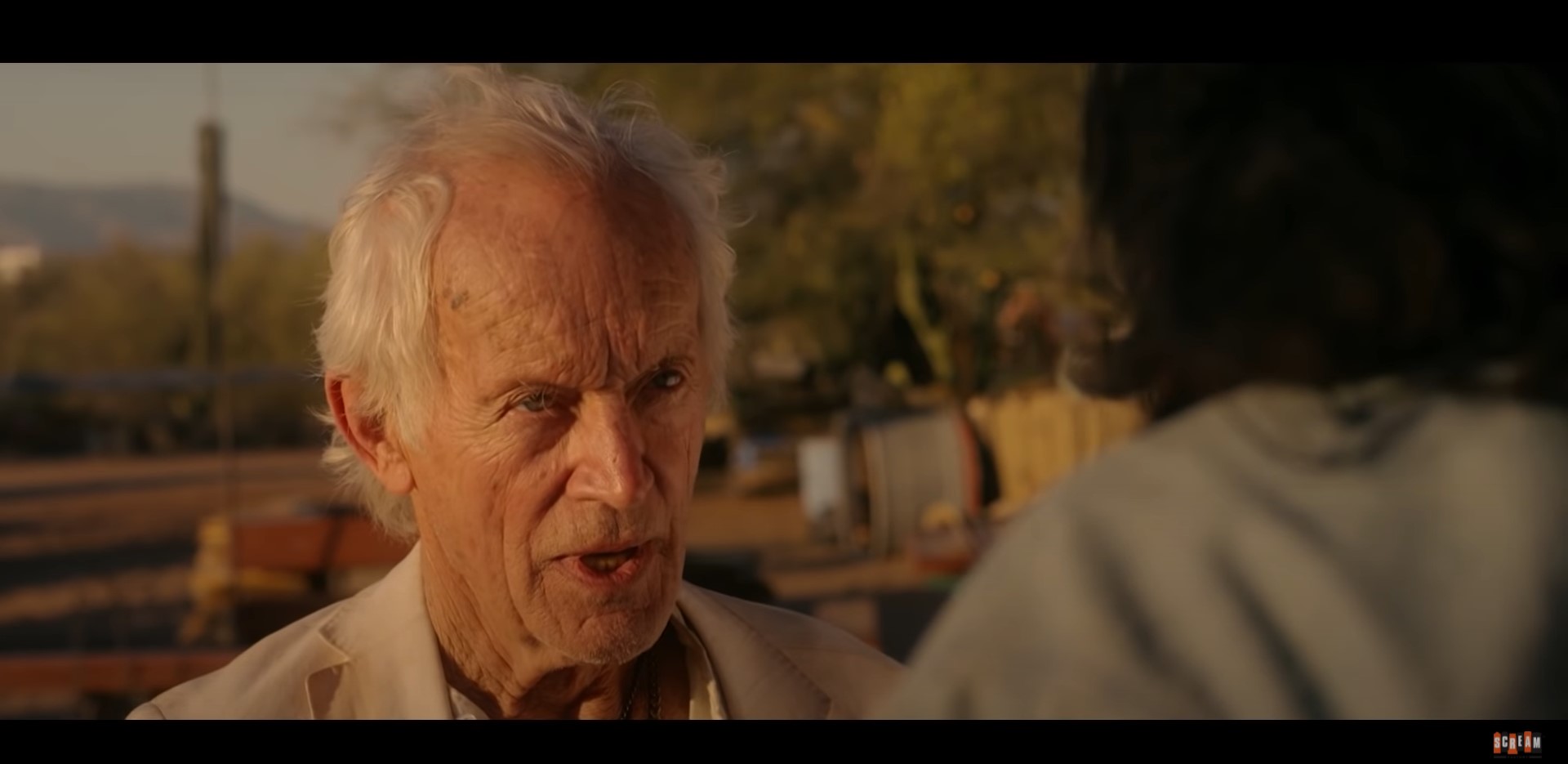
Headlined with three big and recognizable names inside the genre circles and out, the film stars Lance Henriksen (“Pumpkinhead,” “Aliens”), Natasha Henstridge (“Species,” “Ghost of Mars”) and Adam Beach (“Windtalkers,” “New Mutants”) playing variable degrees in their roles important to “The Unhealer’s” story progression and each performance never overlaps prominent personalities that can sometimes stall out and unbalance a production.   Henriksen plays a long in the tooth snakeoil salesman named Pflueger who exploits the locals with his newfound healing powers and when he’s hired by Kelly’s desperate mother, Natasha Henstridge, the scene becomes a passing of the torch as Pflueger unintentionally transfers his powers to Kelly (Elijah Nelson, “Chain of Death”) that magically heals him of his longtime psychological Pica disorder. Not so much a youthful soul anymore, Henriksen has tall tell signs of showing his age, but the 81-year-old New York City born actor can still sear memorable performances into our psyche with a wisecracking charlatan conman in Pflueger, dressed from head to toe in a shabby white suit and tossing up awkward hand gestures when deriding burial ground protecting Shaman Red Elk, played by long time serial supporting man Branscombe Richmond (“Commando,” “Hard to Kill”). More awkward in his reaction to receiving an unexplainable supernatural gift is Elijah Nelson who goes from deaths door to want to join the Navy Seals in a matter of minutes after the Pflueger plot point passes. The writing doesn’t exactly assist in Kelly’s transition with an acceptance of power without an inkling of trying to comprehend is as Kelly tries to hurt himself and tries to encourage being pounded by bullies as if he already fully understands the immense reality of his abilities. Even his mother, who under the understanding that she has tried everything possible scientific medicine man has to offer to cure her only child, is instantly okay with Kelly’s rushing into the unknown. A nearly unrecognizable Natasha Henstridge from her “Species” franchise days after a thyroid autoimmune disease diagnosis doesn’t stop the late 40’s blond beauty from being just that – a beauty – in an overly protective mother role desired by the local single men from the house visiting doctor to the Adam Beach’s Native American Sheriff Adler. Beach becomes the absent father figure for Kelly and a person who has a foot in both the Native American spiritual world and in the Anglo-Saxon realities and melodramatics. Beach proceeds as the main lead of the third act, following Henriksen and Henstridge to keep a constant, recognizable presence throughout and providing his own stamp as the voice of reason whereas the first two culminated extreme biases toward Kelly. Kayla Carlson, Angeline Appel, Gavin Casalegno, David Gridley, Mike Gray, Thomas Archer, Will Ropp, and one my new personal favorite actors in Chris Browning (“Agnes”) fills out the remaining cast.

Very early on initial reactions toward “The Unhealer” were poor mainly because of the luridly unflattering dialogue and perplexing transitions between scenes that don’t exactly hit the mark matching up character intentions, but the more I watched, the more an optimistic sensation started to arise in me. Starting small in the recesses of my cerebral film database then growing until metastasizing fully into my mind and, eventually, into my nostalgic-detecting ticker is “The Unhealer’s” robust recollection toward how fun bully-revenge-thrillers from two to three decades ago can be with a carbon copy simulation ingrained with a novel narrative surrounding Midwest Native American mysticisms carrying with it that age old “Spiderman” insinuation that with great power, comes great responsibility, but in “The Unhealer’s case, as the tagline suggests, comes great pain. Screenwriters Moore and Harris burden Kelly with a King Midas touch that no matter how hard the character tries to contain his nearly invincible power, outside forces influences and unforeseen happenstances steer Kelly toward self-destructing disaster. Between a group of buffed up and obnoxious high school jocks as unyielding tormenters, Kelly pushed into a self-protecting corner despite a generous passive attitude, especially being run over with car at one point, and the unpredictable and limitless avenues built as substory awry to make “The Unhealer” a joyful hidden gem, the Martin Guigui film on the outside appears to be a cheap, indistinguishable, B-movie, but if you dig deeper, dig until you unearth a medicine man’s ancient dusty bones, and you’ll discover deep seeded veneration, a gripping story, and dark magic carnage.

“The Unhealer” will undoubtedly fly under many viewers’ radars but is a must watch from (Shout!) Scream Factory’s distribution label in a cooperation release with VMI Worldwide (“Orphan Killer”). The full HD, 1080p Blu-ray of the 2020 production is an encoded region A release with unrated certification and a runtime of 93 minutes, presented in a widescreen 2.35:1 aspect ratio. Generally nothing to swing image quality from one spectrum to the next with a RED Weapon Dragon digital shot. Already decent at compression, the RED camera provides a crisp demarcating image in the forefront and capture the textures in a literal closeup with focus precision. “The Unhealer’s” lighting and set dresses cater less to the supernatural phantasmagoria with Massimo Zeri’s realistic Arizona landscapes and suburbia venues that don’t excite the camera with its cold truth realism rather than the mise-en-scene tropes of horror atmospherics. The English DTS-HD Master Audio 5.1 also has zip to complain about with high resolution quality with a surprising ample range of effects. Dialogue is prominent and clear as well. English SDH subtitles are an available option. Special features include one-sided individual cast/character behind-the scenes interviews which is basically cut and edited footage of the actors describing their characters in footnote fashion. The gag reel is a better feature that takes the same interview format, intertwines it with music, and lines up the gags with an instrumental soundtrack in one seamless show of goofs and hijinks throughout production. Deleted scenes and extended/alternate scenes, surrounding mostly around Kelly and Dominique’s coy love interest, cap the features. At first glance of the final package, “The Unhealer” looks totally like a rip off inside and out of the cardboard slipcover with a “Star Wars'” lightsaber color scheme and a character illustrated design underneath the title dressed in “Stranger Things” font, but don’t let parroting cover fool you as “The Unhealer’s” dark journey from being the bullied to the bully is an unabated and inescapable catch-22.

“The Unhealer” on Blu-ray home video from Scream Factory!